Well, April’s here and that means rain and puddles and flowers all around. Or it should, anyway. Instead, we’ve got another cold snap and some snow where I live. But soon! Oh, SOON it will feel spring-like outside! Eventually…
Whatever the weather, Spring Break and Easter have just come to an end for us, and my kids are back in school. My son’s more than a little put-out with this situation, but my daughter’s thrilled to get back to Kindergarten and have some fun. Plenty has happened for us this past week, and it’s been more than a little busy. My daughter obsessively loves rabbits, so Easter is her favourite holiday. In fact, the only thing she likes better than Easter is her birthday, which also passed last month, so this time of year’s always a little bonkers. Aside from Easter events, egg hunts and dinners, we also took my kids to get their picture taken with the Easter Bunny at the mall, and tried to squash in enough time to pick up a gift for my kids. My daughter ended up picking out her own Easter gift when she discovered a children’s stuffed chair–that was a pink rabbit. She’s quite pleased with the gift, and sits in her rabbit chair constantly.
We had two opportunities to get some d20 gaming in this week, although we had hoped to get three in. This past Tuesday my kids sifted through their many, many, MANY characters and took a look at the adventures that each adventuring party was in the middle of or about to embark on. They decided to each pick a group and we’d play one on Tuesday, and the other on Friday. My son chose our aptly named ‘Jungle Characters’ while my daughter chose our much beloved ‘Goblin Characters’ who are about to finish up We B4 Goblins! (which is a FREE download and great fun, so you should definitely click that link! Haha). Deciding we’d start with the Jungle crew, I cracked out my old Dungeon Magazine, Volume #136, and we got right down to playing a modified Tensions Rising. Unfortunately, we ended up busy on Friday and didn’t have time to play our trouble-making goblins, but we did find time on Saturday to begin our second adventure with our Starfinder characters! We embarked on an important Wayfinders mission to Elytrio with Yesteryear’s Truth. Full details on our play sessions this week will appear in an upcoming post, but for now, just know that we had a ton of fun!
In Starfinder news, Pact Worlds was released last week, which we’re itching to get our hands on in my house. Seriously. Even my husband wants that one! And today it just became sanctioned for Starfinder Society Play. Nearly everything in the entire book is an option. Now, if only I owned it… There were also two new Starfinder Society Scenarios released, which I did splurge on. Scenario #1-10: The Half-Alive Streets is a tier 1-4 mystery involving a lethal bio-tech augmentation that sets the PCs loose on Absalom Station. While Scenario #1-11: In Pursuit of the Scoured Past is a tier 3-6 that sends the PCs to the library world of Athaeum, where they’re on the hunt for information about the Scoured Stars Incident. Also joining you? Some Hellknights from the Order of the Pyre! How could it go wrong? Neither of these scenarios involve starship battles.
Later this month the volume five in the Dead Suns adventure path will be released: The Thirteenth Gate. Dead Suns begins with Volume One: Incident at Absalom Station, which I’ve found great fun. They’ve also announced the next Starfinder Adventure Path. For those of you who don’t know, Starfinder Adventure Paths are going to be of varying lengths. One six-part series, followed by two three-part series’. This means that once Dead Suns wraps up we’ll be treated to Against the Aeon Throne, which is a three volume series that begins at level one with The Reach of the Empire. This Adventure Path pits the PCs against the Azlanti Star Empire which I’m absurdly excited for! Afterwards we’ll get to play Signal of Screams, which begins at level 7 with The Diaspora Strain. I’m particularly interested in this one as it strikes me as a horror themed space adventure which is just AWESOME. I can’t wait to see how it unfolds.
As for Pathfinder, the second volume of War for the Crown, Songbird, Scion, Saboteur has been on game shelves for a while, but volume three, Twilight Child, is due out later this month. If you’ve been reading my blog lately you’ll know that I’m super excited for this campaign, although I’m not yet lucky enough to own it. Last month Merchant’s Manifest came out, which admittedly, I’m not very excited for. But, later this month a sourcebook on the creepy nation of Nidal is released. Called Nidal, Land of Shadows, this IS a book I’m thrilled for. I’ve always been drawn to this ominous place and I can’t wait to see what they do with it. The Pathfinder Society has two neat scenario’s out this month. The first is Scenario #9-16: Fallen Family, Broken Name, which is a series of five one-hour quests that take place in Isger and revolves around the now deceased Irrica family who were said to command some kind of supernatural forces. Sent to discover this weapon and the family’s secrets, this scenario sounds like a lot of fun. Plus, if I’m being totally honest, I’ve never had the chance to play in Isger before. This scenario is intended for tiers 1-5. The second scenario recently released is Scenario #9-17: Oath of the Overwatched, which returns to the constantly cursed Blakros Museum and directly involves the Dark Archives faction. I’ve been a big fan of this series of scenarios from way back during Season 0, so I’m desperate to play this one! Intended for tier 5-9, this one’s going to be tricky!
In other news, my whole family’s been loving their play-by-post campaigns they joined for OutPost. My children and I finished one of the scenarios, Scenario #45: Delirium’s Tangle, over a week ago, and my daughter immediately set out to bring her beloved oracle, Lady Naysha into another adventure. She has since joined up in a game of Scenario #5-08: The Confirmation, alongside one of my husband’s new characters. Meanwhile, my son’s forgetful wizard, Fuzzzy, alongside his pet owl, Bobby, joined up to play Master of the Fallen Fortress, a free Pathfinder Module which is sanctioned for Pathfinder Society play. Lady Naysha and Fuzzzy were both previously introduced in this blog post. My character, Juno Berik, has yet to join another game. For those of you curious, our escapades in Delirium’s Tangle can be found here. My husband has had such fun playing his occultist Enzo in our still ongoing Black Waters adventure, that he made three new Pathfinder Society Characters. Toban Tangletop, an eccentric gnomish chef and inquisitor of Shelyn is joining Lady Naysha on her Confirmation; Ruslo, a roguish Varisian slayer who fights with a grappling hook and has a bone to pick with the Aspis Consortium is playing alongside Fuzzzy and Bobby in Master of the Fallen Fortress. And finally, Jeb Barlo, a water kineticist swamper from Wartle, has just begun to tackle Scenario #0-23: Tide of Morning. One of my Starfinder characters has also completed one of her OutPost games: Aurora Vim, a stylish and vain ysoki envoy with a chipper attitude and an ego bigger than a starship. Better known as Rora, this quirky little ball of fun just made a name for herself by tracking down a fugitive on Akiton and saving an entire town in Scenario #1-02: Fugitive on the Red Planet. To read about her adventures on Akiton, check out the completed gameplay thread, here.
And, in anticipation of Pathfinder Playtest, we’ve been reading Paizo’s previews of the new ruleset on their blog. Recent articles include information on critical hits, critical failures and a system that they’re calling the four degrees of success, and a rogue class preview. But, my personal favourite? The details they shared about those beloved pyros: goblins! Colour me intrigued, Paizo!
I hope, like us, your last week has been full of fun, and the glorious sound of rolling dice.
I love the Starfinder Roleplaying Game: Starfinder Core Rulebook. But, I also didn’t want to leap right into Starfinder with my own custom adventures. I wanted to try out some published adventures first. Obviously, there’s not many options right now. There’s the Starfinder Adventure Path: Dead Suns (Part One: Incident at Absalom Station), which looks great, but I didn’t want to lock my family into a long campaign with their first characters. I wanted to do something short. Something that got started right away. That hopped right into the action!
So I turned to the Starfinder Society Scenarios–more specifically, Into the Unknown! Into the Unknown is the first of the Starfinder Society Quests. It’s a tier 1 scenario and is a free download on Paizo’s website. As a quest, it’s formatted a bit different than the other scenarios. Instead of being one four hour long adventure, its a connected series of five short one-hour long adventures. Each of these short quests forms one cohesive, wonderful adventure that feels much grander in scope than your typical scenario. These quests are meant to be played in order, and intelligence gathered in the first four quests can provide you with an advantage in the final quest. The adventure itself has got a bit of everything in it: fun social interactions, local combat, and starship battles. If you’ve read my reviews on the current Starfinder Scenarios which are available, you’ll know that Into the Unknown is one of my very favourites. So, it should come as no surprise that for my family’s first experience playing Starfinder, I picked up Into the Unknown.
But, first, we had a decision to make. We had made our characters for play in Starfinder, not specifically for the Starfinder Society. The rules for character creation are slightly different. Most noticeably for us, halflings are not legal for SFS play as of yet, and my daughter’s robot rabbit may not be strictly legal. After talking it out together, we decided to make our characters legal for SFS play, which required minor changes, and then play Into the Unknown for SFS credit. Afterwards, we’d reevaluate, and decide if we wanted our home campaign to continue as SFS legal, or we would retire from the Starfinder Society and continue on as a regular Starfinder campaign. So, after some fiddling, we set out Into the Unknown. For full details on our characters, check out my previous blog post, Starfinder: Character Focus.
My family spent some time deciding how well they knew each other. In the end, we decided that only one of them–my daughter’s ysoki, Hoponisa–was a Starfinder Agent. A member of the Wayfinders, Hops acts as a contact with a specific group of mercenaries–our other PCs: Tucker Aetherfoot (an operative played by my husband), Vishkesh (a shirrin mechanic with an engineering drone named Rijin, played by my son), and Aya (a kasatha mystic who believes each life if precious and worth saving). Together, Hops and her hired help travel the Vast, deploying drift beacons for credits at the behest of the Wayfinders Faction. After discovering new planets, collecting data on their environments, and deploying drift beacons, the group prepares a report on the planet for the Wayfinders, which allows them to better prepare proper Starfinder teams for further investigation. The mercenaries make some decent credits, and the Wayfinders get to expand their influence without using up valuable Starfinder resources and personnel. This allowed their characters to be allies–friends even–and ‘Starfinders’ without committing their characters to a lifetime of SFS. Thus prepared, we gathered our equipment and got ready to set out Into the Unknown!
Due to their backstory, our session began with a bit of preamble. The group arrived back in Absalom Station and turned their intel over to the Starfinders for some hard-earned credits. Their’s is not the only ship to go on such missions, there’s a few and they’ve formed something of a fraternity. They socialized for a few days in between missions with the other ships and crews, only to realize that one of their fellow Vast explorers, a fully sanctioned Starfinder vessel called the Unbounded Wayfarer, never showed up. This was odd, but not unheard of. Missions involving the discovery of unknown planets was always dangerous, and unforeseen circumstances often popped up which could delay ships by a few weeks. Surely they would run into them next time!
Unfortunately, Hoponisa has some bad news for them. After reporting her information on their last mission to her superior, Venture Captain Arvin, she was told to fetch her mercenary friends for a special mission involving the crew of the Unbounded Wayfarer! Oh, no!
This brought us to the proper start of Into the Unknown‘s first quest, Station, which begins with a briefing hosted by Venture Captain Arvin, of the Starfinders. Arvin’s a friendly lashunta, with brown skin and green hair. He was endearing, and the group seemed to like him quite a bit. However, this mission is urgent, and they have little time to spend interacting with Arvin at the beginning of this quest. Thankfully, Arvin makes many appearances in the current Starfinder Society Scenarios available, so I fully expect them to grow to love the guy as they interact with him time and time again.
More pressing for my players, was the purpose of the briefing. Arvin had just received word that a pawnbroker from the Downlow neighbourhood of Absalom Station had come into possession of some Starfinder Insignias. Insignias belonging to the crew of the Unbounded Wayfarer, who were quite late in reporting back to the Station! Worried, Arvin is dispatching the group to meet with the pawnbroker, a vesk named Julzakama, in order to purchase the Starfinder Insignias back and determine how he got ahold of them. The price had already been negotiated, and the credits transferred. All that remained was to complete the deal. With hope, this intel could allow them to discover what happened to the Unbounded Wayfarer.
My players were so worried for their friends that they set to work nearly immediately, asking few questions of Arvin. They ascertained where Julzakama could be found and the name of his pawnshop (Julzakama’s Loans). They also discovered that some Starfinder Insignia are more than just badges and pins. Many hide secret information and can encrypt or decrypt information the the Starfinders would prefer to keep hidden.
Thus prepared, the group hurried off through the poor, densely-populated, Downlow neighbourhood in order to get to Julakama’s Loans. They found the place without difficulty, and entered the crowded little shop to look around. They found it stinky and crowded, and filled with relatively useless bits of junk, so they approached Julzakama right away.
Julzakama turned out be a lot of fun. My whole family–especially my kids–loved roleplaying with the swaggering, aggressive vesk. They saw through his attempts to con them out of some extra credits, and bargained for information on the seller of the insignias with aplomb. Soon, they discovered that the seller was a female named Exegara. She wore a flight suit, and had clearly come off of a long trip. Once she had her money she asked about purchasing clean skeletons and he directed her to the Vat Garden.
Vishkesh made a purchase from the store in thanks, before the group hurried out into the ‘streets’ of Downlow and made their way to the Vat Garden. Hoponisa let the others know that the Vat Garden was a flooded garden run by a family of ysoki. In addition to selling the plants they grow throughout Absalom Station, the ysoki also act as a mortuary for the poor, and accept corpses for fertilizer. My son, being a young environmentalist, decided that this was perfectly acceptable, and couldn’t wait for his character to meet the ysoki!
Once again, they found the Vat Garden without trouble. A multi-level, dynamic environment, packed full of dense plant-life and surrounded by catwalks, this location turned out to be a lot of fun. Upon arriving they heard people sifting through the garden and saw no signs of the ysoki family who owned the gardens. Worried, they spread out to cover the various ladders and stairs that led down from the catwalks into the garden, and snuck up on the occupants. Vishkesh sent his drone flying above the Garden, before Vishkesh himself called out to greet the people hidden in the garden. His reply was a shot from a laser pistol! Deciding that this was unacceptable, Tucker hopped out of hiding to get the jump on the shooter, while Hops and Aya descended into the garden from the other exits.
The battle in the Vat Garden turned out to be a lot of fun, but quite a challenge! My kids worried over the fate of the ysoki family the entire time. Aya took one heck of a beating, while Hops stayed out of the way and fired her laser pistol at the enemies. Tucker proved an invaluable asset, dashing around and making great use of his trick attack ability. Vishkesh’s drone fired his flare gun at the enemy from above, which helped draw attention to their locations. Vishkesh realized after his first shot with his flame thrower, that he probably should have invested in a different gun. Although it was wonderful shooting a line of fire through the plants at his well-hidden enemies, my son was very sad about the damage it caused to the plants! In the end they subdued a female ghoul–Exegara–and her hired mercenaries just as they were digging skulls and bones out of the wet, deep mud at the bottom of the Vat Gardens. Our Starfinder heroes had knocked everyone unconscious, including Exegara. Fortunately, they discovered a data pad upon her and managed to learn a great deal of information. Even if it was weird using a data pad made of bone, metal and necromantic magic! They decided that Eoxian technology was very disconcerting!
Turns out Exegara had recently joined the Corpse Fleet, a unit of violent renegades from the Undead planet of Eox that believe living beings are nothing but chattel and prey. She sailed on a vessel known as the Endless Threnody. While travelling through the Vast they picked up a distress signal from the Starfinder ship, Unbounded Wayfarer. Following the distress signal to a desert planet surrounded by asteroids, the Endless Threnody found that the Unbounded Wayfarer had crashed. Although the data-pad made no mention on if any of the crew had survived, it did mention that they thoroughly looted the Starfinder vessel and acquired several treasures, including the Starfinder Insignias. From there, the Endless Threnody left the planet. But, before they could enter the Drift they were attacked by a ship called the Lawblight. Surprised and crippled, the Endless Threnody managed to escape into the Drift, but was promptly stranded within. Exegara took a smaller craft and was dispatched to Absalom Station for the purpose of acquiring the parts needed to repair the Endless Threnody. Unfortunately, she had to sell much of their treasure in order to cover the costs–the Starfinder Insignias included. Although the data pad did not include information on the location of the Unbounded Wayfarer, it did include the coordinates of the Endless Threnody within the Drift. If they could access the databanks of the Eoxian ship, they could discover the coordinates of their friends ship.
Hops, Tucker, Vishkesh and Aya were all upset by this news, and decided that they had to report to Venture Captain Arvin immediately. But first…
The station authorities arrived on the scene, led by four interesting ysoki. As the ‘cops’ took the mercenaries and Exegara into custody, the ysoki family approached the PCs to ask who they heck they were and what they were doing here.
My family had a blast roleplaying with these four quirky characters. Admittedly, it helped that I had images prepared for each of them, which is not contained within the module. So, they happily spent some time roleplaying with Grandma Gold, her sons Scum and Mix, and her grandson Spike. Eventually, they remembered the urgency of their mission, and bid the ysoki goodbye before hurrying off to the Lorespire Complex to report to Venture Captain Arvin.
With that, we immediately segued into the second quest of Into the Unknown, Adrift. This quest begins with another mission briefing, which was streamlined considerably for us, since we were moving right along with the action. Arvin thanked their characters for their hard work, lent them a Pegasus Model ship called the Loreseeker, and sent them off into the Drift to corner the Endless Threnody.
Here we took a break to talk about the rules and roles for spaceship combat, which promptly led to a large argument. Neither of my children, who were made to be awesome ship mechanics, wanted to fill the mechanic’s role. Both fought over being pilot for a while, with Vishkesh winning based on the fact that he took the Ace Pilot theme and was a better pilot. My daughter begrudgingly took over the role of mechanic, being the only person left who was any good with it. Tucker took a spot as a gunner, and Aya took over as captain, being incompetent with all forms of technology and the only party member with any sort of social skills. Unfortunately, at the word ‘captain’ both of my kids got right back into arguing, this time over who got to be the captain, despite that they would both be horrible at it. In the end, we decided everyone had to assume the role they were best at and, for our next adventure, if they wanted to switch around their skills to fill other roles, they could do so. But for now, it was time to get going again. By then we were out of time for the day, so we took up playing Adrift the next day.
As our second session began, there was more arguing from my kids over their roles onboard the starship, but we got past it pretty quickly and the Loreseeker finally left Absalom Station. Travelling through the Drift, the trip took two weeks. My family had great fun describing their interactions during the trip and learning about the Drift. Soon, we moved along, though, and the Endless Threnody came within range of their sensors.
As an Eoxian made ship, the Endless Threnody proved quite an ominous sight. Made of bone, steel, and powered by necromantic engines, the ship featured a blood-red lens that looked a lot like an eye, staring out at them. The ship was open to the depths of space, making it impossible for anything living to survive unprotected. In a flash, the ships detected each other, and both fired up their defences. Our first starship battle was underway!
As our first starship battle experience, this fight was a little rough. Everyone was new to their roles and two of our players were under seven. The cheat-sheets that Into the Unknown provided were very helpful, but there was still a lot of referencing our Starfinder Roleplaying Game: Starfinder Core Rulebook, which slowed down the battle considerably. All in all, the experience was complex, but fun. Both of my kids decided they enjoyed starship battles, even if they didn’t enjoy their roles as much as they hoped. In the end the Loreseeker took down the Endless Threnody, and we launched into the third quest from Into the Unknown, Boarding.
Slowly, our players piloted their ship up alongside the Endless Threnody. They would need to board the creepy bone-ship and make their way to the bridge, where they could access the ship’s databanks and discover the location of their friend’s crashed ship. For obvious reasons, they approached with caution. Hops shifted roles from mechanic to science officer so she could scan the ship. They detected a harmful necromantic energy signature on board, and decided to dock at the rear cargo bay, in order to avoid the surges damaging their own ship. They ensured their armour was fully protecting them from the dangers of outer space–which is was–and then Hops cast life bubble on everyone–just in case! Finally, they approached, and Vishkesh deftly piloted the Loreseeker into position without damaging it.
After boarding, they found the Endless Threnody had artificial gravity, but was lightless, and was indeed open to space. In fact, if they were brave enough, they could actually reach their fist out through the gaps in the bone wall right out into the Drift. DISCONCERTING!
The PCs readied themselves for battle and began to explore the cargo hold. There they found a magical computer terminal which allowed them to learn a bit about the Endless Threnody, how it functioned, and mitigate the deadly necromantic surges by deactivating a few of the ship’s necromantic engines. The rest could not be accessed from this terminal, so they group left the cargo hold and set off down the bone and steel hallways to find the bridge. Unfortunately, the ship was not undefended. Although most of the undead aboard were destroyed by the ship battle, a few still roamed the halls! As the group spread out to find their way through a series of branching hallways which were within reach of the harmful necromantic power surges, the skeletons surged out at them.
This battle was tricky! The skeletons, coupled with the necromantic generator made for some tough mechanics. In addition, our party was split up. While Hop worked on shutting down the generators from inside the area of the surges, Tucker protected her. Meanwhile Vishkesh and his drone Rijin were left with the job of fighting the rest off! Vishkesh suffered heavy damage, and his drone was nearly destroyed! Luckily, Hops had good luck with the computer terminal, and managed to shut off the nearby necromantic engines, which put an end to the harmful surges (in this area, at least). This gave the group the edge they needed to regroup and turn the battle around. In the end, everyone survived the encounter against the skeletons and they PCs continued on to the Bridge where they hacked into the computer and transferred all the data they could to Hop’s computer. Armed with information on the Unbounded Wayfarer–their friend’s crashed ship–and on the Lawblight–the space pirate ship that disabled the Eoxian ship in the first place, the group quickly left the Endless Threnody.
Back aboard the Loreseeker, my family debated for a short time over the fate of the Endless Threnody. In the end they decided to destroy the ship, by turning their weapons onto it and blowing it up once and for all. As Vishkesh piloted the Loreseeker off through the Drift, Hop and Tucker got to work deciphering the data they had uncovered.
This brings us to the fourth quest of Into the Unknown: Salvage. Their recently recovered intelligence has revealed that the Unbounded Wayfarer crashed on a planet called Ulmarid in the Vast. Quickly, they reported to Arvin, and he responded by holographic message, urging them to continue on to the unexplored planet and discover what happened to the Unbounded Wayfarer. There they must rescue any survivors, and slot the Starfinder Insignias into the bridge’s computer console, decrypt the information stored inside, and bring all of the information back home to the Starfinders.
The group happily accepted their new mission goals and flew off through the Drift to Ulmarid. Sounds simple, but this wasn’t going to be a walk in the park. Although Ulmarid was unexplored, that didn’t mean it was undiscovered. Previous landing groups had managed to discover some basic information on the planet. It was a desert planet wracked with fierce storms. In addition to weather, visitors would need to contend with the large number of dangerous, violent beasts who make the planet home. Beneath the surface are a network of artificial square tunnels with no discernible purpose. Finally, the approach was dangerous, as Ulmarid’s two moons collided ages ago, shattering into pieces that now orbit the planet in its upper atmosphere.
Despite the risk, my family was itching to finally get the chance to examine the Unbounded Wayfarer. And after a quick trip through the Drift they had reached Ulmarid. After scanning the planet for extra dangers, which turned up nothing, the group decided to fulfill some character goals by deploying a series of Drift Beacons on Ulmarid. They chose three optimal deployment locations, with a location near the Unbounded Wayfarer as their fourth spot, and flew down to the surface. Vishkesh proved a capable pilot and they managed to deploy the beacons and get them online without trouble.
Finally, they landed on the surface, near the location of the Unbounded Wayfarer. The nearest safe landing zone was only a short distance away, but travelling between the two location proved harder than expected. A sudden storm overtook the group, raining down toxic crystals that could tear right through your flesh. Luckily, the group noticed before being pincushioned, and managed to take some precautions, preventing the toxins from affecting them too much with some special plant bulbs they were gifted by the ysoki from the Vat Garden back in quest one. Wounded, but not too worse for wear, they finally came within sight of the Unbounded Wayfarer. Unfortunately, intel from the Endless Threnody was spot on. The ship had crashed, and the Unfounded Wayfarer was a wreck.
Suddenly there was a rumbling, and the ground shook. A massive monster leapt from the sands and attacked. Known as a skreebara, this large burrowing beast had six legs, and a carapace of reflective crystals. Of all the battle featured in Into the Unknown, this one was the one I was most worried for. As a CR 3 challenge against only four level one characters, it would be tricky. Fortunately, Hoponisa noticed a massive starship gun still mounted on the back of the Unbounded Wayfarer, and hurried over to it, unleashing massive damage on the beast. Coupled with some good luck, the group came out just fine. And with that, they approached the wreck of their friend’s ship.
They were very saddened–my kids especially–to find that none of their friends had survived the crash. However, this wasn’t unexpected. They had already been picked over by an undead crew of people-eaters. So, with some tears (in character) they set about retrieving the classified data from the ship’s computers. Meanwhile, Tucker salvaged a bunch of valuable crystals from the dead skreebara’s corpse, and Vishkesh examined the ship itself, discovering that the Unbounded Wayfarer was in a fierce space battle before crashing, against a ship with weapons eerily similar to those that took down the Endless Threnody. Had the same space pirates that attacked the Corpse Fleet been the true cause of their friends deaths?
When there was nothing else they could do, they deployed their final drift beacon and headed back to their ship. All that was left was to pilot their ship back through the asteroids, reenter the Drift, and head home to Absalom Station.
Or was it?
On the way out of the asteroids, just as they were almost free of Ulmarid, a ship came into view. The Lawblight! The space pirates who had taken down not only a battle ship of the Corpse Fleet, but also been their death of their fellow Starfinders!
As the law blight flew out to ambush them, it’s captain hailed them, taunting them with their impending death in overly theatrical fashion.
“Yar! Beg for your lives before Captain Rook and the Lawblight blow you to bits!”
My kids responded by throwing up their shields and preparing for battle. The final quest, Lawblight, had begun!
With Vishkesh at the helm, dodging asteroids was easy, but the many guns of the Lawblight would be another matter entirely. Luckily for them, the vast amount of intel they had retrieved and discerned about this ship gave them an advantage.
This starship battle ran a lot smoother than the first. Not only had we already gotten the hang of starship combat from the previous battle, we’d all grown accustomed to our roles a bit. In addition, my children’s anger at these space pirates made them completely forget to argue over their roles on the ship. They were ready for vengeance!
The battle went easier than expected, and in short order the Lawblight was defeated. The Loreseeker had triumphed! With their mission finally complete, the PCs activated their Drift Engines and left Ulmarid behind, for Absalom Station.
As our first Starfinder adventure came to an end, they got a chance to see Absalom Station from afar. Venture Captain Arvin was waiting for them as they disembarked, with congratulations on a job well done. He offered them a reward, above and beyond their typical credits owed, and accepted a full report of their mission. Those PCs who weren’t official Starfinders were offered membership, and the previous Starfinder, Hoponisa, was gifted her own Starfinder Insignia as a reward.
We had reached the end of Into the Unknown and we had all had a blast. My daughter, especially, loved the entire experience. There were changes they wanted to make to their characters. And different roles on the starship they wanted to try out. But, they had had fun. Everyone decided they wanted to join the Starfinders–most specifically, the Wayfinders Faction–so they could continue their work deploying drift beacons as members of the organization.
But would we continue as actual Starfinder Society characters? Well, that was still up for debate! Although tempting, my daughter was keen to try making her own Starship instead of using the Pegasus or Drake model ships the Starfinders utilize.
What was certain? Our characters would all be back for more!
And next time? They would explore one of the newly discovered planets found in the Unbounded Wayfarer‘s databanks. That’s right! We’re going to tackle Scenario #1-03: Yesteryear’s Truth!
I love Pathfinder. My husband loves Pathfinder. My kids love Pathfinder. So when I first heard about the release of Starfinder I was excited. I didn’t think I’d love it as much as I did Pathfinder, but I knew I’d enjoy it. And I was right! Although it didn’t supplant Pathfinder as my favourite d20 game, it turned out to be a blast. My husband and son were the same. Love that Starfinder! But love Pathfinder more.
And my daughter? Ah, my daughter! She loves Starfinder best of all. Absolutely, positively loves it. She has such patience for the game, and for learning it. It should be noted: she’s six.
So, it came as no surprise to me that she finally looked at me and said, “Mom! d20 Diaries needs to hear about our Starfinder characters! Write about my Starfinder!”
And here we are! Mommy’s on it, dear!
So without further ado, (and because my daughter’s certain she’s waited enough!), here they are.
I was the first one to make a Starfinder character in my house. But, I didn’t start by making characters I intended to play, so much as making characters for the sake of making them. I wanted to get a handle on the creation process, and understand the mechanics of the game. I tested out classes and mixed them with different themes, curious how much it would effect the feel of the character. The first character I made with the intent of continued play was a bold, enthusiastic (and admittedly stupid) Vesk solarion by the name of Julakesh Starfist created for playing in the Starfinder Society via play by post. She’s not my only Starfinder Society character, of course. I have three, but we’ll touch on them another time.
So, imagine my surprise when it came time to sit down and make our characters as a family, that my daughter was the first to insist upon a turn. She immediately informed me that nothing would be good enough until we converted her lovingly made rabbitfolk to Starfinder. But, we sat side by side and flipped through the book while I read to her. She thought humans might be okay, and that bug and lizard people were right out (“Ewwww!” was her actual response). But there, right at the back, were the ysoki.
“Rats?!” She said. And then, “Hmmmm… Them are cute…”
And by the time she heard the words ‘cheek pouches’ she was sold. “Them are my favourite!” She exclaimed.
“They.” I corrected, because grammar matters.
“THEY are my favourite! I will be a ee-so-keeeeee with a robot rabbit that I made myself!”
Sure, I thought. She’ll be a mechanic! So I read her the mechanic class and she said, “No way! I am NOT a mechanic!”
Uh… Okay, then.
So we set to work reading through all of the classes and she finally decided upon technomancer. We fiddled with her stats, and picked out her spells. I thought for sure she’d choose something flashy, and was surprised at her very utilitarian, understated choice of air bubble and unseen servant. For cantrips she chose dancing lights, energy ray, mending, and token spell.
We looked at themes and she immediately decided on being a bounty hunter. When asked why she told me, “Cause her is–“
“She.”
“Cause SHE is looking for the perfect mate! She will hunt him down if she has to!”
I decided it was best to discuss that issue no further, and her ysoki bounty hunter technomancer was born! She put skill points into computers and engineering, so she could modify her custom robot rabbit at higher levels, and then chose to put the rest into acrobatics, medicine, physical science, piloting and mysticism. For her feat she chose skill focus (engineering), to better enable her to create her own robot rabbit.
Then we turned our attention to gear. Her first priority? Making her robot rabbit. So we flipped to the chapter on computers and created a mobile computer that looks like a mechanical bunny, with basic AI, an artificial personality, a voice box, locomotion, the ability to function as a personal comm unit, and as her spell cache. Oh! And she wrapped it up in faux rabbit fur for optimal cuddling. It’s the most expensive frivolous object I’ve ever had a hand in crafting. Unfortunately, it used up all of her starting credits (and some if mine as a loan). Apparently I would be making a character who was either generous, or a moneylender…
With her ysoki complete, all she needed was a name. She scrunched up her face in thought, and made up the name Hoponisa! Or Hops for short. She decided Hops was from the dark side of Verces, and used to the cold. And what did she name her robot/spell-cache rabbit? Snowball.
But who would be travelling with our quirky little ysoki? A good question! For answers we turned to my son. After peering over my shoulder as I read to my daughter, and stealing my Starfinder rulebook to gawk at the pictures whenever he could, my son already had a solid idea of what he wanted to make.
“I love drones, Mom! You know I always ask you to get me one for Christmas and you never do! Well, I WILL have one! I am a mechanic! And I will either be a ysoki or a shirrin. I like the Shirrin best, I think, cause they are so funny… But she is being a rat… Maybe I should be one to?”
“Don’t copy me!” My daughter yelled. “Mom! Him is copying me!”
Obviously, there was a great argument following this statement, which I will spare you, but by the end of it my son decided he liked shirrin better. He would be a bug and have lots of baby bugs dangling off of him in their little canisters, and it would be awesome! So there!
My son decided early that his ‘super-awesome way-better-than-a-ysoki’ shirrin mechanic would be an ace pilot by the name of Vishkesh. His drone was a spy drone, with little arms and hands. With these he would manipulate tools and be a mini mechanic who always helps Vishkesh with repairs–or does them on his own if they’re in hard to reach places. With a flare gun mounted on his back and a chipper attitude reminicent of Claptrap from the Borderlands video games, the little fellow was adorable. He decided to name him Rijin, and even before play began, my son LOVED him. For skills, he invested in piloting, engineering and computers, followed by perception, physical science, athletics and survival. For his feat he chose skill focus (piloting). Enamoured with the iconic mechanics flamethrower, my son decided he would purchase a flame pistol for himself. Along with his other gear he purchased a pig stuffed animal. He decided Vishkesh was from Absalom Station, and worshipped the god Hylax.
My husband went next, and after much deliberation he ended up making two characters. However, the one he chose to use to play with our kids characters in the end was a halfing by the name of Tucker Aetherfoot. Tucker’s an operative with the daredevil specialty, making him a nimble, acrobatic fellow. He chose scholar for his theme and nimble moves for his feat. For skills he invested in acrobatics and athletics, of course. He also invested in bluff, computers, culture, life science, perception, piloting, sleight of hand, stealth. Finally, he invested in profession (blogger), his quirkiest choice by far. When it came time to choose his equipment, Tucker invested in a survival knife and azimuth laser pistol for combat purposes, along with some more utilitarian gear. As a nod to his pal, Vishkesh, he purchased a t-shirt with a Shirrin design across it, while to represent his friendship with Hops he purchased a space helmet with a rose tinted visor and stylized mouse ears on the the sides. Tucker comes from Absalom Station, and worships Desna. Thus prepared, it was my turn.
As previously mentioned, I have a few Starfinder characters, and already had a few favourite races (ysoki, vesk, and shirrin), so I wanted to try out a race I hadn’t before. In the end I chose to make a kasatha. Knowing our group would be in need of healing, I decided on Mystic for my class. Although I had a few connections I was debating between, I went with the healing connection in the end, with the concept that my character would be a serene, wise, enigmatic character with a strong respect for life. This granted me the healing channel, and healing touch abilities. I chose the xenoseeker theme, and the bodyguard feat. For zero level spells I went with daze, detect magic, stabilize and token spell, while my first level spells were mystic cure, mind thrust and share language. Deciding my character would be traditional and more interested in cultures than technology, I went with culture, diplomacy, life science, mysticism and survival for my skills. (That’s right! No engineering, piloting, or computers here!). When it came to choose her gear, I picked up a battle staff (love that block ability!), and a pulse caster pistol (because all life is precious). I have ambitions of installing a merciful infusion on my battle staff, but that’s a thought for another day. Then it came time for the name. Now, it should be noted, I love naming conventions, so the Kasatha’s absurdly long lineage name really tickled my fancy. In the end I decided to not go too crazy or off formula. I named her Aya. Full name: Aya Nina Qaru Jehir of Clan Zomala, House Maendar, soul-splinter of the Line of Altronus. Aya worships Talavut, and is lawful neutral. She comes from Idari, the kasathan home-ship.
With our characters complete, it was time to get together, and play. But, that’s a tale for another day!
I love the Starfinder Roleplaying Game (Starfinder Core Rulebook). But, I also didn’t want to leap right into Starfinder with my own custom adventures. I wanted to try it out as a player first. Obviously, there’s not many options right now. There’s the Starfinder Adventure Path: Dead Suns (Part One: Incident at Absalom Station), which looks great, but I didn’t want to lock my family into a long campaign with their first characters. I wanted to do something short. Something that got started right away. That hopped right into the action!
So I turned to the Starfinder Society.
The Starfinder Society is a lot like the Pathfinder Society, but in space. It’s a world-wide organized play campaign where anyone can make a character and play a single short adventure (usually four hours in length). The adventures are called scenarios and available as PDF downloads on Paizo’s website for only a few dollars each (usually $4.99 American). These scenarios are short, action packed, and fun. There’s other rules you’ll need to know for playing in the Starfinder Society, all of which are available as a free download on their website, here. In addition to special rules, you should also know a bit about the setting, and the recent achievements of the Starfinder Society. Paizo’s website says it better than I ever could:
“The gods have mysteriously spirited Golarion away to an unknown location and refuse to answer questions about it. In its place, the cultures of that world have evolved and spread throughout the solar system, especially to a vast space platform called Absalom Station. Gifted access to a hyperspace dimension by an ascended AI deity, the residents of the system suddenly find themselves with the ability to travel faster than light, and the race is on to explore and colonize potentially millions of worlds. But there are horrors out there in the darkness…”
“The Starfinder Society is on the brink of ruin, having had to resort of mercenaries to maintain their hold on claimed planetoids, stellar regions, and archeological sites. After training to join a new cadre of Starfinders, it is up to you as a member of the Starfinder Society to help restore the organization. The Starfinder Society, with memories of the Scoured Stars incident still fresh, embarks on the quest to rebuild and discover the truth of what happened in the inaugural season: Year of Scoured Stars!”
Playing in the Starfinder Society is a blast, and I highly recommend it either in person, or online via play-by-post (which is my preferred method), but you don’t have to use these Starfinder Society Scenarios for organized play alone. These scenarios also make great mini-adventures for playing at home in a more casual setting. I’ve continually been impressed with their quality, and the continuity of the scenarios. When used together they’re already beginning to tell a longer, more important story than they do on their own.
Today we’re going to take a look at the Starfinder Society Scenarios that are currently available for purchase, and let you know our favourites. Although you’ll find references to events in each that I liked or disliked, and comments about specific characters, these scenarios are not explored in detail. It’s not my intention to spoil the events in these scenarios, or give summaries and full reviews, but to share my opinions and provide recommendations. That said, if you want to avoid even minor spoilers I recommend you check out a different article. So sit back, and get ready to enter the Drift!
Scenario #1-00: Claim to Salvation is a Tier 3-4 adventure which is unlike any of the other scenarios. In this special scenario you don’t play your own Starfinder Society character. Instead, you play one of the level four pre-generated iconic characters. These characters are mercenaries hired by the Starfinder Society only a few months after the Scoured Stars incident decimated their ranks. These mercenaries are tasked with exploring the surface of a ‘fake-moon’ known as Salvation, for the purpose of determining if the site is worth further exploration, or is a dud that needs shelving. As one of the very first scenarios released, this adventure has some great supplementary rules notes and cheat sheets included within it for ease of play, which is a really awesome addition. This adventure is really fun, and has a cast of colourful characters, both allies and enemies, which are a blast to interact with. The starship battle in this adventure is really unique and kooky. Plus, it’s got goblins in it! Who doesn’t want to see goblins in space?!? Despite that this was a really fun adventure, there are two major downsides for me. The first, is that you need to use pre-generated characters if you’re playing it in the Starfiner Society, as mentioned above. And the second? You’re only exploring the surface of Salvation and determining if the site is worth further exploration. Exploration of the interior continues in another adventure, #1-09: Live Exploration Extreme!, and I strongly believe it will continue on in at least another scenario or two further down the line. That means that when you reach the end of this scenario you’re likely to feel as a player like its unfinished. Although I’m definitely going to use this scenario with my family as part of an ongoing campaign, I’m unlikely to play it in the Starfinder Society. Pre-generated characters aren’t really my thing. Overall, I give this scenario three out of five stars. However, if you enjoy using pre-generated characters, or, if you’re going to use it in a home campaign, I’d increase it to four out of five stars.
Starfinder Society Quests: Into the Unknown is the next adventure we’re going to take a peek at. This tier 1 scenario is awesome! For starters, Into the Unknown is a free download. So click the link and get downloading. Its a repeatable adventure, which means that if you’re playing it in the Starfinder Society you can play it once for each character (as opposed to only once as a player). That’s a very important thing when there’s so few scenarios to choose from. Like Claim to Salvation, Into the Unknown has some wonderful cheat sheets and extra rules listed, which makes it awesome for beginner players and GMs. As a quest, it’s formatted a bit different than the other scenarios. Instead of being one four hour long adventure, its a connected series of five short one-hour long adventures. Each of these short quests forms one cohesive, wonderful adventure that feels much grander in scope than your typical scenario. These quests are meant to be played in order, and intelligence gathered in the first four quests can provide you with an advantage in the final quest. The adventure itself has got a bit of everything in it: fun social interactions, local combat, and starship battles. My kids loved roleplaying with Julzakama and the ysoki family who own the Vat Garden in the first quest, ‘Salvation.’ The Vat Garden encounter also had some tricky environmental effects that made it unique. I loved the ‘Boarding’ quest, but did have a few qualms with it. There’s no mention of any bodies, which is unfortunate. Also, this scene could really benefit from an ominous, atmospheric opening description. I loved the battle in ‘Salvage,’ although this scene also could have benefitted from a scripted description of the wreck. There’s a total of two different starship battles in these quests, both of which are very different. I would have loved to learn more about the crew of the Lawblight, though. For such a cool ship with a lot of build-up, we don’t even learn the name of the captain! Events in this scenario tie into later adventures, including #1-02: Yesteryear’s Truth. In addition, there’s further hints that this scenario will tie into other unwritten scenarios in the future. All in all, Into the Unknown is one of my very favourite scenarios, and I give it five out of five stars. I highly recommend it as the first scenario for new players to try.
Up next is scenario #1-01: The Commencement. This is a repeatable scenario that does not feature any starship battles. This scenario is intended as an introduction to the Starfinder Society and its major factions. As brand new Starfinders, you’ll need to complete a task for each of the faction leaders. These tasks are fun, but quite minor. Some of them are… silly. That being said I enjoyed the silliest one a lot. (Star Sugar Heartlove!!!, here’s looking at you!). I found there was a bit too much rolling and math during the Acquisitives mission, which bogged down gameplay quite a bit. The Wayfinder and Exo-Guardian missions were great fun, while the Dataphiles task allowed characters with a lot of skills to shine. One of the best parts of this scenario is its adaptability. Multiple parts of this scenario are chosen randomly each time you play, which is just awesome in a repeatable scenario. From vehicle statistics, to enemy abilities, and even alien appearances and motives, although the tasks don’t change, the details do, which will make for a fresh experience every time. Conceptually, I like that they give fresh agents minor tasks, but in practise it feels… underwhelming. Not very exciting. For that reason, although this is a great first adventure for Starfinder Society characters, and a wonderful introduction to the factions, I don’t recommend it be your first Starfinder experience. If you’re new to Starfinder, play Into the Unknown instead. This adventure features events that tie into other adventures, as well as characters that continue to play a role in the Year of Scoured Stars. I give it three out of five stars.
Scenario #1-02: Fugitive on the Red Planet is a tier 1-4 adventure that doesn’t feature any starship battles. This scenario sends you to the Mars-like planet of Akiton on the trail of an ex-Starfinder who stole an artifact from the Society. This is a another fun adventure. I like the encounters, both social and combat, but the scenario itself was very ‘on the rails.’ Now, this isn’t surprising for SFS or PFS scenarios, and it doesn’t feel like it’s constraining, but it is worth noting. I was impressed that the investigation in Maro has an effect later in the scenario. I really enjoyed the inclusion of AbadarCorp in this scenario, and that there were repercussions or benefits based on your interactions with them. I also liked that infamy repercussions were built right into the module, which is a nice early example that evil actions don’t work out for your characters in the long run. The final battle’s location was wonderfully varied, and the inclusion of the mine carts made it very dynamic. Overall, I really enjoyed this scenario and give it four out of five stars.
Scenario #1-03: Yesteryear’s Truth is a tier 1-4 adventure that contains one starship battle. This mission is of particular importance to the Wayfinders faction and sends you to explore a newly discovered planet. I found that the starship battle was too long, but a slower launch rate of the combat drones, or less hp for each drone would fix that easily. I really loved the premise of this adventure. It’s very much a ‘first contact’ situation, and I thought it followed through on this wonderfully. As expected for a scenario of this kind, social skills are very important to the mission, which could be hard for some groups. That being said, they have plenty of chances to make friends with both types of locals, and the module can progress as scheduled even if they fail to do so. Finally, I loved the history this scenario lets you uncover, and that your actions can affect the planet’s future. This scenario features a planet that was first mentioned in Into the Unknown, and introduces Winks, a character who will later be met again in Scenario #1-04: Cries from the Drift. I give it five out of five stars.
Scenario #1-04: Cries from the Drift is a tier 1-4 adventure that sends the players to investigate a missing Starfinder ship. It contains one starship battle. This mission is of particular importance to the Exo-Guardians faction and is highly likely to link to further missions regarding Sangoro’s Bulwark. I thoroughly loved this scenario, but be warned, this one is NOT for the squeamish. It features body horror, gore and suspense. Because this scenario really benefits from all players being surprised, I won’t be saying anything else about the events contained within. What I will say is that it connects to lots of other adventures. It name-drops Winks, from scenario #1-03: Yesteryear’s Truth. It also introduces a starfinder team known as the Manta Corps, who will make a further appearance in scenario #1-08: Sanctuary of Drowned Delight. This social encounter is a fun way to let players brag about their accomplishments. There’s some fun goodies hidden in this scenario for players who’ve already experienced scenario #1-01: The Commencement, including the return of Zigvigix and his warehouse. It also features tie-ins to a not-yet-released scenario that involves a Strawberry Machine Cake concert. I give this scenario five out of five stars, but remember: it’s not for everyone!
Scenario #1-05: The First Mandate is a tier 1-4 adventure that tasks your players with impressing dignitaries and contacts who are important to the Starfinder Society. It is of particular importance to members of the Acquisitives faction, and the Second Seekers faction. There are no starship battles in this scenario. This scenario introduces six really important NPCs, including Luwazi Elsebo, leader of the Starfinder Society. It also introduces Royo, a ysoki Forum member, and Naiaj, a gnome bleachling Venture-Captain. All three of these characters were fun to interact with, detailed, and are certain to make plenty more appearances as the Starfinder Society continues. There’s also two other important NPCs of note, Iteration-177, an android Aspis Consortium member, and Zo!, an Eoxian media mogul. Despite the premise of this adventure, it doesn’t all come down to social skills. There’s plenty of combat to go around and the NPCs varied interests mean that even the most awkward characters have a chance of impressing someone. The NPCs represent a wide variety of races, which was really refreshing. The social encounters themselves are a lot of fun, and the rules introduced to measure the players success aren’t overly complicated. In addition to the intangible benefits of impressing the dignitaries, there’s also visible, mechanical benefits that occur in the scenario, which are sure to make players pleased. I felt that the investigation part of this scenario was really well done. The clues were subtle, and it didn’t beat you over the head with details, which was really refreshing. The final battle allowed for multiple different approaches, methods and tactics, all of which look to be a lot of fun. So far two other scenarios are connected to this one, including #1-06: Night in Nightarch, and #1-09: Live Exploration Extreme! Although I wasn’t sure I’d like this scenario from it’s premise, I ended up really loving it. I give it five out of five stars.
Scenario #1-06: Night in Nightarch is a tier 3-6 scenario that grants your players leave to track down a missing weapons shipment from a drow thief. The best part? She’s on a planet of drow. Yeah. Take a second and imagine that. Yikes! This scenario doesn’t feature any starship battles. I absolutely love the premise of this scenario. It’s got some fun NPCs to interact with, awesome drow artwork, and does a great job of setting an atmospheric tone with only a few short sentences. I really enjoyed that the mission was on a timeframe, and the quick mechanics that were used to speed up/determine time. The office levels were well-detailed and organic. It had character, which was really nice. There were multiple ways to go about one of the encounters, which is nice. The outcome of the battle doesn’t change too much from one to the other, but its nice to have the option. I even loved the little details hidden here and there, like the advertisements–particularly the one featuring Zo!’s reality tv show. I give this scenario four out of five stars.
Scenario #1-07: The Solar Sortie is a tier 1-4 adventure that sends the players undercover on Brilliance, a solar satellite owned by the Arch Energy Consortium, for the purpose of recovering classified information. To this end, the players must earn the friendship of Envar Tamm, the ‘boss’s’ hard-partying son. This scenario could contain one starship battle. This scenario is fun and quirky. It requires subterfuge, social skills and computer skills to succeed, but is not without combat. Because of the skills required, its not a scenario for everyone, but it did a great job of making all kinds of characters useful. Envar himself is a great NPC who’s going to be a blast to play at the table. This scenario features a character introduced in #1-01: The Commencement, and can be affected by your players experiences in #1-02: Fugitive on the Red Planet. I give this adventure four out of five stars.
Scenario #1-08: Sanctuary of Drowned Delight is a tier 3-6 adventure that has your players investigate an old Starfinder Lodge on an aquatic planet. In addition to determining if the Lodge is salvageable, they also need to make contact with the first group who was sent on this mission, the Manta Corps, who were introduced in #1-04: Cries from the Drift. This mission is of particular importance to the Wayfinders faction. It does not contain any starship battles. This scenario is location based, which is to say that they are given a single location to explore, and can do so in any fashion and order they desire. In addition to room-based encounters and there are also event-based encounters, which are a lot of fun. In addition to getting to explore a great location on a new planet, players will get to meet and interact with a new alien race. This is a great adventure for players who love to role-play social encounters. It also features investigation elements which are wonderfully subtle. This scenario reintroduced us to Fitch and the Master of Stars, which is the same ship visited in #1-01: The Commencement. This scenario is just… AWESOME! I give this scenario five out of five stars.
The last adventure we’re going to take a look at today is Scenario #1-09: Live Exploration Extreme! This is a tier 1-4 adventure which is a direct sequel to #1-00: Salvation’s End. It also has ties to #1-05: The First Mandate, and features Zo!, who was met in that scenario. It is the first (likely of multiple) scenarios that will delve into the fake-moon, Salvation. The catch? In the aftermath of the Scoured Stars incident, The Starfinders had to rely on mercenaries, investors and powerful organizations in order to keep operational. One such investor was Zo!, a undead Eoxian media mogul. He provided the Starfinders with a vast amount of funding, on the condition that if any important discoveries were made on those sites the Starfinders would cease investigation immediately, until Zo! and his camera crew were ready to document the findings and turn it into a new reality television special. That’s right! You don’t just get to explore an awesome ruin and make amazing discoveries, you have to do it alongside a film crew while impressing a live studio audience! It does an awesome job of playing up this quirky experience, including pulling characters aside to ask prying questions, and having the studio audience vote on how some situations should play out. This adventure is populated with a ton of entertaining characters. From the crew, to Zo!, and the people met while exploring Salvation, this is a scenario that’s overflowing with fun, engaging, social encounters. It’s full of personality, and I guarantee you’ve never played anything like it before. Aside from the wonderful ‘reality t.v.’ schtick it’s got going for it, the adventure itself–the things you find in Salvation–are really, really surprising. Honestly. Wow! I cannot wait for the investigation into Salvation to continue in another scenario, and I strongly hope that Zo! and his camera crew will be along with us for the ride. This scenario is one of my very favourites. I give it five out of five stars.
And that’s it! The first eleven Starfinder Society scenarios, specials and quests for your perusal. I don’t know about you, but I can’t wait to play through them all. But when it comes down to it, which ones were my very, very, favourites? Which ones blew my mind?
Into the Unknown, Sanctuary of Drowned Delights, and Live Exploration Extreme!
What about you? If you’ve got a favourite Starfinder scenario let us know in the comments below! Have experiences playing or GMing these adventures that you want to share? Do so! We’d love to hear from you!
Today is the official start date for OutPost I, an online play-by-post Pathfinder convention hosted on Paizo’s message boards and a few other websites. As mentioned in a previous post, my whole family is taking part, and we couldn’t be more thrilled.
OutPost is hosting a wide variety of games, including Pathfinder, Starfinder and the Pathfinder Adventure Card Game. My husband is playing in one scenario as his Pathfinder Society character Enzo Jeggare (a Chelaxian occultist who specializes in conjuring creatures), alongside my children, who will be playing Bunny Paras (a kitsune druid), Paras (Bunny Paras’ parasaurolophus animal companion), and Senton (an Ulfen ranger better known as Mr. Ice). These characters were first introduced on d20 Diaries, here. I’ll be joining them, as well, with my uncaring kitsune kineticist, Everbloom. They’ll be trying their hand at the classic scenario, Black Waters, from Season Zero! Run by one of my favourite GMs I’ve had the pleasure of playing alongside on Paizo’s Messageboards, I’m sure GM Shieldbug’s going to give us a great game.
My children and I are playing in a second scenario together, as well. Lady Naysha (an oracle of whimsy who looks like a child) alongside her stuffed rabbit, Miss Whiskers, is setting out with a very forgetful old wizard, Fuzzzy, and his pet owl, Bobby. Bobby’s a clever little bird who helps keep Fuzzzy on task. I’ll be joining them with my dwarven fighter, Juno Berik, a self-centred woman who believes she’s far more important than she’s given credit for. They’re going to be tackling a complicated maze underneath Absalom City on the search for a lost minotaur prince, Nuar Spiritskin, in another classic PFS Scenario, #45: Delirium’s Tangle.
I’m playing another Pathfinder Scenario with my beloved half-orc monk, Kenza Bloodborn. As a member of the Scarab Sages, whose faction stories are coming to an end, I’m excited to see this stoic, warrior tackle a Scarab Sage-centric mission. Taking place in the Thuvian city of Merab, Kenza’s going to be delving into haunted ruins on the hunt for a mysterious spirit that even now seeks her master’s jewels… That’s right, she’s participating in Scenario #9-04: The Unseen Inclusion! As I only own one Season Nine Scenario, I have no idea what’s down the road for her.
But not everything’s about Pathfinder! I’m also involved in three wonderful Starfinder Society Scenarios. My primary SFS character, a bold, boastful vesk solarion with far more brawn than brains by the name of Julakesh Starfist is going to be participating in SFS #1-03: Yesteryear’s Truth. I’m also using OutPost as an opportunity to try out two Starfinder classes I’ve yet to have a chance to test. I’ve created a proud, smooth-talking ysoki xenoseeker envoy by the name of Aurora Vim (Rora, for short) who will be giving SFS #1-02: Fugitive on the Red Planet a try with a whopping three other ysoki! Apparently those furry little fellows are popular! I’ve also made a curious but awkward shirrin spacefarer operative, Zez’ka, whose keen to head off on her first mission, SFS #1-04: Cries from the Drift.
However these adventures turn out, my family and I are happy to be participating. It can be really difficult to find games for children to play via play-by-post, especially ones as young as mine, so being able to sign them up not only together, but alongside myself and my husband is a really great experience. Both of them are having a ton of fun already, especially my daughter. She asks me every few hours if she can have another turn yet, and is always giggling as she contemplates what she’s going to post.
Updates on our experiences throughout OutPost won’t be up for some time. Due to the slow pace of play-by-post games, these short scenarios will take a long time to play out. However, further details on the various Starfinder Society Scenario’s currently out for purchase will be coming later this week.
So, if you’re going to be participating in OutPost, be sure to check into your games and get posting! Let us know what you’ll be playing in the comments! We’d love to hear from you.
And for everyone else? Enjoy the start of your week!
Mine came with a minor blizzard. So much for spring! Haha.
As the snow starts to melt, and our long, long, long, winter finally looks like its coming to an end, there’s plenty going on around my house this week. In addition to pulling out sunglasses, splash pants, and rubber boots, that is…
To start with, a play-by-post campaign of Legacy of Fire that I’m involved in just lost a player, and my kids were accepted as a replacement. They spent a few days after school brainstorming and planning, and together we put their characters onto the Paizo website. They loved picking out their avatars, and saying hello on the discussion board. So what are they bringing to the table?
A pair of gnome siblings who travel the world as their whims take them. They have a particular fondness for the desert, and have recently been wandering the wilds of Katapesh. My son is a sorcerer with the elemental bloodline (water). Studious and curious, Min Bunnisbeldar is a blue-haired gnome who obsessively studies and researches magical techniques and theories. Along with his elemental ray bloodline talent, colour spray is his go-to method of attack. But, his intelligence might be his greatest weapon. Min’s sister, Rab-rab, shortened her last name to Bunnis. She has a pet jackrabbit (not surprising at all, if you know my daughter’s love of rabbits), and is childish and whimsical. Rab-rab is an air kineticist who can push her enemies back with her air blasts. She loves to explore, and fly kites, using her aerokinesis to keep it aloft even when there’s no breeze. Min and Rab-rab hope to bring some excitement and optimism to the campaign when they get to join in a few weeks.
In other news, Paizo updated their website. Although I was expecting some minor maintenance, it turns out they launched an entire new site design. Ironically, I was just thinking the other day they their site was super useful and easy to navigate, but was looking decidedly old fashioned. Well, that’s no longer the case! The site looks gorgeous, and it’s much, much easier to see the current new releases. It’s bold, and works great. There are some down-sides, of course. The ‘My Campaign’ tab, which you’ll rely on constantly if you’re involved in play-by-post gaming, has vanished. There are other ways to navigate to your campaigns, thankfully, but none are as fast or efficient. Fortunately, I hear they’re working on bringing the ‘My Campaign’ function back. There were some complaints that the font hurt people’s eyes or was too small. Personally, I liked it, but the majority has spoken and the font size for the message boards was increased dramatically. I think it’s obnoxiously large, myself, and hopefully they can strike a balance in the future. Honestly, my biggest problem is the black bar on the top of the page. I find that if you look at it and then proceed onto one of the white pages–like the messageboards–you get afterimages across your eyes, which makes it hard to read and gives me a headache. All in all, I’m happy with the changes, and am excited to see how the site gets tweaked in the coming weeks.
At home, my family and I have been slowly playing through our first Starfinder adventure, Into the Unknown. Soon, I’ll be sharing our character designs and our experiences here, on d20 Diaries.
In Pathfinder news, my kids have both been working on writing an adventure in their free time. My son’s involves buried treasure, and is intended to be played by pirates, while my daughters involves a mysterious island. In the coming weeks I’ll be sharing their adventures, and our characters created for them, with you, so stay tuned!
Lastly, my son filmed a youtube video about a dungeon he made. It’s our first d20 Diaries video, so we’re pretty excited. He’s thrilled with the outcome. So if you want to see what a six-year-old D&D player gets up to in his free time watch, The Temple of Snakes, below, or check out d20diaries on Youtube! We’d love to hear what you think.
With the passing of Family Day here in Canada, and a wonderfully lazy long weekend over and done, it’s time to get back to work, and back to school!
So welcome back to d20 Diaries!
There’s a ton of new releases kicking around Paizo’s Pathfinder and Starfinder lines, and we’re going to look at my favourites today. So sit back, enjoy, and get ready to wish your wallets had a bit more money in them! I know I will… Haha.
Pathfinder:
Pathfinder’s War for the Crown: Part One: Crownfall, by Thurston Hillman.
There’s three great new Pathfinder products I’m dying to get my hands on! First up is a book we’ve already taken a look at here on d20 Diaries, War for the Crown: Part One: Crownfall. This is part one of a new Adventure Path which takes place in Taldor and looks AWESOME. All of the reviews I’ve read of it have been great, and I literally cannot wait to get my hands on it! I hear that the Player’s Guide is in editing, and won’t be out for another week or two.
The second release is something I’ve been waiting for since I got my hands on Pathfinder Roleplaying Game: Bestiary 6. That’s right! The Pathfinder Pawns: Bestiary 6 Box! There’s plenty of awesome pawns in this collection, including monkey goblins, mockinfey, a ton of new daemons and demons, enough dragons and golems to make any GM cackle madly, and–my personal favourite–the ever creepy sakhils. The icing on the (fabulous) cake? A total of six Archdevils and three Great Old ones! I hope your PCs have some mythic tiers under their belts… Currently, The Pathfinder Pawns: Bestiary 6 Box is only available on Paizo’s website, but I’ll be sure to update this post as soon as it appears on Amazon.
Pathfinder Campaign Setting: Inner Sea Taverns! Newly released by Paizo Publishing.
Finally, we’re going to talk about a surprising addition: Inner Sea Taverns. I have quite a few of the ‘Inner Sea’ supplments, and the ‘Of Golarion’ line. Some of them I’m thrilled with, while others see little use around my house. I wasn’t sure where I would fall with this one. It’s about taverns, after all! But, after reading the previews and reviews, I’m actually keen to get my hands on it. This book takes a look at six unique taverns throughout the Inner Sea, including the Whispering Stone in Wati (which will be sure to see use for anyone running Mummy’s Mask: Part One: The Half-Dead City ); Runoff in Starfall, where even taking a sip of your drink is dangerous (perfect for Iron Gods: Part 5: Palace of Fallen Stars!); Formidably Maid in Port Peril (which is where Skull & Shackles: Part 1: The Wormwood Mutiny begins!); and–the one I’m most excited for–Aeylinth Vineyard, a sophisticated treetop wine bar in Kyonin! In addition to detailing these very different establishments, it’s owners and some notable patrons, Inner Sea Taverns also includes rules for barfights and some new pub games. It sounds like a ton of fun!
Starfinder:
And with that we blast off into space! As a new product, Starfinder has a ton going on right now, but we’re going to take a look at two products that just hit shelves, and one that’s coming soon!
Paizo’s Starfinder Roleplaying Game: Pact Worlds, due out next month!
The final product we’re going to salivate over is coming out next month: Starfinder Roleplaying Game: Pact Worlds! As previously mentioned on d20 Diaries, Pact Worlds is much more than a book about Starfinder’s campaign setting. Yes, it contains details on all of the major planets of the Pact Worlds. And yes, it has all kinds of awesome details on those planet’s inhabitants, settlements and environments! But it also contains new playable races, new themes, new ships, new archetypes, and new gear, spells and feats! In short, despite being a book about the setting of Starfinder, it’s got a ton of new class options for everyone. I can’t wait!
Thanks for checking out some of Paizo’s new releases with us!
The Starfinder Roleplaying Game launched a while ago, and unsurprisingly there’s a LOT of supplementary products already out on the market. Today, we’re going to take a look at these awesome (and not so awesome) products!
To start off with, The Starfinder Core Rulebook (for more details on the Starfinder Core Rulebook, check out my blog post about it here). You want it. You need it. This book is NOT optional. It’s got everything you need to play! Or does it? The only thing it’s missing?
Monsters! Which brings us to our second necessary product, the Starfinder: Alien Archive. This is the book where you’ll find a ton of monsters, new player races and, most importantly, simple rules for making MORE monsters and races. If you’re going to run a game of Starfinder, you NEED the Alien Archive.
But there’s another product you can already pick up about monsters in Starfinder. And this one’s FREE. Starfinder: First Contact is a short PDF of some Starfinder monsters, available as a free download on Paizo’s website. You can also purchase it in print for five dollars on their website, but I’m pretty partial to free, myself.
So you’ve got your game, and you’ve got you’re monsters. For books, this is all that’s necessary. However, Paizo just announced a third hardcover book in their line-up which is available for pre-order (and is expected out next month): The Pact Worlds! If you enjoyed the campaign setting chapter in the Starfinder Core Rulebook, then Starfinder: Pact Worlds is for you! This book contains details on all of the major planets of the Pact Worlds, new playable races, new themes, new ships, new archetypes, and new gear, spells and feats! In short, despite being a book about the setting of Starfinder, it’s got a ton of new class options for everyone. This book isn’t necessary, but I know I’m DEFINITELY adding it to my collection.
Once you’ve got your books, you need something to actually play on. Starfinder uses two grid types, one for player battles, exploration and so forth, and one for starship battles. For starship battles, they have only one flip-mat for sale, but it’s awesome. It’s big, it’s beautiful, it’s good with dry and wet erase markers, as well as permanent markers, and it’s double sided. Starfinder Flip-Mat: Basic Starfield is a must-have play mat for the Starfinder game.
For standard play, though, there are a ton of options. Now, chances are, if you’ve played Pathfinder, Dungeons and Dragons or any other d20 games you have a play mat already. My personal favourite, Pathfinder Flip Mat: Basic Terrain Multi-Pack, is a great choice for a wide variety of terrain types. Starfinder has launched another new basic flip-mat, which is a great addition to your game (and my favourite of the new Starfinder mats), Starfinder Flip-Mat: Basic Terrain. One side is a windswept desert or badlands style terrain, while the other is a metallic, grey terrain type. In addition to basic mats, Starfinder has launched a couple REALLY beautiful flip-mats. In general, although they’re lovely, and easy to use, I tend to stick with the basic mats for budgeting purposes. But if you’re interested, there’s the Starfinder Flip-Mat: Cantina, which features a high-end dance-club scene on one side, and a grungy, dive-bar on the other. The Starfinder Flip-Mat: Starship features a sleek exploratory starship on one side, and a more utilitarian ship on the other side which would work great as a military ship, a freighter, or a derelict ship. The last map I haven’t been able to find on amazon, which means you’ll have to order direct from Paizo’s website (which if you’re Canadian, like, means the shipping fees are a nightmare). That being said, the Starfinder Flip-mat: Urban Sprawl is gorgeous. One side is a sleek, futuristic city or parkscape, while the other side is a grungy, dystopian slum. There are plenty of other maps on the horizon, which we’ll be sure to keep our eyes out for.
You’ve got your books, and you’ve got your play-mat, but what the heck are you going to put on it? Paizo has a few paintable resin miniatures available on their website, Navasi the human envoy, Iseph the android operative, and Keskodai the shirren mystic. They’re nice figures, and I’d expect the other iconics to be released in the future. But, for the cost and time investment, paintable minis aren’t for me. What I’d suggest instead is the Starfinder Core Rulebook Pawn Collection which comes with a hundred awesome minis perfect for player characters and humanoid enemies, as well as a large assortment of ship pawns. You are going to get a TON of use out of this collection! In addition, I highly recommend the Starfinder Pawns: Alien Archive which has 300 pawns inside, in a collection of monsters, humanoids and even a few ships. These two pawn collections will give you a ton of minis to work with, and should be al you need for a long time to come. The only other thing you’ll need to go with them is a set of bases. They’re compatible with the Pathfinder Pawn bases, so if you have some at home already, you won’t need to buy more, but if you don’t you can pick Starfinder Pawns: Base Assortment from amazon or from Paizo’s website here.
In addition to the necessities, which we’ve gone over, there’s a collection of other, less useful, supplementary products available. There’s a helpful Starfinder GM Screen (which has gorgeous artwork on one side and a collection of very important information for the GM on the other), Starfinder Player Character Folio (which is a very detailed character sheet), and Starfinder Combat Pad (to help make combat organization quicker and easier). But what I’d recommend is the Starfinder: Condition Cards, which put all of the conditions in Starfinder on handy cards which can be given out to players, or used by the GM for easy reference. They also feature some snazzy artwork of space goblins on each condition to make them more interesting.
But, if long adventure paths aren’t your thing, you can also check out the Starfinder Society. Much like the Pathfinder Society, this is a world-wide gaming community where you make a character, bring them to your local game store, convention, or take them online on Paizo’s message boards, and play a short 4 hour scenario together. If you’re not interested in actually joining these games, you can always purchase the PDFs for a few dollars each and run them at home with your regular Starfinder rules. I’m a big fan of these short scenarios, and for my family, this was how we decided to test out the Starfinder Roleplaying Game.
Currently there are eight scenarios available for purchase, with new ones coming out regularly. I highly recommend picking up Into the Unknown, which is a series of short 1 hour mini-quests that form a continuing story-line and is available as a free PDF download on Paizo’s website. It’s great fun, and has a great introduction to starship combat rules, which makes it a spectacular first-time adventure for everyone. In addition, the plot-line’s great. I also highly recommend Scenario #1-03: Yesteryear’s Truth, which can be used as a sequel to Into the Unknown, as well as Scenario #1-04: Cries from the Drift, and Scenario #1-08: Sanctuary of Drowned Delight. All three have a great balance of social encounters, combat encounters, and starship encounters. They’re AWESOME.
Scenario #1-01: The Commencement provides a great introduction to all the factions of the Starfinder Society, but has your players performing minor tasks that aren’t very glamourous. If you’re planning on playing in the Starfinder Society I’d pick this one up, but otherwise I recommend passing on it. If you’re a fan of social encounters or mysteries I’d give Scenario #1-02: Fugitive on the Red Planet, Scenario #1-05: The First Mandate, or Scenario #1-07: The Solar Sortie a try, but keep in mind that none of them feature starship battles. Lastly, Scenario #1-06: A Night in Nightarch is a fun romp which sees the players attempt to reclaim a stolen weapons shipment from a drow thief, though this is a slightly higher level adventure and is intended for levels 3-6.
Thanks for joining me for a look at the many Starfinder Products available! Be sure to check back in at d20 Diaries to read about new releases, and reviews on further products.
Today we’re taking a look at the Starfinder Core Rulebook! So fuel up your starships, set your phasers to stun and double-check you’re not wearing a red shirt! We’re launching into space!
Starfinder is a new d20 game from Paizo Publishing which is heavily based on Pathfinder. With a streamlined set of rules, a bunch of new races, and a whole galaxy to explore, Starfinder certainly brought with it a lot of excitement! The Starfinder Core Rulebook is massive. It weighs in at a whopping 527 pages, and has an American cover price of $59.99. That means if you’re Canadian, like myself, you’re looking at paying around 75-80 dollars. If you’re lucky, you can find some decent sales on this hefty tome. At the time of posting this the Starfinder Core Rulebook is on sale on amazon for only $56 Canadian, which is an awesome deal! I highly suggest picking it up before it goes back up to full price. The book itself is split into thirteen chapters, plus the reference sections at the back.
Before we take a look at the contents of the book itself, I’d like to make a few general points about the book. First off, the entire book is user friendly and well-written. It does a wonderful job of making the game accessible and easy to understand. This is a definite improvement over the Pathfinder Core Rulebook, which can be complicated, to say the least! Second, although a lot of Starfinder’s rules are familiar, and a player of Pathfinder could technically pick up a character sheet and hop right into the game, there are a lot of minor changes to the rules and character creation process. This means that there are differences which you should read. Owning and reading the Starfinder Core Rulebookisn’t optional. You need to read this bad-boy! And finally, The Starfinder Core Rulebook isn’t just a rulebook. Like the Pathfinder Core Rulebook, it also has everything you need to GM a game. In addition, unlike the Pathfinder Core Rulebook, this book also has a large portion dedicated to the campaign setting, including various planets, religions and organizations. This is an AWESOME addition.
The first chapter is an overview. Now, that may not sound very exciting, but let me tell you, this chapter is invaluable for new players. It tells you, right up front, what the heck Starfinder is, what you need to play, how the game works, and gives you definitions for a bunch of common terms. In addition, it has an enjoyable example of play. If you’re familiar with d20 games, and Pathfinder specifically, you won’t need to read this chapter more than once, but if you’re not? It’s amazing. More importantly, it gives someone browsing at a bookstore or a game shop an actual idea of what Starfinder is. I can’t tell you how many times when I was a pre-teen I picked up the old Dungeons & Dragons 3.5 Player’s Handbook, browsed it, desperately wanted to buy it, but put it back because I had NO IDEA what it was. Haha. So, from me to you, Starfinder, THANKS. Countless curious readers will appreciate the overview. I promise.
Chapter Two
A human envoy, from the Starfinder Core Rulebook.
The second chapter is INVALUABLE. It’s all about Character Creation. To start with, it gives an AWESOME step-by-step guide to making your character. It’s simple, easy to understand, and super user-friendly. Also in the chapters is a short, one sentence description of each of the core races, themes, and classes in Starfinder, as well as chart showing which ability scores they modify for ease of reference.
Right from the beginning of this chapter you’ll find some differences between Starfinder and Pathfinder. There’s the addition of a few vital statistics, including Stamina Points, which act like a buffer for your Hit Points, and Resolve Points, which allow your character to perform amazing feats, stabilize themselves, and even regain consciousness. All ability scores are chosen by point buy, but on a one-for-one basis with ten points to spend. This is going to give you stronger characters with better stats than you would get with Pathfinder, while the addition of SP and RP will make characters sturdier, and hardier. In short, even if you think you know what you’re doing, you need to give this chapter a read. Although the character creation process is familiar to players of Pathfinder, Dungeons and Dragons and other d20 games, there are differences you need to be aware of.
Later in the same chapter is another very important section: Themes.
What is a theme?
A theme represent a focus for your character, which may represent your background, training, or natural gifts. These themes are quite broad, and every character gets one in addition to their class. It makes characters seem more varied, and allows two different characters of the same class to feel different, even if they chose similar builds and tactical options. An ace pilot mercenary might be a hot-shot space pilot who’s a master of starship battles and races, while an icon mercenary might be a galaxy-famous gladiator, and a priest mercenary might be a mystical holy warrior. A theme is like adding flavour and personality onto your character based on their interests.
Mechanically, each theme adds a +1 bonus to a single ability score and grants four special abilities. The first ability is universal across all classes, and is called Theme Knowledge. This ability gives each theme an important skill as a class skill, or grants them a +1 bonus in that skill if it is already a class skill. In addition, it reduces the DC for those characters to learn information related to their chosen theme. For example, an Ace Pilot finds it easy to learn about starships, vehicles and famous pilots, while a Priest finds it easier to recall information about religions, their symbolism and their leaders. The other three abilities that each theme grants are different for each theme, but are gained at levels 6, 12 and 18. For those of you who don’t want to choose a theme, you can make a character themeless, which gives you a few generic benefits, but isn’t as powerful as the other themes.
There’s a total of ten themes in Starfinder. They are: Ace Pilot, Bounty Hunter, Icon, Mercenary, Outlaw, Priest, Scholar, Spacefarer, Xenoseeker and Themeless. They’re all quite solid choices, but my personal favourites are the Ace Pilot–who doesn’t want to be an awesome starship pilot?!–the Spacefarer and the Xenoseeker. The Spacefarer is an explorer who is a master at discovering and surviving new worlds. They get a bonus on Constitution, and are naturally skilled at the Physical Sciences. At later levels they gain the ability to better utilize skills they’re not trained in, and can regain Resolve Points by exploring new worlds and locations. The Xenoseeker is similar to the Spacefarer, in that they love exploring new worlds, but where the Spacefarer loves the worlds themselves, the Xenoseeker is interested in the life found upon them. Xenoseeker’s get a bonus to Charisma and are naturally skilled at the Life Sciences, including learning about living creatures and their culture. At later levels they gain the ability to quickly create a pidgin tongue in order communicate with alien beings, and can easily make a good impression upon them. They can regain their Resolve Points by discovering or documenting a new species of flora or fauna.
Whichever theme you’re drawn to, I think they’re a great addition to the game, and are a lot of fun.
Chapter Three
An android operative, from the Starfinder Core Rulebook.
Chapter Three brings us to the Races of Starfinder. One of these, the human, is a staple of all d20 games, but the others are more obscure. The core races in Starfinder also include androids, kasathas, lashuntas, shirrens, vesk and ysoki. Some of these, namely androids, kasathas, lashuntas, and ysoki, might be familiar to players of Pathfinder, while the shirren and vesk are entirely new.
Curious what happened to the old favourites, like dwarves and elves? They’re still a part of Starfinder, but are much more rare than the core races. These races can be found in a different chapter of the book, which we’ll get to later.
In addition to altering ability scores and giving special abilities, races also have an HP value. This HP is added to the HP granted by your class to make your starting HP. After the technical aspects of the class, each race entry has a few notes about playing that race, as well as descriptions about the race’s physical description, home world, society, alignments, relationships, and naming conventions. Each race has a full two-page spread dedicated to it, with some awesome artwork.
There are seven core races in Starfinder. Humans are as adaptable as ever, but we won’t delve into them any more than that. You are one, so I think you can handle it. Haha. Androids are artificial creatures with both biological and mechanical components that are smart, but poor at interacting with others. Kasathas are four-armed, hairless humanoids, with elongated craniums that come from a desert planet. They’re strong and wise, and have great reverence for their past and history, which causes them to live by a lot of odd taboos and traditions. Lashuntas are dimorphic, and have two different types of statistics. All lashunta are good at interacting with others, but the muscular Korasha’s can be brash and unobservant, while the tall and slender Damaya’s are clever, but delicate. Both types of lashunta have telepathic powers, and are capable of a few minor magical spells. They have antennae on they foreheads, but otherwise look relatively human. Shirrens are an insectile species of humanoid with a delightful disposition. Shirrens were once part of a hive-mind, and have broken free from it. Now they take great delight in free-will and making choices. These quirky bug-people are hardy and clever, but not very good at interacting with others. They also give out some of the highest HP of the core races. Shirren have blind sense, and some telepathic powers. They’re fascinated with learning about other cultures and societies, and are good at working with others. Vesk are strong, hardy lizard-like humanoids who come from a battle-focused society. Not long ago, the Vesk (who have an entire galaxy under their control) were at war with the Pact Worlds, but in order to conquer a greater threat, the Vesk made peace with their one-time enemies. Vesk are bold, fearless, and capable of combat even when unarmed. Like the Shirren, they give out some of the highest starting HP of the core races. Finally, there’s the Ysoki, or ratfolk. Ysoki are nimble, smart little fellows that are good at building and creating things. They’re found on nearly every world, and are known to be resilient. They’re small though, and slight, making them weaker than the other core races, and they do not give out much HP. They have cheek pouches which they can store goods in, can see in the dark, and are scrappy even when the odds are against them.
So what are my favourites? Honestly, I like them all, but my VERY favourites, would be the tough but stupid vesk, and the enthusiastic, scrappy little ysoki! It should be noted that the quirky shirren came in a close third for me, and considering how much I hate bugs, that’s quite an accomplishment!
Chapter Four
A kasatha solarian, from the Starfinder Core Rulebook.
Chapter four is all about classes! That’s right! For many player’s this is the best, and most used chapter of any rulebook. The classes in Starfinder will likely feel familiar, but are not quite what you’d expect. You won’t find a bard, or a rogue or a sorcerer here. Instead there’s the Envoy, the Mechanic, Mystic, Operative, Solarion, Soldier and Technomancer. Each of these classes have a set HP they give out, as well as a certain number of Stamina Points, which is modified by your Constitution. They each have a key ability score which is what your Resolve Points run off of. Like most d20 games, they each have a list of class skills, give out a certain number of skill points, grant certain armour and weapon proficiencies, and have a ton of cool abilities. One thing I’d like to point out is that each of these classes is very adaptable and varied. That is, each gives the player different options or specialties, which will make two characters of the same class seem different right from the get-go. Combine this with different themes, and the combinations of characters you can create are vast. Each class entry varies between seven to ten pages long, and ends with an example of four quick character examples made by combining themes with classes.
The first class, the Envoy, is kind of like a mix between a bard and a diplomat. The envoy uses their charm, skills and wits to get by. Their expertise ability lets them add an extra 1d6 to Sense Motive checks, as well to any skills they have skill focus in. They can also select other skills to become an expert at as they gain levels. Later they can unlock other ways to use their skills, with expertise talents. Their other major ability is envoy improvisation, which lets them learn abilities which can bolster their allies, confound their enemies or change the ebb and flow of battle. My favourite low level envoy improvisation is ‘Inspiring Boost’ which lets you inspire an ally that was wounded last turn to regain stamina equal to your level plus your Charisma modifier. There’s also ‘Go Get ‘Em!’ which lets you choose an enemy as a move action, and grants a bonus on attack rolls against that enemy. Both are awesome staples, and good examples of some of the tricks your envoy can utilize right from level one.
The second class, the Mechanic, is a favourite in my house, with both myself and my children desperately loving it. The mechanic is a master of machines an computers, who makes an artificial intelligence and can implant it into either a drone, or their own brain (which is called an exocortex). Drones come in three basic types (combat, hover and stealth) but can be modified as you gain levels, while installing the AI inside yourself allows the mechanic to gain proficiency with extra weapons, and increases your battle prowess. Along the way mechanics can become experts at hacking and overriding machines, repairing mechanical devices and starships, and can gain some snazzy tricks. My favourite low level trick for those with a drone is ‘Repair Drone,’ which is pretty self explanatory, haha, and energy shield, which grants you a force field for a minute (functions as temporary hp).
A shirren mystic, from the Starfinder Core Rulebook.
The third class is the Mystic, which is Starfinder’s divine caster and healer. They give out a decent amount of HP, SP, and run off wisdom. In addition to being able to cast spells, every mystic chooses a force which is connected to their powers. This force, or connection, will determine the extra abilities the mystic receives. Connections that are available include Akashic, Empath, Healer, Mindbreaker, Overlord, Star Shaman, and Xenodruid. Each are very cool, and each can be associated with different religions, if you like, but doesn’t have to be. My favourite connections are the Healer, which gain the ability to channel at level one, and later can steal health from enemies in order to heal themselves, and can resurrect the dead; and the Star Shaman, who can survive perfectly fine unprotected in the vacuum of space, and can later transform themselves into flying bursts of starlight, call down meteor showers, and teleport between planets.
The fourth class is the Operative, which is kind of like a rogue. They give out a decent amount of HP and SP, and run off of Dexterity. Every operative has a specialization which grants them skill focus with a few key skills and gives them some special abilities. These specializations include Daredevil, Detective, Explorer, Ghost, Hacker, Spy and Thief, each of which is very cool and really helps make each operative feel unique. They also gain the trick attack ability, which allows them to fake out their opponents in order to deal more damage. To trick your opponent you can use bluff, intimidate or stealth, as well as any special skills tied to your specialization. As operatives progress, they also gain exploits, which are special abilities that grant you bonuses on skill checks, or new offensive or defensive options. Operative’s have trained hard to get where they are and get a bonus on all initiative and skill checks. They also gain the evasion ability and increased move speed. At high levels they have can make extra attacks when taking a full attack action. Operatives are a really solid class, and I like a lot of their options, but my favourite specialization has got to be the daredevil. I’m a fan of flashy combatants. Haha.
The fifth class is another favourite of mine, the Solarian, a warrior attuned to the powers of the universe. Solarian’s get among the highest HP and SP of all the classes, and a decent array of skills. They run off of charisma, which they use to channel their stellar powers, which are generally themed around gravity and the stars. Every solarian gets either a melee weapon or armour made from their stellar powers, the cosmetic description of which can be highly variable. Whatever they choose, the manifestation gets better over time. At the start of every battle, solarians attune themselves to the powers of the universe (photons or gravitons), which allows them to use special powers (revelations) associated with those themes. The most powerful of these abilities (called zenith revelations) use up this attunement, while the rest can be used as long as you are attuned. At first level each solarian gets the same two zenith powers: supernova, which lets out a burst of fire to harm your enemies, and black hole, which drags your enemies closer to you. At later levels the revelations are your choice, but must be taken in equilibrium. This means that you cannot make a creature with only gravity or only solar powers. Solarians tend to be melee focused, so they benefit greatly from high strength and constitution. Although a lot of fun, solarian’s feel the least varied to me in terms of character options.
A vesk soldier, from the Starfinder Core Rulebook.
The sixth class is the Soldier, which is kind of like a fighter. They get the highest HP and SP of all the classes (tied with the solarian), and a wide range of weapon and armour proficiencies. They get a ton of bonus feats, and some abilities which let them get better use out of their gear. Like the operative, soldiers get the ability to make extra attacks at higher levels, and must choose a fighting style to specialize in. At higher levels they’ll also gain a secondary fighting style. The fighting styles are extremely varied, and include Arcane Assailant, Armour Storm, Blitz, Guard, Hit-and-Run, and Sharpshoot. I was really impressed with the wide range of combat styles, but my favourites turned out to be the Arcane Assailant, which lets you magically enchant your weapons and shake off harmful conditions; and Bombard, which make you an expert with grenades.
The seventh and final class is the Technomancer, which is Starfinder’s arcane caster. Technomancer’s use technology to empower, harness and manipulate magic, and they use magic to augment, control and modify technology. In addition to casting spells, and gaining some some basic abilities and bonuses, they get a collection of spell hacks–special abilities that modify or augment their spells. There are plenty of cool spell hacks, but my favourite low-level ones include Fabricate Tech, which lets you use up a spell slot to create technological items as a full action, and Selective Targeting, which lets you shape your area of effect spells so that they ignore one five foot square.
The last part of the Classes chapter features two archetypes. Each archetype replaces a specific number of class abilities with new ones. These archetypes are the Phrenic Adept, which gain powerful psychic abilities, and the Starfinder Forerunner. I like the archetypes, but mostly I like the way they’re done. Starfinder archetypes always grant abilities at either 2nd, 4th, 6th, 9th, 12th and 18th levels, and for each of these levels, each class gives up certain class abilities. This means that each archetype can be used with any class, and doesn’t need to specify what abilities are lost, only what level the new abilities are gained. I think this is an interesting way to use archetypes, and so far, I quite like it.
Chapter Five
A lushunta technomancer, from the Starfinder Core Rulebook.
Chapter five is about skills. There are less skills than there are in Pathfinder, and most of the skills do a lot more than I expected. In addition to familiar skills–like Acrobatics, Athletics, Bluff, Diplomacy, Disguise, Intimidate, Perception, Profession, Sense Motive, Sleight of Hand, Stealth and Survival–there’s quite a few new ones. Some of these are self-explanatory: Computers, Engineering, Medicine, and Piloting, come to mind. But others take a bit more to explain.
Culture lets you learn about other cultures, including their laws, customs, government, religion, history and related topics, but also lets you decipher texts and learn languages. Life Sciences lets you craft food, poisons, drugs and medicines, identify creatures and plants, and recall knowledge about bioengineering, biology, botany, ecology, genetics, zoology and other forms of biological sciences. Mysticism lets you identify, craft, disable and utilize magical devices, and recall knowledge about alchemy, magic, the planes, and deities and their traditions. Physical Sciences lets you create drugs, poisons and medicines, and recall knowledge about astronomy, chemistry, climatology, geography, geology, hyperspace, meteorology, oceanography, physics and other fields of natural science.
See what I mean? Each skill does SO MUCH. They’re super-charged! Even familiar skills, like Survival, do more than I expected. In addition to allowing you to track, navigate, predict the weather and live off the land, Survival also allows you to rear wild animals, and ride creatures. Cool!
Chapter Six
Up next is feats! Who doesn’t love a good feat, right? And what was the first thing I noticed about the feats chapter? It’s not very long. I mean, there’s a good deal of feats, but not a ton. I was expecting more.
The second thing I noticed? Many of the feats are highly adaptable, or do more. For example, Skill Focus! It’s the same as in Pathfinder. But Skill Synergy? This feat allows you to choose two skills and either make them class skills, or get +2 in both of them. Cool! That’s multiple Pathfinder feats all rolled into one feat, AND made more useful. This is a theme with Starfinder’s feats. There’s less, but they do more and are often adaptable.
Another common theme among these feats is that a lot of things you would have needed a feat for in Pathfinder, no longer needs a feat. Take Improved Unarmed Strike. This is still a feat, but it’s not needed to throw a punch. Instead, it allows you to do progressively more damage with your unarmed strikes, count as armed when unarmed, and allow you to attack with more than just your fists. Or take a look at Weapon Focus. Familiar? Yes. The same? No! Its better. In Starfinder, Weapon Focus allows you to choose a weapon type (NOT a specific weapon) and gain +1 attack with that weapon. If your BAB sucks? It grants a +2 instead. See? Better.
Lastly, feat trees are shorter and many feats that would require other feats as prerequisites in Pathfinder, no longer do in Starfinder. Cleave, Body-Guard, Mobility, and so on. All feats which no longer have other feats as prerequisites. This is just… awesome.
All in all, I really like what they’ve done with the feats in Starfinder. Some are familiar, some are new, but all of them deserve a read! You can’t just assume you know what they do!
Chapter Seven
A ysoki mechanic, from the Starfinder Core Rulebook.
The seventh chapter is one you’re going to use constantly. Also? It’s huge. At nearly 70 pages long, chapter seven is all about equipment. Weapons, armour, mundane gear, technological wonders, magical equipment, hybrids, cybernetics, augmentations, vehicles and even AIs. It’s all here!
In Starfinder you don’t use gold, or coins. That’s a thing of the past. Instead you use credits, which are kept on cred-sticks and can be set up like bank accounts or like gift cards. Some can even store access to a credit line. Each character starts with a whopping 1,000 credits upon character creation, which is less than it seems when you account for the cost of weapons and armour. I’ve found this is a good, generous number. You’re not rich, and you can’t just spend willy-nilly, but it’s certainly more than you need. And with every character getting the same amount, you no longer need to fret that your character will get less stuff based on their class. It’s a change I like.
Now, even if you strike it rich, that doesn’t mean you can just buy anything. Every item has a level, and you can only purchase items up to one level higher than your own. This means that even though there’s a level 10 laser pistol you really want, no shopkeep will show it to you until you’re level 9. This might seem weird, at first, but it’s a super streamlined way to let a player know what they can purchase in a city, without a lot of calculations, rolling of percentile dice, or bookkeeping. I highly approve.
Next thing you’ll learn about in this chapter is carrying capacity. Don’t groan! I know that no one likes number crunching pounds and recalculating for being small, but you know what? Starfinder knows that, too! Starfinder uses Bulk. This is an abstract measurement, not an actual weight, and is super easy to use. Each character can comfortably carry up to half of their strength score in bulk. If they carry more than that, they’re encumbered, which affects their movement speeds, max-dex and makes it hard for them to use physical and dextrous skills. No one can carry more than their strength score in bulk, and if they’re forced to they are overburdened. Which sucks, so don’t do it! Haha.
This system makes it easy to calculate you carrying capacity. You’ve got 8 strength? You can carry 4 bulk without being hindered, and if you carry five or more, you’re encumbered. You can’t carry more than eight. Easy! Items will say beside their names either a whole number (1 Bulk, 2 Bulk), nothing, or L. What is L? L means something is light and weighs less than one bulk. 10 L makes 1 Bulk. And if you have less than 10? It doesn’t count toward your bulk at all! That’s right! You could carry 1 Bulk and 9 L, and still only count as 1 Bulk. Awesome. Now, I know this might make it feel like you can’t carry much. You’ll look at that 5 or 6 bulk and worry that you’ll go over the weight and get yourself encumbered, but you know what? I can honestly say that it hasn’t been a problem for me. I’ve made a ton of characters with these rules already, and haven’t once had an issue with carrying too much stuff. Not once.
For the most part, the weapon and armour charts will look like they do in most d20 games. They’re sorted by type, they’ve got a price and damage, and such, but there’s a lot more information hiding in these charts than you’re used to. In addition to items having levels, they also state what kind of damage they do right in their damage entry. P denotes piercing, S is slashing, B is bludgeoning, F is fire, E is electricity and so on. Physical attacks (which typically do B, P, or S damage) target Kinetic AC or KAC for short, while energy attacks (which typically do A, C, E, F, or So damage) target Energy AC or EAC for short. This means that all armour now have two AC bonuses they grant, an EAC and a KAC bonus. Guns and powered armours all have a capacity column now, which shows how many bullets or charges an item can hold, and a usage column, which shows how many bullets or charges are utilized each time the object is used. The column for critical has changed. All weapons do double damage on a critical hit, but many also have special abilities that function when a critical is scored. Some might knockdown the opponent, others might light them on fire, and others might cause bleeding wounds. Whatever the case, you’ll grow to love these extra critical abilities. There’s also another column, which is also pretty exciting: Special. Nearly all weapons and armour have special properties, and instead of describing them in every weapon or armour entry these abilities have all been given key words, which are written under special. From analog weapons, which don’t require technological or electronic parts to function, to automatic, operative, stun and penetrating, these abilities are going to come in handy–or be a hinderance, depending on the ability. The last addition you’ll find on these equipment charts? Upgrade slots. Some armour has a number of open spaces within which you can install upgrades. These can range from granting you inferred sensors and force fields, to jet packs and spell reflectors. Upgrades are COOL.
A space goblin, from the Starfinder Core Rulebook. What? You thought you’d get away from these little pests in space? Not a chance!
Now, we’re not going to go into the actual items found in the book in depth, but what I will say is that there’s a lot of weapons and armour, which is great, and a lot less magical objects than I expected, which is not so great, but not horrible. Many of the things once done by magic has become technological or hybrid items, which means you don’t need as much space for magical objects as most d20 games do. Of particular note, is that there is a lot of information in this chapter on computers. On the one hand, that’s good, cause they’re clearly going to play a large role in the game, and you’ll get a lot of use out of your computers skill, but is bad because honestly, most of that information flew right over my head. Haha. The computers section can be overwhelming on a first read, but after a second (or third), I think I’ve got the hang of it. Still, it was more complicated than I expected and was the first, and only, part of the book that confused the heck out of me.
Overall, I really like the equipment, currency and carrying capacity systems that Starfinder utilizes.
Chapter Eight
The next chapter is where we finally start to get into the game itself: Tactical Rules. This chapter takes up about fifty pages and is quite clear and well-written. It makes sense, and all of the changes from Pathfinder really serve to streamline combat and make it more enjoyable. Only three things provoke attacks of opportunity now (moving away from melee, making a ranged attack in melee, and spell-casting in melee). You’ll also want to brush up on the rules about charging, full attacks, damage and dying, all of which operate differently than they do in Pathfinder. This is also where you’ll find details on conditions, vehicles, and chases.
Chapter Nine
The Pegasus, an exploratory ship used by the Starfinder Society, and one of the many kinds of Starcraft you can create in Starfinder.
The next chapter is around forty pages long and is all about starships and space travel! This is one of the more exciting chapters, which allows you to make, modify and create your own ships easily. It’s also got all the rules you’ll need to fly, battle and repair your ships, as well as details on types of space flight. There’s a collection of beautiful artwork showing the different cultural style of ships, which are just gorgeous!
The ship creation system is simple, but allows for a wide range of custom vessels, and I think it works wonderfully. Same goes for the starship combat rules. In addition to flying and shooting any guns your ship might have, there’s duties and jobs for all members of the crew to do during a starship battle, all of which can turn the tide in your crew’s favour. This means that not just the pilot, and the gunners get to participate, the engineers are invaluable, and the science officers and captains can dramatically alter the battle’s outcome. Movement during these battles is tactical, as the way your ship is facing can change which weapons it can target the enemy with, and which shields your enemy can strike of yours.
I haven’t had a chance to play out a starship battle yet, but this chapter got me VERY excited to do so.
Chapter Ten
Chapter ten has all the rules you need to know for spellcasting, as well as all the spells currently available in Starfinder. There’s only two spell lists: mystic spells and technomancer spells, and both of these are spontaneous casters (which means all magic in Starfinder is spontaneous!). Spells in Starfinder only go up to level six, and there’s not a lot of them (the entire chapter only takes up forty five pages). That being said, some of the spells do a lot more than I expected, while others can be cast at varying levels, which changes their effects. Flight is a good example of a spell with a variable level, as is mystic cure and mind thrust. Magic missile is a good example of a spell that does more than it’s Pathfinder equivalent (at low level).
There’s plenty of familiar spells within this chapter. Spells you’ll recognize from Pathfinder, Dungeons and Dragons and other d20 games. But, there’s also a lot of new ones, some of which are VERY cool. Give it a read and let me know what you think! You won’t be disappointed.
Chapter Eleven
Up next is a chapter you’ll either get a lot of use out of, or none at all…
It’s all about Game Mastering. This is where you’ll find information on creating encounters, experience and wealth, how to run a game, environments and their hazards, settlements, traps, afflictions, and–very importantly–how to read a stat block! Every section of this chapter is explained concisely, and is easy to understand. I’m a big fan, actually, and I’m going to be reading it (and using it) a LOT.
Chapter Twelve
As we near the end of the book, we come to one of the most exciting, flavourful chapters: the world universe of Starfinder! The setting.
Now, obviously, with a universe at your fingertips, the number of worlds and species you can encounter is limitless, but this chapter, all sixty glorious pages of it, breathes life into Starfinder’s presumed setting: The Pact Worlds. This chapter starts off with a short history of the Pact Worlds, and a few notes on what happened to Golarion, the world of Pathfinder.
Wait!
What happened to it?
What do I mean?
It’s simple. Golarion has completely vanished. How? Why? Oh, you’ll have to read to find out, but I will say that in it’s place is Absalom Station, a massive space station and home to the Starfinder Society (a group that is inspired by the Pathfinders). In addition to learning about the planets, cultures, religions and major organizations that are going to be the homes, travel destinations, and enemies of your players, this chapter also introduces a few very important concepts that are integral to the campaign setting. These include the Drift, the Gap, and the formation of the Pact Worlds.
I am a HUGE fan of this chapter and its inclusion in the Core Rulebook. The setting is wonderful and vibrant, and within this chapter is a ton of inspiration for your players and your adventures.
The Pact Worlds System, from the Starfinder Core Rulebook.
Chapter Thirteen
A dwarf soldier from the Starfinder Core Rulebook.
And here we are! The final chapter in the Starfinder Core Rulebook! But what’s left?
Pathfinder Legacy.
This is a short, ten page chapter that provides statistics for all of Pathfinder’s core races, allowing your players to be classics like elves, half-orcs and gnomes. And even more exciting? This chapter has all the rules necessary to convert any monster or class over from Pathfinder, to Starfinder. Likewise, it’s a simple process to convert other races over to the Starfinder rules.
This information appears at the end because it is supplemental, and has the potential to unbalance a game. Conversions must be done with care, and only by the GM. However, despite these limitations, the core races are available to all players, so get ready to bring your dwarf into space. He’s more than welcome.
I love the Starfinder rules, and the game. And I LOVE that the campaign setting is included right inside the Core Rulebook. Before I even finished reading this big, beautiful, tome, I was testing out the character creation rules, and reading up on religions, curious as to what might be familiar and what would be new. I was pleasantly surprised with the game at every turn, and can’t wait to bring the joy of Starfinder to my family.
I hope you enjoyed taking a look at Starfinder with me today.

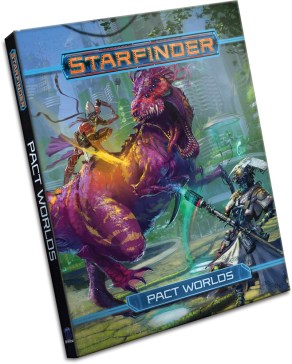


 . This is part one of a new Adventure Path which takes place in Taldor and looks AWESOME. All of the reviews I’ve read of it have been great, and I literally cannot wait to get my hands on it! I hear that the Player’s Guide is in editing, and won’t be out for another week or two.
 . That’s right! The
  ! There’s plenty of awesome pawns in this collection, including monkey goblins, mockinfey, a ton of new daemons and demons, enough dragons and golems to make any GM cackle madly, and–my personal favourite–the ever creepy sakhils. The icing on the (fabulous) cake? A total of six Archdevils and three Great Old ones! I hope your PCs have some mythic tiers under their belts… Currently, The Pathfinder Pawns: Bestiary 6 Box is only available on
 . I have quite a few of the ‘Inner Sea’ supplments, and the ‘Of Golarion’ line. Some of them I’m thrilled with, while others see little use around my house. I wasn’t sure where I would fall with this one. It’s about taverns, after all! But, after reading the previews and reviews, I’m actually keen to get my hands on it. This book takes a look at six unique taverns throughout the Inner Sea, including the Whispering Stone in Wati (which will be sure to see use for anyone running
  ); Runoff in Starfall, where even taking a sip of your drink is dangerous (perfect for
  !); Formidably Maid in Port Peril (which is where
  begins!); and–the one I’m most excited for–Aeylinth Vineyard, a sophisticated treetop wine bar in Kyonin! In addition to detailing these very different establishments, it’s owners and some notable patrons,
  ! This adventure is intended for level seven characters and sees the players explore an ancient alien city floating in the atmosphere of a gas giant in the middle of an unexplored star system! Throw in a powerful weapon and the ominously named Devourer Cult, and this adventure sounds like a blast! This adventure is part of a six volume adventure path, and is preceded by
  , and
, and  .
. . This useful collection of sci-fi rooms includes a med-bay, escape pods and a starship brigde, all of which are perfectly suited for starships and buildings. Coupled with
  , or
, or  , you can easily make a ton of varied environments for your players to explore.
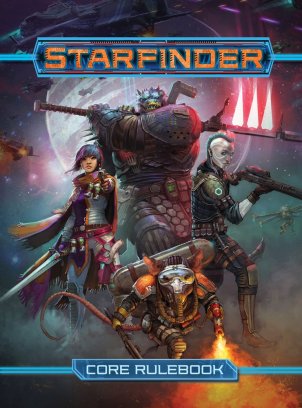
 . This is the book where you’ll find a ton of monsters, new player races and, most importantly, simple rules for making MORE monsters and races. If you’re going to run a game of Starfinder, you NEED the Alien Archive.
 is a must-have play mat for the Starfinder game.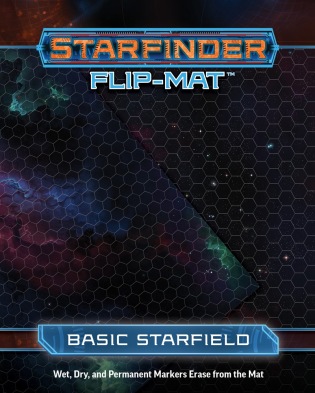
 , is a great choice for a wide variety of terrain types. Starfinder has launched another new basic flip-mat, which is a great addition to your game (and my favourite of the new Starfinder mats),
  . One side is a windswept desert or badlands style terrain, while the other is a metallic, grey terrain type. In addition to basic mats, Starfinder has launched a couple REALLY beautiful flip-mats. In general, although they’re lovely, and easy to use, I tend to stick with the basic mats for budgeting purposes. But if you’re interested, there’s the
  , which features a high-end dance-club scene on one side, and a grungy, dive-bar on the other. The
  features a sleek exploratory starship on one side, and a more utilitarian ship on the other side which would work great as a military ship, a freighter, or a derelict ship. The last map I haven’t been able to find on amazon, which means you’ll have to order direct from Paizo’s website (which if you’re Canadian, like, means the shipping fees are a nightmare). That being said, the

 which comes with a hundred awesome minis perfect for player characters and humanoid enemies, as well as a large assortment of ship pawns. You are going to get a TON of use out of this collection! In addition, I highly recommend the
  from amazon or from Paizo’s website
  (which has gorgeous artwork on one side and a collection of very important information for the GM on the other),
  (which is a very detailed character sheet), and
  (to help make combat organization quicker and easier). But what I’d recommend is the
  , which put all of the conditions in Starfinder on handy cards which can be given out to players, or used by the GM for easy reference. They also feature some snazzy artwork of space goblins on each condition to make them more interesting.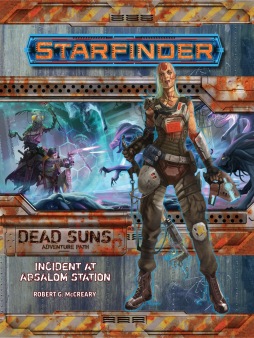
 . From what I’ve read so far of the Adventure Path, it’s great fun.
 , which can be complicated, to say the least! Second, although a lot of Starfinder’s rules are familiar, and a player of Pathfinder could technically pick up a character sheet and hop right into the game, there are a lot of minor changes to the rules and character creation process. This means that there are differences which you should read. Owning and reading the
  , browsed it, desperately wanted to buy it, but put it back because I had NO IDEA what it was. Haha. So, from me to you, Starfinder, THANKS. Countless curious readers will appreciate the overview. I promise.


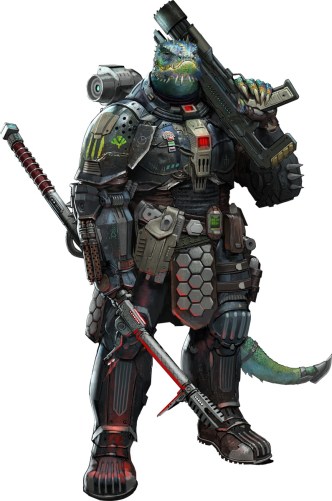


 d20 Diaries