As you may have heard, Pathfinder recently announced that in August they’ll be releasing the beta version of Pathfinder’s Second Edition ruleset. For the first few months these rules will be available for a free download on Paizo’s website, and feedback will be collected from us, the players. Known as Pathfinder Playtest, this news has stirred up a lot of excitement. As mentioned in my previous post on the matter, I’m excited for the new edition, but also afraid. It’s not that I worry about the rules–I know I’ll like them–but I worry about the investment. I have no intention of leaving behind 1e, especially in regards to the Pathfinder Society. Although I know I’ll switch over to 2e eventually, the cost that’s going to be involved when 2e officially launches is going to prevent me from making the transition immediately.
Pathfinder is slowly releasing some spoilers and details on their blog of the new Playtest rules, and has an extensive FAQ section dedicated to the game already. So what do we know? For starters, alchemist will be one of the classes released with the original core classes in the first book. Also, goblins will be among the core ancestries up for offer, which is exciting! Who doesn’t love goblins? Wait! Ancestries? What’s that? It’s a new name for races, which will influence your character as it always has. In addition to ancestry and class, your character will also be influenced by a third category called your Background. I’m not sure what this is exactly, as details haven’t launched yet, but it sounds like having a theme from Starfinder. There’s also plenty of other little things that have been hinted at, but the only things that have been spoilered in any kind of detail is the action system.
You know all that work you put into learning which actions are standard, move, swift and free actions? Ignore that! Instead, everything costs one Action. During each round, every player gets three actions. Want to attack three times? Go for it! Draw a potion, move and administer it to someone else? Sure! Move and attack twice? Yup! Open a door, move through, shut a door? Yup! Three actions. Do what you will. Those of you choosing to attack multiple times take a cumulative -5 penalty on those additional attacks (so the second attack is at a -5 penalty and the third is at a -10). The only exception mentioned so far in regards to the ‘one Action’ rule is spells. Most spells will cost 2 Actions, some can be cast as 1 Action, and some will be cast at variable Action costs, which will increase the spell’s effectiveness. Every character also gets a single Reaction that they can take between the start of their turn and the start of their next turn. In addition to attacks of opportunity, each class has special Reactions they can take, like a fighter readying a shield against an attack in order to reduce its damage. So far I like this concept. It’s effective and uncomplicated. But will it work? After hearing it in action on the Glass Cannon Podcast special where they tried out Pathfinder Playtest alongside Jason Bulmahn and Erik Mona, I think it’s going to be great. This podcast was a lot of fun to listen to, and featured a lot of cool glimpses at the new rules.
My favourite thing I learned from the podcast? Initiative is no longer a single score. Instead, what you roll for initiative is determined by what you’re doing. For example, if you’re looking around and keeping alert it will run off of your Perception. If you’re slinking around and hiding at the time, Stealth will be what you’re rolling. And if you’re checking out the terrain and looking for tracks, you’ll roll Survival for your initiative. It’s a neat way to run initiative that sounds like a lot of fun.
For further details on Pathfinder Playtest check out Paizo’s website, blog post, or the podcast mentioned above.
What’s surprised me more than the new rules we’ve heard about is the variety of attitudes I’ve seen on the Paizo Messageboards about it. Some people are thrilled, which is what I expected, and some people are worried–also expected. Some are upset. One GM was so angry he immediately dropped every game he was GMing, leaving dozens of players in the lurch! Seriously!? How unprofessional can you be? Luckily, the wonderful community of players on the Paizo Messageboards leapt to the rescue and are managing replacement GMs as we speak. My character leaps for joy and thanks her lucky stars.
Since the announcement of Pathfinder Playtest, the news has settled. The shock has faded. And we’ve received a glimpse at the new rules and how play works. So how do I feel now? Excited. I can’t wait until we get to learn more about the new system.
And you? How are you feeling about Pathfinder Playtest and the upcoming Pathfinder 2e?
I love the Starfinder Roleplaying Game (Starfinder Core Rulebook). But, I also didn’t want to leap right into Starfinder with my own custom adventures. I wanted to try it out as a player first. Obviously, there’s not many options right now. There’s the Starfinder Adventure Path: Dead Suns (Part One: Incident at Absalom Station), which looks great, but I didn’t want to lock my family into a long campaign with their first characters. I wanted to do something short. Something that got started right away. That hopped right into the action!
So I turned to the Starfinder Society.
The Starfinder Society is a lot like the Pathfinder Society, but in space. It’s a world-wide organized play campaign where anyone can make a character and play a single short adventure (usually four hours in length). The adventures are called scenarios and available as PDF downloads on Paizo’s website for only a few dollars each (usually $4.99 American). These scenarios are short, action packed, and fun. There’s other rules you’ll need to know for playing in the Starfinder Society, all of which are available as a free download on their website, here. In addition to special rules, you should also know a bit about the setting, and the recent achievements of the Starfinder Society. Paizo’s website says it better than I ever could:
“The gods have mysteriously spirited Golarion away to an unknown location and refuse to answer questions about it. In its place, the cultures of that world have evolved and spread throughout the solar system, especially to a vast space platform called Absalom Station. Gifted access to a hyperspace dimension by an ascended AI deity, the residents of the system suddenly find themselves with the ability to travel faster than light, and the race is on to explore and colonize potentially millions of worlds. But there are horrors out there in the darkness…”
“The Starfinder Society is on the brink of ruin, having had to resort of mercenaries to maintain their hold on claimed planetoids, stellar regions, and archeological sites. After training to join a new cadre of Starfinders, it is up to you as a member of the Starfinder Society to help restore the organization. The Starfinder Society, with memories of the Scoured Stars incident still fresh, embarks on the quest to rebuild and discover the truth of what happened in the inaugural season: Year of Scoured Stars!”
Playing in the Starfinder Society is a blast, and I highly recommend it either in person, or online via play-by-post (which is my preferred method), but you don’t have to use these Starfinder Society Scenarios for organized play alone. These scenarios also make great mini-adventures for playing at home in a more casual setting. I’ve continually been impressed with their quality, and the continuity of the scenarios. When used together they’re already beginning to tell a longer, more important story than they do on their own.
Today we’re going to take a look at the Starfinder Society Scenarios that are currently available for purchase, and let you know our favourites. Although you’ll find references to events in each that I liked or disliked, and comments about specific characters, these scenarios are not explored in detail. It’s not my intention to spoil the events in these scenarios, or give summaries and full reviews, but to share my opinions and provide recommendations. That said, if you want to avoid even minor spoilers I recommend you check out a different article. So sit back, and get ready to enter the Drift!
Scenario #1-00: Claim to Salvation is a Tier 3-4 adventure which is unlike any of the other scenarios. In this special scenario you don’t play your own Starfinder Society character. Instead, you play one of the level four pre-generated iconic characters. These characters are mercenaries hired by the Starfinder Society only a few months after the Scoured Stars incident decimated their ranks. These mercenaries are tasked with exploring the surface of a ‘fake-moon’ known as Salvation, for the purpose of determining if the site is worth further exploration, or is a dud that needs shelving. As one of the very first scenarios released, this adventure has some great supplementary rules notes and cheat sheets included within it for ease of play, which is a really awesome addition. This adventure is really fun, and has a cast of colourful characters, both allies and enemies, which are a blast to interact with. The starship battle in this adventure is really unique and kooky. Plus, it’s got goblins in it! Who doesn’t want to see goblins in space?!? Despite that this was a really fun adventure, there are two major downsides for me. The first, is that you need to use pre-generated characters if you’re playing it in the Starfiner Society, as mentioned above. And the second? You’re only exploring the surface of Salvation and determining if the site is worth further exploration. Exploration of the interior continues in another adventure, #1-09: Live Exploration Extreme!, and I strongly believe it will continue on in at least another scenario or two further down the line. That means that when you reach the end of this scenario you’re likely to feel as a player like its unfinished. Although I’m definitely going to use this scenario with my family as part of an ongoing campaign, I’m unlikely to play it in the Starfinder Society. Pre-generated characters aren’t really my thing. Overall, I give this scenario three out of five stars. However, if you enjoy using pre-generated characters, or, if you’re going to use it in a home campaign, I’d increase it to four out of five stars.
Starfinder Society Quests: Into the Unknown is the next adventure we’re going to take a peek at. This tier 1 scenario is awesome! For starters, Into the Unknown is a free download. So click the link and get downloading. Its a repeatable adventure, which means that if you’re playing it in the Starfinder Society you can play it once for each character (as opposed to only once as a player). That’s a very important thing when there’s so few scenarios to choose from. Like Claim to Salvation, Into the Unknown has some wonderful cheat sheets and extra rules listed, which makes it awesome for beginner players and GMs. As a quest, it’s formatted a bit different than the other scenarios. Instead of being one four hour long adventure, its a connected series of five short one-hour long adventures. Each of these short quests forms one cohesive, wonderful adventure that feels much grander in scope than your typical scenario. These quests are meant to be played in order, and intelligence gathered in the first four quests can provide you with an advantage in the final quest. The adventure itself has got a bit of everything in it: fun social interactions, local combat, and starship battles. My kids loved roleplaying with Julzakama and the ysoki family who own the Vat Garden in the first quest, ‘Salvation.’ The Vat Garden encounter also had some tricky environmental effects that made it unique. I loved the ‘Boarding’ quest, but did have a few qualms with it. There’s no mention of any bodies, which is unfortunate. Also, this scene could really benefit from an ominous, atmospheric opening description. I loved the battle in ‘Salvage,’ although this scene also could have benefitted from a scripted description of the wreck. There’s a total of two different starship battles in these quests, both of which are very different. I would have loved to learn more about the crew of the Lawblight, though. For such a cool ship with a lot of build-up, we don’t even learn the name of the captain! Events in this scenario tie into later adventures, including #1-02: Yesteryear’s Truth. In addition, there’s further hints that this scenario will tie into other unwritten scenarios in the future. All in all, Into the Unknown is one of my very favourite scenarios, and I give it five out of five stars. I highly recommend it as the first scenario for new players to try.
Up next is scenario #1-01: The Commencement. This is a repeatable scenario that does not feature any starship battles. This scenario is intended as an introduction to the Starfinder Society and its major factions. As brand new Starfinders, you’ll need to complete a task for each of the faction leaders. These tasks are fun, but quite minor. Some of them are… silly. That being said I enjoyed the silliest one a lot. (Star Sugar Heartlove!!!, here’s looking at you!). I found there was a bit too much rolling and math during the Acquisitives mission, which bogged down gameplay quite a bit. The Wayfinder and Exo-Guardian missions were great fun, while the Dataphiles task allowed characters with a lot of skills to shine. One of the best parts of this scenario is its adaptability. Multiple parts of this scenario are chosen randomly each time you play, which is just awesome in a repeatable scenario. From vehicle statistics, to enemy abilities, and even alien appearances and motives, although the tasks don’t change, the details do, which will make for a fresh experience every time. Conceptually, I like that they give fresh agents minor tasks, but in practise it feels… underwhelming. Not very exciting. For that reason, although this is a great first adventure for Starfinder Society characters, and a wonderful introduction to the factions, I don’t recommend it be your first Starfinder experience. If you’re new to Starfinder, play Into the Unknown instead. This adventure features events that tie into other adventures, as well as characters that continue to play a role in the Year of Scoured Stars. I give it three out of five stars.
Scenario #1-02: Fugitive on the Red Planet is a tier 1-4 adventure that doesn’t feature any starship battles. This scenario sends you to the Mars-like planet of Akiton on the trail of an ex-Starfinder who stole an artifact from the Society. This is a another fun adventure. I like the encounters, both social and combat, but the scenario itself was very ‘on the rails.’ Now, this isn’t surprising for SFS or PFS scenarios, and it doesn’t feel like it’s constraining, but it is worth noting. I was impressed that the investigation in Maro has an effect later in the scenario. I really enjoyed the inclusion of AbadarCorp in this scenario, and that there were repercussions or benefits based on your interactions with them. I also liked that infamy repercussions were built right into the module, which is a nice early example that evil actions don’t work out for your characters in the long run. The final battle’s location was wonderfully varied, and the inclusion of the mine carts made it very dynamic. Overall, I really enjoyed this scenario and give it four out of five stars.
Scenario #1-03: Yesteryear’s Truth is a tier 1-4 adventure that contains one starship battle. This mission is of particular importance to the Wayfinders faction and sends you to explore a newly discovered planet. I found that the starship battle was too long, but a slower launch rate of the combat drones, or less hp for each drone would fix that easily. I really loved the premise of this adventure. It’s very much a ‘first contact’ situation, and I thought it followed through on this wonderfully. As expected for a scenario of this kind, social skills are very important to the mission, which could be hard for some groups. That being said, they have plenty of chances to make friends with both types of locals, and the module can progress as scheduled even if they fail to do so. Finally, I loved the history this scenario lets you uncover, and that your actions can affect the planet’s future. This scenario features a planet that was first mentioned in Into the Unknown, and introduces Winks, a character who will later be met again in Scenario #1-04: Cries from the Drift. I give it five out of five stars.
Scenario #1-04: Cries from the Drift is a tier 1-4 adventure that sends the players to investigate a missing Starfinder ship. It contains one starship battle. This mission is of particular importance to the Exo-Guardians faction and is highly likely to link to further missions regarding Sangoro’s Bulwark. I thoroughly loved this scenario, but be warned, this one is NOT for the squeamish. It features body horror, gore and suspense. Because this scenario really benefits from all players being surprised, I won’t be saying anything else about the events contained within. What I will say is that it connects to lots of other adventures. It name-drops Winks, from scenario #1-03: Yesteryear’s Truth. It also introduces a starfinder team known as the Manta Corps, who will make a further appearance in scenario #1-08: Sanctuary of Drowned Delight. This social encounter is a fun way to let players brag about their accomplishments. There’s some fun goodies hidden in this scenario for players who’ve already experienced scenario #1-01: The Commencement, including the return of Zigvigix and his warehouse. It also features tie-ins to a not-yet-released scenario that involves a Strawberry Machine Cake concert. I give this scenario five out of five stars, but remember: it’s not for everyone!
Scenario #1-05: The First Mandate is a tier 1-4 adventure that tasks your players with impressing dignitaries and contacts who are important to the Starfinder Society. It is of particular importance to members of the Acquisitives faction, and the Second Seekers faction. There are no starship battles in this scenario. This scenario introduces six really important NPCs, including Luwazi Elsebo, leader of the Starfinder Society. It also introduces Royo, a ysoki Forum member, and Naiaj, a gnome bleachling Venture-Captain. All three of these characters were fun to interact with, detailed, and are certain to make plenty more appearances as the Starfinder Society continues. There’s also two other important NPCs of note, Iteration-177, an android Aspis Consortium member, and Zo!, an Eoxian media mogul. Despite the premise of this adventure, it doesn’t all come down to social skills. There’s plenty of combat to go around and the NPCs varied interests mean that even the most awkward characters have a chance of impressing someone. The NPCs represent a wide variety of races, which was really refreshing. The social encounters themselves are a lot of fun, and the rules introduced to measure the players success aren’t overly complicated. In addition to the intangible benefits of impressing the dignitaries, there’s also visible, mechanical benefits that occur in the scenario, which are sure to make players pleased. I felt that the investigation part of this scenario was really well done. The clues were subtle, and it didn’t beat you over the head with details, which was really refreshing. The final battle allowed for multiple different approaches, methods and tactics, all of which look to be a lot of fun. So far two other scenarios are connected to this one, including #1-06: Night in Nightarch, and #1-09: Live Exploration Extreme! Although I wasn’t sure I’d like this scenario from it’s premise, I ended up really loving it. I give it five out of five stars.
Scenario #1-06: Night in Nightarch is a tier 3-6 scenario that grants your players leave to track down a missing weapons shipment from a drow thief. The best part? She’s on a planet of drow. Yeah. Take a second and imagine that. Yikes! This scenario doesn’t feature any starship battles. I absolutely love the premise of this scenario. It’s got some fun NPCs to interact with, awesome drow artwork, and does a great job of setting an atmospheric tone with only a few short sentences. I really enjoyed that the mission was on a timeframe, and the quick mechanics that were used to speed up/determine time. The office levels were well-detailed and organic. It had character, which was really nice. There were multiple ways to go about one of the encounters, which is nice. The outcome of the battle doesn’t change too much from one to the other, but its nice to have the option. I even loved the little details hidden here and there, like the advertisements–particularly the one featuring Zo!’s reality tv show. I give this scenario four out of five stars.
Scenario #1-07: The Solar Sortie is a tier 1-4 adventure that sends the players undercover on Brilliance, a solar satellite owned by the Arch Energy Consortium, for the purpose of recovering classified information. To this end, the players must earn the friendship of Envar Tamm, the ‘boss’s’ hard-partying son. This scenario could contain one starship battle. This scenario is fun and quirky. It requires subterfuge, social skills and computer skills to succeed, but is not without combat. Because of the skills required, its not a scenario for everyone, but it did a great job of making all kinds of characters useful. Envar himself is a great NPC who’s going to be a blast to play at the table. This scenario features a character introduced in #1-01: The Commencement, and can be affected by your players experiences in #1-02: Fugitive on the Red Planet. I give this adventure four out of five stars.
Scenario #1-08: Sanctuary of Drowned Delight is a tier 3-6 adventure that has your players investigate an old Starfinder Lodge on an aquatic planet. In addition to determining if the Lodge is salvageable, they also need to make contact with the first group who was sent on this mission, the Manta Corps, who were introduced in #1-04: Cries from the Drift. This mission is of particular importance to the Wayfinders faction. It does not contain any starship battles. This scenario is location based, which is to say that they are given a single location to explore, and can do so in any fashion and order they desire. In addition to room-based encounters and there are also event-based encounters, which are a lot of fun. In addition to getting to explore a great location on a new planet, players will get to meet and interact with a new alien race. This is a great adventure for players who love to role-play social encounters. It also features investigation elements which are wonderfully subtle. This scenario reintroduced us to Fitch and the Master of Stars, which is the same ship visited in #1-01: The Commencement. This scenario is just… AWESOME! I give this scenario five out of five stars.
The last adventure we’re going to take a look at today is Scenario #1-09: Live Exploration Extreme! This is a tier 1-4 adventure which is a direct sequel to #1-00: Salvation’s End. It also has ties to #1-05: The First Mandate, and features Zo!, who was met in that scenario. It is the first (likely of multiple) scenarios that will delve into the fake-moon, Salvation. The catch? In the aftermath of the Scoured Stars incident, The Starfinders had to rely on mercenaries, investors and powerful organizations in order to keep operational. One such investor was Zo!, a undead Eoxian media mogul. He provided the Starfinders with a vast amount of funding, on the condition that if any important discoveries were made on those sites the Starfinders would cease investigation immediately, until Zo! and his camera crew were ready to document the findings and turn it into a new reality television special. That’s right! You don’t just get to explore an awesome ruin and make amazing discoveries, you have to do it alongside a film crew while impressing a live studio audience! It does an awesome job of playing up this quirky experience, including pulling characters aside to ask prying questions, and having the studio audience vote on how some situations should play out. This adventure is populated with a ton of entertaining characters. From the crew, to Zo!, and the people met while exploring Salvation, this is a scenario that’s overflowing with fun, engaging, social encounters. It’s full of personality, and I guarantee you’ve never played anything like it before. Aside from the wonderful ‘reality t.v.’ schtick it’s got going for it, the adventure itself–the things you find in Salvation–are really, really surprising. Honestly. Wow! I cannot wait for the investigation into Salvation to continue in another scenario, and I strongly hope that Zo! and his camera crew will be along with us for the ride. This scenario is one of my very favourites. I give it five out of five stars.
And that’s it! The first eleven Starfinder Society scenarios, specials and quests for your perusal. I don’t know about you, but I can’t wait to play through them all. But when it comes down to it, which ones were my very, very, favourites? Which ones blew my mind?
Into the Unknown, Sanctuary of Drowned Delights, and Live Exploration Extreme!
What about you? If you’ve got a favourite Starfinder scenario let us know in the comments below! Have experiences playing or GMing these adventures that you want to share? Do so! We’d love to hear from you!
Big changes were just announced for Pathfinder today. The release of Pathfinder’s Second Edition.
That’s right.
Whether that causes you to jump for joy or cringe in terror, it’s big news! What does it give me? Fear.
Now, thankfully, things won’t be happening right away, or all at once. On August 2nd Pathfinder’s launching their rules as a playtest. Called, Pathfinder Playtest, there’ll be a free copy of the new rulebook available as a download on their website, as well as a new deluxe adventure module, and a flip mat. All of these downloads can also be purchased in hard cover on their website. During the first few months after the release of Pathfinder Playtest you’re encouraged to try out the new ruleset and leave your feedback on their messageboards. Upon completion of the playtest they’ll launch Pathfinder Second Edition.
I rather like the playtest phase, and I am excited that there’s a free download of the rules that’s going to be available. So, thanks for that Paizo. But, honestly, I don’t want new rules. New rules means replacing rulebooks. It means a phasing out of the content I have at home. It means trying to get a handle on a new game. And mostly, it means more money. Money I don’t have to reinvest.
Now, let’s be clear. Pathfinder’s not perfect. Are there things that could be fixed? Yes. Streamlined? Yes. Does that mean I want it changed and altered? No. I stopped playing Dungeons and Dragons the moment they switched to 4th edition and took up Pathfinder instead. Why? Is it cause I hated 4th? No. I never even gave it a try. I stopped because I didn’t want to learn new rules, or buy another new Core Rulebook. I switched to Pathfinder, because I wouldn’t have to learn anything new. And I loved it. I worry that this switch will leave me behind.
I understand where they’re coming from. I understand that lots of players will be thrilled. Games and rules for d20 games are always evolving. Always getting better. I understand wanting to make Pathfinder the best it can be. I understand making it easier and more user-friendly for new gamers. And I certainly understand that after creating Starfinder, why wouldn’t they want to do the same to Pathfinder? I mean, at its core, Starfinder ‘fixed’ and ‘improved’ a lot of the basic rules from the Pathfinder game into a ‘better’ version. After having done that, successfully, why wouldn’t they want to do the same for Pathfinder? I definitely get that.
And, I suppose, underneath my apprehension and fear, I am excited.
But what about the new rulebooks? They won’t be compatible with the old ones. What about all the wonderful books I own? I won’t forget about them. I won’t stop using them. It’s much more likely I stop buying new product. What about the Pathfinder Society? The classes? How compatible will Pathfinder Second Edition be with Pathfinder?
From a thorough reading of the information on Paizo’s website, I get the feeling that although adventures and monsters will be relatively easy to switch over to the new rules, it’s the character rules, and the basic rules themselves that will take more work. This won’t be something you just switch over. You’ll need the new rules for that.
As of August 2018 there will no longer be content published for Pathfinder (First Edition). Everything will be published for their new ruleset. However, that doesn’t mean you won’t be able to get the old books. The Pathfinder Pocket Editions will be kept in stock as long as people continue to purchase them, while PDF versions of their extensive Pathfinder collection will be available for the foreseeable future on their website.
As for Pathfinder Society? It sounds like the Pathfinder Society will continue on in two forms. Like the rulebooks, as of August all new scenarios will be to the Playtest/Second Edition ruleset. You’ll need new characters to play by the new rules. However, all of the ‘old’ scenarios will still be available for purchase, and can be run for credit with ‘old’ characters using the original ruleset. This is likely going to continue at conventions and via online play-by-post for a long time to come. Kind of like choosing between Core and Standard, now you’ll also have the addition of ‘Second’ (or whatever it’s going to be called…)
Pathfinder knows what they’re doing. And I love Pathfinder.
But when it comes down to it, what do I really think of the upcoming changes? What am I going to do?
I’m going to take a deep breath, and give it a try.
When Pathfinder Playtest comes out on August 2nd, I guarantee you I will download the rules. I will read the rules. And I will test out the rules.
In fact, I bet I’ll enjoy them.
But when Second launches will I buy the books again? Will I keep up with it?
In time? For sure. But right away?
I honestly can’t say.
What I can say, is that I think they’re going about it the right way. This playtest will be invaluable for them, both for gaining valuable feedback, and for providing nervous gamers like me the chance to try out the rules for free, before we make up our minds. We get to give it a try before investing. And most importantly? Allowing and facilitating use of the old ruleset, for those of us who decide we don’t want to move on to a ‘bigger’ and ‘better’ Pathfinder.
Want to learn more about Pathfinder Playtest? Follow the link to Paizo’s website and give the FAQs a read for yourself.
Have an opinion? Want to let me know your thoughts on Pathfinder Playtest?
Let me know in the comments. I’d love to hear your thoughts.
Today we’re going to be taking a look at one of the wonderful new Pathfinder books I purchased: Blood of the Beast!
Blood of the Beast is a Pathfinder Player Companion compatible with the Pathfinder Roleplaying Game. This means it’s a thin, soft-cover book with plenty of new options intended for players creating characters. More specifically, this volume focuses on some of the anthropomorphic (‘animal-people’) races of Golarion.
The races detailed in Blood of the Beast include catfolk, grippli, kitsune, nagaji, ratfolk, tengu and vanara. Although each of these races was originally introduced in Pathfinder’s Advanced Race Guide, Blood of the Beast introduces further information about each race, as well as new favoured class options, archetypes, feats and spells. Most of these options are compatible with other races, which means this book will give you a lot more bang for your buck than expected. Each race contains four pages worth of information, making the entire book 32 pages long.
Blood of the Beast opens with a map of the Inner Sea showcasing the areas that each of the featured races are most commonly found. This was surprisingly enlightening. Although I expected grippli to be found in the Mwangi Expanse, tengu to be found in the Shackles, and Nagaji to be found in Jalmeray, many of the other race’s territories were unexpected. Especially when it came to ratfolk!
Following this is the Introduction, which gives us a new trait for each of the races, as well as a reference list for easily finding the options in this book by type (archetypes, feats, and other options). I liked most of the traits, although some are considerably less useful than others. Although the catfolk trait, Adherent of Ancient Osirion, is really cool, my favourite turned out to be the grippli trait, Jungle Native, turned out to be my favourite. In addition to making survival a class skill, this trait also grants you a +1 trait bonus on saving throws against disease and poison, and a +1 trait bonus on initiative checks made in jungle terrain! This is one solid Region trait!
After the Introduction we dive right into the races! Up first was the Catfolk! Although I know plenty of people who love catfolk, they’ve never been my cup of tea. Probably because my sister-in-law plays only catfolk, so they’re a pretty common sight around my game table. That being said, catfolk are cool, so I was excited to see what this chapter had to offer! Catfolk options in this book include nine favoured class options, three archetypes, three feats, a vigilante course (for use with the wildsoul vigilante archetype from Ultimate Intrigue), and three spells. Although I expected the Senedipity Shaman archetype to be my favourite catfolk option, it turns out I was most impressed with the Prowler At World’s End, an archetype for bloodrager. Based on the premise that “ancient catfolk legends claim their kind was created to protect the world from the sinister forces that exist at the world’s fringes,” these bloodragers commune with powerful predatory nature spirits who take on the forms of lions, cheetahs, and leopards. This allows the bloodrager to use the medium’s spirit and spirit surge abilities. At later levels these bloodragers can also assume the forms of these great cats while bloodraging, and can cast spells while transformed this way. Honestly, I’ve never been particularly interested in being a medium, since it’s the most complicated class I’ve ever read, but this archetype really makes me want to give this medium-inspired Prowler At World’s End a try! Other highlights of the catfolk chapter are the Graceful Athlete feat, and the Curse of Befouled Fortune spell.
The second featured race in this book are Gripplis. Grippli are small frog people who live in jungles. These colourful little fellows are a quirky race, but I’ve never personally played one. My son does, and he loves it, but frogs aren’t really my thing. That being said, the options presented for grippli are my favourite in the entire book! Next time I have a chance, I’m definitely making a grippli. There’s nine favoured class options in this chapter, three archetypes, two feats and three spells. All three of these archetypes are awesome! Fiend Keeper is a medium archetype that allows you to contain evil spirits within yourself and, through your good deeds, cleanse the spirit until it is no longer evil. Done through the generations, it is an honour to be a fiend keeper among grippli tribes. Warpainter is a skald archetype which allows you to ceremonially paint your allies faces in order to imbue them with your magical songs. Later, spells and rage powers can also be imbued into your allies with this ability. However, my favourite grippli archetype is the Poison Darter! This ranger archetype allows you to concoct debilitating poisons which get better over time, grants you poison use, and allows you to take some rogue talents or alchemist discoveries in place of a combat style. It also grants you sneak attack–when attacking with a blowgun! Cool! As for other options, I really enjoyed the Cunning Killer feat, and the Batrachian Surge spell.
Up next is Kitsune. For the record, kitsune are my favourite non-core race in Pathfinder, so I expected to be irrationally in love with this chapter. Which is why I was so surprised that the previous chapter on grippli turned out to be my favourite! That being said, kitsune didn’t disappoint. This chapter contains four alternate race traits, nine favoured class options, three advanced versatile performances, one archetype, three feats, two spells, three vigilante social talents and three vigilante talents. To start with, each of the four alernate race traits are very cool. Keen Kitsune lets you shift around the kitsune bonus ability score from Charisma to Intelligence. Multilingual shakes up the kitsune starting languages and allows you to choose any languages you want with a high intelligence score. Skilled gives kitsune an extra skill point every level. My favourite, Superior Shapeshifter, gives you the feat fox shape which allows you to take on the form of a normal fox, in addition to the form of a specific humanoid via change shape. Among their favoured class options is another neat option which can be taken by kitsune of any class, that allows them to gain the Magical Tail feat every six times it’s taken. I’m a big fan of that feat, so I’m thrilled to see this option surface! In a similar vein, the sorcerer archetype Nine-Tailed Heir lets the kitsune gain the Magical Tail feat four times through the course of its 20 levels, in exchange for the bloodline spells known. If you’re a fan of that feat, like me, you might finally get to be a kitsune with the whole nine tails! Though not overpowered, it’s more than a fair trade. Martial Performance turned out to be my favourite Advanced Versatile Performance option available, while the feats Shapechanging Savage and Startling Shapechange really tickled my fancy. Coupled with the shape changing themed feats found in the Pathfinder Player Companion: Dragon Empires Primer, they get even better! If you’re into the Vigilante class, be sure to check out the Obscurity, Brutal Maneuver and Deceitful Trick talents.
Nagaji are up next in Blood of the Beasts, which is very exciting. For some reason I’ve been hooked on these guys since their brief introduction in the Advanced Race Guide, and their links to the Naga’s of Kaer Maga, which (thanks to Pathfinder Chronicles: City of Strangers), is my favourite city in all of Golarion. The nagaji article featured eight favoured class options, two naga bloodlines (one for bloodrager and one for sorcerer), two feats, one archetype, three mesmerist tricks and a whopping five spells. Both of the Naga bloodlines turned out to be interesting, although I liked the sorcerer one slightly more. With the ability to turn invisible, increased effectiveness with charm abilities, and the ability to cast spells with somatic components even when your hands are full by gyrating your body like a snake, this bloodline sounds like a blast! The First Mother’s Fang cavalier archetype allows you to ride a large constrictor snake and allows you to become a master of martial and politic pursuits. Personally, I think it’s the mesmerist abilities that are the coolest part of the nagaji entry. Be sure to check out the feat Venemous Stare, and the trick Break Stupor. For spells, be sure to check out Greater Hypnotism, and all of the Naga Shape spells!
If you’ve read the article on my blog ‘Vermin, vermin, everywhere…‘ you’ll know that vermin are not my favourite thing. So, it should come as no surprise to you that ratfolk are not at the top of my list for races I was excited for in this book. Still, with an open mind I delved into the ratfolk chapter. And was more than pleasantly surprised! This chapter contains ten favoured class options, three archetypes, five feats, and a psychic discipline. Like the much beloved grippli chapter, I thoroughly enjoyed every one of the ratfolk archetypes. Opportunist is an awesome fighter archetype that makes you a master at using bombs, alchemical weapons and dirty tricks. Swarm Monger is a druid archetype that lets you influence vermin, turn your companion and eventually yourself into a swarm. Finally, my personal favourite, the Scavenger archetype for investigators lets you make clockwork gadgets instead of extracts, allows you to enhance, hinder or repair mechanical devices, and even craft constructs. To read about a Scavenger in action, check out my character Nix in my blog post ‘Iron Gods: Character Focus: Haji and Nix,’ or read about her continuing adventures in the Iron Gods Adventure Path starting with ‘Iron Gods: Part One: Into the Weeping Pond.’ For feats, be sure to check out Cooperative Swarmer and Underfoot. Lastly, be sure to check out the Warp psychic discipline which allows your ratfolk to sense the weak points in reality, and open portals through which they can manipulate objects, teleport, and turn aside blows. For a bit of awesome flavour, listen to the last line of text describing the warp discipline: “Ancient practitioners […] even claimed that the art once allowed ratfolk to guide great caravans to the stars.” That’s right. Now you know why the ysoki are found on nearly every planet in the Starfinder’s Pact Worlds. Awesome!
With only two races left to explore, we’ve come to the chapter on tengu. Much like ratfolk, although a lot of people love tengu, I’ve never really been one of them. Despite this, I was excited for reading about tengu and hoped that I’d find something I’d love. This chapter has ten favoured class options, three archetypes, two feats and three spells. Although I was most excited to read about the Jinx Witch archetype for witches, it’s the Courser swashbuckler archetype that really excited me. This archetype takes the already nimble swashbuckler and ramps it up a notch, focusing on speed, agile maneuvers, spring attacks, and some cool deeds including the ability to run along walls, and leap incredible distances. Got a character who’s a big old liar? Be sure to check out the feats Empty Threats and Lovable Scoundrel. As for spells, check out fumblestep.
Last up? Vanara! These wonderfully fun monkey-people come with two alternate racial traits, twelve favoured class options, five feats, one archetype, some fighter advanced weapon training options, one unchained summoner eidolon subtype, and a bevy of unchained monk options. Now, I love Vanara, but I have to say this chapter was less useful than the others for one reason: nearly all of the options in this chapter requires you to own other supplementary books that many of us don’t own. While this is expected with Pathfinder’s many, many books in print, to have three quarters of the chapter require these books is unfortunate. All five of the feats offered for vanara are meditation feats, rules for which you’ll need to check out Pathfinder Player Companion: Faiths & Philosophies. Fighter Advanced Weapon Training options are found in Pathfinder Player Companion: Weapon Master’s Handbook (but it looks like enough details are presented in this volume for you to get by without it),. Lastly, all of the monk and summoner options require you to make unchained characters with the rules found within Pathfinder Roleplaying Game: Pathfinder Unchained. To those of us who don’t own these supplementary books, that leaves only the alternate racial traits, favoured class options, and the archetype usable. On the plus side, the Fortune-Finder archetype for rangers is pretty cool. These expert explorers adapt themselves to fight against any enemy in any terrain, and can traverse any terrain, even magically impeding ones, without difficulty.
And that’s it! We’re at the end of Blood of the Beast! Overall, I really liked this little supplement book. If you’re a player with interest in any of the more bestial races of Golarion, I highly suggest you pick it up!
The Starfinder Roleplaying Game launched a while ago, and unsurprisingly there’s a LOT of supplementary products already out on the market. Today, we’re going to take a look at these awesome (and not so awesome) products!
To start off with, The Starfinder Core Rulebook (for more details on the Starfinder Core Rulebook, check out my blog post about it here). You want it. You need it. This book is NOT optional. It’s got everything you need to play! Or does it? The only thing it’s missing?
Monsters! Which brings us to our second necessary product, the Starfinder: Alien Archive. This is the book where you’ll find a ton of monsters, new player races and, most importantly, simple rules for making MORE monsters and races. If you’re going to run a game of Starfinder, you NEED the Alien Archive.
But there’s another product you can already pick up about monsters in Starfinder. And this one’s FREE. Starfinder: First Contact is a short PDF of some Starfinder monsters, available as a free download on Paizo’s website. You can also purchase it in print for five dollars on their website, but I’m pretty partial to free, myself.
So you’ve got your game, and you’ve got you’re monsters. For books, this is all that’s necessary. However, Paizo just announced a third hardcover book in their line-up which is available for pre-order (and is expected out next month): The Pact Worlds! If you enjoyed the campaign setting chapter in the Starfinder Core Rulebook, then Starfinder: Pact Worlds is for you! This book contains details on all of the major planets of the Pact Worlds, new playable races, new themes, new ships, new archetypes, and new gear, spells and feats! In short, despite being a book about the setting of Starfinder, it’s got a ton of new class options for everyone. This book isn’t necessary, but I know I’m DEFINITELY adding it to my collection.
Once you’ve got your books, you need something to actually play on. Starfinder uses two grid types, one for player battles, exploration and so forth, and one for starship battles. For starship battles, they have only one flip-mat for sale, but it’s awesome. It’s big, it’s beautiful, it’s good with dry and wet erase markers, as well as permanent markers, and it’s double sided. Starfinder Flip-Mat: Basic Starfield is a must-have play mat for the Starfinder game.
For standard play, though, there are a ton of options. Now, chances are, if you’ve played Pathfinder, Dungeons and Dragons or any other d20 games you have a play mat already. My personal favourite, Pathfinder Flip Mat: Basic Terrain Multi-Pack, is a great choice for a wide variety of terrain types. Starfinder has launched another new basic flip-mat, which is a great addition to your game (and my favourite of the new Starfinder mats), Starfinder Flip-Mat: Basic Terrain. One side is a windswept desert or badlands style terrain, while the other is a metallic, grey terrain type. In addition to basic mats, Starfinder has launched a couple REALLY beautiful flip-mats. In general, although they’re lovely, and easy to use, I tend to stick with the basic mats for budgeting purposes. But if you’re interested, there’s the Starfinder Flip-Mat: Cantina, which features a high-end dance-club scene on one side, and a grungy, dive-bar on the other. The Starfinder Flip-Mat: Starship features a sleek exploratory starship on one side, and a more utilitarian ship on the other side which would work great as a military ship, a freighter, or a derelict ship. The last map I haven’t been able to find on amazon, which means you’ll have to order direct from Paizo’s website (which if you’re Canadian, like, means the shipping fees are a nightmare). That being said, the Starfinder Flip-mat: Urban Sprawl is gorgeous. One side is a sleek, futuristic city or parkscape, while the other side is a grungy, dystopian slum. There are plenty of other maps on the horizon, which we’ll be sure to keep our eyes out for.
You’ve got your books, and you’ve got your play-mat, but what the heck are you going to put on it? Paizo has a few paintable resin miniatures available on their website, Navasi the human envoy, Iseph the android operative, and Keskodai the shirren mystic. They’re nice figures, and I’d expect the other iconics to be released in the future. But, for the cost and time investment, paintable minis aren’t for me. What I’d suggest instead is the Starfinder Core Rulebook Pawn Collection which comes with a hundred awesome minis perfect for player characters and humanoid enemies, as well as a large assortment of ship pawns. You are going to get a TON of use out of this collection! In addition, I highly recommend the Starfinder Pawns: Alien Archive which has 300 pawns inside, in a collection of monsters, humanoids and even a few ships. These two pawn collections will give you a ton of minis to work with, and should be al you need for a long time to come. The only other thing you’ll need to go with them is a set of bases. They’re compatible with the Pathfinder Pawn bases, so if you have some at home already, you won’t need to buy more, but if you don’t you can pick Starfinder Pawns: Base Assortment from amazon or from Paizo’s website here.
In addition to the necessities, which we’ve gone over, there’s a collection of other, less useful, supplementary products available. There’s a helpful Starfinder GM Screen (which has gorgeous artwork on one side and a collection of very important information for the GM on the other), Starfinder Player Character Folio (which is a very detailed character sheet), and Starfinder Combat Pad (to help make combat organization quicker and easier). But what I’d recommend is the Starfinder: Condition Cards, which put all of the conditions in Starfinder on handy cards which can be given out to players, or used by the GM for easy reference. They also feature some snazzy artwork of space goblins on each condition to make them more interesting.
But, if long adventure paths aren’t your thing, you can also check out the Starfinder Society. Much like the Pathfinder Society, this is a world-wide gaming community where you make a character, bring them to your local game store, convention, or take them online on Paizo’s message boards, and play a short 4 hour scenario together. If you’re not interested in actually joining these games, you can always purchase the PDFs for a few dollars each and run them at home with your regular Starfinder rules. I’m a big fan of these short scenarios, and for my family, this was how we decided to test out the Starfinder Roleplaying Game.
Currently there are eight scenarios available for purchase, with new ones coming out regularly. I highly recommend picking up Into the Unknown, which is a series of short 1 hour mini-quests that form a continuing story-line and is available as a free PDF download on Paizo’s website. It’s great fun, and has a great introduction to starship combat rules, which makes it a spectacular first-time adventure for everyone. In addition, the plot-line’s great. I also highly recommend Scenario #1-03: Yesteryear’s Truth, which can be used as a sequel to Into the Unknown, as well as Scenario #1-04: Cries from the Drift, and Scenario #1-08: Sanctuary of Drowned Delight. All three have a great balance of social encounters, combat encounters, and starship encounters. They’re AWESOME.
Scenario #1-01: The Commencement provides a great introduction to all the factions of the Starfinder Society, but has your players performing minor tasks that aren’t very glamourous. If you’re planning on playing in the Starfinder Society I’d pick this one up, but otherwise I recommend passing on it. If you’re a fan of social encounters or mysteries I’d give Scenario #1-02: Fugitive on the Red Planet, Scenario #1-05: The First Mandate, or Scenario #1-07: The Solar Sortie a try, but keep in mind that none of them feature starship battles. Lastly, Scenario #1-06: A Night in Nightarch is a fun romp which sees the players attempt to reclaim a stolen weapons shipment from a drow thief, though this is a slightly higher level adventure and is intended for levels 3-6.
Thanks for joining me for a look at the many Starfinder Products available! Be sure to check back in at d20 Diaries to read about new releases, and reviews on further products.
Today we’re taking a look at the Starfinder Core Rulebook! So fuel up your starships, set your phasers to stun and double-check you’re not wearing a red shirt! We’re launching into space!
Starfinder is a new d20 game from Paizo Publishing which is heavily based on Pathfinder. With a streamlined set of rules, a bunch of new races, and a whole galaxy to explore, Starfinder certainly brought with it a lot of excitement! The Starfinder Core Rulebook is massive. It weighs in at a whopping 527 pages, and has an American cover price of $59.99. That means if you’re Canadian, like myself, you’re looking at paying around 75-80 dollars. If you’re lucky, you can find some decent sales on this hefty tome. At the time of posting this the Starfinder Core Rulebook is on sale on amazon for only $56 Canadian, which is an awesome deal! I highly suggest picking it up before it goes back up to full price. The book itself is split into thirteen chapters, plus the reference sections at the back.
Before we take a look at the contents of the book itself, I’d like to make a few general points about the book. First off, the entire book is user friendly and well-written. It does a wonderful job of making the game accessible and easy to understand. This is a definite improvement over the Pathfinder Core Rulebook, which can be complicated, to say the least! Second, although a lot of Starfinder’s rules are familiar, and a player of Pathfinder could technically pick up a character sheet and hop right into the game, there are a lot of minor changes to the rules and character creation process. This means that there are differences which you should read. Owning and reading the Starfinder Core Rulebookisn’t optional. You need to read this bad-boy! And finally, The Starfinder Core Rulebook isn’t just a rulebook. Like the Pathfinder Core Rulebook, it also has everything you need to GM a game. In addition, unlike the Pathfinder Core Rulebook, this book also has a large portion dedicated to the campaign setting, including various planets, religions and organizations. This is an AWESOME addition.
The first chapter is an overview. Now, that may not sound very exciting, but let me tell you, this chapter is invaluable for new players. It tells you, right up front, what the heck Starfinder is, what you need to play, how the game works, and gives you definitions for a bunch of common terms. In addition, it has an enjoyable example of play. If you’re familiar with d20 games, and Pathfinder specifically, you won’t need to read this chapter more than once, but if you’re not? It’s amazing. More importantly, it gives someone browsing at a bookstore or a game shop an actual idea of what Starfinder is. I can’t tell you how many times when I was a pre-teen I picked up the old Dungeons & Dragons 3.5 Player’s Handbook, browsed it, desperately wanted to buy it, but put it back because I had NO IDEA what it was. Haha. So, from me to you, Starfinder, THANKS. Countless curious readers will appreciate the overview. I promise.
Chapter Two
A human envoy, from the Starfinder Core Rulebook.
The second chapter is INVALUABLE. It’s all about Character Creation. To start with, it gives an AWESOME step-by-step guide to making your character. It’s simple, easy to understand, and super user-friendly. Also in the chapters is a short, one sentence description of each of the core races, themes, and classes in Starfinder, as well as chart showing which ability scores they modify for ease of reference.
Right from the beginning of this chapter you’ll find some differences between Starfinder and Pathfinder. There’s the addition of a few vital statistics, including Stamina Points, which act like a buffer for your Hit Points, and Resolve Points, which allow your character to perform amazing feats, stabilize themselves, and even regain consciousness. All ability scores are chosen by point buy, but on a one-for-one basis with ten points to spend. This is going to give you stronger characters with better stats than you would get with Pathfinder, while the addition of SP and RP will make characters sturdier, and hardier. In short, even if you think you know what you’re doing, you need to give this chapter a read. Although the character creation process is familiar to players of Pathfinder, Dungeons and Dragons and other d20 games, there are differences you need to be aware of.
Later in the same chapter is another very important section: Themes.
What is a theme?
A theme represent a focus for your character, which may represent your background, training, or natural gifts. These themes are quite broad, and every character gets one in addition to their class. It makes characters seem more varied, and allows two different characters of the same class to feel different, even if they chose similar builds and tactical options. An ace pilot mercenary might be a hot-shot space pilot who’s a master of starship battles and races, while an icon mercenary might be a galaxy-famous gladiator, and a priest mercenary might be a mystical holy warrior. A theme is like adding flavour and personality onto your character based on their interests.
Mechanically, each theme adds a +1 bonus to a single ability score and grants four special abilities. The first ability is universal across all classes, and is called Theme Knowledge. This ability gives each theme an important skill as a class skill, or grants them a +1 bonus in that skill if it is already a class skill. In addition, it reduces the DC for those characters to learn information related to their chosen theme. For example, an Ace Pilot finds it easy to learn about starships, vehicles and famous pilots, while a Priest finds it easier to recall information about religions, their symbolism and their leaders. The other three abilities that each theme grants are different for each theme, but are gained at levels 6, 12 and 18. For those of you who don’t want to choose a theme, you can make a character themeless, which gives you a few generic benefits, but isn’t as powerful as the other themes.
There’s a total of ten themes in Starfinder. They are: Ace Pilot, Bounty Hunter, Icon, Mercenary, Outlaw, Priest, Scholar, Spacefarer, Xenoseeker and Themeless. They’re all quite solid choices, but my personal favourites are the Ace Pilot–who doesn’t want to be an awesome starship pilot?!–the Spacefarer and the Xenoseeker. The Spacefarer is an explorer who is a master at discovering and surviving new worlds. They get a bonus on Constitution, and are naturally skilled at the Physical Sciences. At later levels they gain the ability to better utilize skills they’re not trained in, and can regain Resolve Points by exploring new worlds and locations. The Xenoseeker is similar to the Spacefarer, in that they love exploring new worlds, but where the Spacefarer loves the worlds themselves, the Xenoseeker is interested in the life found upon them. Xenoseeker’s get a bonus to Charisma and are naturally skilled at the Life Sciences, including learning about living creatures and their culture. At later levels they gain the ability to quickly create a pidgin tongue in order communicate with alien beings, and can easily make a good impression upon them. They can regain their Resolve Points by discovering or documenting a new species of flora or fauna.
Whichever theme you’re drawn to, I think they’re a great addition to the game, and are a lot of fun.
Chapter Three
An android operative, from the Starfinder Core Rulebook.
Chapter Three brings us to the Races of Starfinder. One of these, the human, is a staple of all d20 games, but the others are more obscure. The core races in Starfinder also include androids, kasathas, lashuntas, shirrens, vesk and ysoki. Some of these, namely androids, kasathas, lashuntas, and ysoki, might be familiar to players of Pathfinder, while the shirren and vesk are entirely new.
Curious what happened to the old favourites, like dwarves and elves? They’re still a part of Starfinder, but are much more rare than the core races. These races can be found in a different chapter of the book, which we’ll get to later.
In addition to altering ability scores and giving special abilities, races also have an HP value. This HP is added to the HP granted by your class to make your starting HP. After the technical aspects of the class, each race entry has a few notes about playing that race, as well as descriptions about the race’s physical description, home world, society, alignments, relationships, and naming conventions. Each race has a full two-page spread dedicated to it, with some awesome artwork.
There are seven core races in Starfinder. Humans are as adaptable as ever, but we won’t delve into them any more than that. You are one, so I think you can handle it. Haha. Androids are artificial creatures with both biological and mechanical components that are smart, but poor at interacting with others. Kasathas are four-armed, hairless humanoids, with elongated craniums that come from a desert planet. They’re strong and wise, and have great reverence for their past and history, which causes them to live by a lot of odd taboos and traditions. Lashuntas are dimorphic, and have two different types of statistics. All lashunta are good at interacting with others, but the muscular Korasha’s can be brash and unobservant, while the tall and slender Damaya’s are clever, but delicate. Both types of lashunta have telepathic powers, and are capable of a few minor magical spells. They have antennae on they foreheads, but otherwise look relatively human. Shirrens are an insectile species of humanoid with a delightful disposition. Shirrens were once part of a hive-mind, and have broken free from it. Now they take great delight in free-will and making choices. These quirky bug-people are hardy and clever, but not very good at interacting with others. They also give out some of the highest HP of the core races. Shirren have blind sense, and some telepathic powers. They’re fascinated with learning about other cultures and societies, and are good at working with others. Vesk are strong, hardy lizard-like humanoids who come from a battle-focused society. Not long ago, the Vesk (who have an entire galaxy under their control) were at war with the Pact Worlds, but in order to conquer a greater threat, the Vesk made peace with their one-time enemies. Vesk are bold, fearless, and capable of combat even when unarmed. Like the Shirren, they give out some of the highest starting HP of the core races. Finally, there’s the Ysoki, or ratfolk. Ysoki are nimble, smart little fellows that are good at building and creating things. They’re found on nearly every world, and are known to be resilient. They’re small though, and slight, making them weaker than the other core races, and they do not give out much HP. They have cheek pouches which they can store goods in, can see in the dark, and are scrappy even when the odds are against them.
So what are my favourites? Honestly, I like them all, but my VERY favourites, would be the tough but stupid vesk, and the enthusiastic, scrappy little ysoki! It should be noted that the quirky shirren came in a close third for me, and considering how much I hate bugs, that’s quite an accomplishment!
Chapter Four
A kasatha solarian, from the Starfinder Core Rulebook.
Chapter four is all about classes! That’s right! For many player’s this is the best, and most used chapter of any rulebook. The classes in Starfinder will likely feel familiar, but are not quite what you’d expect. You won’t find a bard, or a rogue or a sorcerer here. Instead there’s the Envoy, the Mechanic, Mystic, Operative, Solarion, Soldier and Technomancer. Each of these classes have a set HP they give out, as well as a certain number of Stamina Points, which is modified by your Constitution. They each have a key ability score which is what your Resolve Points run off of. Like most d20 games, they each have a list of class skills, give out a certain number of skill points, grant certain armour and weapon proficiencies, and have a ton of cool abilities. One thing I’d like to point out is that each of these classes is very adaptable and varied. That is, each gives the player different options or specialties, which will make two characters of the same class seem different right from the get-go. Combine this with different themes, and the combinations of characters you can create are vast. Each class entry varies between seven to ten pages long, and ends with an example of four quick character examples made by combining themes with classes.
The first class, the Envoy, is kind of like a mix between a bard and a diplomat. The envoy uses their charm, skills and wits to get by. Their expertise ability lets them add an extra 1d6 to Sense Motive checks, as well to any skills they have skill focus in. They can also select other skills to become an expert at as they gain levels. Later they can unlock other ways to use their skills, with expertise talents. Their other major ability is envoy improvisation, which lets them learn abilities which can bolster their allies, confound their enemies or change the ebb and flow of battle. My favourite low level envoy improvisation is ‘Inspiring Boost’ which lets you inspire an ally that was wounded last turn to regain stamina equal to your level plus your Charisma modifier. There’s also ‘Go Get ‘Em!’ which lets you choose an enemy as a move action, and grants a bonus on attack rolls against that enemy. Both are awesome staples, and good examples of some of the tricks your envoy can utilize right from level one.
The second class, the Mechanic, is a favourite in my house, with both myself and my children desperately loving it. The mechanic is a master of machines an computers, who makes an artificial intelligence and can implant it into either a drone, or their own brain (which is called an exocortex). Drones come in three basic types (combat, hover and stealth) but can be modified as you gain levels, while installing the AI inside yourself allows the mechanic to gain proficiency with extra weapons, and increases your battle prowess. Along the way mechanics can become experts at hacking and overriding machines, repairing mechanical devices and starships, and can gain some snazzy tricks. My favourite low level trick for those with a drone is ‘Repair Drone,’ which is pretty self explanatory, haha, and energy shield, which grants you a force field for a minute (functions as temporary hp).
A shirren mystic, from the Starfinder Core Rulebook.
The third class is the Mystic, which is Starfinder’s divine caster and healer. They give out a decent amount of HP, SP, and run off wisdom. In addition to being able to cast spells, every mystic chooses a force which is connected to their powers. This force, or connection, will determine the extra abilities the mystic receives. Connections that are available include Akashic, Empath, Healer, Mindbreaker, Overlord, Star Shaman, and Xenodruid. Each are very cool, and each can be associated with different religions, if you like, but doesn’t have to be. My favourite connections are the Healer, which gain the ability to channel at level one, and later can steal health from enemies in order to heal themselves, and can resurrect the dead; and the Star Shaman, who can survive perfectly fine unprotected in the vacuum of space, and can later transform themselves into flying bursts of starlight, call down meteor showers, and teleport between planets.
The fourth class is the Operative, which is kind of like a rogue. They give out a decent amount of HP and SP, and run off of Dexterity. Every operative has a specialization which grants them skill focus with a few key skills and gives them some special abilities. These specializations include Daredevil, Detective, Explorer, Ghost, Hacker, Spy and Thief, each of which is very cool and really helps make each operative feel unique. They also gain the trick attack ability, which allows them to fake out their opponents in order to deal more damage. To trick your opponent you can use bluff, intimidate or stealth, as well as any special skills tied to your specialization. As operatives progress, they also gain exploits, which are special abilities that grant you bonuses on skill checks, or new offensive or defensive options. Operative’s have trained hard to get where they are and get a bonus on all initiative and skill checks. They also gain the evasion ability and increased move speed. At high levels they have can make extra attacks when taking a full attack action. Operatives are a really solid class, and I like a lot of their options, but my favourite specialization has got to be the daredevil. I’m a fan of flashy combatants. Haha.
The fifth class is another favourite of mine, the Solarian, a warrior attuned to the powers of the universe. Solarian’s get among the highest HP and SP of all the classes, and a decent array of skills. They run off of charisma, which they use to channel their stellar powers, which are generally themed around gravity and the stars. Every solarian gets either a melee weapon or armour made from their stellar powers, the cosmetic description of which can be highly variable. Whatever they choose, the manifestation gets better over time. At the start of every battle, solarians attune themselves to the powers of the universe (photons or gravitons), which allows them to use special powers (revelations) associated with those themes. The most powerful of these abilities (called zenith revelations) use up this attunement, while the rest can be used as long as you are attuned. At first level each solarian gets the same two zenith powers: supernova, which lets out a burst of fire to harm your enemies, and black hole, which drags your enemies closer to you. At later levels the revelations are your choice, but must be taken in equilibrium. This means that you cannot make a creature with only gravity or only solar powers. Solarians tend to be melee focused, so they benefit greatly from high strength and constitution. Although a lot of fun, solarian’s feel the least varied to me in terms of character options.
A vesk soldier, from the Starfinder Core Rulebook.
The sixth class is the Soldier, which is kind of like a fighter. They get the highest HP and SP of all the classes (tied with the solarian), and a wide range of weapon and armour proficiencies. They get a ton of bonus feats, and some abilities which let them get better use out of their gear. Like the operative, soldiers get the ability to make extra attacks at higher levels, and must choose a fighting style to specialize in. At higher levels they’ll also gain a secondary fighting style. The fighting styles are extremely varied, and include Arcane Assailant, Armour Storm, Blitz, Guard, Hit-and-Run, and Sharpshoot. I was really impressed with the wide range of combat styles, but my favourites turned out to be the Arcane Assailant, which lets you magically enchant your weapons and shake off harmful conditions; and Bombard, which make you an expert with grenades.
The seventh and final class is the Technomancer, which is Starfinder’s arcane caster. Technomancer’s use technology to empower, harness and manipulate magic, and they use magic to augment, control and modify technology. In addition to casting spells, and gaining some some basic abilities and bonuses, they get a collection of spell hacks–special abilities that modify or augment their spells. There are plenty of cool spell hacks, but my favourite low-level ones include Fabricate Tech, which lets you use up a spell slot to create technological items as a full action, and Selective Targeting, which lets you shape your area of effect spells so that they ignore one five foot square.
The last part of the Classes chapter features two archetypes. Each archetype replaces a specific number of class abilities with new ones. These archetypes are the Phrenic Adept, which gain powerful psychic abilities, and the Starfinder Forerunner. I like the archetypes, but mostly I like the way they’re done. Starfinder archetypes always grant abilities at either 2nd, 4th, 6th, 9th, 12th and 18th levels, and for each of these levels, each class gives up certain class abilities. This means that each archetype can be used with any class, and doesn’t need to specify what abilities are lost, only what level the new abilities are gained. I think this is an interesting way to use archetypes, and so far, I quite like it.
Chapter Five
A lushunta technomancer, from the Starfinder Core Rulebook.
Chapter five is about skills. There are less skills than there are in Pathfinder, and most of the skills do a lot more than I expected. In addition to familiar skills–like Acrobatics, Athletics, Bluff, Diplomacy, Disguise, Intimidate, Perception, Profession, Sense Motive, Sleight of Hand, Stealth and Survival–there’s quite a few new ones. Some of these are self-explanatory: Computers, Engineering, Medicine, and Piloting, come to mind. But others take a bit more to explain.
Culture lets you learn about other cultures, including their laws, customs, government, religion, history and related topics, but also lets you decipher texts and learn languages. Life Sciences lets you craft food, poisons, drugs and medicines, identify creatures and plants, and recall knowledge about bioengineering, biology, botany, ecology, genetics, zoology and other forms of biological sciences. Mysticism lets you identify, craft, disable and utilize magical devices, and recall knowledge about alchemy, magic, the planes, and deities and their traditions. Physical Sciences lets you create drugs, poisons and medicines, and recall knowledge about astronomy, chemistry, climatology, geography, geology, hyperspace, meteorology, oceanography, physics and other fields of natural science.
See what I mean? Each skill does SO MUCH. They’re super-charged! Even familiar skills, like Survival, do more than I expected. In addition to allowing you to track, navigate, predict the weather and live off the land, Survival also allows you to rear wild animals, and ride creatures. Cool!
Chapter Six
Up next is feats! Who doesn’t love a good feat, right? And what was the first thing I noticed about the feats chapter? It’s not very long. I mean, there’s a good deal of feats, but not a ton. I was expecting more.
The second thing I noticed? Many of the feats are highly adaptable, or do more. For example, Skill Focus! It’s the same as in Pathfinder. But Skill Synergy? This feat allows you to choose two skills and either make them class skills, or get +2 in both of them. Cool! That’s multiple Pathfinder feats all rolled into one feat, AND made more useful. This is a theme with Starfinder’s feats. There’s less, but they do more and are often adaptable.
Another common theme among these feats is that a lot of things you would have needed a feat for in Pathfinder, no longer needs a feat. Take Improved Unarmed Strike. This is still a feat, but it’s not needed to throw a punch. Instead, it allows you to do progressively more damage with your unarmed strikes, count as armed when unarmed, and allow you to attack with more than just your fists. Or take a look at Weapon Focus. Familiar? Yes. The same? No! Its better. In Starfinder, Weapon Focus allows you to choose a weapon type (NOT a specific weapon) and gain +1 attack with that weapon. If your BAB sucks? It grants a +2 instead. See? Better.
Lastly, feat trees are shorter and many feats that would require other feats as prerequisites in Pathfinder, no longer do in Starfinder. Cleave, Body-Guard, Mobility, and so on. All feats which no longer have other feats as prerequisites. This is just… awesome.
All in all, I really like what they’ve done with the feats in Starfinder. Some are familiar, some are new, but all of them deserve a read! You can’t just assume you know what they do!
Chapter Seven
A ysoki mechanic, from the Starfinder Core Rulebook.
The seventh chapter is one you’re going to use constantly. Also? It’s huge. At nearly 70 pages long, chapter seven is all about equipment. Weapons, armour, mundane gear, technological wonders, magical equipment, hybrids, cybernetics, augmentations, vehicles and even AIs. It’s all here!
In Starfinder you don’t use gold, or coins. That’s a thing of the past. Instead you use credits, which are kept on cred-sticks and can be set up like bank accounts or like gift cards. Some can even store access to a credit line. Each character starts with a whopping 1,000 credits upon character creation, which is less than it seems when you account for the cost of weapons and armour. I’ve found this is a good, generous number. You’re not rich, and you can’t just spend willy-nilly, but it’s certainly more than you need. And with every character getting the same amount, you no longer need to fret that your character will get less stuff based on their class. It’s a change I like.
Now, even if you strike it rich, that doesn’t mean you can just buy anything. Every item has a level, and you can only purchase items up to one level higher than your own. This means that even though there’s a level 10 laser pistol you really want, no shopkeep will show it to you until you’re level 9. This might seem weird, at first, but it’s a super streamlined way to let a player know what they can purchase in a city, without a lot of calculations, rolling of percentile dice, or bookkeeping. I highly approve.
Next thing you’ll learn about in this chapter is carrying capacity. Don’t groan! I know that no one likes number crunching pounds and recalculating for being small, but you know what? Starfinder knows that, too! Starfinder uses Bulk. This is an abstract measurement, not an actual weight, and is super easy to use. Each character can comfortably carry up to half of their strength score in bulk. If they carry more than that, they’re encumbered, which affects their movement speeds, max-dex and makes it hard for them to use physical and dextrous skills. No one can carry more than their strength score in bulk, and if they’re forced to they are overburdened. Which sucks, so don’t do it! Haha.
This system makes it easy to calculate you carrying capacity. You’ve got 8 strength? You can carry 4 bulk without being hindered, and if you carry five or more, you’re encumbered. You can’t carry more than eight. Easy! Items will say beside their names either a whole number (1 Bulk, 2 Bulk), nothing, or L. What is L? L means something is light and weighs less than one bulk. 10 L makes 1 Bulk. And if you have less than 10? It doesn’t count toward your bulk at all! That’s right! You could carry 1 Bulk and 9 L, and still only count as 1 Bulk. Awesome. Now, I know this might make it feel like you can’t carry much. You’ll look at that 5 or 6 bulk and worry that you’ll go over the weight and get yourself encumbered, but you know what? I can honestly say that it hasn’t been a problem for me. I’ve made a ton of characters with these rules already, and haven’t once had an issue with carrying too much stuff. Not once.
For the most part, the weapon and armour charts will look like they do in most d20 games. They’re sorted by type, they’ve got a price and damage, and such, but there’s a lot more information hiding in these charts than you’re used to. In addition to items having levels, they also state what kind of damage they do right in their damage entry. P denotes piercing, S is slashing, B is bludgeoning, F is fire, E is electricity and so on. Physical attacks (which typically do B, P, or S damage) target Kinetic AC or KAC for short, while energy attacks (which typically do A, C, E, F, or So damage) target Energy AC or EAC for short. This means that all armour now have two AC bonuses they grant, an EAC and a KAC bonus. Guns and powered armours all have a capacity column now, which shows how many bullets or charges an item can hold, and a usage column, which shows how many bullets or charges are utilized each time the object is used. The column for critical has changed. All weapons do double damage on a critical hit, but many also have special abilities that function when a critical is scored. Some might knockdown the opponent, others might light them on fire, and others might cause bleeding wounds. Whatever the case, you’ll grow to love these extra critical abilities. There’s also another column, which is also pretty exciting: Special. Nearly all weapons and armour have special properties, and instead of describing them in every weapon or armour entry these abilities have all been given key words, which are written under special. From analog weapons, which don’t require technological or electronic parts to function, to automatic, operative, stun and penetrating, these abilities are going to come in handy–or be a hinderance, depending on the ability. The last addition you’ll find on these equipment charts? Upgrade slots. Some armour has a number of open spaces within which you can install upgrades. These can range from granting you inferred sensors and force fields, to jet packs and spell reflectors. Upgrades are COOL.
A space goblin, from the Starfinder Core Rulebook. What? You thought you’d get away from these little pests in space? Not a chance!
Now, we’re not going to go into the actual items found in the book in depth, but what I will say is that there’s a lot of weapons and armour, which is great, and a lot less magical objects than I expected, which is not so great, but not horrible. Many of the things once done by magic has become technological or hybrid items, which means you don’t need as much space for magical objects as most d20 games do. Of particular note, is that there is a lot of information in this chapter on computers. On the one hand, that’s good, cause they’re clearly going to play a large role in the game, and you’ll get a lot of use out of your computers skill, but is bad because honestly, most of that information flew right over my head. Haha. The computers section can be overwhelming on a first read, but after a second (or third), I think I’ve got the hang of it. Still, it was more complicated than I expected and was the first, and only, part of the book that confused the heck out of me.
Overall, I really like the equipment, currency and carrying capacity systems that Starfinder utilizes.
Chapter Eight
The next chapter is where we finally start to get into the game itself: Tactical Rules. This chapter takes up about fifty pages and is quite clear and well-written. It makes sense, and all of the changes from Pathfinder really serve to streamline combat and make it more enjoyable. Only three things provoke attacks of opportunity now (moving away from melee, making a ranged attack in melee, and spell-casting in melee). You’ll also want to brush up on the rules about charging, full attacks, damage and dying, all of which operate differently than they do in Pathfinder. This is also where you’ll find details on conditions, vehicles, and chases.
Chapter Nine
The Pegasus, an exploratory ship used by the Starfinder Society, and one of the many kinds of Starcraft you can create in Starfinder.
The next chapter is around forty pages long and is all about starships and space travel! This is one of the more exciting chapters, which allows you to make, modify and create your own ships easily. It’s also got all the rules you’ll need to fly, battle and repair your ships, as well as details on types of space flight. There’s a collection of beautiful artwork showing the different cultural style of ships, which are just gorgeous!
The ship creation system is simple, but allows for a wide range of custom vessels, and I think it works wonderfully. Same goes for the starship combat rules. In addition to flying and shooting any guns your ship might have, there’s duties and jobs for all members of the crew to do during a starship battle, all of which can turn the tide in your crew’s favour. This means that not just the pilot, and the gunners get to participate, the engineers are invaluable, and the science officers and captains can dramatically alter the battle’s outcome. Movement during these battles is tactical, as the way your ship is facing can change which weapons it can target the enemy with, and which shields your enemy can strike of yours.
I haven’t had a chance to play out a starship battle yet, but this chapter got me VERY excited to do so.
Chapter Ten
Chapter ten has all the rules you need to know for spellcasting, as well as all the spells currently available in Starfinder. There’s only two spell lists: mystic spells and technomancer spells, and both of these are spontaneous casters (which means all magic in Starfinder is spontaneous!). Spells in Starfinder only go up to level six, and there’s not a lot of them (the entire chapter only takes up forty five pages). That being said, some of the spells do a lot more than I expected, while others can be cast at varying levels, which changes their effects. Flight is a good example of a spell with a variable level, as is mystic cure and mind thrust. Magic missile is a good example of a spell that does more than it’s Pathfinder equivalent (at low level).
There’s plenty of familiar spells within this chapter. Spells you’ll recognize from Pathfinder, Dungeons and Dragons and other d20 games. But, there’s also a lot of new ones, some of which are VERY cool. Give it a read and let me know what you think! You won’t be disappointed.
Chapter Eleven
Up next is a chapter you’ll either get a lot of use out of, or none at all…
It’s all about Game Mastering. This is where you’ll find information on creating encounters, experience and wealth, how to run a game, environments and their hazards, settlements, traps, afflictions, and–very importantly–how to read a stat block! Every section of this chapter is explained concisely, and is easy to understand. I’m a big fan, actually, and I’m going to be reading it (and using it) a LOT.
Chapter Twelve
As we near the end of the book, we come to one of the most exciting, flavourful chapters: the world universe of Starfinder! The setting.
Now, obviously, with a universe at your fingertips, the number of worlds and species you can encounter is limitless, but this chapter, all sixty glorious pages of it, breathes life into Starfinder’s presumed setting: The Pact Worlds. This chapter starts off with a short history of the Pact Worlds, and a few notes on what happened to Golarion, the world of Pathfinder.
Wait!
What happened to it?
What do I mean?
It’s simple. Golarion has completely vanished. How? Why? Oh, you’ll have to read to find out, but I will say that in it’s place is Absalom Station, a massive space station and home to the Starfinder Society (a group that is inspired by the Pathfinders). In addition to learning about the planets, cultures, religions and major organizations that are going to be the homes, travel destinations, and enemies of your players, this chapter also introduces a few very important concepts that are integral to the campaign setting. These include the Drift, the Gap, and the formation of the Pact Worlds.
I am a HUGE fan of this chapter and its inclusion in the Core Rulebook. The setting is wonderful and vibrant, and within this chapter is a ton of inspiration for your players and your adventures.
The Pact Worlds System, from the Starfinder Core Rulebook.
Chapter Thirteen
A dwarf soldier from the Starfinder Core Rulebook.
And here we are! The final chapter in the Starfinder Core Rulebook! But what’s left?
Pathfinder Legacy.
This is a short, ten page chapter that provides statistics for all of Pathfinder’s core races, allowing your players to be classics like elves, half-orcs and gnomes. And even more exciting? This chapter has all the rules necessary to convert any monster or class over from Pathfinder, to Starfinder. Likewise, it’s a simple process to convert other races over to the Starfinder rules.
This information appears at the end because it is supplemental, and has the potential to unbalance a game. Conversions must be done with care, and only by the GM. However, despite these limitations, the core races are available to all players, so get ready to bring your dwarf into space. He’s more than welcome.
I love the Starfinder rules, and the game. And I LOVE that the campaign setting is included right inside the Core Rulebook. Before I even finished reading this big, beautiful, tome, I was testing out the character creation rules, and reading up on religions, curious as to what might be familiar and what would be new. I was pleasantly surprised with the game at every turn, and can’t wait to bring the joy of Starfinder to my family.
I hope you enjoyed taking a look at Starfinder with me today.
This just in! Old Spice–makers of hilarious commercials and a ton of men’s grooming products that probably make a bunch of people in your life smell good–have sent their creative energy out into the gaming sphere…. and created a Pathfinder Class!
Now, obviously this class is a joke, but in my opinion? It’s a good one!
The gentleman is goofy, and while some abilities are overpowered, others are underpowered and some are completely useless. It’s a fun, flavourful, silly class that reminds us Old Spice has a sense of humour. I laughed out loud multiple times while reading it through, and frankly? I’d love to play test this at mid-to-low levels. For obvious reasons, play-testing this at high levels would be impossible, since the ‘Being of Pure Energy’ ability breaks the game completely. Haha.
My favourite abilities are ‘Catchphrase,’ which allows the Gentleman to utter his or her catchphrase in order to inspire an ally to greater heights; ‘Punchline,’ which lets the gentleman utter a hilarious insult that might harm the enemy if they can’t take a joke; and ‘I’m on a Horse’, which makes a horse miraculously appear beneath the gentleman and prance away before disappearing. Even better, if your character is married and your significant other is sitting beside you, they can join you on the horse. Why? Cause it’s romantic, obviously!
Considering the intended audience of Old Spice products, I expected the Gentleman class to be a ‘man’s’ class, and was pleasantly surprised to find that the Gentleman can also be a ‘Gentle-lady.’ The only problem? The class specifically points out that some abilities work on members of the ‘opposite sex,’ instead of ‘someone who could be sexually attracted to you.’ Obviously, this makes the class hetero-normative and ignores the possibility of same-sex and non-binary relationships.
When all is said and done, I really enjoyed giving the Gentleman a read. It made me smile, and it made me laugh. Not much else you can ask for in a joke. Haha. The best part? It shines a spotlight on d20 games!
Give it a read, and let me know what YOU think in the comments below.
For more information of Old Spice, or to watch some of their hilarious videos and articles, check out their website! To pick up some of their products, click on the links below.
Old Spice has had plenty of catchy slogans in the past decade, but I’ll leave you with my favourite: “The Original. If your grandfather hadn’t worn it, you wouldn’t exist.”
Now, if you’ll excuse me, I have to think of my own catchphrase…
Have any of you seen the film Kubo and the Two Strings? I watched it with my children and husband recently, and was literally amazed by it.
Kubo is wonderful stop-motion movie that follows a boy named Kubo on a journey to protect himself from the dreaded Moon King. But Kubo is no ordinary boy. Kubo can make magic happen by playing his samisen. On his journey he’s accompanied by an origami samurai, a talking monkey, and a samurai beetle who has amnesia.
It’s a samurai film and a fantasy film, lovingly made with puppets and gorgeous scenery. Not only was it a joy to look at, the story was well-developed, the characters were lovable (or terrifying) and everyone was… well-rounded. Whole, believable people. No one thought they were the villain, not everyone got along, and not everything came down to killing things. It was a touching tale, and admittedly I was sobbing my face off near the end, but at the same time, it was heartwarming and hopeful.
Although an American movie, Kubo is clearly a Japanese story, and a ton of research went into making it as historically accurate as possible–considering the story, haha. For those of you who haven’t given this movie a chance, I STRONGLY recommend you do.
Watching Kubo made me want to play some of the awesome adventures I have kicking around my house that have an Eastern feel to them, but since I have way too many campaigns on the go as it is, today we’re going to celebrate them on d20 Diaries! Presenting my five favourite d20 adventures that are inspired by Eastern cultures. Whether they’ve got samurai, ninja, monasteries of contemplative warrior monks seeking enlightenment, or a fusion of many places and cultures, these adventures celebrate, embrace, emulate or are inspired by the Far East!
So sit back, and enjoy!
The Winding Way
The first adventure we’re taking a look at is The Winding Way. Written by Nicholas Logue, and Published by Paizo in Dungeon Magazine Volume 117, The Winding Way is a 3.5 Dungeons and Dragons adventure intended for 14th level characters. Although it was written for a ‘neutral’ campaign setting and is meant to be dropped into any fantasy world, The Winding Way is clearly inspired by contemplative warrior monks like the Shaolin of China. That being said, it’s a horror adventure first and foremost, so don’t expect to be achieving enlightenment, or making friends with this one.
The Winding Way takes place at a secluded temple monastery which was built on the slopes of Darkmoon Mountain. During construction the Master, Marik Draven, discovered an ancient stone door, sealed for untold generations. Marik and his students were unable to decipher much of the text, but what they did translate was ominous: words like death, darkness and plague. Marik halted construction of his temple and meditated in contemplation. Eventually he decided that the door should be left untouched, and that his temple would be built around and above it. In addition to being a school for martial arts and enlightenment, the Temple of the Winding Way would become a guardian of this unholy doorway, ensuring it remained sealed for all time.
But it was not to last. Out of jealousy and greed, a rebuffed student sought to steal the riches of the temple for himself, and discovered the graven door. He picked the locks, disabled the door’s defences, and opened it, sealing the fate of those within the temple. For death was behind the door, and its spread is unstoppable!
This adventure has the PCs explore the Temple of the Winding Way for a variety of reasons, only to find that everyone inside has been turned into undead monstrosities. In order to put an end to this evil, they’ll have to defeat a wide variety of undead including bhuts, dread wraiths, forsaken shells, vampires and–my personal favourite–a pennaggolan monk! That’s right, an undead monk that’s going to use unarmed strike to fight with his own lungs and entrails. It’s going to be AWESOME! In addition, they’ll have to pass through the trials of the Winding Way itself, not all of which can be accomplished with brute strength or agility, and discover the source of the undead plague.
The Quest for Perfection
The second adventure we’re taking a look at today is actually a three-part trilogy of Pathfinder Society Scenarios entitled the Quest for Perfection. All three scenarios are Tiers 1-5. Scenario #3-09: The Quest for Perfection Part 1: The Edge of Heaven is written by Jerall Toi, and takes place in Tian Xia, a continent on Golarion strongly inspired by Chinese cultures. This adventure tasks the Pathfinders with travelling through the Wall of Heaven, the tallest mountain range on Golarion, on a journey to reach the Clouded Path Monastery and obtain an ancient relic, the Braid of a Hundred Masters, from the monastery. The trip is dangerous, and has a lot of wonderfully designed encounters where terrain plays a huge part. In addition to the perils of the mountain itself, the players are clearly on a pilgrimage trail, and there’s a lot of neat shrines, and other monuments along their journey. Upon reaching the monastery itself, they find it the lair of violent yetis who make excellent use of their surroundings. Their leader throws relics and nearby objects at the group including foo lion statues (of which there’s a picture)! In addition to enemies, the group can also meet a former monk of the monastery, currently a statue capable of tactile telepathy, who can share much of the history of the monastery with the group. After obtaining the Braid of a Hundred Masters, the Pathfinders discover it’s powers have gone dormant, which leads us into part two.
Scenario #3-11: The Quest for Perfection Part 2: On Hostile Waters is written by Benjamin Bruck, and sets the Pathfinders on a quest to reactivate the Braid of a Hundred Masters by bringing to the last remaining descendant of its rightful owner, a woman from the town of Nesting Swallow by the name of Je Tsun. The journey is a long one, down the Tuunma River and into the Sea of Eels. The river is surrounded on all sides by political turmoil, as it passes through the warring successor states of Lingshen, Po Li and Quain. In addition to the dangers of the river, and banditry, the players have to defend the Braid from soldiers and naval ships from Lingshen who desire to claim its power for themselves.
Scenario #3-13: The Quest for Perfection Part 3: Defenders of Nesting Swallow is written by Sean McGowan, and finally sees the Pathfinders arrive in the small town of Nesting Swallow, only to discover it has been under attack from tengu bandits. Je Tsun agrees to aid them in reactivating the Braid of a Hundred Masters–and will even let them keep it–if they can defend Nesting Swallow from the villains who prey upon them. The rest of the adventure allows the players to organize the defence of the town, train the villagers, and set up barricades or whatever else the group might think of. When the bandits finally come, they get to see how their work has paid off (or not!) as the villagers and the Pathfinders fight alongside one another to drive off the bandits. Wave after wave attacks the town, and whether anyone survives is up to your players. In the end, the bandit leader himself joins the battle, the tengu samurai mounted atop his axe beak mount: Khwankonu! This is the adventure’s finale, and is a ton of fun! If Je Tsun lives she makes good on her word and reignites the magic of the Braid, bestowing it upon the Pathfinders for saving her village.
The Palace of Plenty
The third adventure we’re taking a look at is the Palace of Plenty, a 3.5 Dungeons and Dragons adventure written to complement the Oriental Adventures: Dungeons & Dragons Supplement book. This adventure was written by Tito Leati, and was published in Volume 130 of Dungeon Magazine. It is intended for 10th level characters.
This is a wonderful, atmospheric adventure that has the players explore the frozen wastes of Kisarimuke, with the purpose of finding the Amata Goten–the legendary Palace of Plenty–which was said to be a magical palace that once was connected to the city of Okabaimura. After making the journey through Kisarimuke, the group can explore the ruins of Okabaimura, a sombre, mysterious experience. Events in the ruins can give the group clues as to the nature of the Palace of Plenty, and how to get there, but it does so in a very subtle, wonderful way. After eventually finding the way to Amata Goten, the players find a beautiful palace, lush with greenery, that is frozen in time. Within are spirits and ghosts, and many more mysteries. I’ll refrain from giving anything else away about this adventure. But, I will say that I cannot emphasize enough how wonderful this adventure hints at the backstory, and the stories and lives of the ghosts and spirits within it, without just giving away information. It’s subtlety is spectacular.
The Ruby Pheonix Tournament
The fourth adventure we’re looking at is The Ruby Phoenix Tournament, a Pathfinder adventure written by Tim Hitchcock and intended for 11th level characters. This adventure brings us back to the Wall of Heaven on the continent of Tian Xia. Here, on the island of Xielan, a prestigious fighting tournament takes place, which allows the winners to claim any one object from the treasury of Hao Jin, the Ruby Pheonix. This tournament attracts combatants from all over the world, including from nations inspired by real-world Japan, China, India and many more. The matches the players are going to engage in are varied, with the terrain often playing an important part in the battles. Some places the players might find themselves fighting in are: flooded mud pools, hot coals, atop multiple towers and rope bridges, and even fighting horizontally on the side of a cliff (literally standing on the cliff face with slippers of spider-climb)! Your players are bound to be continually surprised. In addition to the tournament battles, the players can join in extra matches and challenges. But as the tournament proceeds it becomes clear that something is wrong. From entrants being poisoned and assassins attacking, the players will have to work fast to figure out who’s trying to put an end to the Ruby Pheonix Tournament and stop them, before it’s too late!
Although this adventure has a simple premise, I HIGHLY recommend it. It’s a great, exciting adventure that can be a ton of fun!
Tide of Honor
The final adventure we’re talking about today is my very, very favourite. Jade Regent Part 5 – Tide of Honor by Tito Leati. Now, the Jade Regent is a Pathfinder campaign where the last three books take place in Minkai, Paizo’s Japanese inspired nation in Tian Xia, but volume five of the series is my all time favourite. This adventure was clearly written with such LOVE and RESPECT. It’s honestly astounding how clearly that shows in the final product. But enough about the writing, what about the adventure?!
Tide of Honor has the PCs arrive in Minkai with their friend Ameiko Kaijitsu, true heir to the Imperial Throne of Minkai. …But they have no army! Minkai is currently ruled by the Jade Regent, a vicious tyrant who claimed the throne by murdering the emperor. In order to overthrow the Jade Regent the players are going to need allies. A LOT of them. The players single out an honourable Ronin and his small band of masterless samurai as a likely ally, knowing that they were expelled from the capital and are opposed to the Jade Regent. If the players can make contact with the ronin and ally with them, they will gain not only a number of trained warriors, but also allies who know the country, and may be able to help the group get other allies–or at least in contact with them. The leader of the ronin, Hirabashi Jiro attempts to test the PCs character and, if he finds them trustworthy, gives them a task. There is a group of bandits terrorizing the villagers and farmers of the region, but as they operate in two units, the ronin do not have enough warriors to defeat both groups at once. If the players can attack and conquer the bandit fortress, then Jiro and his men can take out the raiders before they harm any innocents. This opening battle is very adaptable and mobile, featuring a lot of ways the players can go about attacking, and organic ways in which the inhabitants respond to attacks. This encounter can benefit a LOT from good planning and scouting, and it’s a great location. To make it better? If the players can defeat the bandits, not only does Jiro agree to join your cause, but he also sets up the fortress as a base of operations for your group and your allies. This fortress is YOURS.
After some deliberation and discussion, Jiro can give the group a list of important political players and potential allies throughout the nation: the ninja clans of Enganoka, the merchants of Minkai who can be contacted by the geisha of Sakakabe, and the samurai of a cruel daimyo! But success isn’t as easy as simply meeting these groups, the players will have to earn their trust, and prove themselves worthy. But, if they can? The players will have an army at their disposal, one which will help them take on the Jade Regent himself and restore the throne to its rightful heir!
But the Jade Regent has many spies, and will not let the players operate without opposition! I hope you’re ready for some fearsome Oni!
And that’s all for us today! I hope you enjoyed taking a look at some of my favourite Eastern styled adventures! What are yours? Did I miss any you think deserve to be on my list?
At the very least, I hope you have a chance to watch Kubo and the Two Strings. You won’t regret it!
Welcome to d20 Diaries! Today we’re taking a look at my husband and mine’s first session of Iron Gods! Iron Gods is a six-part adventure path by Paizo Publishing that fuses technology and fantasy into one awesome Pathfinder campaign. The first volume, Fires of Creation, is written by Neil Spicer, and is intended to bring characters from levels one to four. The Iron Gods Player’s Guide is a free download on Paizo’s website, here. For further information on the Iron Gods campaign, check out my blog post ‘Iron Gods Adventure Path,’ and for information on our characters, check out my blog post ‘Iron Gods: Character Focus: Haji and Nix.’ If you’re going to play Iron Gods yourself, I highly recommend picking up the Iron Gods Pawn Collection, which has a ton of unique pawns for use in the campaign.
Our story begins with Haji returning to Torch after a week spent mining in the surrounding foothills. He strode into town tall and proud, olive skin slick with sweat, and long black hair and beard weighted down by the stones and gems braided into its length. He carried his trusty shovel over his shoulder and wore a heavy backpack. Beside him scurried Rothmhar, a hideously ugly, hairless rat with rocky protrusions sticking up out of his flesh.
Haji strode through town, watching the citizens with his one green eye. The other eye was nothing but a large glittering gem resting in an empty eye socket and encircled by a massive triangular brand. Despite his poor vision, Haji noticed the garbage piling up in the streets, the over-crowded bars and and the unusual amount of idle citizens. Haji popped by his tiny shack in the junkyard to drop off his gear, then visited his friend, Junkmaster Garritt Burrwaddle. After paying him a few shiny stones as rent he set off to visit his girlfriend, Nix.
Artwork discovered on Pinterest and chosen to represent Nix. If you know the name of the artist let me know in the comments so proper credit can be given!
Nix’s home was a small one-room warehouse crowded with a mess of scrap, cluttered worktables and unfinished projects. When Haji arrived, Nix was tinkering with an unfinished device–a gun that had more in common with a hunk of junk than a proper firearm. She wore massive work goggles over her eyes and was wielding a screwdriver with her large mechanical arm. After a short reunion, Nix exclaimed with a smile:
“Took you long enough, freak! Let’s go!”
“Go? Go where?”
“Go where? What?! Oh, boy, are YOU in for a surprise! Come on!”
Nix led Haji through Torch, then up the Black Hill where Haji was surprised to discover no smiths, and no labourers. And worst of all? No violet flame. The lifeblood of Torch had died. Without the violet flame atop Black Hill, the town’s economy would flounder, and they would no longer be able to pay tribute to the oppressive Technic League.
“See? What the hell, right?” Nix prodded. “When it went out people were freaking out. Screaming and crying! Haha! They’re still freaking out! It’s been… like… four days or something.”
Surmounting the hill, Haji and Nix went to check out the former site of the flame. Now little more than depression in the earth filled with a strange, rippling, black fluid, that swirled with a prismatic sheen. It smelt weird–burning wildflowers, crude oil, vinegar, citrus, even vanilla on occasion. Nix scooped some up in a bucket and carried to home to test in her alchemy lab.
“Whoah! What are you going to do with that?” Haji asked with worry. “Don’t eat it! That stuff will mess you up!”
Nix only laughed.
The next few days were busy. Nix tinkered in her lab, Haji sifted through the junkyard, did a bit of mining and stuffed himself to bursting at the local taverns. And Torch? Things weren’t looking so well for our little town.
Massive headaches plagued its citizens. Tunnels were discovered underneath Torch, where more than a few groups of adventurers had gone missing plumbing their depths. Khonnir Baine, a friend of Haji’s and one of Torch’s Councilmen entered the tunnels and returned with a disabled automaton. After speaking with the rest of the Council he headed back below ground, and hasn’t been heard from since. The Council posted a staggering reward for the rescue of Khonnir–4,000 gold! And another 4,000 gold to whoever can get the violet flame burning again.
Worried for Khonnir, Haji picked up Nix, and together they went to the Foundry to visit Khonnir’s daughter, Val. The place was closed, but as they approached they heard a scream and a lot of loud crashing noises.
“Val?!” Haji called out. He took off at a run for the Baine’s home. “This way, Nix!”
As they turned the corner a metal monstrosity came crashing out of the front door with a jerky, staggering gait. As wood splinters showered the front steps, the five-foot tall, three-legged robot reached for the house and began tearing it apart with its four-fingered hands. The automaton was a wreck. Although it’s spider-like legs allowed it to maneuver across the ground with ease, the rest of the body was in poor repair. Parts of its chassis was missing, revealing technological components and delicate circuitry within. It’s head was lop-sided, and each movement made a loud and tortured grinding noise.
From inside the house, Haji heard Val scream.
Haji growled and charged at the robot with his shovel. “I’m coming, Val!”
From behind him, Nix smiled. “Whoah! This thing is amazing! Look at it move!”
“Take it down, Nix!” Haji ordered.
Nix laughed. Pulling a clockwork device from her belt she gave it a twist, causing thin protrusions like a spider’s leg to extend from its centre. Nix placed the device against her collarbone, where the thin filaments punctured her skin. Suddenly a crackling aura of electricity sparked to life around her. A moment later it disappeared, but she could feel it around her. The air was alive with power.
“With pleasure, babe.”
Haji fought the robot with his shovel, putting his muscles to good use, while Nix drew her morningstar and beat at the robot. Although it took the pair a while to take the mechanical marvel down, they were relatively unscathed from the battle. Haji hurried off into the house, worried over Val, while Nix stayed outside and began disabling the robot for scrap.
At the sight of Haji, Val burst out from her hiding place under a table and gave the intimidating half-orc a big hug. Haji laughed with relief.
In time, he calmed Val down and learned that the rumours were true, Khonnir Baine was missing. With hopeful eyes, Val asked Haji if he was going to save her father, and Haji assured her he would. In gratitude, Val offered Haji and Nix the use of the Foundry Tavern as a base of operations while they explored the tunnels beneath Torch. She promised them clean bedrolls on the floor, and hearty meals cooked for them whenever they desired. With more heartfelt pleas from the child to save her father, Haji went back outside to see Nix.
Poking her head up from the robots inner workings, Nix smiled widely. “Give me a hand hauling this back home! There’s all kinds of great stuff in here!”
Haji laughed. “Want to go to those deadly tunnels under Torch to find Khonnir with me?”
“Pfft! Heck yeah!”
As they dragged a broken metal automaton down the street, Nix pointed out, “Hey, we should go to the Town Hall first so we get paid for it. Isn’t there a reward for saving him?”
With their priorities set straight, Haji and Nix dropped the robot’s carcass off in Nix’s workshop and traipsed through Torch to the town hall.
Although one of the nicest buildings in the town, it was quiet today. Only one Councillor, Dolga Freddert, was present in the offices. Dolga was well-respected around Torch, and had been around since the violet flame first arced up into the sky. She was there, experimenting with smelting, while the town of Torch sprung up around her. Unfortunately, neither Haji or Nix we particularly well-versed in local history. Both were more interested in their crafts than politics and local legends.
“What do you want?” Dolga asked from her cluttered office. Despite the dwarven woman’s old age, a massive adamantine warhammer was within reach of her desk.
“We’re going to rescue Khonnir Baine.” Haji replied.
Nix raised an eyebrow and smiled. “You paying?”
Dolga frowned. She gave the duo a thorough once over, then shrugged. “Why not. You won’t be the first to die down there, and I’m getting desperate. Come in then, and I’ll tell you what I know.”
Haji and Nix spoke with Dolga for a while, learning all they could about the tunnels below Torch, the previous groups who ventured there, and what was discovered within. Of particular note? The entrance to the tunnels is in the Weeping Pond. Underwater. Could be trouble! Haji and Nix bargained with Dolga, eventually earning the group a writ good for 20% off at all shops and stalls in Torch, and the promise that Joram Kyte, a Councillor and priest of Brigh, would cast a water breathing spell upon the duo whenever they desired. Armed with information and away to avoid drowning, Haji thanked Dolga for her time, and then left with Nix.
After a quick trip to the temple of Brigh to have Joram work his magic upon them, Haji and Nix arrived at the Weeping Pond. This placid-looking pond was devoid of life. No plants grew near its banks, no fish swam within it, and no animals ventured near it. The placid waters are toxic and stunk of sulphur and other chemicals. It was enough to make their nostrils burn and their eyes water.
Haji examined the surrounding terrain, and came up with a pretty good guess of where the tunnels were most likely to be located. Then the pair plunged into the poisonous pond. Visibility was horrible, and they stuck close together to avoid getting lost.
Suddenly, the water shifted around Haji, and what looked like a circular air bubble the size of a child sped straight toward him. As it slammed into his chest its touch burned like acid. It stuck to him–or it tried to–and Haji squirmed out of its grip. He swung his shovel at it, but the water made it difficult, and although he struck the strange gelatinous blob, he barely harmed it at all.
Seeing Haji flail around like a weirdo, Nix swam a bit closer to him, but couldn’t see the creature. Haji was on his own!
As the giant amoeba (Bestiary 2) surged at Haji, sizzling away part of his flesh with it’s touch, Haji screamed–a sign to Nix that something had hurt him, even if she couldn’t see it. Changing tactics, Haji stabbed at the creature with his shovel, jabbing its tip into the weird blob just as he would dig into the earth. By the time Nix joined the battle it was half-over, and the strange creature broke apart and died shortly after.
With no further enemies barring their way, Haji Nix and Rathmhar discovered the underground tunnels and made their way inside. Eventually they reached a stony, soot-scarred beach. The dark water continued on, past the beach and into the darkness. The air in this cavern still stunk, and the walls were thick with moisture. Upon the stone beach was a head-high ledge that opened the way to a low-ceilinged cave dotted with stalagmites and stalactites.
Haji and Nix clambered up out of the water and onto the stone beach. They discovered signs of the previous explorer’s passage: footprints and scuff marks leading up the ledge and into the cavern, as well as signs of an alchemical explosion. As they looked around, Haji noticed an approaching light just before a trio of giant beetles with glowing glands on their heads burst from a fissure in the wall over the water. The beetles looked ravenous, and surged across the water at Haji, Nix and Rathmhar. But Haji wasn’t taken by surprise. He smashed his shovel into one of the bugs, crushing its head before it had a chance to bite him. The other fire beetles (Bestiary or Bestiary Pocket Edition.) put up more of a fight, but not enough to be more than a hinderance. Nix set upon their corpses with glee, carving out their glowing glands to use as a light source.
With their macabre lantern prepared, Haji led the way up onto the ledge, and into the low-ceilinged cavern. Being over six and a half feet tell, Haji had to stoop quite low just to proceed, but Nix had less trouble, being only five foot four. The cavern was filled with stalagmites and stalactites, turning it into a forest of rough stone. As they creeped forward they discovered a body. Worried, Haji immediately fell to his knees… And was relieved to see it wasn’t Khonnir Baine. It was a half-orc woman who had clearly been robbed. She had wounds on her back… Knife, perhaps? Some kind of short blade? Whatever it was she hadn’t seen it coming. Unfortunately for the corpse, neither Haji nor Nix had any idea who she was. With a shrug they continued on, eventually entering a large cavern. Haji smiled and stretched, happy to be able to stand up straight.
The cavern continued straight ahead, with a pool of water on the left and a tunnel leading deeper into the caves on the right. Haji and Nix entered the cave warily, worried about whatever had killed the half-orc. Noticing a magical aura coming from in the water, they approached the pool only to come face to face with a pale white, frog beast.
Despite the warning, Nix only laughed. “Close ONE eye? Which one are you gonna use?”
But as the blindheim turned its red gaze onto Nix it wasn’t very funny anymore. She was blind. It bit her and tried to drag her into the pond, but she struggled. Haji beat it upside the head and Nix punched at it with her metal arm–striking nothing but air. This fight would be up to Haji!
The battle against the blindheim turned out to be the toughest fight the party faced so far, lasting a staggering seven full rounds before the creature was defeated. Bad luck plagued the party, with miss after miss from both Haji and the blinded Nix. Right before the battles end, Nix fell unconscious, and a furious Haji finally beat the blindheim’s head into paste before hurrying to Nix’s side.
“Nix! Can you hear me?”
Using magic granted to him by Rothmhar, Haji healed her wounds.
“Wow, this place SUCKS!” she remarked as she regained consciousness. “I mean it! It’s so overpopulated! How have these things not eaten each other by now?”
Haji laughed. “The blindness will pass in a few hours. Best to head back home for now. But first…”
Haji dove into the water and looked around for the source of the magical aura he had seen earlier. Finding it on a dead body, Haji dragged it to the surface.
“Don’t be Khonnir. Don’t be Khonnir.”
The body was mostly eaten… The armour and clothing were ruined. It looked male… It could be Khonnir… But the belt pouch on the hip finally gave him a clue. It contained gold, some healing potions–all of which could be Khonnir’s–and a silver holy symbol of a pick made from bones with a skull at its centre. Definitely NOT Khonnir’s.
Haji breathed a sigh of relief before returning to Nix’s side. Leaving the body (and the other one) behind, Haji helped Nix through the stalactite forest, back down the ledge and into the flooded tunnels. Tying themselves together to prevent being lost, they set off into the toxic Weeping Pond and finally climbed out stinky and soaking wet onto the beach in Torch.
Haji and Nix had survived their first foray into the tunnels.
Would they survive the next?
That’s up to the dice!
I hope you enjoyed our first experience with the Iron Gods Adventure Path! Tune in next time when we continue our foray below Torch with more from book one, Fires of Creation!
This past Friday was game night around my house, and we played Mummy’s Mask. Currently on Book 2 – Empty Graves, we played through one of the parts of this campaign that my children were most excited about–an auction at the Canny Jackal. Now, my children don’t actually play in Mummy’s Mask on Friday nights, but they did help me populate and pre-test the auction, so they were literally bouncing in excitement all day.
Having recently finished exploring three tombs within Wati’s Necropolis, my player’s characters have earned the right to place their artifacts up for auction at the Canny Jackal. They’ve selected their lots, priced their goods, and spent a good deal of coin on proper attire for the festivities. Because of their exceptional performance in the lottery, they were granted a writ for 1,000 gp each to be spent at the auction by High Priestess Sebti of the Grand Mausoleum. That combined with an estimate of how much they’ll be making at the auction, and their wealth from previous delves, left my player’s with a heavy coin purse. Knowing that one of my players, my sister-in-law, loves all things Egyptian, I decided to go all out on the auction. I fully populated the Canny Jackal and it’s guests, and made a player handout listing all the objects up for bid which I handed out to my players the session before. After arriving, browsing the catalogue of artifacts, and socializing with the guests, they settled in to spend a lot of coin!
Insula Mater
Art chosen to represent my husband’s character, Arc Goodstorm, a herb witch with a rabbit companion who carries a miniature garden on his back. Art is by ‘onionholk’ and was discovered on Pinterest. For more awesome character art, check us out on Pinterest.
In the hours leading up to the auction my characters passed by the Insula Mater, a small building run by the Grand Mausoleum’s Auntie Jehuti, which cares for pregnant women and their infants. One of my characters, the recently heartbroken catfolk Nazim Salahadine, is a pious worshipper of Pharasma and has even invested skill ranks in Profession (midwife). Another, the herb witch Arc Goodstorm, is a healer and herbalist who always offers assistance to the sick. As the group passed by Insula Mater for the first time they got immediately interested in the building. They chatted up some of the pregnant women, offered advice for their ailments, and Arc used his entire day’s worth of poultices and cure-alls to make medicine for the various women’s aches, pains and illnesses. They offered a sizeable donation to Auntie Jehuti, asked for extra jars so Arc could bring by more poultices in the coming days, and even set out to buy care packages for the many women in the building, including blankets, clothes, wooden chew toys, and baskets for the newborns. In fact, they took such an immediate shine to the women they spoke to, they each invited one of them to the Canny Jackal later that evening for a night out and some fine food. Two of the women accepted, Pahetti, a middle to upper class woman from Wati’s sister town of Tephu, who was in the market for a husband. Pahetti threw herself at the ever-awkward Arc and was hopeful she could woo him into making an honest woman out of her. The second, Manat, was a peasant woman with many children who lives on the poor end of Asp and works as a dyer on Mender’s Row. With hands stained purple, and plenty of births under her belt, Manat was immediately adored by the whole party. They loved her lack of shame, down-to-earth attitude and strong work ethic. After ensuring that nothing weird was expected of her, Manat decided to give the auction a go–they were offering guests free dinner, and she couldn’t even imagine what kinds of things rich folk might eat! Some other women turned down their offer, and so the trio set off with their ‘dates’ to the market. There they insisted on buying their guests fine clothes and enough jewelry to make a good impression, as well as a bath at the local inn. Manat balked at the extravagances, but they assured her after the evening was over she could keep it, and sell whatever she wanted, a kingly gift that would provide Manat more money than she and her husband made over the course of a few years. Stunned at the group’s generosity, she accepted, planning to feed and clothe her children, and see them tutored in… smart things! Perhaps they might even move into a nicer home. Fully clothed in proper attire for a night at the Canny Jackal, the group (Arc, Nazim and Kasmet: collectively known as the Fateway Five), their pets (Arc’s rabbit familiar and his silvanshee friend), and their guests (Manat and Pahetti) entered the Canny Jackal for an evening of food, drink, and entertainment.
The Guest List
Artwork chosen to represent Nazim Salahadine, a catfolk devotee of Pharasma. Nazim looks like a fat, overgrown housecat and, unlike this image, wields a khopesh and shield and wears a keffiyeh upon his head.
The auction at the Canny Jackal can be as detailed or streamlined as you wish, but I had a feeling my group would love it as detailed as possible, so I made sure there were plenty of people around to chat with and influence. The guests present at our auction included four major types of people: Nobility: who were here to socialize or spend money; Representatives: people who were here on business for a company or a collector and were here to acquire objects of value; Suppliers: adventurers and other dealers who were here to sell their products in the auction; and Officials: people who were here on behalf of their government or church in order to represent their organization and possibly acquire relics related to their group’s interests. So, without further ado, let’s take a look at our guests! Note that none of the artwork below or linked to is my property. For artist information check out the signatures on the images, or find the links on our Pinterest page.
Employees
The Canny Jackal is owned and operated by Minnothet, a shrewd business woman with a silver tongue, and a well-trained group of historians, appraisers, guards and labourers in her employ. Her establishment is the finest auction house in Wati, and caters to the nobility and well-off collectors. By this point, the player’s characters will have interacted with Minnothet a few times, to register for the auction, to have their relics brought in for verification, and to organize their relics into lots.
The two employees most interacted with by patrons are Ahteb and Hamapetra, servants who are dressed in revealing ancient-styled attire, and who greet, serve, answer questions and generally tend to the needs of the auction house’s patrons. This duo will be the first people that the player’s characters see tonight, and are likely to be familiar faces. Ahteb and Hamapetra will have greeted them on all their prior visits to the Canny Jackal.
Plenty of other workers are seen during the auction, including servants who carry water and food around to guests, and guards who patrol the building and it’s display rooms.
Suppliers
In addition to my players, the Fateway Five, plenty of other adventuring groups put forth the goods up for auction tonight. Some of them are in attendance. The first is a person that is new to my player’s: Aladwen Enns, a member of the Four Lanterns, an adventuring group from Andoran who were hoping to spread a message of freedom throughout Wati. Aladwen is an artist whose main purpose in the group was to document their findings. He is found in the display area, sketching a picture of some of the objects up for sale. Aloof and engrossed in his work, the player’s are unlikely to catch his attention. However, if they manage to he happily draws their portrait alongside some of their finds, and may seek them out later in the evening, when the auction comes to a sudden end.
The second adventuring group the player’s are likely to encounter are Lirgana Ahmose and Verichi Denger, members of the Flickering Four. The only two members of this team in attendance, Verichi is seen peering into one of the display cases and examining the artifacts inside with magic, while Lirgana is chattering away in excitement. These two were likely met during the Lottery within the Necropolis, and should be familiar faces to the group. In addition to Lirgana chatting away with the group about what objects she’s interested in bidding on, Verichi’s action may cause clever PCs to examine the displays with detect magic themselves, allowing them to catch a few objects that may have been undervalued. Lirgana is chipper and excitable, and can easily be convinced to bid on your group’s items if the player’s give influencing her a try.
Melu, of the Amethyst Dragons is in attendance, socializing with the nobles in the parlour, and attempting to enchant one or two particularly rich, lone guests. During our auction, Annen Essesh was her target of choice, who is detailed later on. Melu will be memorable to most groups, as she was another team who was met in the Necropolis. She likely tried to enchant one of the player’s characters into helping her, and (if the group has had their ears to the ground for rumours) word is that she lost a whopping six companions (two sets of three) to the dangers of the necropolis. Still, Melu looks no worse for wear and seems to be about to make a killing on selling her relics today.
Partway during dinner, three final adventurers arrive representing the Daughters of the Desert: the mysterious Twins and Sigrun Firehair, a personal favourite in my house. Although the Twins are here to examine the relics and choose a few objects to bid on, Sigrun is here to have a good time, and hype up the crowd in the hopes of her lot selling for big money. Sigrun’s grandstanding, epic tales and obvious marketing skills are likely to make your player’s suddenly realize that they can do that too. I’d suggest letting your players each choose one item to really push. Contrariwise, they could choose to go the opposite route, and try to convince the guests to bid on relics other than the ones that your player’s want to buy in order to lower the prices. Either way, Sigrun is great fun, and your player’s are bound to have a blast interacting with her.
Nobility
Wati is home to plenty of nobles who live in the Morning Sun district. Some of them are present at the auction to represent their family’s, some are present out of genuine interest, and some are just at the Canny Jackal to have a good time.
While travelling through the showroom, the party will encounter their first group of nobles: Maru and Namaru Meshhoten. This pair was a hit with my players. Maru is an old woman and grandmother to Namaru. They’re currently peering into a display case filled with risqué objects. While Maru laughs and chats happily, Namaru blushes brightly and scolds her grandmother for being crass. As the group arrives, Maru smiles widely at them and can share rumour four.
Maru: “Greetings strangers! I’m Maru Meshoten, and this is my granddaughter Namaru. You were among the ambitious explorers who delved into the Necropolis, I take it?”
*Listens to the players.* Maru: “Yes! Of course! I’ve heard of you! You must be skilled to have come out of it alright. I hear most groups didn’t. Nine groups vanished, the Sunrise Fellows were betrayed by one of their own, the Scorched Hand are all dead, and I hear the Amethyst Dragons lost six members!”
When it’s time to bid the player’s farewell, Maru offers the group handshakes. If there are any handsome men among the group she tells them: “Oh, bring yourself in for a hug, dearie! You’re a handsome, strapping thing!” As that player walks away Maru watches them go, loudly exclaiming: “Mmmm, mmmm, mmm! Get’s the blood flowing, doesn’t it?!”
Namaru blushes brightly and exclaims: “Grandmother!” in embarrassment.
The rest of the nobles arrive fashionably late, and are likely in the parlour chatting and socializing when the players finish their trip through the display cases in the warehouse. The nearest group of nobles consists of four women, one of whom is a dwarf. Here, Amanakha Tejuht (wife of the Archbanker of Abadar and a shrewd businesswoman), Baketra (a notorious gourmand known for her extravagant and scandalous dinner parties), Lady Neferebi (a spoiled, proud noblewoman who was carried here on a palanquin), and Meehr Zet (a dwarven woman whose father owns the Tarworks, making him the richest man in Wati. She uses her father’s wealth to buy her way into fine events like this one), all chat about the objects up for auction, and the effects of mumia, allowing the group to learn rumour five if they join the conversation.
Baketra: “Did you know that mumia can protect you against mummy rot? I’d never take the stuff myself–it’s made from actual mummies, you know, not to mention illegal–but I’m sure some of those adventuring types in the city these days don’t have such scruples.” Amanakha: *nods* “It costs a tidy sum.” Lady Neferebi: “Oh, Baketra, you’re horrible!” *laughter* Meehr: *looks confused* “That can’t be very good for your health…”
The other ladies then laugh at Meehr.
Nearby is a smaller group of young noblewomen: Yuya Mahfre (of the distinguished House Mahfre: the only nobles who remained in Wati throughout the aftermath of the Plague of Madness) and Denae Shepses (a pious Pharasmin of the distinguished House Shepses, cousin of the Commander of Voices, Nakht Shepses, and descendant of the man who founded the Grand Mausoleum, the Necropolis and revitalized Wati). Yuya and Denae are friends and both are here to represent their families with honour. Unfortunately, as a Mahfre, Yuya despises members of House Okhenti, particularly the swaggering bastard Teos who is present tonight. Throughout her conversation with Denae, Yuya casts glares at Teos from across the room. If the player’s join the young women in conversation, Yuya can be heard to share rumour two.
“Naturally, the Okhenti’s will throw their vulgar coin at anything with a blade–if they haven’t already spent tonight’s share on companionship and liquor, of course!”
The next group consists of the aforementioned Teos Okhenti, one of many bastards from House Okhenti, and his half-brother Khammayid, a Scion of House Okhenti and a true descendant of their line, Khammayid has recently returned from studying abroad in Absalom and is at the Canny Jackal to obtain a respectable artifact to present to his father upon his return home later tonight. Unfortunately, his half-brother, Teos is here representing the Okhenti family, and fully intends to make Khammayid work for it. Teos knows that Khammayid thinks he’s superior to him, so he is currently spending his time teasing and cajoling his half-brother into a foul mood. For his part, Khammayid despises Teos, believing his father’ many bastard to be a mark of disrespect upon their House.
Khammayid: “Cease your prattle. I’ve no desire to speak with you.” Teos smiles and throws an arm around Khammayid, loudly proclaiming to the group: “My brother has been gone for years and this is the greeting I get!” Khammayid: “We’re not brothers.” Teos: “Of course we are!” *To the group he adds:* “I’m Teos Okhenti and this rude fellow is Khammayid Okhenti.” Khammayid: “I am a Scion of House Okhenti.” Teos: “He thinks he’s better than me.” Khammayid: *Turning to the group* “If you’ll excuse me. I tire of the company.” *leaves for the showroom. Teos: *laughs* “We have different mothers.”
If any women are in the party, Teos then hits on them shamelessly, and kisses their hand. After excusing himself he struts over to go hit on Yuya Mahfre, despite the angry looks she gives him. A short while later Yuya stomps off, with Denae in step behind her, heading into the showroom.
If the group is still nearby Teos tells them: “She wants me.”
The final group of nobles present is a large and eclectic one. Consisting of two couples, an elderly man in absurd attire, a foreign nobleman and Melu the enchantress. The first couple, Yakarab and Maihiri Sekhenkhet, have recently purchased their noble title and are extremely pleased to be here. They’re confident, proud and strut about with wide smiles. They’re here to make big purchases to fill their lavish home, and to socialize. The second couple is Basif Iosep, a nobleman who makes his money off his coffee plantation located just outside of Wati. A half-elf, Basif is here to acquire any paperwork he can in the hopes of discovering more about his ancestry. Alongside him is his current girlfriend, Lady Nubumshaset. Although beautiful, Lady Nubumshaset knows her time with Basif is numbered. Having lost his wife many decades ago, Basif keeps his girlfriends no longer than a few years at a time. The old man is none other than the Grand Justice Euclid Menephes an out-of-touch man who’s here to socialize. Annen Essesh is the final noble in the group, a Vudrani merchant who owns the only textile mill in Wati. Though friendly, he dislikes the Grand Justice immensely. Annen knows that culture is not always about the rich, and is fascinated in artifacts owned by the everyman. His family worked itself up from nothing, and he wishes to ensure that the lives of the poor are not forgotten. Unfortunately for Annen, Melu has set her sights on him, and shortly after the conversation he become enthralled with the woman. By joining this group’s conversation players can learn rumours one and two.
Judge: “Absolutely dreadful the way the church is opening our history to so many foreigners!” Annen: “Foreigners?” Judge: “Not you, of course, Lord Essesh. You live here. You’re Osiriani.” Annen: “I am Vudrani, Euclid, and living here doesn’t change that.” Judge: *Pauses…* “Haty-a Oshep Kahmed is going to increase the taxes on travellers from beyond the sister cities to recoup the cultural damage.” Basif: “He’ll do no such thing! The opening of the Necropolis is good for our economy–as it is throughout the country!” Annen: *nods* Melu: “And how nice is it to see the Pharasmins on board?” Maihri: “Mmm hmm! Let’s you know the relics are real. My husband got taken for a fortune on a ‘Second Age’ chest last year. Looked ancient enough, but turned out the damned thing only survived a house fire in An!” Yakareb: *smiles and shrugs* “What can you do?” Judge: “You can’t trust the veracity of anything up for sale, no matter how old it looks. That’s why all legal transactions are vetted and approved by historians.” Yakareb: “Ah, who said it wasn’t legal?!” Judge: *huffs* “If you’ll excuse me!” *leaves* Annen: *turning to the party* “And you, friends? What have you to say on the matter?”
Representatives
Unlike Wati’s nobility, many powerful people are present at the auction to make purchases on behalf of their organizations. These people are all found in the showroom, examining the displays with serious looks, some of them making notes on a piece of paper or in a journal as they do so. These scholars and businessmen include: Smendes Arun, the pompous curator in charge of acquisitions for the Sothis Exhibitory (Osirion’s grandest museum). Smendes is interested in historically important objects and true relics–nothing that has been repaired or altered; Takhat Elazul, a nobleman and patron here representing the Great Library of Tephu. He is here looking for pieces to add to the library’s archives. Though proud and aloof, Takhat is impressed if he learns that the group put up valuable documents for auction (and took care of them). Secretly a member of the Sacrosanct Order of the Blue Feather, Elazul is scheduled to make a reappearance in Mummy’s Mask Book 3 – Shifting Sands, and may prove to be a recurring contact for the player’s. Menaat Heshwah is a serious, humourless buyer for the Sothis Trading House. She refuses to be distracted by the players. She is interested in acquiring furniture, housewares and pottery. Tenet is a calm, focused scholar who wears a simple silver chain around his wrist and is seen examining masks and historical objects. Unbeknownst to the group, Tenet is a member of the Silver Chain, and a secretive member of another group that’s going to harry the party in the future. Tenet will make another appearance further into Book 2 – Empty Graves, but for now is calm, courteous and distant. Dakar Sonbef arrives late–probably just as soon as the group is about to leave the showroom–and immediately begins looking around for something. He is friendly and joyous, and says he’s an exporter here for the same reason as most people–To make money! He wears a silver chain around his wrist (which matches Tenet’s) and seems nervous. Canny players might realize he doesn’t seem very interested in any of the relics.
Two final representatives are more interactive. These are Ranjetti, a friendly member of the Aspis Consortium (which is a group in good standing in Osirion). Ranjetti is standing alongside another woman, Meru Sehebre, of the Pathfinder Society (a group that is in poor standing in Osirion). Ranjetti smiles and laughs, teasing and chatting with Meru while she examines an ancient map. Meru clearly despises Ranjetti, and ignores him as best as she can. Unfortunately for Meru, Ranjetti adores harassing her, and moves to follow her around the showroom like a shadow. During the auction he bids on everything she chooses to, willing to drop a large amount of coin just to irritate her. Although Ranjetti is here on behalf of his organization, Meru is here on a private matter. She’s in Wati to help a friend of hers–but won’t say more with Ranjetti around. Although interested in the objects on display, she’s here as a fortuitous opportunity, not to purchase anything specific for her organization.
If the players can distract Ranjetti and get Meru some time free of the man she happily tells them her true purpose in Wati. “A friend of mine–a dwarf scholar in Tephu–found clues regarding something that’s peaked his interest. I came to see if there was any truth to it. Unfortunately, access to the Necropolis is hard to come by. I haven’t found any proof at the auction, yet.” *gives the group a discerning look* “If you go back into the necropolis, keep your eyes open for a symbol for me: a stylized owl’s face, eyes open, beak pointing down. No text or hieroglyphs present. Agreed?”
Clergy
All three of Wati’s churches are represented at the Canny Jackal tonight. Amanakha Tejuht, though not a clergy member herself, is here on behalf of her husband, Archbanker of the local church of Abadar, the Sanctum of Silver and Gold. In the showroom, the group will see a familiar face: Elder Neferaba, one of the oldest and most respected member of Pharasma’s clergy in Wati, and the Grand Mausoleum’s chosen representative. Elder Neferaba was likely met by the group on one of their may visits to the grand Mausoleum, and is the cleric they would have been referred to if they if they had lingering ability damage or curses that needed lifting. Elder Neferaba is currently staring into a display which holds grave goods, and canopic jars. He looks solemn and somber.
Neferaba: “This is a sight I thought I would never see… The treasures of our holy necropolis on display like commodities… We were lucky here. The Grand Mausoleum holds great influence in Wati. The tombs in other places were… treated with much less respect than our own. Still, much of this needs to be returned… Canopic jars and funerary masks…. The relics of the first Pharasmins. With their protection gone I worry about the state of the Necropolis…”
True to his word, Elder Neferaba is here to buy back what relics he can on behalf of the church, as well as any artifacts that contains people’s remains that they may be returned to their rightful place in the necropolis.
After speaking with Elder Neferaba for a moment another voice can be heard. Turning, the group discovers a woman with a shaved head, an Arcanist of Nethys by the name of Intef Karam, and an acolyte under her care, the serious looking Djat Masakhet. Intef is here on behalf of her church, the Temple of Arcana Unbound.
Intef: “Why, Neferaba! I thought of all people you would have been able to stop this.” Neferaba: *smiles widely* “My dearest Intef! Surely you are not suggesting that I would do something drastic?”
As Intef and Neferaba laugh and share a hug in greeting it is clear they are friends. Neferaba: *introduces the group to Intef and Intef to the group* Intef: “A pleasure. This is Djat Masakhet, and acolyte under my tutelage.” Djat: “…Greetings.” *whispers to Intef, then leaves for the showroom* Intef: “I am here looking for relics of my faith. The Nethysian church were among the original builders of Wati–along with the agents of the Pharaoh. That’s a lot of honoured priests who were recently… disturbed.” Neferaba: “Yes, the Ruby Prince is certainly progressive.” *Offers his arm to Intef and they excuse themselves*
Ptemenib of the Grand Mausoleum. Art by Miguel Regodon for the Mummy’s Mask Adventure Path by Paizo Publishing.
Once final member of the Pharasmin church arrives later in the evening: Ptemenib. Although this is Ptemenib’s first scheduled meeting with the group, I introduced Ptemenib earlier, way back during the group’s first visit to the Tooth and Hookah, and have had the party meet him in passing a few times since (at the Grand Mausoleum, or in the Veins). Ptemenib enters the showroom distracted and speaking to himself (actually his invisible companion, Qasin). He clearly looks around for someone. If he’s known to the group he greets them and chats for a moment but is clearly distracted. Soon he remarks, “If you’ll excuse me, I’m on important business.” Then he walks away and asks “Where?” After a few steps one way he suddenly veers off course and heads a completely different direction. Curious characters can follow Ptemenib to discover he’s following and spying on Dakar Sonbef, an exporter mentioned above.
Other
Among the other guests, there are a few who fit into no category above. The first whom the party will meet is Menya the Whip, an up and coming armoursmith who’s recently purchased a shop that faces the Sunrise Market. Menya is here to network with as many nobles and adventurers he can in the hopes of winning either a patron or customers. He’s also here looking for an interesting centrepiece for his shop. Menya is a fun, down-to-earth guy and is likely to get along well with you players. He’s a good smith, and if the group is kind to him they could earn themselves a discount at his shop in the future. He’s also easily swayed to bid on any particularly interesting and large relic that the player’s have put up for auction, if they suggest it, so long as it’s a good conversation piece for his shop. Menya can be found in the parlour well before the evening begins, waiting to greet everyone who enters the Canny Jackal.
Khim-ali Set is a perfumer who the group may have interacted with before this evening–if they went out of their way to purchase fine clothes and attire for the auction. His perfumery, Threshed Souls Fragrances, is the finest and most well-respected in town, and is located in the Morning Sun district. Khim-ali is polite to his customers, but otherwise makes a beeline through the parlour straight into the showroom. Curiously, Khim-ali examines all of the lots that include mummies.
The last of the uncategorized guests includes Teht Blackblossoms and Terhk Fourwinds. Teht and Terhk are lovers and entrepreneurs. Teht is a well-informed gossip and information broker who owns the Whispering Stone, a local tavern. Diplomatic and exotic, Teht has many admirers. Terhk is a massive half-orc who looks both stupid and fierce. He growls at any nobles who get to close, causing Teht and Terhk to have a large amount of space in the parlour to themselves. Terhk is actually a scholar and historian who loves ancient relics. He’s the owner of Terhk’s Expeditions, a company that organizes caravans and mercenaries for cross-desert treks. Teht claims she was gifted tickets to the event by an admirer and is here to purchase jewelry and perhaps a new relic for her bar. In reality, she herself purchased the tickets knowing that Terhk would love to attend the event and invited Terhk along to join her. Terhk acts terrifying, but can be seen perusing the showroom with a smile, and examining the scholarly documents with a pair of tiny glasses perched on his nose–which he quickly removes as soon as Teht warns him anyone is nearby.
Government
The final category of guests include the two most prominent and powerful people at the auction. The first is introduced with a fanfare as soon as your player’s have had a chance to mingle with guests in the parlour and browse the showroom. Djoser Kahmed, son of the Haty-a (governor) of Wati is in attendance. As servants announce him, everyone in the building bows to him respectfully. Then, suddenly, he bows, deeply and nearly to the floor, as another is announced to a chorus of gasps: Lady Hemetre, cousin of the Ruby Prince. Everyone in the auction house suddenly falls to their knees and bows to the cousin of the Pharaoh. Anyone who doesn’t will be publicly scolded by Minnothet until they do, or they are removed from the auction house.
Despite being another hour until the auction is scheduled to begin, Lady Hemetre announces “The auction may begin,” and struts into the bidding hall. Djoser Kahmed follows, trailed by Hemetre’s many servants and guards. Minnothet and her workers hurry to have the auction start early.
The Auction
As the auction officially begins, your players should have had a chance to walk through the showroom and examine the artifacts. If you haven’t given them one already, make sure they get a copy of the items up for auction. The items I provided my players are included on a sheet near the bottom of this post. Give them time to look this over, as they’ll likely want to bid on an item or two. If any of the members of your party have an interest in the old gods, be sure to alter some of the items on this sheet to include those gods. In my group’s case, this was the goddess Bastet, hence the large number of items sacred to her on the handout. In addition, ensure you know what objects your players are putting up for auction and who might be interested in them. If your player’s tried to influence the prices of any objects now’s the time to make sure they’ve made a check or two to do so, and to decide if they’ll succeed. Once everyone’s ready, Minnothet strides proudly onto the stage and says a few opening words, being sure to flatter the Lady Hemetre at every opportunity. Behind her, lot one is rolled onto the stage, and the auction begins.
For every object brought on stage, Minnothet announces and details it thoroughly, while her servants move objects on and off the stage. Describe the bidders interested in the pieces, and then pause, allowing your players to decide if they want to bid. If they do, let them know the highest bid which will win without their interference, and let them decide if they’ll put in a final, winning bid. You’ll be surprised how often the players will cast a bid for something just to foil one of the people they’ve met whom they disliked, or how they’ll refrain from bidding against someone they particularly liked. Some members of my group even purchased objects for other people–their guests, and Menya the Whip–when they were outbid. Be sure to describe the bidders vying for the relics the players put up for auction. This will grant the player’s a great deal of satisfaction. Partway through the auction, be sure to describe Dakar Sonbef leaving the auction, followed by Ptemenib a half-minute later.
There’s one extremely important thing to note here: Lady Hemetre. The good lady is not here for entertainment or to pick up an object of interest, she’s here to ensure the people of Wati are following the Pharaoh’s decrees. That means she is here to ensure that the objects for auction sell for high profits, and that they are not purchased by the people who might ‘lawfully’ own them, or by someone who is just going to return them to where they were taken from. To this end Lady Hemetre opens the first few bids herself, bidding so that the other nobles and people who desire her favour bid in turn. At any point during which the auction is lagging, or a piece only has a few bidders, she bids in order to inspire the other nobles to start a bidding war to impress her. If Elder Neferaba bids on items he’s obviously going to reinter, she bids as high as necessary to acquire the items in question–unless someone else bids on them. She also refuses to let anyone related to a tomb acquire their relics back. This is of particular importance for Lot 42 which includes the remains and grave goods of a member of the Mahfre family. As Yuya bids on her ancestors remains in outrage, Lady Hemetre will spend any amount of coin to see the object not fall into Mahfre hands. A point needs to be proven. Such is her purpose here. Luckily (or not) for Yuya Mahfre, Teos Okhenti is here to bid on the object on her behalf–if the player’s don’t get involved, and all it will cost her in return is a few drinks and a favour.
The Lots up for Auction
Lot 01 – Collection of six clay lamps and a simple clay solar disk. Taken from the home of a labourer. Opening bid: 20 gp
Lot 02 – Collection of grave goods from a textile mill. Goods include five wood-bead bracelets, a ceramic ring, six hand-carved wooden animal figurines and six ceramic jars. Thought to have belonged to the mills slaves and labourers. Opening bid: 25 gp
Lot 03 – Collection of thirteen rough depictions of a smiling dwarf face—the god Bes. Various materials include clay, ceramic, stone, bone and wood. Largest is four inches in diameter. Retrieved from a series of peasant homes and presumed to be hand-crafted by the home-owners in order to ask Bes to protect their homes and families. Opening bid: 25 gp
Lot 04 – Collection of wood and bronze farming implements. Goods include pitchfork, three sickles, a scythe, as well as shovels, trowels, nails, etc. Opening bid: 30 gp
Lot 05 – Collection of housewares. Ceramic and wood. Unadorned. Includes plates of various sizes, bowls, cups, jars, jugs and utensils. Opening bid: 30 gp
Lot 06 – A collection of charcoal sketches of the tripartite tomb of Lord Rab Wadjitor’s favourite concubines: Lady Ever Grace, Mistress Silken Glory and Madame Gilded Lotus; as well as charcoal rubbings from the interior of the tomb. Opening bid: 30 gp
Lot 07 – Set of four ceramic statuettes of a humanoid cat figure in suggestive poses. Six inches tall. Presumed to be Bastet, Sly Enchantress, goddess of cats, pleasure and secrets. Retrieved from the Cat’s Pleasure brothel. Opening bid: 30 gp
Lot 08 – Collection of ceramic and wood grave goods found in a grocer’s store. Pieces include protective amulets, bead bracelets, jars, pots and miniature Pharasmin spirals. Opening bid: 40 gp
Lot 09 – Twenty-two ceramic canopic jars (condition varies) and six bronze canopic jars. Retrieved from a textile mill and thought to belong to the mills slaves and labourers. Opening bid: 50 gp
Lot 10 – Collection of twenty ancient coins, various denominations. Opening bid: 50 gp
Lot 11 – Six matching bronze sconces, two incense bowls and one large lamp, all featuring jackal motifs. Taken from the tomb of Neb-at, and Anubisian priest. Opening bid: 50 gp
Lot 12 – Collection of perfume and make-up. Includes seven scented oils (perfumes) in ceramic containers, various tubes of kohl, green, blue and gold eye shadow, and henna lip smear. Retrieved from Cat’s Pleasure brothel. Opening bid: 50 gp
Lot 13 – Collection of papyrus scrolls and scroll tubes from a scribe’s office. Extremely fragile. Contents unknown. Opening bid: 50 gp
Note: Examination of this lot with detect magic reveals that two of the scrolls contained therein are magical, but its aura is too dim to determine the scroll’s purpose or type.
Lot 14 – Collection of ten ceramic statuettes depicting everyday life in lower-middle class Wati. Size varies between four inches tall and eight inches tall. Opening bid: 50 gp
Lot 15 – Collection of apothecary tools. Materials vary. Tools include weights and scales, mortar and pestle, jars of various sizes, spoons, cups, bowls, vials and a tea set. Also includes ten jars of dried herbs (potency and types undetermined), seven vials of essential oils (potency and types undetermined), and a variety of tea. All tools still function. Opening bid: 50 gp
Lot 16 – Collection of two hundred preserved insects labelled by their ancient names and in framed glass display cases. Many species of scarab, beetle, scorpion and butterfly are represented. Particular attention is paid to aquatic insects. Specimens were preserved by being coated in lacquer. Opening bid: 50 gp
Lot 17 – Collection of seven wands found in a Nethysian shrine. Materials and motifs vary. Wands no longer magical. Opening bid: 50 gp
Lot 18 – Set of six ceramic wall hangings of an erotic nature. Imagery depicts the cat goddess Bastet engaged in carnal acts with various other deities. Retrieved from the Cat’s Pleasure brothel. Opening bid: 60 gp
Lot 19 – Four foot by five foot painting of a smiling dwarf face—the god Bes. Bes is known as the Guardian Fool and was considered the god of households, luck, marriage and protection. In some ages he was also considered a god of childbirth, protector of children, guardian of sleep, and protector against evil spirits and dangerous beasts. The painting is hung in a wood frame carved with ancient prayers to Bes and images of a family going about typical household life. Opening bid: 70 gp
Lot 20 – Set of ten matching scarabs crafted in gold and semi-precious stones. Exceptional quality. Opening bid: 75 gp
Lot 21 – Collection of fine housewares. Painted ceramic, carved wood. River motifs. Includes plates, bowls, jars, jugs and utensils. Opening bid: 75 gp
Lot 22 – Complete set of mummification tools. Materials vary. Opening bid: 75 gp
Lot 23 – Collection of polished marble erotic tools and well-preserved erotic manual. All exquisite quality and working condition. Retrieved from the Cat’s Pleasure brothel. Opening bid: 100 gp
Lot 24 – Collection of ten bronze animal statuettes. Sizes vary from three to ten inches in length. Animals depicted include the cat, lion, jackal, crocodile, cow, scorpion, ibis, falcon, scarab and the ram. Opening bid: 100 gp
Lot 25 – Ceremonial crook, flail, mask and headgear of an Orisisian priest. Cereamic and gold. Opening bid: 100 gp
Lot 26 – A pair of sandstone warrior statues wielding khopesh and shields. Measures one and a half feet square by four feet tall. Retrieved from Crocodile’s Pride training centre. Opening bid: 100 gp
Lot 27 – Mummified crocodile with golden collar. Eight feet long. Opening bid: 100 gp
Lot 28 – A collection of two-hundred and seventy-six viable ancient seeds salvaged from a greenhouse in Wati’s Necropolis. Thirteen of these seeds are of extinct species; seventy-three seeds are of rare species and forty-seven are unidentified. Opening bid: 100 gp
Lot 29 – Lacquered wooden trunk filled with noble-woman’s clothing. Articles include various linen sheath dresses and pleated dresses, a pair of rush slippers, a pair of leather sandals, four linen shawls, three beaded belts, two beaded collars and one wig. All items have been magically repaired. Opening bid: 100 gp
Lot 30 – A collection of grave goods belonging to Lady Ever Grace, one of Lord Rab Wadjitor’s favourite concubines. Includes a silver diadem, silver armband, silver jewelry, glass bead collar, ivory hair comb, black kohl, silver and ivory funerary mask, silver rings and silver and ivory canopic jars. Opening bid: 150 gp
Lot 31 – Preserved food and liquor from a noble villa. Three jars of honey, small clay jar containing nine preserved dates (no longer edible), large ceramic jug of wheat, small sealed jar of vinegar, one large clay jug of beer (no longer drinkable), three unopened bottles of wine (no longer drinkable), one bottle of fine unopened gin and one bottle of fine unopened whiskey. Opening bid: 150 gp
Lot 32 – An exceptionally well-preserved, unique tome detailing the gods worshipped in ancient Wati, their stories, areas of interest, prayers and ceremonies. Written by a scholar dedicated to the worship of Thoth, Lord of Divine Words and god of magic, the moon, wisdom and writing. Opening bid: 150 gp
Lot 33 – Magically preserved map of the Osirion empire during its height. Map is of exceptional quality. Framed for preservation in a wood and glass frame. Opening bid: 150 gp
Lot 34 – Collection of eight silver statuettes depicting psychopomps – otherwordly beings said to lead the soul into the afterlife, or guard it. Sizes vary from 6 to twelve inches. Beings depicted are the scarab, whippoorwill, jackal, nosoi (falcon-like), esobok (dog-like creatures with skeletal crocodile heads), vanth (skeletal bird humanoid), Anubis (jackal-headed god of death, funerals, tombs and mummification) and Pharasma (goddess of birth, death, fate and prophecy). Opening bid: 150 gp
Lot 35 – Exquisitely crafted silver sceptre in the shape of Ptah, Lord of Eternity’s holy symbol (which incorporates the ankh, djed and was). Opening bid: 170 gp
Lot 36 – Winged solar disk crafted from gold and semi-precious stones, meant to be hung on a wall or used as a centre-piece for an altar or shrine. The solar disk is the holy symbol of Ra, King of the Heavens and god of creation, rulership and the sun. Measures two feet by two and a half feet. Opening bid: 200 gp
Lot 37 – A collection of chairs and side tables. Extremely fragile. Opening bid: 200 gp
Lot 38 – A collection of twenty copper holy symbols featuring ancient gods. Deities represented are: Anubis: Guardian of the Tomb (jackal head), Apep: Devourer of the Dawn (coiled serpent), Bastet: Sly Enchantress (cat), Bes: Guardian Fool (laughing dwarf face), Hathor: Mistress of Jubilation (solar disk with horns), Horus: Distant Falcon (eye of Horus), Isis: Queen of Miracles (knot of Isis), Khepri: Humble Hand (scarab), Maat: Feather of Truth (ostrich feather), Neith: Ruler of Arrows (shield and two crossed arrows), Nephthys: Mistress of the Mansion (basket atop a palace), Osiris: Lord of the Living (crook and flail), Ptah: Lord of Eternity (staff composed of ankh, djed and was), Ra: King of the Heavens (winged solar disk), Sekhmet: Lady of Slaughter (seven arrows), Selket: Mistess of the Beautiful House (scorpion), Set: Lord of the Dark Desert (sha head), Sobek: Raging Torrent (crocodile), Thoth: Lord of Divine Words (scroll with solar disk and cresent) and Wadjet: Green Empress (uraeus). Opening Bid: 200 gp
Lot 39 – The mummified pets of Nanjut Elatep, a noble woman who outlived her husband and eight children and was said to have found solace in her menagerie of pets. Pets include twenty-nine cats, seven songbirds, four snakes, two small dogs, one cow, one ibis, one falcon, one ram and a leopard. Each pet wears a ceramic protective amulet labelled with their name. Opening bid: 200 gp
Lot 40 – The Eternity Lotus. This miraculous blue lotus blooms each day and withers each night only to sprout again each morning. Discovered in an ancient shrine dedicated to Osiris, Lord of the Living; god of fertility, rebirth, the afterlife and resurrection. The Eternity Lotus requires neither care, air, soil, water or sunlight to flourish. Opening bid: 200 gp
Lot 41 – A collection of five ankhs. One silver, one bronze, one gold, one gold with rubies, one gold and platinum. Opening bid: 250 gp
Lot 42 – The canopic jars and funerary mask of Entef Mahfre, ancestor of the distinguished Mahfre noble line. Canopic jars are made of white marble and amber, funerary mask is made of polished silver, ivory and amber. Opening bid: 250 gp
Lot 43 – A collection of grave goods belonging to Mistress Silken Glory, one of Lord Rab Wadjitor’s favourite concubines. Includes silver jewelry, silver armband, glass bead collar, a silver hand mirror, silver comb, hair beads, black kohl, perfumed oil, silver funerary mask and a wooden trunk which magically preserved ten exotic articles of silk lingerie and three scrolls of erotic poetry written by the entombed. Opening bid: 250 gp
Lot 44 – A collection of grave goods belonging to Madame Lotus Bloom, one of Rab Wadjitor’s favourite concubines. Includes amber bead jewelry, amber bead collar, amber comb, incense, incense bowl, amber wall decorations, amber funerary mask, amber holy symbol of Maat (goddess of justice, law, order and truth) and fourteen manuals regarding enlightenment and physical perfection. Opening bid: 300 gp
Lot 45 – A set of six gold statuettes depicting Pharoah Djederet II, founder of Wati, and his family. Pharoah Djederet measures one foot in height, while his family members each measure approximately eight inches tall. Opening bid: 300 gp
Lot 46 – Large copper water clock. No longer functions. Opening bid: 300 gp
Lot 47 – Collection of bronze weapons from the Crocodile’s Pride training centre. Includes 8 khopesh, four kukri, three spears, two curved daggers, two flails, two falchions, one short sword, one quarterstaff and six javelins. Also contains the deteriorated remains of two bows, one sling, and nine arrows in a rush quiver. Opening bid: 300 gp
Lot 48 – A glass jar filled with a semi-precious stones. Opening bid: 325 gp
Note: When examined with detect magic, three of the stones inside are revealed to be cracked ioun stones. A cracked amethyst pyramid, a cracked dusty rose prism, and a cracked tourmaline sphere.
Lot 49 – A collection of silver ceremonial objects. Includes a censer, lantern, ankh, quarterstaff and an exquisite silver dagger of masterwork quality. Opening bid: 350 gp
Lot 50 – A pair of falcon feathers retrieved from a shrine dedicated to Ra, King of the Heavens and god of creation, rulership and the sun. Functions as a feather token (ram) and a feather token (fan). Opening bid: 400 gp
Lot 51 – A lacquered wood palanquin with gold leaf detailing. Opening bid: 400 gp
Lot 52 – Large collection of stone tablets retrieved from a record room in a Shrine to Thoth, god of magic, the moon, wisdom and writing. Of the few currently deciphered, two are official records, one is instructional and two are repositories of knowledge. Opening bid: 500 gp
Lot 53 – Three life-size, painted stone statues of Lord Rab Wadjitor’s favourite concubine’s. Featuring the maiden Lady Ever Grace, the sensual Mistress Silken Glory, and the poised Madame Lotus Bloom. Opening bid: 500 gp
Lot 54 – Nine foot tall black stone statue of Anubis, Guardian of the Tomb and god of burial, the dead, funeral rites and mummification. Features gold accents. Opening bid: 500 gp
Lot 55 – Regalia of a priestess of Bastet, the Sly Enchantress and goddess of cats, pleasure and secrets. Includes a fine silver sistrum, a silver ceremonial dagger with a handle shaped like a walking cat in profile, gold and white linen headband, gold armband, glass bead collar with a pair of gold cats as a decoration, an armoured kilt with a gold holy symbol of Bastet as a central decoration, a single cat’s claws (tekko-kagi), and an aegis (buckler) enchanted to look as if it were made of gold that features a lion’s face upon its outer side and protective prayers to Bastet upon its inside face. Cat’s claws, armoured kilt and aegis are all of masterwork quality. All items in this lot were protected by divine preservative magic, making them in perfect, fully functional condition. Opening bid: 650 gp
Lot 56 – Collection of extravagant housewares. Gold and crystal. Solar disk motif. Includes plates, bowls, decanter, glasses and utensils. Opening bid: 700 gp
Lot 57 – A foreign merchant’s ring. Crafted from smooth red and blue porcelain and wrapped with threads of copper, this ring magically protected its wearer from the heat and cold of his travels. Functions as a ring of inurement. Opening bid: 750 gp
Lot 58 – A phylactery with a preserved scarab inside. Sacred to Khepri’s faith (The Humble hand; god of freedom, the rising sun and work). Functions as a phylactery of faithfulness dedicated to Khepri. Opening bid: 800 gp
Lot 59 – Collection of magical arrows in a black lacquered quiver retrieved from a slave market. Contains five sleep arrows and three vine arrows. Opening bid: 900 gp
Lot 60 – A magical glass lens mounted in a round silver frame that fits snugly in the eye orbit of any small or medium sized humanoid. Retrieved from a scribe’s workshop. Functions as an antiquarian’s monocle. Opening bid: 1,000 gp
Lot 61 – A collection of women’s gold jewelry taken from Maiden’s Joy jewelry shop. Pieces include ten necklaces (fine to thick chains featuring designs of a cat, jackal, bird, feathers, ankh, knot of Isis, waves, basket, moon, and sun), four bracelets (two fine chain, one bangle with engraved feather detailing, one medium chain with seven star charms), two armbands, six rings (two plain bands, two knot-detailings, one with a winged solar disk, one with cat) and seven pairs of earrings (one hoop, two dangling, three disks, one stud). Opening bid: 1,000 gp
Lot 62 – Wargear of a priest of Sekhmet. Includes a pair of golden rosettes (meant to be worn over the nipples of a man or woman), fine armoured kilt died red with blood, a battleaxe with seven arrows engraved along the blade, a heavy wooden shield carved with the face of a roaring lion and stained with blood, and three potions (two of cure light wounds and one of rage). The battleaxe and wooden shield are of masterwork quality. Opening bid: 1,000 gp
Lot 63 – The cursed belt that killed Haty-a Chepren. Made of gold and ivory, this belt appeared to be able to augment the aging Haty-a’s health, when in fact, it sapped it from him until he died. Functions as a belt of weakness. Although it is unknown who delivered the belt to the Haty-a, it is presumed by many to be his advisor Bunefer, who was named Haty-a after Chepren’s death. Opening bid: 1,000 gp
Lot 64 – An empty sarcophagus retrieved from the tomb of Amadjawat the Many Veiled, of the Turanhotep noble line. The Turanhotep’s were master illusionists and prominent members of the Nethysian clergy. Sarcophagus is of stone and draped with illusions of polished gems and gold. Opening bid: 1,000 gp
Lot 65 – Two magically and alchemically treated plant bulbs with a root growing out of each that loops around it like a handle and are capable of causing plants to grow in any terrain. Also comes with a folded papyrus scarab capable of multiplying into a swarm of papyrus scarabs with the completion of a final fold. Function as greensurge bombs and an origami swarm. Opening bid: 1,100 gp
Lot 66 – Exotic looking blue leather boots with a knife motif worked into them and curled up toes. Retrieved from an unmarked building. Function as bondbreaker’s boots. Opening bid: 1,200 gp
Lot 67 – A platinum chain with three platinum protective talismans upon it: an ankh, a scarab and a feather. Each talisman can protect its wearer once before crumbling to dust. Functions as lesser protective talismans (ankh, scarab and beneficial winds). Opening bid: 1,400 gp
Lot 68 – A trio of javelins once owned by a member of the Haty-a (governor) of Wati’s personal guard. Two javelins are of masterwork quality and one is a javelin of lightning. Opening bid: 1,600 gp
Lot 69 – A magical tight-fitting silk corset with thin bone ribbing sewn into it, beautifully embroidered with images of birds and clouds. Comes with a matching (non-magical) embroidered silk collar. Functions as a corset of delicate moves. Opening bid: 1,600 gp
Lot 70 – A magical crocodile skin belt with a gold buckle discovered in the tomb of an unnamed warrior. Functions as a belt of superior maneuvers. Opening bid: 1,700 gp
Lot 71 – A pair of boots cracked and weathered from the desert sun. Functions as dunestrider boots. Opening bid: 2,000 gp
Lot 72 – Canvas and leather gloves stitched with invocations to Ptah, Lord of Eternity and patron of architects, engineers, alchemists and crafters of all kinds. Discovered in the tomb of Alamed Neptus, a master architect and trapsmith who was ritually sacrificed and entombed after completing his labours as lead architect on the tomb of Haty-a (Governor) Neftet Ankametep. These magical gloves impart the wisdom of Alamed Neptus upon the wearer, granting mastery over mechanical devices. (Functions as engineer’s workgloves). Opening bid: 2,500 gp
Lot 73 – This Pharasmin ritual blade used during ceremonies sacred to the Lady of Graves, such as the cutting of umbilical cords, or to lay beside the bodies of honoured Pharasmins as their spirits travel through the Boneyard. The magical blade is etched with spiderweb designs and the hilt is shaped like a skeleton that has been laid to rest. Functions as a fate blade. Opening bid: 2,600 gp
Lot 74 – The khopesh of Manut the Mad, captain of Wati’s town guard from 2490-2499 AR. Captain Manut was the first high profile victim of the Plague of Madness. He slaughtered every prisoner in his custody, six guards, fourteen slaves, one noble, and eleven passersby on his way home before finally murdering his neighbours. Manut was killed by his wife who is reported to have succumbed to the same plague only three days later. Khopesh is of masterwork quality and forged from adamantine. The grip is crocodile skin; the pommel is topped by a fierce crocodile head carved from polished river stones; and the neck of the blade is engraved with ancient hieroglyphics meant to invoke strength and military prowess. Opening bid: 3,000 gp
Lot 75 – The Rods of Gehentet the Merciful. These matching metamagic rods are each crafted from magically hardened marble, one black and one white. Both rods were once wielded by High Priest Gehentet of Nethys’ church. Called ‘the Merciful’, Gehentet was known for never killing his enemies. Instead, he knocked them unconscious and tithed them to the Nethysian church as slaves. The white rod is a lesser merciful metamagic rod, and the black rod is a lesser selective metamagic rod. Opening bid: 4,000 gp
Lot 76 – A buckler belonging to Theban Ahmose, leader of the Sha-beasts, a notorious thieves guild that operated for one hundred years (ending at the Plague of Madness). The buckler is made of black wood and carved to resemble the face of a sha with painted red eyes. Functions as a burglar’s buckler. Opening bid: 4,200 gp
Lot 77 – A magical staff found in the tomb of an unknown Nethysian priest who died during the start of the Plague of Madness. Images from his tomb depict him as charitable, attractive and beloved by all. He seems to have had no wives, but was buried with four children who died before him. It is presumed the children were either adopted, bastards, or young acolytes. The staff is made from gold and capped by a white orb on one end and a black orb on the other. It is functions as a Staff of Blessed Relief. Opening bid: 6,800 gp
And that’s it!
Or is it..?
As Minnothet proudly takes the stage she announces one final lot up for auction…
Lot 78 – Discovered in the tomb of Wati’s first Haty-a, kept in magical stasis for well over 6,000 years, Sallal–honuored slave-girl. Sallal is a child, despite being over 6,000 years old. She only speaks Ancient Osiriani and is new to our ways of life. The knowledge within her is vast, but to keep her unsullied she has been asked as few questions as possible. Her secrets are yours to discover. Opening bid: 5,000 gp.
Now, for good reason, this last lot up for auction is probably going to upset your characters. For starters, slavery is horrible, and this is a child we’re talking about, but keep in mind this is Osirion. Slavery is legal here and a ton of bidders are going to be interested in Sallal. Unfortunately, no matter how much coin your players can throw at her, Lady Hemetre is destined to win the slave girl. Many people cast bids, some in excitement, some in curiosity and others in distaste, but none can beat out Lady Hemetre’s final bid of 12,500 gp. If for some reason your player’s can, she bids higher.
Quickly, Minnothet wraps up the auction with a speech and informs guests to mingle in the parlour. They’ll be called up one by one to finalize their purchases and either bring their goods home now or schedule a convenient time for delivery. So let the player’s stew over their losses and brag about their wins with the others guests, cause soon, shit is going to hit the fan.
While they socialize be sure to highlight a few social encounters…
Maru has won a lot of scandalous objects–much to her granddaughter’s embarrassment. Have Teos Okhenti stroll up to the old woman and jokingly ask for her hand in marriage, or if he can pay her a visit later. The old bird will laugh him off and give him a farewell hug–perhaps even a slap on the butt. Unforunately, Teos is in trouble, as Yuya Mahfre slaps him in the face for buying her ancestor’s remains at auction. Teos thoroughly embarrasses the young woman by insisting she thank him, he spent that coin for her, after all! And all it will take for her to get her great so-and-so back is a romantic evening at his estate! Meanwhile, Sigrun Firehair, Baketra and Maru Meshoten find they have a lot in common, as they chat and laugh together. Melu tries to enchant the Haty-a’s son only to be caught in the act by Intef Karam of the Church of Nethys. At her command Melu is arrested and lead from the auction house immediately.
Soon, the group is called in to speak with Minnothet. Allow them to see their goods and carry whatever they want with them. For those objects they don’t pick up be sure to schedule a delivery time. Figuring out what they have with them is very important.
As the group leave Minnothet’s office, they are overcome with a strange feeling, as if a pulse of very subtle energy flowed through them. Elder Neferaba is the only other guest who seems to notice.
Suddenly a banging can be heard at the front door… As Ahteb and Hamapetra go to open it the door bursts open in a shower of wood and splinters. Knocked to the ground and bleeding uncontrollably, Ahteb and Hamapetra are buried under the debris and stepped on by the newest guests to the Canny Jackal… A horde of newly risen dead!
I hope one of your player’s chose to bring a weapon tonight! Cause the dead have come to party!
My players and I all had a blast playing through he auction, literally from start to finish! Even my kids were thrilled, and the spent their time sneaking out of their bedrooms to eavesdrop, plan what they would buy, and shout at my husband what his character should buy for them. I gave my player’s their handouts of the lots early, and they spent over a week reading and rereading the lots available for purchase and trying to decide what to bid on. They made friends among the guests, influenced prices to their benefit and were positively distraught that they didn’t have enough money left to buy the poor slave-girl Sallal. With most of the group dressed in their finery, and a bunch of new friends to save, they get to spend the next week or two wondering who they’re going to save…
Will it be Ahteb and Hamapetra, the poor, friendly servants they’ve met a few times, or Grandma Meshoten and her daughter? Will Menya the Whip escape unscathed, or will they choose to defend the nobles of House Shepses and Mahfre instead? Can they keep their pregnant guests Pahetti and Manat safe?
I can’t wait to find out!
The Other Side of the Curtain:
Today’s Auction at the Canny Jackal is from Mummy’s Mask Book 2 – Empty Graves, by Paizo Publishing. The Canny Jackal is the opening scene in the book and, although hugely expanded upon, my version of the auction includes and is based upon the information in this section of the adventure, as well as information on the city of Wati found in Mummy’s Mask Book 1: The Half-Dead City. In addition, the character of Sallal is from Wayfinder Volume 12, available as a free download here, although I changed her purpose entirely.
I hope you find use for some of these additions in your home version of Mummy’s Mask, and that your players have some fun with it. This auction provides a great way for your player’s to get to know a bunch of people they’ll soon have to defend while simultaneously getting to shop and spend their hard earned coin. By the time the auction is rudely interrupted, they’ll be lulled into such a sense of safety it will take them completely by surprise. Of course, once it’s underway, wait and see how long it takes them to realize that Sallal might still be in the building… They wouldn’t rob the great Lady Hemetre! Would they?

 . But, I also didn’t want to leap right into Starfinder with my own custom adventures. I wanted to try it out as a player first. Obviously, there’s not many options right now. There’s the
  , which looks great, but I didn’t want to lock my family into a long campaign with their first characters. I wanted to do something short. Something that got started right away. That hopped right into the action!
 !
! , Blood of the Beast introduces further information about each race, as well as new favoured class options, archetypes, feats and spells. Most of these options are compatible with other races, which means this book will give you a lot more bang for your buck than expected. Each race contains four pages worth of information, making the entire book 32 pages long.
 ), and three spells. Although I expected the Senedipity Shaman archetype to be my favourite catfolk option, it turns out I was most impressed with the Prowler At World’s End, an archetype for bloodrager. Based on the premise that “ancient catfolk legends claim their kind was created to protect the world from the sinister forces that exist at the world’s fringes,” these bloodragers commune with powerful predatory nature spirits who take on the forms of lions, cheetahs, and leopards. This allows the bloodrager to use the medium’s spirit and spirit surge abilities. At later levels these bloodragers can also assume the forms of these great cats while bloodraging, and can cast spells while transformed this way. Honestly, I’ve never been particularly interested in being a medium, since it’s the most complicated class I’ve ever read, but this archetype really makes me want to give this medium-inspired Prowler At World’s End a try! Other highlights of the catfolk chapter are the Graceful Athlete feat, and the Curse of Befouled Fortune spell.
 , they get even better! If you’re into the Vigilante class, be sure to check out the Obscurity, Brutal Maneuver and Deceitful Trick talents.
 ), is my favourite city in all of Golarion. The nagaji article featured eight favoured class options, two naga bloodlines (one for bloodrager and one for sorcerer), two feats, one archetype, three mesmerist tricks and a whopping five spells. Both of the Naga bloodlines turned out to be interesting, although I liked the sorcerer one slightly more. With the ability to turn invisible, increased effectiveness with charm abilities, and the ability to cast spells with somatic components even when your hands are full by gyrating your body like a snake, this bloodline sounds like a blast! The First Mother’s Fang cavalier archetype allows you to ride a large constrictor snake and allows you to become a master of martial and politic pursuits. Personally, I think it’s the mesmerist abilities that are the coolest part of the nagaji entry. Be sure to check out the feat Venemous Stare, and the trick Break Stupor. For spells, be sure to check out Greater Hypnotism, and all of the Naga Shape spells!
 . Fighter Advanced Weapon Training options are found in
  (but it looks like enough details are presented in this volume for you to get by without it),. Lastly, all of the monk and summoner options require you to make unchained characters with the rules found within
  . To those of us who don’t own these supplementary books, that leaves only the alternate racial traits, favoured class options, and the archetype usable. On the plus side, the Fortune-Finder archetype for rangers is pretty cool. These expert explorers adapt themselves to fight against any enemy in any terrain, and can traverse any terrain, even magically impeding ones, without difficulty.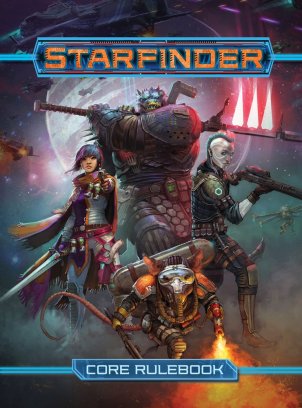
 . This is the book where you’ll find a ton of monsters, new player races and, most importantly, simple rules for making MORE monsters and races. If you’re going to run a game of Starfinder, you NEED the Alien Archive.
 is for you! This book contains details on all of the major planets of the Pact Worlds, new playable races, new themes, new ships, new archetypes, and new gear, spells and feats! In short, despite being a book about the setting of Starfinder, it’s got a ton of new class options for everyone. This book isn’t necessary, but I know I’m DEFINITELY adding it to my collection.
 is a must-have play mat for the Starfinder game.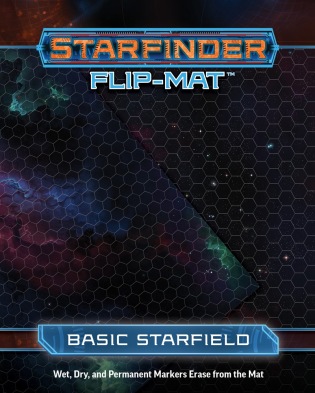
 , is a great choice for a wide variety of terrain types. Starfinder has launched another new basic flip-mat, which is a great addition to your game (and my favourite of the new Starfinder mats),
  . One side is a windswept desert or badlands style terrain, while the other is a metallic, grey terrain type. In addition to basic mats, Starfinder has launched a couple REALLY beautiful flip-mats. In general, although they’re lovely, and easy to use, I tend to stick with the basic mats for budgeting purposes. But if you’re interested, there’s the
  , which features a high-end dance-club scene on one side, and a grungy, dive-bar on the other. The
  features a sleek exploratory starship on one side, and a more utilitarian ship on the other side which would work great as a military ship, a freighter, or a derelict ship. The last map I haven’t been able to find on amazon, which means you’ll have to order direct from Paizo’s website (which if you’re Canadian, like, means the shipping fees are a nightmare). That being said, the

 which comes with a hundred awesome minis perfect for player characters and humanoid enemies, as well as a large assortment of ship pawns. You are going to get a TON of use out of this collection! In addition, I highly recommend the
  from amazon or from Paizo’s website
  (which has gorgeous artwork on one side and a collection of very important information for the GM on the other),
  (which is a very detailed character sheet), and
  (to help make combat organization quicker and easier). But what I’d recommend is the
  , which put all of the conditions in Starfinder on handy cards which can be given out to players, or used by the GM for easy reference. They also feature some snazzy artwork of space goblins on each condition to make them more interesting.
 ,
,  ,
,  ,
,  , and
, and  . From what I’ve read so far of the Adventure Path, it’s great fun.
 , which can be complicated, to say the least! Second, although a lot of Starfinder’s rules are familiar, and a player of Pathfinder could technically pick up a character sheet and hop right into the game, there are a lot of minor changes to the rules and character creation process. This means that there are differences which you should read. Owning and reading the
  , browsed it, desperately wanted to buy it, but put it back because I had NO IDEA what it was. Haha. So, from me to you, Starfinder, THANKS. Countless curious readers will appreciate the overview. I promise.


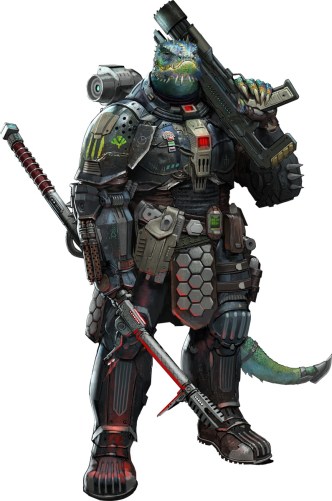


 Presenting, the
 ,
,  and the classic
  .
.

 The Quest for Perfection
 Scenario
 The third adventure we’re taking a look at is the Palace of Plenty, a 3.5 Dungeons and Dragons adventure written to complement the
  book. This adventure was written by Tito Leati, and was published in
  The fourth adventure we’re looking at is
  , a Pathfinder adventure written by Tim Hitchcock and intended for 11th level characters. This adventure brings us back to the Wall of Heaven on the continent of Tian Xia. Here, on the island of Xielan, a prestigious fighting tournament takes place, which allows the winners to claim any one object from the treasury of Hao Jin, the Ruby Pheonix. This tournament attracts combatants from all over the world, including from nations inspired by real-world Japan, China, India and many more. The matches the players are going to engage in are varied, with the terrain often playing an important part in the battles. Some places the players might find themselves fighting in are: flooded mud pools, hot coals, atop multiple towers and rope bridges, and even fighting horizontally on the side of a cliff (literally standing on the cliff face with slippers of spider-climb)! Your players are bound to be continually surprised. In addition to the tournament battles, the players can join in extra matches and challenges. But as the tournament proceeds it becomes clear that something is wrong. From entrants being poisoned and assassins attacking, the players will have to work fast to figure out who’s trying to put an end to the Ruby Pheonix Tournament and stop them, before it’s too late!
 The final adventure we’re talking about today is my very, very favourite.
  by Tito Leati. Now, the Jade Regent is a Pathfinder campaign where the last three books take place in Minkai, Paizo’s Japanese inspired nation in Tian Xia, but volume five of the series is my all time favourite. This adventure was clearly written with such LOVE and RESPECT. It’s honestly astounding how clearly that shows in the final product. But enough about the writing, what about the adventure?!
 , is written by Neil Spicer, and is intended to bring characters from levels one to four. The Iron Gods Player’s Guide is a free download on Paizo’s website,
  , which has a ton of unique pawns for use in the campaign.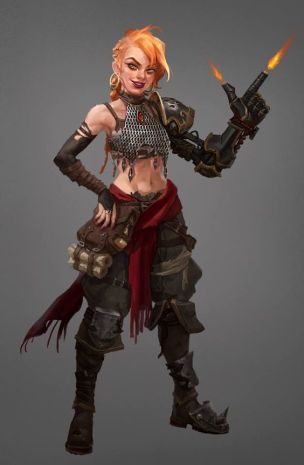
 , we played through one of the parts of this campaign that my children were most excited about–an auction at the Canny Jackal. Now, my children don’t actually play in Mummy’s Mask on Friday nights, but they did help me populate and pre-test the auction, so they were literally bouncing in excitement all day.

 , and may prove to be a recurring contact for the player’s.
 . In addition, the character of Sallal is from Wayfinder Volume 12, available as a free download
  d20 Diaries