Well, it may be a little late (okay, more than a little), but the War for the Crown Player’s Guide has finally been released by Paizo. Meant to go with their War for the Crown Adventure Path, which takes place in the nation of Taldor, this player’s guide is a free download on their website. The War for the Crown Adventure Path is already underway, with volume one, Crownfall, released in February, and volume two, Songbird, Scion, Saboteur, released this month. The other four volumes have yet to be released.
Now, I’m not sure about all of you, but I’ve been supremely excited for the War for the Crown Adventure Path. However, purchasing that lovely little book isn’t in the cards right now, so I was ready to pounce on the Player’s Guide the moment it launched. And I waited…. And waited…. And waited….
Like the Adventure Path Player’s Guides before it, this one is filled with all the information you need to create a character well-suited to the (War for the Crown) Adventure Path, and invested in its major plots and purpose. It contains advice and compiled lists of which classes and archetypes are best suited to the campaign. It briefly describes the region that the Adventure Path will be taking place in (Taldor, in this instance), as well as the culture or cultures found there. It describes each races place in the region, and gives advice on which obscure races are more common there (I was pleasantly surprised to find Taldor contains a LOT!). It also releases a series of traits specific to the Adventure Path (called Campaign Traits), of which each character is expected to have one.
There was plenty of wonderfully, interesting information in this little guide, and I actually got a really great feel for Taldor from it. Not a clichéd stereotype of the nation, either. An actual feel for the place. It left me happily inspired. Although there’s lots of neat tidbits we could discuss here, I’m not going to go into details. It’s free! You might as well download it yourselves.
My favourite parts of the Player’s Guide were quite unexpected. The first was a wonderfully illustrated map of Taldor. It’s just… beautiful. I love it!
And the second? We finally got a good, clear view of Princess Eutropia Stavian, eldest daughter and only living child of Grand Prince Stavian III, ruler of Taldor. Who? The War for the Crown Adventure Path was not given its name without cause! The players are going to be acting as spies/diplomats/agents of Princess Eutropia herself as she maneuvers through a budding civil war in order to claim Taldor’s throne for herself. And her opponents? Not nearly as awesome as she is! Holy smokes! I knew a bit about her from campaign spoilers, namely that she wanted to change Taldor for the better, she supports reform, she wants to ensure that women could inherit (as currently in Taldor only men can), and wants to claim the throne for herself. I’m not sure what I expected, but the Princess Eutropia we got was not it! In a good way! She’s AMAZING. From her stats to her backstory, from her public attitude to her inner turmoil, and especially THAT ART, she literally blew me away. Never mind who her opponents are, I’m in, hands down. Call it! I support the Princess!
Seriously! Look her up.
But, it’s a Player’s Guide! It’s not about our patrons, or our country. Not at its core. At its beating heart the Player’s Guide is a free tool to help players like us make characters who will work well within the Adventure Path they’re going to commit to. It should inspire us to make characters, entice us with ideas, provide us with some cool traits, and let us go crazy. And this one did.
There’s plenty of character concepts you could run with for this campaign, and a ton of classes that would work. Rogues and bards (from the Core Rulebook or the Core Rulebook (Pocket Edition)) as well as investigators (from the Advanced Class Guide or the Advanced Class Guide (Pocket Edition)) are the most obvious options, and probably the best suited to the campaign. But, I’m not one for optimization. I won’t play something just because it’s going to be the best or the most useful. It’s characters and quirkiness that I tend to enjoy most. So, I gave all the classes a lot of thought. I quickly narrowed it down to four classes that I was inspired to make. Yes, bard was one of them. I LOVE bards. Absolutely, positively, my favourite class. And although I’ve made plenty of bards, they all seem doomed to have their campaigns crash and burn and die. So sad. Which means that bard is once again a strong contender for class choice. I also adore occultists, and making one who utilizes ancient relics of Taldor sounds like a ton of fun. The third option I’m contemplating is the mesmerist. I recently had a chance to test one (finally) as a player for a Pathfinder Society Scenario and I just had a ball. I think mesmerist’s would be a great choice for this campaign. Both the occultist and mesmerist are from Pathfinder Roleplaying Game: Occult Adventures.
And lastly? The vigilante, of course! I feel that vigilante’s are a hard class to play. Not mechanically, but to actually use. At their heart they’re linked to one area or region (which not a ton of campaigns are) and they rely on keeping your two identities secret (which could be a challenge among certain parties, and even among players). Although I’ve been interested in them since their release in Pathfinder Roleplaying Game: Ultimate Intrigue, I haven’t had opportunity to play one before. And War for the Crown seems like the PERFECT time. Honestly! Is there ever going to be a better chance than this campaign? I highly doubt it. How can I resist?
So, although mesmerist is a close runner-up, I’d play a vigilante for War for the Crown. But what kind? One that I’ve desperately wanted to play since it’s publication is the magical child. Yeah, yeah. It’s cheesy, I know. But my favourite show growing up was Sailor Moon. This archetype is literally my childhood dreams all rolled up into a spectacular little package! So, obviously I want to make one. But, it’s not the only vigilante archetype I’m interested in. The warlock is also cool. With the ability to hurl magical bolts or wield them in melee combat and up to sixth level spells at your disposal, I think this archetype would be a ton of fun. And finally, the psychometrist! This class gains the ability to use the focus powers of the occultist class, with implements you designed yourself. You get to be an master inventor, who utilizes awesome gadgets. How cool is that? All three archetypes are from Pathfinder Roleplaying Game: Ultimate Intrigue.
In the end, it was the psychometrist that won me over. I’d probably play a clever woman… The daughter of an inventor or craftsman. She was married to a ‘like-minded’ man before her father’s death so that she could inherit her father’s business and home (through her husband). Unfortunately, her husband wasn’t as ‘like-minded’ as they thought. He sold the business, took over the house, and was generally a big jerk. Infuriated, she lobbied for change and reformation, making a public spectacle of herself, and gaining the support of many of the lower classes (or at least causing them to talk). In order to shut her up, she was given a government job tending to the plights of the commoners. It was office work, reading official requests for assistance and sorting them by priority and importance. Unfortunately, the department she was supposed to pass on her recommendations to, turned out to be completely un-staffed. It existed only on paper. Her job was useless! A sham! And her reputation? Ruined! Or was it? Using the complaints as a guide, and her father’s inventions (with a few modifications of her own), she took to the streets to help those in need. She would save Taldor one person at a time!
How about you? What character concepts and builds would YOU like to play for War for the Crown? I’d love to hear them!
I love Pathfinder. My husband loves Pathfinder. My kids love Pathfinder. So when I first heard about the release of Starfinder I was excited. I didn’t think I’d love it as much as I did Pathfinder, but I knew I’d enjoy it. And I was right! Although it didn’t supplant Pathfinder as my favourite d20 game, it turned out to be a blast. My husband and son were the same. Love that Starfinder! But love Pathfinder more.
And my daughter? Ah, my daughter! She loves Starfinder best of all. Absolutely, positively loves it. She has such patience for the game, and for learning it. It should be noted: she’s six.
So, it came as no surprise to me that she finally looked at me and said, “Mom! d20 Diaries needs to hear about our Starfinder characters! Write about my Starfinder!”
And here we are! Mommy’s on it, dear!
So without further ado, (and because my daughter’s certain she’s waited enough!), here they are.
I was the first one to make a Starfinder character in my house. But, I didn’t start by making characters I intended to play, so much as making characters for the sake of making them. I wanted to get a handle on the creation process, and understand the mechanics of the game. I tested out classes and mixed them with different themes, curious how much it would effect the feel of the character. The first character I made with the intent of continued play was a bold, enthusiastic (and admittedly stupid) Vesk solarion by the name of Julakesh Starfist created for playing in the Starfinder Society via play by post. She’s not my only Starfinder Society character, of course. I have three, but we’ll touch on them another time.
So, imagine my surprise when it came time to sit down and make our characters as a family, that my daughter was the first to insist upon a turn. She immediately informed me that nothing would be good enough until we converted her lovingly made rabbitfolk to Starfinder. But, we sat side by side and flipped through the book while I read to her. She thought humans might be okay, and that bug and lizard people were right out (“Ewwww!” was her actual response). But there, right at the back, were the ysoki.
“Rats?!” She said. And then, “Hmmmm… Them are cute…”
And by the time she heard the words ‘cheek pouches’ she was sold. “Them are my favourite!” She exclaimed.
“They.” I corrected, because grammar matters.
“THEY are my favourite! I will be a ee-so-keeeeee with a robot rabbit that I made myself!”
Sure, I thought. She’ll be a mechanic! So I read her the mechanic class and she said, “No way! I am NOT a mechanic!”
Uh… Okay, then.
So we set to work reading through all of the classes and she finally decided upon technomancer. We fiddled with her stats, and picked out her spells. I thought for sure she’d choose something flashy, and was surprised at her very utilitarian, understated choice of air bubble and unseen servant. For cantrips she chose dancing lights, energy ray, mending, and token spell.
We looked at themes and she immediately decided on being a bounty hunter. When asked why she told me, “Cause her is–“
“She.”
“Cause SHE is looking for the perfect mate! She will hunt him down if she has to!”
I decided it was best to discuss that issue no further, and her ysoki bounty hunter technomancer was born! She put skill points into computers and engineering, so she could modify her custom robot rabbit at higher levels, and then chose to put the rest into acrobatics, medicine, physical science, piloting and mysticism. For her feat she chose skill focus (engineering), to better enable her to create her own robot rabbit.
Then we turned our attention to gear. Her first priority? Making her robot rabbit. So we flipped to the chapter on computers and created a mobile computer that looks like a mechanical bunny, with basic AI, an artificial personality, a voice box, locomotion, the ability to function as a personal comm unit, and as her spell cache. Oh! And she wrapped it up in faux rabbit fur for optimal cuddling. It’s the most expensive frivolous object I’ve ever had a hand in crafting. Unfortunately, it used up all of her starting credits (and some if mine as a loan). Apparently I would be making a character who was either generous, or a moneylender…
With her ysoki complete, all she needed was a name. She scrunched up her face in thought, and made up the name Hoponisa! Or Hops for short. She decided Hops was from the dark side of Verces, and used to the cold. And what did she name her robot/spell-cache rabbit? Snowball.
But who would be travelling with our quirky little ysoki? A good question! For answers we turned to my son. After peering over my shoulder as I read to my daughter, and stealing my Starfinder rulebook to gawk at the pictures whenever he could, my son already had a solid idea of what he wanted to make.
“I love drones, Mom! You know I always ask you to get me one for Christmas and you never do! Well, I WILL have one! I am a mechanic! And I will either be a ysoki or a shirrin. I like the Shirrin best, I think, cause they are so funny… But she is being a rat… Maybe I should be one to?”
“Don’t copy me!” My daughter yelled. “Mom! Him is copying me!”
Obviously, there was a great argument following this statement, which I will spare you, but by the end of it my son decided he liked shirrin better. He would be a bug and have lots of baby bugs dangling off of him in their little canisters, and it would be awesome! So there!
My son decided early that his ‘super-awesome way-better-than-a-ysoki’ shirrin mechanic would be an ace pilot by the name of Vishkesh. His drone was a spy drone, with little arms and hands. With these he would manipulate tools and be a mini mechanic who always helps Vishkesh with repairs–or does them on his own if they’re in hard to reach places. With a flare gun mounted on his back and a chipper attitude reminicent of Claptrap from the Borderlands video games, the little fellow was adorable. He decided to name him Rijin, and even before play began, my son LOVED him. For skills, he invested in piloting, engineering and computers, followed by perception, physical science, athletics and survival. For his feat he chose skill focus (piloting). Enamoured with the iconic mechanics flamethrower, my son decided he would purchase a flame pistol for himself. Along with his other gear he purchased a pig stuffed animal. He decided Vishkesh was from Absalom Station, and worshipped the god Hylax.
My husband went next, and after much deliberation he ended up making two characters. However, the one he chose to use to play with our kids characters in the end was a halfing by the name of Tucker Aetherfoot. Tucker’s an operative with the daredevil specialty, making him a nimble, acrobatic fellow. He chose scholar for his theme and nimble moves for his feat. For skills he invested in acrobatics and athletics, of course. He also invested in bluff, computers, culture, life science, perception, piloting, sleight of hand, stealth. Finally, he invested in profession (blogger), his quirkiest choice by far. When it came time to choose his equipment, Tucker invested in a survival knife and azimuth laser pistol for combat purposes, along with some more utilitarian gear. As a nod to his pal, Vishkesh, he purchased a t-shirt with a Shirrin design across it, while to represent his friendship with Hops he purchased a space helmet with a rose tinted visor and stylized mouse ears on the the sides. Tucker comes from Absalom Station, and worships Desna. Thus prepared, it was my turn.
As previously mentioned, I have a few Starfinder characters, and already had a few favourite races (ysoki, vesk, and shirrin), so I wanted to try out a race I hadn’t before. In the end I chose to make a kasatha. Knowing our group would be in need of healing, I decided on Mystic for my class. Although I had a few connections I was debating between, I went with the healing connection in the end, with the concept that my character would be a serene, wise, enigmatic character with a strong respect for life. This granted me the healing channel, and healing touch abilities. I chose the xenoseeker theme, and the bodyguard feat. For zero level spells I went with daze, detect magic, stabilize and token spell, while my first level spells were mystic cure, mind thrust and share language. Deciding my character would be traditional and more interested in cultures than technology, I went with culture, diplomacy, life science, mysticism and survival for my skills. (That’s right! No engineering, piloting, or computers here!). When it came to choose her gear, I picked up a battle staff (love that block ability!), and a pulse caster pistol (because all life is precious). I have ambitions of installing a merciful infusion on my battle staff, but that’s a thought for another day. Then it came time for the name. Now, it should be noted, I love naming conventions, so the Kasatha’s absurdly long lineage name really tickled my fancy. In the end I decided to not go too crazy or off formula. I named her Aya. Full name: Aya Nina Qaru Jehir of Clan Zomala, House Maendar, soul-splinter of the Line of Altronus. Aya worships Talavut, and is lawful neutral. She comes from Idari, the kasathan home-ship.
With our characters complete, it was time to get together, and play. But, that’s a tale for another day!
There’s been exciting changes to the Pathfinder Society Organized Play this past week. On Wednesday, Pathfinder Roleplaying Game: Ultimate Wilderness became legal for play. So crack out your books, and calculating statistics, it’s time to make some Shifters! In addition to the Shifter class, there’s a ton of wilderness themed archetypes that became usable. Around 80 archetypes from the book are now considered legal, and nine of them are not (blighted defiler, blighted myrmidon, fiendflesh shifter, flood walker, rageshaper, raging cannibal, verdant grappler, wildborn and wild soul). Happily, all three of my favourites, the oozemorph, the season sage and the viking, made it into PFS. Nearly all of the familiar and animal companion options were made legal, as were all of the animal tricks (excluding mark territory). All but three of the spells were added to the additional resources document (with forest’s sense, grasping vine, and vine strike being the spells left out of play), making around fifty new spells up for grabs. Feats had nearly as good luck, with around a hundred feats sanctioned for play and only ten being left out (Cultivate Magic Plants, Expert Cartographer, Expert Explorer, Expert Salvager, Hide Worker, Mutated Shape, Natural Poison Antitoxin, Sproutling, Wild Growth Hex, and Wood Crafter are still not allowed). Nearly all of the miscellaneous character rules like discoveries and rage powers were made legal. All in all it’s an exciting, vast collection of new player options for us to tinker with. For full details on what’s become legal from Ultimate Wilderness for PFS Organized Play, check out the Additional Resources document on Paizo’s website and scroll down to the bottom.
The sigil of the Scarab Sages, a faction of the Pathfinder Society whose relevance is coming to an end.
On a related note, another major announcement was made last week. The storyline of the Scarab Sages Faction has officially come to an end, although characters are still allowed to keep their Pathfinder Society Characters in the faction and continue earning their season goals. In it’s place we get a new faction, Concordance. As the only ‘nature’ or ‘wilderness’ themed faction, this group was a long time coming. The two main members of the group we’ve been introduced to so far were met quite a long time ago, with the janni Jamila being introduced back in the third PFS scenario ever published, #03: Murder on the Silken Caravan, and the gnome Falbis being introduced in scenario #3-05: Tide of Twilight. The actual leader of the group, Ashasar, was introduced in scenarios #8-12: Caught in the Eclipse, and #8-24: Raid on the Cloudborne Keep. The Concordance was first utilized in the Tyranny of Winds Trilogy, which includes scenarios #8-08: The Sandstorm Prophecy, #8-10: Secrets of the Endless Sky, and #8-12: Caught in the Eclipse.
Now, I mentioned that The Concordance is a ‘nature’ themed Faction, but this isn’t strictly true. They’re not some ring of tree-hugging druids, or animal-loving rangers. They’re concerned with keeping the elements, and the elemental planes, in balance. Although they’re typically involved in affairs on the elemental planes themselves, a group of the Concordance has recently established itself on the material plane, upon realizing that its home to many extra-planar rifts, wild magic, elemental surges and the like. More properly known as the Concordance of Elements, this group is ancient and diverse. Honestly, I think they sound awesome.
The sigil of The Concordance of Elements, a new Faction joining the Pathfinder Society.
The Concordance wasn’t released on it’s own. It was also released with a society scenario which features the organization, and offers Pathfinders who play in it the chance to join the faction after playing it through to its completion (without cost or penalty). That’s pretty neat! Very rarely do you get the chance to test out a faction in this way, without committing.
The scenario itself, #9-14: Down the Verdant Path, was a lot of fun. I won’t get into the plot line too much, but know that it involves a bleached gnome, the First World of the Fey, and unnatural weather. Down the Verdant Path makes spectacular use of NPCs, both allies and enemies, and in addition to starring new characters it also features all three of the above-mentioned members of the Concordance Faction (Jamila, Falbis and Ashashar). They did a splendid job of bringing these characters to life in an engaging, fun way. Down the Verdant Path is a splendid tier 1-5 scenario, which I can’t wait to play in.
With who?
A member of the Concordance, of course! As to WHAT I’ll make her, I’m not quite sure. I’m contemplating an elf druid of some kind. I never make elves. Haha.
Things are pretty crazy around my house right now. My son’s sick (again), and both of my children had their birthdays this past week. But, as things begin to settle, we’re ready to get right back into the swing of things here on d20 Diaries. So today, we’re taking a look at another book I recently got my hands on: Pathfinder Player Companion: Adventurer’s Armory 2!
The Adventurer’s Armoury 2 is a sequel to the ever-popular Adventurer’s Armory, which was also released as a Player Companion back in April 2010. As a product from the Player Companion line, it’s a thin, soft-cover book intended for use by players, which clocks in at 32 pages in length. In my opinion, the Adventurer’s Armory was among the most universally useful books in the Player Companion line, so I was thrilled to pick up the sequel.
Without further ado, let’s take a look at what’s inside…
The inside covers both feature purchasing charts showcasing the new equipment in this book. The front inside cover’s home to weapon and armour charts, while the back inside cover’s where you’ll find everything else. This includes adventuring gear, alchemical remedies, alchemical tools, alchemical weapons, poisons, clothing, magical items, and mundane tools. Looking past the covers we find the table of contents and then the introduction.
Although it doesn’t sound very exciting, the introduction’s home to one feat, Equipment Trick, which is an old, quirky feat originally printed in Adventurer’s Armory which allows your characters to make interesting uses out of a specific type of equipment chosen at the time of taking the feat. Only certain items have equipment tricks written for them, and in order to use each trick you must meet its specific requirements. Sound confusing? No worries. You take the feat and select which kind of item you’re going to learn tricks with, then read the list of tricks. If you meet the requirements for any of those tricks, you can use them. If not, keep an eye on them. You can use the trick as soon as you do meet the requirements, even if its many levels down the road. Curious what kind of equipment you can utilize? We’ll touch on that again later. For now, just know there’s plenty.
After the feat, you’ll find a collection of five traits which are all themed around where you buy your goods and feature some of the most infamous marketplaces in the Inner Sea. Including Absalom’s Coin District, Cassomir, Katapesh, Ostenso, and Riddleport, each of these traits are flavourful and fun. That being said, they’re not staples. You won’t read them and decide every one of your characters has to have it. My personal favourite? Absalom’s Amiable Briber, which is a social trait allows you to offer bribes without fear. The first time someone refuses a bribe you offer, that person’s attitude towards you doesn’t worsen, even if the offer normally would offend the person. Cool! Cassomir’s Bountiful Herb-Lore and Riddleport’s Master Messenger are also pretty cool, so be sure to check them out.
Lastly, the introduction features a handy rules index that lists the page numbers of each feat, trait and other rules option presented in this book. By now, one thing’s already clear: not everything in Adventurer’s Armory 2 is new. Some of the equipment and player options in this book are reprints from other out-of-print books. An understandable move, and helpful for those of you who might not own the original sourcebooks.
Moving on from the introduction we come to one of my favourite sections of the book: Equipment Packages! What, you may ask, is an equipment package? Simple! It’s a big collection of gear that your characters can choose to start with. What does it cost you? Two things! First, it costs a trait: Well-provisioned Adventurer. Second, it costs your starting gold. That’s right! If you take this trait you don’t staring gold at all. So, are these equipment packages worth it? That depends. In terms of value, each of these packages is worth about a thousand gold pieces. That’s a lot! In addition, the gear is well-chosen, and varied. Each allows for a minor amount of tweaking with GM approval, which should make them even more accessible. Having that much extra wealth can mean the difference between life and death at level one. However, whether or not you personally feel the gear is better than a +1 to a saving throw, a bonus to a few skills, turning a skill into a class skill, or picking up a quirky minor ability, is entirely a personal preference. My husband wasn’t wowed by it, but I certainly was, and my kids also loved it. I wouldn’t use it for all of my characters, of course, but for plenty these equipment packages are an option I’d consider. In addition to a well-chosen set of equipment geared at many different class types, these packages also include the weight for both medium and small characters already calculated. A wonderful thing if you don’t really like number crunching weights and carrying capacities, determining the adjusted weights for small sized characters, or coin counting to the copper piece. These equipment packages can also be purchased for 1,000 gp, for those of you who don’t want to use a trait to get one. As an aside, GMs can also use these equipment packages as rewards, care packages and gifts to be handed out to your players by grateful NPCs. The only obvious downside? They’re heavy. With the lightest weighing in at 44 pounds (28 3/4 for small characters) your low-strength characters are bound to be overburdened by them. I’d love to see some more light-weight options appear in the future. My favourite equipment packages turned out to be the Arcane Adept (intended for arcane spellcasters) and the Daring Bravo (intended for any lightly armoured combatant). My young son loved the Wilderness Warrior, while my daughter loved the Mystic Guide (which she’d like to use on her next druid). After you’ve given the equipment packages a read, leave us a comment and let us know if you intend to use any. I’d love to hear your thoughts.
Next up we come to what most people will purchase this book for: armour and weapons. First up’s the armour. With eight new choices varying in price from 1 gp to 2,100 gp, there’s a wide variety of new armour, even if there aren’t many. My personal favourites are the Erutaki coat, the Varisian dancing scarves, and the reinforced tunic. In addition to armour, this book introduces a new type of item called a modification. Modifications can be applied to armour by a skilled smith, and offer both a benefit and a drawback. You’ll also find a feat later in the book that allows players to better utilize armour modifications. Although cool, none of these modifications are cheap, so invest with care. I’d recommend the nimble modification, which increases an armour’s Max Dex by two, reduces its check penalty by one, but costs 1,000 gp, and adds five pounds to its weight. Burnished also sounds like lots of fun at lower levels. For a cost of 500 gp, five pounds of added weight, and a -10 penalty to stealth in areas of bright light, you can dazzle your enemies with your brilliantly shining armour! Capable of targeting everyone who can see you within 30 feet, this ability has the potential to be really effective. However, each target can only be affected once per day. Other armour modifications include deflecting, double-plated (which I expect will see a lot of use), jarring, nimble, razored, slumbering (which is SUPER handy) and vitalguard.
With that we come to the Weapons. There’s a whopping twenty-five new weapons in this book, most of which are exotic, and only one of which is simple. I’m pretty partial to the cutlass, the lantern staff, and the spiral rapier. That being said, the flask thrower’s going to be incredibly handy for some characters. Past the new weapon options you’ll find a handy list showing what weapon group each belongs to, followed by seven weapon modifications. Weapon modifications work in the same way as armour modifications do, and also feature some feats which can improve their efficiency and capabilities. In addition, modified weapons have their weapon type increase by one step (from simple to martial, and martial to exotic). The weapon modifications included in this book are brutally weighted, dual-balanced, jagged hooks, razor-sharp, serrated edge, tactically adapted, and versatile design. Personally, I think that dual-balanced (which reduces the penalties for two-weapon fighting by -1) and tactical adapted (which allows you to add weapon qualities like blocking, disarm, and nonlethal to a weapon) are bound to see the most use in play.
All in all, I like the idea of modifications more than I like them mechanically. I’m unlikely to invest in them due to their hefty price tag, and the extra weight. Of course, if I’m playing a character who has extra cash to spend, a wide array of proficiencies and carrying capacity to spare, I’d give definitely them a try. I’m very curious to see them in action.
Next up we have a single page of feats. There’s nine of them total, and all of them are combat feats. Seven have to do with armour and weapon modifications, while the last two involve utilization of the dwarven dorn-derger, an exotic weapon that appears in this book. Although I’m sure some people are bound to try out the modification feats, especially Creative Armorsmith and Creative Weaponsmith, I found the feats on offer so specialized that I’m highly unlikely to use them. It’s a shame, but luckily these aren’t the only feats up for offer in Adventurer’s Armory 2.
Leaving the weapons and armour behind we come to the next section of the book, which showcases eighteen new pieces of mundane gear. Of them, I’d guess that only five or six will see play with any kind of frequency. The most useless item on the list would definitely be the false teeth, while the most universally used would probably be the charcoal. It’s so much better than buying ink and an inkpen! But, my favourite? The spring-loaded scroll case. This snazzy little case is five gold, and can be hung from a belt or backpack. It holds a single scroll which can be retrieved as a swift action. Shiny!
After the adventuring gear is a new type of equipment known as preparatory gear. These are items that you practise with for an hour everyday, then make a specific skill or ability check. If you pass, you gain a benefit that lasts for 24 hours. For example, the drowner’s helmet can help train you to hold your breath longer and the practise straitjacket can help train you to escape from bindings. There’s only two other preparatory gear in this book: the hanging board and a thief trainer. Each option’s a bit pricey–between 35 and 200 gp–but is certainly useful. The one hour daily training requirement might be a turn-off for some players, but I don’t mind at all. It’s particularly useful for non-spellcasters who travel with spellcasters and can give them something to do while your casters prepare their spells or pray to their deities. Since the benefits of each last 24 hours, training can also be done at night before heading to bed. All in all I think it’s an intriguing concept, and I’m excited to see them put to use.
Up next is some equipment tricks for use with a few fun bits of mundane gear: ladders, lanterns, mirrors and poles. Each type of gear has between three to five tricks associated with it (poles have three, ladders have four, while lanterns and mirrors have five each). Some of these tricks require a number of ranks in an associated skill to utilize, while others require specific feats as the prerequisites. The lantern tricks are the most utilitarian, and allow users to make their lanterns burn brighter or dimmer and explode like alchemist’s fire when thrown. When being held in the same hand as a shield, your lantern can deal some fire damage with each shield bash. Finally, you can toss lantern oil in an opponent’s eyes with the dirty trick maneuver (your lantern or theirs) which can both blind and burn them. The mirror tricks also sound like lots of fun. My personal favourites let you shine light into your opponents eyes, reflect gaze attacks, and even penetrate illusions! No longer is your mirror just for looking around corners!
Leaving behind the mundane adventuring gear we head into the exciting world of more mundane gear! This time it’s tools and tool kits we’re taking a gander at. Both of these sections are small, with only six items in each. As far as tools go, I was excited for a duo of new bear traps, while my daughter insisted that the portable terrarium was the greatest item in the entire book. (Warning: She may have been biased by the adorable picture of the terrarium, which features a cute little frog in a glass globe…). As for tool kits, I’m partial to the elemental explorer’s kit, and the underground survival kit, although I’m more than ready to admit that the fiendslayer’s kit and the undead survivor’s kit will see more use in play. And what other kits are up for offer, you ask? The emergency interrogation kit, and the invisible enemies kit.
The next section is a single page that features seven new poisons. The cheapest poison up for offer is the delightfully named rainbow scarab shell. At a price of only 150 gp per dose, this iridescent toxin deals strength damage upon injury once per round for four rounds. Although it’s not particularly difficult to resist or overcome, victims who reach 0 strength also begin to suffocate. The priciest poison also happens to be my favourite. Grinding joint paste is an ingested poison with a ten minute onset which costs a whopping 2,100 gold per dose. Made from dried and ground up cockatrice organs it causes a decent amount of Dexterity damage for six minutes. In addition, movement becomes so painful that the victims take damage whenever they swing a two-handed weapon or move more than ten feet in a round. Ouch! I’m also pretty partial to the Leng’s tears, which is a fast acting contact poison which causes vivid hallucinations and paralysis. Failing just once causes a full ten minutes of paralysis, with unlucky victims being unable to move for an entire hour. Nasty!
Following these nasty poisons is another set of equipment tricks, this one for instruments. Of all the equipment tricks offered in this book, this set are by far my favourite. In fact, they might be my favourite equipment tricks ever. I love them! Attention grabber lets your character draw attention to themselves in order to cover their allies movements. Goad animal lets you command friendly animals to perform tricks they know as a free action or push them to perform tricks they don’t know as a standard action. Jaw-dropping distraction lets you feint with a perform check instead of a bluff check. Play to the crowd let’s you use a perform check in place of an initial diplomacy check to influence an NPC, and finally, ruffian’s riff lets you treat an instrument as an improvised weapon with the performance special feature. Got a masterwork instrument? Then it counts as a masterwork weapon. Got a magical one? It’s treated as magic for the purpose of overcoming damage reduction. Awesome. I’m definitely going to be giving these tricks a try.
Side by side on the same page with the instrument equipment tricks is a column that I actually loved a lot. Examples of masterwork tools. I know, it doesn’t sound very exciting. But, think of it. How often do you purchase the generic ‘masterwork tools’ from the Core Rulebook. On occasion, right? Maybe if you’ve got a character who has a craft or profession. But this list reminds us that these tools are far more useful than the average player has been giving them credit for. This lists a large number of skills (which don’t already have a designated tool or tool kit), and provides example tools that you could purchase to improve those skills. Want to improve your acrobatics check? Pick up a balancing pole, gymnast’s slippers or a vaulting pole. Feel like being menacing? You could invest in frightening tattoos, an executioner’s hood, or a set of torturer’s tools. How about a reference book to help with a knowledge check, or lubricating oils to help escape bonds. This list really got me thinking about the term ‘tool’ and how they can be applied to a wide variety of characters and skills. I was honestly surprised how useful I found this little column, and I’m sure plenty of other players will get good use out of it, as well.
The next two pages revolve around clothing, with the first page being ten new articles of clothing, and the second being six new spells that need to be cast upon specific articles of clothing. The burglar’s outfit, courtesan’s outfit and squire’s outfit all provide great new options for starting outfits, while the spells allied cloak, grappling scarf, and surefoot boots were all great fun.
Past clothes we get to one of my favourite sections in the book: impromptu equipment. That’s right! Want a list of example objects and their damage for reference? It’s here! Want some magical items that help improvised weapons? Also here! There’s also a few neat feats and, my personal favourite: special qualities that some improvised weapons can possess. So whether you’re wielding a pronged taxidermic moose head, a gross hunk of rotting meat, a heavy anvil, or a burning log, these improvised weapons qualities are a lot of fun that can really get your player’s creativity flowing. It’s going to be a blast! As for feats, check out hook fighter, which lets you turn a grappling hook into a deadly weapon. For magical gear be sure to pick up gloves of improvised might and quick metal bracers, both of which are awesome options for characters interested in focusing on improvised weapons.
As we near the end of the book we find ourselves among a pile of products that can be created with arguably the most popular type of crafting in Pathfinder: alchemy. This section features two new alchemical remedies, three new alchemical tools, and seven new alchemical weapons (four of which are forms of alchemical bolts). My personal favourites were troll stypic (a painful paste which can grant users fast healing for up to 8 rounds) and the tress tincture (an alchemical weapon that causes raid hair growth, which can be terribly irritating, as your opponents hair constantly gets in their eyes and obscures vision. Yes, you read that correctly!). In addition to new alchemical substances we also get three new sets of equipment tricks which showcase the classics of alchemy: smokesticks, tanglefoot bags, and thunderstones. Exciting! Although all three are awesome, the tanglefoot bag tricks are my favourite. If you’ve got a sneaky or stealthy character, definitely give the smokestick tricks a read. The final part of the alchemy section is a new kind of brew called concoctions. These creations are less stable than your typical alchemical creations and are known for having bad side effects. In addition, players who consume more than one concoction at a time roll on a table of random effects. Half of these effects are good, and half are bad. Of those, they vary from alright and not too bad, all the way up to amazing and horrible. If you’re a gambler this can be great fun to fiddle with, but with the options ranging from ‘unleash the full potential of my body and mind’ which allows you to gain a +4 bonus on two ability score for 24 hours, all the way to the concoction explodes within your stomach, or is highly toxic, I’m not really into to testing my luck. The concoctions themselves are typically 50 gold each with the priciest being 100 gp. Each offers a benefit and a drawback. The crystal-sweet concoction gives you +2 on diplomacy and -4 on sense motive, while the sphere-song concoction gives you +1 on Will saving throws and a -2 on initiative. Although interesting, I think these items have great potential for GM
use. These can easily be added into drug dens, dangerous bars and high-end noble parties. They can also be focal points for social encounters, or used as a ‘test of faith’ or as ‘dares’ by gangs, religious organizations and the nobility. Whatever use your group happens to find for them, they’re certainly a colourful (and potentially dangerous) experience.
The next two pages of Adventurer’s Armory 2 feature a variety of equipment from two distinct regions: the Dragon Empires and the Padishah Empire. Each region has an entire page to itself, and contains a few articles of clothing, alchemical remedies or tools, and a special material. Spirit-vision ink turned out to be my favourite piece of equipment from Tian Xia, while the special material, sunsilver, was my favourite object to come from the Keleshite culture.
The final section of this book turned out to be among my favourites. It releases rules for a brand new type of construct you can make right from level one: poppets. If crafting’s not your cup of tea, you can also purchase these little fellows. Although too costly to purchase as a brand new level one character, they’re certainly affordable by the time level two rolls around. These tiny or small creations can be upgraded and modified with a host of abilities, and can even be taken as familiars with a special feat. If you’ve been reading my blog for a while now, you may have already heard me speak about poppets. My seven-year-old son made a mad scientist who is obsessed with creating new life, and currently has two poppets he’s hand-crafted with care. To read more about poppets and our experiences using them in games, read my blog post Character Focus: Professor McMaan, and Crown of the Kobold King: Part One. Short summary: we love them.
And that’s it. We’ve reached the end.
So when it comes down to it, what do I think of Adventurer’s Armory 2? Was it worth the money?
I think so. This books features a lot of new equipment and gear, as well as some cool new rules to go with them. Although most of the rules are quite specialized and exclusive to certain character builds, the items in the book are much more varied and useful. It’s one of those books that you’ll pull out every time you’re making a new character, and pull out again for your first few level ups. Certainly, it’s not as useful as Ultimate Equipment. And with the upcoming change to Pathfinder Playtest this next August, it’s unlikely to be as popular as its predecessor, Adventurer’s Armory, was. But as far as Player Companions go, it’s definitely one of the most universally useful ones they’ve printed. In my opinion, it’s worth it.
Have a copy of Adventurer’s Armory 2 at home? Let us know what you think in the comments! Do you have a favourite item featured in its pages? Let us know that, too!
Today is the official start date for OutPost I, an online play-by-post Pathfinder convention hosted on Paizo’s message boards and a few other websites. As mentioned in a previous post, my whole family is taking part, and we couldn’t be more thrilled.
OutPost is hosting a wide variety of games, including Pathfinder, Starfinder and the Pathfinder Adventure Card Game. My husband is playing in one scenario as his Pathfinder Society character Enzo Jeggare (a Chelaxian occultist who specializes in conjuring creatures), alongside my children, who will be playing Bunny Paras (a kitsune druid), Paras (Bunny Paras’ parasaurolophus animal companion), and Senton (an Ulfen ranger better known as Mr. Ice). These characters were first introduced on d20 Diaries, here. I’ll be joining them, as well, with my uncaring kitsune kineticist, Everbloom. They’ll be trying their hand at the classic scenario, Black Waters, from Season Zero! Run by one of my favourite GMs I’ve had the pleasure of playing alongside on Paizo’s Messageboards, I’m sure GM Shieldbug’s going to give us a great game.
My children and I are playing in a second scenario together, as well. Lady Naysha (an oracle of whimsy who looks like a child) alongside her stuffed rabbit, Miss Whiskers, is setting out with a very forgetful old wizard, Fuzzzy, and his pet owl, Bobby. Bobby’s a clever little bird who helps keep Fuzzzy on task. I’ll be joining them with my dwarven fighter, Juno Berik, a self-centred woman who believes she’s far more important than she’s given credit for. They’re going to be tackling a complicated maze underneath Absalom City on the search for a lost minotaur prince, Nuar Spiritskin, in another classic PFS Scenario, #45: Delirium’s Tangle.
I’m playing another Pathfinder Scenario with my beloved half-orc monk, Kenza Bloodborn. As a member of the Scarab Sages, whose faction stories are coming to an end, I’m excited to see this stoic, warrior tackle a Scarab Sage-centric mission. Taking place in the Thuvian city of Merab, Kenza’s going to be delving into haunted ruins on the hunt for a mysterious spirit that even now seeks her master’s jewels… That’s right, she’s participating in Scenario #9-04: The Unseen Inclusion! As I only own one Season Nine Scenario, I have no idea what’s down the road for her.
But not everything’s about Pathfinder! I’m also involved in three wonderful Starfinder Society Scenarios. My primary SFS character, a bold, boastful vesk solarion with far more brawn than brains by the name of Julakesh Starfist is going to be participating in SFS #1-03: Yesteryear’s Truth. I’m also using OutPost as an opportunity to try out two Starfinder classes I’ve yet to have a chance to test. I’ve created a proud, smooth-talking ysoki xenoseeker envoy by the name of Aurora Vim (Rora, for short) who will be giving SFS #1-02: Fugitive on the Red Planet a try with a whopping three other ysoki! Apparently those furry little fellows are popular! I’ve also made a curious but awkward shirrin spacefarer operative, Zez’ka, whose keen to head off on her first mission, SFS #1-04: Cries from the Drift.
However these adventures turn out, my family and I are happy to be participating. It can be really difficult to find games for children to play via play-by-post, especially ones as young as mine, so being able to sign them up not only together, but alongside myself and my husband is a really great experience. Both of them are having a ton of fun already, especially my daughter. She asks me every few hours if she can have another turn yet, and is always giggling as she contemplates what she’s going to post.
Updates on our experiences throughout OutPost won’t be up for some time. Due to the slow pace of play-by-post games, these short scenarios will take a long time to play out. However, further details on the various Starfinder Society Scenario’s currently out for purchase will be coming later this week.
So, if you’re going to be participating in OutPost, be sure to check into your games and get posting! Let us know what you’ll be playing in the comments! We’d love to hear from you.
And for everyone else? Enjoy the start of your week!
Mine came with a minor blizzard. So much for spring! Haha.
As the snow starts to melt, and our long, long, long, winter finally looks like its coming to an end, there’s plenty going on around my house this week. In addition to pulling out sunglasses, splash pants, and rubber boots, that is…
To start with, a play-by-post campaign of Legacy of Fire that I’m involved in just lost a player, and my kids were accepted as a replacement. They spent a few days after school brainstorming and planning, and together we put their characters onto the Paizo website. They loved picking out their avatars, and saying hello on the discussion board. So what are they bringing to the table?
A pair of gnome siblings who travel the world as their whims take them. They have a particular fondness for the desert, and have recently been wandering the wilds of Katapesh. My son is a sorcerer with the elemental bloodline (water). Studious and curious, Min Bunnisbeldar is a blue-haired gnome who obsessively studies and researches magical techniques and theories. Along with his elemental ray bloodline talent, colour spray is his go-to method of attack. But, his intelligence might be his greatest weapon. Min’s sister, Rab-rab, shortened her last name to Bunnis. She has a pet jackrabbit (not surprising at all, if you know my daughter’s love of rabbits), and is childish and whimsical. Rab-rab is an air kineticist who can push her enemies back with her air blasts. She loves to explore, and fly kites, using her aerokinesis to keep it aloft even when there’s no breeze. Min and Rab-rab hope to bring some excitement and optimism to the campaign when they get to join in a few weeks.
In other news, Paizo updated their website. Although I was expecting some minor maintenance, it turns out they launched an entire new site design. Ironically, I was just thinking the other day they their site was super useful and easy to navigate, but was looking decidedly old fashioned. Well, that’s no longer the case! The site looks gorgeous, and it’s much, much easier to see the current new releases. It’s bold, and works great. There are some down-sides, of course. The ‘My Campaign’ tab, which you’ll rely on constantly if you’re involved in play-by-post gaming, has vanished. There are other ways to navigate to your campaigns, thankfully, but none are as fast or efficient. Fortunately, I hear they’re working on bringing the ‘My Campaign’ function back. There were some complaints that the font hurt people’s eyes or was too small. Personally, I liked it, but the majority has spoken and the font size for the message boards was increased dramatically. I think it’s obnoxiously large, myself, and hopefully they can strike a balance in the future. Honestly, my biggest problem is the black bar on the top of the page. I find that if you look at it and then proceed onto one of the white pages–like the messageboards–you get afterimages across your eyes, which makes it hard to read and gives me a headache. All in all, I’m happy with the changes, and am excited to see how the site gets tweaked in the coming weeks.
At home, my family and I have been slowly playing through our first Starfinder adventure, Into the Unknown. Soon, I’ll be sharing our character designs and our experiences here, on d20 Diaries.
In Pathfinder news, my kids have both been working on writing an adventure in their free time. My son’s involves buried treasure, and is intended to be played by pirates, while my daughters involves a mysterious island. In the coming weeks I’ll be sharing their adventures, and our characters created for them, with you, so stay tuned!
Lastly, my son filmed a youtube video about a dungeon he made. It’s our first d20 Diaries video, so we’re pretty excited. He’s thrilled with the outcome. So if you want to see what a six-year-old D&D player gets up to in his free time watch, The Temple of Snakes, below, or check out d20diaries on Youtube! We’d love to hear what you think.
When we left our eccentric heroes, Nix, Haji and his ugly rat Rothmhar had returned from the tunnels beneath the toxic Weeping Pond to purchase cold iron weapons–perfect for smashing gremlin skulls–and to return a few corpses to Joram Kyte (leader of the local Temple of Brigh) for a reward.
Artwork discovered on Pinterest, and chosen to represent Nix.
Nix was a small woman, just over five feet tall, but she was strong and fit. She had piercing golden eyes, and long, tangled orange hair that she whore pulled back in a ponytail. A manic smile was permanently set on her lips, and no matter what life threw at her, she never let it get her down. She had only one arm, the other had been torn off by a volatile piece of broken machinery she found in the junkyard. In its place was a mechanical one she had built herself. It was a black marvel of engineering. Her finest creation! And that was saying something! For Nix was an inventor, first and foremost, handy with mechanical and clockwork contraptions, as well as with alchemical substances and magical potions.
In contrast to his girlfriend’s slight frame, Haji was large even for a half-orc. He had a muscular, lean body honed from a lifetime’s worth of hard labour. He had olive green skin, long black hair and a long black beard weighted down by the stones and gems braided into its length. Like Nix, Haji was not quite whole. One of his eyes was green and alert, but the other was missing entirely, plucked out long ago by his cruel one-time master. In its place was a glittering gem, and surrounding the gaping eye-socket was a massive triangular brand. On his shoulder sat Rothmhar, his hideously ugly, hairless rat. Rocky plates of stone covered the top of the cunning rat’s head and back, while sharp, spikes of stone grew out of his skin on his shoulders and back legs. It looked painful, but Rothmhar didn’t seem to mind. Haji and Rothmhar were inseparable, for through communion with Rothmhar’s limitless consciousness, Haji was granted access to powerful magic. Rothmhar was his saviour. His friend. His god.
It was a bit of a trek from the Temple of Brigh to the Foundry. Nix and Haji walked past the base of Black Hill, which was completely empty and abandoned where it should be bustling and overflowing with smiths, and labourers. The barren hill was a forlorn sight, but they didn’t stop to linger over it. They continued on, into the square just outside of the town hall. There was a crowd gathered outside, jostling and yelling, while Dolga Freddert stood outside on the front step of the building, waving her arms for calm and quiet. None of the other town councillors stood with her.
The crowd roared at the old dwarf woman, demanding to know what was being done to fix the flame that should be blazing atop Black Hill.
“Now, now,” Dolga replied loudly. “Investigators are looking into that as we speak…”
Nix burst out laughing. “Ha! Poor, old, bird!”
Haji eyed Dolga, then the crowd with his one good eye. Deciding revealing himself would not help matters, he grumbled. “Let’s get out of here.”
Dolga caught sight of them, and her eyes widened slightly. She waved her hand at them surreptitiously, shooing them away with a motion.
Clearly, she agreed.
Haji nodded at her, and turned to leave.
Nix chuckled as they walked away. “Did you hear that? We’re investigators. We should get paid.”
“We are getting paid,” Haji reminded her with a smile.
“We should get paid more.” Nix corrected with a wide grin.
They headed down the road and over a little stone bridge that led across the stream. They passed by ‘Tempting Tonics,’ a healers shop run by a half-elf woman that dealt in medicines and magical healing potions. There was a massive crowd outside, and a line running down the road. Most of the people clutched at their heads, or moaned in pain, while a few rolled around on the ground and wept.
“Damn,” Nix replied. “A lot of people have been getting those headaches lately.”
Haji groaned, remembering the pain of the one he had upon his return to Torch. “Be happy you haven’t had one yet. They hurt like you wouldn’t believe.”
“I guess so!” Nix replied with a chuckle. “Everyone’s whining like babies! Look at them!”
Too wrapped up in their pain, none of the crowd noticed Nix pointing at them rudely with her mechanical arm.
Further down the road they passed by the General Store, which was run by a pretty red-headed woman with a mass of curly hair, and then onto the Foundry. The Foundry was a trio of buildings all owed by Councilman Khonnir Baine, a smith and a good friend of Haji’s. Though all three buildings were termed ‘The Foundry,’ each served a different purpose. One was his personal residence where he lived his his adopted daughter Val, the second was a popular tavern, and the third was a literal foundry, where smiths employed by Khonnir could ply their trade for a steady income. Since Khonnir’s disappearance in the tunnels under Torch, the operations of the Foundry fell to young Val, who decided to close both the tavern and the smithy until her father returned home.
Although the tavern did appear closed for business, as expected, it looked like the Foundry’s workshop was open. There was a clanging sound coming from inside–the familiar ring of a hammer on metal–and smoke billowing out of one of the chimneys. Peering inside, they discovered a woman working at one of the forges. She didn’t notice them, but after watching her for a moment Haji and Nix moved on.
Outside of her home stood Val Baine, beating the dust out of a rug with all the strength her little arms could muster. The house looked whole, clearly the damage caused by the rampaging robot the other day had been properly repaired. Haji nodded with satisfaction.
At the sight of Haji, Val smiled brightly. “Haji, you’re back!” She dropped her switch and hurried over to the big half-orc, giving him a hug. “Any news?”
Haji pulled away from Val and smiled gently, shaking his head. The gems and stones braided into his hair and beard jingled at the movement. “We haven’t found Khonnir among the dead. There’s signs that he made it through the caverns and into the metal ruins where he first found the robot. We’ll know more soon.”
Val nods. “I see… Well, there’s still hope, right?”
Haji smiled kindly, but Nix smirked. “Yeah, sure kid,” she replied without conviction, clearly humouring the child.
The distinction was lost on Val, who smiled brightly. “I’ll fetch your dinner! We’re having aurochs stew!”
As little Val scampered off into her kitchen to fill some bowls up with food, Haji and Nix headed into the Foundry Tavern to have a drink. Nix ate with enthusiasm, while Haji gorged himself on food and liquor. He had gone most of his life without steady meals, and had the habit of eating all he could whenever he could, just in case.
Stuffed to bursting they thanked Val and assured her they would return tomorrow after their next foray under Torch. Then they stumbled out of the Foundry and headed off down the road, to the dingy old warehouse that served as Nix’s workshop and home. Haji and Nix settled down to bed together, with Rothmhar nearby.
Morning broke with Nix growling in pain.
“OW!” Clutching at her head she rolled around for while. “OW! OW! DAMNIT! It DOES hurt like crazy!”
Despite her headache she rolled out of bed and got dressed, then headed to her workbench. She brewed herself a concoction that she hoped would cure her headache. Although it failed to do so, it did lessen the pain. Then she tossed on her work goggles and got to work crafting her gadgets for the day.
Haji watch her for a while then stretched and pulled out his bag of rocks. Rothmhar scurried up to his side, although the rocky formations that had pierced his skin yesterday were gone, leaving him hairless and sickly looking. Haji sifted through a bag of stones and gems a pulled out the agate they had discovered yesterday, along with an older agate he had found a few weeks ago. One he popped into his own mouth, and swallowed! The other he placed in Rothmhar’s mouth. Rothmhar did the same, swallowing the stone, only to start violently convulsing and frothing at the mouth. The spit and foam-like saliva engulfed the entire rat and then hardened, into a strange sort of cocoon that looked remarkably like the rock he had swallowed. There, on Nix’s dirty bedroll, Haji sat in silent communication with Rothmhar’s spiritual consciousness, connecting with magical powers beyond his understanding.
An hour later, the rocky cocoon cracked and broke open. Rothmhar scurried out, his hairless flesh covered in new spiky, rocky protrusions that featured swirling lines in yellow, red, and grey. As Haji opened his eye, Nix growled in pain. Her goggles were on the work-bench and her new mechanical gadgets were strapped to her belt. She cradled her head in her hands.
“Can we go now?” she hissed.
The streets were empty this morning. They should be busy with smiths on their way to Black Hill, and labourers hauling carts and tools. As they hurried through the streets to the Temple of Brigh, they saw a group of people already lined up outside ‘Tempting Tonics,’ clutching their heads in pain. Further down the road they came across a trio of townsfolk–apprentice smiths, by the look of them–who stood around gossiping and complaining about Torch’s recent troubles.
The woman among them crossed her arms. “The Technic League is behind the problems in town!” she spat. “One of their agents put out the Torch so we’ll all go broke and they can take this place over for free once we starve!”
A tired looking man among them shook his head angrily. “And the damned council ain’t doing a thing about it!”
Deciding they didn’t want to have anything to do with that conversation, Haji and Nix walked right passed.
“What do you think?” Nix asked Haji with a distracted grimace.
Haji shrugged. “I don’t know.” He never had cared much for gossip and politics.
Nix hissed in pain, then grunted. “It’s kind of heavy handed for the Technic League, ain’t it? I mean, the Torch is all they want from this town. Why take over the town if the only thing they wanted was broken? It’s like… dumb.”
Haji considers this, then nods. “I suppose.”
“I bet they’ve got spies in town, though.” Nix adds.
“Really?” Haji asks in surprise. He’d never thought about it before. The Technic League wasn’t really his concern. He didn’t care about gadgets and the metal ruins that the Technic League horded. Not like Nix did.
“Of course!” She exclaimed. “I mean, why not?”
“Well with an argument like that…” Haji joked.
Nix hissed in pain and clutched at her head. “Shut up,” she groaned. After a moment she added, “I feel like my brain got kicked by a horse.”
Haji chuckled, then suddenly fell silent. They was a small group of people outside the Chapel of the Wanderer–a tiny chapel run by an elf who took care of all the funerals in Torch. They people stood whispering and wondering over who had died while the elven gravedigger, Mylan Radli, dug graves not far away. There were six of them. One for each of the bodies Haji and Nix had hauled up from the tunnels.
Not far past the graveyard they reached the Temple of Brigh. Haji took Nix by the arm. “We’re here. Come on.”
The main chapel was quiet. Joram sat nearby, with his hands clasped in prayer. At the sound of their footsteps echoing in the chapel, he held up a hand for them to wait. At the end of his prayers he sighed in relief.
“There!” he remarked happily. “Cursed headaches! Praise Brigh for her aid.” Turning to the group he smiled. “Sorry, how can I– OH! Hello Haji, Nix.” Joram nodded at them.
“Yeah, yeah,” Nix remarked. “Can you make my headache go away like that?”
Joram smiled kindly. “Of course, my dear. Brigh can make many of our ills a thing of the past–for a tithe, of course.”
“You money-grubbing–“
Haji quickly covered Nix’s insults with the sound of his jingling coin purse. He gave Joram some coins and the old man prayed over Nix. After a moment, she sighed happily.
“Oh, yeah, that’s the stuff.”
“Money well spent,” Haji assured Joram as the old priest slipped the coin into an elaborate clockwork tithe box.
“Of course,” Joram replied. “Now, come. Sit.” He gestured at the nearby pews.
As Haji and Nix took a seat, Joram continued. “You did good yesterday. We managed to identify the dead and that matters. Some of these folks have people who care.” He nodded solemnly. “The halflings you found were the first group to go into those tunnels. They were brothers. Their Mamm’s none too pleased, but is happy to get to bury her boys.”
“The half-eaten man was one of them thugs from the second expedition. The group that Parda, the half-orc you found, went into the tunnels with. The man had a foul faith, but Parda was well-liked. She was a local brawler who fought for coin on occasion. Folks will be sad to see her go.” Joram nodded sagely. “The cold man–Gerrol Sondor was his name–he went with Khonnir on the final expedition. He was a popular fellow. Recently got engaged to Emelie Otterbie. You know the Otterbie’s, don’t you?”
Haji and Nix returned his gaze blankly.
“No?” Haji eventually replied.
“They run Torch’s Guildhouse,” Joram explained. “Which means those fancy new weapons on your hip,” he gestured at their cold iron weapons, “Probably came from one of their smithy’s. Anyway, poor Emilie’s distraught. Very grateful to you, of course, but… Devastated. And rightly so, of course. When you get a chance, stop by the Guildhouse and see her father–Arceus Otterbie. He wants to make you each a masterwork weapon as a reward. You’ll need to let him know what you want.”
Nix smiled widely, but Haji nodded respectfully.
Turning to Haji, Joram remarked, “Good eye on the infection, my boy! You saved us all a world of hurt!”
Haji laughed. “I guess so!”
Joram handed over a coffer to Haji. “This is from the Council to you, for returning the dead to us. Fifty gold per body.”
Haji accepted the coffer, but Nix yanked it out of his hands and began to count the coins.
Joram nodded at Haji and offered him a handshake. “Be well. Careful you don’t make yourself one of the dead, yeah?”
“Yeah,” he replied grimly.
“You off now?” Joram asked.
“Yeah,” Haji replied again.
Joram nodded and stood, then used his magical rod to augment his magic, as he cast a spell upon Haji, Nix and Rothmhar.
With a nod and a thanks, Haji stood and left the Temple, with Nix and Rothmhar at his side.
“The old man was right,” Nix pointed out. “Fifty gold per body!” She let out a whistle. “Momma’s going to brew some explosives tonight!”
Haji chuckled.
As short while later they arrived at the Weeping Pond. It was dark and placid like always. Clearly toxic. It stunk like chemicals and made their throats itch and eyes water, even through Joram’s spell. They entered the slimy water and set off together for the underwater tunnels. Nothing attacked them this time, which was a welcome relief. As they dragged themselves out of the water, weighted down by their wet clothes, they found the tunnels as they had left them. At least until they reached the skulk caverns. There, in place of one of the rubble mounds, was a rack filled with drying meat. Skulk meat. Clearly, Sef had no qualms about eating her dead. As they passed by the meat, a voice spoke to them. (Skulks can be found in Pathfinder: Bestiary 2).
“You came back.” Sef remarked, appearing nearby.
“We have returned,” Haji announced loudly. His voice echoed around the cavern ominously. Holding up his cold iron falchion, he smiled. “This is Cutter! He’ll take care of the gremlins for you.”
Nix’s jaw dropped. “What?!? You named your sword? Damnit! I want to name my weapon!” With a smile she stroked her chin in thought. “Damn… Now, I’m on the spot! My morningstar is called… Gremlin Crusher! For now. I reserve the right to change it later!”
Haji grinned, then sheathed his sword.
Sef raised an eyebrow. After a moment of silence she pointed down another tunnel. “There. You go. Kill gremlins.”
Haji and Nix nodded at the skulk woman and headed off down the tunnel. With the aptly named Cutter and Gremlin Crusher in their hands, they entered the lair of the gremlins. The tunnels narrowed, then the ceiling lowered. Soon, they were travelling through tunnels only three feet wide and four feet tall. Nix had to crouch to pass through, but Haji was nearly doubled over completely. Despite the discomfort, it was oddly familiar. Haji had spent most of his life toiling underground in cramped tunnels. This was no different. Although, admittedly, he was bigger now than he had been under his Master’s firm hand.
They came to a small ledge, and then the tunnel began to branch, winding off in different directions into a maze of gremlin warrens. The floor in each tunnel was clear, but in each cavern it was cluttered with debris, knick-knacks, scrap and random household objects, clearly stolen from the city of Torch above.
“Guess these are the same gremlins that terrorize the town,” Haji remarked.
“Delightful,” Nix replied with a grin.
Suddenly, they heard a clattering from a nearby cavern. Following the noise as best as they could, they came upon a little gremlin. The lean, bat-eared horror muttered as it rifled through a collection of mismatched cutlery.
They tried to sneak up on it, but after only a step into the room they had made such a clatter that the gremlin turned on them and let out a loud shriek displaying a mouth full of needle-like teeth and glowing, orange eyes. From further down the cramped tunnels, other voices called back.
“Well, crap!” Nix remarked. She stomped into the cavern and swung her morningstar at the noisy little thing. The gremlin nimbly dodged out of the way and yammered at her some more. It pulled out a little sword and stabbed at her, piercing her in the leg.
“Ow!” Nix growled at it. “That hurt! Kind of…” With a shrug she called out to Haji, “I mean, it’s not life threatening or anything… But it could be if the damned thing hit me enough!”
Haji shook his head at his girlfriend as he stomped into the room. Stooped over he swung his falchion at the gremlin, striking only air, and then wall. His sword shuddered in his hands.
“Hold still!”
The gremlin waggled it’s hands at the half-orc and laughed, clearly taunting him. (These gremlins are jinkins, which can be found in Pathfinder: Bestiary 2)
Suddenly, Nix’s morningstar crushed the little gremlin’s head, causing it to fall to the ground, dead.
“Ha!” she exclaimed happily. “Take THAT!” Looking at her morningstar she told it, “I named you well!”
Haji turned to the entrance to the cavern. “Well, Cutter’s going to have plenty of time to do his job. There’s more coming…”
As he finished speaking, a trio of gremlins burst into the cave, screaming loudly and waving their little swords at the group. One of them loaded bolts into a tiny crossbow.
The battle was a long one, with more and more reinforcements appearing in waves. Soon the commotion drew a particularly well-armed (and armoured!) gremlin into the fray, who wielded a small sized warhammer that proved painful, indeed! Nix suffered a lot of tiny wounds from the little gremlins, but as the infuriatingly hard to hit gremlin-boss fell, she let out a whoop of pride. Victory was close!
Or she thought it was, anyway.
And then the last little gremlin disappeared.
“Seriously!?” She exclaimed.
“Come on!” Haji ordered. “They can’t teleport far! We can find him!”
Haji tore off down the tunnels, digging quickly through each cave in the hopes of finding the last cowardly gremlin. Unfortunately, half the caverns were filled with traps, which proved…painful. As another rack of sharpened blades cut into Haji’s back, Nix tried to squish past him.
“Maybe I should go first,” she remarked. With their pace slowed by Nix’s trapfinding, the duo eventually discovered the last gremlin, still wounded from battle, hiding in a tiny crevice. The battle was quick this time. The gremlin had nowhere left to run.
After catching their breath, and a minor celebration, Haji frowned. “This place is a maze. We’ll have to go through it carefully to make sure we got them all.”
Nix nodded. “True enough. But, who knows? Maybe they’ll have some good stuff in all this junk.” She gestured at the stolen knick-knacks and scrap littering the cavern floors.
Haji considered this. “Maybe…”
They spent the next few hours sifting through junk, and crawling their way through cramped tunnels and caverns. Happily, they did find some ‘good stuff.’ They shoved armour and weapons of various sizes and qualities into their backpacks greedily. Nix pocketed an alchemical concoction she had never brewed before–liquid ice–as well as a smokestick and a sunrod. There were a few silverdisks among the junk, which gleamed beautifully in the light from Nix’s fire beetle glands. And a pair of scrolls that Nix slipped into her pockets.
They also found their first technological object… A strange pen-like device that had no discernible purpose.
“WOW! LOOK AT THIS!” Nix cried happily as she examined the odd little rod.
“What’s it do?” Haji asked.
“I HAVE NO IDEA!” Nix replied, practically yelling with excitement.
Haji shook his head and chuckled at Nix’s enthusiasm. “Alright, alright.” He replied after a moment. “Let’s go see Sef. She promised us a reward.”
Nix nodded absently, too busy trying to figure out what the device did to pay much attention to her surroundings.
When they found Sef she cocked her head at them
“Kill gremlins?” she asked.
Haji nodded. “Yes. They’re all dead.”
Sef faltered for a moment, then smiled. “Dead? Good.”
Haji narrowed his eyes. Clearly Sef had been hoping they would be a little worse for wear after their encounters with the gremlins. The skulk probably wanted to take advantage of their wounds and kill them. Not now, of course. Now she looked… scared of them. Wary.
Haji grinned. Good.
“You promised us safe passage,” Haji reminded her. “And information.”
“Yes, yes. And a treasure.” Sef crossed her arms defensively and nodded. “You will get it. She paused only for a moment, then sighed. “You look for others? Yes?”
Haji nodded. “Yes.”
“Many others came. We kill lots. But not all. But no our fault. We…” Sef paused, clearly trying to find the right words. “Job? Paid! We paid to kill.”
Haji look surprised. “What? You were paid to kill?” He frowned. Who would do that?
Sef nodded. “Yes. My people not live here long. Lived… lower. Deeper caves. It was good, but our leader brought us closer to the bright. To these tunnels. She was… magic. Used magic to get us here, from the hole that leads below.”
Sef gestured at the deep hole in the cavern with no visible bottom. “We battled the gremlins. Did well for a time. And then the woman came. With… purple? Yes, purple hair. She came with orcs and rat-men. They killed our leader, and many skulks. More than you.” Sef spits bitterly. “I became leader, then. Spoke with woman. She paid us to kill all others who came here. All others. Then she left with her people. Went into the metal tunnels. The danger ones.”
Sef gestured at the metal wall with the circular hole in it. “Not those ones. The others. In the gremlin caves.
Haji nodded. He and Nix had discovered another metal wall in the gremlin caves, but it was sealed shut. They hadn’t found a way inside.
“And the other people?” Haji asked. “Did you spare any?”
Sef nodded. “We try kill all. But sometimes skulks die. Hid from some people, and fled from others. Your people took our payment. A few passed through my territory, into metal tunnels there.”
This time she gestured at the nearby metal wall with the circular entrance.
“Then screams.” she continued. “Lots screams. Metal tunnels are dangerous. Kill those we did not.”
“All of them? You know for sure everyone died?” Haji demanded.
Sef shook her head ‘no.’ “You leave?”
Haji shook his head in return. “No. We’re heading into the metal tunnels. We need to find someone.”
Sef shrugged. “Then you die. Angry dead live inside. And metal men do worse than dead.”
Nix scoffed. “Like that would keep me away. Now what about this treasure?”
Sef nodded and handed Nix a bag of silverdisks.
Nix’s eyes widened and she smiled brightly. “Well, hellooooooo, beautiful!”
“There this also,” Sef said, handing over five strange cards of flexible, smooth material. They were white, with a long brown stripe on the bottom end. A few of them had faded images of faces on them, long since worn to a suggestion of features. “Junk. But the purple haired woman asked for such junk. Means… not junk. Has purpose.”
Nix took the strange striped cards with even more excitement than the silverdisks. “What are these MADE OF?”
Haji resisted the urge to chuckle at his absurd girlfriend, and instead gave Sef a stern look. “Thank you.” He told her. “And remember. Safe passage.”
Cowed by Haji’s strength–for the moment–Sef nodded deferentially. “Safe passage.”
“Yeah, thanks,” Nix muttered absently. Grabbing Haji’s hand she urged him, “Come on, let’s go!”
Haji let Nix guide him away to the massive metal wall. A circular opening pierced the wall about five feet off the ground. Haji peered through the opening, into the metal halls.
“Ready?” He asked Nix.
Nix laughed. “Oh, honey, I was made for this.” She smiled brightly, golden eyes glittering with excitement.
Haji chuckled. But as he gazed into the dark, metal ruins, he turned grim.
Had Khonnir survived? Was he alive in there?
Would they survive?
“No time like the present!” Nix remarked. She nimbly climbed up the wall and rolled up into the opening in the metal wall.
With a grunt, Haji followed.
Together they took their first steps into the ancient metal ruins below Torch…
I hope you enjoyed our third experience with the Iron Gods Adventure Path! Tune in next time when we continue our foray below Torch with more Iron Gods: Part 1: Fires of Creation!
Today on d20 Diaries we’re heading back to Torch, for more of the Iron Gods adventure path!
Iron Gods is a six-part adventure path by Paizo Publishing that fuses technology and fantasy into one awesome Pathfinder campaign. The first volume, Fires of Creation, is written by Neil Spicer, and is intended to bring characters from levels one to four. The Iron Gods Player’s Guide is a free download on Paizo’s website, here. For further information on the Iron Gods campaign, check out my blog post ‘Iron Gods Adventure Path,’ for information on our characters, check out my blog post ‘Iron Gods: Character Focus: Haji and Nix,’ and for information on our first play session, check out my blog post ‘Iron Gods: Part One: Into the Weeping Pond.’ If you’re going to play Iron Gods yourself, I highly recommend picking up the Iron Gods Pawn Collection, which has a ton of unique pawns for use in the campaign.
When we left our eccentric heroes, Nix, Haji and his ugly rat Rothmhar had returned from the tunnels beneath the toxic Weeping Pond to nurse their wounds until Nix’s eyesight returned. The next few hours were touch and go, but in the end they both recovered and spent the night together in Nix’s home. It was a small one-room warehouse crowded with a mess of scrap, cluttered worktables and unfinished projects.
Artwork discovered on Pinterest, and chosen to represent Nix.
Nix was up early, brewing some new alchemical acid and tinkering with her tiny magical gadgets. She wore massive goggles over her golden eyes, and her tangled orange hair was pulled back in a pony-tail. Despite having only one real arm and one mechanical arm, Nix was confident working with tiny mechanical parts, breakable glassware and volatile chemicals. She smiled brightly while working, a sign (perhaps) that she was not as sane as most women. But then, where was the fun in that?
Nearby, Haji sat on the stone floor, legs crossed. He was large even for a half-orc, with olive green skin, and long black hair and beard weighted down by the stones and gems braided into its length. Like Nix, Haji was not quite whole. One of his eyes was green and alert, but the other was missing entirely, plucked out long ago by his cruel one-time master. In its place was a glittering gem, and surrounding the gaping eye-socket was a massive triangular brand. Before him sat Rothmhar, his hideously ugly, hairless rat. Haji sifted through a bag of stones and gems a pulled out a few choice pieces. One he popped into his own mouth, and swallowed! The other he placed in Rothmhar’s mouth. Rothmhar did the same, swallowing the stone, only to start violently convulsing and frothing at the mouth. The spit and foam-like saliva engulfed the entire rat and then hardened, into a strange sort of cocoon that looked remarkably like the rock he had swallowed. There, on Nix’s oil-stained floor, Haji sat in silent communication with Rothmhar’s spiritual consciousness, connecting with magical powers beyond his understanding.
An hour later, the rocky cocoon cracked and broke open. Rothmhar scurried out, his hairless flesh covered in new spiky, rocky protrusions. As Haji opened his eye, Nix smiled. Her goggles were on the work-bench and her new mechanical gadgets were strapped to belt.
“Ready to kick some ass?” she asked
Haji chuckled. “After breakfast. I’m starving.”
“Oh, yeah! That girl — “
“Val,” Haji corrected Nix.
“Yeah, her! That girl said she’d feed us! Let’s go!”
The duo hurried off to The Foundry, to score some free food off of Val Baine, the daughter of Haji’s friend and mentor, Khonnir, who had gone missing in the tunnels under Torch.
Val was happy to see them ready to set out again, but saddened they had yet to find news of her father.
Nix ate enthusiastically, and Haji stuffed himself to bursting. With most of his life spent only eating rarely, or not at all, Haji had learned to eat as much as he could, whenever he could in order to get by.
“If you keep feeding us, kid, Haji will need new pants,” Nix joked to Val.
After breakfast the duo headed out to the Temple of Brigh, to meet with Joram Kyte. Joram was the high priest of the temple, and a councillor. He had promised to cast protective magics on Haji, Nix and Rothmhar each day that they set out for the tunnels under Torch, in order to allow them to breathe water. He also served as the pair’s main point of contact with Torch’s council. It was Joram who would see the pair were paid for their efforts if they managed to save Khonnir Baine, or reignite the violet flame atop Torch’s Black Hill. While there, Haji asked after the identity of the half-orc woman’s body they had found, and the half-eaten man’s. Although Joram was no help in ascertaining who the half-eaten man was, he did know that the half-orc was a popular brawler by the name of Parda. Many people would miss her and he was certain that having her body recovered would go a long way to helping them grieve. With the promise of further rewards if the pair would return any dead bodies they found to the surface, Haji turned to find Nix gone.
Bored, Nix had moved on from the chapel to gawk at the mechanical wonders on sale at the temple’s storefront.
“Hey, look at this gun!” she exclaimed happily, waving around a technical marvel. “It’s so advanced! I think it shoots fire or something!” Checking the price tag she examined it’s structure, curious how she could make it herself for less coin…
Haji chuckled. “There’s an extra reward for us if we can return the deceased from the tunnels.”
“Yeah?” Nix asked with a smile. She put the gun down and followed Haji through town to the Weeping Pond. “Well, no time like the present!”
The Weeping Pond was dark and placid. It stunk like chemicals and made their throats itch and eyes water, even through Joram’s spell. They entered the slimy water and set off together for the underwater tunnels. Nothing attacked them this time, which was a welcome relief. As they dragged themselves out of the water, weighted down by their wet clothes, they found the tunnels as they had left them. The cut-up remains of the fire beetles were undisturbed, the half-orc’s body was still in the stalagmite carven, the foul frog-beast was dead on the shore, and the half-eaten man’s corpse was where they had left it.
“We can move the bodies later,” Haji announced. Noticing a partly-flooded tunnel leading east from the blindheim’s cavern, Haji entered the water. “Let’s keep exploring. I think this tunnel might lead back to the entrance.” He placed Rothmhar up onto his shoulder and gripped his trusty shovel in his hands.
With a shrug, Nix pulled out her morningstar and followed him.
The water quickly grew shallow, and after only a few turns in the tunnel the pair found themselves in a mold-slick cavern with three large foul-smelling mounds inside.
“It smells rank in here,” Nix complained. “What the heck kind of mold is this?”
“Oh, the mold isn’t the problem,” Haji replied. “The mold is harmless and totally natural. The stink is what it’s growing around. See? It’s growing over some corpses. Halflings, maybe? Kids?”
Nix shrugged. “Bodies are bodies. They’ll be worth coin, won’t they? Think they’ve got anything good on them?”
Nix and Haji approached the bodies only to have them twitch… Their mouths opened and a green sludge came pouring out, pooling on the ground. Then it sloshed it’s way towards them.
“Uhhh…” Haji muttered, holding his shovel out defensively. “That’s not normal.”
“Whoah! Those are the tiniest slime molds I’ve ever SEEN!” Nix exclaimed. “They’re usually… like… WAY bigger!”
As the slime molds (Bestiary 2) slammed their small, mold covered bodies against Nix and Haji, Nix gave one a hit with her morningstar.
“Just whack ’em, Haji!” She called out. “They’ll break like anything else.”
Taking Nix’s word for it, Haji swung his shovel at the green goop around his knees, slashing a line through it’s squishy form.
The battle was surprisingly long, with Haji and Nix suffering through some bad luck. Although Haji came out unscathed, Nix nearly fell unconscious. As the third and final slime mould exploded under Nix’s monrningstar, Haji looked around for any other signs of trouble.
Bloody, and breathing heavily, Nix activated one of her gadgets, causing a clockwork beetle to scurry it’s way from her belt over to her thigh, where it sprayed a magical antiseptic foam across her open wounds. After healing her, the beetle crumbled into tiny pieces. Nix scooped them up and tossed them into her bag.
Finding no other dangers in the cavern, Haji and Nix checked out the corpses.
“Definitely halflings,” Haji remarked. “Were there halfling adventurers sent down here before us?”
“Ha!” Nix laughed. “Like I know!”
“They’ve already been robbed. Except for…” Feeling something in one of their inner vest pockets, Haji rummaged around and pulled out a stone. “This! A lace agate! Wow, it’s beautiful! Polished and everything! Isn’t that nice, Rothmhar?!”
Nix burst out laughing. “You’re adorable, freak. You know that’d be worth good coin if you didn’t eat the damned things. No one wants to buy them after you’ve shit the things back out.”
Haji shrugged. “Doesn’t matter. They’re not up for sale, are they Rothmhar?”
The rock-spiked rat shook its head possessively and bared its teeth at Nix.
Nix smiled, as used to her boyfriend’s quirks (and freaky pets) as he was to hers. “There’s another tunnel here. You coming?”
Haji gave one last happy look at the new stone before putting it in his belt pouch. “That tunnel should take us back to the entrance.”
The pair headed off to discover Haji was correct. Unsurprisingly. As a trained miner he spent a lot of time underground. He was more at home in these caverns than he was in Torch. The group doubled back to the blindheim’s cavern, and turned the other direction, heading off down the only tunnel they had yet to explore.
It was dark, but Nix’s trio of fire beetle glands glowed brightly, lighting the way forward. Suddenly, Haji heard something–an echoing trio of thumps. Footsteps? Bare feet on stone, maybe? He raised his hand for Nix to stop.
“What?” Nix asked loudly.
Haji held up a hand for silence and they continues forward, cautiously…
The tunnel continued ahead, but to the left and right there appeared two side caverns. The one on the right was large, nearly thirty feet deep, while the one on the left was shallow–only ten feet or so. Both were filled with debris, scrap and bits of metal and wires. The large cavern had it strewn across the floor and mounded in the corners, while the small cavern had it heaped nearly up to the top.
“WHOAH!” Nix exclaimed with excitement, clearly forgetting to be quiet. “Look at all this SCRAP!” She dove into the large room, sifting through bits of wire and metal and shoving everything that would fit into her backpack. “There’s even some SILVERDISKS in here!”
“Oh, hey!” She suddenly remarked. “There’s some weird chalk drawings on the wall in here. A three-legged robot like the one we smashed topside, with… I don’t know, some weird spiny plants and scrawny four-armed dudes.”
Suddenly Haji cocked his head, clearly listening to something. Quietly, he said, “I hear… whispers. They’re distant, but coming from… here.” Haji looked at the small cavern blocked by debris. “There’s something past this junk,” he decided.
“Scrap,” Nix corrected. “Up and over?” she whispered. She stowed her morningstar and crept over quietly, making barely a sound.
Haji tried to follow her example, but his weight caused the debris wall to topple, and make a loud crashing noise.
“Smooth,” Nix remarked with a grin.
Haji shrugged. “It’s done.”
The pair drew their weapons and headed down the tunnel that had been hidden by debris. It opened up into a large room, wide enough that Nix’s lights would illuminate it, but so deep that neither her glowing glands, nor Haji’s darkness-piercing eye could see to the far end.
They were on a narrow ledge, just wide enough for them to walk single file comfortably, that was ten feet higher than the rest of the cavern. It wound around the cavern to the left, leading off into another tunnel, and to the south, where it backed up into another tunnel and then descended down to the cavern floor at a steep incline. The ceiling here was quite high–nearly thirty feet high–and free of stalagmites. There were a few heaping mounds of debris, fibrous cords and hides down on the cavern’s floor.
Nix looked around with curiosity, but Haji narrowed his eyes. He leaned over and whispered into Nix’s ear.
“I hear something at the base of the ramp. And also right…” Haji suddenly turned around and lunged at the open space behind him. “HERE!”
His shovel drove into something, causing a weird silver blood to splatter around and a surprised looking hairless humanoid to flicker into sight. It’s flesh was grey, but it was camouflaged to blend in with the stones around it. It wore no clothes, but had a short sword clutched in its hands. (Skulks are from Bestiary 2)
As Haji attacked the strange humanoid Nix drew one of the volatile chemicals she had brewed and lobbed it at the ramp, causing it to burst into flames. For a brief moment a humanoid was outlined in flames, and let out a cry of pain.
“Ha!” Nix exclaimed proudly. “I see ’em!”
With the element of surprise lost, the strange humanoids tried to flee, or fight, (or both!), but stood little chance. Luck was on Haji and Nix’s side (for a change)! Even when reinforcements snuck onto the scene, the gray-skinned sneaks all perished.
“Sneaky buggers!” Nix remarked. “Think this is what killed some of the others?”
Haji nodded. “Parda was stabbed in the back, and so was that half-eaten guy. Their wounds could match with these swords. I didn’t check the halflings for wounds, but I wouldn’t be surprised if these things had a hand in their death, as well.”
Nix shrugged as she examined their corpses. “Guess they don’t have many places to hide treasure, hey?” She laughed headed over to the scrap mounds while Haji collected their swords.
“These things are made with junk–not much even I could find use for,” Nix admitted. “I think they were being lived in. Like, huts or something. But it’s a sign there’s more around here, right? I mean, there’s got to be!”
Haji grunted noncommittally. They headed deeper into the cavern, listening warily for signs of further skulks. They found a massive pit so deep they couldn’t see to the bottom, two more tunnels, and a massive wall of pitted metal.
“WHOAH!” Nix exclaimed loudly. “DO YOU KNOW WHAT THIS IS?!”
Haji nodded. “Numerian steel?”
Nix nodded her head rapidly in turn and ran her hands over the metal. “Glaucite! An iron and adamantine alloy that’s a pain in the ass to make, work with, AND break down. Steel’s better for nearly EVERYTHING, and it’s not really worth the effort to try to extract the adamantine from it, BUT, artifacts and ruins from the Rain of Stars are often made of this stuff! Behind this wall is probably, like… SOMETHING AWESOME! And COOL! And OLD!”
Haji raised an eyebrow. He had heard tales of the metal ruins hidden underground throughout Numeria. Ruins that had supposedly fallen from the stars, but he had never seen one before. Never confirmed their existence. And he had spent a LOT of time underground. He had little interest in the ruins themselves, but the metal? That might have interesting effects on Rothmhar… And Nix? She would love whatever they found inside.
“There’s an opening in the glaucite further down,” he pointed out, gesturing to a circular opening nearly five feet off the ground.
Nix hurried over and stood on her tip toes, peeking her eyes inside. “Oh, we HAVE to go in there!”
“We haven’t found Khonnir, yet.” Haji reminded her. “Or finished exploring these caverns. Let’s make sure it’s safe out here before heading into THAT deathtrap.”
Nix scrunched up her nose in distaste. “Why do you have to be so practical?” she asked. “FINE! Lead the way, party-pooper!”
Haji smiled, surprised that leading Nix away from the metal corridor had been so easy. She must still be hurt from the battle.
They backtracked a bit, heading up the ledge and down one of the tunnels.
“I think this will take us back to that other tunnel that led out of the debris room.” Haji remarked.
As they walked it got colder, and colder. Their breath made little clouds in the air and a rime of white frost coated the floors and walls.
“Why’s it so cold down?” Nix asked.
Haji shrugged. “I… I don’t know.”
The tunnel opened up into a larger one, shaped like a wedge, with a single other tunnel leading exiting it to the north, back to the debris room. The floor in the cold room was covered with a fine layer of brown dust, and a body slumped against the far wall.
“Oh!” Nix exclaimed. “I recognize this! It’s brown mold! It’s… like… mold that drains the heat from everything around it, making it cold and… stuff! Fire only makes it grow, even though I always thought that was bonkers! And…” she wracks her brain, trying to remember anything else useful. “I don’t think it can actually kill you, but it can take you pretty close.”
“That guy looks pretty dead to me,” Haji remarked.
“I see your point.”
Haji got out a rope and grappling hook from his backpack, tied them together and tossed them into the room. He snagged the body on the first try, and hauled it back out into the tunnel.
“Recognize him?” Nix asked as she poked at the cold corpse.
“Yes, actually.” Haji remarked with surprise. “He was a friend of Khonnir’s! I don’t know his name or anything but… Yes. I’m certain it’s him.”
“Well, this guy hasn’t been robbed yet,” Nix replied. “And he wasn’t poor either! His tools are way nicer than mine! There’s some empty vials on him, so he probably could afford to pay for potions, and look at his armour? Chain shirts like this cost a fortune!”
Haji nodded and began removing the armour. “I call dibs.”
Nix smirked. “Fine, but his tools and crossbow are mine.” Holding up the tiny crossbow in one hand she aimed it around. “This thing is bitching!”
After looting the body, Haji inspected it.
“I think you’re right. I don’t think the cold killed this guy. Look, he’s got stab wounds here and here…”
“From those grey sneaks?”
Haji nodded. “These ones are, yes. But these other two puncture wounds, they’re from a spear, and they’ve got a strange mold growing inside them.”
“MORE mold?” Nix asked. She rolled her eyes. “So he fled in here and, what? Bled to death?”
“Probably. And whoever stabbed him didn’t follow him in here to fetch his corpse.”
Nix nodded. “It’s not that brown mold in the wound, is it? Or the slime mold?” Nix peeked into the wounds then frowned.
Haji shook his head. “Worse. It’s russet mold. It’s sore of like… a fungal infection that gets inside you, and kills you from the inside out as it grows.” Pointing at the body he continued, “You see here, and here, there’s mold veining beneath the surface? That’s the infection. Once it kills you a plant guy bursts out of your body.”
“A plant guy?” Nix asked with doubt.
“Seriously!” Haji remarked. “It’s a vegepygmy. You know, a little plant man? They venerate the bodies they grow from as birth-corpses.” (Bestiary)
“That’s weird. So, what, this guy’s going to explode and out pops a plant dude?”
Haji nodded. “I think the cold halted the infection’s progress. But, once it warms up again? Yeah, probably. Not right away. It’ll take a half day or so, I think. Maybe longer.”
Nix grabbed the body. “So toss him back in!”
Together, Haji and Nix hoisted up the dead body and tossed it into the cold cavern.
“We can fetch him later and bring him to Joram. He should know a cleric who can cleanse the body.”
Form there they returned to the large cavern and took a trip down another tunnel, ending up on a ledge seven feet above the floor in a small cavern. Bits of scrap, wires and technological objects littered the floor here, and in the corner stood another large scrap mound. They looked around, but saw no sign of enemies. As they approached the ledge, a woman suddenly flicked into view, her perfect camouflage deactivating, and revealing her grey skin. The woman wore a ton of blades and knives strapped onto her body, and bore a sneer on her face. (Sef, leader of the skulks)
“I am Sef, leader of the skulks who claim caverns! YOU are in my territory. You killed my people! Not all…” the woman announced angrily in broken common. “I be kind and make you offer.”
Nix raised an eyebrow, but Haji nodded. “What’s the offer?”
“Safe passage through my caves–now and in future–if you do two things for me. Kill no further skulks. And go that way,” she pointed off into the distant tunnel. “Enter gremlin caves and kill them all. They are pests. Do this and I give you a strange treasure I have found in metal room.”
“We came here looking for the other people–“
“Other people are dead,” Sef cut in. “You not be if you do this for me.”
Haji frowned. “Gremlins? What can you tell us about them?”
“They are pests,” the woman repeated. “Cause trouble. Break things. Gone when try to catch them. Not gone like skulks. Actually gone.”
Haji nods. Clearly the woman didn’t have the vocabulary to articulate much further. “We can do this, but we need to leave and gets supplies first. Gremlins can be hard to harm. You will allow us back in without trouble?”
Sef nodded.
“I am Haji, and this is Nix. Remember us. SAFE PASSAGE.”
Sef scowled, but nodded. “Safe. Yes. Go now. Come back when you kill the gremlins.”
Haji nodded and led Nix back out of the chamber.
“Did you just get us a job as exterminators?”
Haji shrugs. “We’ll need cold iron weapons,” he points out, well aware of the nature of gremlins.
Nix nods. “Or explosives!”
“Come on. Lets get the bodies back to the surface and turn them in to Joram. We can stop by the marketplace afterwards.”
“Fine. But I want to dig through the junk room, first!”
Retreating back through the caverns, Haji and Rothmhar collected the various dead bodies while Nix rifled through the cavern full of scrap. Once finished they set out to bring the bodies back to Torch, tying themselves to the corpses one at a time and floating them back up to the surface through the Weeping Pond. By the time they were done the duo was exhausted. They lashed the bodies together and floated them downstream nearly all the way to the temple, then hired a cart for a copper to haul them the rest of the way through Torch.
Joram met them with great sorrow, but hurried off into the temple with the bodies the moment Haji mentioned that one of them was about to spawn a vegepygmy. With the promise of receiving their reward tomorrow, Haji and Nix headed out to the market to pawn a few bits of gear, purchase some cold iron weapons, and then head of to the Foundry for some hard-earned food.
They had made progress today, but tomorrow, there would be gremlins to deal with! Trouble was on the horizon!
I hope you enjoyed our second experience with the Iron Gods Adventure Path! Tune in next time when we continue our foray below Torch with more from book one, Fires of Creation
The Starfinder Roleplaying Game launched a while ago, and unsurprisingly there’s a LOT of supplementary products already out on the market. Today, we’re going to take a look at these awesome (and not so awesome) products!
To start off with, The Starfinder Core Rulebook (for more details on the Starfinder Core Rulebook, check out my blog post about it here). You want it. You need it. This book is NOT optional. It’s got everything you need to play! Or does it? The only thing it’s missing?
Monsters! Which brings us to our second necessary product, the Starfinder: Alien Archive. This is the book where you’ll find a ton of monsters, new player races and, most importantly, simple rules for making MORE monsters and races. If you’re going to run a game of Starfinder, you NEED the Alien Archive.
But there’s another product you can already pick up about monsters in Starfinder. And this one’s FREE. Starfinder: First Contact is a short PDF of some Starfinder monsters, available as a free download on Paizo’s website. You can also purchase it in print for five dollars on their website, but I’m pretty partial to free, myself.
So you’ve got your game, and you’ve got you’re monsters. For books, this is all that’s necessary. However, Paizo just announced a third hardcover book in their line-up which is available for pre-order (and is expected out next month): The Pact Worlds! If you enjoyed the campaign setting chapter in the Starfinder Core Rulebook, then Starfinder: Pact Worlds is for you! This book contains details on all of the major planets of the Pact Worlds, new playable races, new themes, new ships, new archetypes, and new gear, spells and feats! In short, despite being a book about the setting of Starfinder, it’s got a ton of new class options for everyone. This book isn’t necessary, but I know I’m DEFINITELY adding it to my collection.
Once you’ve got your books, you need something to actually play on. Starfinder uses two grid types, one for player battles, exploration and so forth, and one for starship battles. For starship battles, they have only one flip-mat for sale, but it’s awesome. It’s big, it’s beautiful, it’s good with dry and wet erase markers, as well as permanent markers, and it’s double sided. Starfinder Flip-Mat: Basic Starfield is a must-have play mat for the Starfinder game.
For standard play, though, there are a ton of options. Now, chances are, if you’ve played Pathfinder, Dungeons and Dragons or any other d20 games you have a play mat already. My personal favourite, Pathfinder Flip Mat: Basic Terrain Multi-Pack, is a great choice for a wide variety of terrain types. Starfinder has launched another new basic flip-mat, which is a great addition to your game (and my favourite of the new Starfinder mats), Starfinder Flip-Mat: Basic Terrain. One side is a windswept desert or badlands style terrain, while the other is a metallic, grey terrain type. In addition to basic mats, Starfinder has launched a couple REALLY beautiful flip-mats. In general, although they’re lovely, and easy to use, I tend to stick with the basic mats for budgeting purposes. But if you’re interested, there’s the Starfinder Flip-Mat: Cantina, which features a high-end dance-club scene on one side, and a grungy, dive-bar on the other. The Starfinder Flip-Mat: Starship features a sleek exploratory starship on one side, and a more utilitarian ship on the other side which would work great as a military ship, a freighter, or a derelict ship. The last map I haven’t been able to find on amazon, which means you’ll have to order direct from Paizo’s website (which if you’re Canadian, like, means the shipping fees are a nightmare). That being said, the Starfinder Flip-mat: Urban Sprawl is gorgeous. One side is a sleek, futuristic city or parkscape, while the other side is a grungy, dystopian slum. There are plenty of other maps on the horizon, which we’ll be sure to keep our eyes out for.
You’ve got your books, and you’ve got your play-mat, but what the heck are you going to put on it? Paizo has a few paintable resin miniatures available on their website, Navasi the human envoy, Iseph the android operative, and Keskodai the shirren mystic. They’re nice figures, and I’d expect the other iconics to be released in the future. But, for the cost and time investment, paintable minis aren’t for me. What I’d suggest instead is the Starfinder Core Rulebook Pawn Collection which comes with a hundred awesome minis perfect for player characters and humanoid enemies, as well as a large assortment of ship pawns. You are going to get a TON of use out of this collection! In addition, I highly recommend the Starfinder Pawns: Alien Archive which has 300 pawns inside, in a collection of monsters, humanoids and even a few ships. These two pawn collections will give you a ton of minis to work with, and should be al you need for a long time to come. The only other thing you’ll need to go with them is a set of bases. They’re compatible with the Pathfinder Pawn bases, so if you have some at home already, you won’t need to buy more, but if you don’t you can pick Starfinder Pawns: Base Assortment from amazon or from Paizo’s website here.
In addition to the necessities, which we’ve gone over, there’s a collection of other, less useful, supplementary products available. There’s a helpful Starfinder GM Screen (which has gorgeous artwork on one side and a collection of very important information for the GM on the other), Starfinder Player Character Folio (which is a very detailed character sheet), and Starfinder Combat Pad (to help make combat organization quicker and easier). But what I’d recommend is the Starfinder: Condition Cards, which put all of the conditions in Starfinder on handy cards which can be given out to players, or used by the GM for easy reference. They also feature some snazzy artwork of space goblins on each condition to make them more interesting.
But, if long adventure paths aren’t your thing, you can also check out the Starfinder Society. Much like the Pathfinder Society, this is a world-wide gaming community where you make a character, bring them to your local game store, convention, or take them online on Paizo’s message boards, and play a short 4 hour scenario together. If you’re not interested in actually joining these games, you can always purchase the PDFs for a few dollars each and run them at home with your regular Starfinder rules. I’m a big fan of these short scenarios, and for my family, this was how we decided to test out the Starfinder Roleplaying Game.
Currently there are eight scenarios available for purchase, with new ones coming out regularly. I highly recommend picking up Into the Unknown, which is a series of short 1 hour mini-quests that form a continuing story-line and is available as a free PDF download on Paizo’s website. It’s great fun, and has a great introduction to starship combat rules, which makes it a spectacular first-time adventure for everyone. In addition, the plot-line’s great. I also highly recommend Scenario #1-03: Yesteryear’s Truth, which can be used as a sequel to Into the Unknown, as well as Scenario #1-04: Cries from the Drift, and Scenario #1-08: Sanctuary of Drowned Delight. All three have a great balance of social encounters, combat encounters, and starship encounters. They’re AWESOME.
Scenario #1-01: The Commencement provides a great introduction to all the factions of the Starfinder Society, but has your players performing minor tasks that aren’t very glamourous. If you’re planning on playing in the Starfinder Society I’d pick this one up, but otherwise I recommend passing on it. If you’re a fan of social encounters or mysteries I’d give Scenario #1-02: Fugitive on the Red Planet, Scenario #1-05: The First Mandate, or Scenario #1-07: The Solar Sortie a try, but keep in mind that none of them feature starship battles. Lastly, Scenario #1-06: A Night in Nightarch is a fun romp which sees the players attempt to reclaim a stolen weapons shipment from a drow thief, though this is a slightly higher level adventure and is intended for levels 3-6.
Thanks for joining me for a look at the many Starfinder Products available! Be sure to check back in at d20 Diaries to read about new releases, and reviews on further products.
Today we’re taking a look at the Starfinder Core Rulebook! So fuel up your starships, set your phasers to stun and double-check you’re not wearing a red shirt! We’re launching into space!
Starfinder is a new d20 game from Paizo Publishing which is heavily based on Pathfinder. With a streamlined set of rules, a bunch of new races, and a whole galaxy to explore, Starfinder certainly brought with it a lot of excitement! The Starfinder Core Rulebook is massive. It weighs in at a whopping 527 pages, and has an American cover price of $59.99. That means if you’re Canadian, like myself, you’re looking at paying around 75-80 dollars. If you’re lucky, you can find some decent sales on this hefty tome. At the time of posting this the Starfinder Core Rulebook is on sale on amazon for only $56 Canadian, which is an awesome deal! I highly suggest picking it up before it goes back up to full price. The book itself is split into thirteen chapters, plus the reference sections at the back.
Before we take a look at the contents of the book itself, I’d like to make a few general points about the book. First off, the entire book is user friendly and well-written. It does a wonderful job of making the game accessible and easy to understand. This is a definite improvement over the Pathfinder Core Rulebook, which can be complicated, to say the least! Second, although a lot of Starfinder’s rules are familiar, and a player of Pathfinder could technically pick up a character sheet and hop right into the game, there are a lot of minor changes to the rules and character creation process. This means that there are differences which you should read. Owning and reading the Starfinder Core Rulebookisn’t optional. You need to read this bad-boy! And finally, The Starfinder Core Rulebook isn’t just a rulebook. Like the Pathfinder Core Rulebook, it also has everything you need to GM a game. In addition, unlike the Pathfinder Core Rulebook, this book also has a large portion dedicated to the campaign setting, including various planets, religions and organizations. This is an AWESOME addition.
The first chapter is an overview. Now, that may not sound very exciting, but let me tell you, this chapter is invaluable for new players. It tells you, right up front, what the heck Starfinder is, what you need to play, how the game works, and gives you definitions for a bunch of common terms. In addition, it has an enjoyable example of play. If you’re familiar with d20 games, and Pathfinder specifically, you won’t need to read this chapter more than once, but if you’re not? It’s amazing. More importantly, it gives someone browsing at a bookstore or a game shop an actual idea of what Starfinder is. I can’t tell you how many times when I was a pre-teen I picked up the old Dungeons & Dragons 3.5 Player’s Handbook, browsed it, desperately wanted to buy it, but put it back because I had NO IDEA what it was. Haha. So, from me to you, Starfinder, THANKS. Countless curious readers will appreciate the overview. I promise.
Chapter Two
A human envoy, from the Starfinder Core Rulebook.
The second chapter is INVALUABLE. It’s all about Character Creation. To start with, it gives an AWESOME step-by-step guide to making your character. It’s simple, easy to understand, and super user-friendly. Also in the chapters is a short, one sentence description of each of the core races, themes, and classes in Starfinder, as well as chart showing which ability scores they modify for ease of reference.
Right from the beginning of this chapter you’ll find some differences between Starfinder and Pathfinder. There’s the addition of a few vital statistics, including Stamina Points, which act like a buffer for your Hit Points, and Resolve Points, which allow your character to perform amazing feats, stabilize themselves, and even regain consciousness. All ability scores are chosen by point buy, but on a one-for-one basis with ten points to spend. This is going to give you stronger characters with better stats than you would get with Pathfinder, while the addition of SP and RP will make characters sturdier, and hardier. In short, even if you think you know what you’re doing, you need to give this chapter a read. Although the character creation process is familiar to players of Pathfinder, Dungeons and Dragons and other d20 games, there are differences you need to be aware of.
Later in the same chapter is another very important section: Themes.
What is a theme?
A theme represent a focus for your character, which may represent your background, training, or natural gifts. These themes are quite broad, and every character gets one in addition to their class. It makes characters seem more varied, and allows two different characters of the same class to feel different, even if they chose similar builds and tactical options. An ace pilot mercenary might be a hot-shot space pilot who’s a master of starship battles and races, while an icon mercenary might be a galaxy-famous gladiator, and a priest mercenary might be a mystical holy warrior. A theme is like adding flavour and personality onto your character based on their interests.
Mechanically, each theme adds a +1 bonus to a single ability score and grants four special abilities. The first ability is universal across all classes, and is called Theme Knowledge. This ability gives each theme an important skill as a class skill, or grants them a +1 bonus in that skill if it is already a class skill. In addition, it reduces the DC for those characters to learn information related to their chosen theme. For example, an Ace Pilot finds it easy to learn about starships, vehicles and famous pilots, while a Priest finds it easier to recall information about religions, their symbolism and their leaders. The other three abilities that each theme grants are different for each theme, but are gained at levels 6, 12 and 18. For those of you who don’t want to choose a theme, you can make a character themeless, which gives you a few generic benefits, but isn’t as powerful as the other themes.
There’s a total of ten themes in Starfinder. They are: Ace Pilot, Bounty Hunter, Icon, Mercenary, Outlaw, Priest, Scholar, Spacefarer, Xenoseeker and Themeless. They’re all quite solid choices, but my personal favourites are the Ace Pilot–who doesn’t want to be an awesome starship pilot?!–the Spacefarer and the Xenoseeker. The Spacefarer is an explorer who is a master at discovering and surviving new worlds. They get a bonus on Constitution, and are naturally skilled at the Physical Sciences. At later levels they gain the ability to better utilize skills they’re not trained in, and can regain Resolve Points by exploring new worlds and locations. The Xenoseeker is similar to the Spacefarer, in that they love exploring new worlds, but where the Spacefarer loves the worlds themselves, the Xenoseeker is interested in the life found upon them. Xenoseeker’s get a bonus to Charisma and are naturally skilled at the Life Sciences, including learning about living creatures and their culture. At later levels they gain the ability to quickly create a pidgin tongue in order communicate with alien beings, and can easily make a good impression upon them. They can regain their Resolve Points by discovering or documenting a new species of flora or fauna.
Whichever theme you’re drawn to, I think they’re a great addition to the game, and are a lot of fun.
Chapter Three
An android operative, from the Starfinder Core Rulebook.
Chapter Three brings us to the Races of Starfinder. One of these, the human, is a staple of all d20 games, but the others are more obscure. The core races in Starfinder also include androids, kasathas, lashuntas, shirrens, vesk and ysoki. Some of these, namely androids, kasathas, lashuntas, and ysoki, might be familiar to players of Pathfinder, while the shirren and vesk are entirely new.
Curious what happened to the old favourites, like dwarves and elves? They’re still a part of Starfinder, but are much more rare than the core races. These races can be found in a different chapter of the book, which we’ll get to later.
In addition to altering ability scores and giving special abilities, races also have an HP value. This HP is added to the HP granted by your class to make your starting HP. After the technical aspects of the class, each race entry has a few notes about playing that race, as well as descriptions about the race’s physical description, home world, society, alignments, relationships, and naming conventions. Each race has a full two-page spread dedicated to it, with some awesome artwork.
There are seven core races in Starfinder. Humans are as adaptable as ever, but we won’t delve into them any more than that. You are one, so I think you can handle it. Haha. Androids are artificial creatures with both biological and mechanical components that are smart, but poor at interacting with others. Kasathas are four-armed, hairless humanoids, with elongated craniums that come from a desert planet. They’re strong and wise, and have great reverence for their past and history, which causes them to live by a lot of odd taboos and traditions. Lashuntas are dimorphic, and have two different types of statistics. All lashunta are good at interacting with others, but the muscular Korasha’s can be brash and unobservant, while the tall and slender Damaya’s are clever, but delicate. Both types of lashunta have telepathic powers, and are capable of a few minor magical spells. They have antennae on they foreheads, but otherwise look relatively human. Shirrens are an insectile species of humanoid with a delightful disposition. Shirrens were once part of a hive-mind, and have broken free from it. Now they take great delight in free-will and making choices. These quirky bug-people are hardy and clever, but not very good at interacting with others. They also give out some of the highest HP of the core races. Shirren have blind sense, and some telepathic powers. They’re fascinated with learning about other cultures and societies, and are good at working with others. Vesk are strong, hardy lizard-like humanoids who come from a battle-focused society. Not long ago, the Vesk (who have an entire galaxy under their control) were at war with the Pact Worlds, but in order to conquer a greater threat, the Vesk made peace with their one-time enemies. Vesk are bold, fearless, and capable of combat even when unarmed. Like the Shirren, they give out some of the highest starting HP of the core races. Finally, there’s the Ysoki, or ratfolk. Ysoki are nimble, smart little fellows that are good at building and creating things. They’re found on nearly every world, and are known to be resilient. They’re small though, and slight, making them weaker than the other core races, and they do not give out much HP. They have cheek pouches which they can store goods in, can see in the dark, and are scrappy even when the odds are against them.
So what are my favourites? Honestly, I like them all, but my VERY favourites, would be the tough but stupid vesk, and the enthusiastic, scrappy little ysoki! It should be noted that the quirky shirren came in a close third for me, and considering how much I hate bugs, that’s quite an accomplishment!
Chapter Four
A kasatha solarian, from the Starfinder Core Rulebook.
Chapter four is all about classes! That’s right! For many player’s this is the best, and most used chapter of any rulebook. The classes in Starfinder will likely feel familiar, but are not quite what you’d expect. You won’t find a bard, or a rogue or a sorcerer here. Instead there’s the Envoy, the Mechanic, Mystic, Operative, Solarion, Soldier and Technomancer. Each of these classes have a set HP they give out, as well as a certain number of Stamina Points, which is modified by your Constitution. They each have a key ability score which is what your Resolve Points run off of. Like most d20 games, they each have a list of class skills, give out a certain number of skill points, grant certain armour and weapon proficiencies, and have a ton of cool abilities. One thing I’d like to point out is that each of these classes is very adaptable and varied. That is, each gives the player different options or specialties, which will make two characters of the same class seem different right from the get-go. Combine this with different themes, and the combinations of characters you can create are vast. Each class entry varies between seven to ten pages long, and ends with an example of four quick character examples made by combining themes with classes.
The first class, the Envoy, is kind of like a mix between a bard and a diplomat. The envoy uses their charm, skills and wits to get by. Their expertise ability lets them add an extra 1d6 to Sense Motive checks, as well to any skills they have skill focus in. They can also select other skills to become an expert at as they gain levels. Later they can unlock other ways to use their skills, with expertise talents. Their other major ability is envoy improvisation, which lets them learn abilities which can bolster their allies, confound their enemies or change the ebb and flow of battle. My favourite low level envoy improvisation is ‘Inspiring Boost’ which lets you inspire an ally that was wounded last turn to regain stamina equal to your level plus your Charisma modifier. There’s also ‘Go Get ‘Em!’ which lets you choose an enemy as a move action, and grants a bonus on attack rolls against that enemy. Both are awesome staples, and good examples of some of the tricks your envoy can utilize right from level one.
The second class, the Mechanic, is a favourite in my house, with both myself and my children desperately loving it. The mechanic is a master of machines an computers, who makes an artificial intelligence and can implant it into either a drone, or their own brain (which is called an exocortex). Drones come in three basic types (combat, hover and stealth) but can be modified as you gain levels, while installing the AI inside yourself allows the mechanic to gain proficiency with extra weapons, and increases your battle prowess. Along the way mechanics can become experts at hacking and overriding machines, repairing mechanical devices and starships, and can gain some snazzy tricks. My favourite low level trick for those with a drone is ‘Repair Drone,’ which is pretty self explanatory, haha, and energy shield, which grants you a force field for a minute (functions as temporary hp).
A shirren mystic, from the Starfinder Core Rulebook.
The third class is the Mystic, which is Starfinder’s divine caster and healer. They give out a decent amount of HP, SP, and run off wisdom. In addition to being able to cast spells, every mystic chooses a force which is connected to their powers. This force, or connection, will determine the extra abilities the mystic receives. Connections that are available include Akashic, Empath, Healer, Mindbreaker, Overlord, Star Shaman, and Xenodruid. Each are very cool, and each can be associated with different religions, if you like, but doesn’t have to be. My favourite connections are the Healer, which gain the ability to channel at level one, and later can steal health from enemies in order to heal themselves, and can resurrect the dead; and the Star Shaman, who can survive perfectly fine unprotected in the vacuum of space, and can later transform themselves into flying bursts of starlight, call down meteor showers, and teleport between planets.
The fourth class is the Operative, which is kind of like a rogue. They give out a decent amount of HP and SP, and run off of Dexterity. Every operative has a specialization which grants them skill focus with a few key skills and gives them some special abilities. These specializations include Daredevil, Detective, Explorer, Ghost, Hacker, Spy and Thief, each of which is very cool and really helps make each operative feel unique. They also gain the trick attack ability, which allows them to fake out their opponents in order to deal more damage. To trick your opponent you can use bluff, intimidate or stealth, as well as any special skills tied to your specialization. As operatives progress, they also gain exploits, which are special abilities that grant you bonuses on skill checks, or new offensive or defensive options. Operative’s have trained hard to get where they are and get a bonus on all initiative and skill checks. They also gain the evasion ability and increased move speed. At high levels they have can make extra attacks when taking a full attack action. Operatives are a really solid class, and I like a lot of their options, but my favourite specialization has got to be the daredevil. I’m a fan of flashy combatants. Haha.
The fifth class is another favourite of mine, the Solarian, a warrior attuned to the powers of the universe. Solarian’s get among the highest HP and SP of all the classes, and a decent array of skills. They run off of charisma, which they use to channel their stellar powers, which are generally themed around gravity and the stars. Every solarian gets either a melee weapon or armour made from their stellar powers, the cosmetic description of which can be highly variable. Whatever they choose, the manifestation gets better over time. At the start of every battle, solarians attune themselves to the powers of the universe (photons or gravitons), which allows them to use special powers (revelations) associated with those themes. The most powerful of these abilities (called zenith revelations) use up this attunement, while the rest can be used as long as you are attuned. At first level each solarian gets the same two zenith powers: supernova, which lets out a burst of fire to harm your enemies, and black hole, which drags your enemies closer to you. At later levels the revelations are your choice, but must be taken in equilibrium. This means that you cannot make a creature with only gravity or only solar powers. Solarians tend to be melee focused, so they benefit greatly from high strength and constitution. Although a lot of fun, solarian’s feel the least varied to me in terms of character options.
A vesk soldier, from the Starfinder Core Rulebook.
The sixth class is the Soldier, which is kind of like a fighter. They get the highest HP and SP of all the classes (tied with the solarian), and a wide range of weapon and armour proficiencies. They get a ton of bonus feats, and some abilities which let them get better use out of their gear. Like the operative, soldiers get the ability to make extra attacks at higher levels, and must choose a fighting style to specialize in. At higher levels they’ll also gain a secondary fighting style. The fighting styles are extremely varied, and include Arcane Assailant, Armour Storm, Blitz, Guard, Hit-and-Run, and Sharpshoot. I was really impressed with the wide range of combat styles, but my favourites turned out to be the Arcane Assailant, which lets you magically enchant your weapons and shake off harmful conditions; and Bombard, which make you an expert with grenades.
The seventh and final class is the Technomancer, which is Starfinder’s arcane caster. Technomancer’s use technology to empower, harness and manipulate magic, and they use magic to augment, control and modify technology. In addition to casting spells, and gaining some some basic abilities and bonuses, they get a collection of spell hacks–special abilities that modify or augment their spells. There are plenty of cool spell hacks, but my favourite low-level ones include Fabricate Tech, which lets you use up a spell slot to create technological items as a full action, and Selective Targeting, which lets you shape your area of effect spells so that they ignore one five foot square.
The last part of the Classes chapter features two archetypes. Each archetype replaces a specific number of class abilities with new ones. These archetypes are the Phrenic Adept, which gain powerful psychic abilities, and the Starfinder Forerunner. I like the archetypes, but mostly I like the way they’re done. Starfinder archetypes always grant abilities at either 2nd, 4th, 6th, 9th, 12th and 18th levels, and for each of these levels, each class gives up certain class abilities. This means that each archetype can be used with any class, and doesn’t need to specify what abilities are lost, only what level the new abilities are gained. I think this is an interesting way to use archetypes, and so far, I quite like it.
Chapter Five
A lushunta technomancer, from the Starfinder Core Rulebook.
Chapter five is about skills. There are less skills than there are in Pathfinder, and most of the skills do a lot more than I expected. In addition to familiar skills–like Acrobatics, Athletics, Bluff, Diplomacy, Disguise, Intimidate, Perception, Profession, Sense Motive, Sleight of Hand, Stealth and Survival–there’s quite a few new ones. Some of these are self-explanatory: Computers, Engineering, Medicine, and Piloting, come to mind. But others take a bit more to explain.
Culture lets you learn about other cultures, including their laws, customs, government, religion, history and related topics, but also lets you decipher texts and learn languages. Life Sciences lets you craft food, poisons, drugs and medicines, identify creatures and plants, and recall knowledge about bioengineering, biology, botany, ecology, genetics, zoology and other forms of biological sciences. Mysticism lets you identify, craft, disable and utilize magical devices, and recall knowledge about alchemy, magic, the planes, and deities and their traditions. Physical Sciences lets you create drugs, poisons and medicines, and recall knowledge about astronomy, chemistry, climatology, geography, geology, hyperspace, meteorology, oceanography, physics and other fields of natural science.
See what I mean? Each skill does SO MUCH. They’re super-charged! Even familiar skills, like Survival, do more than I expected. In addition to allowing you to track, navigate, predict the weather and live off the land, Survival also allows you to rear wild animals, and ride creatures. Cool!
Chapter Six
Up next is feats! Who doesn’t love a good feat, right? And what was the first thing I noticed about the feats chapter? It’s not very long. I mean, there’s a good deal of feats, but not a ton. I was expecting more.
The second thing I noticed? Many of the feats are highly adaptable, or do more. For example, Skill Focus! It’s the same as in Pathfinder. But Skill Synergy? This feat allows you to choose two skills and either make them class skills, or get +2 in both of them. Cool! That’s multiple Pathfinder feats all rolled into one feat, AND made more useful. This is a theme with Starfinder’s feats. There’s less, but they do more and are often adaptable.
Another common theme among these feats is that a lot of things you would have needed a feat for in Pathfinder, no longer needs a feat. Take Improved Unarmed Strike. This is still a feat, but it’s not needed to throw a punch. Instead, it allows you to do progressively more damage with your unarmed strikes, count as armed when unarmed, and allow you to attack with more than just your fists. Or take a look at Weapon Focus. Familiar? Yes. The same? No! Its better. In Starfinder, Weapon Focus allows you to choose a weapon type (NOT a specific weapon) and gain +1 attack with that weapon. If your BAB sucks? It grants a +2 instead. See? Better.
Lastly, feat trees are shorter and many feats that would require other feats as prerequisites in Pathfinder, no longer do in Starfinder. Cleave, Body-Guard, Mobility, and so on. All feats which no longer have other feats as prerequisites. This is just… awesome.
All in all, I really like what they’ve done with the feats in Starfinder. Some are familiar, some are new, but all of them deserve a read! You can’t just assume you know what they do!
Chapter Seven
A ysoki mechanic, from the Starfinder Core Rulebook.
The seventh chapter is one you’re going to use constantly. Also? It’s huge. At nearly 70 pages long, chapter seven is all about equipment. Weapons, armour, mundane gear, technological wonders, magical equipment, hybrids, cybernetics, augmentations, vehicles and even AIs. It’s all here!
In Starfinder you don’t use gold, or coins. That’s a thing of the past. Instead you use credits, which are kept on cred-sticks and can be set up like bank accounts or like gift cards. Some can even store access to a credit line. Each character starts with a whopping 1,000 credits upon character creation, which is less than it seems when you account for the cost of weapons and armour. I’ve found this is a good, generous number. You’re not rich, and you can’t just spend willy-nilly, but it’s certainly more than you need. And with every character getting the same amount, you no longer need to fret that your character will get less stuff based on their class. It’s a change I like.
Now, even if you strike it rich, that doesn’t mean you can just buy anything. Every item has a level, and you can only purchase items up to one level higher than your own. This means that even though there’s a level 10 laser pistol you really want, no shopkeep will show it to you until you’re level 9. This might seem weird, at first, but it’s a super streamlined way to let a player know what they can purchase in a city, without a lot of calculations, rolling of percentile dice, or bookkeeping. I highly approve.
Next thing you’ll learn about in this chapter is carrying capacity. Don’t groan! I know that no one likes number crunching pounds and recalculating for being small, but you know what? Starfinder knows that, too! Starfinder uses Bulk. This is an abstract measurement, not an actual weight, and is super easy to use. Each character can comfortably carry up to half of their strength score in bulk. If they carry more than that, they’re encumbered, which affects their movement speeds, max-dex and makes it hard for them to use physical and dextrous skills. No one can carry more than their strength score in bulk, and if they’re forced to they are overburdened. Which sucks, so don’t do it! Haha.
This system makes it easy to calculate you carrying capacity. You’ve got 8 strength? You can carry 4 bulk without being hindered, and if you carry five or more, you’re encumbered. You can’t carry more than eight. Easy! Items will say beside their names either a whole number (1 Bulk, 2 Bulk), nothing, or L. What is L? L means something is light and weighs less than one bulk. 10 L makes 1 Bulk. And if you have less than 10? It doesn’t count toward your bulk at all! That’s right! You could carry 1 Bulk and 9 L, and still only count as 1 Bulk. Awesome. Now, I know this might make it feel like you can’t carry much. You’ll look at that 5 or 6 bulk and worry that you’ll go over the weight and get yourself encumbered, but you know what? I can honestly say that it hasn’t been a problem for me. I’ve made a ton of characters with these rules already, and haven’t once had an issue with carrying too much stuff. Not once.
For the most part, the weapon and armour charts will look like they do in most d20 games. They’re sorted by type, they’ve got a price and damage, and such, but there’s a lot more information hiding in these charts than you’re used to. In addition to items having levels, they also state what kind of damage they do right in their damage entry. P denotes piercing, S is slashing, B is bludgeoning, F is fire, E is electricity and so on. Physical attacks (which typically do B, P, or S damage) target Kinetic AC or KAC for short, while energy attacks (which typically do A, C, E, F, or So damage) target Energy AC or EAC for short. This means that all armour now have two AC bonuses they grant, an EAC and a KAC bonus. Guns and powered armours all have a capacity column now, which shows how many bullets or charges an item can hold, and a usage column, which shows how many bullets or charges are utilized each time the object is used. The column for critical has changed. All weapons do double damage on a critical hit, but many also have special abilities that function when a critical is scored. Some might knockdown the opponent, others might light them on fire, and others might cause bleeding wounds. Whatever the case, you’ll grow to love these extra critical abilities. There’s also another column, which is also pretty exciting: Special. Nearly all weapons and armour have special properties, and instead of describing them in every weapon or armour entry these abilities have all been given key words, which are written under special. From analog weapons, which don’t require technological or electronic parts to function, to automatic, operative, stun and penetrating, these abilities are going to come in handy–or be a hinderance, depending on the ability. The last addition you’ll find on these equipment charts? Upgrade slots. Some armour has a number of open spaces within which you can install upgrades. These can range from granting you inferred sensors and force fields, to jet packs and spell reflectors. Upgrades are COOL.
A space goblin, from the Starfinder Core Rulebook. What? You thought you’d get away from these little pests in space? Not a chance!
Now, we’re not going to go into the actual items found in the book in depth, but what I will say is that there’s a lot of weapons and armour, which is great, and a lot less magical objects than I expected, which is not so great, but not horrible. Many of the things once done by magic has become technological or hybrid items, which means you don’t need as much space for magical objects as most d20 games do. Of particular note, is that there is a lot of information in this chapter on computers. On the one hand, that’s good, cause they’re clearly going to play a large role in the game, and you’ll get a lot of use out of your computers skill, but is bad because honestly, most of that information flew right over my head. Haha. The computers section can be overwhelming on a first read, but after a second (or third), I think I’ve got the hang of it. Still, it was more complicated than I expected and was the first, and only, part of the book that confused the heck out of me.
Overall, I really like the equipment, currency and carrying capacity systems that Starfinder utilizes.
Chapter Eight
The next chapter is where we finally start to get into the game itself: Tactical Rules. This chapter takes up about fifty pages and is quite clear and well-written. It makes sense, and all of the changes from Pathfinder really serve to streamline combat and make it more enjoyable. Only three things provoke attacks of opportunity now (moving away from melee, making a ranged attack in melee, and spell-casting in melee). You’ll also want to brush up on the rules about charging, full attacks, damage and dying, all of which operate differently than they do in Pathfinder. This is also where you’ll find details on conditions, vehicles, and chases.
Chapter Nine
The Pegasus, an exploratory ship used by the Starfinder Society, and one of the many kinds of Starcraft you can create in Starfinder.
The next chapter is around forty pages long and is all about starships and space travel! This is one of the more exciting chapters, which allows you to make, modify and create your own ships easily. It’s also got all the rules you’ll need to fly, battle and repair your ships, as well as details on types of space flight. There’s a collection of beautiful artwork showing the different cultural style of ships, which are just gorgeous!
The ship creation system is simple, but allows for a wide range of custom vessels, and I think it works wonderfully. Same goes for the starship combat rules. In addition to flying and shooting any guns your ship might have, there’s duties and jobs for all members of the crew to do during a starship battle, all of which can turn the tide in your crew’s favour. This means that not just the pilot, and the gunners get to participate, the engineers are invaluable, and the science officers and captains can dramatically alter the battle’s outcome. Movement during these battles is tactical, as the way your ship is facing can change which weapons it can target the enemy with, and which shields your enemy can strike of yours.
I haven’t had a chance to play out a starship battle yet, but this chapter got me VERY excited to do so.
Chapter Ten
Chapter ten has all the rules you need to know for spellcasting, as well as all the spells currently available in Starfinder. There’s only two spell lists: mystic spells and technomancer spells, and both of these are spontaneous casters (which means all magic in Starfinder is spontaneous!). Spells in Starfinder only go up to level six, and there’s not a lot of them (the entire chapter only takes up forty five pages). That being said, some of the spells do a lot more than I expected, while others can be cast at varying levels, which changes their effects. Flight is a good example of a spell with a variable level, as is mystic cure and mind thrust. Magic missile is a good example of a spell that does more than it’s Pathfinder equivalent (at low level).
There’s plenty of familiar spells within this chapter. Spells you’ll recognize from Pathfinder, Dungeons and Dragons and other d20 games. But, there’s also a lot of new ones, some of which are VERY cool. Give it a read and let me know what you think! You won’t be disappointed.
Chapter Eleven
Up next is a chapter you’ll either get a lot of use out of, or none at all…
It’s all about Game Mastering. This is where you’ll find information on creating encounters, experience and wealth, how to run a game, environments and their hazards, settlements, traps, afflictions, and–very importantly–how to read a stat block! Every section of this chapter is explained concisely, and is easy to understand. I’m a big fan, actually, and I’m going to be reading it (and using it) a LOT.
Chapter Twelve
As we near the end of the book, we come to one of the most exciting, flavourful chapters: the world universe of Starfinder! The setting.
Now, obviously, with a universe at your fingertips, the number of worlds and species you can encounter is limitless, but this chapter, all sixty glorious pages of it, breathes life into Starfinder’s presumed setting: The Pact Worlds. This chapter starts off with a short history of the Pact Worlds, and a few notes on what happened to Golarion, the world of Pathfinder.
Wait!
What happened to it?
What do I mean?
It’s simple. Golarion has completely vanished. How? Why? Oh, you’ll have to read to find out, but I will say that in it’s place is Absalom Station, a massive space station and home to the Starfinder Society (a group that is inspired by the Pathfinders). In addition to learning about the planets, cultures, religions and major organizations that are going to be the homes, travel destinations, and enemies of your players, this chapter also introduces a few very important concepts that are integral to the campaign setting. These include the Drift, the Gap, and the formation of the Pact Worlds.
I am a HUGE fan of this chapter and its inclusion in the Core Rulebook. The setting is wonderful and vibrant, and within this chapter is a ton of inspiration for your players and your adventures.
The Pact Worlds System, from the Starfinder Core Rulebook.
Chapter Thirteen
A dwarf soldier from the Starfinder Core Rulebook.
And here we are! The final chapter in the Starfinder Core Rulebook! But what’s left?
Pathfinder Legacy.
This is a short, ten page chapter that provides statistics for all of Pathfinder’s core races, allowing your players to be classics like elves, half-orcs and gnomes. And even more exciting? This chapter has all the rules necessary to convert any monster or class over from Pathfinder, to Starfinder. Likewise, it’s a simple process to convert other races over to the Starfinder rules.
This information appears at the end because it is supplemental, and has the potential to unbalance a game. Conversions must be done with care, and only by the GM. However, despite these limitations, the core races are available to all players, so get ready to bring your dwarf into space. He’s more than welcome.
I love the Starfinder rules, and the game. And I LOVE that the campaign setting is included right inside the Core Rulebook. Before I even finished reading this big, beautiful, tome, I was testing out the character creation rules, and reading up on religions, curious as to what might be familiar and what would be new. I was pleasantly surprised with the game at every turn, and can’t wait to bring the joy of Starfinder to my family.
I hope you enjoyed taking a look at Starfinder with me today.


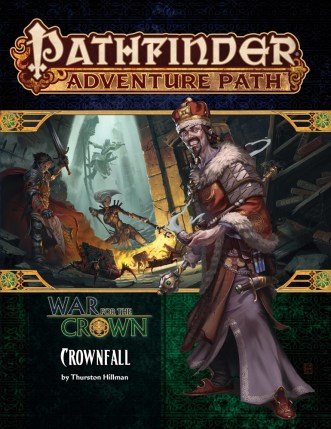
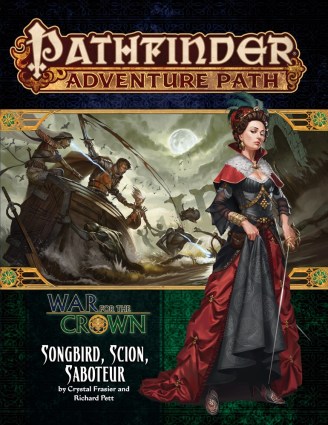



 !
!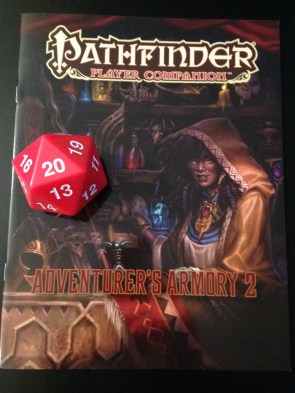
 , which was also released as a Player Companion back in April 2010. As a product from the Player Companion line, it’s a thin, soft-cover book intended for use by players, which clocks in at 32 pages in length. In my opinion, the Adventurer’s Armory was among the most universally useful books in the Player Companion line, so I was thrilled to pick up the sequel.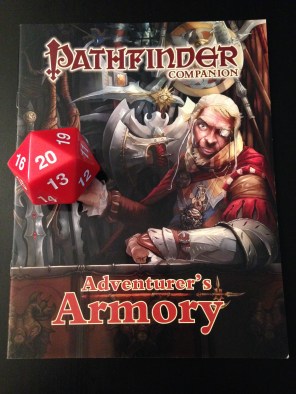

 , is written by Neil Spicer, and is intended to bring characters from levels one to four. The Iron Gods Player’s Guide is a free download on Paizo’s website,
  , which has a ton of unique pawns for use in the campaign.
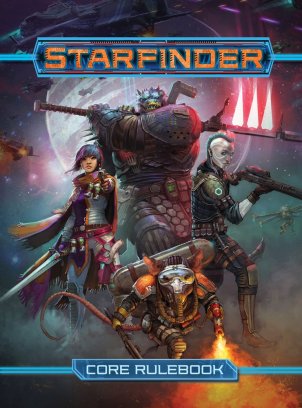
 . This is the book where you’ll find a ton of monsters, new player races and, most importantly, simple rules for making MORE monsters and races. If you’re going to run a game of Starfinder, you NEED the Alien Archive.
 is for you! This book contains details on all of the major planets of the Pact Worlds, new playable races, new themes, new ships, new archetypes, and new gear, spells and feats! In short, despite being a book about the setting of Starfinder, it’s got a ton of new class options for everyone. This book isn’t necessary, but I know I’m DEFINITELY adding it to my collection.
 is a must-have play mat for the Starfinder game.
 , is a great choice for a wide variety of terrain types. Starfinder has launched another new basic flip-mat, which is a great addition to your game (and my favourite of the new Starfinder mats),
  . One side is a windswept desert or badlands style terrain, while the other is a metallic, grey terrain type. In addition to basic mats, Starfinder has launched a couple REALLY beautiful flip-mats. In general, although they’re lovely, and easy to use, I tend to stick with the basic mats for budgeting purposes. But if you’re interested, there’s the
  , which features a high-end dance-club scene on one side, and a grungy, dive-bar on the other. The
  features a sleek exploratory starship on one side, and a more utilitarian ship on the other side which would work great as a military ship, a freighter, or a derelict ship. The last map I haven’t been able to find on amazon, which means you’ll have to order direct from Paizo’s website (which if you’re Canadian, like, means the shipping fees are a nightmare). That being said, the

 which comes with a hundred awesome minis perfect for player characters and humanoid enemies, as well as a large assortment of ship pawns. You are going to get a TON of use out of this collection! In addition, I highly recommend the
  from amazon or from Paizo’s website
  (which has gorgeous artwork on one side and a collection of very important information for the GM on the other),
  (which is a very detailed character sheet), and
  (to help make combat organization quicker and easier). But what I’d recommend is the
  , which put all of the conditions in Starfinder on handy cards which can be given out to players, or used by the GM for easy reference. They also feature some snazzy artwork of space goblins on each condition to make them more interesting.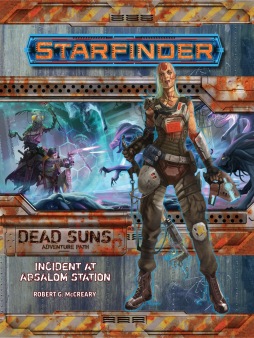

 ,
,  ,
,  ,
,  , and
, and  . From what I’ve read so far of the Adventure Path, it’s great fun.
 , browsed it, desperately wanted to buy it, but put it back because I had NO IDEA what it was. Haha. So, from me to you, Starfinder, THANKS. Countless curious readers will appreciate the overview. I promise.


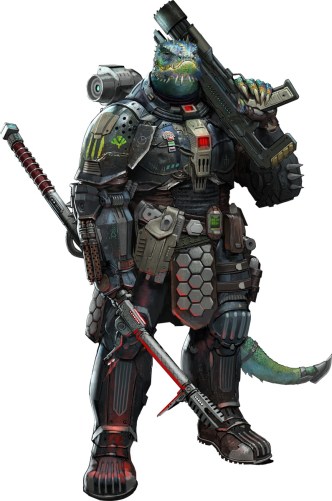


 d20 Diaries