Iron Gods: Part Four: The Dead Desert

Today on d20 Diaries we’re heading back to Torch, for more of the Iron Gods adventure path!

Iron Gods is a six-part adventure path by Paizo Publishing that fuses technology and fantasy into one awesome Pathfinder campaign. The first volume, Iron Gods: Part 1: Fires of Creation, is written by Neil Spicer, and is intended to bring characters from levels one to four. The Iron Gods Player’s Guide is a free download on Paizo’s website, here. For further information on the Iron Gods campaign, check out my blog post ‘Iron Gods Adventure Path.’ For information on our characters, check out my blog post ‘Iron Gods: Character Focus: Haji and Nix,’ and for information on our first few play sessions, check out my blog posts ‘Iron Gods: Part One: Into the Weeping Pond, Iron Gods: Part Two: Bring Out Your Dead,’ and ‘Iron Gods: Part Three: Gremlins!’ If you’re going to play Iron Gods yourself, I highly recommend picking up the Iron Gods Adventure Path Pawn Collection, which has a ton of unique pawns for use in the campaign.


Pheonix 'Nix'
Art that inspired Nix. Discovered on Pinterest. If you know the artist or the source let me know, so proper credit can be given!

As Nix, Haji and Rothmhar stepped into the metal ruins for the first time, their footsteps echoed down the corridor loudly. The walls, floors and ceiling were made of smooth, dark grey metal–glaucite–while panels of lighter material ran along the ceiling eight feet above. To their left and right, the tunnel was blocked by piles of rubble, but ahead it continued through an open doorway.

Nix stepped forward to sift through the rubble with excitement. She was an impulsive woman. Impatient, and reckless, but she was also brilliant. The bits of wire and metal she might find in the blocked passageways could become something wonderful with a bit of tinkering in her workshop. Like the massive metal arm that she wore. Built from scrap salvaged from the junkyard, it was a fine replacement for her missing one, which had been torn off by a piece of malfunctioning machinery a few years ago.

‘Wait!” Haji hissed. A far more cautious creature than Nix, Haji was often the voice of reason in their relationship.

With a roll of her golden eyes, Nix paused.

Haji peered into the darkness with his one remaining eye. The second eye socket was filled with a glittering gemstone, and surrounded by a strange triangular rune that had been branded into his flesh by his one-time master. The same master who had taken his eye.

Haji spotted a figure down the tunnel… It was still and silent. Unmoving. Looking closer he realized it had three spider-like legs, two metallic arms, and a single red lens in the centre of its head. It was a robot–the same kind they had fought outside Val Baine‘s home (see Iron Gods: Part One: Into the Weeping Pond for more details). This one looked to be in much better condition, though. It’s outer shell was solid, it’s arms looked to be all in joint, and its legs looked even and well-oiled. Recognizing the threat it could pose, Haji approached the robot with his falchion.

Nothing.

Slowly, he poked it.

Nothing.

With a shrug, Nix began to dig around in the debris.

The robot in front of Haji whirred to life. It’s lens lit up, bathing Haji in bright red light.

“It’s awake!” Haji exclaimed, swinging at the robot with his falchion.

Parts of the robot’s chassis split open under the assault, but its didn’t slow. It swung its metal arms at Haji, knocking the breath out of him.

The stones and gems braided into Haji’s hair and beard jingled as he was knocked around by the blow. On his shoulder, Rothmhar hissed at the robot.

Turning to see a robot bludgeoning her boyfriend, Nix stalked forward. With a big downward swing she yelled, “Hey! Leave him alone!”

Her morningstar smashed parts of the robot apart, but a moment later, a strange flickering occurred around the damage, and the metal bits started repairing themselves.

“Well, shit!” Nix swore.

The battle continued, but the robot didn’t stand a chance. Already aware of its weaknesses, Haji and Nix made short work of the metallic monster–though its ability to quickly repair itself did draw out the battle.

As it collapsed to the floor in pieces, Nix leapt upon the robot’s body, pulling parts and pieces out for her own use. Soon it was nothing but scrap, and its repairing capabilities no longer functioned.

Further down the hall they came upon another entry hatch that led into a room filled with a tangle of broken cages.

“Was this a… prison?” Nix asked.

Holding up a few bits of ancient bones, Haji shook his head. “No. Animals were kept in these cages. Or… aberrations, maybe. Creatures not of this world.”

There were two other doors leading out of the ancient menagerie. One was open while the other was sealed shut. Nix tried to break her way into the sealed door using her wide array of tools, but had no luck. In another pile of rubble they discovered a few strange technological objects. Nix was thrilled, but Haji insisted she wait until they were home safely before fiddling with them.

In time they came to a room with a pair of machines protruding from opposite walls. They were covered with coils of metal tubes and nozzles, which were aimed at the room’s interior.

“What’s does this thing do?” Haji asked Nix.

Nix smiled widely and examined the weird machines. “I… I don’t know, but they don’t seem to be working.”

With a shrug they continued on through the room. Past another door, they found themselves in a tunnel of rough stone.

“What?” Nix complained. “That’s it?”

“No…” Haji mused. “I… There’s something strange with this rock. It’s not… Real.”

“The rock’s not real? What are you talking about?”

“It’s… artificial rock, I guess. It was formed this way, into this tunnel.”

“What the heck for?”

Haji shrugged. “I don’t know.”

With their weapons drawn they proceeded down the tunnel and came across a large rock formation that looked a bit like petrified coral.
PZO9085_500.jpeg
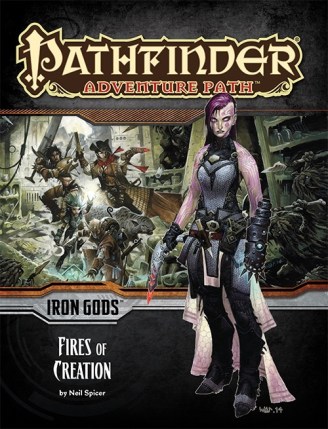
You can find the ghelarn, a large aberration, in Iron Gods Part One: Fires of Creation.

As they approached, something deep inside the stone formation moved and a mass of long, tentacle like protuberances reached out from the centre of the rock formation and lashed at the duo.

Haji growled and slashed at it with his falchion, slicing some of the rubbery tentacles apart.

The tentacles recoiled, hiding inside the rock formation like it was a shell.

“What the hell?” Nix asked. “Should we kill it?”

Rothmhar hissed and bobbed his head. A moment later, Haji grunted. “Yes.”

The strange beast attacked from within its stone carapace, lashing with its tentacles and spitting a sticky substance. The tentacles tore into Nix’s flesh, causing deep, bleeding wounds. Haji struggled against the goop’s entangling tendrils, but the little rat on his shoulder hissed and began to gnaw right through it. With a growl, Haji strained and struggled, and burst his bonds. He swung his falchion and severed some of the strange creature’s tentacles, while Nix smashed through the stone-like exterior with her morningstar. As stone shattered, revealing a pulsing purple mound, Haji drove his blade right into the centre of the mass. A strange, viscous liquid exploded out of the beast’s wounds, splattering Haji and Nix.

Nix stumbled over to the side of the cave and wiped the goo out of her face. She was heavily wounded during the fight, although Haji came out unharmed. Nix activated one of her gadgets, causing a metallic beetle to scurry over her body and spray a healing foam into her nastiest wounds. As it crumbled to pieces she activated a second one, then scooped the parts back into her backpack.

“Well, that was fun.” Nix groaned sarcastically.

Haji looked her over with worry, while Rothmhar hissed in his ear. With an annoyed look at the rat, Haji grumbled, “Yeah, I’m going.”

Then he looked back at his girlfriend. “You alright?”

“Shiny.” she replied, though she clearly wasn’t. “Come on, then, before that rat bites your ear off.”

Rothmhar hissed at Nix, then tossed its nose up in the air.

With Haji and Rothmhar leading the way, they continued down the tunnel. After a few twists and turns it opened into a large cavern. The floor was red sand, and the cavern walls behind them were steep but smooth. Difficult to climb, they disappeared out of sight in all direction–left, right and up. Nix’s sunrod barely pierced the gloom.

“Can you see the other side?” Nix asked.

Haji shook his head. “No. And not the ceiling or side walls, either. This cavern is… vast.”

Nix let out a short “Huh.”

It was eerily quiet in the cavern, with no sign of the pervasive damp of the previous caverns they had been in, and no distant echoes. The sand at their feet looked natural, but bore no dunes or gentle curves as it would on the surface.  It was flat and still. Unnaturally so.

A shiver ran up Haji’s spine. He couldn’t shake the sudden feeling of unease that overcame him. But Nix hobbled off a few steps into the sand, apparently unconcerned.

“We need to stay together,” Haji warned. “It would be easy to get lost in here…”

“Lost? It’s so quiet in here you could hear my footsteps from a mile away.” She chuckled, but then stopped. “Speaking of footprints… I found some. Looks like a few pairs. What do you think?”

Haji moved over to check them out. Sure enough there were a few sets. “Looks like a group of people traipsed through here, and headed off ahead. One of ’em was wounded. Khonnir’s group, maybe. Some time later another few tracks came through. And it looks like… one pair managed to leave again.”

“Leave?” Nix asked. “Oh! Yeah!” she exclaimed with a clank of her metal fingers–it would have been a snap had she used her good hand. “That guy we found in the cold mold! That naked freak said he had stumbled out of here like a madman.”

Haji nodded absently. “Gerrol Sondor. He was a friend of Khonnir’s. And the woman’s name was Sef. She said nothing of the sort, by the way.”

“Same difference.” Nix replied. “Should we follow them?”

Haji nodded and drew his falchion. “Yes.”

They set off following the tracks through the sand. After a short time they could see none of the cavern walls at all. They were adrift in an endless expanse of motionless sand.

Suddenly, Haji stopped. “Did you hear that?”

“What?” Nix asked.

Rothmhar sniffed at the air.

Suddenly there was a shifting of sand. Footsteps. Then more.

“Who’s there?” Nix called out. “Show yourself!”

At the edge of Haji’s vision he saw a figure. Skeletal and tall with a massively elongated cranium and four arms, the creature stalked through the sands. And there, to his left! Another. And another from behind.

“We’re surrounded…” Haji told Nix.

“Shit! I can’t see them. Where are they?”

“They’ll be in your light soon. Looks like they’re slow, though. And stupid.”

Suddenly, the eyes of one of the skeletons glowed red. That skeleton cocked its head, looked right at Haji and met his eyes. Then it charged him, bounding across the sand in an instant.

“BAH!” Haji exclaimed in surprise.

The skeleton tore into him with a clawed hand, ripping flesh with its ancient bones.

“Slow, my ass!” Nix exclaimed.

Rothmhar hissed at the skeleton while Nix hurried over to Haji. She swung her morningstar at the skeleton and smashed a gaping hole in its skull. The skeleton turned on her, it’s red, baleful eyes focusing on her with hate.

“I thought you said it was stupid!” Nix exclaimed.

The skeleton launched itself at her and tore gaping wounds in her arms and neck with its claws. Suddenly, the light in its eyes faded. The other skeletons traipsed mindlessly closer, when suddenly another’s eye-sockets lit up in a red light. It looked right at Nix, and charged at her, zipping past Haji in order to swing a claw at her back.

Haji roared in anger. He raised his sword and brought it down on the skeleton that had so heavily hurt Nix. As his blade struck bone it sent a jarring vibration up his arms, but  he powered through, tearing through the skeletons ribcage and spinal column with his oversized sword. The skeleton fell to pieces, but around them, others moved closer.

Nix quickly swung her morningstar, taking the red-eyed skeleton out at the knees, and sending it toppling to the ground. But, even as it fell, the red light transferred to another skeleton, and in the distance, they heard more footsteps. And more… And more…

The red light was moving faster now, jumping from skeleton to skeleton and imbuing each with intelligence before moving on. As the skeletons all surged forward, swinging their claws at Nix, and trying to tear her weapon from her hand, Haji roared.

“Run!” He bellowed. “RUN!”

Heavily wounded, Nix took off after the trail of footprints, dripping blood across the sand. Haji took another swipe at the skeletons before following her. As the ran they could hear more skeletons shuffling out there in the distance. Nix quickly activated another of her gadgets, causing a clockwork beetle to scurry it’s way from her belt over to the bleeding wounds across her chest. It sprayed a magical antiseptic foam across her open wounds, causing them to heal–partly. After healing her, the beetle crumbled into tiny pieces. This time she didn’t spare the time to retrieve them.

As she hobbled across the desert, pouring blood, Nix hissed at Haji, “I’m out of healing.”

Haji raced after her. “I’ve got some left, but it’ll only slow us down.”

Quickly, he shoved his hand into one of his belt pouches and let out a quick prayer to Rothmhar. His words were strange and unintelligible, but they had a dark and foul sound. As he muttered the brand around his eye surged with power, Rothmhar let out a fierce hiss, and the trio of rocks inside the pouch began to magically glow. Haji pulled out one of the rocks, which struck one of the skeletons in the chest and caused its ribcage to explode. It stumbled on for a few steps before tumbling to the ground in pieces.

The path led Nix to a rock formation that jutted up out of the sand like a miniature mountain. As they raced along it’s edge Haji threw his other two stones, both of which smashed into skeletons. As the bones fell lifeless to the dirt, Haji let out a whoop.

Atop the rocks to Nix’s left, there was a sudden pair of glowing red lights–another skeleton. It eyed Nix, but let her run right past. Instead, it focused on Haji and his magical stones. It leapt off the crags and landed upon Haji, knocking him over into the sand.

Haji let out a growl of pain and lashed out at the skeleton. He managed to get to his feet, but the skeleton gave a deep gash across his arm for the trouble. He gripped his falchion in his hands and faced off against the red eyed skeleton, just as the other skeletons caught up to him. Surrounded, he let out a growl. From the sand beside his foot, little Rothmhar hissed menacingly.

“Don’t stop!” Haji yelled to Nix. “Get out of here!”

At his words, Nix spared a glance behind her. Seeing Haji surrounded, she growled. “Like hell!”

Haji swung his falchion at the most damaged of the skeletons around him and forced his blade through the bones, causing it to shatter to pieces. “Come and get me, you freaks!”

The red eyed skeleton attacked with all four arms, tear and scratching at Haji’s exposed skin.

Haji grunted in pain and spat a glob of blood on the ground. “That all you got?”

As the red light left the skeleton’s eye sockets and entered another’s, Haji knew he was done for. The second skeleton attacked him with its many sharp claws, then the third… He howled in pain and fell to his knees. He tried to swing his sword, but it was too heavy… His hands weren’t working right…. And his vision… Why was everything so blurry? Soaked with blood, and moments from death, Haji lost his grip on his sword, and toppled over, bleeding in the red sand.

Rothmhar hissed and nipped at the skeleton who had taken down his friend, but his teeth did nothing to the monster’s ancient bones.

One of the skeletons raised its claws in the air, ready to drive them down into Haji’s chest. There was a shuffling of sand and an explosion of bone, as Nix smashed her morningstar through its skull. She let out a strangled cry–half sob and half scream–and stood over Haji’s body.

Waving her morningstar menacingly at the last two skeletons, she smiled like a mad woman. “Over my dead body, bitches.”

The skeletons turned their attention to Nix, tearing and cutting her flesh with their bony, clawed hands. She screamed in pain, and fought back. Howling in rage and frustration.

She wouldn’t let Haji die here. Not alone.

Bloody and near death herself, Nix fought.

Meanwhile, Rothmhar had buried himself into Haji’s belt pouch. He grabbed a vial in his mouth and scurried back out of the sack. He dragged it across Haji’s chest and perched his hideous body right up beside Haji’s open mouth. He worked at the vial’s cork, gnawing it out with his teeth until the vial opened with a pop. Then he nudged the vial over, into Haji’s gaping mouth. Slowly, the healing potion trickled into Haji’s throat.

Above them, Nix had smashed one of the skeletons, but her wounds were great. The last wounded skeleton dugs his four hands into her chest and tore, yanking great hunks of skin off and sending her tumbling to the ground. She landed with a dull thump, tangled in a heap just inches from Haji.

Haji opened his eye just in time to see Nix fall beside him like a lifeless doll. Blood covered her and she was missing massive hunks of flesh. As her head smashed into the sand she caught sight of him just for a moment, before her eyes looked past him–dull and unfocused.

Haji let out a howl of anger and launched himself at the skeleton, pounding it with his fists… his head… a nearby rock. Anything he could grab hold of. He vented his anger and pain on the creature, slowly smashing in its skull with blind rage. Finally, the red light left its eyes.

With bloodied hands, and broken knuckles, Haji heaved in gulps of air, panting with exertion and anger. He screamed, then crawled across the sand to Nix’s side.

She didn’t look good. She was pale and bloody, bruised and broken. She looked dead.

He pressed his hand against her, and prayed loudly to Rothmhar. The rat hissed at him in anger, clearly thinking Nix wasn’t worth it. But, Haji didn’t let up. He snarled his prayers over and over. Beneath his hands, Nix didn’t draw breath. Her heart didn’t beat.

Haji glared at Rothmhar and continued to chant in the foul tongue, forcing his prayers upon the hideously ugly rat. Rothmhar let out a rather human sigh. Finally, the brand around Haji’s eye burned with power, and a surge of healing energy poured from Haji’s hands and down into Nix’s chest. Some of her wounds healed, and he felt a single beat of her heart under his palms. Haji continued to chant, funnelling more and more of Rothmhar’s magic into his dying girlfriend. Eventually she drew in a shuddering, weak gasp of breath. Her eyes refocused. She blinked, and groaned.

“You’re not dead,” she rasped. Her bloody lips turned up into a smile.

A wide grin broke out across Haji’s face. “Neither are you.”

Nix chuckled, but then hissed in pain.

“Don’t move,” Haji ordered her. “You’re too wounded, and I’ve got no healing spells left.”

She groaned and dug a few vials out of her pockets. “Drink,” she told him, “You look like shit.”

But instead of drinking them himself, Haji fed them to Nix.

Bloody and wounded, but alive, they both struggled to their feet.

“Ugh, this place sucks.” Nix groaned.

Haji nodded. He put an arm over Nix’s shoulders and pulled her close. “Let’s go home.”

Rothmhar chittered angrily up at the duo, clearly displeased that despite saving their lives he was given so little attention.

Together, they limped their way back to through the metal ruins, on their way back home.


Thanks for checking out d20 Diaries today! Haji and Nix’s adventures playing Iron Gods Book 1: Fires of Creation, will continue soon, in their fifth instalment: High Times in Torch! We hope you’ll join us again!

Jessica


Disciple’s Doctrine

We’ve been looking at a lot of Starfinder products lately, but today we’re changing gears. I recently got my hands on Pathfinder Player Companion: Disciple’s Doctrine, so today, we’re going to take a look at what’s inside.

Disciple’s Doctrine is a soft cover book that is 32 pages in length. Like the other ‘Faith’ books before it (Faiths of Balance, Faiths of Purity, Faiths of Corruption, Faiths & Philosophies, etc.), this book takes a look at a dozen complex philosophies that are found throughout Golarion. As a book in the Player Companion line, it’s aimed at players, which means that you won’t find any great secrets of the order explained in this book. What you will get is spoiler-free information about each of the disciplines inside, including what the discipline’s about, how its organized, and what’s expected of its members. In addition, you’ll find some new player options related to each discipline, typically spells and character archetypes.
PZO9488
Pathfinder Player’s Companion: Disciple’s Doctrine

Curious? Read on!

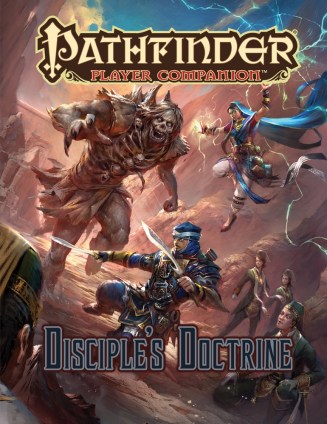
Disciple’s Doctrine features awesome cover art by Setiawan Fajareka, and features the Iconic Psychic Rivani, and the Iconic Slayer Zadim, facing off against a devourer. The inside front cover compiles information on each of the disciplines inside the book. Each has some iconography to represent it, and a few sentences describing it in an abbreviated fashion. So what’s in the book, exactly? The Concordance of Elements, Cults of the Failed, Esoteric Order of the Palatine Eye, Harbringers of Fate, Hellknights of the Godclaw, Magnimarian Mystery Cults, Oracular Council of Po Li, Prophecies of Kalistrade, Razmir the Living God, Sangpotshi, Shoanti Shamanic Traditions and Tamashigo. It’s quite an array! Some of them are expected–for example, I was well aware that the Oracular Council and the Prophesies of Kalistrade would get some attention in this book, but others are a surprise. I had honestly no idea that the Concordance of Elements would be featured in this book! I’m a huge fan of them in the Pathfinder Society Organized Play, so I’m thrilled to get a bit more background for this group. I was also super excited about getting to learn about the Hellknights of the Godclaw and the Cults of the Failed. A few of the other disciplines I’ve read about before, so I wasn’t entirely sure how much new information would be presented here on them. The Esoteric Order of the Palatine Eye, for example, although mysterious to most is featured in the Carrion Crown Adventure Path–which I’m currently running for my children. (Yes, that’s a horror campaign, and yes, my children are very young. They love it, I swear! Haha! More details on that in the future!). The Shoanti Shamanic Traditions are another example of this. I LOVE them, I cannot emphasize that enough, but they were already covered in depth during the Curse of the Crimson Throne Adventure Path (which I played through with a wonderful group of players back when it was new). Still, I was hopeful that the player focus of this book would bring something new to the table.

Up next is the table of contents, followed by the introduction. Here you’ll find some flavourful information about what’s inside the book–and what the difference is between a religion and a discipline or a philosophy. Of more interest to most players is the Rules Index, which is a handy list of all of the archetypes, traits and other rules option found in this book, with page numbers for reference. There’s also a series of six new traits focused on some of the traditions found in this book. Five are faith traits, with one a social trait. Of those, one is very focused on a specific tradition (Dogged, which is for members of the Cult of the Failed), while the others are more broad. They’re not amazing traits, and you’re certainly not going to wish you could take them with every character, but they’re thematic, and I really like them. I think that Heretic’s Caution, which gives you a bonus on bluff checks that gets better against religious figures, is going to see the most use, followed by Self-Sustaining, which grants you a 0-level spell once per day as a spell-like ability (from a small selection).

Past the introduction we enter the bulk of the book: the disciplines. Each one has two facing pages devoted to it, with approximately one page being information about the group, and one page being player options (although there is variance in these lengths).

Concordance
The Concordance of Elements

Concordance of Elements is up first and, as previously mentioned, I was super excited for it! The Concordance of Elements is a planes-spanning organization whose goal is to preserve balance between the elemental forces of the world (air, earth, fire and water). They can act as diplomats and impartial investigators amongst the elemental planes, and also work to stop planar disturbances, planar portals and powerful magic from messing the world up. The information presented on the Concordance is all quite useful and interesting, and contained different information than that which can be found in the Pathfinder Society Roleplaying Guild Guide. In addition to general organizational information, we get to learn about the role that Concordance Agents play within the group, and how the group as a whole interacts with other organizations and religions.

As for character options, we’re treated to two archetypes and a combat style. The first is the Elemental Monk, which is a monk archetype I can’t wait to try. It’s definitely one of my favourite archetypes in the entire book! For starters, they must be true neutral, and instead of gaining stunning fist and bonus feats they gain the feat elemental fist with one special alteration: they don’t select one element for use with this feat. Instead, they select what element they want whenever they use the feat, which makes them super adaptable. At second level they gain the ability to enter any of the five genie fighting styles as a swift action, chosen each time they activate the ability. At low levels this grants them the basic fighting style feat, but as they increase in level they gain access to the more advanced fighting style options automatically. This is super cool! I’ve been a fan of style feats for a while, but they’re such a big feat investment for very specific circumstances that I’ve never really had the opportunity to make good use of them. I’m thrilled that this archetype give us a chance! There’s other abilities the elemental monk gets, but I won’t go into any more depth on it than I already have. Just know: I love this one. I want to make one. Heck, I might go make one right now. The second archetype is the Elemental Envoy for rangers, which is quite thematic and cool, but very focused. Lastly, we’re treated to the elemental combat style for rangers, which offers some quirky feat choices for a combat style. Overall, I really enjoyed getting to take a look at the Concordance of Elements. It’s one of my favourite entries in the book.

Up next is the Cults of the Failed, a group of people who pay homage to those brave souls who have attempted to achieve godhood through the Test of the Starstone and failed. They venerate, honour, and learn from these deceased mortal heroes lives, and trials. They maintain a spartan temple in Absalom which is more of a solemn memorial than anything, and have no holy texts, or official clergy. Now, having played through Pathfinder Society Scenario #6-10: The Wounded Wisp, I know a tiny bit about the Cults of the Failed, which made me very curious to hear more. The information was definitely intriguing, and I was pleasantly surprised. For character options, we get a single medium archetype: Vessel of the Failed. Now, although I love the flavour of this archetype, it’s not really my cup of tea. As previously mentioned in other blog posts, the medium is my least liked class, so it takes a lot to get me interested in a medium archetype enough to make me want to actually make one. It’s not impossible, as I learned when we took a look at Blood of the Beast, but it is hard, and this one didn’t really do it for me. Still, I was intrigued enough with the group to start thinking of other things I wanted to do with the them, which is a win in my book!

Next we come to the Esoteric Order of the Palatine Eye. This elite secret society is heavily influenced by Osirion mysticism, Varisian occult traditions, and Pharasmin beliefs, which they have fused into a strange amalgam in order to achieve wisdom, enlightenment and an understanding of the occult. Based in Ustalav, this group has far reaching influence, and hidden agents throughout the world. As previously mentioned, this group is featured in the Carrion Crown Adventure Path, and an in-depth article aimed at GMs can found in Carrion Crown: Part 2: Trial of the Beast. That means that I was coming to the table with a lot of information in hand. I found that although the information on the Order inside this book didn’t offer me anything new, it was interesting, well-written and (very importantly) geared towards players, meaning the group is now accessible to a much wider audience without giving away the group’s secrets and too much history. I really enjoyed it. As for player options, there’s one archetype offered for my favourite class, the occultist, which I loved. The Esoteric Initiate focuses his studies on objects of antiquity related specifically to his Order’s teachings. Their symbolism ability is particularly interesting. There’s also a few new magus arcana which are super useful, my favourite of which is Book-Bound.

The Harbringers of Fate are up next, and I can honestly say I had no idea what these guys were about when I opened this book. And now? It think they’re cool! In short, they believe that Aroden can be ushered back into the world if the prophecies in his holy text are be made real. They gather information and attempt to manipulate events in order to bring about such prophecies. Apparently the group was recently splintered into three differing opinions, all of which are pretty interesting. Now, there’s not too much information on the Harbingers themselves, with one half of a single page devoted to information about their order, while the rest of the two pages consists of player options. We get a new Prophesy School (a focused arcane school for wizards) which I really enjoyed, and three new thematic spells, including one enchantment (debilitating speech), and two divinations (fortune’s path and prophetic lore). Although nice options, I wish there was a big more useful information on the group itself.

Godclaw.jpeg
The five faiths of the Godclaw

Then we come to The Hellknights of the Godclaw! Now, I was intrigued with these guys from the moment I first read about them on the front inside cover. They’re Hellknights, obviously, but they don’t exclusively worship Asmodeus or Hell. Instead, they worship a collection of five lawful deities–Abadar, Asmodeus, Iomedae, Irori, and Torag–believing that all five work together to put an end to chaos. Abadar is the keeper of laws, Asmodeus is the strategist, Iomedae is the perfect offensive combatant, Irori is disciplined, and Torag is the perfect defensive combatant. Together, they are the Godclaw. Now, obviously, this is super heretical to all five of those faiths, but these guys? They don’t care! Their quirky, super oppressive dogma collects the lawful aspects of those deities, and smushes them together into one religion, playing it off like these five are good pals who happen to work together to obliterate disorder in their off-time. Like some weird, super, adventuring party. I cannot express how much I love it! Haha. Suffice to say as far as information goes, I’m sold! But what about character options? I loved that too! In fact, this whole section is right up in there among my favourite parts of the book. First, we’ve got the Fist of the Godclaw, which is an archetype for war priests that sounds like a ton of fun. Because it’s so focused on defeating chaos, it’s quite specific in terms of usage. It’s not one of those universally awesome archetypes you’ll always want to add to your character, but it’s cool and I love it. Also? It’d be particularly useful in the Wrath of the Righteous Adventure Path, as well as the Second Darkness Adventure Path (to a lesser extent). After this we’ve got a new war priest blessing: Godclaw, which is useful and quirky. And lastly we’ve got four new spells called litanies, which are each activated as either an immediate or a swift action, and are for inquisitors, paladins and on occasion even antipaladins. You should really check these awesome spells out! All in all, I highly recommend you give this part of the book a read!

Up next is the Magnimarian Mystery Cults. Now, this entry isn’t really a unified group or religion. It’s a lot of religions, all focused on the worship of little known empyreal lords. These demigods are worshipped in private or in small groups, at personal shrines or sacred monuments. Typically, these beliefs are passed down through the generations. They are particularly prominent in and around the Varisian city of Magnimar, where they have been worshipped since before the city was founded. The most commonly worshipped empyreal lords in Magnimar are Arshea (the Spirit of Abandon), Ashava (The True Spark), Ragathiel (General of Vengeance), Sinashakti (The Immaculate Joy), Soralyon (The Mystic Angel) and Ylimancha (Harborwing). There’s a ton of information on these Empyreal Lords (and a lot more!), mystery cults, and the Mystery Cultist prestige class in Pathfinder Campaign Setting: Chronicle of the Righteous, but this entry contains just enough information to whet your appetite for more, and to briefly describe (just a few sentences) each of the most common empyreal lords in Magnimar. After this it moves right onto a new cavalier order, Order of the Monument. I think this Order is very cool and useful, but not suitable for all campaigns. This order requires that you select a single city or settlement to protect. You don’t need to stay in that city all the time, but it’s pretty hard to justify somehow protecting your city when you haven’t been there in a long time. So, although this would be an awesome Order to play in plenty of Adventure Paths and modules (including Curse of the Crimson Throne, Kingmaker, Hell’s Vengeance, Ironfang Invasion, Ruins of Azlant, The Dragon’s Demand and even the Crown of the Kobold King series of adventures), there’s a lot of other Adventure Paths and Modules where it wouldn’t be thematically appropriate. After this nifty new Order we get a Variant Channeling ability for each of the mentioned empyreal lords, which can also be chosen by clerics who worship deities with the same portfolios. These variant channeling abilities include Duty, Flying, Journeys, Moonlight, Monuments and Sexuality. Personally, I like the moonlight and monuments abilities best, but I’d be curious to see what everyone else thinks.

And that brings us to the Oracular Council. Located in the nation of Po Li where divine magic is revered, but worshipping the gods is forbidden, the Oracular Council uses advanced mathematics and a wide variety of divinations to foretell the future and govern their nation. In addition to information about the group itself, there’s also details on initiation and membership with the Oracular Council, as well as details on what it’s like working for the Council. Although this entry wasn’t my favourite, they did a great job of presenting thorough, but not overwhelming, details on this group. I really liked it. After this is the Divine Numerologist, which is an oracle archetype that’s pretty neat. This archetype is compatible with any mystery, and replaces the 10th, 12th, 14th, 16th, and 18th level bonus spells with divination themed ones. But, it’s the two unique revelations that really make this archetype shine. The first is Calculate the Odds, which must be taken at 1st level, and allows your character to quickly use numerology to grant herself a bonus on her next d20 roll equal to her Charisma bonus. Very cool, but I wish you could use it more often (it’s usable once per day at 1st level, twice at 7th, and three times at 15th).  The second unique revelation is Program the Divine Algorithm, which you must take at 7th level, and lets you choose to take the average of a single or set of die rolls instead of rolling (so a 10 on a d20 or three 3s if rolling 3d6). All of your regular modifiers are then added as normal. The final revelation makes your character immune to aging, and allows a critical threat rolled within 30 feet of you by an ally to automatically confirm once a day. Neat. But, that’s not all this entry has to offer. There’s also five new numerology themed investigator talents, the coolest of which is Greater Numerical Alchemy. Definitely check it out!

Prophecies of Kalistrade
Iconography of the Prophecies of Kalistrade

Up next is the article I was the most excited to read about when I learned about this book: The Prophecies of Kalistrade. Now, I knew of the prophecies, and I knew that Prophets of Kalistrade were full of themselves and interested in amassing wealth. I also know that they wore long white gloves so they’d never have to come sully themselves via contact with someone not of their faith. But, I didn’t know much more than that. They have weird taboos, but I didn’t know what they were, and they wear a lot of white and gold. Voila! I know, Ygritte, I know nothing. Which is why I was hoping I would learn something more concrete about their group in this book. There was plenty of information in here, but at the end of it, I still don’t fell like I’ve got a handle on them. Maybe it’s me. I have a feeling I might ‘get’ them more if I just made a Kalistocrat and played them. Still, info aside, these guys have some awesome player options. First up is a new psychic discipline: Superiority, which focuses on the Kalistocrats absolute confidence in themselves, disdain for touching the unworthy, and their greed. The Magical Hoarder ability is particularly cool! I definitely recommend checking this one out if you’re going to make anyone who’s particularly proud or self-centred. It’s pretty awesome! There’s also three new spells, fastidiousness (which keeps you perpetually clean), hallucinatory decor (which lets you change the way things appear so they meet your high standards), and unflappable mein (which tries to stop others from touching you, and can harm them if they try). I’m not going to lie, my next bard is definitely taking fastidiousness! Haha.

Razmir.jpg
A mask worn by followers of Razmir, the Living God.

Following the self-centred Kalistocrats is a guy who takes ‘self-centred’ to a whole new level: Razmir, the Living God. Now, I love to hate these guys. In everything I’ve seen Razmirans used, they’re the villain. The wonderful modules Masks of the Living God and City of Golden Death are particularly good examples of this. But, that doesn’t mean that’s all these cultists are. An entire nation worships Razmir, and most of those people are just trying to get by. They’re normal. So, I love that this is an article that aimed at them. We get some information about Razmir himself, reasons that outsiders might say he’s not a ‘real’ god but a charlatan, reasons that believers refute those claims, and reasonings behind Razmir’s teachings. There’s information on a priest’s role, and Razmir’s interactions with other religions. All of this was really helpful, and I feel like it gave me a much better understanding for them as a group. I definitely want to make a worshipper of Razmir now, which isn’t something I’ve never wanted to do before. After all this information we get to an archetype for the ninja. Yeah, when does that ever happen, right? Well, wait no longer! This ninja archetype is called Mask of the Living God, and it’s pretty awesome. Of course, it’s also intrinsically tied to the Razmiran faith, so it’s not very adaptable. After this there’s four new arcanist exploits, my favourite of which is Mending Flesh, and a single greater exploit which is pretty nifty, Convert Wand. All of the arcanist options are worth a read.

Next we have the philosophy of Sangpotshi, which is the concept that our souls are reincarnated after death into a form based upon our deeds and worthiness from our previous lives, until we eventually achieve the honour of breaking the cycle and resting in Pharasama’s Boneyard. It’s a mix of the concepts of reincarnation, karma and fate, all rolled into one. This philosophy is incredibly prevalent in Tian Xia, and is compatible with many different religions. Most of the information presented on it involves the role of a believer to the, and their relationships with other religions. There’s a spiritualist archetype up for offer, called the Seeker of Enlightenment, which I thought I would like more than I did. I think my favourite ability it offered was Words of the Past, which lets you cast comprehend languages at will as a spell-like ability. There’s also some options for vigilantes, including two social talents and three vigilante talents. My favourites were  Ancestral Enlightenment, Magical Familiarity and Weapon Familiarity.

Which brings us to the Shoanti Shamanic Traditions. Now, as mentioned, I LOVE, LOVE, LOVE the Shoanti peoples and their culture. But, I’ve also read a lot about them already. So, as much as I was hoping there’d be new information on them for me to drool over, I wasn’t sure what I’d be getting. Unfortunately, I didn’t find any new information about their traditions in this volume. However, for those of use who don’t own the original Curse of the Crimson Throne Adventure Path, The Inner Sea World Guide, or Varisia, Birthplace of Legends, this is a great way to explore the awesomeness that is the Shoanti. The character options were quite exciting, though. The Totem Channeler is a fun looking skald archetype, while the faith trait Aspect of the Quah, allows hunters to replace one of their animal aspects with a new aspect related to a Shoanti’s quah (tribe). Shiny!

The last discipline we’re looking at in this book is Tamashigo, which is a philosophy that teaches that every part of nature has a soul and a spirit, and that these spirits must be treated with honour and respect, for their whims shape the world. This is most common in Tian Xia (which is where it is known as Tamashigo), but this philosophy can also be found in many other cultures of the Inner Sea, from Kellid tribes, to the Shoanti Quahs, and beyond. Much like Sangpotshi, this philosophy is compatible with nearly any religion, and can be used for characters of a variety of faiths. After this there’s a cool Samurai archetype, called the Ward Speaker, which honours the kami (more information on Kami can be found in Bestiary 3 or the Jade Regent Adventure Path). There are also two new bardic masterpieces, which are neat. I especially like Kaminari Drums, which allows percussionists to call lightning down from the sky.

Although that brings us to the last of the disciplines explored in Disciple’s Doctrine, this isn’t the end of the book. There’s a little bit left: a chapter called Tools of the Faith, which features three pages of mundane and magical equipment for characters to purchase, followed by two occult rituals. I particularly enjoyed the Godstar, and the Lantern of the Four Elements. The Echo of Divinity’s Promise was also cool, but too expensive. As for the occult rituals, check out the Song of the Kami’s Gift!

And that brings us to the end of Disciple’s Doctrine. This was a really good book, and I rather enjoyed it. My favourite entries were on the Concordance of Elements, The Cults of the Failed, the Hellknights of the Godclaw, and Razmir the Living God. As for character options, it’s the elemental monk archetype, the superiority psychic discipline, the arcanist exploits, and the hellknight litanies that I’m going to make the most use of.

Have your own copy of Disciple’s Doctrine? Let us know your favourite parts in the comments!

Jessica


May New Releases

Well, another month has come and gone, which means there’s a whole bunch of new and awesome products coming out from Paizo. But first, it should be noted that today’s your last day to pre-order physical copies of the Pathfinder Playtest Rulebook, Pathfinder Playtest Adventure: Doomsday Dawn, and the Flip-mat multipack. If you intend to pick up a copy of any of them, now’s your last chance. Free copies of the PDF will be available in late August.

GrandLodgeSymbol
The Pathfinder Society’s Glyph of the Open Road

Two new Pathfinder Society Scenarios were recently released, Scenario #9-18: Scourge of the Farheavens is a tier 1-5 scenario that sends the players all the way to Iobaria, which promises to be a blast. This is definitely the scenario I’m most excited for, and I hope to pick it up soon. The second PFS release is Scenario #9-19: Clash in the Kaimuko Wood, is a tier 5-9 scenario that takes place on the border of Kwanlai and Tianjing in Tian Xia. Involving abyssal corruption, this adventure continues events in Scenario #9-12: Shrine of the Sacred Tempest, and directly contributes to the ongoing storyline of the Silver Crusades.

Near the end of May there’ll be two more scenarios for us to sink our teeth into. Scenario #9-20:  Fury of the Final Blade is a tier 7-11 scenario that sees the Liberty’s Edge faction leader, Colson Maldris, up to some shifty underhanded shenanigans, involving Andoran’s corrupt elite, the Grey Gardeners of Galt, and the soul-trapping guillotines they’re known for. Turning to the Pathfinders for aid Maldris set out to lay the groundwork for a rescue plan–only to end up captured himself. This awesome-sounding scenario leaves the fate of Colson Maldris in your players hands, and directly affects the Liberty’s Edge faction’s ongoing plot. Finally, we have Scenario #9-21: In the Grandmaster’s Name, which is a tier 3-7 adventure that lets your players pose as intercepted agents of Grandmaster Torch, and perform some underhanded espionage in Druma. I don’t know about you, but I’m super excited for this mission, as my whole family loves the Grandmaster (or rather, some love him, and some love to hate him!).

There’s two new awesome pawn collections coming out soon, the Ruins of Azlanti Pawn Collection, which contains just over 100 pawns from the Ruins of Azlant Adventure Path (including minis from Part One: The Lost Outpost, Part Two: Into the Shattered Continent , Part Three:: The Flooded Cathedral, Part Four: City in the Deep, Part Five: Tower of the Drowned Dead and Part Six: Beyond the Veiled Past). The second is the Starfinder Pact Worlds Pawn Collection, which features over 200 pawns, including creatures and starships. As I’ve recently come to own Pact Worlds, I can assure you these pawns have a ton of cool artwork. I can’t wait to see how they look.

PZO90130.jpg
Pathfinder Adventure Path: War for the Crown Part 4 of 6: City in the Lion’s Eye

The very intriguing War for the Crown Adventure Path continues this month with Part Four: City in the Lion’s Eye. Previous releases include Part One: Crownfall, Part Two: Songbird, Scion, Saboteur, and Part Three: Twilight Child. We’ve talked plenty on d20diaries about the War for the Crown, so if you’d like to learn more, click away: Preview: War for the Crown, Paizo New Releases, War for the Crown: Player’s Guide and April Blooms and d20 News.

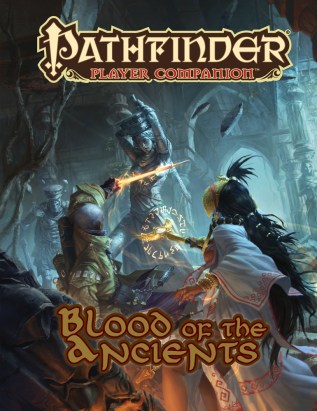
While last month brought us the delightfully dark Pathfinder Campaign Setting: Nidal, Land of Shadows, this month brings us a Player Companion that looks like it’s handy for everyone. Pathfinder Player Companion: Blood of the Ancients, looks like it’s going to focus on both unlocking the powers of your own ancestry, and on the remnants of ancient civilizations. I’m particularly curious about the Azlanti ioun kineticist archetype, and the Jistkan artificers. But, we’ll have to wait to find out more.

There’s two new Pocket Editions out: Ultimate Magic and Bestiary 4; and a whopping four play-mats. Two of the Play-mats are brand new: Starfinder Flip-mat: Starship: Sunrise Maiden, and Pathfinder Flip-mat: Carnival. The other two are reprints from the Pathfinder Flip-mat Classics line: Darklands and Battlefield. Both are popular mats which are pretty heavily used in Pathfinder Society Scenarios.
PZO9490
Pathfinder Player Companion: Blood of the Ancients

But, the most exciting new release? The Jungle of Despair pre-painted plastic minis! Like the rest of the randomized Pathfinder Battles minis, they come in four-figure boosters (with one large and three medium minis inside). You can also buy a brick (which is eight booster boxes) or a case (which contains four bricks).

Whatever you’re interested in, there’s a lot of neat stuff coming out this month. Far more than I could indulge in, that’s for sure! It’s the two pawn collections that I’m most interested in getting my hands on. That and the Scourge of the Farheavens PFS scenario. What about you? What are you most excited for from Paizo’s upcoming products? I’d love to hear your thoughts.

Jessica

New Starfinder Society Scenarios: Ashes of Discovery & On the Trail of History

Today we’re going to take a look at the two most recent Starfinder Society Scenarios that are currently available for purchase, and let you know we thought. Although you’ll find references to events in each that I liked or disliked, and comments about specific characters, these scenarios are not explored in detail. It’s not my intention to spoil the events in these scenarios, or give summaries and full reviews, but to share my opinions and provide recommendations. That said, if you want to avoid even minor spoilers I recommend you check out a different article. Whether you intend to use them in home games of the Starfinder Roleplaying Game, sanctioned scenarios for use with the Starfinder Society Organized Play, or just want to read a nifty new adventure, we’ve got you covered! So sit back, and get ready to explore the Pact Worlds!

Scenario # 1-12: Ashes of Discovery is a Tier 1-4 adventure which takes place on an abandoned outpost in Near Space. It has the repeatable tag and features starship combat. As a repeatable scenario, this adventure can be played once with every character (as opposed to once per player), which is AWESOME and makes it easier to get some much needed experience for low level characters. In addition, it features randomized mechanical and story elements, which means that each time you play it will be slightly (or very) different. These randomized elements include what special abilities the enemies have, the atmosphere of the planet, attitudes and cultural quirks of the locals, what corporation the colony once belonged to, and much, much more. I was super impressed with how completely these randomized elements could change the scenario. I fully intend to play this one through with every character I ever make for SFS play. The only difficulty? With a scenario this randomized it’s really up to the GM to sell the environments, characters, and atmosphere. With a GM not willing to put their all into running this delightful scenario, it could fall flat.

So what’s this scenario about? Recently a corporation discovered records of a long abandoned outpost they haven’t had contact with in centuries. They’ve hired to Starfinders to head on down to the planet–cleverly named Colony-753–and have a look see. Your Starfinder will get to explore an unknown planet, deal with hazards and wildlife, befriend the locals and survive a bit of wild weather. Basically, this scenario is a wonderful example of what being a Starfinder is all about! It features Guidance, an AI created from the memories and knowledge of previous Starfinders. Unlike the other repeatable scenario (#1-01: The Commencement, which also happens to be Guidance’s first appearance), this one really lived up to my expectations. It was wonderful. Overall, I highly recommend Ashes of Discovery. I give it five out of five stars.

sfs 1-12 - ashes of discovery - besmaran whelp
Besmaran whelp from SFS #1-12: Ashes of Discovery. Art courtesy of Paizo Inc.

Scenario #1-13: On the Trail of History is a Tier 3-6 adventure which takes place on an unchartered planet in the Vast known as Icefront, or Izalraan to the natives. It has the Faction (Second Seekers [Luwazi Elsebo] scenario tag and features starship combat. In addition to being of great importance to the Second Seekers (Luwazi Elsebo) faction, this scenario also contributes to the ongoing year of the Scoured Stars storyline. Following a lead discovered in Scenario #1-11: In Pursuit of the Scoured Past, First Seeker Elsebo sends the Starfinders on an expedition to a planet that could have a connection to the Scoured Stars incident. Tasked with finding out whatever they can about the planet, and a relic believed to have landed there, the group must deal with a strange environment, and dangerous locals. Unlike similar scenarios, this adventure features a whole lot more than you’d expect, the mysterious introduction of what’s sure to be an important part of the Scoured Stars plot line, and some delightful moral dilemmas. Those of you who have played through #1-05: The First Mandate, will find that one of your boons might earn you an extra hint or two. Overall, this was an awesome scenario, that was very different from those that have come before. I give it five out of five stars.

sfs 1-13 - on the trail of history - jinsul ship
A mysterious ship… Art courtesy of Paizo Inc.
starfinder society agent
A Starfinder Society Agent from the Starfinder Society Guild Guide. Art Courtesy of Paizo Inc.

And that’s all for today! Thanks for joining us on our exploration of the wonderful new scenario’s available this month. I hope you’ve enjoyed reading about them as much as I have. Both scenarios look like a ton of fun, and I can’t wait until I have a chance to run them for my family, or play them myself. My son’s been super curious about the mystery of the Scoured Stars incident, so I can’t wait to tell him about what’s waiting for him down the line.

Until next time,

Jessica

Space Rabbits and Radioactive Robots

Just the other day we took a look inside the covers of the Starfinder Roleplaying Game: Alien Archive. I shared some of my favourite creatures, spoke about what the book contains, and touched on the easy and adaptable monster and NPC creation process. My children and I tested out the creation system, and today, we’re going to share what they made in order to emphasize just how fun and easy it is.
StarfinderCover
The creatures featured today are for use with the Starfinder Roleplaying Game: Core Rulebook.

Now, it should be noted, that my children are young. My daughter turned six last month, while my son turned seven last month. This means that if they can do it, you can do it.

Now, where to start?

The first step is the concept and CR. My daughter immediately decided to make a colossal rabbit which flies through space, firing laser beams from her eyes, breathing fire from her nose, and feeding off the electrical energy of space storms, starships, asteroids, and even other living beings. It’s quite big and strong, so she’s hoping to make it a CR 10 or so. And my son? He made radioactive robots! As their creators and their societies were destroyed by nuclear war, some of the robots survived the devastation. Damaged from the blast and the centuries that have passed since, these robots have broken chassis, exposed wiring, and scratched and dented frames. Their solar panels no longer work, but they absorbed a huge amount of radiation, and function on nuclear power, instead. He’s aiming for a lower powered monster, making it CR 3.

The next step is to choose the creature’s array, which is its role in combat. Although my daughter strongly debated changing around her concept to make her space rabbits spellcasters, in the end she stuck to her original concept, and made her space rabbits a combatant. My son chose the same. Once you know your array you check out the associated charts and get all of your statistics for the creature. We wrote these down, and got ready for the next step: selecting a creature type. My daughter’s space rabbits were going to be magical beasts, and didn’t need a subtype. This means they’ll be getting dark vision, low-light vision, +2 to Fortitude and Reflex saving throws, and +1 on attack rolls. Meanwhile, my son’s radioactive robots were going to be constructs, which grants his monster a -2 to all its saving throws, a +1 to its attack rolls, and some snazzy traits including darkvision and construct traits. They would also have the technological subtype, which didn’t add any new abilities.

The next step is adding a class graft, which neither of my children’s creations needed. Skipping this step meant we would next be adding any any other templates they desired, which they also both decided against.

PZO7105
Creatures featured today were created with the rules found inside the Starfinder Roleplaying Game: Alien Archive.

The next step they found the most fun: selecting special abilities and your creature’s attack forms. Their array and CR will determine how many abilities they can choose. In addition, some abilities are free. It should also be noted that this number is a guideline, and can be altered as necessary to make your monster concept come to life. The special abilities you can select include things like feats, universal monster abilities, and statistic increases. You can also select abilities that show up in other stat blocks.

So what did they choose? Well, our space rabbits already have darkvision and low-light vision from being a magical beast, but my daughter was very intrigued with the idea of giving them blindsight (voltage), which would allow them to detect and see electrical fields to a range of 60 feet. If she did choose to add this, it would count as one special ability. Attacks are necessary to the creature, so the natural attacks it would receive (a piercing bite and laser beam eyes) would be free of charge. Other free abilities creatures receive is anything that they require to survive in their environments. For our space rabbits this means they need immunity to cold and a vacuum, as well as the no breath ability. Because of her CR she’d get a third immunity, so my daughter chose electricity.

Which brings us to our second special ability! Space rabbits would get a breath weapon which shoots out a super heated blast of energy–fired from their nose, of course! She also contemplated taking the swallow whole ability, but was undecided. This would be their third ability, if she chose to select it. And lastly, they’d need a supernatural fly speed so that they can move around in space. Luckily, movement speeds (within reason) are also free. That left her with three abilities. Her chart suggested having two, but, as mentioned, you can go over within reason (or under, for that matter). There was one other ability my daughter thought they needed: the ability to land upon and leave planets safely. After all, how could they escape a planet’s gravity with only a 60 ft. move speed…? We left my daughter to mull this over, and moved on to help my son.

PZO7109
Starfinder Roleplaying Game: Alien Archive 2, due out in October,is currently available for preorder!

So what did our radioactive robots need? Well, unlike the rabbits, they didn’t need any special abilities to survive in their environment, nor did they need a fancy move speed. Just walking was fine. As a construct, they would already have plenty of immunities and snazzy traits, so he didn’t want to add to that. The robot’s natural attacks would be a slam attack. Originally this would have done bludgeoning damage, but my son adores the idea of them broken and crackling with electricity, so he decided it does bludgeoning and electricity damage. He also gave it the arc critical ability. To represent that the robots are already broken open and damaged, he gave them a weakness: vulnerable to critical hits. The first special ability he knew he wanted to give them was an aura of radiation. Due to their minor CR, it would only be low level radiation, which he thought was a little disappointing–especially since they would be found on a radiated planet and the PCs would likely already have their armour’s environmental protections up (which would make them immune to low levels of radiation). We decided to revisit the radiation levels later, and continue on with planning. For their ranged attack, he decided that they would shoot out a beam of their internal nuclear energy–an attack against EAC which would deal fire damage. He wants them to explode upon destruction, so we gave them the self-destruct special ability, but we were torn on whether to make it deal fire or electricity damage–fire to represent their minor nuclear explosion, and electricity to represent their sparking, glitching exposed wiring. In the end we decided to make it deal fire. There was one other thing he wanted to make his robots do: spark with electricity when touched in melee combat. We decided that this would do only minor damage, just a single zap of damage to anyone touching them with a manufactured or natural melee attack. And that was it! He was happy.

From there we chose which skills each creature would be best with, a simple step which was over in a flash. Then you select spells and spell-like ability–if your monster has a spell casting class graft or a special ability which grants them casting. Neither of our creatures did, so all that was left was to put it together and check it over.

So how did it turn out? Take a peek for yourself.


GALACTIC RABBIT

CR 10                  XP 9,600
N Colossal magical beast
Init +5; Senses blindsense (electicity) 60 ft., darkvision 60 ft., low-light vision; Perception +24

DEFENSE           HP 165
EAC 23; KAC 25
Fort +14; Ref +14; Will +9
Immune cold, electricity, vacuum

OFFENSE
Speed 30 ft., fly 60 ft. (Su, good); thermal flight (speed 6; maneuverability good (turn 1))
Melee bite +21 (2d8+18 P plus swallow whole)
Ranged eye lasers +19 (3d4+10 F)
Offensive Abilities breath weapon (70 ft. cone, 11d6 F, DC 17, usable every 1d4 rounds), swallow whole (1d6+15 F, EAC 23, KAC 21, 41 HP)
Space 30 ft.; Reach 20 ft.

STATISTICS
Str +8; Dex +5; Con +3; Int –2; Wis +2; Cha +0
Skills Acrobatics +24, Intimidate +19, Survival +19
Languages Sylvan (can’t speak any language)
Other Abilities no breath, thermal flight

SPECIAL ABILITIES
Eye Lasers (Ex): Galactic rabbits can fire laser beams from their eyes at a range of 120 feet. Despite having two eyes, both laser beams must be directed at the same target, and function as a single attack.

Thermal Flight (Su): Galactic rabbits can use the thermal energy stored in their stomachs to achieve incredible bursts of speed for a short time. This enables them to land upon and take off from planets without difficulty, and reach speeds equivalent to that of a spaceship. A galactic rabbit cannot activate thermal flight if they have used their breath weapon within four rounds. Once activated, the galactic rabbit gains shields as if it were a starship (20 shields, split evenly between its four quadrants), and a fly speed of 6 hexes (good maneuverability). This flight speed lasts for a number of minutes equal to the galactic rabbits CR (10 minutes for adult galactic rabbits). After activating thermal flight, galactic rabbits no longer have enough thermal energy to utilize their breath weapon, or thermal flight for 24 hours.

ECOLOGY
Environment space
Organization solitary, pair, or herd (2 galactic rabbits with 2–6 galactic bunnies)

GALACTIC BUNNY
CR 4                    XP 1,200
N Large magical beast
Init +5; Senses blindsense (electicity) 60 ft., darkvision 60 ft., low-light vision; Perception +15

DEFENSE           HP 50
EAC 16; KAC 18
Fort +8; Ref +8; Will +3
Immune cold, electricity, vacuum

OFFENSE
Speed 30 ft., fly 40 ft. (Su, average); thermal flight (speed 4; maneuverability average (turn 2))
Melee bite +12 (1d6+9 P plus swallow whole)
Ranged eye lasers +9 (1d4+4 F)
Offensive Abilities breath weapon (40 ft. cone, 5d6 F, DC 13, usable every 1d4 rounds), swallow whole (1d4 F, EAC 16, KAC 14, 12 HP)
Space 10 ft.; Reach 5 ft.

STATISTICS
Str +5; Dex +3; Con +1; Int –2; Wis +0; Cha +0
Skills Acrobatics +15, Intimidate +10, Survival +10
Languages Sylvan (can’t speak any language)
Other Abilities no breath, thermal flight

SPECIAL ABILITIES
Eye Lasers (Ex): Galactic bunnies can fire laser beams from their eyes at a range of 90 feet. Despite having two eyes, both laser beams must be directed at the same target, and function as a single attack.

Thermal Flight (Su): Galactic bunnies can use the thermal energy stored in their stomachs to achieve incredible bursts of speed for a short time. This enables them to land upon and take off from planets without difficulty, and reach speeds equivalent to that of a spaceship. A galactic bunny cannot activate thermal flight if they have used their breath weapon within four rounds. Once activated, the galactic bunny gains shields as if it were a starship (4 shields, split evenly between its four quadrants), and a fly speed of 4 hexes (average maneuverability). This flight speed lasts for a number of minutes equal to the galactic bunnies CR (4 minutes for galactic bunnies). After activating thermal flight, galactic bunnies no longer have enough thermal energy to utilize their breath weapon, or thermal flight for 24 hours.

ECOLOGY
Environment space
Organization solitary, litter (2-6), or herd (2 galactic rabbits with 2–6 galactic bunnies)

Galactic rabbits look surprisingly like their mundane counterparts—on a much large scale. Although capable of flying through any environment, galactic rabbits prefer to live in the void of space. They survive on electrical energy, and are capable of seeing it from great distances. They can devour any sources with electrical fields, including electrical devices, starships, satellites, asteroids, and even other lifeforms. They can also absorb it directly from space storms. Electricity is digested and stored as thermal energy in their stomachs. This thermal energy can be released in a superheated exhalation shot from their constantly twitching nose, or used to power extreme bursts of speed.

Although quite rare, galactic rabbits can wreak havoc on technologically advanced planets and starships and are often attacked with extreme prejudice when spotted. Because of their modest intelligence, Xenowardens often befriend galactic rabbits. In most cases, this is to protect them, or raise them as companions, while more violent xenowardens use them as a weapon against their enemies, releasing them upon corporate satellites, and exploitive colonies.

It is unknown how galactic rabbits came into being, although their ability to understand the language of the fey makes most scholars suggest that they are a beings of the fabled First World, or perhaps the result of fey experimentation upon the galactic rabbit’s mundane cousins. Whatever the case, galactic rabbits are here to stay, and are capable of procreating incredibly rapidly. Their offspring, galactic bunnies, are capable of living alone after only two months, and are full grown within a year. Galactic rabbits live for centuries, and can go for extended periods of time without feeding. They are capable of birthing two litters of young a year, if given even electrical currents to feed off of.  Although this can easily overrun a planet, the galactic rabbit’s fondness for space means that this is rarely a problem. Even a horde of well-fed galactic rabbits cannot overpopulate the infinite solar systems.

There are rumours that a galactic rabbit exists deep in the Vast, so large it can devour an entire planet, and swallow the largest of starships whole. These rumours are unsubstantiated, and no reliable source has ever reported or proven such claims.


Radioactive Robot (Patrol Class)
CR 3                    XP 800
N Medium construct (technological)
Init +2; Senses darkvision 60 ft., low-light vision; Perception +8
Aura radiation (15 ft., DC 13)

DEFENSE           HP 40
EAC 14; KAC 16
Fort +3; Ref +3; Will +1
Immunities construct immunities, electrified exterior
Weaknesses vulnerable to critical hits

OFFENSE
Speed 20 ft.
Melee slam +12 (1d6+7 B & E; critical arc 1d4)
Ranged nuclear beam +9 (1d4+3 F; critical burn 1d4)
Offensive Abilities self-destruct (1d6+3 F, DC 12)

STATISTICS
Str +4; Dex +2; Con —; Int —; Wis +1; Cha +0
Skills Athletics +8
Languages One local language (can’t speak any language)
Other Abilities mindless, unliving

SPECIAL ABILITIES
Aura of Radiation (Ex)
Due to the devastation of nuclear war or extremely radioactive environments, radioactive robots have absorbed extreme levels of radiation, and have evolved the ability to produce, store and redirect this energy without being harmed by it. A radioactive robot emanates low radiation out to 15 feet.

Electrified Exterior (Ex)
Radioactive robots are broken and damaged, and spark with electricity. Making physical contact with a radioactive robot can cause electrocution. Any creature that succeeds on a melee attack against a radioactive robot with a manufactured or natural weapon—even if this attack does not harm the radioactive robot—takes 1 electricity damage.

Self-destruct (Ex)
A radioactive robot is highly unstable and self-destructs when it is reduced to 0 HP, dealing an amount of fire damage equal to 1d6 + the robot’s CR to all creatures in a 10-foot-radius burst. A creature can attempt a Reflex saving throw to reduce this damage by half. This ability destroys any technological components that could have been salvaged from the radioactive robot.

Radioactive Robot (Enforcer Class)
CR 7                    XP 3,200
N Large construct (technological)
Init +2; Senses darkvision 60 ft., low-light vision; Perception +14
Aura radiation (30 ft., DC 17)

DEFENSE            HP 105
EAC 19; KAC 21
Fort +7; Ref +7; Will +4
Immunities construct immunities, electrified exterior
Weaknesses vulnerable to critical hits

OFFENSE
Speed 30 ft.
Melee slam +18 (2d6+12 B & E; critical arc 1d6)
Ranged nuclear beam +15 (2d6+7 F; critical burn 1d6)
Offensive Abilities self-destruct (1d6+7 F, DC 15)

STATISTICS
Str +5; Dex +4; Con —; Int —; Wis +2; Cha +0
Skills Athletics +14
Languages One local language (can’t speak any language)
Other Abilities mindless, unliving

SPECIAL ABILITIES
Aura of Radiation (Ex)
Due to the devastation of nuclear war or extremely radioactive environments, radioactive robots have absorbed extreme levels of radiation, and have evolved the ability to produce, store and redirect this energy without being harmed by it. A radioactive robot emanates medium radiation out to 15 feet and low radiation for an additional 15 feet.

Electrified Exterior (Ex)
Radioactive robots are broken and damaged, and spark with electricity. Making physical contact with a radioactive robot can cause electrocution. Any creature that succeeds on a melee attack against a radioactive robot with a manufactured or natural weapon—even if this attack does not harm the radioactive robot—takes 1d4 electricity damage.

Self-destruct (Ex)
A radioactive robot is highly unstable and self-destructs when it is reduced to 0 HP, dealing an amount of fire damage equal to 1d6 + the robot’s CR to all creatures in a 10-foot-radius burst. A creature can attempt a Reflex saving throw to reduce this damage by half. This ability destroys any technological components that could have been salvaged from the radioactive robot.

ECOLOGY
Environment any environment with high levels of radiation
Organization solitary, pair, unit (3-4 radioactive robots attempting to complete a similar objective)

Radioactive robots are found in places where nuclear war or high levels of radiation have destroyed technologically advanced societies. The few robots who survive such destruction are battered and broken—sparking with electricity form their exposed, tattered wiring and circuitry. These robots have absorbed the radiation around them, and use it to power themselves. Mindless and glitching they wander aimlessly, sometimes attempting to continue their original purposes, and other times corrupted to the point of senseless violence. They never wander far from their radioactive environments.

Radioactive robots can be found in localized areas of devastation, like the ruins of exploded nuclear reactors, or the wreckage of crashed starships that were once powered by nuclear engines. They can also be found in large swaths of territories that have high radiation levels, like the desert wastes of a planet destroyed by nuclear war, or natural phenomenon. They are a common sight on the ghibrani homeworld of Elytrio, which was devastated by thermonuclear war, and Jasterax, a planet in the Vast wracked with fierce storms of radioactive rain.


I hope you enjoyed reading about our creations as much as we enjoyed making them. My kids and I had a blast, and they couldn’t be more proud with what they’ve developed.

Have any creations you’d like to share with us? Let us know in the comments!

See you soon,

Jessica (and kids)


Starfinder: Alien Archive

Today on d20diaries we’re going to take a look at an awesome supplement book for the Starfinder Roleplaying Game, the Alien Archive! This book has a hardcover, and clocks in at 159 pages. It’s got an American cover price of $39.99, which means that if you’re Canadian (like myself), you’re looking at a cost of around forty-five to fifty dollars for the book online, or up to sixty in your local game store. There’s a sequel in the works, Starfinder Roleplaying Game: Alien Archive 2, which is due out in October, though I’ve heard little more than that about it.

At it’s core, Starfinder Roleplaying Game: Alien Archive is a book of monsters. Like Pathfinder Roleplaying Game: Bestiary, you’ll find a ton of monsters to fight and ally with inside this book, as well as some new player races. With that being said, there are a lot of differences between the Alien Archive and the many Bestiaries available for the Pathfinder Roleplaying Game. For starters, it’s shorter, with a typical Bestiary being around 325 pages in length, compared to the Alien Archive’s 159 pages. But, that’s only scratching the surface. The Alien Archive is also easier to use, and much more adaptable, than any Bestiary I’ve ever read. So, without further ado, let’s get started!

The Alien Archive features lovely cover art by Remko Troost, which shows off some of my favourite creatures inside the book–the dragonkin and the skittermander–as well as a robot. The inside front and back covers feature an image of the Pact Worlds, although it’s faded looking, instead of shiny and bright. After that we come to the table of contents.

The Alien Archive has sixty distinct monster entries inside it, many of which have more than one stat block or variation of that creature, making the actual number of foes inside larger than it seems (around ninety four). Of these, twenty-two are playable as character races. Each of these player races is differentiated from the other entries by a star beside their name, which is really useful for quickly referencing player options.

Combatant
Combatant icon, which denotes creatures that excel in physical combat.

After the table of contents we reach the introduction. This is where we learn how the races are oriented, and how to read a stat block. While most of this is basic information that only a player new to d20 games with need to read, some of the information is quite important.

For starters, each of the stat blocks inside the Alien Archive is sorted into one of  three categories: combatants (which excels in physical combat), experts (who are most effective with skills), and spellcasters (who rely on spells or spell-like abilities). These categories are represented by an icon in the left margin. These images are easy to distinguish and provide a quick and easy way for GMs to realize the role each monster plays in combat, which makes it super easy to find the type of creatures your looking for, or to quickly discern a creature’s tactics.

Expert
Expert icon, which denotes creatures that rely upon their skills in combat.

There’s also a few interesting things to note about the stat blocks themselves. Very few of the creatures inside have Resolve Points and none have Stamina Points. A creatures ability scores aren’t listed, instead, their stats show their ability modifiers. This is a simple change that will make it easier for GMs–especially new GMs–to handle unexpected situations (like unlisted skill checks) in combat. Not all of a creatures feats are listed in their entry. Instead, only feats that grant new combat options will be shown. Feats that grant static bonuses (like improved initiative, or skill focus) are already factored into the stat block and will not be listed anywhere at all. This really streamlines the stat blocks, and makes it easier to find important information fast. Similarly, not all of a creature or NPCs spells will be listed in a stat block. Instead, it only features their most powerful spellcasting options.

Spellcaster
Spellcaster icon, which denotes creatures who utilize spells and spell-like abilities during combat.

In addition to information provided in this chapter, I’d like to point out a few other things of note. Every one of the bestiary entries in this book is two side-by-side pages long. These entries include information on the creature, where they’re found, their use throughout the Pact Worlds, and their society–if they have one. Many of the entries include more than one stat block on a theme. For example, the Aeon Guard entry gives us stats for a CR 3 rank and file soldier, along with a CR 7 specialist, capable of working without support for weeks and months at a time. Similarly, the apari entry features the both the hive-like apari, and it’s tiny, bug-like constituents. Some entries include many stat-blocks, or simple grafts that can be added to a featured creature to make it into other versions. Examples of this include elementals, which are statted out by size and have grafts which apply the elemental abilities themselves (including air, earth, fire and water), and dragons, which have one age category statted out, rules for making other age categories, and grafts which can be applied to determine the dragon’s colour (including black, blue, green, red and white). In fact, as you’ll soon discover, grafts and templates are a common sight in the Alien Archive, and are used to great effect. Many of the archive entries introduce new gear or consumables. My personal favourites include the shadowstaff found on the draelik’s entry, and the bone cestus of the crest eater.

After this we come to the meat of the book: the Alien Archive itself. There are a ton of cool creatures in this book, and even some that I wasn’t sure I’d like on first perusal, I ended up really enjoying. Some of my favourites you should check out include the asteray, a CR 12 fey which is to space what mysterious water creatures like mermaids and nixies were to the oceans and waterways of golarion. I also adored the caypin, a CR 6 aquatic tentacle beast with eyeball mouth worms which can detach and explore their surroundings, before returning to the caypin’s face. Seriously cool! Electrovores were a fun, low level challenge I also really enjoyed, as were the radioactive fey, hesper.

PZO7105.jpg
Starfinder Roleplaying Game: Alien Archive

Mixed amongst the monster entries are twenty-two playable races. Each entry features two different CR stat blocks representative of their race, a bunch of interesting information on their societies and home worlds, and a side bar which include the rules for playing them as a race. Although many of these were ‘humanoid shaped’, with arms and hands or some sort, there were some which were not, most notably the jellyfish-like barathu. This was just awesome to see, and I really enjoyed it! Some of the races and monsters from old Golarion were up for selection, including contemplatives, drow, and space goblins but many were brand new. I honestly loved a TON of these races, but my favourite new additions are dragonkin, ikeshti, sarcesians, and the cheerful skittermanders.

Curious about the playable races available in this book? Well, look no further! The Alien Archive includes:

  • Barathu: highly adaptable jellyfish-like race who float like blimps through the sky
  • Contemplative: telepathic creatures with massive brains and atrophied little bodies
  • Draelik: green, nihilistic, gaunt humanoids with ties to the negative energy plane
  • Dragonkin: large bipedal dragons who form a close bond with their soul-mate
  • Drow: dark-skinned, demon-worshipping, evil elves–a fantasy classic!
  • Formian: ant-like humanoids who live in hives and are resistant to sonic effects
  • Space Goblin: comical little runts with big heads, and bad attitudes. You know you love them!
  • Gray: small, hairless humanoids with bulbous heads and telepathic powers who abduct and experiment on other beings for unknown reasons
  • Haan: large insectile humanoids who can spew fire and create buoyant balloons of webbing
  • Ikeshti: small lizardfolk who live in desert wastes and can squirt blood from their eyes
  • Kalo: aquatic humanoids with wing-like fins who live in freezing cold waters
  • Maraquoi: primitive simians with prehensile tails who have exceptional hearing
  • Nuar: strong minotaurs with pale skin, a great sense of direction and an affinity for complex patterns
  • Reptoid: cold-blooded reptilians who can assume the appearance of specific individuals
  • Ryphorian: trimorphic elves who have adapted to the generations-long seasons of Triaxus
  • Sarcesian: large humanoids who can survive in a vacuum for a time, and grow glowing wings of energy in the void of space
  • Shobhad: large, four-armed, nomadic giants who are ferocious and quick
  • Skittermander: small, furry, six-armed humanoids with a cheerful disposition who love to lend a helping hand
  • Urog: large, crystalline magical beasts with meticulous minds, a lack of tact, and a resistance to electricity
  • Verthani: tall, long-limbed humanoids with black, orb-like eyes and skin capable of camouflage
  • Witchwyrd: terribly mysterious interstellar merchants with four-arms who are capable of absorbing force from magic missiles and launching them back at their enemies
  • Wrikreechee: amphibious, humanoid, filter-feeders who look like a mix between bugs and mollusks

Past the statistics for all those snazzy new aliens we come to arguably the most important part of the book: Appendix 1: Creating Races and NPCs. In Starfinder, monsters and NPCs–even those with class levels–are created differently than PCs. Within these fifteen pages you’ll find simple, easy to use instructions on how to make any kind of creature you can imagine. To use some options you’ll also need access to the Starfinder Core Rulebook, which shouldn’t be an issue, as if you’ve purchased the Alien Archive you probably own the Core Rulebook it already. And if you haven’t? Well, you really should! Haha.

PZO7109.jpg
Starfinder Roleplaying Game: Alien Archive 2, due out in October.

My kids and I gave making monsters a try and found it very simple and easy to use. It makes use of a few handy charts, some simple templates and your creativity. That’s it, that’s all. For those of you more interested in the nitty gritty, I’ll give you a quick rundown. First: a concept. Figure out what you want to make and what CR. Next? Pick an array. That means deciding if it’s a combatant, expert or spellcaster. Then you look at the chart for that category. Each category has two charts for it, which give you the all the stats you need to make the monster. These numbers are the actual values you’ll be using, so you won’t need to do any calculations. These values include everything from ACs, and hp, to the amount of damage they’ll do with ranged and melee attacks. In addition, it lists how many extra special abilities they’ll be able to select later on.

Once you’ve got your stats you need to select your monster’s creature type from a list. Each of these will grant your monster a slight variation to its statistics, as well as a few other static abilities (typically related to its vision types, and innate immunities). For example, aberrations gain darkvision 60 feet, and a +2 to all Will saves, while fey gain low-light vision, +2 on Fortitude and Reflex saves, and a -1 to all attack rolls. Simple and easy. Once you’ve got your creature’s type applied, you pick out it’s subtype. Not all creatures will have one, but if they do, it will grant them some extra traits. Give your monster the cold subtype and they gain immunity to cold and vulnerability to fire. Give them the demon subtype and they gain immunity to electricity and poison, resistance 10 to acid, cold and fire, the ability to summon allies, and telepathy. Slightly more complicated than applying a creature type, but still easy.

What’s next? A class graft. Now, not all monsters will have a class graft, but many intelligent NPCs you make will. This is essentially a quick and easy way to give your creations access to class abilities. So, how does it work? First, you choose the class you want them to have, then you check out the class graft. This will have a requirement (for example, envoys need to use the expert array), a few adjustments (like which saving throws they get an extra bonus to, and which skills they’re best at), a quick formula for giving them equipment, and a helpful chart. On this chart you look up the CR you’re aiming for and check out which abilities you’ll be applying. Now, this isn’t the full class abilities, but rather a few of the best abilities, which the creature will be able to use. You’re not literally applying a whole class here, but just the selected items on this list. For example, if you’re making a CR 1 mystic, the chart tells you to select one first level connection power and one special ability. Pick those out and you’re done. If he’s instead CR 11, the chart tells you to select the first, third, sixth and ninth connection powers, mind link and telepathic bond. Done and done. Although not overly complicated, this is the most difficult step involved in monster creation.

Once you’re done with your class graft (if you’re adding one) you can choose to add a simple template. These are available later in the Alien Archive (in Appendix Three) and include choices like fiendish, giant and two-headed. These grafts are as easy to use as the creature type ones are, and take barely any time at all to add. There’s also some other templates found in the Alien Archive which can be chosen.

The next step is to select your monster’s special abilities. Depending on their array and CR they’ll have a number between one and four that they can choose from. In addition, some abilities are free. These abilities include things like feats, universal monster abilities, and statistic increases. You can also select abilities that show up in other stat blocks. If you’re like my son, you’ll want to make radioactive broken robots, so you could select an aura of radiation as one ability, the ability to shoot blasts of electricity as a second, construct immunities as a third, a vulnerability to critical hits (to represent their broken chassis), and have them self-destruct upon their destruction. If you’re like my daughter, you’ll want to make colossal sized flying space rabbits who shoot laser beams from their eyes, breathe fire from their noses and can survive in a vacuum. Yes, that’s seriously what she made. So pick up a breath weapon as your first ability, a ranged natural attack as your second, as well as immunity to cold, vacuums, and the no breath universal monster ability. This is also where you’ll decide what kind of attacks your monsters will use. Maybe the aforementioned radioactive robots have a slam attack with the stun critical ability, or perhaps their slams do bludgeoning and electricity damage. (My son’s pretty fond of both at once). And the flying space rabbits? Their bite attacks do piercing damage, and perhaps they can swallow you whole. But their laser beam eyes? Definitely fire damage.

PZO7403
Starfinder Roleplaying Game: Alien Archive Pawn Box, which contains over three hundred pawns.
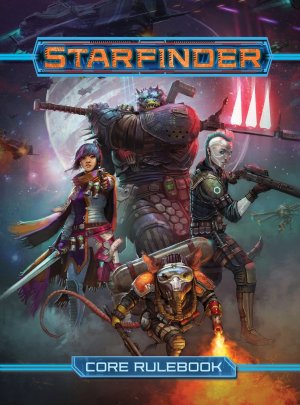
Once you’re done with the special abilities, you can select your monster’s skills. Your array chart already gave you the skill points you’ll have, and how many you’ll be good at, but now’s the time you choose which skills those will be. This is a simple step, and will be done in a flash. Then you’re onto selecting spells and spell-like abilities (if your creature happens to have them from a class graft or a special ability you’ve chosen). If it does you check out a simple chart to see what you’ll be adding by CR, make your spell selections and away you go. If you happen to be making a CR 2 creature with Spell-like abilities, they’ll have two 0 level spells usable at will, and two first level spells each usable once per day. If they instead are CR 16, they’ll have two third level spells usable at will, four fourth level spells usable three time a day each, and two fifth level spells usable once a day each. The chart works the same for spellcasting, but with different numbers. Again, only the most powerful spells will be added into your stat block. Your CR 15 creatures won’t have level one spells available, since they’ll be much more likely to use their third fourth and fifth level spells during battle.

And now it’s time for the last step: checking it over. Take a gander at your creation and make sure it lives up to your concept.

And you’re done! It may sound complicated, but it’s actually very easy to use in practise. Even my kids, who are only six and seven, managed to make something fun, balanced, and unique in a short amount of time.

Once you’re done with the first appendix you move on to the second, which focuses on summoning creatures. Much like the monster creation process, this six page section makes use of charts and grafts, although this is infinitely simpler and easier. Each time you gain access to a summon creature spell you select four specific creatures that you can summon. But what are the options? They’re awesome is what they are! Balanced, thematic and adaptable all at the same time. So what do you do?

First, head on over to the elemental statistics. These will be the base stats for all summoned creatures. The level of summoning spell you’re using determines which size stat block you’ll be using. Then, check out the charts and select what you’re summoning. Is it an aeon, agathion, angel or archon? An elemental? what about a protean, robot or shadow creature? Depending on what you choose it will allow you to select either an elemental or summoning graft which you can then apply to the creature. These grafts are simple and easy to use. And that’s it! You’re done. Get summoning. I, for one, can’t wait.

Which brings us on to our third appendix: simple template grafts. This is two pages of simples grafts, which I already mentioned when I spoke about creating monsters. In addition to their use for monster creation, NPC creation and summoned creature statistics, you can also use these templates to quickly alter existing creatures into new creations.

StarfinderCover
Starfinder Roleplaying Game: Starfinder Core Rulebook

Past this is our fourth and final appendix, which focuses on universal creature rules. Here you’ll find a listing of the common abilities that the different monsters in the Alien Archive have, which also happen to be abilities you can choose to give your monstrous creations.

So what’s left? An index which sorts the creatures by CR for ease of reference, and an advertisement at the back of the book.

That’s it. We’ve come to the end of the Alien Archive.

And what did I think?

I highly recommend this book for players, even if just to have access to the plethora of fun races, but for GMs? This book isn’t recommended, it’s necessity. You need it for the monsters inside, and you need it for the monster creation rules. Lucky for us, this book is just awesome! I’m supremely happy to own it.

And now it’s time to say goodbye!

But before I go, I want to hear from you! What’s your favourite creatures and races from the Alien Archive? What have you made with it? Let me know in the comments!

Until next time,

Jessica


Mummy’s Mask: The Dead Come Knocking…

This past week my brother and sister-in-law came over for our weekly game night–an event which hasn’t occurred in weeks! Can you say ‘thrilled’? So while all of our kids settled in for a late night of Scooby-Doo cartoons, the adults dusted off our Mummy’s Mask characters and settled in to play!

PZO9079
Pathfinder Adventure Path: Mummy’s Mask: Book 1: The Half-Dead City

The Mummy’s Mask Adventure Path is a six part campaign which begins with Book 1: The Half-Dead City, and continues with Book 2: Empty Graves, both of which take place in the town of Wati. The Mummy’s Mask Player’s Guide is a free download on Paizo’s website, available here. If you intend to GM the Mummy’s Mask Adventure Path, I highly recommend picking up the Mummy’s Mask Pawn Collection, which has over a hundred awesome and unique minis to go with the campaign. You’ll also get a TON of use from the Mummy’s Mask Poster Map Folio. Trust me, by the end of Empty Graves your map of Wati will have had one hell of a workout. Mine’s already covered in a ton of numbers and labels I’ve added in permanent marker, to help my players keep track of the many locations in this quirky city. Mummy’s Mask is also the subject of many other neat (but not necessary) game supplements, including Mummy’s Mask Face Cards, Mummy’s Mask Item Cards, and a gorgeous Mummy’s Mask Dice Set by Q-Workshop, which I’d love to get my hands on. Heck, you can even play Mummy’s Mask as a card game (Pathfinder Card Game Mummy’s Mask Base Set), or listen to it as an audio adventure (Beginning with Pathfinder Legends Audio Adventures: The Mummy’s Mask: The Half Dead City). Seriously! There’s a ton of Mummy’s Mask supplements out there, and if that doesn’t tell you Mummy’s Mask is a fun, popular adventure path, I don’t know what does. Other than, you know, me. Haha.
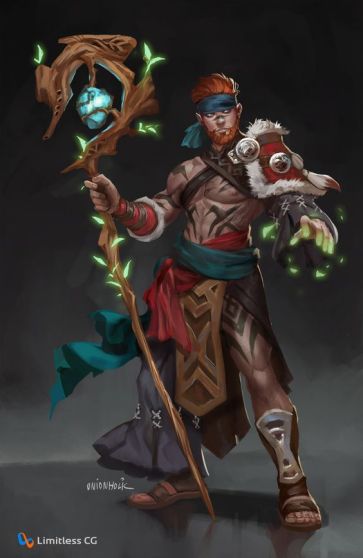

PZO9080
Pathfinder Adventure Path: Mummy’s Mask: Book 2: Empty Graves

If you’re interested in my previous posts about Mummy’s Mask, check out Mummy’s Mask: Game AidsMummy’s Mask: The Shrine of Wadjet, and Mummy’s Mask: The Canny Jackal.


We last left of our adventures in Wati with a cliff-hanger. My group’s characters had just finished participating in a wonderfully fun auction at the Canny Jackal. They had finalized their purchases, selected some choice buys to wear immediately, and scheduled delivery for the other items at their inn, the Tooth and Hookah.  They spent a bit of time worrying over Salal, the ancient slave girl they witnessed sold, and a bit more time socializing and hob-nobbing with the many colourful characters in attendance alongside them at the auction.

MIKE
Artwork by Onionholk discovered on Pinterest which inspired Arc Goodstorm’s appearance.

Arc Goodstorm, my husbands awkward, plant-obsessed witch, chatted with a local coffee plantation owner, Basif Iosep, while Arc’s guest at the auction, a pregnant gold-digger by the name of Pahetti he had only met that morning, tried her best to flirt with the other eligible bachelors in attendance. Arc hadn’t bothered to dress up for the auction at all, although his date did convince him to purchase her new clothes, jewelry and perfume for the evening’s festivities, in addition to purchasing her an object or two during the auction itself. On his back, Arc carries a deep, heavy basket filled with soil and luscious plants, which he tends with care. His rabbit familiar, Mischa, lives inside the basket, and a sarcastic silvanshee named Kal follows him around most of the time, mocking him and his friends. And his dates. And everything, really. Except the rabbit. The silvanshee LOVES his rabbit. So while Arc chatted, Pahetti flirted, and his rabbit twitched its nose, Kal heckled the surrounding nobles, and cast irritating cantrips at them when no one was looking.

Nazeem Salahadine
Artwork similar in appearance to  Nazim Salahadine.

In another part of the room, Nazim Salahadine, my brother’s undead-hating catfolk cleric of Pharasma, chatted with Menya the Whip, a local, up-and-coming armoursmith who Nazim had decided to sponsor. Nazim looked like an overgrown persian cat, and was dressed in some of the finest attire one could purchase in Wati. Bedecked in silks, gems and expensive perfumes, he cut an interesting figure!

Kasmet, my sister-in-law’s catfolk rogue, was similarly attired in the finest ancient Osiriani-inspired fashions. With her revealing white linen dress, collar of gold and blue beads, and her bracelets, anklets, and armbands, Kasmet looked like Bastet herself, pulled through time to the Canny Jackal. Kasmet chatted with her date–well, the date she and Nazim shared–a pregnant peasant woman named Manat whom they had met that morning at the Insula Mater. Manat quickly won them over with her down-to earth attitude and complete lack of shame. While she and Kasmet spoke, Manat stuffed her face with the finest food she had ever tasted, while wearing the finest clothes she would ever worn. The clothes had been a gift, from Kasmet and Nazim to Manat, which Manat only accepted on the condition that she be allowed to sell the clothes afterwards, which would feed, clothe and educate her family for months to come.

Thus arrayed around the room, there was a sudden knocking at the front door. Ahteb and Hamapetra, the most eye-catching of the Canny Jackal’s many servants, moved to open the door–only to have it smashed in by six zombies. With the servants pinned to the ground and dying under the heavy doors, the zombies poured into the Canny Jackal… And we had stopped.

You see why we were so excited to get back into the game!

We picked up this week with the zombies pouring into the Canny Jackal, spreading out to attack the various nobles and adventurers that my players had grown to love over the past few game sessions. Some nobles were prepared to fight back, of course, like Teos Okhenti, a bastard of House Okhenti who moved immediately to protect Yuya Mahfre, who openly hated him despite his many shameless attempts to flirt with her. Most panicked and screamed. Luckily, there were a few other capable combatants in the room at the time, including Sigrun Firehair and her mysterious companions known only as The Twins, all of whom were members of the Daughters of the Desert adventuring group.

My players leapt into action to protect their pregnant guests and help those in need around the room. Ah, but this battle wasn’t so simple! Crawling hands, shifting crowds, panicking guests and collapsing scaffolding all worked to complicate this fun, dynamic encounter. My personal favourite part? Their pregnant guest Manat stood unworried at the back of the room, filling a massive bowl with as much left overs as she could carry.

In the midst of this battle, the group could hear cries of “More!” and screams of alarm from outside in the Sunburst Market, and deeper into the showrooms of the Canny Jackal, so at its conclusion they took a moment to heal themselves, and ensure their guests were safe, before hurrying on to the next nearest sounds of panic.

PZO1112_500.jpeg
You can find zombies and the mummy in Pathfinder Roleplaying Game: Bestiary and Pathfinder Roleplaying Game: Bestiary (Pocket Edition)

In the showroom warehouse they discovered the owner of the Canny Jackal, Minnothet, being attacked by a zombie, while the coffee merchant Basif Iosep protected his mistress, Lady Nubumshaset, from another. Splitting up to better protect the nobles worked well–for a time. Unfortunately a nearby sarcophagus burst open a few moments later, revealing the mummy of Amadjawat the Many Veiled to them in all her undead, angry glory! Luckily, only Kasmet and the nobles suffered under her fear aura, leaving Nazim to shout his ululating battle cry and hurry into battle, with Arc following close behind with his magical lighting spear in hand.

Throughout this rolling series of encounters, the Fateway Five, as our trio of heroes is known, saved other nobles from zombies and rescued the ancient slave-girl Sallal from being abducted. After ensuring the Canny Jackal was safe and looked after, they headed out into the city of Wati–only to see MORE undead terrorizing the populace.

Nearby a terrified man hurried to unlock his door while two zombies closed in on him. Nervously he fiddled and fussed… and dropped his keys. Further away, the familiar sight of Mila Ansretti, a travelling merchant who they had befriended during our first play session and who had been a recurring character since, stood in the market surrounded by four zombies, with only a pair of market stalls and her wits to protect her. The many severed hands of thieves tied to the Pillar of Second Thoughts twitched with unlife, while in the distance they could see The Abadaran Sanctum of Silver and Gold, and the Nethysian Temple of Arcana Unbound both under assault. The other way they could see the holy, white crocodiles being devoured by zombies–their keeper apparently having decided to leave them to their fate. And further away? They could hear the screams of the terrified residents of Wati. The dead had risen!

PZO1116_500
You can find the crawling hand in Pathfinder Roleplaying Game: Bestiary 2 and Pathfinder Roleplaying Game: Bestiary 2 (Pocket Edition)

The rest of the session turned out to be a fun, dynamic series of battles, where our heroes saved familiar faces, made new friends, and brought the dead back into undead. When they had finally cleared the Sunburst Market of dangers they spoke with the nearby churches in order to coordinate a plan to save Wati, and investigated a nearby wagon accident. There they discovered wagons had been smuggling corpses from the Necropolis into Wati, when the dead had suddenly burst out of the wagons and killed the drivers and camels. Although this showed them where some of the undead had come from, it didn’t explain how they had animated, or where all the other undead had come from. Unfortunately, as they were investigating the wagons, the corpses of the wagon drivers stood up, and the broken pinned down bodies of the camels twitched to life. Or, more accurately, unlife. Fighting off the zombies and dodging zombie camel bites was a ton of fun, and when it was over my players were left with an imposing sense of doom.

Something had made the dead rise. And then, right before their eyes, the freshly killed had risen again.

By then it was late, and the time had come to wrap up for the day. So we tidied up, collected our children, and said goodbye.

They have some time to think on their plans before we play again this week, and I can’t wait to see where they decide to visit next!

See you next time!

Jessica

And remember, if the dead come knocking, don’t open the door!

Starfinder Society Scenario Reviews: Half-Alive Streets and the Scoured Past

Today we’re going to take a look at the two most recent Starfinder Society Scenarios that are currently available for purchase, and let you know we thought. Although you’ll find references to events in each that I liked or disliked, and comments about specific characters, these scenarios are not explored in detail. It’s not my intention to spoil the events in these scenarios, or give summaries and full reviews, but to share my opinions and provide recommendations. That said, if you want to avoid even minor spoilers I recommend you check out a different article. Whether you intend to use them in home games of the Starfinder Roleplaying Game, sanctioned scenarios for use with the Starfinder Society Organized Play, or just want to read a nifty new adventure, we’ve got you covered! So sit back, and get ready to enter the Drift!

PZOSFS0110E
Scenario #1-10: The Half-Alive Streets, a Tier 1-4 scenario for the Starfinder Society.

Scenario #1-10: The Half-Alive Streets is a Tier 1-4 adventure which takes place in Absalom Station. It has no scenario tags and does not feature starship combat. This lovely little scenario sends the PCs on a hunt throughout Absalom’s Freemarkets to track down the creator of a new series of biotech augmentations which the Pathfinder Society would like to make accessible to its agents. Unfortunately, the creator is unknown, and the only lead comes from a shady contact of the Society’s, Julzakama, a vesk pawnbroker first introduced in Quests: Into the Unknown. In addition to the wonderful recurrence of Julzakama, this scenario also involves AbadarCorp, and the shirrin Philt, so anyone who has played through Scenario #1-02: Fugitive on the Red Planet and earned the AbadarCorp Respect boon, will want to slot it for this scenario. There’s plenty of wonderful new faces in this scenario as well, including a ysoki pawnbroker named Dot, a vesk ‘barber’ who specializes in scale and horn detailing named Katazoa, a burly medicinals saleswoman named Isidre, a verthani technomancer named Chryson, and a halfling family in need of your player’s help. This tidy little mystery is great fun, and a has a bit of a horror vibe to it. However, its got a  bit of a horror vibe to it. It would definitely freak my kids out. Overall, I give this scenario four out of five stars.

PZOSFS0111E.jpg
Scenario #1-11: In Pursuit of the Scoured Past, a Tier 3-6 scenario for the Starfinder Society.

Scenario #1-11: In Pursuit of the Scoured Past is a Tier 3-6 adventure which takes place on the library planet of Athaeum which constantly teleports throughout the galaxy. It is of utmost importance to the Second Seeker’s Faction (Luwazi Elsebo), and is strongly tied to the Year of Scoured Stars metaplot. In addition to Luwazi herself, this scenario also includes Royo (a ysoki who dislikes digital records) and Iteration-177 (and android member of the Apis Consortium), both of which are characters introduced in Scenario #1-05: The First Mandate. Anyone who’s earned the boon High Society Influence (Royo) should definitely slot it. New characters and organizations introduced include the axiomite Curators of Athaeum, and the Hellknight Order of the Pyre! Rife with wonderful roleplaying opportunities and a delightful cast of characters, this scenario is a blast! How can it go wrong? Right?! All in all it was a fun scenario, and certainly unique. The major downside is that it’s a relatively high-minded plot in this one, so if you’re just after a fun romp, or you’re playing alongside children, I would recommend a different scenario. Overall, I give this scenario three out of five stars. If you’re particularly interested in the Scoured Stars Incident, or a big fan of roleplaying (like I am) I’d increase the rating to four out of five stars. It should also be noted that there is a Mission Faction Note missing at the end of this scenario. This line has been copied from the Paizo website and is shared below:

“If the PCs succeeded at their primary mission, they further goals of Luwazi Elsebo in uncovering the truth behind the Scoured Stars incident. Each PC earns 1 additional Reputation with the Second Seekers (Luwazi Elsebo) faction, in addition to any other Reputation earned as a result of completing this scenario.”

 Thanks for joining us today on our exploration of the new scenario’s available this month. I hope you’ve enjoyed reading about them as much as I have. Now it’s time to go out, join a game, and get playing!

Jessica

The Many Fortunes of Grandmaster Torch

GrandLodgeSymbol
The Glyph of the Open Road, Sigil of the Pathfinder Society.

Another week has passed, and another of our OutPost games has come to an end. It was an oldie, but a goodie, from way back in Season 0. Scenario #06: Black Waters was an absolute delight. Put on by GM Shieldbug, the best GM I’ve ever had the opportunity to play alongside, my kids, my husband and I all had a ton of fun! Black Waters is designed for 1st to 5th level characters, and was written by Tim and Eileen Connors. In it, the Pathfinder Society sends its agents to the Tri-Towers Yard, an elite academy for the children of Absalom which was destroyed and flooded by an earth quake a decade ago. During the quake the school collapsed into an undiscovered necropolis, and the Pathfinders have been itching to get at the ruins ever since. Kept out of the mass graves by the (understandable) sentimentality of the influential parents whose children died in the tragedy, the Pathfinders have bided their time. Now known as the Drownyard, the Pathfinders are finally granted a chance! Sent to retrieve a magical ring, this scenario is more than just a dungeon delve. It’s got a surprisingly wide cast of entertaining characters to interact with, from influential noblewoman Lady Dacilane, to a gardener who is more than he appears, and the spirits of the dead themselves. I highly recommend this one!

Five lucky Pathfinders were chosen for the job, including my husband’s character: Enzo Jeggare, a Chelaxian occultist with a splendid moustache and a habit of summoning a dog to battle on his behalf. My daughter played Bunny Paras, a two-tailed kitsune druid with a fondness for dinosaurs and rabbits. Bunny Paras owns a rabbit breeding farm and is a vegetarian. In addition to her many pet rabbits, she has a pet parasaurolophus named Paras, who loves to dance and toot out rocking tunes. My son was paying Senton,  an Ulfen ranger better known as Mr. Ice who fled south to escape the continual cold of his homeland: unfortunately, he’s still freezing anyway. I played my wood kineticist, Everbloom, a kitsune who grew up alone in the wilds and views life and death as just another fascinating part of existence. More than a little aloof and uncaring, Everbloom comes off as way nicer than she actually is. The final character was Tera Fosham, a veiled ifrit oracle with clouded vision whose healing touch and blessings were invaluable on this adventure. For more information on Enzo Jeggare, Bunny Paras, Paras and Mr. Ice, check out the following blog posts (Joining the Pathfinder Society and Signs in Senghor: Part One and Part Two) where I talked about their backgrounds, creation, and their first adventure playing Scenario #9-10: Signs in Senghor.  To read about our adventures playing Black Waters, check out the gameplay thread, here.

250px-Scarab_Sages_faction_symbol
Sigil of the Scarab Sages, a faction of the Pathfinder Society.

After wrapping up that wonderful game, my kids wanted to immediately begin another one, but my husband had other plans. Knowing he was only one adventure shy of a reaching level two, my husband suggested I GM them through another scenario this weekend, and my kids agreed. I spent some time thinking about what my kids love best about playing Pathfinder. Fulfilling faction goals, of course, which means missions that have importance to the Scarab Sages and the Dark Archives. My daughter loves adventures that contain animals and cute things. Definitely nothing with lycanthropes. My son loves missions where he gets to interact with colourful characters, and make friends. Also? Turns out he loved messing with the Aspis Consortium, which he saved his good pal Gideon Wren from. And my husband? Something he’s never done before. And surprisingly, he showed interest in missions regarding the Shadow Lodge. Awesome! So after a ton of sifting, reading and sorting through the scenarios I own, I made an absurdly long list of potential scenarios we could play, and set to work reading. In the end, I decided to run us through an old scenario from Season 0 intended for Tiers 1-7: Scenario #14: The Many Fortunes of Grandmaster Torch. Why, you might ask, did you choose to run that old thing? Well, for starters, Grandmaster Torch is an important character to both the Shadow Lodge and the Scarab Sages, so I definitely wanted to ensure my family got to meet him before we played later scenarios which might involve or mention him. Second, this scenario takes place in Qadira and involves the illegal smuggling of Osirian artifacts, a topic which would interest both my son and daughter’s characters, as they are members of the Scarab Sages. Third, it involves retrieving the stolen relics, all of which have magical properties, and turn out to be more dangerous than originally thought–aspects which could interest my husband’s character, who is a member of the Dark Archives faction. Fourth? This scenario has a lot of roleplaying opportunities, not just with your venture captains and Grandmaster Torch, but also with the people around each of the relics, and the people who possess them. And lastly, although this scenario might seem to be pretty straightforward, there’s actually a lot of ways that players who think outside the box could shake up or alter how the encounters are supposed to take place. And if there’s one thing my family’s good at, its coming up with crazy plans and ideas that no one’s accounted for. In short, I thought they’d have a blast.

And I was right!

Dark Archive
The sigil of the Dark Archives, a faction of the Pathfinder Society.

We began our adventure with a short introduction to it’s setting: Qadira and the city of Sedeq, followed by our mission briefing with Venture-Captain Yasmin Kal’al (complete with pictures, of course!). From there we set out into the city, to track down the smuggler Matzal Chaim and determine who he sold the relics to. Bunny Paras and Mr. Ice were also interested in who his inside contact was within the Osirian Cultural Ministry, without whom the relics would have remained out of his hands. They found Chaim, and came up with a good plan to corner him, but he noticed them and fled into a bathhouse. While our Iconic filler character and Mr. Ice watched the outside entrances an exits, Enzo and Bunny Paras chased him into the bathhouse, and cracked out a bunch of wonderful skill checks to avoid slipping on wet tiles, pushing past crowds of bathers, jumping over baths, and seeing through stream. Enzo nearly slipped and fell on the tiles, while Bunny Paras was thrown off guard when she had to slip past a group of naked bathers who fled from Paras in a panic. In the end they caught up to their target, but they were too late. He had run into a private bath and was cut down by the guards–guards working for the notorious information broker, Grandmaster Torch. Lucky for them, Torch had the information they were looking for and was willing to part with it–for a price.

My kids had a blast interacting with the ever-creepy Grandmaster. My daughter immediately began trying to purchase other, non-related, frivolous objects from his associates for her rabbit farm (a giant rabbit statue and planter, anyone?), while my son offered Torch a whopping two dollars for the information. Hearing the price was 3,000 gold pieces, Mr. Ice sure was surprised! He bargained for the information by offering favours and was rewarded with four names–one for each person who had purchased one of the stolen statuettes. Mr. Ice promptly asked for more information on them, in exchange for another favour each. Grandmaster Torch was more than happy to oblige. With that information, my son set out to learn more by offering MORE favours, but was interrupted by Enzo Jeggare, who had to drag his companions out of the bathhouse before they agreed to any more favours and absurdities. Clearly, his companions had never dealt with anyone unscrupulous before! Not trusting the Grandmaster, Enzo himself led the group through the streets of Sedeq to find each of their targets.

Although it’s expected that the PCs will have to engage in four or five combat encounters during this scenario–some groups might manage three or four–my family managed to use quick thinking, cunning plans, distractions, summoned creatures and childish optimism to complete three of those encounters non-violently. That left only two battle encounters for the entire scenario. A real feat! The battles all went well, but weren’t particularly difficult for them. But in this scenario it was the interactions and roleplaying that really shined. Everyone had a BLAST.

After completing their mission and some minor interactions with their venture captain, the group was given an invitation to have dinner with Grandmaster Torch–an event which Enzo accepted with some trepidation, Bunny Paras was happy for, and Mr. Ice was over the moon.  Seriously. He was SUPREMELY excited. In the end he decided that Grandmaster Torch was his second favourite NPC, and he wanted to make him his best friend–alongside Gideon Wren, of course! Mr. Ice invited Grandmaster Torch to his upcoming birthday party, and the group bid him farewell.

And so our scenario came to an end. As their third scenario, they got to spend some time levelling up their characters to level two, and purchasing gear. And which adventure will they go on next time?

I’m thinking… Scenario #7-10: The Consortium Compact! It’s a low level, repeatable scenario involving the Aspis Consortium that I think my kids will rally have a ball with!

And that’s all for us today!

See you next time, on d20diaries!

Jessica

Gifts from the Stars!

PZO7302
Starfinder Flip-Mat: Basic Starfield

It’s been a while, but I finally got my hands on a Starfinder flip-mat! Which one, you might be wondering? The most important one, of course! We’ve been using a hex grid at my house for starship combat while playing Starfinder, but it’s terrain from another game. Admittedly, brightly coloured grass, hills and some trees is not exactly an atmospheric location to be making fancy piloting maneuvers and firing our laser turrets. But, Starfinder Flip-Mat: Basic Starfield has come to the rescue! This mat is gorgeous, folds well, can handle markers, and has two different sides: one is black with white stars, while the other is more colourful. We’ve tested it out a few times and honestly, couldn’t me more thrilled.

2018-04-05 18.27.44
Contents from the Starfinder Pawns: Starfinder Core Pawn Collection. My kids and I had a blast unboxing it!

Which brings me to the next wonderful product I finally got my hands on: Starfinder Pawns: Starfinder Core Pawn Collection. Now, there’s other pawn collections out there for Starfinder: Starfinder Pawns: Alien Archive is another beauty, but I knew that if I only invested in one pawn collection, Starfinder Pawns: Starfinder Core Pawn Collection would be it. Why? For starters, it has ships. SHIPS. No longer will we fly around a random leucrotta or demon mini while travelling the stars! Oh, no! We’re upgrading to a gorgeous Idaran spaceship! Second? The races. With over ten different minis for each of the core Starfinder races, many of which contain multiples, this Pawn Collection has you set for player characters, NPCs and enemies of all kinds.

2018-04-05 18.59.19.jpg
My son’s favourite pawn from the set: The Thaumtech Omenbringer!

In addition to the core races represented, there’s also a mini or two for each of the legacy races, as well as a few select Starfinder races from other sources, including the haan, elebrian, grey, and contemplative. The icing on the amazing star-cake? A few drone minis for all those mechanics out there! My son adores all the ships inside, but his favourite turned out to be the Thaumtech Omenbringer, an ominous looking Eoxian ship made of bone and magically enforced steel.

2018-04-05 18.59.592018-04-05 18.59.38My daughter’s favourite was certainly more expected: the cutest and cleanest looking ysoki in the set: The ysoki Star Shaman. And myself? I’m actually a big fan of the stealth drone, which turned out to be a cute little dog-bot!

Come on! You know you want it! Haha.

 After sifting through the pawns with my kids and finding them a new home in a shoe box, we had a ton of fun picking out which minis would be our Starfinder characters. No longer will Hoponisa be using a kobold mini, nor will Vishkesh and his drone be represented by a kuo-toa and a stirge! We couldn’t be happier.

Do any of you own the Starfinder Core Rulebook: Pawn Collection? Got a favourite mini you want to share? Let us know!

We’ll see you in the Vast!

Jessica