Pathfinder Playtest: Ever Evolving

The Pathfinder Playtest is ever evolving. You download (or purchase) the rulebook, make your characters, and play. Maybe you play one of the adventures from Doomsday Dawn, maybe you play all of Doomsday Dawn. Maybe you play one of the Pathfinder Playtest Society Scenarios (#1: Rose Street Revenge, #2: Raiders of Shrieking Peak, #3: Arclord’s Envy). And maybe you play a custom adventure. When you’re done you fill out one of Paizo’s many surveys. Paizo goes through that feedback and makes changes. That’s right! Constantly over this next year they’ll be combing through your survey responses and adapting their rules for the playtest. It sounds like these changes will occur approximately monthly, but don’t quote me on that. We’ll have to wait and see. What is certain, is that their first update to the Pathfinder Playtest rulebook is already here.

Pathfinder Playtest Rulebook
Pathfinder Playtest Rulebook is available in print or as a free download on Paizo’s website.

Right now.

So what’s different?

First off, head over to Paizo’s website and download the update document. Then give it a read. The update document is five pages long (the final page is the OGL), and is split into four types of rule changes: New Rules Updates, Critical Updates, Other Updates, and Doomsday Dawn Updates. Despite being ranked by importance, it’s imperative you begin to use all of the new rules immediately.

As for the rules themselves, we won’t get into specifics. The document is free and does a better job of explaining things than I ever could. The biggest changes you will notice are to death, dying, and the rules surrounding it. No longer can you be dying while conscious, which is wonderful. The updates make use of the slowed condition, which I think is going to be an improvement. We’ll have to see how that plays out. Another major update includes some alchemist changes. For starters, your special alchemist abilities (Quick Alchemy and Advanced Alchemy) no longer specify that they must be used with common formula, so if you unlock an uncommon formula throughout the course of your adventures you can still use it with your special abilities. In addition, they gain training in one extra skill, and the number of formula that alchemist’s start with has been clarified. Turns out the number is eight. Four from your formula book and four from the alchemical crafting feat. (Note to self, update my daughter and my alchemists…). Also, all classes are proficient with unarmored defence (which means you’ll still get a bonus to AC even if you’re unarmored). Bards gain an extra spell known to start, druids get training in one less skill, rangers can choose Strength or Dexterity as their key ability score, stabilize has been changed, bastard swords deal slashing damage (they were erroneously  listed as piercing damage, haha), recognize spell has been adjusted (to fix counter spelling), and don’t worry: the bag of holding has been fixed! This is just a taste of the changes. There’s a lot more updates. Four whole pages worth! So put on your thinking caps and get reading. (Wow, I really hope they put out an updated copy of the Pathfinder Playtest Rulebook that includes these changes. Once they put out a second update document, referencing it for changes is going to be painful! Haha).

Changes will continue to occur over time so your feedback is incredibly important. Not only does it provide Paizo with a large pool of data that they can use to decide the future of the game, it also lets them find out all kinds of nifty little bits of information. For example: most played race so far? Human. Most worshipped deity? Cayden Cailean. Class that died the most? Cleric. Number of people who chose to worship Asmodeus? Three. Not three percent. Nope. Just three.

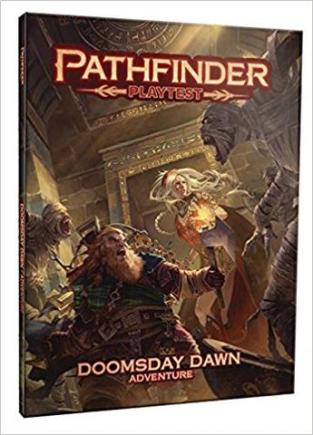
Pathfinder Playtest Doomsday Dawn
Pathfinder Playtest Adventure: Doomsday Dawn is available in print or as a 
free download on Paizo’s website.

At the moment, you can fill out surveys on a variety of adventures. Each of the Pathfinder Society Scenarios has it’s own trio of surveys: player survey, GM survey, and general feedback survey. Doomsday Dawn originally launched with access to three surveys, all for the first part of the adventure: The Lost Star. (Again, a player survey, GM survey, and general feedback survey). Just the other day they released a second trio, all for the second adventure in Doomsday Dawn: In Pale Mountain’s Shadow. It is incredibly important that if you complete the survey on In Pale Mountain’s Shadow you us the new, updated rules! Further surveys for the later adventures in Doomsday Dawn will be released in the future.

Now, if you haven’t filled out your previous survey on the Lost Star, don’t worry! It’s not too late. All of the surveys will be available until the end of the year, and will be revisited by the Paizo team regularly. You haven’t missed your chance to contribute.

Now, if you’ll excuse me, my daughter and I have to select some extra formula for our alchemists.

Jessica


Blood of the Sea

Welcome back to d20 Diaries!

As mentioned this past Monday, today we’re going to be taking a look at one of the wonderful Pathfinder books I happen to own: Blood of the Sea!

Blood of the Sea is a Pathfinder Player Companion compatible with the Pathfinder Roleplaying Game. This means it’s a thin, soft-cover book with plenty of new options intended for players creating characters. More specifically, this volume focuses on some of the aquatic races of Golarion, how you can use them in water and on land, and on underwater adventuring. This book goes hand in hand with Pathfinder Campaign Setting: Aquatic Adventures, which contains information on each of the oceans of Golarion, underwater combat, a host of new rules and some new character options.

Blood of the Sea
Pathfinder Player Companion: Blood of the Sea

The races detailed in Blood of the Sea include aquatic elves, cecaelias, gillmen, locathahs, merfolk, tritons, adaro, grindylow, and sahuagin. Statistics for playing these races as characters are including for all of these races except for aquatic elves, gillmen and merfolk. Aquatic elves, gillmen and merfolk can be found in a variety of sources, including the the Advanced Race Guide and Inner Sea Races. Gillmen can also be found in the Inner Sea World Guide, and the Inner Sea Monster Codex, while merfolk can also be found in the first Bestiary.

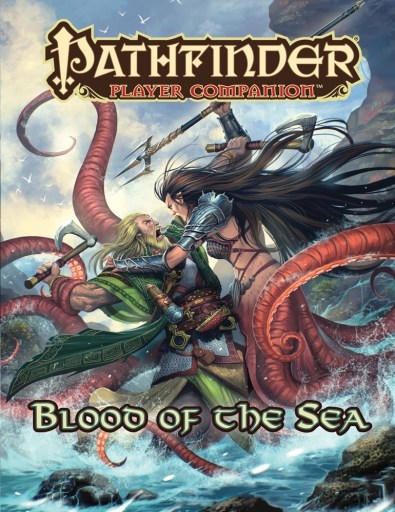
Blood of the Sea features dynamic cover art by Kiki Moch Rizky, which showcases Hakon, the iconic skald, battling an enraged cecaelia on the beach. The inside cover has a really useful map of Golarion with all of its oceans and seas labelled. I definitely read some I didn’t recognize, which is nice to see. The oceans include Abari, Antarkos, Arcadian, Embaral, and Okaiyo, while the seas depicted are Castrovin, Fever, Ivory, Inner, Shining, Songil, Steaming, and Valashmai. For more information on these major waterways you’ll need to check out Aquatic Adventures.

Up next is the table of contents and the introduction. Unlike most Pathfinder Player Companion introductions, this one does not contain any traits or character options. It does still contain a handy rules index, which lists all the new archetypes, feats, and other new rules options contained in the book, alphabetically by type with the page numbers so they can be found on for easy reference. After this we move right into the bulk of the book: aquatic races. The goodly races are presented first, each with two pages dedicated to them. Each contains information about the race in general, how they might come to be adventurers, and some new rules options which typically include statistics for playing them as a race, alternate race traits, favoured class options, feat, and archetypes. Villainous races are showcased afterwards, with two pages shared between then three of them.

Up first? Aquatic elves! Curious and respectful, these elves take it upon themselves to explore and protect underwater ruins — although they have the wisdom to leave the most dangerous ruins untouched. There’s some nifty artwork featuring an aquatic elf with a dagger that has a handle made from a conch shell, which looks pretty cool. As already mentioned, the statistics for playing an aquatic elf are not included in this book. Instead, there is a nice rogue archetype called ‘seeker of the lost‘ which I rather enjoyed. It focuses on exploring underwater ruins, disabling magical traps (which are some of the only kind to survive long periods of time underwater without deteriorating), and underwater combat. Although it’s not ground-breaking or anything, I rather like it. There are also three alternate race traits, and a total of nine favoured class options. ‘Deep sea dweller‘ allows aquatic elves to survive in the dark, depths of the ocean — sort of. It grants you dark vision and cold resistance at the cost of low-light vision and elven immunities. It does not, however, grant and protections from pressure. So it allows you to be in the lightless parts of the ocean, but not too far down. It’s my favourite of the race traits for sure! ‘Surface features‘ allows you to blend in with surface elves which, although useful, doesn’t really tickle my fancy. Why be a weird race and then choose to look like everyone else? Still, it’s sure to see use in play. It replaces keen senses. Lastly, ‘surfacer antagonist‘ is for all the aquatic elves out there who have been harmed by those nasty humans. (Ugh. Filthy land-lubbers. Am I right? lol).  This trait grants you a +1 bonus on attack rolls against humans at the cost of elven magic. Yeah, against HUMANS. This trait is going to be really good in pretty much any adventure or campaign. I honestly can’t think of one where you don’t fight a human at some point. Despite it’s usefulness, ‘deep sea dweller’ beats it as my favourite character option for aquatic elves.

Next we come to cecaelias, which first appeared in Pathfinder as an enemy in Bestiary 3. I can honestly say that before reading this book they were not one of the races I ever thought I would want to play. They seem relatively impractical for a PC (being aquatic, and having tentacles), and I’m not big into octopi. It just wasn’t interesting to me. But, after reading the book, I’m probably the most excited for playing a cecaelia. For starters the artwork is awesome, and makes them a lot more relatable than the bestiary image. Their racial traits are fun looking. They have enough of the monster’s original abilities, while still being playable as a PC. They’re a powerful race, of course, at 23 RP, which puts them on par with grindylow, sahuagin, ogres, and svirfneblin. They have great flavour and cultural information. I adore that they’re super curious and social. They’re out to enjoy life, which is always fun to play. They come with three alternate race traits: ‘dextrous tentacles,’ ‘garrulous,’ and ‘tripping tentacles.’ They’re all pretty good, with ‘dextrous tentacles‘ allowing you to use your tentacles to hold and manipulate objects and increase the range of your tentacle sense ability (which gives you blindsight underwater) at the expense of being able to shoot an ink cloud; ‘garrulous‘ gives you a bonus on linguistics and diplomacy skill checks as well as allows you to learn two languages each time you invest a rank into linguistics at the expense of being able to shoot an ink cloud; lastly, ‘tripping tentacles‘ makes you really good at tripping your opponent but causes you to lose your tentacle sense ability. I like ‘garrulous‘ best, but I’m one of those players who enjoys learning a ton of languages, so I’m definitely biased. Haha. As for class options, they have only a single feat up for offer. That said, I like it, so its enough for me. The feat is ‘cecaelia focus tattoo’ which gives you a magical tattoo. Although you can have any number of tattoos, you can only activate one at a time. Once activated a tattoo functions for one hour. There are currently eight different tattoos which can increase your saves against poison or death effects, your stealth or survival skill checks, or the distance of your darkvision. Once you have the feat you can also choose to take another tattoo or increase the potency of one of your tattoos in place of a favoured class bonus, which is a pretty nifty option.

Leaving behind our tattooed cephalopods we get to a race I’ve liked since they were introduced ages ago: gillmen. I know, I know, having to submerge yourself in water or die a horrible death is tricky for a lot of campaigns, but what can I say? I like them! As mentioned previously, statistics for playing gillmen  are not included this book. Instead, we get some nice flavour and cultural information (some of which is new), and a lot of class options. There’s the ‘hidden current‘ vigilante archetype which allows gillmen to take on the identity of a nonaquatic humanoid when they’re on land, and at higher levels can even let them magically travel between the land or sea. There’s also four feats, four alternate race traits, an four favoured class bonuses. Also? Awesome artwork! Its my favourite of the entire book. My favourite class options are the feats ‘surface survivor‘ (which makes playing gillmen more manageable) and ‘aphotic explorer,’ as well as the ‘venomkissed‘ alternate race trait.

Locathahs are up next, which is another one of those races I’ve never really felt an urge to play. That said, the flavour really sold it for me, and I think I’d enjoy creating one. My favourite part? They’re stinky and proud of it! Haha. Locathahs use their scent to communicate, even underwater, which is pretty cool. Locathah racial traits are a great conversion from their statistics from Bestiary 2, and the race comes in at 10 RP, which makes them approximately on par with the core races. There are also three feats here, all of which are a part of a combat style called ‘electric eel‘ that utilizes the ‘elemental fist‘ feat. I’ve mentioned in other blog posts that combat styles aren’t really my cup of tea, but I’m actually quite fond of this one. I recommend giving it a read. There are also five alternate race traits available for locathah characters, and six favoured class bonuses. I like all of the alternate race traits, but I think my favourites are ‘blunt head‘ which gives you a bite attack but reduces your swim speed, and ‘coastal emissary.‘ I also love ‘powerful smell,’ but its bound to irritate your companions. Haha.

Aquatic Adventures
For more information on underwater combat and the waterways of Golarion, pick up Pathfinder Campaign Setting: Aquatic Adventures

Up next is merfolk. As mentioned, the statistics for merfolk are not provided in this book.  Instead there’s a lot of music-themed class options and six favoured class bonuses. In fact, they have some of my very favourite class options in the entire book. For starters there the oracle archetype ‘ocean’s echo‘ which gives you a nice selection of sound-themed bonus spells, and the ability to use some bardic performances. I’m in! (It should be noted: I love bards). There’s also a new oracle curse which is bound to be a ton of fun: ‘song-bound,’ which compels you to sing loudly whenever you speak. Yes, always. How fun is that? I don’t know about you, but I would literally sing everything my character says (I’m an average singer at best, by the way). My kids love it, too. Lastly, there are two new masterpieces in this section, one of which can grant your companions a swim speed, and the other that can scare off trespassers. Both can be sung or played on a string instrument.

Tritons are the final goodly aquatic race in this book. Just over half of the entry is racial and cultural information, most of which is new (as far as I know, haha).  Their racial traits are well done, but wow! Are they ever slow on land! Haha. They’re a great conversion from their statistics in Bestiary 2, and come out to a total of 11 RP which makes them approximately on par with the core races and locathahs. There’s a paladin archetype in this section called ‘kraken slayer‘ which looks interesting, but isn’t going to see much use in non-aquatic campaigns. There’s also two feats which work well together: ‘ally caller‘ which lets you use your innate spell-like ability to summon water elementals and dolphins two extra times per day (this feat can be taken multiple times) and ‘aquatic squires‘ which makes that same spell-like ability last 1 minute per level. Not amazing or anything, but fun and flavourful. I like it. All told, though, triton is my least favourite of the goodly races featured in this book.

With the good guys over and done we come to two pages entitled ‘Enemies of the Sea.’ Here we find statistics for playing adaros, grindylow, and sahuagin, as well as a paragraph of racial information on each. Grindylow and sahuagin are both 22 RP, putting them on par with the cecaelia, while adaro are a whopping 32 RP, which makes them among the toughest races you can choose, just under gargoyles and driders. I’ve always enjoyed adaros and grindylow, so I’m happy to see they were included.

Flipping the page we get to three pages on gear — most of which is mundane. Air breathing creatures can make use of artificial gills to survive underwater for a while, while aquatic creatures with slow base speeds like merfolk and tritons can make use of land limbs to improve their speed on land. There’s also a lot of practical gear like underwater paper, pens and compasses, as well as wall hooks. But, my personal favourite mundane bit of gear? Sponge suit! This is a mandatory purchase for the next gillman I make!

There are only four magical items, but they’re all quite useful. The ‘crystal helm‘ fills with water while on land and with air while underwater, allowing a PCs out of their environment the ability to breathe. The familiar bubble can keep your familiar breathing underwater, and shimmering kilt can turn an aquatic humanoid’s tail into legs. (No need to barter with evil cecealia witches anymore… Poor Ursula’s going to be unemployed). But, my personal favourite? The ‘cloak of eternal mist.’ In addition to making you character count as if they were submerged in water, it grants you a bonus to hide in fog and mist, and can grant you concealment when immobile. The best part? Its relatively affordable.

There are four spells on the next page. They are nicely thematic, but none of them blew me away. I think my favourite is ‘arid refuge,’ a spell that can help enable prolonged underwater adventures for land-bound characters by giving them a safe place to rest. Other spells include ‘instant clot,’ ‘silt sphere,’ and ‘suspend drowning.’

Leaving magic behind we get to four pages of aquatic class options that can be taken by most races. There’s a total of five class archetypes, one cavalier order (order of the eel) and one eidolon subtype (deepwater eidolon). I particularly like the ‘aquatic beastmaster‘ archetype for hunter, which contains a whole new array of water themed animals to use with the animal focus ability. I also really like that the ‘coral witch‘ witch archetype allows you to grow your familiar out of coral, an that the ‘keeper of the current‘ inquisitor archetype can track underwater by reading traces of eddies and currents. Very cool! The last two archetypes are ‘crashing wave‘ for the cleric (which has a very interesting form of channel energy that leaves neutrally aligned creatures unaffected) and the ‘tempest tamer‘ druid archetype (which taps into the powers of typhoons, whirlpools, and other storms).

After this is a very useful chapter on the challenges facing underwater creatures who find themselves on land, and ideas and methods for overcoming those challenges (both magical and mundane). I found these four pages a huge help. It not only urges you to think about some troubles you might not have thought of, but it also makes playing aquatic races in a land-based campaign a lot more… attainable. There were certainly some topics discussed that I’d never thought of. Not because it’s obscure or anything, but just… I don’t know. I never thought about it. Haha. For example, weight. If you’re used to being buoyant, walking on land would be hard. How would you act? Imagine how heavy your body would feel to you. Sounds exhausting! What about weather? It’s a lot different than the sway of the currents. And climate? In a lot of places the ocean is cold. How does someone used to that feel on land? What about little things, like seeing a fire or cooking your food? Or keeping up with your companions? This section also has some awesome artwork of a serious ranger on a horse looking off into the distance. Except he’s not just a ranger. He’s a merfolk ranger riding sidesaddle. It’s great. Haha.

Which bring us to the last part of the book. Two pages discussing how air-breathing creatures can adventure and travel on or under water. Like the chapter before it, this section brings up some interesting topics. It also works as a handy reference for spells and magical gear that are useful for underwater exploration. There’s also a small sidebar that lists the oceans of Golarion, a few of its seas, and gives you a one sentence description about that body of water. It’s super brief, but better than nothing. As previously mentioned, players looking for more information on Golarions major waterways should pick up a copy of Pathfinder Campaign Setting: Aquatic Adventures.

And that’s it! Then end.

This was a really fun, useful book that presented a lot of unique race and class options for players. I think it’s well-worth the investment. That said, due to its topic, it is quite niche. It’s not a book you’ll be able to use with every character or adventure you’re in. It’s quite focused: underwater races, and underwater class options. That said, this book invested a lot of effort into making underwater races playable on land indefinitely, and it succeeded. Some of the class options are just as usable above water as they are underwater — the ‘ocean’s echo‘ oracle archetype and the ‘tempest tamer‘ druid archetype are great examples of this. The rest, though, cleave pretty tightly to the waves. That said, there are plenty of places in Golarion where water is plentiful. The oceans, seas, and underwater, of course. There’s also the Shackles, Sodden Lands, and River Kingdoms, as well as many port towns, and the coasts throughout Golarion. There’s some settlements which are located both above and below the waves, like Acisazi (there’s at least one more, but I can’t recall its name at the moment… Hmmm… If you happen to remember it let me know in the comments!), and even Absalom has a the half-flooded district of the Puddles.

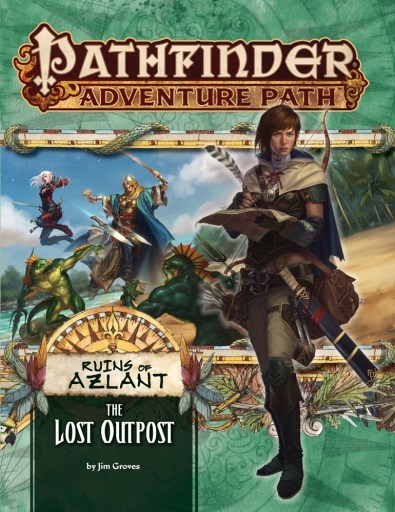
Ruins of Azlant Lost OutPpost Book One
The Ruins of Azlant Adventure Path is a great choice for aquatic adventures and races. Ruins of Azlant begins with Ruins of Azlant: Book One: The Lost Outpost

Those of you looking for adventures to play aquatic races or aquatic themed archetypes in should try the Pathfinder Modules: Plunder & Peril (which is a level four adventure that takes place in the Shackles), Ire of the Storm (which is a level one adventure that takes place in Sargava), River into Darkness (which is a level four GameMastery Module for 3.5 that takes place almost entirely along the Vanji River in the Mwangi Expanse), or — my personal favourites — Seers of the Drowned City (a level six adventure that takes place in a half-flooded ancient city in the Sodden Lands), and From Shore to Sea (a level six adventure that involves ancient Azlanti ruins and a super insular town on the coast of Cheliax). Those looking for a longer campaign should check out the Ruins of Azlant Adventure Path (which begins with Ruins of Azlant: Book One: The Lost Outpost), Skull and Shackles Adventure Path (which begins with Skull & Shackles: Book One: The Wormwood Mutiny), or even the Kingmaker Adventure Path (which begins begins with Kingmaker: Book One: Stolen Land). I know, I know, Kingmaker seems like an off choice. But, it takes place in the River Kingdoms (which has a whole lot of rivers), it’s encounters and adventure structure allow for regular resting (and taking a dunk in the nearest water source), and you can build your own town. Perfect for those high-maintenance aquatic races looking to make a unique mark on the world.

Overall, I highly recommend Pathfinder Player Companion: Blood of the Sea. It was an enjoyable, inspiring read.

I hope you enjoyed taking a look at Blood of the Sea with me today, and that this article can help you decide if this delightful little book was right for you.

Until next time,

Jessica


Pathfinder Playtest Scenarios: Reviews

Pathfinder Playtest RulebookToday we’re going to look at Pathfinder PLAYTEST Society Scenarios and tell you what we thought. Currently, there are three of them available as a free download on Paizo’s website, so if you don’t have them yet you might as well pick them up! Each scenario is replayable. You may create your own characters for the intended tier (either created as level one for a tier one scenario, or created as level five for a tier five scenario). Unlike regular Pathfinder Society Scenarios, you do not need to earn enough XP to reach higher levels for the Playtest. If you don’t want to make your own characters, you can also head over to Paizo’s website and download the Pregenerated Pathfinder Playtest characters. All you’ll need to run these three scenarios (other than your characters) is the Pathfinder Playtest Rulebook and the scenarios themselves. Each scenario is intended for groups of FOUR players (unlike regular PFS Scenarios which are intended for six) although each contains easy ways to scale up encounters for larger groups. Although you’ll find references to events in each that I liked or disliked, and comments about specific characters, these scenarios are not explored in detail. It’s not my intention to spoil the events in these scenarios, or give summaries and full reviews, but to share my opinions and provide recommendations. Once you’re done playing or GMing any one of these scenarios, be sure to head over to Paizo’s website and fill out a survey about your experiences. This will be used by the Paizo team to make the Pathfinder Playtest the best that it can be.

So, without further ado, let’s get started!

Pathfinder Playetst Society Scenario 1 Rose Street RevengePathfinder Playtest Scenario #1: Rose Street Revenge is a Tier 1 adventure written by Leo Glass, Thurston Hillman, Joe Pasini, and Linda Zayas-Palmer. It includes three short quests which can be played in any order, followed by a fourth quest which can only be played after completing at least one of the first three quests. Each quest should run between 40-60 minutes in length. Each quest you complete before heading onto the final quest will give you an advantage in the final encounter, so I highly recommend completing all three before heading to the final quest. Plus, it’s just more fun that way. The entire adventure takes place Absalom, although each quest is set in a different neighbourhood. Neighbourhoods featured include the Docks, Puddles, Precipice and the Sewers. For more information on Absalom you can check out Pathfinder Chronicles: Guide to Absalom and the Inner Sea World Guide. Venture-Captain Ambrus Valsin begins the adventure by explaining that there’s serial killer on the prowl stalking the recently liberated slaves of Absalom! The killer’s actions have been sensationalized by locals and they’re now known as the ‘Rose Street Killer.’ The latest victim is a Pathfinder, and so Ambrus is sending your PCs out to investigate. He gives the group some fun player hand-outs, each of which contains a different lead. Then he sends you on your way. There’s time to rest between investigating each lead, which is nice for a change. Also, it should be noted that this entire scenario makes excellent use of sidebars to relay important aspects of the rules in a way that’s helpful, easy to understand, and is NOT overwhelming. It’s wonderfully done.

The first quest in Rose Street Revenge is entitled ‘Snippets‘ and is written by Joe Pasini. In this quest you’re tasked with investigating the Bloody Barbers, a thieve’s guild known for robbery, smuggling and murder. If they’re not guilty, they’re likely to know details about the murders, as they’re very well-informed. If you can find them, of course. This quest utilizes Pathfinder Flip-Mat Classics: City Streets and takes place in the Docks district. It was enjoyable, and had an interesting surprise which I’ll refrain from mentioning. It allows players to make use of a wide array of skills in order to obtain information on the Bloody Barbers (WAY more than I imagined would be helpful) which is really nice to see. Surprisingly, this quest can be accomplished without violence (although most groups are likely to get into a fight). I quite enjoyed it.

The second quest in Rose Street Revenge is entitled ‘Dragons‘ and is written by Thurston Hillman. In it you are to meet with a liaison from the ‘Sewer Dragons’ kobold tribe (longstanding allies of the Pathfinder Society). Your job is to find out if the killer has been utilizing the sewer systems — which is the territory of the Sewer Dragons. The liaison offers to give you whatever help they can as long as you help them oust a rival kobold tribe (the Dragon Sharks) that is encroaching upon their territory! You get to head into the sewers and fight alongside your kobold allies against the enemy. This scenario is a LOT of fun. It is filled with wonderful social interactions (particularly with Fazgyn!). I adored Fazgyn’s lessons on trapfinding which are not only funny and entertaining, but also serve double duty as teaching players how traps work in the Pathfinder Playtest. It also gives a nice introduction to Exploration mode, and helps showcase the importance of the Sneak and Search exploration methods. This quest makes use of the Pathfinder Map Pack: Sewer System. It was my favourite of the four quests.

The third quest in Rose Street Revenge is entitled ‘Puddles‘ and is written by Linda Zayas-Palmer. It takes place in the Puddles District and tasks your PCs with asking the Muckruckers (volunteer guards for the Puddles) for information, and following up on what they tell you. This quest has some fun social interactions, and wonderful artwork for a Muckrucker named Ziraya Al-Shurati. It has by far the most clues to the true murderer’s identity and involves the most ‘crime scene’ investigation, which is great fun. However, in an effort not to spoil the mystery’s details, I won’t be saying much more than that. It utilizes Pathfinder Flip-Mat: Haunted House.

The fourth quest in Rose Street Revenge is entitled ‘Haven‘ and is written by Leo Glass. It takes place in the Precipice Quarter (which was previously known as Beldrin’s Bluff). This is the finale of the adventure, and tasks the PCs with investigating an old safe house that the victims all used at one time or another. I’ll refrain from mentioning much more than that so that I don’t spoil the mystery’s end, but I will say that it was great fun, and certainly not what I expected! This quest utilizes Pathfinder: Map Pack: Ruined Village.

Overall, I really enjoyed Rose Street Revenge. It’s a great introduction to the Pathfinder Playest system and was a lot of fun. I give it four out of five stars and highly recommend it as the first Pathfinder Playtest adventure that groups should give a try (yes, I recommend it over Pathfinder Playtest Adventure: Doomsday Dawn).

Pathfinder Playtest Society Scenario 2 Raiders of Shrieking PeakPathfinder Playtest Scenario #2: Raiders of Shrieking Peak is a Tier 5 adventure written by Luis Loza. As previously mentioned, you do not need to earn enough XP to reach level five. Instead, you need only create your characters at level five. This scenario takes place on the Isle of Kortos. It begins in Absalom, moves quickly to Diobel, and from there heads out into the wilderness. For more information on Absalom, Diobel and the Isle of Kortos check out Pathfinder Chronicles: Guide to Absalom, Pathfinder Campaign Setting: Towns of the Inner Sea, and the Inner Sea World Guide. This scenario utilizes the Pathfinder Flip-Mat: Classics: Battlefield, Pathfinder Flip-Mat: Classics: Woodlands (twice) and a custom map.

A Pathfinder Agent by the name of Inisa Araali was secretly carrying an Iomedean relic by caravan from Diobel to Absalom when she was attacked. She sent Venture-Captain Ambrus Valsin a very cryptic note about the encounter, and then went off to find the relic herself. Knowing that she’ll need help he sends you to find the survivors of the caravan in Diobel, who are shacked up in a Pathfinder safe house (although he doesn’t know which one). You’ll need to find the safe house, check on the people, find out all you can about the caravan’s intended route and the attack, track down the robbers (and hopefully Inisa), retrieve the relic and get it back to Absalom. This scenario introduces secret rolls, which is necessary for knowledge and gather information checks because a critical fail on the check will result in your players uncovering false information. It’s best, of course, if your players don’t know whether the information they’ve received is false or not. That said, secret rolls can easily bog down a game (particularly if it’s heavy on the knowledge checks like this one is at the start), so proceed with this method of rolling with caution. As mentioned, this scenario begins with a bit of investigation. I really like how thorough the Recall Knowledge and Gather Information results are set up (especially the false information for a critical fail). That said, there are no pre-made PCs to interact with during this part of the investigation (which is something I always enjoy), so that’s a bit of a let down. Such embellishments will have to be up to the GM. Social encounters with the caravan survivors are helpful, but not particularly memorable. Overall, I felt that the events in Diobel fell flat. From there the mission moves on and becomes quite combat and exploration heavy. It pits you against some nice classic enemies, inculding harpies, minotaurs, and ghouls, which I really enjoyed. I particularly liked the ghoul statistics. I also really enjoyed the interactions with the minotaurs. Overall, this is the Pathfinder Playtest Scenario I liked least. I give it three out of five stars.

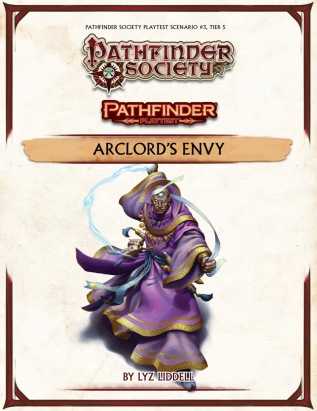
Pathfinder Playtest Society Scenario 3 Arclord's EnvyPathfinder Playtest Scenario #3: Arclord’s Envy is a Tier 5 adventure written by Liz Liddell. It takes place in Quantium, capital of Nex. For more information on Nex be sure to check out the Inner Sea World Guide. This scenario utilizes the Pathfinder Map-Pack: Village Sites, Pathfinder Flip-Mat: Bigger Village, and a custom map. It features gnomish Venture-Captain Sebnet Sanserkoht who is officially my favourite V.C. EVER. She’s awesome. In this scenario you’re tasked with investigating the murder of an Arclord of Nex, and determining who should be given a recently discovered book written by Nex himself, which the Arclord was likely killed for.

Sebnet Sanserkoht gnome
Venture-Captain Sebnet Sanserkoht of Quantium’s Pathfinder Lodge.

This scenario did a really nice job of showcasing little bits of life in Quantium right from the start, with the many overly magical effects present in the local Pathfinder Lodge, right through to the golems walking the streets, and the strange politics of the city. It made use of a ton of rare races including ifrits, oreads, shabti, mercane, and even an invisible stalker you get to chat up at a party. It was awesome. The scenario itself begins with an interesting investigation. I particularly enjoyed retrieving the victim’s corpse from the foot of a massive patrol golem — without drawing the golem’s attention! I think this part would be a lot of fun at a table. That said, I do have one issue with the investigation. At one part you notice scorch marks on a wall which the scenario says you can identify as coming from a certain spell with the ‘Identify Magic’ use of Arcana. Except Identify Magic takes an HOUR (unless you have a special ability that shortens it to ten minutes). Now, that’s not to say that it’s not doable. I suppose some groups might spend an hour looking at a few scorch marks on a wall when there’s a lot of other stuff to go check out, but I wouldn’t. It’s just another use of the ‘Identify Magic’ skill use that feels way too long and time consuming. It’s one of my pet peeves of the Pathfinder Playtest rules, and I sincerely hope they shorten the time it requires by the time Pathfinder Second Edition comes around next year. Of course, this is a nitpick of mine regarding the rules, not the scenario itself. Moving on from the investigation there’s some fun social encounters, and some awesome character art (particularly for Ngasi!). The culprit you’re supposed to unmask is variable, which changes the clues that can lead you to them. That’s a nice option for a scenario that’s supposed to be repayable. I wouldn’t say there’s a LOT of potential culprits, but it’s certainly not static. The final encounter is quite complex, and includes different tactics and available spells depending on which Arclord ends up being your enemy, It’s going to be quite a climatic battle, I think. Overall, I thought the scenario was fresh, fun, and in a great location. I give it four out of five stars.

And that’s all for today! I hope you enjoyed checking out these scenarios with me. I know I enjoyed reading them. I’m quite excited to run my kids through the ‘Rose Street Revenge’ when we have a chance.

Until next time,

Jessica

SaveSave

SaveSave

Pathfinder Playtest – Review

Welcome back to d20diaries!

Wow, finding the time to fully read the new Pathfinder Playtest Rulebook took longer than I expected! Well, not to read it, so much as to digest it. Understand it. Plenty of rules are different, so I had to really focus. Considering that I normally find time to read while overseeing screaming, bickering, playing, laughing, children of various ages (hey, moods change quick!), finding quiet time to get some reading done was more than a little difficult.

That said, I’m a quick reader. I finished it in about two days, then spent some time crafting characters in order to try out the creation process. Before I can take the time to teach my husband and kids how to play, I need to be able to explain it. Properly. Haha. After that I helped my family through the creation process, read through Pathfinder Playtest Adventure: Doomsday Dawn (the first adventure we would be trying out), and we got to work playing.

It’s been a whirlwind! But a fun one.

And then I got sick. Still am.

LAME. Haha.

So whats on the agenda for today?

Today we’re going to take a look at Pathfinder Playtest. Not in depth — this isn’t a replacement for the rulebook. After all, the rulebook’s a free download. It’s my impressions, thoughts, and experiences. Things I’ve discovered, and even some questions I’ve got. Got an opinion of your own? Or an answer to a question I have? Let me know! This game system is brand new and we’re all learning together. Once you’ve had a chance to try out Pathfinder Playtest, be sure to head over to Paizo’s website and give them some feedback. They’re running surveys right now, and have forums up for you to share broader comments.

Ready? Let’s begin!

Pathfinder Playtest RulebookPathfinder Playtest is a new set of rules and gameplay for the Pathfinder Roleplaying Game. It’s intended to streamline the game, while retaining its robust character creation options. Running combat, monsters, and characters should go smoother. Learning the rules from scratch should be easier. Levelling up should be simpler. The book and rules are supposed to be user friendly — even for those who don’t know how to play d20 games.

In theory.

Pathfinder Playtest features gorgeous cover art by Wayne Reynolds which showcases Seoni (the iconic sorceress), Valeros (the iconic fighter), and Fumbus (the iconic alchemist) battling a white dragon! Wait! Fumbus who? Fumbus the goblin alchemist. Thats right! Not only are goblins a core race, but alchemist is a base class. Both are available options to try out in the playtest.

Open the covers (or flip to the next page on the pdf) and you’ll find an introduction by the Paizo staff, followed by the overview. This is where you’ll learn what the heck a d20 game is and how to play. There’s also an overview of the basic terms used in the game, including a few that are new, an explanation of the modes of play, and a list of what you’ll need to play. This section was easy to understand, even for a layman, although not as easy as I expected. It’s a difficult read for my children, for example, and my son (who is more than capable of reading chapter books aimed at pre-teens, published adventures for d20 games, and other Pathfinder products) would definitely get bored and flip past a few pages. Would my teenage/adult siblings read it all the way through? …Tough to say. Probably not. It’s more likely they’d give it a skim and see how it goes. So… sort of an easy read. An easy read for this genre and its audience, I suppose.

Many of the terms in this chapter will be familiar to those of you who have played d20 games before, but even experienced gamers need to give this section a thorough read. Calculations for some of the familiar statistics are different, and there are some very important brand new game mechanics that are explained here. Be sure to pay extra attention to the types of actions, the modes of play, and proficiencies. We won’t get into them in too much detail right now, but for those of you who are curious, these three aspects form a huge part of the game.

There are three modes of play in Pathfinder Playtest. Encounter mode is what you enter when your every moment matters. This is used during a battle, for traps, ambushes, hazards, and anything else similar. You play encounter mode in rounds which are six seconds long, and encounter mode ends when the danger has passed. This is a huge part of the game and the rules. But, it’s not all there is to the Playtest. Exploration mode is used for any situation where you’re not in immediate danger, but you’re not entirely safe, either. This includes exploring a town, ruin, forest, or even a hallway between encounters. It’s what you’re playing in when you’re not fighting something. It’s more than just walking, or a segue between the ‘exciting stuff.’ Exploration mode has its own rules, and has proved quite fun around my house so far. Finally, there’s downtime mode, which is what you use when you’re completely safe.

There are three major kinds of actions in Pathfinder Playtest. Actions, free actions, and reactions. Pretty much all the game is based around this. Nearly every feat, ability, and spell that has a non-passive effect has a symbol beside it right near the top showing what it costs to use. Free actions are free, obviously, Reactions can be taken once per turn, even on your opponents turns, as long as its triggering conditions are met. An example of this is an attack of opportunity (which only fighters can utilize right away!), but there are plenty others for different classes and characters. Lastly, there’s actions. Everything takes actions. Moving, attacking, special attacks, spells and such. Most spells take two actions to cast, although some take one or three. Each turn during encounter mode you’re allowed three actions, and most things you can imagine take one. Walking forward, drawing a sword, and swinging it? Three actions total. Attacking, attacking, and attacking a third time? Three actions. And totally allowed (each successive attack in a round takes a cumulative -5 penalty).  Lastly, there’s proficiencies. Yes, this includes armours and weapons. But in the Playtest proficiencies also replace your base attack bonus, base saving throws, and skill ranks. If you’re trained in something you add your level to the rolls you make with it. If you’re untrained you add your level subtract two. If you’re an expert you add your level plus one, master is your level plus two and if you’re legendary you add your level plus three. For example, if you’re trained in athletics you roll a d20, add your proficiency modifier (your level), your strength modifier, and any other item or extra modifiers you have. Expert in your weapon? Add the expert proficiency (your level plus one), your ability modifier (strength for melee, dexterity for ranged), and any other bonuses from your items. Master at reflex saves? Add your level plus two, plus your Dexterity modifier, anything else special you might have and off you go.

Got it? Good! If not, read the Pathfinder Playtest Rulebook!

After this we get into the fun stuff. Character Creation. The Playtest has a great step-by-step guide to making your characters. In short, you come up with a concept. Then you pick and apply their ancestry (race), background, and class. Each of these will increase some of your ability scores, but you also gain four increases to apply as you see fit. Once you’ve finalized your ability scores, select your trained skills and do some simple math to make it all come together. Spend your coin (150 sp), pick your spells (if you’re a caster) and fill in all your finishing details. Done. Relatively simple. The levelling up process is also simple, as well.

After this there’s an easy to follow example of how you make your ability scores. As I previously mentioned, ancestry, background, class, and your personal preference all play a part. So how does it work?

For starters, you need to know how much to increase an ability score. Increases are referred to as an ‘ability boost’. If the score you’re increasing is under 18 you increase it by 2 points. If it’s over 18 you increase it by 1 point. At character creation, you cannot make a character with over 18 in any one ability score, so all of your boosts will be increasing your ability scores by +2.

When you create a character all of your ability scores start at 10. Now you pick your ancestry. Most will give you two ability boosts that are applied to a specific ability, one ability boost that you can apply as you see fit (called ‘free’), and one flaw (which is a -2 in a specific score). For example, dwarves get ability boosts to Constitution, Wisdom, and Free. They also suffer an ability flaw to Charisma. Humans are different from most races in that they receive no flaw, and no specific ability boosts. Instead they get two free ability boosts, which can be applied at your whim.

Now that you know what to increase you apply it. However, there is a limitation. During each step that you apply your ability boosts, you must apply each to a different ability. In our previous example with dwarves, that means you’re getting +2 Con, +2 Wis, -2 Cha and a +2 to be added to any other ability score (Str, Dex, or Int). The next time you apply your ability scores you can increase any scores you want, but again, only one time each in that phase.

Backgrounds grant an ability boost in a single specific ability score chosen from a selection of two, and then grant a free ability boost. For example, acrobats get an ability boost to either Strength or Dexterity, and then a second ability boost that is free. Meanwhile, a barkeep gets an ability boost to either Constitution or Charisma, and then a second ability boost that is free. (This is not all that a background grants you, just the part that applies to ability scores). As mentioned before, during this step, each ability can only be boosted once. So, our example dwarf could apply the barkeep ability boosts to Constitution, and Strength, but couldn’t apply it to Constitution twice.

Classes offer a single specific ability boost to that classs’ key ability score. Alchemist’s increase Intelligence, bards increase Charisma, and so on. Some classes, like the fighter, can choose one of two ability scores to be their key ability score (in the case of fighters this is a choice between Strength and Dexterity).

Lastly (or second last if you choose to apply these before your class), you get four free ability boosts. You can assign these however you want — although each ability score can only be boosted once in this phase. Essentially this means that four different ability scores will increase by +2.

And that’s the ability score creation process. It’s quite simple when you get the hang of it, and can create a diverse array of balanced characters. There’s also a random generation method offered, for those of you who prefer to roll out your stats, but the characters they create will not come out as powerful as those created with the standard method. Still, it’s nice that its there.

After this we get into the chapter on ancestries and backgrounds. There are six major ancestries you can choose: dwarf, elf, gnome, goblin, halfling, and human. Those of you looking to be half-elves or half-orcs will select ‘human’ as your ancestry, and then choose a heritage feat which allows you to be either of those two ‘half-breed’ races.  This method opens up a unique design space which has potential for an interesting take on some uncommon races when the full game releases next year.

Each ancestry grants you some ability boosts and flaws (as already noted). It also grants you some hit points (which you will only receive at first level), your speed, size, and languages. Some of them also grant you a vision type, or a single special ability. That’s it. You won’t be getting a ton of racial abilities built into your ancestry. I know, I know. This seems like you get so much less. In a way, at low level, you do get less. But, as you level up you also get more out of your race. You see, each ancestry has a list of feats to choose from that only members of that ancestry can select. This is where you’ll find a lot of familiar ‘racial’ abilities like weapon familiarity, ancestral hatred, stonecunning, sure-footed, and other such features that would have once been found under ones race. There’s plenty of new ones, as well. You start the game with one ancestry feat of your choice, and gain more as you level up. This allows you to make your ancestry work for your character as an individual. After all, not all elves are the same.

After I got over the initial shock of seeing ‘how little’ each race gave me, I gave the different ancestry feats a read and, in the end, decided I like this method. It’s adaptable, easy to use, and enjoyable. I found it worked well during character creation. I particularly enjoyed the gnome ancestry feats, so be sure to give them a read!
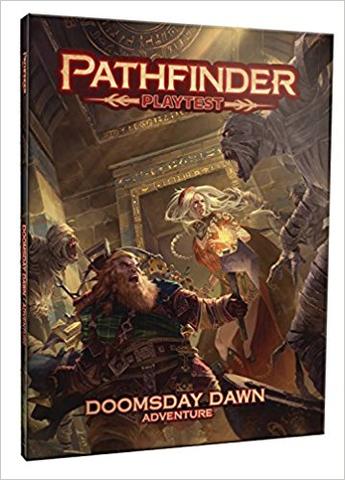
Pathfinder Playtest Doomsday DawnNext up is backgrounds. These represent the things your character did before becoming an adventurer. In addition to the ability boosts mentioned previously, each background grants you one skill feat and training in a single Lore skill tied to that background. What’s a lore? A lore is like a very specific knowledge skill. You can have lore in pretty much anything, as long as it has a very narrow focus. Examples include Vampire Lore, Desna Lore, Circus Lore, and Farming Lore. During downtime, lore skills can also be used to make an income. There are a lot of backgrounds up for offer in the Pathfinder Playtest Rulebook (nineteen!) and you can expect to see a whole lot more in the future. Each adventure path will offer new backgrounds that will tie your characters to the story. The Pathfinder Playtest Adventure: Doomsday Dawn is the first example of this, and provides a further six backgrounds to choose from. The Playtest Rulebook backgrounds include: acolyte, acrobat, animal whisperer, barkeep, blacksmith, criminal, entertainer, farmhand, gladiator, hunter, labourer, merchant, noble, nomad, sailor, scholar, scout, street urchin, and warrior. Although all of the backgrounds are equally ‘good,’ I particularly like the entertainer and the nomad, while my daughter enjoys the animal whisperer, and my son enjoys the warrior.

Past the Background we get to a short section on selecting languages. Players with very high intelligence scores will be surprised to find they don’t get as many languages as in Pathfinder First Edition, with an intelligence over 14 now granting a single bonus language!

Up next is the chapter on Classes. The classes available for the playtest include Alchemist, Barbarian, Bard, Cleric, Druid, Fighter, Monk, Paladin, Ranger, Rogue, Sorcerer, and Wizard. Despite these being familiar to you, each class has plenty of new features, and offers a lot of adaptability. In addition to hp, special abilities and a selection of class feats you can choose from in order to tailor your class to your character, each class also gives you proficiencies in saving throws, perception, and in various weapons, armour and shields. It also gives you a number of skills you can choose to be trained in. Spellcasters get spells, characters get abilities and so on. Now, you really need to read the classes to get a feel for them, so we’re not going to take too close of a look at them. What I will say is that each class we’ve tested in my house has turned out to be a lot of fun. My favourites include Bard (who can use some of their performances an unlimited number of times per day!), Sorcerer (whose spell list and type of magic is determined by their bloodline), and Paladin (who are just plain awesome!). My children particularly enjoyed the druid.

Next up is Skills. This chapter goes over each of the skills, how to calculate their modifiers, and what they can be used for. This is also where you’ll find the rules for crafting, performing and lore. Even experienced players need to give this chapter a read, as there are some changes to the skills. For example, grabbing, grappling and shoving are all tied to your Athletics skill. Yeah. Neat. Skills definitely do more for you now, than they used to. Also, anyone can make attempt any skill check. Obviously, they won’t all be as good at it, but the potential is there, which is nice. That said, some skills have uses that can only be used by characters trained in that skill, which is a nice feature.

After skills we get to the chapter on feats. Now, this section doesn’t have all the feats available in the book. Ancestry feats can be found under ancestries. Instead, it contains all the general, and skill feats available. This chapter is particularly important, because you will gain a LOT of feats.  Beginning characters start with two (at minimum!). One from your ancestry, and one from your background. Most classes grant at least one other feat (sometimes a class feat, sometimes a general or skill feat, and sometimes both). This is a wonderful surprise, which allows customization in a simple way.

After feats you’ll find Equipment. Pathfinder Playtest uses silver as the core coin (instead of gold) which means that the price of gear will be different than what you’re used to. There’s also been some changes to the armour, weapons, and weight systems — all for the better in my opinion! Definitely give the information at the start of this chapter a read before trying to spend your coin! Haha.

Past equipment you get into spells. This begins with a lot of important information about magic, spells, and how they work. Definitely don’t skip this part! Haha. There are four major spell lists: Arcane, Divine, Occult, and Primal. I’m fond of all of them. In addition, you’ll find tenth level spells. After the spell lists are spell descriptions. Amongst these spells you’ll also find a lot of class abilities that are cantrips, or run off of spell points. This includes domain powers, and bardic compositions (among others). Although I understand the purpose of including them here (in alphabetical order alongside the spells), it made it hard to make class choices. For example, if I’m looking for all the bardic compositions (which are a type of cantrip) I have to search through the entire chapter and read the spell traits to find them. There is no compiled list of bardic compositions and, as they are not class spells, they don’t appear on any of the Spell Lists. It’s a giant pain in the butt. Haha. I sincerely hope they find a better way to sort this in the future, cause all that sifting sucks. Not only that, it’s a drain on your time.

I also found (after a lot of jumping between chapters to hunt them down) that a lot of the domain powers weren’t as good as they used to be. Which is unfortunate. I’d gladly trade my cleric of Desna’s domain power from the Playtest with pretty much any other Domain power from First Edition. An unfortunate outcome! Still, it will take more playtesting to determine if it all balances out in the end.

Past this we come to a short chapter on how to level up your characters. In addition, you’ll find the rules for multiclassing and archetypes here. The system for this is very easy to understand, and allows for a lot of cool character concepts. Essentially, you can choose to take archetype or multiclass feats in place of your class feat at any given level — presuming you meet the feat requirements. There’s a bit more to it than that, of course, but not by much. It’s a simple, elegant way to handle multi classing and archetypes without causing characters to fall behind the powers of their peers. I really like it. Definitely give it a read!

Later in the chapter you’ll find the rules for animal companions, familiars, and gods. The rules in all of these categories were fun and easy to use, particularly the rules for familiars. We got ours created in only a few minutes! Wonderful! Of course, I did have questions. It’s specifically pointed out that you can only have one animal companion. But, this is not specified under familiars. Does this mean you can potentially have more than one? My son chose a gnome ancestry feat which granted him a familiar, and then later earned a vine leshy familiar from being a plant druid. Does this mean he gets both? I’ve yet to find a definitive answer, but if you’ve read an official answer somewhere, (or know the page its on that I’ve missed) let me know! I’d love to read the ruling. Another problem with familiars turned out to be damage. Although it mentions the attack rolls they can make, it doesn’t say how much damage one does if it tries to attack. This came up on one of our first combat rounds in our first playtest when my son sent his vine leshy to attack. He hit! And… we had no damage. Haha. I decided that it would do 1 damage unless I found an official ruling that says otherwise. Know of one? Let me know! We’d love to see it!

After this comes a very important chapter entitled ‘Playing the Game.’ Reading it is mandatory. Haha. It’s around 35 pages long and includes all the rules you need to play as a player, as well as the conditions found in the game. Important stuff.

After that is another very important chapter called ‘Game Mastering.’ This chapter includes everything you need to know to run the game as a GM (in addition to the content for players). This chapter is shorter — at only around twenty pages — but its also denser and more complicated. Admittedly, I had to go back and reread parts a few times, particularly regarding exploration mode, downtime mode, hazards, and DCs. I expect I’ll have to reference both this chapter and the ‘Playing the Game’ chapter plenty over the next year, as I get a handle on the rules. In my opinion, the game is easier to learn to play and GM that Pathfinder First Edition was, so I’m pleased, even if reading these chapters caused me a few headaches.

After this we come to (pretty much) the last chapter. Treasure. This is where you’ll find information on wealth, treasure distribution, special nonmagical gear, alchemical items, runes, trinkets, and magic items. There’s a lot of fun stuff in here that you’re going to love reading. I highly recommend discovering these on your own. I will say that I particularly enjoyed the addition of snares, and that I expect to make a character who utilizes them in the near future. I also really like the rune system for making magical weapons and armour. Its very similar to the fusion system in Starfinder.

Past this is the appendices and then the book is over.

That’s it, that’s all! But, that’s not all that I have to say. There are a few things I’d like to mention before wrapping up.

First: Hero Points. I loved them. Each character starts each session with one hero point, and can earn up to one extra each session as a player (for doing something awesome for the group like bringing snacks, tracking gear, or hosting the game) and one extra as a character (for doing something awesome in character like saving someone’s life, being generous, expert teamwork, or accomplishing an important task in game). These points can be used to save yourself from death, reroll a d20, or take an extra action. They’re useful, awesome, and add a great new element to the game. (My daughter’s determined to be the loot-tracker from now on in order to earn that extra point!).

Second: Dying. During our first play session, my husband’s character died. Quickly. All things considered, from the moment he fell unconscious at Dying 1, only a single full round occurred before he died. Two ill-aimed splash damage brought him to Dying 2, and then to Dying 3 with the second instance, and on his turn he failed his first and only fortitude save against death, which brought him to Dying 4: Dead. This was WAY too fast. Sure, he could’ve used Hero Points to save himself. If he had any. He had already fallen unconscious two other times that session, and had used up all his Hero Points. And he wasn’t the only one. My daughter also fell unconscious once during the session, and my son nearly did. Ouch! I found not only did we fall unconscious quite a bit, but we died too QUICK. For a lot of players, a dead character is an end to fun. Especially if your chances for recovery were so brief.

Third: Identifying Magical Items: After you realize something is magical (or alchemical), it takes an HOUR to identify the object. An HOUR. This means, that if you’re the kind of group who doesn’t rest unless its necessary, you can go an entire adventure without knowing what any of your treasure does. In fact, when we played Doomsday Dawn in my house, we went the entire first adventure without knowing what anything did. That means we didn’t get any use out of any treasure. At all. That’s absurd! Now, there are some ways for your characters to shorten this time to ten minutes (or evens shorter at higher levels), which is more manageable. Heck, I even understand the intent. If it takes more time and effort to identify magical objects, that makes them more special. They’ve got an air of mystery about them. That’s cool. But, if it takes so long to identify a healing potion, that without someone specialized in identifying magical or alchemical objects, the group can’t even figure out its a healing potion during their adventure, than what good is it? Now, I know plenty of players like to stop a LOT when they play. Maybe you’re even one of them. The group that gets loot or takes a few wounds and says, ‘We should head back and recover!’ or ‘We should go sell what we’ve found and come back!’ That’s fine. You won’t be hampered by this. But, I’m not that kind of player. Neither are my family or my friends. We very often take on entire missions until we HAVE to rest, due to our wounds. Or we HAVE to recover our spells. Or we’ve spent the whole day and our characters are actually sleepy. This is particularly true in Pathfinder Society missions, which very often occur in a single day on a timeline. This system strikes me as very problematic, unless you specifically ensure your groups always have a way to shorten it. But, why force a group to do so? That’s going to replace another skill or class feat they could have taken. It just… Reading the rules for identifying magical objects didn’t sit right with me. Then we made our characters, brought them to playtest, and it turned out to be both a problem and a handicap. An unfortunate occurrence which we’ve given feedback on.

Fourth: Resonance. This is your character’s natural ability to activate and utilize magical objects. You have a number of resonance equal to your level plus your Charisma modifier. You can invest resonance ahead of time in an object that grants a long-term effect, or spend resonance on the fly to activate a magical object upon use. It’s meant to help replace gear slots (head, hand, and so on). Kind of cool, right? Sure. Until you start counting it out. Want to wear a magical cloak? Cool, 1 point. Want to drink a potion? Cool one point! Wait! One point? What if you only start with one point? What if you’re dying and you have no points? A friend can’t even shove a potion in your mouth to save you?Sort of. When you’re out of points you can attempt to overspend resonance you don’t have in order to activate the magical object anyway. This is a flat check with a DC equal to 10 + the number of points you’ve overspent (including any times you’ve tried and failed). If you pass the magic works, and if you fail it doesn’t (and you can’t attempt to activate that item again until the next day). If you critically fail (roll a 1) you can’t attempt to invest any other magical items at all that day. Ouch! Resonance is of particular interest to alchemists, who need to infuse their alchemical items with resonance in order to craft them. Okay, I can see that, I guess. Particularly for potions and such. Luckily, alchemist’s get to base their resonance off of their Intelligence, instead of their Charisma. But why should the alchemist have to spend resonance to make an acid flask when a wizard can cast cantrip and deal comparable damage at will? Yeah, I get WHY. There’s plenty of justifications. It’s an item, they’re not spell casters, so on and such. But… I don’t know. Both resonance, and the alchemist’s reliance on it is one of those new rules that I read, and just didn’t sit right. So far in playtests around my house it’s been a bit of a problem. Our alchemist was out of resonance within the first fight and had to rely on overspending resonance the entire rest of the adventure. She didn’t critically fail, thank goodness, but if she had, her character would have been completely shut down. She literally would have had to punch people with her gauntlet (a bad idea with her low strength and poor AC) or throw a rock at them (another bad idea). And if a whole character can be shut down so easily (at low levels, at least), that’s probably a problem. Similarly, our dwarf started with no resonance at all. Feeding him a potion in order to save his life was a fifty-fifty chance the first time, with the odds getting worse from there. Considering how quickly he died when he fell unconscious, that’s brutal. Ugh. Now, that said, I haven’t play tested the game enough yet, to make a final decision on resonance. Maybe it’s better with other classes. Maybe it’s less trouble at higher levels. Maybe this is meant to show that magic items are rare and special, tying it into the length of time that it takes to identify them. Maybe we’re not meant to really use something like a healing potion at low level. Maybe other groups didn’t have trouble at all. But so far, it’s been trouble for our groups. I hope that’s not the case in the future. I’d be particularly interested to see how resonance has worked out for you. If you’ve got an experience to share let me know!

Fifth: Initiative. You don’t have one. Instead you initiative is based on your perception modifier. Occasionally, if your character is doing something specific, you can roll a different skill in its place. For example, if you’re swimming your GM might rule you can use Athletics as initiative this time, or stealth if you’re in hiding. And so on. I loved this.

Overall, I really enjoyed the Pathfinder Playtest so far. I like the changes they’ve made to the game system, character creation, and treasure. I like it a lot, actually. That said, I have some questions which need clarifying, and we did run into trouble. We felt it took too long to identify magical items. We felt resonance was too limiting — especially for alchemists. And we felt the that dying turned into dead way too fast. It’s a good game, and we’re going to play it a lot more over the next year so that we can turn our feedback in to Paizo and they can make this next edition the best that it can be.

At the moment, do I think it’s better than Pathfinder First Edition? …I don’t think I can answer that. It’s new, and going to take some getting used to. Meanwhile, I’ve been playing Pathfinder since before it was Pathfinder. It’s nostalgic and homey. You know? I think it would be unfair to compare the two in that manner until I completely get the hang of the new rules. That said, I can answer a similar question. When it comes down to it, I like Pathfinder better than Starfinder. But do I like Pathfinder Playtest better than Starfinder? …No. Not yet. Maybe one day. But, at the moment, the Drift’s got more sway over me.

Well, that’s all for today. I hope you enjoyed this short look at the Pathfinder Playtest, and my opinions on it. I’d really love to hear your opinions and experiences with the Playtest rules, so if you’ve given it a try be sure to leave a comment. If you haven’t downloaded the free PDFs for the Pathfinder Playtest I highly recommend you head on over to Paizo’s website and do so. It’s free! There’s not much you’ve got to lose. Haha. Those of you hoping to get physical copies can find them here: Pathfinder Playtest Rulebook, Pathfinder Playtest Deluxe Rulebook, Pathfinder Playtest Adventure: Doomsday Dawn, Pathfinder Playtest Flip-Mat Multi-Pack.

Until next time,
Jessica

Playtest

New Pathfinder Society Scenarios: Beneath Unbroken Waves and Betrayal in the Bones

Today we’re going to take a look at two of the most recent Pathfinder Society Scenarios that are currently available for purchase, and let you know we thought. Although you’ll find references to events in each that I liked or disliked, and comments about specific characters, these scenarios are not explored in detail. It’s not my intention to spoil the events in these scenarios, or give summaries and full reviews, but to share my opinions and provide recommendations. That said, if you want to avoid even minor spoilers then I recommend clicking on a different article. Whether you intend to use them in home games of the Pathfinder Roleplaying Game, sanctioned scenarios for use with the Pathfinder Society Organized Play, or just want to read a nifty new adventure, we’ve got you covered! So let’s get cracking!

PZOPSS0924E
Scenario #9-24: Beneath Unbroken Waves. A tier 5-9 adventure by Kate Baker.

Scenario #9-24: Beneath Unbroken Waves is a Tier 5-9 adventure written by (the amazing and super nice) Kate Baker! It takes place off the coast of the Isle of Jalmeray, in a region of the Obari Ocean known as the Deadly Ocean Passage. For more information on the Isle of Jalmeray, check out the Inner Sea World Guide. This scenario features creatures from Pathfinder Roleplaying Game: Bestiary, Bestiary 2, Bestiary 3 and Bestiary 5 (although all of the necessary stat blocks are included within the scenario) and utilizes the Pathfinder Flip-Mat Classics: Ship, Pathfinder: Flip-Mat: Sunken City, and a custom map. This mission is of particularly importance to members of the Concordance faction.

This adventure gives the PCs a mysterious key that moves of its own accord and tasks them with taking it to its destination, exploring the site, and discovering what it opens. The location is known to be underwater, and involves a lost monastic academy.  This mission makes heavy use of the underwater combat rules so GMs should refresh their memories on those rules (a handy summary is provided in this scenario) and players should select their PC carefully. If you’ve got sailors, swimmers, monks, unarmed fighters, members of the Concordance, or undine, now is a great time to take them for a spin (all for different reasons).  Do not bring someone who relies on ranged combat, slashing weapons or bludgeoning weapons (they don’t work well underwater). This scenario starts with a very engaging mission briefing with a refreshing Venture-Captain (Rashmivati Melipdra of Niswan) who I desperately want to be pals with! Haha. There’s a fun navigation portion to this adventure. The first battle is very interesting, while another had some great hazards in play. The finale is a blast and looks like it could be a challenge. There were plenty of great opportunities for social encounters, and some interesting NPCs you can interact with. All of the enemies have distinct goals that really show in their tactics, which was awesome to see. Overall I thought this scenario was great fun. I can’t wait to play it. I give it four out of five stars.

Scenario #9-25: Betrayal in the Bones is a Tier 12-15 adventure written by Tom Phillips. It takes place in the ossuary of Taal Mornat in the Five Kings Mountains. For more information on The Five Kings Mountains check out the Inner Sea World Guide, or Pathfinder Player Companion: Dwarves of Golarion. This scenario features creatures from Pathfinder Roleplaying Game: Bestiary, Bestiary 2, Bestiary 3, Bestiary 4 and Bestiary 5 (although all of the necessary stat blocks are included within the scenario). It utilizes the Pathfinder Flip-Mat: Twisted Caverns, Pathfinder Map Pack: Evil Ruins, and a custom map. This mission is of particularly importance to members of the Grand Lodge faction.

PZOPSS0925E
Scenario #9-25: Betrayal in the Bones. A tier 12-15 adventure by Tom Phillips.

This adventure tasks the PCs with entering Taal Mornat, and capturing or killing two enemies of the Pathfinder Society: the demoniac Ex-Venture-Captain Thurl, and the assassin Pasha Muhlia al-Jakri. I highly recommend that players bring along any of their characters who have had run ins with these characters in the past, or have gone up against their machinations and plots. Thurl can be found in Scenarios: #2-08: Sarkorian Prophesy, #5-09: The Traitor’s Lodge, #5-24: Assault on the Wound, #5-25: Vengeance at the Sundered Crag, #7-17: Thralls of the Shattered God, #9-06: Shores of Heaven, and the Special: Siege of the Diamond City. As for Muhlia? As the old leader of the Qadiran Faction, she’s been mentioned and featured in a ton of early scenarios, but most notably #2-21: The Dalsine Affair, #3-25: Storming the Diamond Gate#6-05: Slave Ships of Absalom, and #6-11: Slave Master’s Mirror. This scenario is a direct sequel to #9-21: In the Grandmaster’s Name. That said, due to the tier difference, it won’t be played by the same characters. For more information on #9-21 check out my previous blog post here. This is also a great scenario to play any dwarves you have, or characters who have the ‘Hero of the Five Kings’ boon.

muhlia al-jakri - betrayal in the bones
Muhlia Al-Jakri from Pathfinder Society Scenario #9-25: Betrayal in the Bones.

Now, heading into an ancient dwarven ossuary to get two bad guys isn’t as easy as it sounds. Thurl has drawn a portion of an abyssal labyrinth to the region, making the corridors incredibly dangerous and difficult to navigate. By the time you arrive, many dwarves have gone missing or lost their lives in an attempt to oust the intruders from their holy site. In addition, monsters made from the desecrated remains of the dwarves ancestors have come out of the ossuary and slaughtered a legion of dwarven soldiers. Players who don’t want to try navigating the labyrinth can attempt to enter through the volcanic fissure above the mountain, but its clear that this will likely be an even more difficult task than the labyrinth — especially since no one’s even sure if the fissure can take you to Thurl and Muhlia. Either way, I like that the option is there. Particularly for such high-level PCs.

The next line I’m about to write is a bit more of a spoiler than I normally include, so it gets its own special warning! If you don’t want to read it, skip the rest of this paragraph! The labyrinth portion of this scenario was surprisingly short, and fell a little flat, I felt. Although the battle within was great, it just didn’t feel like you were trapped in a labyrinth. The battle was really well done, though. And I love the… added complications involved.

There were some fun NPCs to interact with, my favourite of which was Borsaget. She’s awesome, although not all groups will end up getting to meet her. Muhlia was very well done! I’m curious to see how different groups handle her (and the arguments that are sure to pop up regarding her fate). Thurl is much more of a classic villain, which will give players someone to unite against and give the characters they bring some much needed closure. Some groups may uncover clues in this scenario that can lead them to the location of another enemy of the society (which is sure to be covered in an upcoming Pathfinder Society Scenario). Overall I thought this was a great, challenging scenario that did an awesome job of wrapping up Thurl and Muhlia’s story. I give it four out of five stars.

Thanks for tuning in today! Be sure to head over to Paizo’s website tomorrow and download the free rulebook for the Pathfinder Playtest! I’ll race you to it!

Jessica

beneath unbroken waves falehetu nicolas espinoza
Falehetu from Pathfinder Society Scenario #9-24: Beneath Unbroken Waves. Illustrated by Nicolas Espinoza.

New Starfinder Society Scenarios: The Blackmoon Survey and To Conquer the Dragon!

Today we’re going to take a look at the two most recent Starfinder Society Scenarios that are currently available for purchase, and let you know we thought. Although you’ll find references to events in each that I liked or disliked, and comments about specific characters, these scenarios are not explored in detail. It’s not my intention to spoil the events in these scenarios, or give summaries and full reviews, but to share my opinions and provide recommendations. That said, if you want to avoid even minor spoilers I recommend you check out a different article. Whether you intend to use them in home games of the Starfinder Roleplaying Game, sanctioned scenarios for use with the Starfinder Society Organized Play, or just want to read a nifty new adventure, we’ve got you covered! So sit back, and get ready to explore the Pact Worlds!

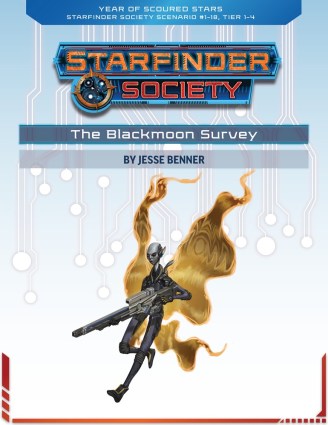
PZOSFS0118E
Starfinder Society Scenario #1-18, The Blackmoon Survey.

Scenario #1-18: The Blackmoon Survey is a Tier 1-4 adventure written by Jesse Benner. It takes place on Eox, a planet with a thin and toxic atmosphere that is run and populated by undead. More specifically it stops in the city of Zinhew, before heading out to the Blackmoon excavation site, and into the barren wastes of the planet. GMs will need to familiarize themselves with the poison rules, while players will need to ensure they have armour, which can protect them from many of the environmental hazards of Eox. This scenario has no tags and does not feature starship combat. Although it is influenced by Scenario #1-09: Live Exploration Extreme!, there are no mechanical advantages to bringing a character along who has played that scenario, nor are there any boons you should specifically slot. You do not need to play Live Exploration Extreme before playing The Blackmoon Survey. This scenario utilizes two custom maps, and has a third encounter area that has no map provided at all. In addition to the Starfinder Core Rulebook, it makes use of content from the Alien Archive and Pact Worlds. All the necessary information from these two extra sourcebooks is included in the scenario. This scenario features Venture-Captain Arvin, and introduces a few new characters, most notably the Starfinder Taylehm (a kasatha borai), and the contracted ‘dirt boss’ Berchta Deepdelver (a vesk mechanic with awesome horns) and her drone Digger.

sfs 1-18 - blackmoon survey - boroi - taylehm - graey erb
Taylehm the boroi kasatha from SFS 1-18 – Blackmoon Survey. Illustrated by Graey Erb. Art courtesy of Paizo Inc.

Recent events have caused the Bone Sages of Eox (their ruling elite) to contract excavation rights on different parts of Blackmoon mountain to different agencies, one of which is the Starfinder Society. This is an incredible opportunity for the Society, both to expand it’s influence on Eox, but also because the site is so famous. It draws publicity in addition to the knowledge that could be gleaned from the location. Unfortunately, the Starfinder excavation has run into some trouble. Starfinders have gone missing, undead labourers have been destroyed, and a few living souls have also turned up dead. Your player’s job is to head to the site, discover what’s causing the disruption, and put an end to it. In addition, they need to ensure they don’t do anything to tick off the Bone Sages. This excavation is very important to the Society, and it needs to return to productivity as soon as possible. The scenario makes excellent use of Pact Worlds history and current politics, which I thought was wonderful. Not only does it involve the history of Eox, but it also touches on the history of the Diaspora, Damiar, Iovo, as well as the Magefire Rebellion of 7AG, and the Thousand Moons trap. Although learning this history and background information isn’t necessary, knowledgable PCs will get extra enjoyment from doing so. It’s a great scenario to crack out your know-it-alls! The mystery and investigation itself has multiple avenues of inquiry, and accounts for a wide array of skills that can be used to gain information. Players who find themselves stumped need not worry, as the scenario keeps moving even if you’re stuck. That said, uncovering as much as you can has benefits, so good investigation is rewarded. It provides some unique roleplaying encounters, mechanically interesting battles, and environmental hazards. One of these battles could be particularly challenging for some groups, so I’m curious how it will turn out in play. This scenario also strongly gives the PCs agency. There are multiple resolutions to this adventure, and your actions have a direct impact on which boons you receive and how various groups perceive you and the Starfinder Society as a whole. All in all, this scenario looks like a ton of fun! I can’t wait to play it. I give this scenario four out of five stars.

Starfinder Society Scenatio 1 - 19 To Conquer the Dragon
Starfinder Society Scenario #1-19, To Conquer the Dragon.

Scenario #1-19: To Conquer the Dragon is a Tier 5-8 adventure written by Matt Duval. It takes place on the planet of Triaxus, in both the city of Cumo, and the Parapet Mountains. This scenario features the starship tag and involves a very tricky starship battle. It is directly influenced by events in Scenario #1-13: On the Trail of History, and I HIGHLY recommend playing the same character through both of those scenarios. It makes use of the Starfinder Flip-Mat: Urban Sprawl, Starfinder Flip-Mat: Basic Starfield, and a custom map. In addition to the Starfinder Core Rulebook, this scenario makes use of content from the Alien Archive and Pact Worlds. All the necessary information from these two extra sourcebooks is included in the scenario. This scenario is the third appearance of the bleachling gnome, Venture-Captain Naiaj, who previously appeared in Scenario #1-05: The First Mandate, and Scenario #1-06: A Night in Nightarch. It also introduces a wonderful new Starfinder, Zafeldrin, a brass dragon who gives your players a bit of a hard time upon their arrival. He’s delightful! If your characters have access to any unique ships via their boons this is a great scenario to slot them in.

sfs 1-19 - to conquer the dragon - zafeldrin - graey erb
Zafeldrin the brass dragon Venture-Captain from SFS 1-19: To Conquer the Dragon. Illustrated by Graey Erb. Art courtesy of Paizo Inc.

To Conquer the Dragon sends your players to Triaxus for the grand opening of the White Sands Starfinder Lodge! This new lodge is located between the Drakelands and the Allied Territories, and its opening is a huge win for the Society! Your job is to get there, ensure the gala goes off without a hitch, and impress the many dignitaries that will be in attendance. Sound a little familiar? Yeah, it’s premise is a bit like #1-05: The First Mandate, which worried me a bit. You attend a gala and try to impress some guests. It gets violent. That said, this scenario is full of surprises, and didn’t go as I expected. You get to spend a lot of effort on patrolling and defending the gala, which can allow you to do some pretty helpful pre-emptive things which affect this adventure’s outcome and how the Starfinder Society is perceived on Triaxus. The attack is certainly different than I expected it to be, and the sections of the adventure that follows are unique. The starship battle is a bit tricky and can really benefit from an awesome science officer, which is great to see. There’s a lot of fun social encounters, but honestly, where I think this scenario can most shine is its villain. She’s unique, driven, and has a grudge out for anyone whose played #1-13. This is personal, and she ensures your players know it. Of all the enemies I’ve seen so far in the Starfinder Society, she is BY FAR my favourite, and the most memorable. I highly recommend GMs play up this fierce opponent as much as possible! All in all, I think this is a great (but very dense) scenario, that suffers a bit from its similarity to The First Mandate. That said, it’s considerably different, and makes excellent use of its side characters and main villain. Overall, I give it three out of five stars, (although its villain nearly pushed the rating up to four out of five).

Thanks for joining us today! We’ll see you again later this week when we take a look at the new Pathfinder Society Scenarios!

See you in the Drift!

Jessica


Summer Flies By! (And other news)

Well, it’s been a busy summer so far. We’ve visited family, celebrated birthdays, gone swimming, tended our garden, played at the park and… Well, frankly my allergies are acting up like CRAZY! Whoo, I feel horrible! Haha. Still, my kids are happy, and I’d rather get out and enjoy the summer than I would let it pass me by.

In gaming news we’ve had a chance to play the Mummy’s Mask Adventure Path a few times, Reign of Winteronly once, Shackled City a few times (look for an update soon!) and haven’t had a chance to play Iron Gods at all (sad!). In fact, we haven’t had a chance to play Starfinder at home lately, either. (Double sad!).

A while ago my daughter asked me if I would start moving some of our d20 games online to play-by-post. She felt that she never got to play her many, many, many adventures and characters because when the weekend comes we only have time for one game, and it’s going to be one of the ones everyone agrees on. That means that we could go months without playing some of her characters.

“Pleeeeeeease, Mom?” she asked. “Some of my characters might as well be DEAD! I would rather play them one post a day than take no turns EVER! PLEEEEEEASE!?!?”

She’s a little dramatic, but she got the point across. Haha.

So, at my daughter’s request, we moved one of our ongoing family PFS games online and we moved our family Dead Suns Adventure Path online. My kids and I also have a lot of campaigns that involve only me and them. I told them they could choose one to move online for now. They gave this a great deal of thought and, although they have a ton of characters they enjoy playing, they also have campaign envy.

What?

Campaign envy.

Every time the grown ups play Mummy’s Mask, or Iron Gods, or Reign of Winter they are desperately jealous. A while ago they began their own Mummy’s Mask campaign and they’ve been begging me to let them start Iron Gods and Reign of Winter ever since. In the end, they chose the Mummy’s Mask Adventure Path. I’m actually really excited, since they created a very entertaining group of characters that shook up our typical party dynamics. More details on that will come in an upcoming blog post.

In other news, Gameday VII will start in another few weeks, which is super exciting! I can’t wait! GenCon is coming up (for those of you lucky enough to attend such things), and Paizo recently released their Puzzle Hunt from PaizoCon online for mass consumption. No idea what that is? In short, its a series of Golarion-themed puzzles within puzzles that were given out at PaizoCon back in May. It’s a free download on their website, and you can talk about the puzzles with other gamers on the boards. I gave them a read and am actually super excited to try them out. It looks fun!

Paizo recently announced their upcoming Pathfinder Society Scenarios, which include the finale for Season 9 and the start of Season 10! They’ve also shared details on the next four Starfinder Society Scenarios. Soon we should get information on two new Adventure Card Game adventures, and the first three of their upcoming Pathfinder Playtest Scenarios! I can’t wait to get my hands on these beauties at the end of the month!

Speaking of the Playtest, there have been some awesome spoilers lately. My favourite turned out to be the BARD. Now, I’ve always had a soft spot for bards, so I was pretty sure I was going to love it no matter what they did. After reading their recent blog post on the topic I was elated! It’s got full spellcasting, performances are now a special sort of bard only cantrip called a composition (which means you’re not going to run out of music!), and some of the performances are reactions (counter song, here’s looking at you)! It’s just… awesome! I can’t wait to read the whole class!

Luckily, we don’t have much longer to wait. Pathfinder Playtest releases on August 2nd, along with the Doomsday Dawn Adventure, free maps to go with it, and a trio of Playtest Society Scenarios. I’ve had the good luck to join up with a group of play-by-posters who are going to be playing all three PFS scenarios in a row, which will give me a chance to try the game as a player. Meanwhile, I’ll be GM for Doomsday Dawn (and perhaps even the PFS Scenarios) for my family at home. I expect there will be a lot of characters being made around the house at that time, so who knows what we’ll end up playing with! It’s exciting.

Now I just have to find the time to read all of that…

Today I’m going to leave you with a photo my daughter took especially for d20 diaries. And yes, it has rabbits.

Enjoy

Jessica

d20diaries rabbit

SaveSave

SaveSave

July New Releases!

School’s out for summer, Canada Day has passed, and Independence Day (for all you American’s out there) has just ended. It’s a new month, with new releases in the gaming world. I don’t know about you, but I’m excited for some of this month’s products!

PZO1141Last month there were some awesome releases, including Pathfinder Roleplaying Game: Planar Adventures, Pathfinder Campaign Setting: Distant Realms, the finale of the Dead Suns Adventure Path: Empire of Bones (Dead Suns 6 of 6), and The Reaper’s Right Hand (War for the Crown 5 of 6)! Tricky to top! So what’s on the schedule for this month?

First off, Pathfinder Playtest.

Now, this isn’t out until AUGUST, but if you want to get your hands on a print copy now is your chance. Paizo is releasing the Pathfinder Playtest Rulebook in hardcover, softcover, and in a special edition cover. They’re also releasing the Pathfinder Playtest Adventure: Doomsday Dawn and the Pathfinder Playtest Flip-Mat: Multipack. All of these products will be available for free as PDF downloads on August 2nd, but print copies will be quite hard to come by. Preorder or bust! In addition they’re releasing three Pathfinder Society Scenarios for Pathfinder Playtest. One series of quests at tier one, and two scenarios at tier five. An interesting choice! All three will be available as PDFs for free on August 7th. For more information, or to preorder print copies, check out Paizo’s website.

With that out of the way, let’s take a look at some products you can get your hands on this month!

In the world of Pathfinder there are only two new products up for grabs. The Six-Legend Soul (War for the Crown 6 of 6) is the much anticipated finale to the War for the Crown Adventure Path! Oh, it’s gonna be a good one! I’m SUPER curious! Pathfinder Player Companion: Heroes from the Fringe presents a look at a lot of non-human, unique character options. Examples of this include the Ekujae elves of the Mwangi Expanse, and Pahmet dwarves of Osirion’s deserts, and many more. The part I’m most excited about? Whimsical phantoms for spiritualists! Come on, you know you want to be haunted by a chipper gnome ghost! I’m very intrigued with this product and can’t wait to see what’s inside. Pocket Editions of Ultimate Combat and Bestiary 5 also come available this month.

PZO7108Starfinder also has two exciting releases: The Dead Suns Pawn Collection, which has over 100 custom pawns from the Dead Suns Adventure Path, including a bunch of awesome starships! It looks amazing! What’s more exciting than that? A new hardcover book! Starfinder: Armory. Aww, yeah! This book is packed full of tons of new weapons and armour, as well as magical, technological, hybrids and mundane gear. There’s new bioaugmentations, weapons fusions… Every kind of item type has some new choices in this book. Also? New character options which focus on equipment! I don’t have a clue what they’re going to be, but I sure am intrigued!

In the world of Organized Play there will be four new scenarios coming out at the end of this month. Pathfinder Society Scenario #9-24: Beneath Unbroken Waves is a tier 5-9 scenario written by Kate Baker of particular importance to the Concordance Faction. It tasks the PCs with investigating underwater ruins. Scenario #9-25: Betrayal in the Bones is a tier 12-15 scenario written by Tom Phillips which continues the ongoing story of the Grand Lodge Faction. It allows players to finally get back at some old enemies! For more details, check out a previous blog post where we spoke about events leading up to this scenario! Starfinder Society Scenario #1-18: The Blackmoon Survey is a tier 1-4 scenario written by Jesse Benner which tasks players with exploring an ancient Eoxian ruin to determine why the workers on the excavation have been going missing. This one sounds like a ton of fun. Scenario #1-19: To Conquer the Dragon is a tier 5-8 scenario written by Matt Duval which send the players to Triaxus to open a Starfinder Lodge! This scenario builds on events from #1-13: On the Trail of History, and involves starship combat. I can’t wait until I get my hands on them later this month!

What’s left? Maps of course! And this month certainly brings us a LOT. Pathfinder Flip-Mat Classics: Watch Station is a pretty handy map set which gives is a solid dungeon or underground prison on one side, and a moderately sized sheriff’s office/town barracks on the other. It can also sub in as any small building that includes barracks, such as a thieves den, guild headquarters or school. Pathfinder Flip-Mat Multi-Pack: Forest is a useful set of two flip mats which feature woodlands, rocky banks, and small rivers. These two mats each connect to each other in multiple ways, which means that you can continue your game with a rolling scene, over and over again. They look gorgeous. Starfinder Flip-Mat: Asteroid is an interesting map release. One side is an incredibly useful map of a canyon, impact site or crater which is going to see a ton of use. It’s super adaptable, and can even work in Pathfinder play. The other side is a complex built into the interior of an asteroid. It looks quite interesting. Clearly intended to be used in the Diaspora, it can double as a lot of other complexes, including an underground bunker, base, laboratory, military instalment or even a school. Unfortunately, all three map sets are not yet released on Amazon, so if you’re Canadian, like me, or from another place in the world where the cost of having anything delivered from Paizo is ABSURD you’ll need to wait a while before getting these beauties on order.

PZO4073There’s also a whole new type of map being released this month: Pathfinder Flip-Tiles! We’ve talked about these before on d20diaries, but in short, they’re a collection of 6×6 tiles with images on both sides which easily can connect to form a large complex. This month brings us two sets of map tiles. Pathfinder Flip-Tiles: Dungeon Starter Set, includes basic dungeon features including halls, stairs, turns, entrances and rooms. It has a whopping 42 double sided map tiles. The second set, Pathfinder Flip-Tiles: Dungeon perils Expansion Set, is an expansion which works will the Dungeon Set (and will work with other sets in the future). It contains 24 double sided flip-tiles which depict hazards including trapped and lit hallways, chemical spills, chasms, rock falls, magical devices, and fungal growths. They look pretty cool. Much like this months flip-mats, these products aren’t yet available on Amazon. As a brand new product, I haven’t yet seen these in person, so I’m not sure how easy they’ll be to adapt and use in a live game, but I’d love to find out. If any of you get your hands on these tiles, let me know! I’d love to hear what you think!

That’s it for this months new releases! What products are you most excited for? I know my household can’t wait to get our greedy little hands on Starfinder: Armory! Here’s hoping!

Jessica

Blood of the Ancients

Today on d20 Diaries we’re taking a look at one of the wonderful new products that came out just last month: Pathfinder Player Companion: Blood of the Ancients. We recently picked it up for my husband as a Father’s Day gift, and we couldn’t be happier! Curious what’s inside? Take a peek!

Blood of the Ancients is a thin softcover book that is 32 pages long. As with every book from the Pathfinder Player Companion line, it’s aimed at players. You won’t find secrets and hidden lore in this baby. You’ll find player options. Lots of them. This includes archetypes, feats, traits, spells and gear, as well as other class options like bloodlines, discoveries and so on. And flavour! Plenty of flavour!

Wonderful stuff!

So what is Blood of the Ancients, anyway? In short: character options that are tied to the ancient civilization of Golarion. Which ones? A lot! Azlant, Celwynvian, Jistka Imperium, Lirgen, Lung Wa, Ninshabur, Osirion, Sarkoris, Shory, Tar Taargadth, Tekritanin League, Thassilon and Yamasa. See? A lot! Let’s start at the beginning, shall we?

PZO9490
Pathfinder Player Companion: Blood of the Ancients

The cover showcases the iconic oracle, Alahazra, and the iconic investigator, Quinn, battling caryatid columns, in some awesome artwork by Setiawan Lie. The inside cover features a map of the Inner Sea with the dates and locations of some of the ancient civilizations mentioned in this book. I say ‘some’ because they’re not all here. Thassilon, Sarkoris, and Tekritanin are not featured on the map but are mentioned in this book. The rest are present, although Lirgen and Yamasa are included as one unit based on their location.

Past the map we come to the introduction. Here you’ll find a rundown of some of the ancient civilizations of Golarion, as well as which books you’ll need to read for further information. This is SUPER handy. I love it. There’s also a handy rules index to help you navigate this book easily.

After this we come to the first character options: the vestige bloodline, which is available for both sorcerers and bloodragers. These are very flavourful, adaptable bloodlines, capable of showing descent from any ancient civilization. Both are pretty cool, but I think I like the bloodrager better. Their final ability allows them to summon a ghostly army from the past. How cool is that? Pretty hard to top.

The next two pages are dedicated to a single feat: ‘ancient tradition.’ This allows people who are so dedicated to embodying their ancient civilization of choice to perform a ritual in order to gain a benefit. At later levels, this also unlocks spell-like abilities that you can use. That’s right, it’s ‘deific obedience‘ for an ancient civilization. Historians rejoice! Now, it should be noted that not every civilization touched on in this book has an entry for this feat. Those that do are Azlant, Jistka Imperium, Lung Wa, Ninshabur, Osirion, Sarkoris, Shory, Tar Targaadth and Thassilon. For those of you trying to figure it out, those not included are Celwynvian, Lirgen, Tekritanin and Yamasa. I particularly enjoyed the Azlant, Lung Wa, and Shory options.

The rest of this book is sorted into individual ancient cultures, with character options for each. Most of the entries are two pages long, with some reaching four pages. Three of the civilizations, (Osirion, Sarkoris, and the Tekritanin League) have less than a page to itself, while Thassilon receives no further character options throughout the book. Those of you hoping to more information on Thassilon will need to turn to some of the many other books in which this culture is featured (particularly the Rise of the Runelords Adventure Path, Pathfinder Campaign Setting: Inner Sea World Guide, Pathfinder Chronicles: Lost Cities of Golarion, and Pathfinder Campaign Setting: Lost Kingdoms).

The first ancient civilization focused on is the ‘Abendego Gulf,’ which is more correctly a region home to two different but intertwined cultures: Lirgen and Yamasa. Both cultures heavily relied on divinations drawn from the movements of celestial bodies. That means astronomy, astrology, and portents were all very important to them. This section offers three new feats all based around astrology, two traits (one each for Lirgen and Yamasa), and three archetypes. The feats were interesting, but quite niche. The traits were both really useful but, as they’re regional traits only available to descendants of Lirgen or Yamasa, they’re not going to see a ton of play.  Still, I suggest checking out ‘naturalist’ for survivors, and ‘stargazer’ for intellectuals. ‘Chart caster’ is a mesmerist archetype which lets you enigmatically read your ally’s future with the aid of star charts. It looks quite fun. The ‘lawspeaker’ archetype for clerics lets you sacrifice channel energy uses in order to cast some pretty nifty spells which let you… get to the heart of any matter. And lastly, ‘hinyasi’ is a brawler archetype which revolves around the use of improvised weapons. This one turned out to be my favourite, so I highly recommend you give it a read! For more information on the nations of Lirgen and Yamasa, check out Pathfinder Campaign Setting: Lost Kingdoms.

Next up? Azlant. This two-page section offers up one archetype: ‘ioun kineticist,’ which is… exactly what it sounds like. Unleash the power of these classic floating gems upon your enemies as an aether kineticist! I loved it! Haha. Seriously. ‘Gem magic’ of all kinds fascinated me as a kid, so I’m thrilled to see something new on that theme. After this there are five faith traits focused on the deities of Ancient Azlant. They were all really cool. I particularly enjoyed ‘fruits of your labor (Jaidi)‘, and ‘planar wayfarer (Onos).‘ For further details on the gods of Azlant you’ll need to pick up Pathfinder Adventure Path 123: The Flooded Cathedral (Ruins of Azlant Book 3 of 6). For further details on Azlant you can check out Pathfinder Campaign Setting: Inner Sea World Guide and the rest of the Ruins of Azlant Adventure Path (which begins with Book One: The Lost Outpost).

The next section is two pages dedicated to the ways of ancient elves. More specifically, these character options focus on protecting, helping, and sheltering others. The first option is the ‘arcane warden‘ archetype for wizards, which is both awesome and understated. Arcane wardens must be universalists. They have a very useful selection of skills and bonus feat to choose from which is different than your standard wizard, and some nifty unique abilities that replace the standard universalist options. I really recommend giving this archetype a read, and then coming back to it a few minutes later to read it again. I think I would really enjoy making one. After the archetype there are three new spells: ashen path, brightest night, and shared training. Although ashen path is arguably the most useful of these spells, I enjoyed shared training the most. It can allow spellcasters to make good use of teamwork feats, which is certainly quirky. For more information on the way of life for ancient elves, check out Adventure Path 15: The Armageddon Echo (Second Darkness Book 3 of 6).

PZO9246_500
Many of these ancient civilizations are further detailed in Pathfinder Campaign Setting: Lost Kingdoms

Leaving the elves behind, we come to four pages on the Jistka Imperium. This treasure trove features a whopping four archetypes, two magical items, two spells and two traits. My favourite options in this section were definitely the ‘antiquarian’ investigator archetype, which replaces their formula book with a collection of religious trinkets, and the ‘Jistkan artificer’ magus archetype which lets you have an awesome golem arm. Yeah! I’m definitely going to play this! As soon as I can think of a wicked character concept that is not a Fullmetal Alchemist rip off…

It’s going to be a blast.

There’s also the ‘Jistkan magistrate‘ archetype for warpriests, and the ‘Poleiheira adherent‘ archetype for wizards. Items include the ‘golem gauntlet‘ and the ‘tablet of arustun,‘ spells include ‘skim’ and ‘summon ship.’ Both of the traits were very cool, but my favourite turned out to be ‘magical aptitude,’ which is a magic trait. For more information of the Jistka Imperium, check out Pathfinder Campaign Setting: Lost Kingdoms.

Up next is Imperial Lung Wa, which also has four pages dedicated to it. Contained within are three archetypes, five feats, three magical items, and three traits. My favourite of the archetypes was the ‘ironbound sword‘ for samurai, which focuses on non-lethal combat. There is also the ‘jinyiwei’ for investigators, which is centred around the divinely guided search for corruption; and the ‘imperial agent’ vigilante archetype. I had a really hard time narrowing down the five feats to only one favourite, so instead, I recommend checking out all three of my top picks which are centred around mundane healing: ‘acupuncture specialist,’ ‘incredible healer,’ and ‘pathologist.’ Read them! The magical items were interesting, but two of them were quite pricey. For traits, be sure to check out the social trait ‘excellent penmanship.’ For more information on Lung Wa, check out Pathfinder Campaign Setting: Dragon Empires Gazetteer.

We return to the Inner Sea with a two-page entry on Ninshabur, a nation known for battling the Spawn of Ravagug. Yeah. Wouldn’t have wanted to mess with those guys… This entry offers us a new legendary marshal spirit for mediums to make use of. It also has two new rituals, ‘spiritual investment‘ for combatting the incorporeal, and the incredibly powerful ‘seal.’ But, my favourite part of the entry was the slayer archetype, ‘spawn slayer.’ These daring fellows specialize in combats waged against one, big, powerful enemy. Badass. For more information on Ninshabur check out Pathfinder Campaign Setting: Mythic Realms.

Up next is the Shory. This is one of my favourite ancient civilizations from Golarion. Considering they’re a nation who lived in flying cities, who can blame me? But, that also means I have pretty high expectations. I want to be blown away! (Pun intended). To start with, it features my favourite art in the book. Go ahead and check out that windblown mage! She looks rocking!

The Shory section features three fun archetypes, only one of which is a spellcaster, which is a nice surprise. ‘Aeromancer’ is an arcanist archetype that focuses not only on air magic, but also on cold, electricity and sonic spells. In addition to being able to increase the effectiveness of such spells, they also learn two snazzy arcanist exploits, one of which allows you to use air walk and wind wall on yourself, and the other which lets you make cones of hurricane force winds. I think I’d enjoy this one! ‘Aerochemist’ is an short alchemist archetype whose mutagen can make them buoyant (and at higher levels can make them fly, or walk on air) and who specialize in attacking from above. Lastly, we have a fighter archetype called the ‘aerial assaulter‘ who focuses on attacking from higher ground. This is particularly effective for characters capable of flight. Coupled with the four new aerial feats in this section, you could have a lot of fun with this archetype. Of those feats, ‘turbulent takeoff‘ and ‘aerial roll‘ turned out to be my favourites. There’s also three spells in this section (check out ‘symbol of storms‘), and four traits. Spellcasters should take a peek at the magic trait ‘aeromantic affinity‘, while those interested in flight should give the combat trait ‘natural flier‘ a read. For more information on the Shory civilization, check out Pathfinder Adventure Path 83: The Slave Trenches of Hakotep (Mummy’s Mask Book 5 of 6).

PZO9226_500
For more information on the modern and ancient civilizations of Golarion, check out the Pathfinder Campaign Setting: Inner Sea World Guide.

From the lofty heights of the skies, we head down to the ground, with two pages on Tar Taargadth. These dwarves come bearing a new fighting style called ‘Skyseeker’ which focuses on defeating opponents bigger than yourself. There’s also three new magical items, two traits and a bard archetype. For items, definitely check out the ‘figurine of the wondrous forge‘ which is a must have for any mobile smiths. Very cool! As for traits, both are awesome, but I’d recommend ‘Tar Taargadth trained.’ ‘Dwarven scholar‘ is an interesting  combat-focused bard archetype that gains some extra proficiencies, bonus combat feats, and can grant your combat feats to your allies. Plus? It runs off of Wisdom instead of Charisma. Very cool! Fort more information on Tar Taargadth check out the Pathfinder Campaign Setting: Inner Sea World Guide.

The last two pages in the book offer us a few more character options, from three different cultures. Ancient Osirion gives us two new paladin codes, one for followers of Osiris, and one for followers of Wadjet. For more information on Ancient Osirion be sure to read Pathfinder Campaign Setting: Osirion, Legacy of Pharoahs. Sarkoris provides us with three new bardic performances that focus around the telling of epic tales! I’d recommend ‘The Tragedy of False Hope‘ which renders your opponents flat footed. For more information on Sarkoris, pick up Pathfinder Campaign Settings: Lost Kingdoms. Lastly, The Tekritanin League gives us one final archetype: ‘Tekritanin Arbiter’ is an investigator archetype which makes you an expert in the use of language and diplomacy. For more information on the Tekritanin League, check out the Pathfinder Campaign Setting: Inner Sea World Guide.

And that’s it. We’ve reached the end of Pathfinder Player Companion: Blood of the Ancients. Hopefully, this article has helped you decide if this is a book you want to invest in. I know we’re happy with it. In the end, my favourite options turned out to be the ‘ioun kineticist,’ ‘arcane warden,’ and ‘Jistkan artificer’ archetypes, the healing feats from Lung Wa, and the flying feats from Shory.

Already have a copy of this book? Let us know your favourites! We’d love to hear from you.

Until next time,

Jessica

Wayfinder 18: Fey and the First World

As you may have heard, the latest issue of Wayfinder Magazine was recently released. Wayfinder is full of fan-created content for the Pathfinder Roleplaying Game, and is a free download on Paizo’s website. Over the years they’ve made an astounding 18 issues of Wayfinder, as well as a Bestiary! Nearly every issue has a theme, with this latest one being Fey and the First World! So whether you you’re a fan of the fey, or a fan of free, I highly suggest you give this little gem a chance!

But, what’s inside it anyway? A lot! At around 75 pages for each issue, that’s a lot of free stuff! The articles inside offer new player races, archetypes, feats and spells. As well as new equipment, both magical and mundane. In addition to player options, there’s plenty for GMs with adventure ideas, plot hooks, characters that can be used as allies or enemies, unique monsters, and even short adventures. Both players and GMs can make use of a ton of locations, personalities and gazetteers that are described throughout. To round things out there’s also songs, poetry, and fiction. And let’s not forget the awesome art!

There was a lot that I loved inside Wayfinder 18. My favourite archetype was the ‘Bogeykin,’ a spiritualist who has formed a bond with a dead bogeyman that urges her to sow terror! This archetype is written by Calder CaDavid, features art by Adam Munger, and can be found on page 26.

PZO9298
For more information of the First World, check out Pathfinder Campaign Setting: The First World, Realm of the Fey

For spells, check out ‘liar’s light,’ ‘mother’s embrace,’ and ‘seneschal’s rebuke,’ all of which are inspired by Eldest of the First World, and can be found on pages 34-35. These spells are written by Jason Daugherty and Wojciech “Drejk” Gruchala, while the art in that article is by Jess Door.

I’m not a big fan of style feats, so imagine my surprise when my favourite feats all turned out to be styles! I’d suggest giving both the ‘Cold Iron Style’ (page 37) and the ‘Quickling Style’ (page 50) feat trees a read. These are written by Stewart “Reduxist” Moyer, and Matt “Helio” Roth, with art by John Bunger.

If it’s gear you’re interested in, be sure to check out the ‘living spear,‘ a +3 living wood called spear which is home to a dryad! This sure-to-be-fun weapon is on page 39. If you’re a worshipper of the Lantern King, then you should also check out the ‘vagabond’s cloak,’ found on page 40.

There are a lot of cool new creatures inside, but my favourites turned out to be the poppy leshy, a CR 1/2 creature found on page 65-66 which has adorable artwork. I also love the zolavoi, a somber little CR 5 creature found on page 67-68.

My favourite campaign inspiration was a plot hook on page 48 entitles ‘Rise of the Gerbie,’ which was written by Amanda Plageman and features art by Adam Munger. I also adored the article entitled ‘Sailing Across Eternity: Locales and Personages of the Sea Without a Shore‘ on page 54. Written by Matt Roth, with art by Fil Kearney, this is a mini gazetteer which takes a look at a few super unique settlements located within the Sea Without a Shore.

My children also enjoyed the Wayfinder Magazine. My daughter’s favourite part was an article on how animal companions can become altered by the First World. This is in no small part due to the wonderful art of a rabbit shooting fairies out of it’s mouth by Beatrice Pelagatti. The article itself is written by Calder CaDavid and features a ton of cool, creative ideas. I’m sure my daughter will be using some in the near future.

Meanwhile, my son’s favourite part was an article about the unintended side effects of bartering with fey. I highly suggest you check it out for yourself on page 14. Entitled ‘First World Trade,’ it’s written by Taylor Hubler, and features art by Jeremy Corff. It’s hilarious!

PZO9480
For more fey-themed player options, pick up Pathfinder Player Companion: Legacy of the First World

For more information on Fey and the First World, be sure to pick up official Paizo products, Pathfinder Player Companion: Legacy of the First World, and Pathfinder Campaign Setting: The First World, Realm of the Fey.

Want some more Wayfinder? Be sure to check out their many, many other issues on Paizo’s website!

Want to contribute to the next Wayfinder issue? You can! The next issue’s topic is Stafinder: Absalom Station! Head on over to the Paizo message boards, here, for more information on how and what you can submit! Each person is only allowed three potential submissions, so send your best! My children have both already submitted a creature each for consideration, while I’ve penned a ‘Weal or Woe’ article which I’ve submitted for consideration. I’ve also got an archetype and a theme in the works, but we’ll keep those under wraps for now. If you don’t own them, be sure to pick up the Starfinder Core Rulebook, and Starfinder Roleplaying Game: Pact Worlds before penning your submissions. Best of luck!

I hope you’ve enjoyed checking out the contents of the latest Wayfinder with me. If you happen to have contributed to it: Thanks! And if you’re thinking of applying for the next issue: I wish you the best of luck!

Have fun!

Jessica