Top Ten Magical Hats!

Today is National Hat Day! Here at d20 Diaries we’re celebrating by putting on our favourite toques and counting down our favourite magical headgear in d20 gaming. Some of our choices are classics, reused through many versions of the game, while others are new, unique, or quirky. All of our choices are sorted by cost, from lowest to highest.

Curious what made the cut?

Read on!

10 – Hat of Disguise
A classic magical hat that’s been in many d20 games, from Dungeons and Dragons (in various incarnations), to Pathfinder, and so on. The hat of disguise allows you to alter your appearance as often as you like. Although the difficulty to see the through the illusory disguise isn’t amazing, it’s a quick and simple way to allow your characters to blend in, and get up to all kinds of shenanigans. This affordable hat is a ton of fun and, in the right hands, is incredibly useful. In the Pathfinder Roleplaying Game a hat of disguise costs 1,800 gold pieces and is available in the Core Rulebook and Ultimate Equipment. In Dungeons & Dragons (5e) you can find it in the Dungeon Master’s Guide.

helm of brilliance9 – Circlet of Persuasion
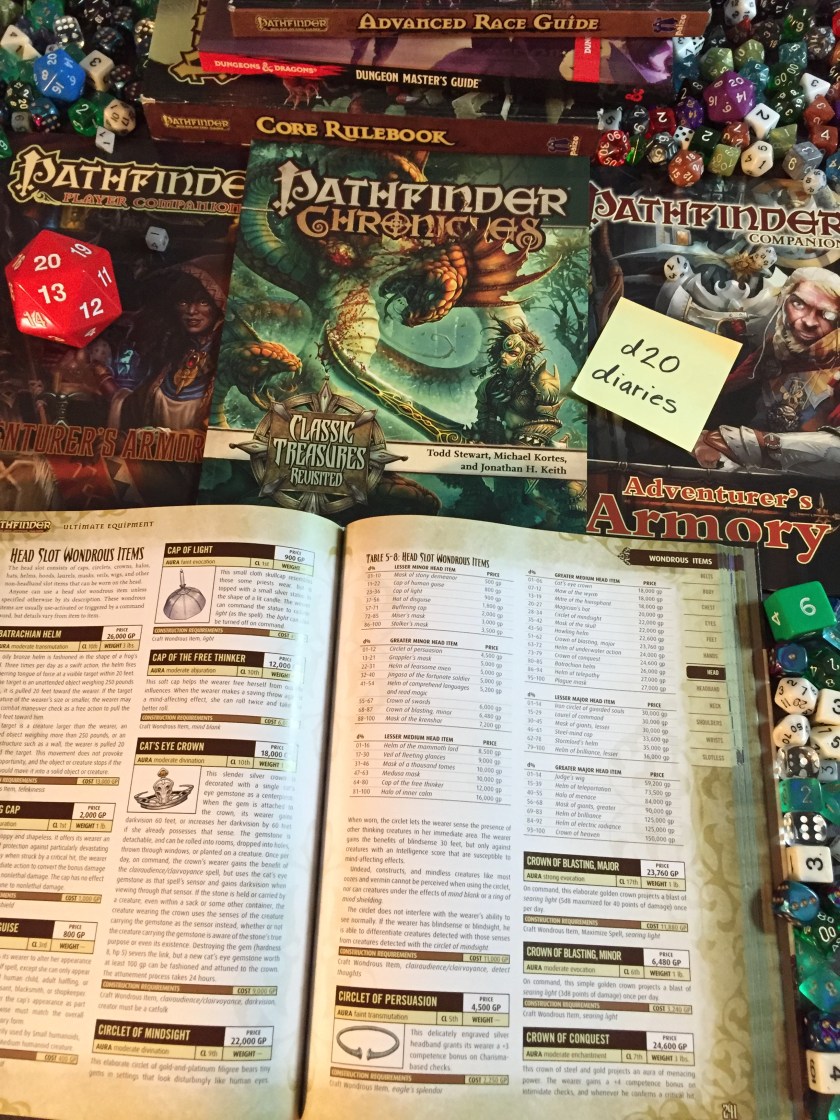
Another classic staple, the circlet of persuasion grants you a +3 competence bonus on all Charisma-based checks. Yup! All of them. Now, that’s not something useful to all characters, but if you’re the kind of character it would be useful for, it’s really useful. In the Pathfinder Roleplaying Game this will set you back 4,500 gp and is available in the Core Rulebook and Ultimate Equipment.

8 – Helm of Comprehend Languages and Read Magic
Pretty self explanatory, I know. This helmet lets you understand any language you see written or hear spoken, including magical writing. It also grants you a bonus on linguistics checks to decipher incomplete and extinct languages, and so on. A steal of a deal at 5,200 gp! In the Pathfinder Roleplaying Game this helmet is available in the Pathfinder Core Rulebook and Ultimate Equipment. In the most recent version of D&D (5e) its known as the Helm of Comprehending Languages, and is slightly different. It can be found in the Dungeon Master’s Guide.

7 – Crown of Swords
Personally, I love the crown of swords. It looks like a steel crown covered in tiny mithral swords. It’s fun, has a flavourful and dynamic effect, and doesn’t use up a lot of time to activate. So what’s it do? Up to ten rounds a day when you’re injured in combat you can cause a spiritual weapon (shaped like one of those snazzy little longswords on your crown) to appear and immediately begin attacking whoever wounded you. It can stick around as long as the enemy is within range and you have the rounds to keep using it. Get injured again? You can make another appear if you want to. This nifty little crown can be a lot of fun! You can find it in Ultimate Equipment, or the Advanced Race Guide for 6,000 gp.

6 – Helm of the Mammoth Lord
This helmet looks awesome, lets you gore enemies with your helm’s tusks, protects you from the cold, and makes you better at interacting (handle animal, ride, wild empathy) with elephant-like creatures. Finally, it lets you magically communicate with elephant-like creatures. Super cool! It’s available in the Pathfinder Roleplaying Game for 8,500 gp, from Ultimate Equipment and Pathfinder Player Companion: People of the North.

5 – Mitre of the Hierophant
This ostentatious hat is the go-to headpiece for divine casters who worship a deity. It grants you a solid bonus on diplomacy and knowledge (religion) skills checks, and lets you communicate with your god (via the commune spell) once a day. Once a week you can also help another creature atone for their sins. This hat is from Ultimate Equipment and costs 18,000 gp.

4 – Howling Helm
This helmet is made from a wolf’s skull and lets you communicate with any canines (from foxes up to dire wolves). It also gives you a bonus to influence magical beasts that are canine-like, such as blink dogs and worgs. Finally, three times a day you can let out a badass howl that summons a pack of magical wolves to fight for you for five rounds, and can demoralize your enemies! This super-cool helmet costs 22,600 gp and can be found in Ultimate Equipment.

3 – Batrachian Helm
This one’s a little weird, I know, but I like it! The batrachian helm looks like a frog’s head and lets you use a magical force tongue attack! This tongue can be used as a swift action to move objects and enemies closer to you. However, if you use it against an object or creature particularly heavy or immovable, you’re pulled towards it instead (which doesn’t provoke)! It’s really adaptable, and can let you manipulate the battlefield and environment in some creative ways. I highly recommend this helmet if you’ve never used it before! It costs 26,000 gp and can be found in Ultimate Equipment.

2 – Helm of Telepathy
A helmet that’s survived through many editions of d20 games, the helm of telepathy lets you detect the thoughts of those around you and send them telepathic messages in turn. And if they think of a response? You hear it and can respond again, of course! Once a day you can also cast suggestion on someone when you give them a telepathic message (although the DC to resist isn’t very high). This telepathic communication can be a boon in all sorts of situations, including for rumourmongering, spying, and communicating secretly among your teammates. In the pathfinder Roleplaying Game it costs 27,000 gp and can be found in the Core Rulebook and Ultimate Equipment. In 5th edition D&D you can find it in the Dungeon Master’s Guide.

1 – Helm of Brilliance
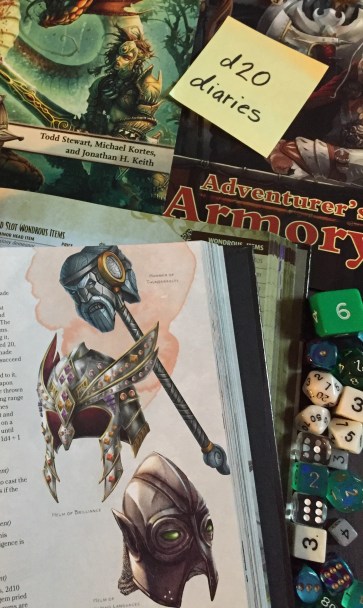
This over-the-top helmet has been around since the original Dungeons and Dragons, and is still kicking around today. The rules have changed a bit throughout the years, but at its heart it’s still the same. The helm of brilliance is covered with magical gemstones that can cast spells. Each gemstone can be used to cast a spell once before it’s magic fades, but don’t worry! There’s a lot of gems on this pricy helmet. Ten diamonds that cast prismatic spray, twenty rubies that create walls of fire, thirty fire opals that cast fireball, and forty opals that cast daylight. As long as you’ve got a gem left with magic still in it the helmet also grants you fire resistance, can make any weapon you’re wielding flaming, glows when undead are nearby, and damages any such undead. Crazy, right? The downside? If you’re harmed by a fire spell and fail a Will save the gems all overcharge, sending prismatic sprays around at random, making walls of fire all over the place, and causing fireballs explode all over you. ClassicA helm of brilliance in Pathfinder will cost you a whopping 125,000 gp and can be found in the Core Rulebook and Ultimate Equipment. In D&D (5e) you can find it in the Dungeon Master’s Guide.

Don’t want your helmet to explode while its on your head? I recommend picking up a Helm of Reclamation instead. This undead-destroying helmet functions in much the same way, with ten diamonds casting sunburst, thirty bloodstones casting searing light, and forty opals casting daylight. It glows near undead and harms such enemies, and can give your weapons the flaming ability. It does not, however, grant you fire resistance. Know what else it doesn’t do? Explode. Fair trade. The helm of reclamation can be found in Pathfinder’s Classic Treasures Revisited.

And that’s our ten favourite magical headgear from d20 games! Got a favourite we didn’t include? Think I’m crazy? Let me know in the comments! Wearing a crazy hat today? I want to hear that, too!

Until next time,

Jessica

pathfinder, d&d, magical gear

Tails of Equestria: The Storytelling Game

Quite a few months ago a fellow gamer recommended my family give Tails of Equestria: Storytelling Game a try. I looked into the game, and told my daughter and son all about it. They were extremely excited. The problem?

Finding it.

Although I was able to find a copy of the rulebook on some American and European retailers websites, I could not find this RPG in Canada. None of the local game shops had it, Amazon had only German language copies in stock, and Indigo was sold out completely. We’ve been keeping our eyes open in the months since and, although I did see a copy turn up once or twice, it was never for long (or affordable!).

And then Christmas came. My daughter, in a stroke of brilliance, asked our only relatives that live in the States for My Little Pony: Tails of Equestria: Storytelling Game for Christmas. She typed out the title of the book she needed to play, and then all of the other supplement books she wanted, and assured me that YES, she would definitely be happy with a big pile of books as a Christmas gift, and YES, she was sure that’s what she wanted.

Grandma and Grandpa came to the rescue. This past Christmas my daughter opened up not one, but three RPG books. My Little Pony: Tails of Equestria: Storytelling Game (which is the Core Rulebook and essentially all you need to play), Tails of Equestria: The Festival of Lights (which is a published adventure), and Tails of Equestria: The Storytelling Game Starter Set (which contains an adventure, dice, and all kinds of accessories).

My daughter was thrilled. So was my son. And honestly? So was I. I had heard wonderful things about this game and, although it wouldn’t become my favourite game anytime soon, it looked like a ton of fun. Definitely something my kids would enjoy.

After squealing in glee and obsessing over some of the cool pictures inside she put down the books and moved on with the rest of the holidays. She tried out new toys and video games. We learned how to play our new board games. And at the end of that first weekend after Christmas she held up her books and gave me a big grin.

“Will you read this with me now, Momma?”

I was about to head out for a trip to the laundromat, so it wasn’t exactly the ideal time. But, I’ve never been one to say no to a kid with a book, so I put aside all the work I was going to bring with me and packed up my kids and our hardcover book instead. Clothes in the wash and water bottle in hand — reading an entire RPG core rulebook aloud is thirsty work! — we settled in to learn a new d20 game together.

my litte pony tails of equestria storytelling game

The book is bright, colourful, and engaging. It’s simple to understand but doesn’t talk down to you. It is perfectly written for its audience. Seriously. My daughter is in grade one and not only did she follow along with everything I was reading to her (and pay attention!), she understood the game and its rules immediately. I never had to stop and explain anything further than the book already had. I never had to give her an easy example to illustrate a rule. Nothing. She listened and understood. My son, who is only a year older than her, could have read the entire book by himself and understood it. In fact, my daughter probably could have read it herself too, but that’s not typical for kids her age (both of my kids are very strong readers). We weren’t done the rulebook by the time we were done at the laundromat, but after we got home my daughter sat down beside me on the couch and we finished it. Cover to cover in few hours. She was practically bouncing in excitement.

“Can we make our characters now?”

So we printed off some fancy character sheets, called over my son, and got creating! The entire process took us around an hour, which included drawing and colouring our ponies. Follow-up ponies we made took much less. About fifteen minutes from start to finish.

We were ready to play!

…sort of. We still had to convince my husband to make a character so he could join in on the game. Haha. I’ll share more details about our first gameplay experience in an upcoming blog post later this month, but for now, we’re going to talk about the rulebook itself. Interested? Read on!

Tails of Equestria: Storytelling Game is an easy to understand pen and paper roleplaying game featuring the world and characters of the hit TV show My Little Pony: Friendship is Magic. The game is aimed at children, but is definitely fun for the whole family. A hardcover book 151 pages in length, this tome is packed full of artwork, and is written in an easy to read font (and font size). Licensed by Hasbro, published by River Horse Games (in Europe) and Shinobi 7 (in the USA and Canada), and written by Alessio Cavatore, Dylan Owen, and Jack Caesar, this book’s suggested retail price is 25 pounds, 30 Euros, 35 American dollars, or 40 Canadian dollars. Of course, that cost will vary a lot depending where you pick it up. I found forty five is more typical online in Canada (if you manage to find a copy in stock at all). The book is sturdy and well made — a must have for kids books! The front cover features an image of the three iconic Tails of Equestria ponies navigating the wilds with a castle in the background. Firebrand, the iconic unicorn takes the lead, with Thrilly Filly the pegasus flying above, and Strong Oak the armoured earth pony alert at the back of the group. My kids love the art, which is drawn by Amy Mebberson, but its the back of the book that really shines for me.

I remember when I was in junior high there was a Chapters nearby that I went to constantly. On one visit I passed by the Dungeons & Dragons Player’s Handbook and stopped in my tracks. I picked it up and flipped through it. I knew in my gut I wanted it, but I had no idea what it was. None. Eventually I put it back and moved on. Every visit afterwards I passed by that book and picked it up. But I never bought it. Not until many years later when someone actually explained to me what the heck D&D was. By then the book store wasn’t even open anymore. I would have liked to buy it from there. But this? This book doesn’t have that problem. Right there on the back cover it explains what this book is, how you use it, and what it’s for. It’s written in simple language that any kid or parent (or grandparent!) can understand. It’s simple, clear, and concise. I love it.

Seriously.

I love it so much I’m going to let you read it for yourself.

What is this book?

Hey there! So I imagine you’ve picked up this book knowing a little bit about My Little Pony: Friendship is Magic. You’ve probably had a quick flick through the book and are wondering exactly what it is.

This book is a manual for a storytelling game, which allows you and your friends to create your very own pony characters to explore the amazing and magical world of Equestria — will you be a dynamic adventurer like Daring Do or a bold treasure hunter like Rarity?

Wait, wait, wait! You said this is a game, but this is clearly a book!

You’re right, but it’s actually both a book and a game. This book contains rules and a story. Rules that will tell you how to make a strong, clever, or charming pony. A story that you and your friends will enjoy, where the choices you make will change the story itself until you are telling the story as much as the book or the GM.

GM… what is that?

A GM (gamemaster) is a player at the table, but instead of playing as a pony, he or she will play as a storyteller, impersonating all of the ponies you meet, the beasts you face, and the challenges you have to overcome. Think of the GM as a narrator in a movie — it is his or her role to tell the players exactly what is happening in the story and what the outcomes of their actions are, depending on their choices.

Cool! How do I win?

Winning a storytelling game is very easy; you just need to have fun! Tails of Equestria is not about getting to the end of the board or having the most points, but all about having fantastical adventures and using the magic of friendship to overcome any obstacle that stands in your way, You and your friends, including the GM, are all on the same team — as long as everypony is having fun, everybody wins!

So open up Tails of Equestria and be prepared to enter a world of magic and friendship.”

See what I mean? Simple, approachable, and understandable. This isn’t just a book for RPG gamers. In fact, most of the kids who pick up this book won’t have played a pen and paper RPG at all. This is a book that can guide kids to becoming RPG gamers in a way that’s fun, cool, and tailored to them. It’s really well done.

Tails of Equestria: Storytelling Game is split into fourteen sections: twelve chapters, an adventure module, and the appendix. The chapters are each colour coded, which makes the book super easy to navigate and has the added bonus of making it look like a pleasant rainbow. Even better, the chapters are well ordered. One naturally progresses into the other in a way that just makes sense. It’s perfect.

The book starts off by explaining what a roleplaying game is, how to play them, what you need to play, what kind of dice the game uses, and some other supplemental material that some people like to use but isn’t mandatory. It mentions other Tails of Equestria products (like dice sets, gaming screens, and ‘tokens of friendship’), but also offers free solutions. It suggests using beads, buttons, and other small objects as ‘tokens of friendship’ and recommends free dice rolling apps. It also has dice charts in the back of the book so that all you need to do is flip to the proper chart, close your eyes, and point, to figure out what you’ve rolled. Offering these free alternative options in a way that makes it seem normal and acceptable is really important. Parents don’t want to be shelling out a ton of money after already having paid for a rulebook. Also, kids who do use buttons and the dice chart don’t need to feel like they’re left out or ‘making due.’ It makes it clear that you don’t need fancy supplies. You just need this one book. There’s also a short section intended for parents, which explains some of the benefits of roleplaying games.

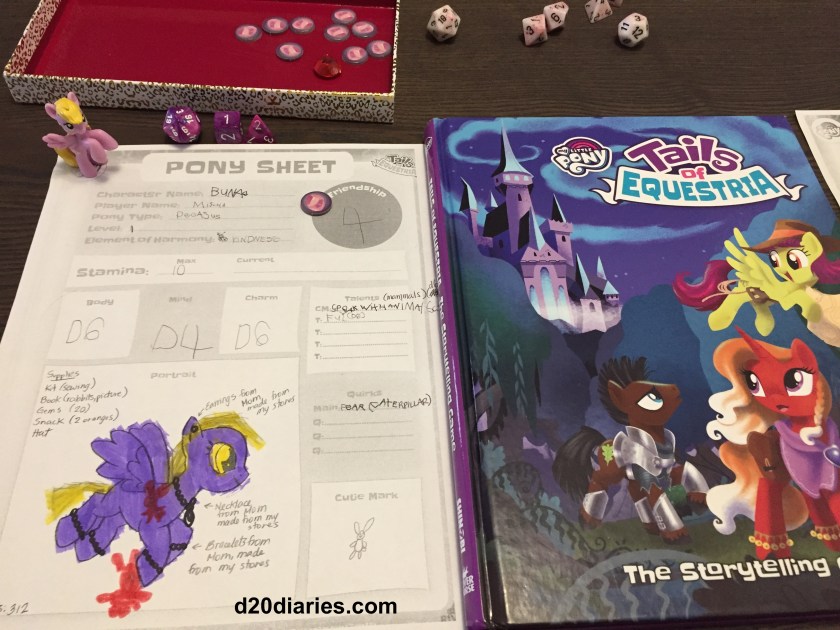
Tails of Equestria: The Storytelling Game then moves on to character creation, which takes up the majority of the book. The first thing you need is a character sheet. One is provided in the back of the book, which you can photocopy. You can also go here to download a variety of character sheets for free. They have blank sheets and ones with male and female ponies, pegasus, and unicorns pre-outlined. My whole family loves those ones, so I highly suggest you give them a gander. Once you’ve got your pony sheet ready you need to choose your pony type.

my litte pony tails of equestria the storytelling game character sheet

Players can choose to be an earth pony, pegasus, or unicorn. Earth ponies are hardy and strong. They gain the stout heart trait, which allows them to really push themselves to accomplish a physical task once a day. They also have higher Stamina (which is your hp) than the other pony types. Pegasus and Unicorns are less hardy than earth ponies, but have special abilities of their own. Unicorns can use magic. They begin the game with telekinesis and can make their horns glow. As they level up you can select more magical powers with them (if you want) such as force fields, stun rays, and teleportation. Pegasus can fly and walk on clouds. As they level up you can even learn to control the weather. There is a fourth type of pony in My Little Pony, the alicorn, but it’s off limits to players. Although kids will likely be a bit sad about that, the book explains quite clearly why, which was more than enough reason for my kids. After all, only Princesses of Equestria can be alicorns, and those thrones are all currently taken.

Once you know what kind of pony you want to use you write down your level, which is one. Then you select your Element of Harmony. This doesn’t have a mechanical effect. It acts more like a a guide to help you and your fellow players know what personality trait your character is most tied to. The Elements of Harmony are generosity, honesty, kindness, laughter, loyalty, and magic (which is a balance of all of the others). Once you’ve chosen your Element of Harmony you allocate your statistics.

Before we get into that, though, let me give you a little context about how this game works. Every pony has three main statistics: Body, Mind, and Charm. Each of these statistics will have a dice type associated with it. In this game your lowest statistic and traits will use a d4, but will increase as you level up, moving on to a d6, d8, d10, and so on. Low dice are bad, and high dice are good. Simple.

If you come across an obstacle — things like kicking down a door, untying a knot, or climbing a cliff — this is called a Test. Your GM selects the Test’s difficulty from a simple chart. Then the players roll a dice for the stat most applicable. Kicking down a door or climbing a cliff would be a Body check, discovering a clue or solving a riddle would be a Mind check, and making friends or telling a joke would be a Charm check. If you beat the DC you pass and if you’re under the DC you fail.

If you happen to have a skill that could also apply to whatever you’re trying to do, like bucking to kick down a door, or keen knowledge (geography) to find your way in the wilds, you get to roll that dice also and keep the better result. For example, if a pony with a Body d4 and Bucking d6 wants to kick down a door, they roll both a d4 and a d6, then they choose which die result they want to keep.

If you’re making a check against a different pony or an opponent, this is instead a Challenge. Examples of this include a baking competition, a race, or a debate. In this case the ponies and opponents involved roll the appropriate dice and the highest outcome is the winner.

Battles are a special type of challenge called a Scuffle. This works just like a regular challenge, except that the loser loses an amount of Stamina equal to the score rolled by the winner. So, if a pegasus and a timberwolf get into a scuffle, they each roll a Body check. If either of them has an additional trait that would be useful they roll that as well and keep the better of their rolls. If the pegasus rolled a 4 and the timber wolf rolled a 6, the timberwolf has won the round and the pegasus loses six Stamina. When you start the game your ponies will have either 10 or 12 Stamina, so battles tend to pass quick. Its a fun and simple way to handle combat. However, it should be noted that scuffles aren’t a major part of Tails of Equestria. Its much more likely ponies will avoid combat with clever roleplaying, creative thinking, and teamwork.

There’s a bit more to rolling than that. Rolling a 1 results in an automatic fail and is called Bad Luck. Beating a Test by double its difficulty is called an Amazing Success, and means something wonderful happens. Rolling maximum on your dice is called an Exploding Hoof and allows you to immediately roll on a dice one step higher (from d4, to d6, to d8, and so on). If you roll higher than your previous roll you can use the higher result, otherwise you keep your previous die roll. And if you roll maximum again? You go up another dice step and keep going. These all turned out to be fun additions to the game. My kids particularly enjoyed the Exploding Hooves. Haha.

Now that we’ve got the basics covered we can jump back into character creation.

All ponies begin with a d6 in Charm (which is your social statistic). Then you get to allocate a d4 and a d6 to the other two stats, which are Body (the physical trait) and Mind (your mental stat). Smart and clever ponies will want to put their d6 into Mind and their d4 into Body, while tough or nimble ponies will want to put the d6 into Body and the d4 into Mind. Earth ponies are a special exception and instead count their Body as one dice type higher, meaning an earth pony’s starting statistics will either be Body (d8), Mind (d4), Charm (d6) for strong ponies, or Body (d6), Mind (d6), Charm (d6) for brainy ponies.

Once you’ve chosen your statistics you calculate your Stamina. This acts as your hp, and is the sum of your Body and Mind stats. This means that pegasus and unicorns will have 10 Stamina to start with, while earth ponies will have 12. Failing Tests, Challenges, and Scuffles can lower your Stamina, as can lack of sleep or a poor diet. You can recover Stamina by resting, eating a good meal, or using Ponybalm (which is like a healing potion).

Now its time to select your Talents, which are sort of feats, special abilities, and skills all rolled into one. Each pony type starts with their own Talent. Earth ponies have Stout Heart (d6), pegasus have Fly (d6), and unicorns have Telekinesis (d6). At level one you also get to select one other Talent from a list, which is tied to your Cutie Mark and is your specialty. This Talent should be a huge part of your character and shape their outlook, personality, name, and so on. There’s a decent sized list of Talents to choose from, many of which have an unlimited number of subtypes. Keen Knowledge, for example, is knowing a lot about a specific topic, but what topic is entirely up to you. Similarly, Creative Flair is something creative that you’re particularly good at, such as baking, comedy, or painting, and Special Skill is something physical that you’re talented in, like bucking, gymnastics, or sneaking. Other Talents are more specific. Healing Touch, which was my personal favourite, allows you to heal an ally, while the Stare allows you to fascinate or command someone to do something. Finally, some talents can only be taken by a specific type of pony. Only unicorns can use magic, for example, and only pegasus can fly. Although the list is nice and allows for a lot of variance between characters, I found myself wishing it was a little longer. Fortunately it’s mentioned that players hoping to create something not on the list can do so with approval from their GM. Although my family has made a few ponies already, we haven’t had the need to do this yet. So far the written Talents have been more than enough.

Whichever Talent you select at level one begins at a d6. Throughout the game you’ll have the chance to upgrade the dice types of your various Talents, and learn more. Any Talents learned later begin as d4s though, so choose wisely.

Once you’ve decided on your Talents you get to pick out a Quirk, which is a character flaw. Again, there’s a decent array of options and, again, I found myself wishing there were more. Fortunately, some of them can be incredibly varied. Fear, for example, is a fear of a specific thing (like spiders or heights). Allergies and Oooohhh… Shiny! are equally variable. The others, such as asthma, blunt, messy, and overconfident are much more specific. Again, as with Talents, players have the freedom to create their own Quirks with GM approval. So why would your pony want a flaw, anyway? Quirks will influence your character’s personality and make them unique. It gives kids something fun and often comical to role-play, and teaches us that no one is perfect. But it has an in game effect as well. Every time your ponies face their fears they get rewarded by the GM. My kids loved this and really embraced their ponies Quirks. It turned out to be a lot of fun.

By now your pony is nearly complete. You’ll need to design their Cutie Mark, draw your pony, and give them a name. Some of the ponies my family created included Soothing Heart the over-prepared earth pony mother, Flying Recall the mystery solving pegasus with a sixth sense for trouble, Bunna the stuffed animal seamstress unicorn who can talk to animals, Nugget the unicorn artist who hopes to draw every magical creature in existence, and Thunderhoof the kung-fu fighting earth pony who wants to be an action star. All in all, this game allows you to make unique ponies with only a short amount of work. It’s a fun, streamlined process that everyone enjoyed.

What’s left? Gear. Now, most ponies don’t need to pick up any gear to start. But some, such as adventuresome ponies or those who have a goal or job in mind, will want to spend some of their money — called Bits — on gear before they begin the game. There’s a solid list of equipment you can purchase in the game, with enough variability that nearly all characters should find the things they need (or a similar item whose cost they can use). Whether you decide to spend your bits or not, each pony begins with 400 bits. In between adventures your ponies can earn 200 bits per month plus or minus d20 bits, as determined by the GM. All in all we found that bits and gear were a nice and important addition, but not integral to gameplay.

Finally, players determine how many ‘Tokens of Friendship’ they begin the game with. These are special crystals (or beads, buttons, and so on) which you can use to reroll dice, automatically pass a failed roll, or slightly change the storyline (depending on how many you spend). You begin the game with Tokens of Friendship equal to the number of people you are playing with (including the GM). You also gain more at each level up. If you decide to use your tokens to help out someone else, you reduce the cost of spending Tokens of Friendship. In very rare circumstances, players and characters who are particularly kind can also be gifted a bonus Token of Friendship by the GM. We found that this was a really fun aspect of gameplay that everyone got into the spirit of.

As you adventure your characters will learn and grow. Tails of Equestria does away with experience points, instead allowing ponies to level up after every adventure — or in between sessions if an adventure is particularly long. When a pony gains a level they increase one of their Statistics (Body, Mind, or Charm) by one die type (a d4 becomes a d6, a d6 becomes a d8, and so on). If they choose to increase Body or Mind this also creases their Stamina accordingly. For every Talent that you used in the previous adventure you increase it by one die type as well. Then you either select one Talent you didn’t have a chance to use and increase it by one die type, or you select a new Talent to gain at d4. Finally, your characters gain a number of Tokens of Friendship equal to the number of players (including the GM) who participated in the last adventure. very rarely you can select a new Quirk if you want, but it has to be for something that happened during your adventure, and each pony should do this only once or twice. For example, if your earth pony fell in a pit full of snakes and you role-played them being horrified by the events they might take the Quirk fear (snakes). This approach is simple and easy to understand, but you’ll soon see your PCs all branching off in different directions the more they level up.

With character creation and the basics of the game out of the way, Tails of Equestria: The Storytelling Game goes on to further explain gameplay for players and GMs. Which should bring us to the end.

Only it’s not the end!

This book also comes with an adventure for first level characters called The Pet Predicament. I cannot express how happy I was to discover this. Particularly after I read it! It is honestly the perfect start adventure for this game. And, it’s not a short or cheap adventure, either! It’s forty pages in length if you count the stat blocks it comes with. It took my family two sessions to play through, though my kids were so engrossed they wanted to play it in one. But, alas! It was bedtime. Haha.
my litte pony tails of equestria the storytelling game in game

In a practical sense, this adventure is incredibly important. It provides a first adventure for players to use, and teaches them how a game should be run by example. For experienced players it also serves to alter our preconceptions about RPGs, and really shake things up. That’s because Tails of Equestria isn’t the same kind of RPG as Pathfinder or D&D. It downplays battle, and really encourages players to use creative thinking, kindness, teamwork, and roleplaying to overcome obstacles. This game requires a different mindset than other RPGs. Happily it’s a mindset that kids and young players will naturally settle into and flourish. I honestly cannot be happier with how this game played.

So what is the Pet Predicament? I mentioned it was the perfect starter adventure for this game and I meant it. It’s well written, engaging, and fun. There’s plenty of opportunity for Scuffles, but just as many chances for players to completely avoid Scuffles with Tests an Challenges. It features the Mane Six (main characters) from My Little Pony: Friendship is Magic as initial NPCs, and leaves the PCs as their pet-sitters. Any kids who has seen the show will be absolutely thrilled at this turn of events. Getting to meet such famous characters is enough to make many kids squeal in glee, and finding themselves the caretakers of all six of their pets? I’ve never met a kid who doesn’t love animals! Both my son and daughter got super into this adventure. They did their best to take care of the animals, feed them their favourite things, pamper and play with them, and so on. Unfortunately for your pet-sitters, not all of the pets are well behaved. Fluttershy’s rabbit, Angel, is a menace (as fans of the show will know!). My daughter, who adores rabbits, had a ton of fun dealing with the fluffy little terror. But, like all good adventures, something goes wrong. And this time? There’s definitely a rabbit to blame! The pets soon get lost in the dangerous and spooky Everfree Forest, and its up to your PCs to rescue all the pets, brings them back to Fluttershy’s cottage, and clean up. Their adventures will present them with all kinds of obstacles, Tests, and Challenges. Rescuing each pet will take creative thinking and teamwork. How each task is accomplished is incredibly open ended, which really allows your group of PCs to use their own unique approach to get things done. I’ll refrain for spoiling any more of the adventure, but I will say that it’s a delight to read, GM, and play. Everyone in my family had a blast (including my husband).  The ending also had my kids hooked, as it leads directly into the Tails of Equestria: The Curse of the Statuettes adventure (although the book also encourages kids to create their own adventure with the cliff hanger ending as an opening plot hook).

In the end, my entire family loved Tails of Equestria: The Storytelling Game. It’s fun, fast-paced, and simple, but offers everyone at the table plenty of opportunities to role-play and work together. I had a blast sharing this game with my kids. And my kids? They couldn’t be happier. In fact, my daughter is sitting in her bed with a little notebook and her rabbit pen creating another character as we speak.

Absolutely a wonderful game.

 Jessica


Our Favourite Things of 2018

To celebrate the New Year we’re taking one last look back at our favourite things of 2018! So what made the cut? Read on and see!

Favourite d20 Bestiary: Alien Archive
(for more information check out this blog post)

Favourite Dungeons and Dragons Book: Dungeons and Dragons: Guildmaster’s Guide to Ravnica
(Dungeons and Dragons meets Magic: The Gathering!!)

Favourite Pathfinder Book: Ultimate Wilderness
(for more information check out this blog post)

Favourite Starfinder Book: Pact Worlds
(for more information check out this blog post)

Favourite d20 Book (Other): Realms of Atrothia: Legacy Races Revisited
(for more information check out this blog post)

Favourite d20 Adventure: Skitter Shot
(for more information check out this blog post)

Favourite d20 Campaign: Return of the Runelords Adventure Path
(for more information check out this blog post and be on the look out for another blog post early this year)

Favourite Pathfinder Society Scenario: #9-10: Signs in Senghor
(for more information check out this blog post as well as this one)

Favourite Starfinder Society Scenario: #1-14: Star Sugar Heartlove!!!
(for more information check out this blog post)

Favourite Kid’s Game: Tails of Equestria: The Storytelling Game
(for more information be on the lookout for a new blog post later this month!)

Favourite Board Game: Dinosaur Island
(for more information check out this blog post)

Favourite Family Movie: Spider-Man: Into the Spider-verse
(now playing in a theatre near you!)

Favourite Movie: Ready Player One
(if you haven’t seen this movie or read this book yet, you REALLY SHOULD!)

Favourite Upcoming Kickstarter: Realms of Atrothia: Primary Expansion
(Kickstarter coming in February 2019!)

I can’t wait to see what 2019 brings!

Jessica

3… 2… 1… HAPPY NEW YEAR!

3…

2…

1…

HAPPY NEW YEAR!

My family and I want to wish each and every one of you a wonderful, amazing, SPECTACULAR, New Year.

I mean that. Truly.

We wish you all the best in the coming year, and every day afterwards.

Thank you for visiting d20 Diaries. And thank you for sharing this past year with us. I hope you join us for another one.

Jessica
(and family!)

Dragon Dice Tree - NEW YEAR.jpeg

Starfinder Society Scenarios: It Rests Beneath and Honorbound Emissaries!

Today we’re going to take a look at the two most recent Starfinder Society Scenarios that are currently available for purchase, and let you know we thought. Although you’ll find references to events in each that I liked or disliked, and comments about specific characters, these scenarios are not explored in detail. It’s not my intention to spoil the events in these scenarios, or give summaries and full reviews, but to share my opinions and provide recommendations. That said, if you want to avoid even minor spoilers I recommend you check out a different article. Whether you intend to use them in home games of the Starfinder Roleplaying Game, sanctioned scenarios for use with the Starfinder Society Organized Play, or just want to read a nifty new adventure, we’ve got you covered! So sit back, and get ready to explore the Pact Worlds!

1-28 It Rests Beneath
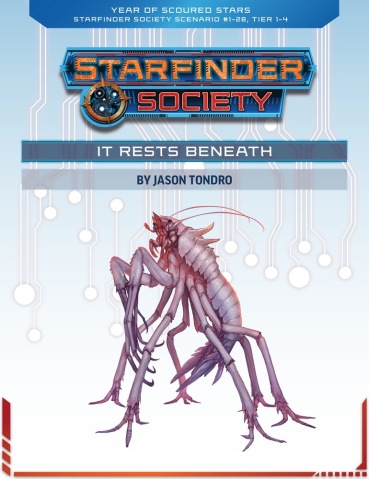
Starfinder Society Scenario #1-28: It Rests Beneath by Jason Tondro.

Starfinder Society Scenario #1-28: It Rests Beneath is a Tier 1-4 adventure written by Jason Tondro. It takes place on the planet Vabaimus, a Near Space world home to a variety of ecosystems and rich mineral deposits. It’s dominant native species is a sloth-like race that is approaching sentience. On Vabaimus you will help out a small Starfinder research facility. This scenario features the Faction (Wayfinders), and Vehicle tags. It does not contain starship combat. It utilizes content from the Starfinder Core RulebookStarfinder Armory, and Starfinder Alien Archive . It makes use of Pathfinder Flip-Mat: Hill CountryPathfinder Flip-Mat: Twisted Caverns, and Starfinder Flip-Mat: Asteroid. In addition, you’ll also want a relatively featureless map, like Pathfinder Flip Mat: Basic Terrain Multi-Pack or Pathfinder Flip-Mat: Dragon’s Lair, for any unmapped encounters. If you’ve got any vehicle-related boons now is the time to slot them. Similarly, if your character happens to own their own vehicle, definitely bring it along!

It Rests Beneath features only one recurring character: Fitch, leader of the Wayfinders faction, an her mischievous grandchildren. It introduces a few new characters: Dr. Mora Motressi, leader of a Starfinder research facility on Vabaimus; her daughter, Little Mina; and Bud, a cuddly sloth-like being that’s both the good doctor’s pet and the most advanced native species on the planet. This scenario begins on the Master of Stars, the largest ship in the Starfinder fleet. It’s currently docked in Absalom Station’s Armada and has been undergoing repairs since the start of Starfinder Society Organized Play. From there it swiftly transitions to Vabaimus, where the rest of the scenario takes place. There PCs will need to assist the science team in performing a survey of a strange landmass. Nearly 85,000 square miles in size, with no water or plant-life, this calcified plateau is of great interest to Dr. Motressi and her team. She asks you to travel across the plateau to three specific locations, set up some specialized towers you brought with you, and calibrate surveying equipment atop of each one. Each tower has its own challenges, hazards, and enemies to contend with. There’s multiple vehicles your PCs can choose from, and the towers can be tackled in any order. There’s a simple vehicle handout that will be useful for both players and GMs, which is a nice touch. I love how flavourful the new creatures and environmental hazards are. A lot of thought has gone into ensuring they fit into their ecosystem — which is particularly important when players are surveying an environment. Also, I particularly enjoyed the mystery of the old kasathan ship.

I do have  one nitpick. Page three is missing half of a sentence at the end of the first section, which I assume should read something along the lines of ‘up to help,’ ‘up to lend a hand,’ or something else similar. It’s not a hindrance to the scenario. You can still get the gist of what it’s supposed to be saying, but it was jarring enough that it caused me to look around in confusion for a half a minute, to make sure I hadn’t missed anything. A minor distraction in an otherwise enjoyable read.

Overall, I loved I this scenario! The premise is different from any that have come before. It was engaging all the way through, with a wonderful array of social interactions, skill-based encounters, hazards, and combat. The enemies and hazards were all well-thought out. The NPCs were properly engaging and ‘real.’ And, best of all, your PCs have to make an important decision regarding the future of this planet. Really top notch! Although it didn’t blow my mind, like some other amazing Starfinder adventures, it was an… understated awesome. I give it 5 out of 5 stars.

1-29 Honorbound Emissaries
Starfinder Society #1-29: Honorbound Emissaries by Jenny Jarzabski.

Starfinder Society #1-29: Honorbound Emissaries is a Tier 7-10 adventure written by Jenny Jarzabski. Yup, you heard that right! Tier 7-10! The first of its kind! It takes place primarily on Saaruq-5, a planet in the Vast that’s part of a multiplanetary federation called the Kreiholm Freehold.  This scenario features the Faction (Second Seekers [Luwazi Elsebo]) tag, and does not involve Starship combat. It continues the ongoing Scoured Stars storyline, and is a direct sequel to the events of Starfinder Society #1-99: The Scoured Stars Invasion. Although playing these previous adventures isn’t necessary, I highly suggest you do. Everything will make more sense, have more importance, and be more engaging if you have.  It features NPCs from some previous scenarios (Starfinder Society Scenario #1-04: Cries from the Drift, Starfinder Society Scenario #1-05: The First Mandate, and Starfinder Society Scenario #1-11: In Pursuit of the Scoured Past). In addition, there are multiple instances where PCs who have played previous scenarios involving the jinsul have an advantage (Starfinder Society Scenario #1–13: On the Trail of History, Starfinder Society Scenario #1–99: The Scoured Stars Invasion, or Starfinder Society Scenario #1–23: Return to Sender). Finally, it should also be noted that this scenario helps lay the foundations for further scenarios, as well as the next interactive special. Important stuff! If you’ve got characters who have played any of the above-mentioned scenarios, I highly suggest bringing them. And, if you’ve got the Honorbound Allies boon, now’s the time to slot it!

Honorbound Emissaries utilizes Pathfinder Map Pack: Starship DecksStarfinder Flip-Mat: Hospital , and a custom half-page map. It contains content from the Starfinder Core RulebookStarfinder Alien ArchiveStarfinder Alien Archive 2, and Starfinder Armory. In addition to containing important events, this scenario has a lot of important NPCs. It features First Seeker Luwazi Elsebo, Iteration-177 (who was previously in Starfinder Society Scenario #1-05: The First Mandate and Starfinder Society Scenario #1-11: In Pursuit of the Scoured Past), Captain Yuluzak (who was previously in Starfinder Society Scenario #1-04: Cries from the Drift), and mentioned (but unfortunately doesn’t feature) the gruff vesk pawnbroker Julzakama (who was previously in Starfinder Quest: Into the Unknown and Starfinder Society Scenario #1-10: The Half-Alive Streets). Captain Yuluzak has his own artwork this time around, and it is awesome! All of these NPCs were well-represented, and I’m happy to see them back. Honorbound Emissaries also introduces a ton of new NPCs to interact with, many of which have names, personalities, and quirks. I particularly enjoyed the crew of Honorbound.

The opening premise for this mission is… convoluted. Captain Yuluzak, who runs a salvager, discovered a starship wreck, took what was valuable and returned to Absalom Station. Some objects he kept, and others he sold to a pawnbroker named Julzakama. Juzakama recognized one of the objects as an important piece of art and contacted some people he thought would buy it. One of those people, Iteration-177, recognized the object as belonging to a culture that was once a part of the Scoured Stars Trinary System, so he contacted Luwazi Elsebo. Luwazi had the object brought to her, along with a team of Starfinders, Iteration-177, and Captain Yuluzak himself. Luwazi tasks the PCs with travelling aboard Captain Yuluzak’s ship to investigate the original wreck. There they’ll  determine the ship’s origins, and travel there to investigate and (hopefully) make some new allies.

Jinsul Graey Erb
A jinsul. Illustrated by Graey Erb. Art courtesy of Paizo Inc.

This scenario was big with a capital ‘B.’ It involves the Scoured Stars storyline, the jinsul, a new solar system full of inhabited planets, three new races (nelentu, syngathrix, and thyr), people to save, important decisions to make, a massive starship battle, and combat on… well we’ll leave that part secret for now. Haha. To say this scenario is bold is an understatement! The entire hospital section of this scenario was particularly well handled, as were the NPC interactions found throughout. And the setting for the final battle? Epic! Your PCs are sure to come away from that fight feeling like badass action heroes. It’s going to be a ton of fun to play.  On the downside, everything in this scenario is overly convenient in a rather heavy-handed way. Now, I’ve no problem with a ‘railroad,’ particularly in short adventures like Society Scenarios, but in Honorbound Emissaries you always arrive in the exact right place at the exact right time in order to avoid something troublesome. Heck, you even travel through a massive space battle and don’t get attacked by either side. At all! In fact, you even manage to approach the planet and land without a single threat or altercation. It’s like you’re invisible. Which brings me to me second down-side: starship combat. This scenario should have had one. Getting to witness an epic starship war and not engage in it at all is kind of a let down. And how fun would it have been to help out the crew of the Honorbound? Now, I get why it’s not in here. This scenario has more than enough encounters to engage in, and they’re all cool. But, it would have been nice to at least see the ship you’re on come under attack. Or mention the bumpy ride as the pilot has to take evasive maneuvers. Something.

…But that final battle! Wow! Haha.

sfs 1-13 - on the trail of history - jinsul ship
A jinsul ship. Originally depicted in SFS #1-13: On the Trail of History. Art courtesy of Paizo Inc.

Overall, I really enjoyed this scenario. It’s bold, daring, and casts your players into situations much bigger than themselves. PCs get to do some heroic things, some absurd things, and   some absurdly heroic things, all of which is going to be a blast! It’s rounded out by some really solid social interactions with a large cast of quirky characters. This is truly one of those scenarios that players will talk about for a long time afterwards, simply because they want to brag about their character’s exploits. Five years some now I’m sure some players will still look back on it fondly and say “Wow, remember when my Starfinder character did THAT? THAT was cool.”

Which is cool!

I give this scenario 5 out of 5 stars.

Thanks for joining us today!

I wish you happy holidays, plenty of natural 20s, and all the best in the upcoming year!

Jessica

Pathfinder Second Edition: Forging the Future!

We haven’t talked about Pathfinder Second Edition in a while. Neither have the folks over at Paizo. Or, at least, not publicly. That’s because the Development Team has been hard at work sifting through survey data, making changes to the game, and generally working their asses off to make Pathfinder Second Edition the best RPG that it can be.

But, this past Pathfinder Friday on Paizo’s twitch stream, we finally got some news! Jason Bulmahn, Director of Game Design, sat down with Host and Marketing Manager Dan Tharp to talk about the future of Pathfinder.

His first topic of conversation?

Surveys.

Feedback surveys on the PF2 Playtest are going to be open until December 31st at midnight. That’s right! You’ve still got time to give them your feedback, answer their questions, and give Paizo the data they need to continue improving the next version of Pathfinder. Be sure to get your surveys done before the New Year!

But, even though they’re still accepting feedback, and sifting through our responses, the development team is already working on improving the game, and revising everything. Word is they’re halfway done editing the book, with another quarter that they hope to get done over the holidays. (Yes, they brought home more work). The whole development team deserves a huge round of applause. Keep up the good work! (And take a breather while you’re at it!).

Now, as I mentioned, they’re still accepting feedback, and they still testing and retesting everything they can. They’ve made some changes, but they’re not done yet — not by a long shot! In addition, some of the things they’ve changed are likely to change again. But they’re making progress. And Jason decided to share some of that progress with us.

The Top Five Things That You Can Look Forward To for Pathfinder Second Edition!

#5 – Polish and Flavour. Jason admitted that a lot of the Pathfinder Playtest Rulebook was technically sound, but dry. It lacked pizazz! They intend to change that. The development team is trying their best to inject as much flavour into the rulebook as they can! Thank goodness! Haha. Sneak peeks Jason mentioned included calling the various rogue specializations a ‘Rogue’s Racket’ and that Wizards get to create their own graduate thesis to represent their specialization in magic. Awesome! I can’t wait to see what else they bring to the table.

#4 Jason rewrote Chapter 1. This new introduction to the game is said to be an engaging narrative which is meant to be as entertaining and easy to understand as possible. It even includes a sample build and an example of play. Awesome!

#3 – GM Resources. The folks at Paizo are trying to make GMing as easy as possible. The table of DCs, which were overly complicated, are now streamlined into a simple chart. Conditions are undergoing some changes, as well. Some were removed, others were changed, and they even added a new one: Doomed! Essentially, Doomed lowers your dying threshold. This is a condition players will want to get rid of ASAP!

#2 – Resonance. They got rid of it completely. Pardon me while I dance in glee.

#1 – Proficiency. Although the system makes sense and was met with positive feedback, many players said that they didn’t feel like the numbers involved allowed for enough variance between the proficiencies, so they’re being changed! Untrained will remain +0 (and does not add your level), Trained skills will be at +2 plus level, Expert at +4 plus level, Master +6 plus level, and Legendary +8 plus level. Here’s hoping they’ve got the math right this time around!

Other mentioned changes include allowing the three different alignments for paladins, making spellcasters and spells more powerful, adding ‘Fail Forward’ rules (which is when even on a failed roll your PCs progress, but with some kind of penalty or downside caused by their failure), and more! I don’t know about you, but I’m exciting to see what Pathfinder Second Edition will become!

Jessica

Assorted Dice Rainbow

Alternate Realities and a Vision of the Past!

Well, last night’s Starfinder Wednesday pre-recorded episode was an absolute delight! But, before we get into that, lets take a peek at what happened the week before. (Admittedly, the holidays have left me a little behind!).

Last week on Starfinder Wednesday Dan and the gang over at Paizo talked about the Character Operations Manual Playtest, where you can take three new Starfinder classes for a test drive. This week was the second of three episodes streaming over the next month that will take an in depth look at these three classes: the biohacker, the witchwarper, and the vanguard. So which is up second?

StarfinderCover
Want to play Starfinder? All you need to get started is the Starfinder Core Rulebook!

The witchwarper!

Host Dan Tharp welcomed special guests Amanda Hamon Kunz and Owen K.C. Stephens. Amanda wrote the first draft of the witchwarper and, although it was a team effort, this class has her personal touch all over it!

So what is the witchwarper? For starters, it’s based around the ‘Infinite Worlds’ theory, which posits that there are an unlimited number of realities where different decisions made by its intelligent life-forms has led to alternate realities slightly different than our own. The witchwarper can see into these alternate realities and temporarily bring aspects of them into our own reality. By drawing on these other worlds they can change circumstances to their benefit, affecting themselves, their allies, their enemies, and their surroundings. Mechanically, this means that they can alter the battlefield, provide buffs and debuffs, and casts spells. As they grow in power, they gain new ways to use their powers on the world around them. They have the same number of spells per day and spells known as mystics and technomancers, and their spell list will be comparable in length when the final version is released.

Also on the topic of magic, it was revealed that there are going to be plenty of new spells released in the upcoming Character Operations Manual. Some spells will be available for all casting classes, others will be available for only two of the three, and a fair amount will be class specific. I can’t wait to see what the folks at Paizo have up their sleeves!

Finally, Amanda and Owen announced that the Starfinder Beginner Box is now available for Preorder. It’s scheduled to be released in April 2019.

Which brings us to today!

The most recent episode of Starfinder Wednesday wasn’t about the future. It was about the past. Host Dan Tharp welcomed special guests Owen K.C. Stephens and Robert G. McCreary onto the show to discuss the history of the Starfinder Roleplaying Game! They started with a talk about it’s origins. Many of us will think back to Pathfinder’s sci-fantasy products as the basis for Starfinder. Places like Numeria (which is fully detailed in Numeria, Land of Fallen Stars), and adventures like the Iron Gods Adventure Path, and the Second Darkness Adventure Path. Golarion’s original solar system was described in Pathfinder Adventure Path 14: Children of the Void (Second Darkness book 2 of 6), and then further expanded into Pathfinder Campaign Setting: Distant Worlds.
But, when asked about the origins of Starfinder, both Owen and Robert agreed that it went back way, way further. To the ages of Pulp Fiction, and to the classic Dungeons and Dragons adventure Expedition to the Barrier Peaks. They emphasized that combining science fiction and fantasy is not new. People have been doing it long before them. And, of course, there’s plenty of other influences from science fiction we could all name.

PZO7107
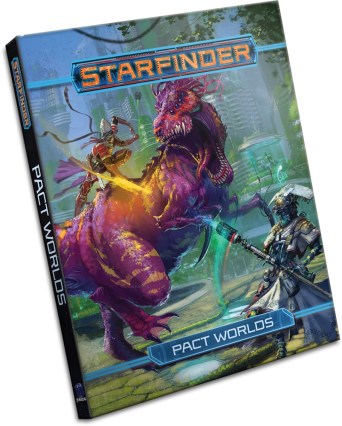
For more information on the Starfinder campaign setting, check out Starfinder: Pact Worlds!

Although there was lots of other interesting topics discussed, I particularly enjoyed hearing about the early days of planning, when they were trying to decide if making a Science Fantasy game even made sense, or if it could be approximated within Pathfinder itself. Was Starfinder a separate entity influenced by Pathfinder? Or was is Pathfinder taken into space? What would make those concepts different? And if they did create Starfinder as its own entity, would it be in a whole new universe? Or would Golarion’s Solar System still fit? How could they even make that work?

What would it look and feel like?

I also really enjoyed getting to hear about the balance they decided to aim for, and how they went about it. What would they carry forward from Pathfinder and what would they create new? What races and monsters, and places would stay the same? What was the right balance between updated and entirely new content? And how could they make old races and places fit in with their new universe?

How did Starfinder become what we know it as today?

There was also some great conversation about the core concepts of Starfinder and how they came to be. Things like cosmology, the Pact Worlds, the Drift, The Gap, and Absalom Station.

Really great stuff! If you haven’t given it a watch yet, I highly suggest you do! Also, you’ll get to see Owen accidentally (or perhaps purposely) mention Alien Archive 3, which is in the works! Robert ended on a more detailed but equally tantalizing  note, mentioning that they’re hoping to create more content that has to do the Near Space, the Vast, and the places you might find in it. Awesome!

Want to learn more about the witchwarper? Download your free copy of the Character Operations Manual Playtest PDF on Paizo’s website right now! You can also tune into Paizo’s twitch channel on Wednesday at 4:00 p.m. PST for ‘Starfinder Wednesday.’ Next week’s show is going to focus on the Vanguard! It’s sure to be a great show!

Until next time,

Jessica


Happy Anniversary!

One year ago today d20 Diaries was born.

Just one year.

It’s been a whirlwind! d20 Diaries has become something bigger and grander than I could have ever imagined. I’ve clocked an impressive 150 posts, gathered fans throughout the world, and our page views increase every month. The future’s looking bright!

I’ve said it before and I’ll say it again: we’re still new around here. d20 Diaries is still in it’s infancy. There’s plenty more features we hope to add in the future, and more stories we hope to share. There’s a pile of articles waiting to be fleshed out, and many, many more adventures to be had.

So today I’m sending out a heartfelt thank you to each and every one of you! Thank you for visiting my blog today. I appreciate it more than you know!

Here’s to another year! I hope you stick around for the ride.

Jessica

d20diairies.com

Happy Holidays!

Snow is falling, lights are twinkling, there’s a chill in the air, and a pile of torn up gift wrap all over my floor. My kids are running around the house testing out new toys, reading new books, playing new video games, and shrieking in glee over the letter Santa left them last night.

It’s Christmas morning.

Some people say this is a magic time of year. A time for reaching out to loved ones and old friends. A time for reflection. For gratefulness. For spreading joy and cheer. For some people it’s a time of faith and prayers. For others it’s just another day. For me it’s always been about family.

It’s that one time of year we always make the time to visit our extended family, even though we don’t really have the time. It’s the time we share meals, and hugs, and showers gifts on the kids. It’s the time to say ‘I love you,’ and to tell your friends and family how much you appreciate them.

And so, in spirit of the holidays, we here at d20diaries would like to take the time to say to each and every one of you: thank you.

Thank you for your time and your attention. Thank you for your feedback and kind words. Thank you, thank you, and a thousand more times, thank you. It means the world to us that so many of you choose to spend some of your precious time with us.

Merry Christmas! Happy Hanukah! Happy Kwanzaa! Happy Yule! Happy Holidays! And if you’re currently celebrating a holiday I haven’t mentioned, then happy that, too!

We wish you all the best today, tomorrow, and every day afterwards.

Best wishes,

Jessica
(and family!)

Holiday Dragon

A Whirlwind Week!

Whoooo! It’s been a busy week.

My kids had their school holiday concert this week. They were supremely excited for it. My daughter’s been practising her holiday songs and dancing around every day since they first started practising two months ago. She would give me a mischievous smile every time I saw her practising, then shut the door in my face. Haha. Anyway, the concert was a lot of fun. They sang Hanukah, Kwanza, Christmas, and holiday songs, and had a ton of fun. I had my niece and nephew with me for both shows (they do an afternoon and an evening show) which I suppose might make some people nervous. What two and four year old want to sit nice through a concert, never mind the same one twice? But they’re usually pretty good for me, and I bring them with me every year, so they were pretty excited to see their cousins put on a show for them. They had a lot of fun and were actually really, really good. Which was nice. I got to enjoy the show too, haha. I parked my niece in her stroller at the edge of an aisle so she could see, but other parents kept getting up and standing in front of her and blocking her view. I suppose they figured she was ‘just a baby’ and wouldn’t mind. Ha! She’s two and at that age where she’s using new words every day. So, every time someone purposely stood in front of her she’d shake her little fist and exclaim, “HEY! CAN’T SEE! YOU! GO! I CAN’T SEE!”

So many parents jumped and looked around shocked to see it was this tiny, cute little chubby toddler giving them a scolding. Some moved, some ignored her, some scowled at her, some jumped a foot like we were on some gag show, but either way I had a laugh. She’s adorable. Haha.

Later in the show Santa made an appearance and went through the crowd greeting kids so my niece and nephew were just AMAZED. “SANTA! ITS SANTA! LOOK AUNTIE! SANTA!!” My kids up on stage were pretty excited about it to. Apparently Santa had made a few visits to their rehearsal ahead of time to say he was coming and greet all the kids. My daughter explained to me later that night that someone from her class had written him an email to invite him to the concert, so OF COURSE he came. It was cute.


Last night we went to a fancy gala for my husband’s work. Princess Auto is celebrating its 85th year in business. Not only that, it’s a small Winnipeg-based, family owned, Canadian business that stretches from coast to coast. Many of you won’t have ever heard of Princess Auto before, but let me start by saying: no, they don’t sell cars. Haha. They were originally an auto wrecking business based on Princess Street here in Winnipeg, but as the years went on their owners were always adapting to the current and future retail market. They got into army surplus at the end of the war, mail order catalogs, and later stores. They kept changing with the times and now they have 43 stores across Canada and are opening one more that I know of this year, with a few more in 2019. They sell products in all kinds of categories: hand tools, outdoor, farm, trailer, driveline, hydraulics, and surplus (where you can find good deals on just a bunch of.. stuff. Haha). Where I live people either have never heard of Princess Auto, or LOVE IT. Like, OBSESSIVELY love it. Their customers are absurdly loyal. I suppose it’s mostly due to their ethos. Princess Auto has made it their mission, and always has, to treat their customers and employees with kindness and respect. They’re one of those businesses where the regulars come in and hang out all day, chatting and visiting and browsing. Staff probably knows them by name, what they do for a living, and about their family. Like at an independent coffee shop, or your local gaming store. A little community where everyone’s welcome. I’m just some employees wife, and I’ve had the pleasure of meeting the owners, CEO, and all kinds of other wonderful people plenty of times. A lot of customers bring in gifts for the staff and store, just because. I have some smoked fish and pepperoni sticks made by some happy customers sitting in my fridge right now.

Anyway, the folks over at Princess Auto are super nice, and they always throw a great party, so it’s one of those work get-togethers that is always fun to go to. For the 85th Anniversary Gala they hosted a big dinner and dance, with a live brass band, free food and drinks, prizes, gifts for everyone, and (very important) free cab vouchers to get home. There were staff in from all over the country, and guests of honour from the early days of Princess Auto. It was a lot of fun.

My kids went for a sleepover to my Mom’s house for the evening, so I’m sitting in my living room as I type this with a hot cup of tea and… silence. There’s just the tap of the keyboard as I type, a distant drip in my sink — I really should get up and turn that off — and my husband’s snoring from the other side of the apartment. It’s so… still.

I’m not used to that. Being still.

Even when my kids are at school I’m watching other young children and trying to stop them from tearing my modest apartment apart. Life is never quiet for me. And certainly never still.

It’s weird. But nice. Give me another few hours and I’ll miss my kids. Haha. But, for now, it’s the first quiet break I’ve had in a long time.


Later this week it’s my birthday. I’ll be turning… (pardon me while I count) … 33! Yes, I literally had to count. Honestly, once I turned 18 (which is the year you’re an adult where I live in Canada) I just stopped counting. I’m an adult! That’s all I need to know. Haha. I don’t do much for my birthday. I’m not one of those people who has a big party, or even family over really. I usually just take a day off from babysitting and spend the day with my husband. My birthday wishes? Same as always! Hugs from my kids, a day free from chores and cooking, and a slurpee for a treat.

I’m a fan of the simple things. Haha.

Not sure what I’ll be doing this year. Taking my kids to school. Probably cleaning my house and cooking. Haha. But, my husband booked the day off (he’s a sweetheart), so maybe I’ll make him do all my chores for me.

Hey! A girl can dream!

So, from me and mine to you and yours, here’s wishing you all happy birthdays throughout the year. I value every one of you that comes by to visit our little corner of the internet.

A thousand thanks!


In other news, PaizoCon registration has officially begun!

PaizoCon will be held at the DoubleTree by Hilton hotel in SeaTac, Washington over Memorial Day weekend (which is May 24–27). I may admit that I’m a little jealous of all you folks who are going to attend. Haha. At PaizoCon you can meet your favorite Paizo artists, authors, designers, developers, editors, and personalities. You can also play games at the Pathfinder and Starfinder Society organized play tables, attend panels and workshops, get some snazzy sneak-peeks, and (of course) buy stuff! This PaizoCon will also mark the relaunch of the Pathfinder Adventure Card Game (which has been getting an overhaul) and their new Adventure Path: Curse of the Crimson Throne. The Starfinder team  apparently has some secrets to share, and Pathfinder Second Edition is sure to be a hot topic, as well.

The Guests of Honor for PaizoCon 2019 are Liane Merciel (author Pathfinder Tales: Hellknight), Wayne Reynolds (freelance illustrator whose work includes every Pathfinder RPG hardcover release and the Pathfinder Iconics), and The Glass Cannon Podcast (weekly live-play podcasters who play Pathfinder and Starfinder. I’ve previously written about them here.).

Curious about pricing? Look no further!

  • 4-Day Badges are $75.00
  • 4-Day Kid’s Badges are $40.00
  • PaizoCon Preview Banquet Tickets are $45.00 and include an exclusive commemorative item available only to attendees at the Preview Banquet and through auctions or prizes at select charity events.
  • Purchasing a 4-Day Badge (regular) and a Preview Banquet ticket together are $110 ($10 savings)

For more information on PaizoCon 2019 and to register head over to PaizoCon.com. Want to learn more about the special guests? Check out LianeMerciel.com, WayneReynolds.com, and GlassCannonPodcast.com.


In other news, Wayfinder is announcing their accepted authors this week. Wayfinder is a free Paizo magazine written by fans, for fans, which features a ton of new content for the Pathfinder RPG. The issues are always a free download on Paizo’s website, and are always a treat to read. Usually they follow a theme and this year it’s not about Pathfinder at all! It’s about Starfinder! Absalom Station to be exact. They’ve been accepting entries from fans since the summer, and reading through them for another two months, and now this weekend they’re supposed to announce everyone who’s articles and submissions they’re going to use. My kids each created a creature for Wayfinder this year, and I submitted a Weal and Woe article and two themes. We’re all excited to see if any of us made the cut. My kids, particularly, are on the edge of their seats. It’s adorable. We’ve got our fingers crossed.

Wish us luck!


Finally, I want to talk about Pathfinder Friday. This past week’s episode was AWESOME! Erik Mona, Chief Creative Officer and Publisher of Paizo, was on the show and was an amazing guest. Erik has been with the team at Paizo the whole time. From back in the Dungeon and Dragon Magazine days, when Pathfinder wasn’t even born yet. This marked his first time on the show since they got they’re snazzy, comfy set for the twitch stream, and wow! They should really get him on more often!

Erik shared a ton of information with us about the Starstone! From behind the scenes inspirations, to the history and lore of the Starstone, how it arrived on Golarion, it’s effect on the world, its powers, and how you can use it. Just a ton of interesting information. Some of it was even new to me (exciting!).

For those of you who don’t know, the Starstone is part of a giant meteorite that was called down from outer space by some ticked off aboleths in order to put those uppity humans back in their place. The meteorite was slowed and detoxified by two Azlanti gods, Acavna and Amazden, which prevented much of the devastation that could have been caused at the expense of their lives. But, the impact still shook up the world. Civilzations ended, the sun was blocked from the sky, the terrain was literally reshaped, some races fled to different locations, which even created new races. In short, it was a BIG DEAL. A long time later a survivor by the name of Aroden found the stone, raised it up from the oceans, created the isle of Kortos, became a god, and made a city for his worshippers called Absalom. Thanks Aroden! When you interact with the Starstone you undergo a series of phantasmagoric visions and experiences that is different for everyone. This is known as the Test of the Starstone, and it sort of pits yourself against yourself. This inner test determines if you’re worthy to be a god, and if so, what you’ll be god of. If you pass you can become a living god, which is sort of like a demigod and is the most available method for ordinary people to become divine. Some people managed (Norgorber, Iomedae, and Cayden Cailean), while many more died in the attempt. Around the Startsone Aroden built a temple and filled it with dangerous tests, traps, and guardians.

“The first part of the Test of the Starstone, the dungeon part, tests your character sheet, but the second part tests your character,” said Erik Mona.

The Starstone is an artifact which had a huge historical impact on Golarion, it’s people, and the Pathfinder Campaign Setting as a whole. It even has a role to play in the Starfinder universe. Which is why this episode was such a neat one to get to see. Because, despite its importance, the Starstone isn’t really something that Pathfinder has focused on. It set the stage for the game and the world, but then it’s been sort of… idle. Nothing’s really happened with it lately, in and out of game. This is something that they hope to remedy in Pathfinder Second Edition. Erik explained that they’re going to do the Test of the Starstone one day, but the question is when and how. Is it better served as an Adventure Path or a high level deluxe adventure? He also mentioned that the team at Paizo is putting in a lot of thought into some central themes which may have been neglected over the last few years. This includes Absalom (which only PFS has focused on), Aroden, the Starstone, and much more.

If you haven’t seen the most recent Pathfinder Friday episode, I highly suggest you give it a watch. You can watch it and other previous episodes on Paizo’s Twitch stream, as well as on youtube. Although, I highly recommend watching it on Twitch so you can see the Q&A portion of the episode as well.

Enjoy!

Have a great week everyone,

Jessica