It’s rare we take the time to talk about RPGs and other games that are crowdfunding, but today we’re making an exception! Why?
Kingmaker!
Next year marks the tenth anniversary of Kingmaker, a six-part Pathfinder Adventure Path by Paizo Inc. This incredibly popular campaign was recently made into a computer game, by Owlcat Games (for more information check out this blog post). As with many of the popular Pathfinder adventure paths, Kingmaker has been out of print for quite a while. Although you can still find it kicking around on amazon, eBay, and other sites, it is not cheap!
Although Kingmaker’s not my favourite adventure path (sandbox-style campaigns aren’t my preference), I’ve always enjoyed reading and GMing Kingmaker. My copies of the adventures are more than a little dog-eared and worn. They’re riddled with highlighter and post-it notes, and I have multiple notebooks full of hand-written events and expansions for the campaign. Sadly, none of my campaigns ended up making it to the end. I’m cursed! Haha.
To celebrate Kingmaker’s tenth anniversary, Paizo Inc. is releasing an anniversary edition of the Kingmaker Adventure Path for Pathfinder Second Edition! Like previous anniversary editions, the campaign will be updated, enhanced, and expanded upon. Unlike previous anniversary editions, this book is huge. Seriously huge. And you know what? It has the potential to be even bigger.
Today Paizo Inc. began a crowdfunding campaign for Kingmaker 10th Anniversary Edition. There are two primary products you can purchase. The Kingmaker Adventure Path for Pathfinder Second Edition (which will be a minimum of 576 pages long!) and the Kingmaker Companion Guide, which contains information on two of the characters from the Kingmaker computer game (the gnome Jubilost and the halfling Linzi), and brings them to the table with stats, information, kingdom roles, and quests. Backers get both a print and PDF copy of the books, which are due out next year. In addition, there are some cool add-ons for this campaign. Among these are dice, hero tokens, a pin, and the Forest Kingdom PDF by Legendary Games. The most exciting add-on? The Bestiary! Kingmaker Bestiary takes all of the Second Edition creatures and NPC stat blocks and recreates them for Pathfinder First Edition or 5th Edition Dungeons and Dragons! The Bestiary volumes will also contain notes and information on how to run the Kingmaker Adventure Path in First Edition Pathfinder or Dungeons and Dragons 5th Edition. Stretch goals include a Kingmaker Pawn Box (which I would love to get my hands on), flip-mats, and expansions to the Kingmaker Companion Guide. In addition, the Kingmaker Adventure Path will feature more and more content as the various funding goals are met.
Colour me intrigued!
For more information on the Kingmaker 10th Anniversary Adventure Path check out the video below, or head on over to the crowdfunding campaign on Game On Table Top.
Hey everyone! Thanks for stopping by. Today we’re taking a look between the the covers of the latest ‘gods’ book: Pathfinder Campaign Setting: Faiths of Golarion! Although I’ll be mentioning what’s in this book and talking about my favourite parts, this is not meant to replace the book itself. The opposite, in fact! It’s meant to let you know what’s inside so you can decide for yourself whether this is a book that will be of use to you. For me? Definitely! Curious what’s inside? Read on!
Featuring cover art by Igor Grechanyi that showcases the gods Gruhastha, Hei Feng, and Nivi Rhombodazzle, this soft cover book is 64 pages in length. Other contributing artists include Gislaine Avila, Emanuele Desiati, Vlada Hladkova, Sandra Posada, Luca Sotgiu, and Vicky Yarova. Contributing authors include Kate Baker, John Compton, Adam Daigle, Crystal Frasier, Ron Lundeen, Liane Merciel, Michael Sayre, and Owen K.C. Stephens.
Like the many god and faith themed books before it, this book takes an up close look at a variety of faiths, talking about the gods and goddesses, their faith, church, priests, worshippers, holy texts, holidays, aphorisms, planar allies, and so on. It also features information on their alignment, domains, subdomains, favoured weapons, centres of worship, paladin and anitpaladin codes (if there is one), obediences, and boons (usable by those who take the deific obedience feat, or take levels in the exalted, evangelist, or sentinel prestige classes from Inner Sea Gods). There’s plenty of awesome art in this book, with each faith discussed having four images: one of the deity, one of the holy symbol, one of a worshipper, and one action shot of the deity.
There are ten faiths discussed in this book. Each is a lesser detailed but very important faith. This includes a few racial faiths — the halfling goddess Chaldira Zuzaristan, the gnome goddess Nivi Rhombodazzle, the elf god Ketephys, and the dwarf god Magrim. It also includes information on deities from other regions of Golarion such as the Tien gods Hei Feng, Shizuru, and Tsukiyo, as well as the anadi goddess Grandmother Spider who is popular in the Shackles and Sodden Lands, the Vudrani god Gruhastha who is popular in Vudra, and the Razatlani goddess Kazutal who is popular in Arcadia. Each of these faiths is incredibly important to their respective cultures and I’m thrilled to see them get some of the attention they deserve. Information on the racial deities, especially, I feel was long overdue. Before sitting down to read this book I was most excited for further information on Ketephys, Shizuru, and Tsukiyo. All of the entries were great, but after reading I was most inspired to make worshippers of Grandmother Spider, Kazutal, and Tsukiyo.
So who, exactly, are these deities?
So glad you asked!
Chaldira Zuzaristan is a brash and reckless halfling demigoddess of battle, luck, and mischief. She fights against oppressors, tyrants, and injustice, trusting in her luck and companions to see her through. A bit of a thieving troublemaker, but not malicious, Chaldira is good friends with the goddess Desna, who shares her love of travel. One of my favourite parts of the article on Chaldira is her eccentric planar allies, particularly her herald The Button Fellow.
Grandmother Spider is a cunning goddess of twilight, illusions, family, and weaving. Created by the gods as a tool be used alongside her brother, Achaekek, Grandmother Spider was tasked with weaving the world and the destiny of the mortals in it. But she rebelled against the gods and wove a new destiny for herself, granting herself free will and divinity. She’s a trickster, teacher, and folk hero. I particularly enjoyed reading about her relationships with the other gods — she once stole Asmodeus’ keys and enjoys teasing her brother Achaekek. Who doesn’t want to irritate the assassin of the gods?! Haha. I also adore all the art in this section!
Gruhastha is the vudrani god of peace, understanding, and self-improvement. Once Irori’s nephew he sought to record his knowledge for the world. Upon completing his perfect book, the Azvadeva Pujila, he became the divine embodiment of that holy text. Now Gruhasta seeks to enlighten the world so that one day it will be so perfect it becomes one with Nirvana. Interesting!
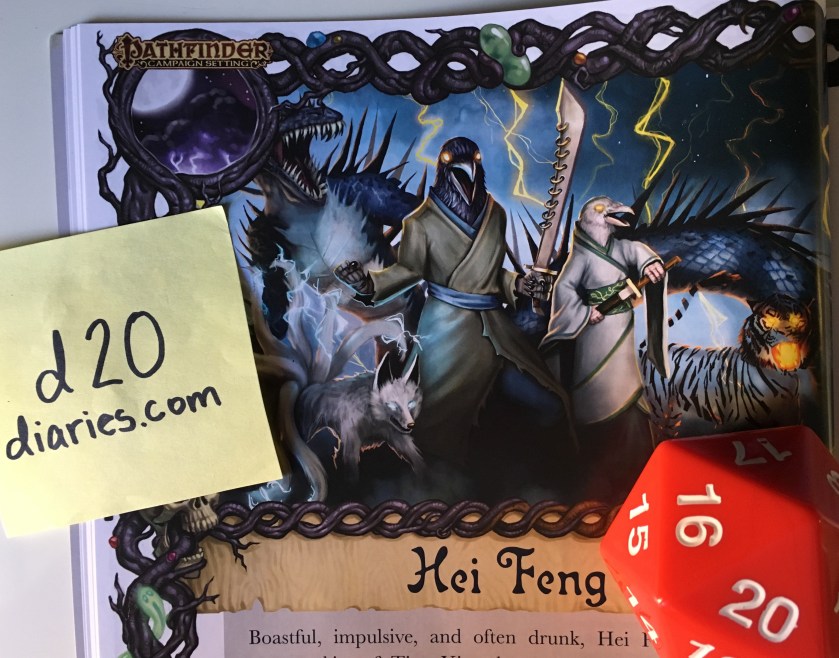
Hei Feng is a wild and unpredictable tengu god who is very popular in Tian Xia. A moody god of the sea, storms, thunder, and wind, he is always accompanied by his four companions, the Counts of Lightning, Rain, Thunder, and Wind. Drunken, boisterous, and easily angered, Hei Feng is a dangerous deity. As one of the most popular Tian gods I’m happy to see he got some attention. Turned out Hei Feng is my son’s favourite god in the book.
Hei Feng and his four Counts.
Kazutal is a deity I didn’t know much about, but wow! She is awesome! Haha. Also known as Mother Jaguar, she’s a war goddess whose focus changed over the Age of Darkness, when community and togetherness became integral for survival. Now a goddess of war, family, togetherness, community, liberty, and safety, she promotes a love of your neighbours, family, and friends. This love should be spoken of plainly and without shame, for its these bonds of love that cause neighbours to have the courage to stand up and protect one another. It’s love that makes communities strong. Those who don’t show love of others are considered cowards. Which is awesome! I really enjoyed reading about her faith’s take on love, and the evolution of her religion. I also adore the art in this section! It’s amazing!
Kazutal, illustrated by Vlada Hladkova. Art courtesy of Paizo inc.
Kazutal Priest, illustrated by Vlada Hladkova. Art courtesy of Paizo Inc.
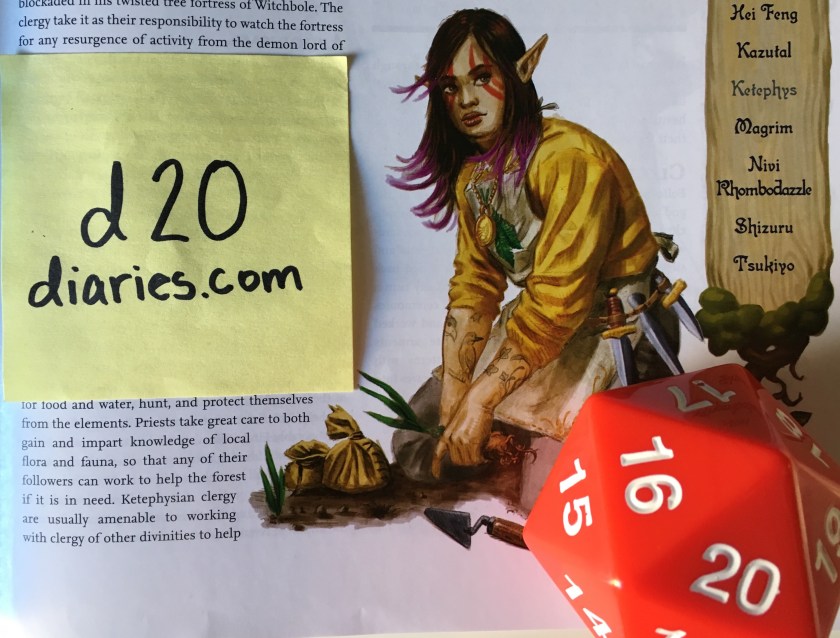
Ketephys is the calm, stoic elven god of hunting, the moon, and the forest. He’s a god of archery, and urges his followers to respect nature, replace what they take, and never waste. This is one of the gods I was most excited to see included in Faiths of Golarion, as the elven deities were among those created back when Pathfinder didn’t have it’s own rules, and I feel like I’ve been waiting forever for further details on them. There are some details, of course. A paragraph or two throughout the various Paizo products, but I wanted more. I would have been happy to see details on any of them, but I’m particularly pleased to see its Ketephys.
A worshipper of Ketephys planting a garden.
Magrim is another deity that’s been around since the beginning of Pathfinder but lacked much information. The dwarven god of death, fate, tradition, and the underworld, he’s fair, unflinching, and unwavering. Magrim considers Pharasma a respected elder, and is often tasked by her to repair damaged spirits that enter the Boneyard. I really enjoyed learning how Magrim fit alongside Pharasma, and his role in the dwarven afterlife.
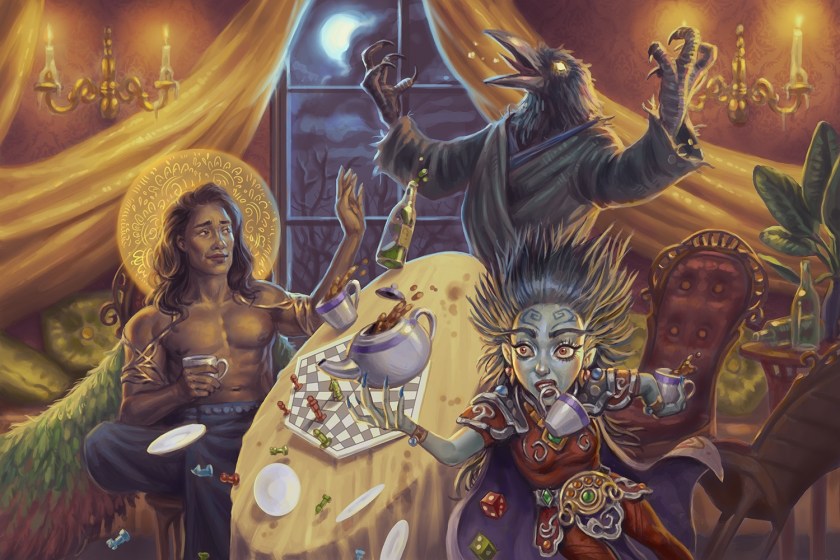
Nivi Rhombodazzle is about as different as Magrim as you can get. This gnome gambler fled underground to escape her many angry creditors and ended up becoming the first of the svirfneblin after she traded a rare gem to Torag in exchange for divinity. Talk about a deal! Nivi’s an impulsive daredevil addicted to the thrill of a wager. She urges others to test their skill, push their luck, and experience the best life has to offer. And when luck turns against you and you’re in a lot of debt? Run, of course! Best of luck! Haha. She’s a tricky, thieving little thing whose faith is said to hold the key to staving off the Bleaching.
Hei Feng proves to be a poor loser in this art featuring Gruhastha, Hei Feng, and Nivi Rhombodazzle. Illustrated by Vicky Yarova. Art courtesy of Paizo Inc.
Shizuru is another of the gods I was most interested in reading about. This draconic Tien goddess is also known as the Empress of Heaven, and is the main deity of the Tien pantheon. A goddess of honour, swordplay, the sun, and ones ancestors, she’s incredibly popular among the people of Tian Xia and players of Pathfinder. I particularly enjoyed reading about her relationship with Tsukiyo, her lover who died and came back to life changed.
Which brings us to Tsukiyo, the final deity in Faiths of Golarion. Killed by his own jealous brother, Tsukiyo was the beloved of Shizuru. But his lover couldn’t accept his death and she ordered Qi Zhong, god of medicine and healing, to bring his back to life. It worked, but Tsukiyo came back changed. Now quiet, contemplative, and possessing an uncommon outlook, he is god of the moon, spirits, and outsiders. He teaches that no matter a person’s perceived flaws and oddities, all are a whole person deserving of respect. This applies to those society shuns, deems insane, are disabled, or those suffering from mental illness. I absolutely love what they did with Tsukiyo. Delightful from start to finish.
Tsukiyo, illustrated by Sandra Posada. Art courtesy of Paizo Inc.
A priestess of Tsukiyo.
Which brings us to the end of Pathfinder Campaign Setting: Faiths of Golarion! If you’re a fan of learning about the many deities of Golarion (like I am) I highly recommend picking up this book!
May is here and plethora of new gaming products are hitting shelves! Check out this month’s new d20 releases!
Dungeons and Dragons
Dungeons and Dragons is releasing two very exciting products this month. Stranger Things D&D Roleplaying Game Starter Set contains everything players need to get started playing D&D – a basic rulebook, an adventure, a set of dice, five character sheets, and an awesome enemy to face off against – all in a retro red box with a Stranger Things twist. The adventure is written in the style of Mike Wheeler, a character and DM from Stranger Things, and pits PCs against a mysterious castle and the Demogorgon! The pre-made character sheets feature the kids D&D characters from Stranger Things, including Dustin the Dwarf, Will the Wise, and so on. Finally, the set comes with two Demogorgon figures (one painted and one unpainted). You can watch Stranger Things on Netflix (I highly recommend it!).
Due out May 21, Ghosts of Saltmarsh is a collection of seven nautical and coastal themed adventures that vary from levels 1-12. These adventures can be run separately, or combined by DMs into one larger campaign. The adventures contained in this volume are all previously published adventures, including some of the most popular first edition D&D adventures and some from Dungeon Magazine. Adventures in Ghosts of Saltmarsh include:
The Sinister Secret of Saltmarsh (originally written by Dave J. Browne and Don Turnbull in 1981)
Danger at Dunwater (originally written by Dave J. Browne and Don Turnbull in 1982)
The Final Enemy (originally written by Dave J. Browne and Don Turnbull in 1983)
Isle of the Abbey (originally written by Randy Maxwell for Dungeon Magazine #34)
Tammeraut’s Fate (originally written by Greg A. Vaughan for Dungeon Magazine #106)
The Styes (originally written by Richard Pett for Dungeon Magazine #121)
Salvage Operation (originally written by Mike Mearls for Dungeon Magazine #123)
In addition to the adventures themselves there’s details on the port of Saltmarsh, mechanics for ship-to-ship combat, new monsters, and new magic items.
Launching next month is Beadle & Grimm’s Sinister Silver Edition for Ghosts of Saltmarsh! Currently available for pre-order on their website, the Sinister Silver Edition contains twelve high quality player handouts, a detailed ship map, a reusable ship map, two large scale battle maps, a map of the Styes, 30 encounter cards (which are designed to be hung over a DM screen so players can see images of the monsters they fight while the DM sees it’s statistics), custom DM screen, two objects, bonus encounters, and characters!
This month’s Pathfinder Society Scenarios have not yet been announced, although canny players can find them on the schedule for PaizoCon (which takes place later this month in Seattle). For more information on PaizoCon and to register for events head over to https://paizo.com/paizocon!
Gardens of Gallowspire (Tyrant’s Grasp Book 4 of 6)
Chronicle of Legends
Pathfinder Adventure Card Game
Very exciting news, as this month the new Pathfinder Adventure Card Game in unveiled! Players can test it out in person at PaizoCon or pick up a copy at the end of the month. Pathfinder Adventure Card Game: Core Set is the base game, which include all the rules, the Dragons Demand adventure series, and a ton of cards. They’re also releasing Pathfinder Adventure Card Game: Curse of the Crimson Throne Adventure Path which is designed to be mixed into the Core Set to create a whole new series of adventures. For more information on some of the changes you can expect to see in the newest version of the Pathfinder Adventure Card Game check out this post, or head straight to the source and check out Paizo’s blog!
WizKids releases some lovely products this month, primarily Pathfinder Battles: Ruins of Lastwall! This brand new set of pre-painted miniatures comes in blind booster boxes that contain four minis each – one large figure and three small or medium figures. In addition to buying a single standard booster box you can order a brick of boosters (which contains eight boosters) or a case of boosters (four bricks for a total of 32 boosters). Anyone who orders an entire case of boosters may also order Pathfinder Battles: Ruins of Lastwall: Cemetery of the Fallen Set which is a collection of graveyard themed set dressing! For images you can check out this blog post from last month, or head straight to the source and view the images on WizKids and Paizo’s blog.
Also out this month is Wave 3 of the Wardlings pre-painted miniatures. My kids and I absolutely adore this line of minis. Each one is interesting, highly detailed, and comes with one youthful adventurer and their pet. A few of the new releases also include male and female versions of eccentric adventurers (such as ghosts, goblins, and zombies), or a single large mini (such as a troll of treefolk).
Wayfinder
Wayfinder Fanzine is a free magazine of fan-created content that releases every year at PaizoCon. Typically filled with Pathfinder content, this years topic is Starfinder – more specifically, Absalom Station! Wayfinder #19 is due out later this month, and will be a free download on Paizo’s website. Although not currently on Paizo’s website, you can find all of the previous Wayfinder issues available, which I highly recommend you download and give a read.
My kids and I are particularly excited for this issue, as each of my kids created an alien that’s going to be featured in the magazine! I wrote a few articles as well (which is awesome!) but not nearly as impressive as my kids doing it. Haha. (Pardon my ‘proud mom’ bragging).
And that’s it for this month! Got a favourite release? I’d love to hear about it!
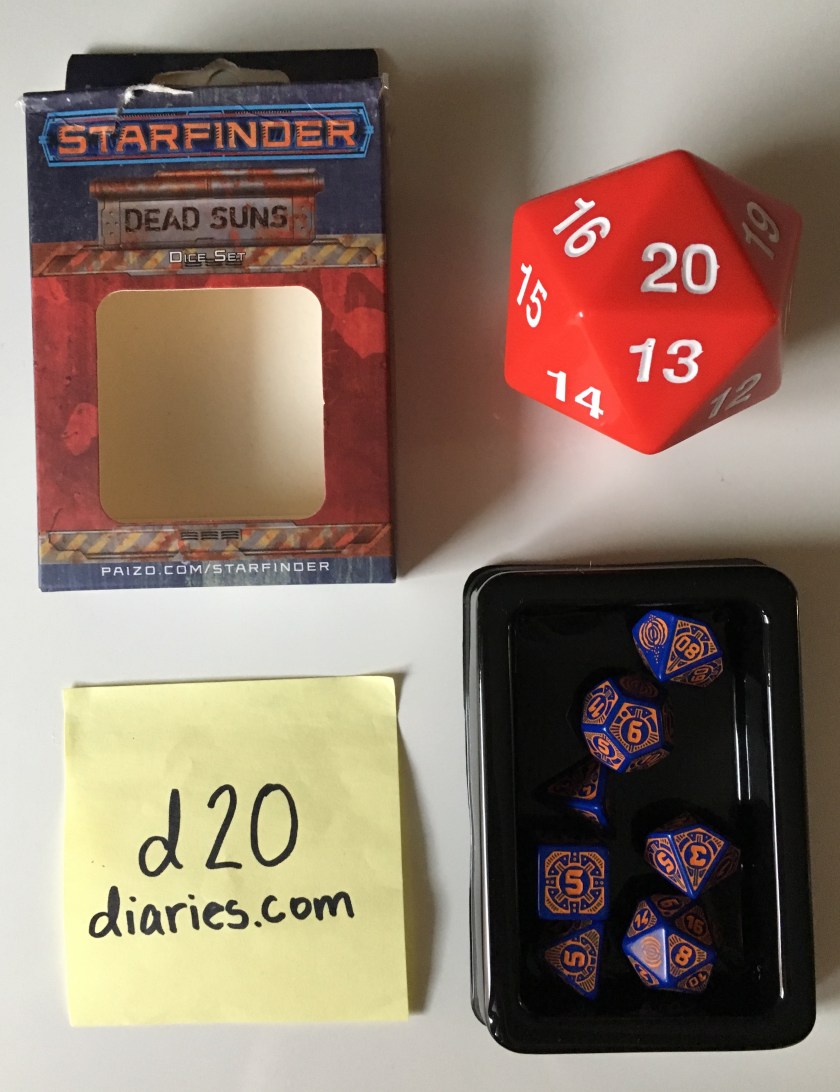
I never expect a gift for Easter. It’s a time to give treats and small gifts to kids. Chocolates and candy and books. So imagine my surprise when my husband and kids gave me an Easter gift. A gorgeous set of dice.
A vibrant dark blue with orange numbers and designs, these beautiful dice are highly detailed. Made by Q Workshop for the Starfinder Dead Suns Adventure Path, it contains a d4, d6, d8, d10, percentile, d12, and d20. The standard seven dice set.
They’re easy to read and look amazing at the table. I own a lot of dice, but the Dead Suns Dice Set is right up there with my very favourite sets. In fact, it’s tied with my Iron Gods Dice Set (also by Q Workshop) for my favourite dice. I love them!
Here’s hoping they bring me some luck!
The Dead Suns Adventure Path consists of six adventures:
To check out more of Q Workshop’s amazing dice head over to their website. To find out more about the Dead Suns Adventure Path head over to Paizo’s website or watch the trailer for the Dead Suns Adventure Path below.
Today we’re going to take a look at two of the most recent Pathfinder Society Scenarios that are currently available for purchase, and let you know we thought. Although you’ll find references to events in each that I liked or disliked, and comments about specific characters, these scenarios are not explored in detail. It’s not my intention to spoil the events in these scenarios, or give summaries and full reviews, but to share my opinions and provide recommendations. That said, if you want to avoid even minor spoilers then I recommend clicking on a different article. Whether you intend to use these scenarios in home games of the Pathfinder Roleplaying Game, sanctioned scenarios for use with the Pathfinder Society Organized Play, or just want to read a nifty new adventure, we’ve got you covered! So let’s get cracking!
Chalos Visanda from #10-18: The Daughters’ Due. Illustration by Leonardo Santanna. Art courtesy of Paizo Inc.
This adventure tasks the PCs with investigating four missing relics from the Blakros Museum which it’s curator, Nigel Aldain, insists were destroyed or stolen by Pathfinders during their many missions within the Blakros Museum over the years. His boss, Lady Hamaria Blakros, has invited the PCs to her museum to investigate or refute these claims. After this quick mystery the PCs can give their report to Hamaria and even pass judgement on Nigel himself — a turn of events that I’m sure many players will take a perverse joy in. Haha. From there the PCs head into Shadow Absalom, to track down the missing relics and retrieve them from the true thieves. PCs who have played in any of the Blakros-themed Pathfinder Society Scenarios over the years (there’s lots!) will find this mission more relevant and entertaining than those who haven’t. It’s particularly closely tied to the events of Pathfinder Society Scenario #2–11: The Penumbral Accords. PCs who have the “Acquainted with Aslynn” boon from Pathfinder Society #5-09: The Traitor’s Lodge and#7-09: The Blakros Connection have a chance to have a slightly different experience than players who haven’t, although its minor.
Start to finish, this scenario was an absolute joy! The investigations in the beginning of the scenario are interesting. There’s a wide variety of fun social encounters and quirky characters to interact with. The battles were challenging and dynamic, with one of them having the potential to be avoided with clever skill use. Best of all, this scenario includes multiple ways in which the PCs can make important decisions which will come to influence the Pathfinder Society in the future. Overall, I thought this was an excellent scenario that’s going to be a ton of fun to play. It brings the Blakros/Onyx Alliance storyline to a nice ‘conclusion’ for First Edition, which is clearly going to be picked up again in Second Edition. I can’t wait to see where it goes from here!
Ellux Shost, one of the gnomes PCs will have a chance to interact with during their investigation. Illustration by Hannah Boving. Art courtesy of Paizo Inc.
This adventure tasks the PCs with investigating a series of deaths in Kalsgard, all of which occurred in gnomes and were attributed to the Bleaching. Of course, the local priestess of Nivi Rhombodazzle, Quil Tabberdash refutes these claims. Venture-Captain Bjersig Torrsen and his husky Mahki dispatch the PCs to Kalsgard to meet up with Quil and get to the bottom of this mystery! PCs will have a chance to quickly check out a series of crime scenes, dead bodies, and petition neighbours and witnesses for information. As the mystery unravels the PCs will have a chance to follow two different avenues of inquiry with each resulting in a different encounter and event. To make matters even more exciting this is all happening on a backdrop of political turmoil in Kalsgard, and canny PCs can even pick up clues that this mission has a connection to an organization and Adventure Path I’ll leave unnamed. This scenario is a great little mystery that should move at a rapid pace. There’s lots of fun NPCs to interact with. Most are brief witness statements, but Quil is an absolute delight. I’ll leave the other NPCs and villains unmentioned to help prevent too many spoilers, but I will say I enjoyed them all. There’s quite a few fights in this one (although one will be excluded depending on your PCs actions), but it’s the final encounter that will likely prove most challenging. Particularly as the composition of the fight depends upon your PCs actions throughout the scenario. This means that some groups will find it difficult and others… less so. Although this could prove problematic, I think it’s a nice change of pace. I’d be interested to see how this plays out at game tables throughout the Organized Play Community. Overall I thought this was a fun and quirky murder mystery that made an effort to shake things up a bit. I particularly enjoyed that the PCs actions can alter the events and battles in this scenario. I give it four out of five stars.
Thanks for joining us today! We’ll see you again soon!
Today we’re going to take a look at the two most recent Starfinder Society Scenarios that are currently available for purchase, and let you know we thought. Although you’ll find references to events in each that I liked or disliked, and comments about specific characters, these scenarios are not explored in detail. It’s not my intention to spoil the events in these scenarios, or give summaries and full reviews, but to share my opinions and provide recommendations. That said, if you want to avoid even minor spoilers I recommend you check out a different article. Whether you intend to use them in home games of the Starfinder Roleplaying Game, sanctioned scenarios for use with the Starfinder Society Organized Play, or just want to read a nifty new adventure, we’ve got you covered! So sit back, and get ready to explore the Pact Worlds!
Starfinder Society Scenario #1-36: Enter the Ashen Asteroid is a Tier 1-4 adventure written by Larry Wilhelm. It takes place on Sledgehammer, a mining facility and exploration vessel owned by Ulrikka Clanholdings, a dwarven mining consortium that may be familiar to PCs who’ve played Starfinder Society Scenario#1-12: Ashes of Discovery. From there the PCs enter Asteroid AA-126D, an asteroid in the Diaspora that contains duergar ruins dating back to the time of the Gap — and marked with the unholy symbol of Droskar. There you will explore the the site and collect any objects of archaeological importance. This does not feature any tags and does not contribute to the ongoing Scoured Stars storyline. PCs who are dwarves, speak dwarven, or have the Contractor’s Respect (Ulrikka Clanholdings) boon from Starfinder Society Scenario #1-12: Ashes of Discovery will find they have an edge in this scenario. Enter the Ashen Asteroid does not feature starship combat. It includes two custom half-page maps (which are beautifully detailed!) and Pathfinder Flip-Mat: Elemental Planes. It makes use of the Starfinder Core Rulebook, Starfinder Armory, and Alien Archive 2.Although this scenario doesn’t feature any recurring characters it does introduce a new NPC of importance, dwarven Venture-Captain Thromkendal. In addition, five other NPCs you’ll have a chance to influence are introduced, most of which (but not all!) are dwarves.
Venture-Captain Thromkendal. Illustrated by Bryan Syme. Art courtesy of Paizo Inc.
At it’s core, Enter the Ashen Asteroid is a dungeon delve. PCs enter an enclosed location, look around, unearth some secrets, and fight some bad guys. It’s a type of adventure that’s underrepresented in Starfinder, so I think it’s a nice change of pace. Happily this delve is packed full of opportunities to use a wide variety of skill checks, has interesting environmental hazards, and features a few obstacles in it that can be overcome in multiple ways. There’s some complex devices and backstory to untangle, which keeps the dungeon interesting, and plenty of important finds to collect. I particularly enjoyed the interconnectivity of the dungeon. Each room has ties to those around it, which is really nice to see. The battles in this scenario are challenging, particularly one against an old foe from Pathfinder whose new art looks amazing! At the end of the scenario PCs will have to report to some Ulrikka Clanholdings bigwigs and offer them a recommendation in regards to the fate of the asteroid. It should be noted that this is a complex adventure to run. There’s some subsystems at work here that new or inexperienced GMs could find confusing — luckily this is mitigated by a super handy player handout. One of the locations also has a complex obstacle some PCs might struggle with. Overall I really enjoyed this scenario. I give it four out of five stars.
Starfinder Society #1-37: Siege of Civility is a Tier 5-8 adventure written by Kalervo Oikarinen. It takes place on a fortress moon named the Eye of Gideron, that orbits a gas giant named Maelstrom’s Maw. These areas are located within the territory of the Gideron Authority, a mostly-hobgoblin militant space empire at war with the Marixah Republic, both of which are introduced in Starfinder Society #1-24: Siege of Enlightenment. Although the two scenarios are linked, playing them is order isn’t necessary. In fact, characters who haven’t played Siege of Enlightenment are likely to have a different outlook on the Gideron Authority than those who have, which can make for some fun roleplaying between the party members. I think it’s best to have a mix of PCs who have and haven’t played Siege of Enlightenment. Whatever the party composition, your PCs mission is to convince representatives of the Gideron Authority to lend the Starfinder Society their aid — the Wayfinders flagship Master of Stars needs a drift engine only the Gideron Authority can provide, and the Starfinder Society would like exploration rights to some of their archaeological sites. This scenario features the Faction (Wayfinders) tag and does not contain starship combat. It makes use of one half-page custom map and no flip-mats. It includes content from Starfinder Core Rulebook, Alien Archive, and Alien Archive 2. There are two recurring characters in this scenario: Fitch, leader of the Wayfinders Faction, and Ceobarn Zeizerer, a drow who first appeared in Starfinder Society Scenario #1-06: A Night in Nightarch. There are five other new NPCs from the Gideron Authority who are likely to be of further importance in the future. PCs who have the Victory Over Authority boon will need to slot it for this mission.
Commander Imako. Illustrated by Bryan Syme. Art courtesy of Paizo Inc.
Overall, this is a really fun social scenario. There’s plenty of interesting NPCs to talk to and sway to your side. The social engagements are well planned out, and interspersed with opportunities for other skill checks and a really cool combat encounter. It think it’s going to be an absolute blast to play! This is a great scenario to crack out your diplomats, envoys, and other charismatic characters. PCs who prefer to pound face all day are better suited to other scenarios, but that doesn’t mean they won’t have a chance to shine. The Gideron Authority is an aggressive, military-based society that values strength and experience, so even PCs with a martial focus will find someone they get along with. Overall, I give this scenario four out of five stars. It’s one of my favourite influence-based Starfinder Scenarios.
Thanks for joining us today! Tune in later this week when we take a look at the newest Pathfinder Society Scenarios!
Big news today as both Paizo Inc., creators of Pathfinder and Starfinder RPGs, and WizKids, an industry leader in high-quality pre-painted miniatures, announced a new branch of their licensing partnership: Starfinder Battles! That’s right! Starfinder pre-painted miniatures are coming to a gaming store near you!
“We’re very excited to explore the Starfinder universe with Paizo,” said Justin Ziran, president of WizKids. “We’re confident that our fans will love the new miniatures this line will have to offer.”
Miniatures will include pre-painted Iconics, monsters, and starships, available in a Booster Set and Premium Set. Product will be available for sale worldwide, with the first release slated to hit shelves in 2020.
“Pathfinder Battles has been a stalwart of the Pathfinder RPG for years, and we’re excited to see WizKids bringing that same expertise to the Starfinder universe,” said Jim Butler, VP of Marketing and Licensing at Paizo. “With hundreds of aliens and scores of player-character races in the Starfinder RPG, the Starfinder Battles line is sure to expand your gaming tabletop for years to come.”
My kids and I couldn’t be more excited! I’ve got my fingers crossed for a nice array of PC options, while my kids are hoping for — you guessed it — skittermanders. Got a favourite alien or ship you’d like to see included in the first run of Starfinder Battles? I’d love to hear it! Let us know in the comments!
For more information on WizKids, visit: WizKids.com. For more information on Paizo, visit: Paizo.com.
Archives of Nethys, an online database for official Pathfinder and Starfinder content and rules, recently announced the launch of their new website: 2e.aonprd.com! This new site will be dedicated to Pathfinder Second Edition and will launch on August 1st, 2019, at 7:00 am (Pacific Time). That’s right! It’s coming out the same day that Pathfinder Second Edition launches in print!
Exciting news!
Through the Archives of Nethys players around the world will have all the rules and characters options for Pathfinder Second Edition at their fingertips, online and free. I am absolutely ecstatic! I know cost is a huge factor to consider when deciding whether I’ll be able to give Pathfinder Second Edition a try. Seeing that barrier removed is amazing.
Today we’re taking a look at a board game my kids recently got for their birthday: 5-Minute Dungeon! This real-time card game tasks up to five players with working together to escape a dungeon in under five minutes. Each dungeon consists of a randomized deck of cards that features obstacles, monsters, people, and events to overcome. At the end of each dungeon is a powerful boss to defeat. To beat the game you’ll need to triumph over five separate dungeons.
This game is frantic, fast-paced, and more than a little chaotic! Communication and teamwork are essential to your success. Player’s win or lose as a team. 5-Minute Dungeon is intended for players ages eight and up. Although a single dungeon takes five minutes, playing through a whole game takes about thirty to forty-five minutes, depending how many times you fail to escape a dungeon.
Players take on the role of one of ten characters by selecting a character board. Each board is colour-coded and double-sided, with one male and one female character per board. Every character board makes use of one of five matching decks, and every character has their own unique ability which can be triggered by discarding three cards from your hand. That means that up to five people can play at a time.
Characters include the blue sorceress and wizard, green huntress and ranger, purple ninja and thief, red barbarian and gladiator, and yellow paladin and valkyrie. Most of the special abilities of these characters fall into two types: those that help get someone in your group extra cards and those that automatically defeat a certain category of card. There’s also the wizard’s unique ability to stop time. We found that it was very helpful to play with the wizard and a character who can help the group draw cards, with the rest of the players taking on abilities that can auto-defeat either monsters, obstacles, or people. Once you’ve got your character picked out you place the matching deck on their board.
Next you set up the dungeon. Start by selecting a boss. There are five to choose from and each is numbered 1 though 5. You simply start at Boss #1: Baby Barbarian and work your way up to Boss #5: Dungeon Master. Each boss also has a number of cards written on it. Baby Barbarian has 20, The Grime Reaper has 25, Zola the Gorgon has 30, and so on. This is the number of dungeon cards you’ll randomly select and place on the boss board. Then you’ll pick out two challenge cards per player and shuffle them into the deck of dungeon cards. This is the boss’s dungeon. You simply place the deck of cards into the space marked with the dotted line and you’re ready to begin.
Player’s begin by drawing a number of cards. This number is variable and determined by how many people are playing the game. Chances are you’ll start with three or four cards. Then you start the five minute timer, flip over the first card in the dungeon deck, and get adventuring!
To reach ‘The Grime Reaper’ you’ll need to defeat the ‘A Cactus that wants a hug.’ Oh, no! I hope you’ve got some shields….
This game doesn’t come with a physical timer. Instead there’s a timer app you can download on your phone, tablet, and other handheld device. It’s a quick download and easy to use. You simply select a voice for the announcer (I love the ‘fearful’ voice, but my daughter’s a fan of ‘spiteful’) and click start. Sometimes you’ll need to pause the game (such as with the wizard’s ‘time stop’ ability) in which case you simply push pause. If you defeat the dungeon you click ‘We Won,’ if you lose you click ‘We Lost’ and if you run out of time you don’t need to click a thing. It’s an enjoyable, humorous little timer app and my kids really like it.
Boss #1: Baby Barbarian. He takes two swords, two arrows, and three dash to defeat, and his dungeon contains twenty cards.
Baby Barbarian and an example of Challenge and Dungeon Cards
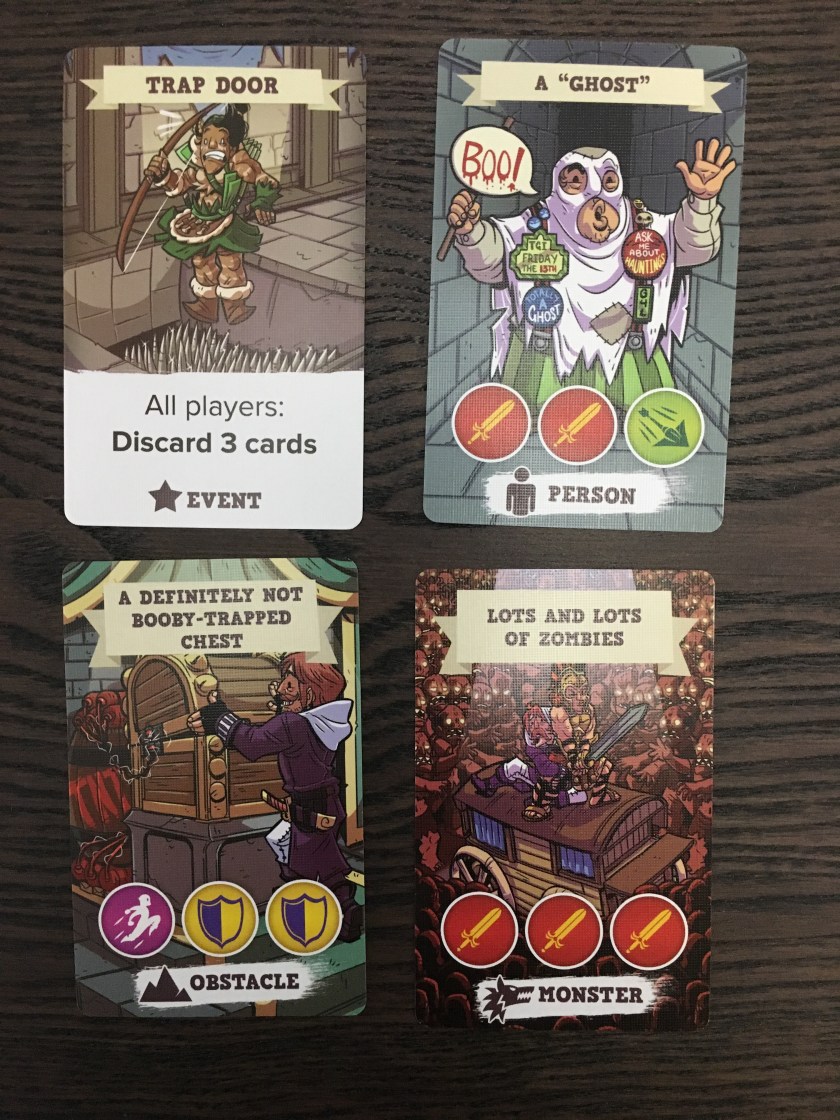
There are four major categories of dungeon cards: event, person, monster, and obstacle. Events are the simplest to resolve. They each have a sentence explaining what you need to do, you do it, then you move on to the next card. Examples of events are ‘Sudden Illness’ which forces every player to discard their hand, or ‘Trap Door’ which forces all players to discard three cards. The rest of the cards — monster, obstacle, and person — have circular symbols on them. These symbols match the cards that you must play to defeat them. These cards can be played in any order and by any player. There are no turns. As soon as all the needed cards are played you have defeated the card, it gets moved to the discard pile, and you flip over the next dungeon card. Once all of the dungeon cards are defeated you will see the symbols needed to defeat the Boss.
This makes gameplay fast and chaotic, with players slapping down cards, shouting out what they’re playing, and calling out what’s still needed to defeat the card. It’s the sort of game where everyone feels a sense of urgency and excitement, and get’s a thrill of triumph when a card is defeated.
The four types of cards you’ll find in a dungeon.
So what the heck are all these symbols?
There are five major symbols in the game, which are colour coded. These same symbols are seen across all the boss cards and all character decks. Called ‘Resources’ they include the red sword, yellow shield, green arrow, blue scroll, and purple jumping person (which my family always calls ‘sprint’ or ‘dash’ but is probably called ‘leap’). Every deck will have cards of these five types, although they will have them in different combinations. The red barbarian/gladiator deck will have a lot of red swords, for example, while the blue sorceress/wizard deck will have a lot of blue scrolls. In addition to these single symbol cards there’s double symbol cards — cards that have two red swords, two blue scrolls, and so on. These are seen in much lower quantities than the single symbol cards, and not every deck will have them in every kind. While the sorceress/wizard deck may have a few double scroll cards, the huntress/ranger deck won’t. One of the decks — the red barbarian/gladiator has special double symbol cards which consist of a red sword and a second other symbol.
The rest of the cards found in the character decks are black bordered and have a special ability written on them. The most common are abilities that let you auto-defeat a certain category of dungeon card. ‘Fireball’ defeats a monster, ‘Backstab’ defeats a person, and ‘Mighty Leap’ defeats an obstacle. These are super useful cards which can be found throughout all of the different coloured decks in differing quantities. While the sorceress/wizard has a lot of ‘Fireballs’ the ninja/thief has more ‘Mighty Leap’ and ‘Backstab’ cards. Finally, every colour deck has some unique black bordered ability cards. ‘Enrage’ from the red barbarian/gladiator deck lets you choose two players who may draw three cards each. ‘Divine Shield’ from the yellow paladin/valkyrie deck pauses time until someone plays a card and lets every player draw one card. ‘Magic Bomb’ from the blue sorceress/wizard deck counts as one of each type of resource. My personal favourite card? ‘Heal’ which lets you select a player who can put their entire discard pile back on top of their draw pile. Awesome!
The many card types found in 5-Minute Dungeon
As mentioned, every deck is different but equally useful. You’ll soon discover which play style you prefer and find a favourite, so I highly recommend trying each deck out. I love the yellow paladin/valkyrie deck best — particularly when played with the valkyrie character who can help her fellow players draw cards. The yellow deck has a lot of different healing cards, which I find can be incredibly helpful. My son, on the other hand, prefers the to play as the blue wizard. He’s a huge fan of the wizard’s ‘Time Stop’ ability — which is so helpful I’d go as far as to call it a necessity. He also loves the ‘Magic Bomb’ card which can only be found in the blue deck. Finally, my daughter prefers to play as the green huntress — solely because she loves the art. To each their own, I guess. Haha.
With all the decks in their places, cards in hand, and the timer started, play can begin. There’s a few other rules you need to know, but not many. Whenever you have less cards than your opening hand consisted of you can immediately draw cards to fill your hand back up to maximum. Discard piles do not get shuffled back into the draw pile once the draw pile is empty. This means that if your deck ever runs out you can no longer draw cards — unless someone plays a card that gives you cards from your discard pile or something similar.
Winning will take teamwork, speed, and luck. If you win you reshuffle your decks, select your character (you do not need to keep the same character throughout all the dungeons), set your boards back up, and build the dungeon for the next Boss. When everything’s ready you begin play again. If you defeat all five dungeons you win the game.
If you ever fail to defeat a dungeon you’re supposed to reset, going all the way back to the Baby Barbarian and his dungeon again, but my family didn’t like this rule. Instead we just replayed the dungeon we were on.
We’ve played this game quite a few times. Sometimes we finish it all the way through, and sometimes we only play a round or two. My kids and I really like it. They enjoy the teamwork aspect, and that they can always be playing. There’s no waiting for your turn or getting beat on by your friends. It’s fun and fast. It’s not a game for everyone, though. My husband doesn’t really like it. He’s a fan of strategic, complex games. Chances are whatever game we’re playing he’s going to be that player taking the longest turns. Unsurprisingly, the chaotic, real-time gameplay of 5-Minute Dungeon is not to his tastes. It’s also not the kind of game you can play anywhere. Players are going to get loud. Although you could bring to a party, family gathering, or friend’s house, it’s not the sort of thing you’re going to bring to play at the library, local coffee shop, laundromat, or airport. Finally, it’s not the sort of game you want to let the kids play late at night. Mine get antsy, excited, and leap and jump around. Not really a relaxing, winding-down sort of game.
The board after my kids and I defeated the final boss!
Victory!
All in all, we really liked 5-Minute Dungeon — especially my son. It’s fast paced, easy to learn, and enjoyable. My only complaints? I wish the boss cards were double sided so you could choose which of the two to face off against and I wish there were more dungeon and challenge cards included in the game so the dungeons felt more varied. But, I suppose wanting more of a game isn’t much of a complaint. More like a wish list. Haha. 5-Minute Dungeon is a pretty easy game to find that currently retails for around $30 Canadian. Our copy belongs to my eight-year old son, and made an excellent gift. He loves it.
Hello adventurers! Today we’re taking a peek between the covers of Pathfinder Player Companion: Heroes from the Fringe! This delightful softcover book from Paizo Inc. focuses on a variety of non-human cultures and societies. The races explored in this book are dwarves, elves, gnomes, half-elves, half-orcs, and halflings — each of which has multiple heritages and cultures examined. There are also a few paragraphs on Tian ratfolk and the merfolk and sahuagin of Outsea.
Pathfinder Player Companion: Heroes from the Fringe is a soft cover book that is 32 pages in length. As a book in the Player Companion line, it’s aimed at players, which means that you won’t find a ton of world lore or secrets inside. Instead you’ll find character options — things like archetypes, feats, traits, spells, and more. The cover features dynamic art by Setiawan Fajareka which depicts the Iconic swashbuckler Jirelle and the Iconic bloodrager Crowe battling a pack of yetis in a snowy mountain pass. Why does a book about non-human races show a picture of a human on the cover? I don’t know! Technically there are a few traits in this book which could be taken by humans from specific regions, but none of them are meant for Shoanti characters. Whatever the reasoning, the art looks cool so I’m not complaining.
The front inside cover features artwork of a single mundane cultural item from each race along with a short paragraph of flavourful information on each object. There’s an Ekujae wand (elf), Sandkin holy symbol of Sarenrae (half-orc), First World gnome mask (gnome), Pahmet axe (dwarf), shoreborn trident (half-elf), and — my personal favourite — the Segada pouch (halfling).
Illustrated by Alyssa McCarthy. Art courtesy of Paizo Inc.
After this is the table of contents, the rules index, and the introduction which contains nine new traits tied to specific regions and cultures. Many of these traits can be taken by a variety of races. I really enjoy ‘mechanical expert’ for characters from Alkenstar and ‘resourceful scavenger’ for characters from Numeria, but it was ‘cliff strider’ for characters from Arcadia that was my favourite. This trait allows you to climb five feet without provoking an attack of opportunity for your movement as a move action, even if you don’t have a climb speed. Awesome! I’m always a fan of characters who can climb, so it’s a trait that’s sure to see some use. Next time I make and Arcadian, anyway. …Okay, so it might take me a while to get around to using that one. Haha.
Pahmet psammokinetic. Illustrated by Priscilla Kim. Art courtesy of Paizo Inc.
Moving on from the introduction we come to six pages on dwarves. Six dwarven heritages are explored: desert dwarves, Mwangi dwarves, Ouat Caste dwarves, Pahmet dwarves, Paraheen dwarves, and Sky Citadel dwarves. Each of these heritages also discusses which already printed alternate race traits they’re likely to select, and comes with a single new alternate race trait. I most enjoyed reading about desert dwarves and Mwangi dwarves, but it was the alternate race traits for desert dwarves (‘desert delver’) and Pahmet dwarves (‘death’s end’) that I liked the most. After the heritages there are new character options intended for dwarves of some of these cultures (although most of these options can also be taken by non-dwarves). There are two archetypes, seven weapons, and nine feats. The ‘psammokinetic’ is a lawful, monk-like sand kineticist common among the Pahmet dwarves. Believing the desert can burn away their imperfections, a ‘psammokinetic’ lives an ascetic life in the desert. Capable of bending sand, earth, and super-hot air to their wills, they also gain access to some ki powers which they can use to empower their kinetic blasts, bolster their AC, and increase the speed. I love this archetype. Of course, I also love dwarves and kineticists, so that’s not too surprising. The ‘symbol striker’ is a bloodrager archetype common among Sky Citadel dwarves. Capable of using rune-based magic they can place spell runes on their weapons, or rune traps on the battlefield. They also have useful and thematic spell-like abilities and treat linguistics as a class skill. The new dwarven weapons are the axe gauntlet (available either heavy or light), giant sticker (a polearm), pellet bow (available either heavy or light), ram hammer (a one-handed weapon), and sphinx hammer (a two-handed weapon). Of the new feats its the ‘cloak of stone’ feat tree and ‘hammer throw’ feat tree that I liked best.
A fire-breathing Mwangi dwarf.
The next six pages are all about elves. There are six heritages discussed, each with it’s own list of applicable alternate race traits and a new alternate race trait. Elven heritages include aquatic, Ekujae, Forlorn, Jininese, Spiresworn, and Snowcaster. I most enjoyed reading about the Jininese and Spiresworn elves. There are three archetypes in this section, but unlike the dwarven ones these are for elves only. The ‘calamity caller’ is a warpriest archetype intended for Ekujae elves that can call down the fury of nature and natural disasters at will but does not gain the focus weapon or sacred weapon abilities (this is my favourite elf archetype). The ‘twilight speaker’ is a skald archetype intended for Snowcaster worshippers of Findeladlara that grants access to some nifty raging songs (improved devotion, song of understanding, and song of secrecy). The ‘warrior poet’ is a samurai archetype intended for Jininese elves which is a graceful, lightly armoured combatant that dances across the battlefield. All three are very cool! Other elven character options include the ‘Order of the Songbird’ samurai order which values beauty, art, and life; two new sanctuary-themed bardic masterpieces (Findeladlara’s refuge and hymn of sacred lands), and three new magical items crafted by the Spiresworn elves (northern star ioun stone, southern star ioun stone, and farspear).
Up next is four pages on gnomes and although there’s less content, it’s no less exciting. In fact, many of my favourite character options and both of my children’s favourite character options are for gnomes. There are three gnomish heritages discussed in this section with each getting two new alternate race traits instead of one: Bleachlings, First World gnomes, and Segada gnomes. I don’t know much about Segada gnomes (or Segada at all) so it was my favourite gnomish heritage to read about. There’s only one archetype up for offer, but it was my daughter’s absolute favourite. ‘First World Caller’ is a wizard archetype that grants your familiar the fey-creature template and later grants them fairy wings. ‘First World Callers’ can summon fey creatures with summon monster spells, and can warp the world around them. My daughter can’t wait to use this ability to make an area completely without gravity. Haha. She’s really excited and is planning on making her next Pathfinder Society character a gnome wizard (first world caller). Likely in conjunction with the ‘spark of the uncanny’ feat from Pathfinder Player Companion: Wilderness Origins that gives your familiar the ability to speak. Other gnome options include the ‘whimsy’ emotional focus for phantoms (which is a ton of fun!), ‘bleaching’ psychic discipline, three new spells (pernicious pranksters is my favourite), and one new bardic masterpiece (wildsoul aria). Perhaps one of my favourite parts about the gnome chapter is a delightful piece of artwork that shows a bleachling spiritualist being teased by his whimsical phantom. Look closer and you’ll realize that the phantom isn’t the spirit of a dead gnome, but the spirit of the bleachling’s old self. His joy literally died. I love it! Haha.
A bleachling spiritualist with his whimsy phantom. But wait! Those two look awfully similar…
Half-elves are up next, followed by half-orcs. Both of these chapters have a lot in common. They’re both four pages long, both feature a vigilante archetype, and they both look at five different heritages. More than that, each of these heritages is one that has already been printed in Pathfinder Player Companion: Bastards of Golarion. Each has a paragraph of information on it and one alternate race trait. After that each has one feat. This feat and the rest of the character options are new additions.
The half-elf heritages examined are shoreborn (with the trait ‘child of the sea’ and the feat ‘gifts from the sea’), darkborn (with the trait ‘thinblood resistance’ and feat ‘strength in defeat’), wildborn (with the trait ‘jungle affinity’ and feat ‘sense allies’), spireborn (with the trait ‘Mordant envoy’ and feat ‘pinch time’), and snowborn (with the trait ‘cold-honed’ and feat ‘twilight words’). Other half-elf character options include the ‘half-elf double scion’ vigilante archetype which allows you to appear as a different half of your heritage (elf or human) in each identity, two new pieces of equipment (I love the poisoner’s buckler!), two magic items (seashell diving mask and soothing stole), two feats (be sure to check out ‘citystep’!), and two spells (false age and mark of spite).
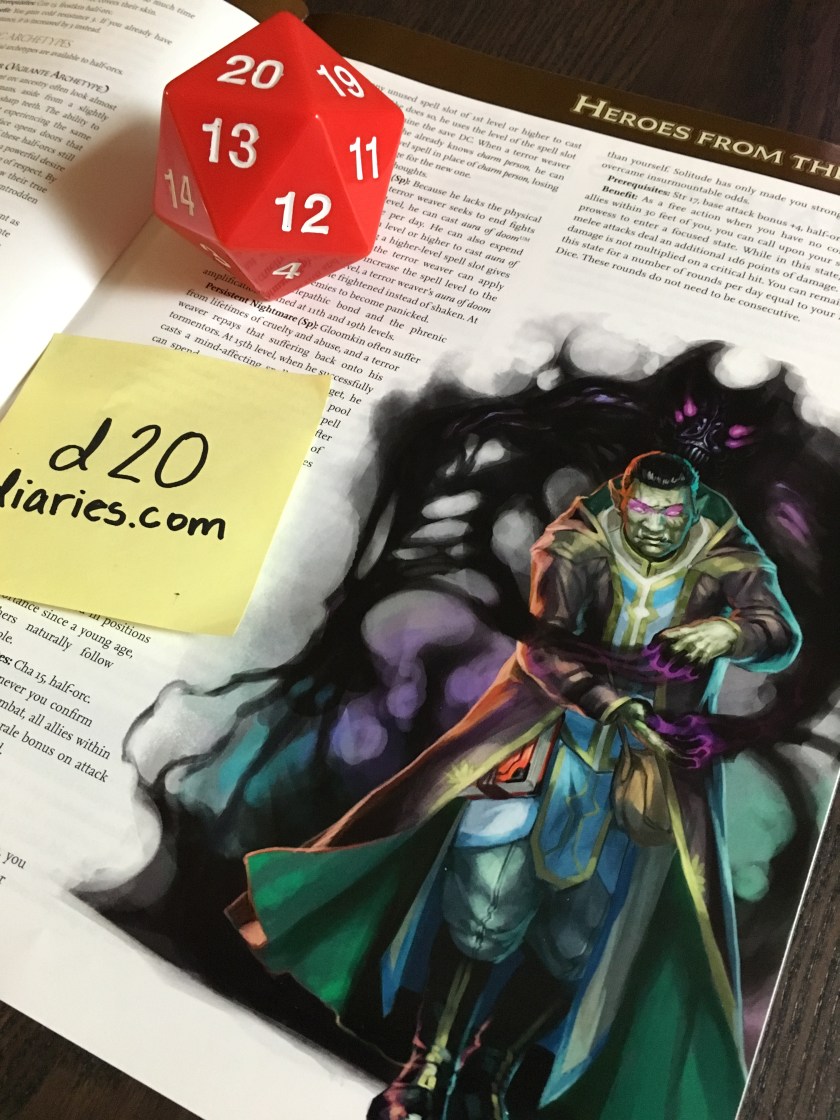
Half-orc heritages discussed are gloomkin (with the trait ‘evader’ and feat ‘unraveler of secrets’), sandkin (with the trait ‘burning assurance’ and feat ‘dawn’s blessing’), rainkin (with the trait ‘warded skin’ and feat ‘great expectations’), cragkin (with the trait ‘cliffside charger’ and feat ‘precipice strike’), and frostkin (with the trait ‘unflinching valor’ and feat ‘frozen skin’). Unlike half-elf, there are two half-orc archetypes up for offer. The ‘ferocious hunter’ vigilante archetype allows a half-orc to pass for human in his social identity and then appears as a proud half-orc in his vigilante identity. ‘Terror weaver’ is a psychic archetype which is sort of like a scary enchanter. I think it would be a lot of fun. Finally, there are two half-orc feats: ‘lead by example’ and ‘solitary survivor.’
A half-orc terror weaver.
Halflings are next, but they have a very short (and not very exciting) chapter. Two heritages are included, each of which has two alternate race traits. Segadan halflings (with the traits ‘festive’ and ‘small quarter ally’) and Song’o halflings (with the traits ‘danger detection’ and ‘evasive nomad’). After this there’s four new magical items (check out the scatter sling!) and a series of four sling equipment tricks.
The last two pages of the book discuss a few other unique cultures. The ratfolk of Tian Xia are getting some love with a very cool ninja archetype called the ‘gunpowder bombardier’ and two new ninja tricks. And the residents of Outsea — both merfolk and sahuagin — get some new options. Merfolk have the alternate race trait ‘unexpected ally’ while sahuagin have the alternate race traits ‘sahuagin song’ and ‘stoic defender.’ There’s also a new combat style called ‘sahuagin blood frenzy’ which includes three feats.
And that’s it! The end of Pathfinder Player Companion: Heroes from the Fringe! I’m a huge fan of learning about other cultures (real or imaginary), so I really loved getting to see details on and character options for a lot of non-human societies. It’s brief, but fun. Unfortunately, I do have one complaint about the book I’ve yet to mention: coverquality. My copy of Heroes from the Fringe has a cover that’s a tiny bit smaller on one side than the pages inside the book, which means the pages are going to get the heck beat out of them in a short time — particularly when my children flip through it. It’s not a big size difference, but it’s enough of a difference to be irritating. I’m sure if I complained I could send it back for a new copy, but I’m way too easygoing to go to all that effort for a few millimetres. Haha. Even with the slightly shrunken cover it’s a good book and I’m happy to have it on my shelf.
Thanks for checking out d20diaries! I hope that taking a peek at what’s inside this Player’s Companion helped you decide if this is the right book for you. There’s plenty of great books out there (and I know I’m not the only one who can’t afford them all!).

 Hey everyone! Thanks for stopping by. Today we’re taking a look between the the covers of the latest ‘gods’ book:
  There are ten faiths discussed in this book. Each is a lesser detailed but very important faith. This includes a few racial faiths — the halfling goddess Chaldira Zuzaristan, the gnome goddess Nivi Rhombodazzle, the elf god Ketephys, and the dwarf god Magrim. It also includes information on deities from other regions of Golarion such as the Tien gods Hei Feng, Shizuru, and Tsukiyo, as well as the anadi goddess Grandmother Spider who is popular in the Shackles and Sodden Lands, the Vudrani god Gruhastha who is popular in Vudra, and the Razatlani goddess Kazutal who is popular in Arcadia. Each of these faiths is incredibly important to their respective cultures and I’m thrilled to see them get some of the attention they deserve. Information on the racial deities, especially, I feel was long overdue. Before sitting down to read this book I was most excited for further information on Ketephys, Shizuru, and Tsukiyo. All of the entries were great, but after reading I was most inspired to make worshippers of Grandmother Spider, Kazutal, and Tsukiyo.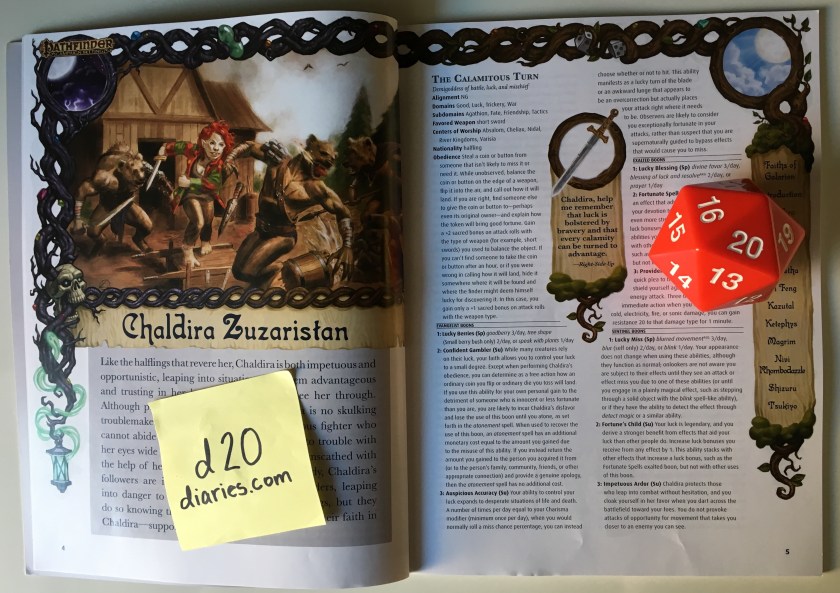






 contains everything players need to get started playing D&D – a basic rulebook, an adventure, a set of dice, five character sheets, and an awesome enemy to face off against – all in a retro red box with a Stranger Things twist. The adventure is written in the style of Mike Wheeler, a character and DM from Stranger Things, and pits PCs against a mysterious castle and the Demogorgon! The pre-made character sheets feature the kids D&D characters from Stranger Things, including Dustin the Dwarf, Will the Wise, and so on. Finally, the set comes with two Demogorgon figures (one painted and one unpainted). You can watch Stranger Things on Netflix (I highly recommend it!).
 include:

 by Larry Wilhelm, and
  by Crystal Frasier and
  and
and  and
and 


 is the base game, which include all the rules, the Dragons Demand adventure series, and a ton of cards. They’re also releasing
  which is designed to be mixed into the Core Set to create a whole new series of adventures. For more information on some of the changes you can expect to see in the newest version of the Pathfinder Adventure Card Game check out

 by Joe Pasini and the
  to look forward to, as well as




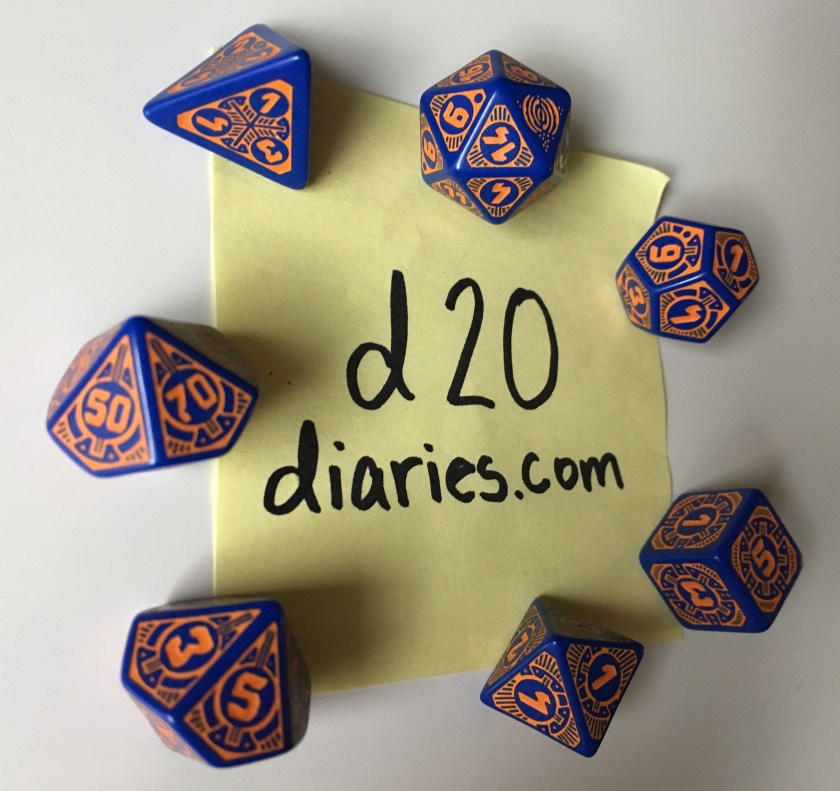
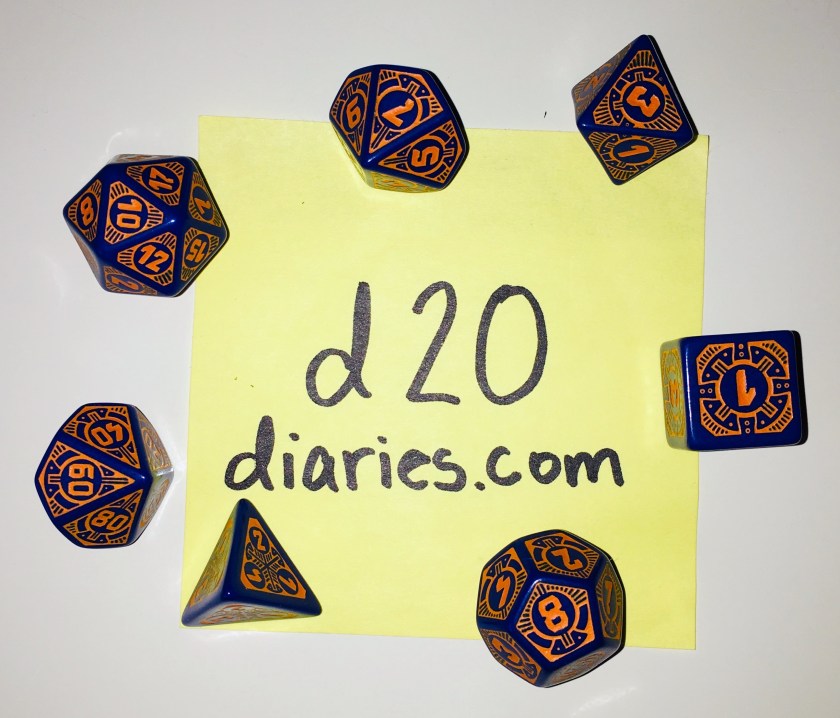
 (also by Q Workshop) for my favourite dice. I love them!
 by Robert G. McCreary
 by John Compton
 by Amanda Hamon Kunz
 by Jason Keeley
 by Stephen Radney-MacFarland
 by Owen K.C. Stephens
 it includes content from the
  (although all of the necessary stat blocks are included within the scenario). It utilizes
  , and a half-page custom map that will look very familiar to some players. For more information on the Shadow Plane check out
  and
and 

 and
and  and
and 


 is intended for players ages eight and up. Although a single dungeon takes five minutes, playing through a whole game takes about thirty to forty-five minutes, depending how many times you fail to escape a dungeon.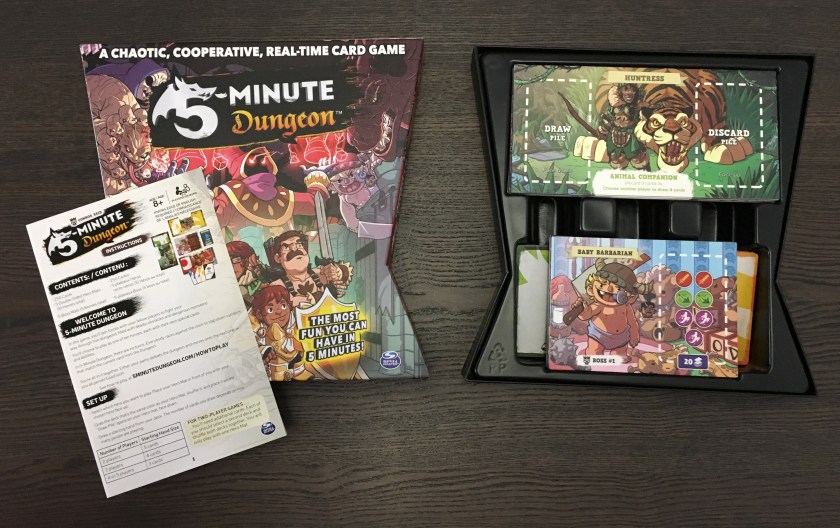




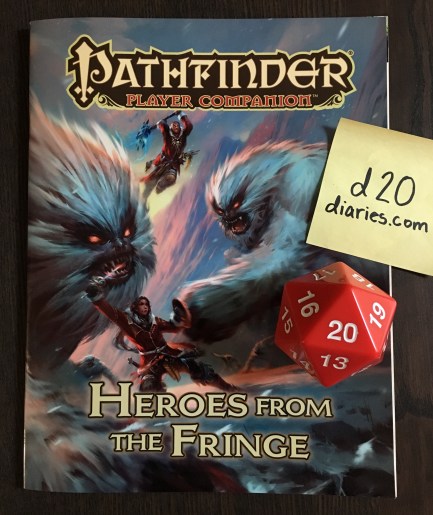
 is a soft cover book that is 32 pages in length. As a book in the Player Companion line, it’s aimed at players, which means that you won’t find a ton of world lore or secrets inside. Instead you’ll find character options — things like archetypes, feats, traits, spells, and more. The cover features dynamic art by Setiawan Fajareka which depicts the Iconic swashbuckler Jirelle and the Iconic bloodrager Crowe battling a pack of yetis in a snowy mountain pass. Why does a book about non-human races show a picture of a human on the cover? I don’t know! Technically there are a few traits in this book which could be taken by humans from specific regions, but none of them are meant for Shoanti characters. Whatever the reasoning, the art looks cool so I’m not complaining.


 The next six pages are all about elves. There are six heritages discussed, each with it’s own list of applicable alternate race traits and a new alternate race trait. Elven heritages include aquatic, Ekujae, Forlorn, Jininese, Spiresworn, and Snowcaster. I most enjoyed reading about the Jininese and Spiresworn elves. There are three archetypes in this section, but unlike the dwarven ones these are for elves only. The ‘calamity caller’ is a warpriest archetype intended for Ekujae elves that can call down the fury of nature and natural disasters at will but does not gain the focus weapon or sacred weapon abilities (this is my favourite elf archetype). The ‘twilight speaker’ is a skald archetype intended for Snowcaster worshippers of Findeladlara that grants access to some nifty raging songs (improved devotion, song of understanding, and song of secrecy). The ‘warrior poet’ is a samurai archetype intended for Jininese elves which is a graceful, lightly armoured combatant that dances across the battlefield. All three are very cool! Other elven character options include the ‘Order of the Songbird’ samurai order which values beauty, art, and life; two new sanctuary-themed bardic masterpieces (Findeladlara’s refuge and hymn of sacred lands), and three new magical items crafted by the Spiresworn elves (northern star ioun stone, southern star ioun stone, and farspear).
 that gives your familiar the ability to speak. Other gnome options include the ‘whimsy’ emotional focus for phantoms (which is a ton of fun!), ‘bleaching’ psychic discipline, three new spells (pernicious pranksters is my favourite), and one new bardic masterpiece (wildsoul aria). Perhaps one of my favourite parts about the gnome chapter is a delightful piece of artwork that shows a bleachling spiritualist being teased by his whimsical phantom. Look closer and you’ll realize that the phantom isn’t the spirit of a dead gnome, but the spirit of the bleachling’s old self. His joy literally died. I love it! Haha.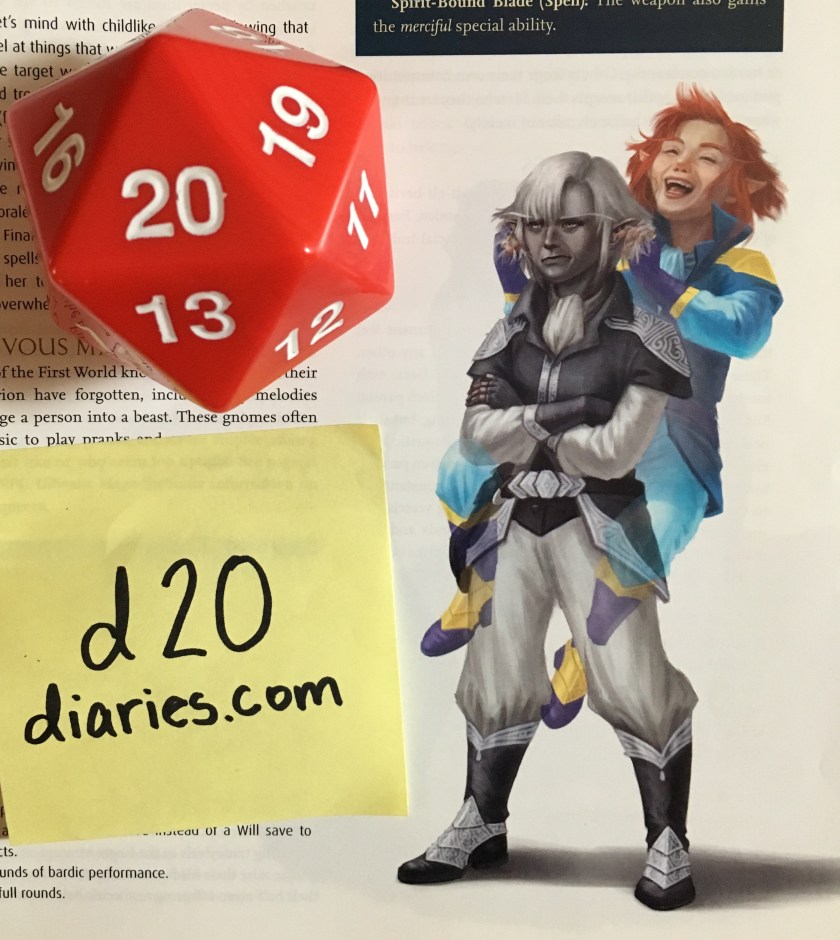
 d20 Diaries