To celebrate the New Year we’re taking one last look back at our favourite things of 2018! So what made the cut? Read on and see!
Favourite d20 Bestiary: Alien Archive
(for more information check out this blog post)
Favourite Dungeons and Dragons Book: Dungeons and Dragons: Guildmaster’s Guide to Ravnica
(Dungeons and Dragons meets Magic: The Gathering!!)
Favourite Pathfinder Book: Ultimate Wilderness
(for more information check out this blog post)
Favourite Starfinder Book: Pact Worlds
(for more information check out this blog post)
Favourite d20 Book (Other): Realms of Atrothia: Legacy Races Revisited
(for more information check out this blog post)
Favourite d20 Adventure: Skitter Shot
(for more information check out this blog post)
Favourite d20 Campaign: Return of the Runelords Adventure Path
(for more information check out this blog post and be on the look out for another blog post early this year)
Favourite Pathfinder Society Scenario: #9-10: Signs in Senghor
(for more information check out this blog post as well as this one)
Favourite Starfinder Society Scenario: #1-14: Star Sugar Heartlove!!!
(for more information check out this blog post)
Favourite Kid’s Game: Tails of Equestria: The Storytelling Game
(for more information be on the lookout for a new blog post later this month!)
Favourite Board Game: Dinosaur Island
(for more information check out this blog post)
Favourite Family Movie: Spider-Man: Into the Spider-verse
(now playing in a theatre near you!)
Favourite Movie: Ready Player One
(if you haven’t seen this movie or read this book yet, you REALLY SHOULD!)
Favourite Upcoming Kickstarter: Realms of Atrothia: Primary Expansion
(Kickstarter coming in February 2019!)
Today we’re going to take a look at the two most recent Starfinder Society Scenarios that are currently available for purchase, and let you know we thought. Although you’ll find references to events in each that I liked or disliked, and comments about specific characters, these scenarios are not explored in detail. It’s not my intention to spoil the events in these scenarios, or give summaries and full reviews, but to share my opinions and provide recommendations. That said, if you want to avoid even minor spoilers I recommend you check out a different article. Whether you intend to use them in home games of the Starfinder Roleplaying Game, sanctioned scenarios for use with the Starfinder Society Organized Play, or just want to read a nifty new adventure, we’ve got you covered! So sit back, and get ready to explore the Pact Worlds!
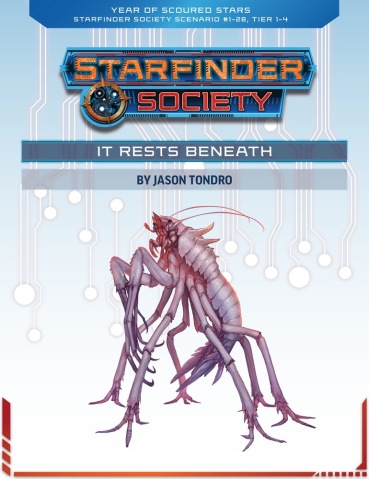
It Rests Beneath features only one recurring character: Fitch, leader of the Wayfinders faction, an her mischievous grandchildren. It introduces a few new characters: Dr. Mora Motressi, leader of a Starfinder research facility on Vabaimus; her daughter, Little Mina; and Bud, a cuddly sloth-like being that’s both the good doctor’s pet and the most advanced native species on the planet. This scenario begins on the Master of Stars, the largest ship in the Starfinder fleet. It’s currently docked in Absalom Station’s Armada and has been undergoing repairs since the start of Starfinder Society Organized Play. From there it swiftly transitions to Vabaimus, where the rest of the scenario takes place. There PCs will need to assist the science team in performing a survey of a strange landmass. Nearly 85,000 square miles in size, with no water or plant-life, this calcified plateau is of great interest to Dr. Motressi and her team. She asks you to travel across the plateau to three specific locations, set up some specialized towers you brought with you, and calibrate surveying equipment atop of each one. Each tower has its own challenges, hazards, and enemies to contend with. There’s multiple vehicles your PCs can choose from, and the towers can be tackled in any order. There’s a simple vehicle handout that will be useful for both players and GMs, which is a nice touch. I love how flavourful the new creatures and environmental hazards are. A lot of thought has gone into ensuring they fit into their ecosystem — which is particularly important when players are surveying an environment. Also, I particularly enjoyed the mystery of the old kasathan ship.
I do have one nitpick. Page three is missing half of a sentence at the end of the first section, which I assume should read something along the lines of ‘up to help,’ ‘up to lend a hand,’ or something else similar. It’s not a hindrance to the scenario. You can still get the gist of what it’s supposed to be saying, but it was jarring enough that it caused me to look around in confusion for a half a minute, to make sure I hadn’t missed anything. A minor distraction in an otherwise enjoyable read.
Overall, I loved I this scenario! The premise is different from any that have come before. It was engaging all the way through, with a wonderful array of social interactions, skill-based encounters, hazards, and combat. The enemies and hazards were all well-thought out. The NPCs were properly engaging and ‘real.’ And, best of all, your PCs have to make an important decision regarding the future of this planet. Really top notch! Although it didn’t blow my mind, like some other amazing Starfinder adventures, it was an… understated awesome. I give it 5 out of 5 stars.
The opening premise for this mission is… convoluted. Captain Yuluzak, who runs a salvager, discovered a starship wreck, took what was valuable and returned to Absalom Station. Some objects he kept, and others he sold to a pawnbroker named Julzakama. Juzakama recognized one of the objects as an important piece of art and contacted some people he thought would buy it. One of those people, Iteration-177, recognized the object as belonging to a culture that was once a part of the Scoured Stars Trinary System, so he contacted Luwazi Elsebo. Luwazi had the object brought to her, along with a team of Starfinders, Iteration-177, and Captain Yuluzak himself. Luwazi tasks the PCs with travelling aboard Captain Yuluzak’s ship to investigate the original wreck. There they’ll determine the ship’s origins, and travel there to investigate and (hopefully) make some new allies.
A jinsul. Illustrated by Graey Erb. Art courtesy of Paizo Inc.
This scenario was big with a capital ‘B.’ It involves the Scoured Stars storyline, the jinsul, a new solar system full of inhabited planets, three new races (nelentu, syngathrix, and thyr), people to save, important decisions to make, a massive starship battle, and combat on… well we’ll leave that part secret for now. Haha. To say this scenario is bold is an understatement! The entire hospital section of this scenario was particularly well handled, as were the NPC interactions found throughout. And the setting for the final battle? Epic! Your PCs are sure to come away from that fight feeling like badass action heroes. It’s going to be a ton of fun to play. On the downside, everything in this scenario is overly convenient in a rather heavy-handed way. Now, I’ve no problem with a ‘railroad,’ particularly in short adventures like Society Scenarios, but in Honorbound Emissaries you always arrive in the exact right place at the exact right time in order to avoid something troublesome. Heck, you even travel through a massive space battle and don’t get attacked by either side. At all! In fact, you even manage to approach the planet and land without a single threat or altercation. It’s like you’re invisible. Which brings me to me second down-side: starship combat. This scenario should have had one. Getting to witness an epic starship war and not engage in it at all is kind of a let down. And how fun would it have been to help out the crew of the Honorbound? Now, I get why it’s not in here. This scenario has more than enough encounters to engage in, and they’re all cool. But, it would have been nice to at least see the ship you’re on come under attack. Or mention the bumpy ride as the pilot has to take evasive maneuvers. Something.
…But that final battle! Wow! Haha.
A jinsul ship. Originally depicted in SFS #1-13: On the Trail of History. Art courtesy of Paizo Inc.
Overall, I really enjoyed this scenario. It’s bold, daring, and casts your players into situations much bigger than themselves. PCs get to do some heroic things, some absurd things, and some absurdly heroic things, all of which is going to be a blast! It’s rounded out by some really solid social interactions with a large cast of quirky characters. This is truly one of those scenarios that players will talk about for a long time afterwards, simply because they want to brag about their character’s exploits. Five years some now I’m sure some players will still look back on it fondly and say “Wow, remember when my Starfinder character did THAT? THAT was cool.”
Which is cool!
I give this scenario 5 out of 5 stars.
Thanks for joining us today!
I wish you happy holidays, plenty of natural 20s, and all the best in the upcoming year!
We haven’t talked about Pathfinder Second Edition in a while. Neither have the folks over at Paizo. Or, at least, not publicly. That’s because the Development Team has been hard at work sifting through survey data, making changes to the game, and generally working their asses off to make Pathfinder Second Edition the best RPG that it can be.
But, this past Pathfinder Friday on Paizo’s twitch stream, we finally got some news! Jason Bulmahn, Director of Game Design, sat down with Host and Marketing Manager Dan Tharp to talk about the future of Pathfinder.
His first topic of conversation?
Surveys.
Feedback surveys on the PF2 Playtest are going to be open until December 31st at midnight. That’s right! You’ve still got time to give them your feedback, answer their questions, and give Paizo the data they need to continue improving the next version of Pathfinder. Be sure to get your surveys done before the New Year!
But, even though they’re still accepting feedback, and sifting through our responses, the development team is already working on improving the game, and revising everything. Word is they’re halfway done editing the book, with another quarter that they hope to get done over the holidays. (Yes, they brought home more work). The whole development team deserves a huge round of applause. Keep up the good work! (And take a breather while you’re at it!).
Now, as I mentioned, they’re still accepting feedback, and they still testing and retesting everything they can. They’ve made some changes, but they’re not done yet — not by a long shot! In addition, some of the things they’ve changed are likely to change again. But they’re making progress. And Jason decided to share some of that progress with us.
The Top Five Things That You Can Look Forward To for Pathfinder Second Edition!
#5 –Polish and Flavour. Jason admitted that a lot of the Pathfinder Playtest Rulebook was technically sound, but dry. It lacked pizazz! They intend to change that. The development team is trying their best to inject as much flavour into the rulebook as they can! Thank goodness! Haha. Sneak peeks Jason mentioned included calling the various rogue specializations a ‘Rogue’s Racket’ and that Wizards get to create their own graduate thesis to represent their specialization in magic. Awesome! I can’t wait to see what else they bring to the table.
#4–Jason rewrote Chapter 1. This new introduction to the game is said to be an engaging narrative which is meant to be as entertaining and easy to understand as possible. It even includes a sample build and an example of play. Awesome!
#3 – GM Resources. The folks at Paizo are trying to make GMing as easy as possible. The table of DCs, which were overly complicated, are now streamlined into a simple chart. Conditions are undergoing some changes, as well. Some were removed, others were changed, and they even added a new one: Doomed! Essentially, Doomed lowers your dying threshold. This is a condition players will want to get rid of ASAP!
#2 – Resonance. They got rid of it completely. Pardon me while I dance in glee.
#1 – Proficiency. Although the system makes sense and was met with positive feedback, many players said that they didn’t feel like the numbers involved allowed for enough variance between the proficiencies, so they’re being changed! Untrained will remain +0 (and does not add your level), Trained skills will be at +2 plus level, Expert at +4 plus level, Master +6 plus level, and Legendary +8 plus level. Here’s hoping they’ve got the math right this time around!
Other mentioned changes include allowing the three different alignments for paladins, making spellcasters and spells more powerful, adding ‘Fail Forward’ rules (which is when even on a failed roll your PCs progress, but with some kind of penalty or downside caused by their failure), and more! I don’t know about you, but I’m exciting to see what Pathfinder Second Edition will become!
Well, last night’s Starfinder Wednesday pre-recorded episode was an absolute delight! But, before we get into that, lets take a peek at what happened the week before. (Admittedly, the holidays have left me a little behind!).
Last week on Starfinder Wednesday Dan and the gang over at Paizo talked about the Character Operations Manual Playtest, where you can take three new Starfinder classes for a test drive. This week was the second of three episodes streaming over the next month that will take an in depth look at these three classes: the biohacker, the witchwarper, and the vanguard. So which is up second?
Host Dan Tharp welcomed special guests Amanda Hamon Kunz and Owen K.C. Stephens. Amanda wrote the first draft of the witchwarper and, although it was a team effort, this class has her personal touch all over it!
So what is the witchwarper? For starters, it’s based around the ‘Infinite Worlds’ theory, which posits that there are an unlimited number of realities where different decisions made by its intelligent life-forms has led to alternate realities slightly different than our own. The witchwarper can see into these alternate realities and temporarily bring aspects of them into our own reality. By drawing on these other worlds they can change circumstances to their benefit, affecting themselves, their allies, their enemies, and their surroundings. Mechanically, this means that they can alter the battlefield, provide buffs and debuffs, and casts spells. As they grow in power, they gain new ways to use their powers on the world around them. They have the same number of spells per day and spells known as mystics and technomancers, and their spell list will be comparable in length when the final version is released.
Also on the topic of magic, it was revealed that there are going to be plenty of new spells released in the upcoming Character Operations Manual. Some spells will be available for all casting classes, others will be available for only two of the three, and a fair amount will be class specific. I can’t wait to see what the folks at Paizo have up their sleeves!
Finally, Amanda and Owen announced that the Starfinder Beginner Box is now available for Preorder. It’s scheduled to be released in April 2019.
But, when asked about the origins of Starfinder, both Owen and Robert agreed that it went back way, way further. To the ages of Pulp Fiction, and to the classic Dungeons and Dragons adventure Expedition to the Barrier Peaks. They emphasized that combining science fiction and fantasy is not new. People have been doing it long before them. And, of course, there’s plenty of other influences from science fiction we could all name.
Although there was lots of other interesting topics discussed, I particularly enjoyed hearing about the early days of planning, when they were trying to decide if making a Science Fantasy game even made sense, or if it could be approximated within Pathfinder itself. Was Starfinder a separate entity influenced by Pathfinder? Or was is Pathfinder taken into space? What would make those concepts different? And if they did create Starfinder as its own entity, would it be in a whole new universe? Or would Golarion’s Solar System still fit? How could they even make that work?
What would it look and feel like?
I also really enjoyed getting to hear about the balance they decided to aim for, and how they went about it. What would they carry forward from Pathfinder and what would they create new? What races and monsters, and places would stay the same? What was the right balance between updated and entirely new content? And how could they make old races and places fit in with their new universe?
How did Starfinder become what we know it as today?
There was also some great conversation about the core concepts of Starfinder and how they came to be. Things like cosmology, the Pact Worlds, the Drift, The Gap, and Absalom Station.
Really great stuff! If you haven’t given it a watch yet, I highly suggest you do! Also, you’ll get to see Owen accidentally (or perhaps purposely) mention Alien Archive 3, which is in the works! Robert ended on a more detailed but equally tantalizing note, mentioning that they’re hoping to create more content that has to do the Near Space, the Vast, and the places you might find in it. Awesome!
Want to learn more about the witchwarper? Download your free copy of the Character Operations Manual Playtest PDF on Paizo’s website right now! You can also tune into Paizo’s twitch channel on Wednesday at 4:00 p.m. PST for ‘Starfinder Wednesday.’ Next week’s show is going to focus on the Vanguard! It’s sure to be a great show!
It’s been a whirlwind! d20 Diaries has become something bigger and grander than I could have ever imagined. I’ve clocked an impressive 150 posts, gathered fans throughout the world, and our page views increase every month. The future’s looking bright!
I’ve said it before and I’ll say it again: we’re still new around here. d20 Diaries is still in it’s infancy. There’s plenty more features we hope to add in the future, and more stories we hope to share. There’s a pile of articles waiting to be fleshed out, and many, many more adventures to be had.
So today I’m sending out a heartfelt thank you to each and every one of you! Thank you for visiting my blog today. I appreciate it more than you know!
Here’s to another year! I hope you stick around for the ride.
Snow is falling, lights are twinkling, there’s a chill in the air, and a pile of torn up gift wrap all over my floor. My kids are running around the house testing out new toys, reading new books, playing new video games, and shrieking in glee over the letter Santa left them last night.
It’s Christmas morning.
Some people say this is a magic time of year. A time for reaching out to loved ones and old friends. A time for reflection. For gratefulness. For spreading joy and cheer. For some people it’s a time of faith and prayers. For others it’s just another day. For me it’s always been about family.
It’s that one time of year we always make the time to visit our extended family, even though we don’t really have the time. It’s the time we share meals, and hugs, and showers gifts on the kids. It’s the time to say ‘I love you,’ and to tell your friends and family how much you appreciate them.
And so, in spirit of the holidays, we here at d20diaries would like to take the time to say to each and every one of you: thank you.
Thank you for your time and your attention. Thank you for your feedback and kind words. Thank you, thank you, and a thousand more times, thank you. It means the world to us that so many of you choose to spend some of your precious time with us.
Merry Christmas! Happy Hanukah! Happy Kwanzaa! Happy Yule! Happy Holidays! And if you’re currently celebrating a holiday I haven’t mentioned, then happy that, too!
We wish you all the best today, tomorrow, and every day afterwards.
Today we’re going to take a look at two of the most recent Pathfinder Society Scenarios that are currently available for purchase, and let you know we thought. Although you’ll find references to events in each that I liked or disliked, and comments about specific characters, these scenarios are not explored in detail. It’s not my intention to spoil the events in these scenarios, or give summaries and full reviews, but to share my opinions and provide recommendations. That said, if you want to avoid even minor spoilers I recommend you check out a different article. Whether you intend to use them in home games of the Pathfinder Roleplaying Game, sanctioned scenarios for use with the Pathfinder Society Organized Play, or just want to read a nifty new adventure, we’ve got you covered! So let’s get cracking!
On the surface, because religion is outlawed in Rahadoum, bringing a cleric, paladin, or other divine caster on this mission is a really bad idea, but actually… that’s only half true. Yes, religion is outlawed in Rahadoum, and playing a divine caster will be a challenge. There will be social repercussions, and you’re likely to run into trouble with the law. However, these interactions are very well-handled in this scenario with the addition of ‘Legion Points,’ which are a measure of how many legal infractions the Pure Legion has caught you committing. The punishments are clear, and you have plenty of opportunities to lower these totals throughout the scenario. You’re not going to be executed, or immediately kicked out of the scenario or something equally drastic. As long as you play your divine character with some subtlety and caution, you should come out alright. As a nice bonus, there are quite a few obvious benefits to bringing that divine caster along. Players who take the time and try their best to navigate this difficult political landscape will find their efforts were worth it. It’s a gamble. Although I don’t recommend you bring a divine-heavy party to this scenario, I don’t condemn their use either. If you’re up for the challenge, go for it!
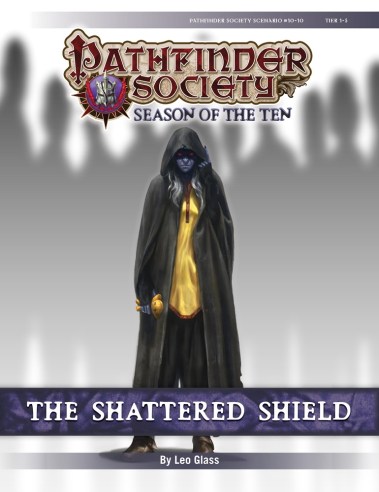
The Shattered Shield tasks the PCs with heading into Rahadoum and attending an illegal auction that deals in religious relics. There they’ll need to obtain a shard of the Shield of Arnisant, which was once known as the Shield of Aroden, and was used to battle the Whispering Tyrant. This shield is supposed to be safe in Vigil, but all signs seem to show that the shard up for auction is legitimate. Of course, as with any good scenario, acquiring the shard will be harder than it sounds.
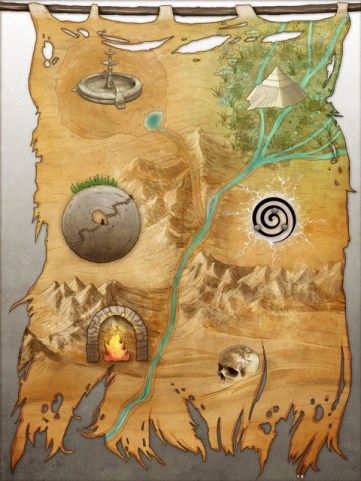
There’s a lot to like in this scenario. It has a lot of interesting social and skill-based encounters. There’s one very weird illness going around that’s used to great effect. The mission briefing with Venture Captain Obo was very detailed, with plenty for roleplay-oriented players to riff off of. I particularly enjoyed how the Pure Legion was portrayed. This scenario did a great job of humanizing them, which was nice to see. The adventure allowed for some deviation from the assumed path, with alternate allies and differing methods accounted for. I really, REALLY liked that. It’s rare to see in published products, particularly of this length. I also really enjoyed some behind the scenes bits with Nulalla, which most players will be curious about but aren’t likely to discover completely. I loved the situation that Torvad Shalzadin and Inusi Mendalari find themselves in. In addition to being dynamic and a little suspenseful, clever PCs will be able to glean a bit of information about this scenario’s main villain from the witnesses. The final location PCs visit in this scenario was super morbid and different. I really, really liked it. And the map for it looks great! Finally, I adored the main villain’s… pal. It’s both horrible and adorable. Just awesome.
That said, there are some downsides. The auction itself was a bit of a let-down. Although there’s some interesting people to interact with, and some cool things to bid on it’s unscripted, and the notes are scattered over a few pages. This is inconvenient for GMs, and means that the auction is unlikely to be a showstopper. Which is a shame! I LOVE a good auction in my Pathfinder. Events are also a bit overly convenient. Not a trait unique to this scenario, but it is more obvious and heavy-handed than is typical. Particularly with regards to the connections between the estate and the auction guests.
Finally, villain tactics. This scenario’s villain is an odd one. Don’t get me wrong, I love her. Seriously. She has flaws, hang-ups, quirks, obsessions, and goals which both haunt and drive her. They affect her tactics and reactions. Unfortunately, it’s not depicted in a way that everyone — GMs and players alike — will necessarily notice. And if you don’t notice? She comes off seeming rather stupid. Which is… unfortunate. And as cool as the final location is, the ending has the potential to be incredibly anticlimactic. I like the premise, and it works for the character, but if certain events occur a lot of players will just be left shaking their heads and asking: ‘That’s it?’ Not really the reaction you want at the end of a successful mission.
There’s one other quibble I have with this scenario: penalties. As with any Society Scenario, there’s many opportunities where not discovering ‘X’ or accomplishing ‘X’ can cause your PCs to lose out on some of the gold rewards on their chronicles. Usually accomplishing those tasks is easy, and it just sort of happens as you play. In this scenario that is not necessarily the case. Some are harder to get than is typical. Most groups won’t get full gold. In fact, some groups will miss out on gold two or three times. Now, on the one hand, I like that it’s not a given you’ll get all the rewards this scenario has to offer. It’s refreshing. But, this scenario might have gone too far in the other direction. If too many players miss out on too much of the rewards, they might even feel like they’ve been unjustly penalized.
Overall, I ended up torn on this mission. I love how Rahadoum and the Pure Legion was handled. I also enjoyed the large number of social and skill based encounters. The villain was flavourful, different, and had some serious quirks — all things I adore. Heck, I even liked her doorman. On the other hand, players are likely to come away from this scenario feeling confused over enemy tactics and behaviour, and the ending has the potential to be a let down. In the end I decided to give it 3 out of 5 stars.
The Hao Jin Tapestry is unstable. Unravelling, one could say. This scenario tasks the PCs with heading into the demiplane, checking out an ancient Tian site, and getting out with whatever lore and treasures they can before it’s too late. It’s a sequel to this year’s interactive special Pathfinder Society Scenario #10-00: The Hao Jin Cataclysm. In the new year this story will continue with Pathfinder Society Scenario #10-13: Fragments of Antiquity, and Pathfinder Society Scenario #10-15: Tapestry’s Trial. If you’ve got characters who have had a hand in acquiring, exploring, or protecting the Hao Jin Tapestry in the past, now is definitely the time to bring them out! Also, if you’ve got characters with knowledge of Tian Xia, who can speak Hwan, or who can magically communicate in other languages, they’ll be used to great effect in this scenario.
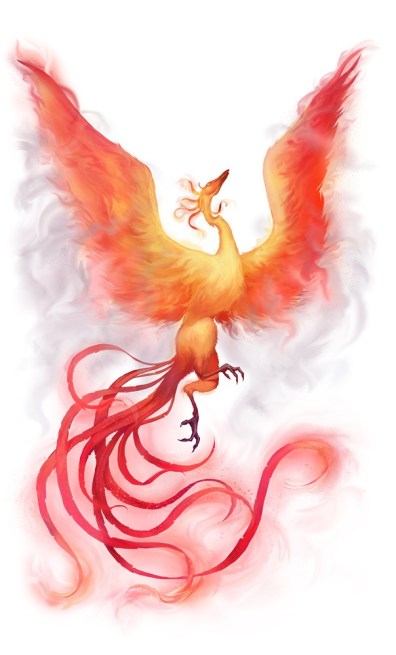
This scenario begins in Absalom with an announcement from two members of the Decemvirate! This is followed by a more typical mission briefing with the oread Master of Spells Sorrina Westyr. From there it quickly moves into the Hao Jin Tapestry’s demiplane. There the PCs will get to explore the ancient Tian village of Onhae, which would once have been found in the jungles of Chang Liao. The PCs main goals are to collect a sample of a rare flower from the area, and to learn all that they can about the traditional religion and culture of the people of Onhae, the Sunsu Godae. Happily, there’s still people in Onhae. This should be a cinch! …But, it turns out they’re not practising their traditional religion anymore. They have a new leader, Lin Fen Hai the Hao Jin Hierophant, and a new god who we’ll just call the Ruby Pheonix. Interesting! Your players will get to navigate this newly changed political environment in order to accomplish their missions, all while the Hao Jin Tapestry frays around them, causing unnatural events, magical malfunctions, and planar breaches. It’s an interesting mission to say the least. Similar in form and tone to some previous adventures like… #3-21: The Temple of Empyreal Enlightenment and #9-12: Shrine of the Sacred Tempest.
The Ruby Phoenix.
Onhae was an interesting, rich little village with both and ancient past, recent history, and current changes. Sussing out this places many secrets looks like an enjoyable challenge. Their new religion was awesome! Haha. So good! Although a lot of this scenario was social encounters and skill checks, there are some battles to be fought. Each of these encounters is well written and has interesting flavour and tactics. There’s also some neat planar malfunctions going on you get to interact with. Overall, I really liked this scenario! I give it 4 out of 5 stars.
Thanks for taking the time to join us today! I hope you stop by later this week when we take a look at the newest Starfinder Society Scenarios!
For my birthday yesterday my family gifted me a wonderful book I’ve been itching to get my hands on: Starfinder Alien Archive 2! And what better way to celebrate than to share it with all of you? So today we’re taking a deep dive into the latest Alien Archive! Ready?
Alien Archive 2 is an awesome supplement book for the Starfinder Roleplaying Game. This book has a hardcover, and is 159 pages in length. It’s got an American cover price of $39.99, which means that if you’re Canadian (like myself), you’re looking at a cost of around forty-five to fifty dollars for the book online, or up to sixty in your local game store. It’s currently on sale for around $32 Canadian on that handy link I posted, so I highly recommend picking it up cheap while you can.
At it’s core, Alien Archive 2 is a book of monsters. You’ll find a ton of creatures to fight and ally with inside this book, as well as some new player races. The book is easy to use, adaptable, and well organized. It also has some new character options, like new spells, equipment, and feats, scattered amongst the monster entries.
The Alien Archive features lovely cover art by Remko Troost which depicts a glitch gremlin, a mi-go, and a trox. The inside front and back covers feature an image of the Pact Worlds. After that we come to the table of contents. Alien Archive 2 has sixty-five distinct monster entries inside it, many of which have more than one stat block or variation of that creature, making the actual number of foes inside larger than it seems (around one hundred and twenty-six by my count). Of these, sixteen are playable as character races. There are also three starships, and twenty-six template grafts.
Combatant
After the table of contents we reach the introduction. This is where we learn how the races are oriented, and how to read a stat block. While most of this is basic information that only a player new to d20 games will need to read, some of the information is quite important. Of course, all of this will be business as usual for owners of the first Alien Archive.
Expert
Each of the stat blocks inside the Alien Archive is sorted into one of three categories: combatants (which excels in physical combat), experts (who are most effective with skills), and spellcasters (who rely on spells or spell-like abilities). These categories are represented by an icon in the left margin. These images are easy to distinguish and provide a quick and easy way for GMs to realize the role each monster plays in combat, which makes it super easy to find the type of creatures your looking for, or to quickly discern a creature’s tactics.
Spellcaster
There’s also a few interesting things to note about the stat blocks themselves. Very few of the creatures inside have Resolve Points and none have Stamina Points. A creatures ability scores aren’t listed, instead, their stats show their ability modifiers. This is a simple change that will make it easier for GMs — especially new GMs — to handle unexpected situations (like unlisted skill checks) in combat. Not all of a creatures feats are listed in their entry. Instead, only feats that grant new combat options will be shown. Feats that grant static bonuses (like improved initiative, or skill focus) are already factored into the stat block and will not be listed anywhere at all. This really streamlines the stat blocks, and makes it easier to find important information fast. Similarly, not all of a creature or NPCs spells will be listed in a stat block. Instead, it only features their most powerful spellcasting options.
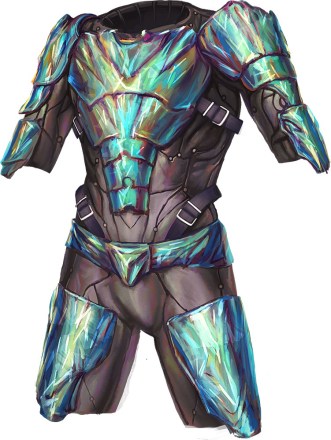
Every one of the bestiary entries in this book is two side-by-side pages long. These entries include information on the creature, where they’re found, their use throughout the Pact Worlds, and their society — if they have one. Many of the entries include more than one stat block on a theme. For example, the Forman entry gives us stats for a CR 7 taskmaster, along with a CR 10 myrmarch. Similarly, the akata entry features the both the akata and the void zombie, which are controlled by its parasitic offspring. Some entries include many stat-blocks (such as the herd animals, predators, and dinosaurs) or include simple grafts that can be added to a featured creature to make it into other versions (such as metallic and outer dragons). Many of the archive entries introduce new gear, rules, or consumables. My personal favourites include the arquand horns found on the arquand gazelle’s entry, the glass skin of the glass serpent, and the apocalypse solarian weapon crystals from the living apocalypse.
Armour made from a Glass Serpent
After this we come to the meat of the book: the aliens archive itself. There are a ton of cool creatures in this book, and even some that I wasn’t sure I’d like on first perusal, I ended up really enjoying. Some of my favourites you should check out include the squox, a CR 1/3 or 1 creature which is utterly adorable and makes a fabulous pet. I also adored the adaptable entries on dinosaurs, herd animals, and predators, each of which comes with a sample stat block for a creature of each size, followed by simple rules for how to make an innumerable combination of custom creatures of those types. It’s simple, incredibly useful, and has awesome art. LOVE IT. Glitch gremlins were a fun low level challenge I also really enjoyed, as were the akatas, which I’m thrilled to see included. For a great high-level challenge check out the calecor and the living apocalypse.
Mixed amongst the monster entries are sixteen playable races. Each entry features two different CR stat blocks representative of their race, a bunch of interesting information on their societies and home worlds, and a side bar which include the rules for playing them as a race. Although many of these were ‘humanoid shaped’, with arms and hands or some sort, there were some which were not, most notably the mollusk-like embri, and the silicon-based quorlu. This was just awesome to see, and I really enjoyed it! Some of the races and monsters from old Golarion were up for selection, including aasimar, tieflings, ghorans, hobgoblins, orcs, and trox, but many were brand new. I honestly loved a TON of these races, but my favourite new additions are damai, osharu, pahtra, and the wolf-like vlaka.
Curious about the playable races available in this book? Well, look no further! The Alien Archive includes:
Aasimar: celestial blooded humanoids you’ll find under ‘planar scion’
Bolida: armoured burrowing arthropods with a wide array of senses
Damai: pale, scrappy humanoids forced to hide underground from the colossi they share their world with
Embri: masked, mollusk like aberrations with a rigid social order secretly controlled by the forces of hell
Ghoran: delicious plant beings from Golarion who have terraformed their own planet-paradise and genetically split into two subraces: oaklings and saplings
Hobgoblin: tall, war-mongering, militaristic humanoids with faces similar in appearance to goblins
Kanabo: a red-skinned oni, which is a type of evil spirit given a physical form
Orc: strong humanoids conditioned as slave labour by the drow of Apostae
Osharu: slug-like creatures that view religion and science as intertwined
Pahtra: asexual cat-like humanoids that adore music and battle
Phentomite: agile humanoids acclimated to thin atmospheres and high altitudes that live on a broken planet
Quorlu: silicon based quadrupeds with tentacle arms and eyestalks capable of digging through earth and stone
Tiefling: fiendish blooded humanoids you’ll find under ‘planar scion’
Trox: large, chitinous, gentle humanoids that have been magically transformed since their time on Golarion
Uplifted Bear: intelligent, bipedal bears that you’ll find under ‘bear’
Vlaka: wolf-life humanoids from a dying world often born deaf or blind
Past the statistics for all those snazzy new aliens we come to the Appendixes, of which there are eleven. Appendix One contains two pages of creature subtype grafts and Appendix Two contains two and a half pages of environmental grafts. Appendix Three contains rules for the polymorphing creatures. This section is around seven pages long and frankly, feels quite complicated to me. Definitely not something my kids could use. Appendix Four contains all of the universal creature special abilities. Appendix Five, Six, and Seven are very short, sorting the creatures in the Alien Archive 2 by CR, type, and terrain. Appendix Eight lists the template grafts and the pages they can be found on, while Appendix Nine lists the new character options and gear and the pages they can be found on. Appendix Ten contains a chart of average vital statistics for all playable races from Alien Archive, Alien Archive 2, and for the Legacy Races from the Starfinder Core Rulebook. Finally, Appendix Eleven is a list of the playable races and their page numbers.
That’s it. We’ve come to the end of the Alien Archive 2.
And what did I think?
In short: I loved it. Alien Archive 2 is packed full of a wide array of monsters and cool races. Many of the stat blocks are highly adaptable, there’s plenty of new templates and grafts that help with monster creation, summon spells, and polymorph. There’s content in here for players and GMs. I’m supremely happy to own Alien Archive 2, and highly recommend it to fans of Starfinder!
Want a sneak peek at some of the playable races? Check out the image below! Got a favourite creature from Alien Archive 2? let me know in the comments!
This morning brings a bunch of huge smiles to the faces around my house as Wayfinder Fanzine announces the authors whose articles will be published in their upcoming magazine: Wayfinder 19.
Wayfinder is full of fan-created content for the Pathfinder Roleplaying Game, and is a free download on Paizo’s website. Over the years they’ve made an astounding 18 issues of Wayfinder, as well as a Bestiary! Nearly every issue has a theme, with this latest one being Fey and the First World. But, the next one coming up really breaks the mold! In fact, it’s not Pathfinder at all. It’s the Starfinder Roleplaying Game! This coming Wayfinder fanzine focuses on Absalom Station.
As some of you may have heard my kids and I all submitted articles to this coming issue and are proud to say we all had something accepted! My kids are literally screaming in glee and jumping up and down. I’m so proud of them. What a huge achievement for a pair of young kids.
And yes, my daughter’s involves rabbits. She’s desperately hoping hers gets some adorable artwork. Haha.
There’s a long time to wait before Wayfinder 19 releases. Art has to be made and edits have to happen, not to mention the ton of other work that the folks over at Wayfinder have to get done. It’s such a huge undertaking, and I know that my family is always happy to see the results. We adore the Wayfinder fanzine.
So join me in congratulating my kids and all the other authors whose pieces will be showcased in this next issue.
And more importantly, we’d like to offer a huge thank you to the people who work hard every year to make the Wayfinder fanzine a thing of beauty, creativity, and awesome gaming material. They should be beyond proud.
Jessica
For a full listing of which authors works were accepted, check out the announcement here.

 or
or 



 Adventure Path, and the
  Adventure Path. Golarion’s original solar system was described in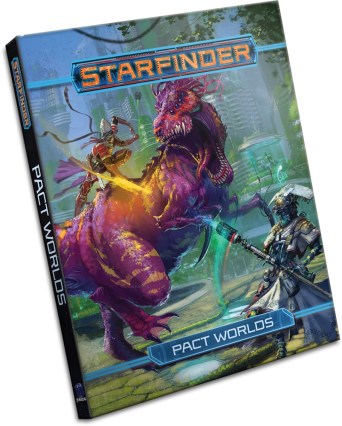

 (although all of the necessary stat blocks are included within the scenario). It makes use of the
  Adventure Path, I’d wager).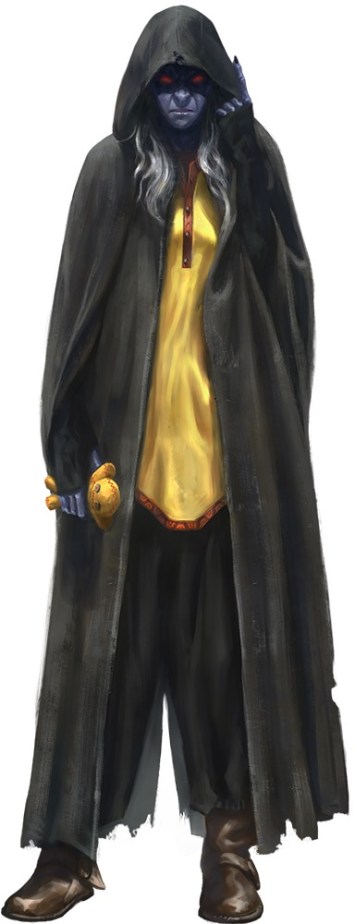

 it makes use of content from




 , and is a free download on Paizo’s website. Over the years they’ve made an astounding
  d20 Diaries