Ch-ch-ch-CHANGES! (August News)

Well, it’s official! Season Nine: Year of Factions’ Favour has come to an end, and the Pathfinder Society has launched Season 10: Year of the Ten. Faction Cards have been updated, and the newest edition of the Pathfinder Society Roleplaying Guild Guide has been released. If you don’t have the newly updated versions of these documents then I highly recommend you head on over to Paizo’s website and give them a download. They’re free.

In other news, Gameday VII is underway. This means that my family is enjoying the chance to play in a bunch of new Pathfinder Society Scenarios online via play-by-post. There is a HUGE number of games scheduled to start now. That includes playing in the Pathfinder Society, Pathfinder Society Core, Pathfinder Society Adventure Card Game, Pathfinder Society Playtest and the Starfinder Society! In addition, they’re running the Pathfinder Society Scenario #8-99: Solstice Scar Special and Starfinder Society: #1-99: Scoured Stars Invasion Special as we speak. More games are slated to start in October. That’s also when Pathfinder Society Scenario #9-00: Assault on Absalom Special will run. Although it’s likely too late to join any of August’s games, there’s still plenty of time to sign up for October’s. That said, many games are full already, so I wouldn’t dawdle much longer if you want to get into a game! Haha.

First seeker Jadnura
First Seeker Jadnura. Art by Graey Erb for Starfinder.

For those of you who don’t know, the Scoured Stars Invasion special also brought with it the introduction of a new faction: Second Seekers (Jadnura). Who the heck is Jadnura? Jadnura is the First Seeker who led the Starfinders into the Scoured Stars system. That’s right. He’s the kasatha who got everyone stuck and lost in an event now known as the Scoured Stars Incident. So why would you still follow this guy when Luwazi Elsebo is the current First Seeker? For starters, it lets you make a character who was a loyal Starfinder before the advent of the Scoured Stars Incident. You can be the guy left behind, whose still loyal to a leader no longer present. Second? Well, the special is called the Scoured Stars Invasion, and it’s main purpose is to enter the Scoured Stars System and rescue as many lost agents as you can. I suppose some might call that a spoiler, but honestly, it’s obviously the point of the scenario right from the first few sentences of playing. Why else go there? Want more details? I can’t give them to you! Haha. I’m currently playing this scenario for Gameday VII and don’t know how it ends. If you want more information (and some spoilers) feel free to check out Paizo’s blog post on First Seeker Jadnura here.

GrandLodgeSymbol
The Sigil of the Open Road, logo of the Pathfinder Society.

So what the heck is Season Ten: Year of the Ten all about, anyway? Judging by the title, something to do with the Decemvirate. But what? It’s been hinted that it has something to do with the infamous Grandmaster Torch, and that some of the Decemvirate might find their anonymity threatened and their mysteries unveiled. Interestingly, most of the missions this season will revolve around the Hao Jin Tapestry. For those of you who don’t know, the Hao Jin Tapestry is a literal tapestry that leads to a demiplane which contains mysteries, relics, ruins and other places collected by the wizard Hao Jin. This object was acquired by the Pathfinder Society way back in Season Three and has been a source of tons of adventures. It’s also been harnessed by the Pathfinders in order to allow their agents to travel the world quickly and efficiently. This season the Hao Jin Tapestry is beginning to unravel and, if we can’t fix it, it’ll dump everything inside it into the Astral Plane. An unfortunate event for not only the Pathfinder Society, but also all the people and creatures who still live inside the demiplane itself. Unfortunately, you can bet that fixing it won’t be as easy as just casting mending. I’m sure there’s plenty of adventure involved! There’s a few other things that have been revealed to be a part of this season. There’s plenty of relics related to the lich Tar Baphon that will be surfacing. There’s also a demon who wants to utilize the Worldwound’s collapse to launch his apotheosis into full demon lord. Pretty nifty! I think I’m most excited for the missions involving Grandmaster Torch, but hey, I’m biased! I’m also excited to learn more about Tar Baphon. I love a good (BAD) lich!

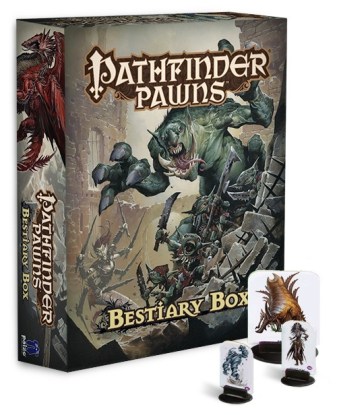
Pathfinder Playtest Rulebook

There’s a few more exciting things going on around my house right now. My daughter’s begun work on creating her second Pathfinder Playtest character so that we can continue with our Doomsday Dawn Playtest. She’s decided to make a gnome fighter who wields an absurdly large sword. She’s very excited to be the melee character for a change.

My family and I entered a contest a week or so ago. Hosted by the overly generous Hmm on Paizo’s message boards, she was going to give away all the boons necessary to create a mermaid in PFS play. There were a few ways to enter — for yourself with a mermaid character concept, for a group of friends with a team created from the other boons she was giving away, or by nominating someone else who you thought deserved to win. Now, when we play in the Pathfinder Society, the question my kids ask me most often is:

“Mom, why can’t I be any race I want?”

Unfortunately, at the ages of six and seven, the idea of holding out for race boons is absurd. Haha. The follow up question I most often get after any explanation I can concoct is:

“Yeah. But WHY?”

So, as soon as I read the contest I told my family about it. My kids were jumping up and down in joy. They spend that night brainstorming, and spent the next day planning their characters while I madly tried to keep up with them. And then we got to the end. They were ready! Sort of. For bonus points you could also write a song.

….yup. A song.

Not my forte. My son wanted to add jokes into the song, and my daughter wanted it to have a lot of animal sounds (since we were nearly all animal people of one kind or another).

It was… hard. Haha.

But, in the end we handed in our entry with pride. So what was it?

My family and I wanted to make a quartet of characters who are (and were) universally considered outcasts among their people and Golarion at large. They’re weird, and different. But what’s strange for one culture isn’t strange for others, and it’s those very oddities that the others embraced and connected with. After all, who cares if the vanara has unnaturally large eyes, if he’s hanging out with a grippli? These guys are friends, companions, and (in many ways) family. They don’t have the same interests, and they don’t always get along. But, hey? What family does?

My daughter made an energetic poisonous grippli, my son made an eco-conscious vanara with a stumpy tail who has hair growth issues, my husband made a ratfolk who chews on everything (including magical objects), and I made an overly adventurous aquatic elf whose curiosity got her abandoned on the surface. Together, these quirky characters would do… stuff!

Just the other day the winners were announced. There were a ton of great ones. And some of the songs were awesome! Hmm ended up giving out boons to winners of each category, which is incredibly generous! We won in the ‘buddies’ category, and my kids have been hard at work ever since, plotting out their character mechanics. We were lucky enough that a fellow play-by-poster offered to run us through our group’s first PFS scenario together, so once everyone is ready and formatted for online play we’ll be starting Heroes for Highdelve! My daughter got to work first and is almost done. She’s thrilled!

We’ll post more about these lovable weirdos once they’re ready for a game. One thing’s for certain: they’re going to be the most eccentric group of characters we’ve ever made! (And that’s saying something…)

Now it’s time to say goodbye,

Or, more accurately: ‘Now it’s time to get to work on my next article.’

Season 10, here we come!

Jessica

SaveSave

Pathfinder Playtest – Review

Welcome back to d20diaries!

Wow, finding the time to fully read the new Pathfinder Playtest Rulebook took longer than I expected! Well, not to read it, so much as to digest it. Understand it. Plenty of rules are different, so I had to really focus. Considering that I normally find time to read while overseeing screaming, bickering, playing, laughing, children of various ages (hey, moods change quick!), finding quiet time to get some reading done was more than a little difficult.

That said, I’m a quick reader. I finished it in about two days, then spent some time crafting characters in order to try out the creation process. Before I can take the time to teach my husband and kids how to play, I need to be able to explain it. Properly. Haha. After that I helped my family through the creation process, read through Pathfinder Playtest Adventure: Doomsday Dawn (the first adventure we would be trying out), and we got to work playing.

It’s been a whirlwind! But a fun one.

And then I got sick. Still am.

LAME. Haha.

So whats on the agenda for today?

Today we’re going to take a look at Pathfinder Playtest. Not in depth — this isn’t a replacement for the rulebook. After all, the rulebook’s a free download. It’s my impressions, thoughts, and experiences. Things I’ve discovered, and even some questions I’ve got. Got an opinion of your own? Or an answer to a question I have? Let me know! This game system is brand new and we’re all learning together. Once you’ve had a chance to try out Pathfinder Playtest, be sure to head over to Paizo’s website and give them some feedback. They’re running surveys right now, and have forums up for you to share broader comments.

Ready? Let’s begin!

Pathfinder Playtest RulebookPathfinder Playtest is a new set of rules and gameplay for the Pathfinder Roleplaying Game. It’s intended to streamline the game, while retaining its robust character creation options. Running combat, monsters, and characters should go smoother. Learning the rules from scratch should be easier. Levelling up should be simpler. The book and rules are supposed to be user friendly — even for those who don’t know how to play d20 games.

In theory.

Pathfinder Playtest features gorgeous cover art by Wayne Reynolds which showcases Seoni (the iconic sorceress), Valeros (the iconic fighter), and Fumbus (the iconic alchemist) battling a white dragon! Wait! Fumbus who? Fumbus the goblin alchemist. Thats right! Not only are goblins a core race, but alchemist is a base class. Both are available options to try out in the playtest.

Open the covers (or flip to the next page on the pdf) and you’ll find an introduction by the Paizo staff, followed by the overview. This is where you’ll learn what the heck a d20 game is and how to play. There’s also an overview of the basic terms used in the game, including a few that are new, an explanation of the modes of play, and a list of what you’ll need to play. This section was easy to understand, even for a layman, although not as easy as I expected. It’s a difficult read for my children, for example, and my son (who is more than capable of reading chapter books aimed at pre-teens, published adventures for d20 games, and other Pathfinder products) would definitely get bored and flip past a few pages. Would my teenage/adult siblings read it all the way through? …Tough to say. Probably not. It’s more likely they’d give it a skim and see how it goes. So… sort of an easy read. An easy read for this genre and its audience, I suppose.

Many of the terms in this chapter will be familiar to those of you who have played d20 games before, but even experienced gamers need to give this section a thorough read. Calculations for some of the familiar statistics are different, and there are some very important brand new game mechanics that are explained here. Be sure to pay extra attention to the types of actions, the modes of play, and proficiencies. We won’t get into them in too much detail right now, but for those of you who are curious, these three aspects form a huge part of the game.

There are three modes of play in Pathfinder Playtest. Encounter mode is what you enter when your every moment matters. This is used during a battle, for traps, ambushes, hazards, and anything else similar. You play encounter mode in rounds which are six seconds long, and encounter mode ends when the danger has passed. This is a huge part of the game and the rules. But, it’s not all there is to the Playtest. Exploration mode is used for any situation where you’re not in immediate danger, but you’re not entirely safe, either. This includes exploring a town, ruin, forest, or even a hallway between encounters. It’s what you’re playing in when you’re not fighting something. It’s more than just walking, or a segue between the ‘exciting stuff.’ Exploration mode has its own rules, and has proved quite fun around my house so far. Finally, there’s downtime mode, which is what you use when you’re completely safe.

There are three major kinds of actions in Pathfinder Playtest. Actions, free actions, and reactions. Pretty much all the game is based around this. Nearly every feat, ability, and spell that has a non-passive effect has a symbol beside it right near the top showing what it costs to use. Free actions are free, obviously, Reactions can be taken once per turn, even on your opponents turns, as long as its triggering conditions are met. An example of this is an attack of opportunity (which only fighters can utilize right away!), but there are plenty others for different classes and characters. Lastly, there’s actions. Everything takes actions. Moving, attacking, special attacks, spells and such. Most spells take two actions to cast, although some take one or three. Each turn during encounter mode you’re allowed three actions, and most things you can imagine take one. Walking forward, drawing a sword, and swinging it? Three actions total. Attacking, attacking, and attacking a third time? Three actions. And totally allowed (each successive attack in a round takes a cumulative -5 penalty).  Lastly, there’s proficiencies. Yes, this includes armours and weapons. But in the Playtest proficiencies also replace your base attack bonus, base saving throws, and skill ranks. If you’re trained in something you add your level to the rolls you make with it. If you’re untrained you add your level subtract two. If you’re an expert you add your level plus one, master is your level plus two and if you’re legendary you add your level plus three. For example, if you’re trained in athletics you roll a d20, add your proficiency modifier (your level), your strength modifier, and any other item or extra modifiers you have. Expert in your weapon? Add the expert proficiency (your level plus one), your ability modifier (strength for melee, dexterity for ranged), and any other bonuses from your items. Master at reflex saves? Add your level plus two, plus your Dexterity modifier, anything else special you might have and off you go.

Got it? Good! If not, read the Pathfinder Playtest Rulebook!

After this we get into the fun stuff. Character Creation. The Playtest has a great step-by-step guide to making your characters. In short, you come up with a concept. Then you pick and apply their ancestry (race), background, and class. Each of these will increase some of your ability scores, but you also gain four increases to apply as you see fit. Once you’ve finalized your ability scores, select your trained skills and do some simple math to make it all come together. Spend your coin (150 sp), pick your spells (if you’re a caster) and fill in all your finishing details. Done. Relatively simple. The levelling up process is also simple, as well.

After this there’s an easy to follow example of how you make your ability scores. As I previously mentioned, ancestry, background, class, and your personal preference all play a part. So how does it work?

For starters, you need to know how much to increase an ability score. Increases are referred to as an ‘ability boost’. If the score you’re increasing is under 18 you increase it by 2 points. If it’s over 18 you increase it by 1 point. At character creation, you cannot make a character with over 18 in any one ability score, so all of your boosts will be increasing your ability scores by +2.

When you create a character all of your ability scores start at 10. Now you pick your ancestry. Most will give you two ability boosts that are applied to a specific ability, one ability boost that you can apply as you see fit (called ‘free’), and one flaw (which is a -2 in a specific score). For example, dwarves get ability boosts to Constitution, Wisdom, and Free. They also suffer an ability flaw to Charisma. Humans are different from most races in that they receive no flaw, and no specific ability boosts. Instead they get two free ability boosts, which can be applied at your whim.

Now that you know what to increase you apply it. However, there is a limitation. During each step that you apply your ability boosts, you must apply each to a different ability. In our previous example with dwarves, that means you’re getting +2 Con, +2 Wis, -2 Cha and a +2 to be added to any other ability score (Str, Dex, or Int). The next time you apply your ability scores you can increase any scores you want, but again, only one time each in that phase.

Backgrounds grant an ability boost in a single specific ability score chosen from a selection of two, and then grant a free ability boost. For example, acrobats get an ability boost to either Strength or Dexterity, and then a second ability boost that is free. Meanwhile, a barkeep gets an ability boost to either Constitution or Charisma, and then a second ability boost that is free. (This is not all that a background grants you, just the part that applies to ability scores). As mentioned before, during this step, each ability can only be boosted once. So, our example dwarf could apply the barkeep ability boosts to Constitution, and Strength, but couldn’t apply it to Constitution twice.

Classes offer a single specific ability boost to that classs’ key ability score. Alchemist’s increase Intelligence, bards increase Charisma, and so on. Some classes, like the fighter, can choose one of two ability scores to be their key ability score (in the case of fighters this is a choice between Strength and Dexterity).

Lastly (or second last if you choose to apply these before your class), you get four free ability boosts. You can assign these however you want — although each ability score can only be boosted once in this phase. Essentially this means that four different ability scores will increase by +2.

And that’s the ability score creation process. It’s quite simple when you get the hang of it, and can create a diverse array of balanced characters. There’s also a random generation method offered, for those of you who prefer to roll out your stats, but the characters they create will not come out as powerful as those created with the standard method. Still, it’s nice that its there.

After this we get into the chapter on ancestries and backgrounds. There are six major ancestries you can choose: dwarf, elf, gnome, goblin, halfling, and human. Those of you looking to be half-elves or half-orcs will select ‘human’ as your ancestry, and then choose a heritage feat which allows you to be either of those two ‘half-breed’ races.  This method opens up a unique design space which has potential for an interesting take on some uncommon races when the full game releases next year.

Each ancestry grants you some ability boosts and flaws (as already noted). It also grants you some hit points (which you will only receive at first level), your speed, size, and languages. Some of them also grant you a vision type, or a single special ability. That’s it. You won’t be getting a ton of racial abilities built into your ancestry. I know, I know. This seems like you get so much less. In a way, at low level, you do get less. But, as you level up you also get more out of your race. You see, each ancestry has a list of feats to choose from that only members of that ancestry can select. This is where you’ll find a lot of familiar ‘racial’ abilities like weapon familiarity, ancestral hatred, stonecunning, sure-footed, and other such features that would have once been found under ones race. There’s plenty of new ones, as well. You start the game with one ancestry feat of your choice, and gain more as you level up. This allows you to make your ancestry work for your character as an individual. After all, not all elves are the same.

After I got over the initial shock of seeing ‘how little’ each race gave me, I gave the different ancestry feats a read and, in the end, decided I like this method. It’s adaptable, easy to use, and enjoyable. I found it worked well during character creation. I particularly enjoyed the gnome ancestry feats, so be sure to give them a read!
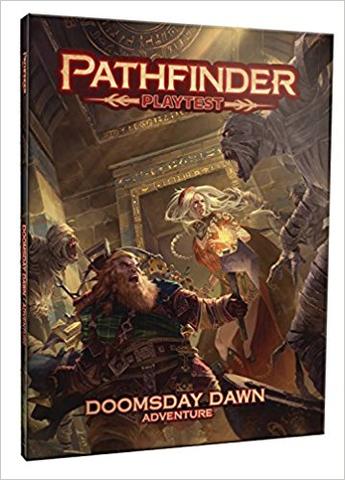
Pathfinder Playtest Doomsday DawnNext up is backgrounds. These represent the things your character did before becoming an adventurer. In addition to the ability boosts mentioned previously, each background grants you one skill feat and training in a single Lore skill tied to that background. What’s a lore? A lore is like a very specific knowledge skill. You can have lore in pretty much anything, as long as it has a very narrow focus. Examples include Vampire Lore, Desna Lore, Circus Lore, and Farming Lore. During downtime, lore skills can also be used to make an income. There are a lot of backgrounds up for offer in the Pathfinder Playtest Rulebook (nineteen!) and you can expect to see a whole lot more in the future. Each adventure path will offer new backgrounds that will tie your characters to the story. The Pathfinder Playtest Adventure: Doomsday Dawn is the first example of this, and provides a further six backgrounds to choose from. The Playtest Rulebook backgrounds include: acolyte, acrobat, animal whisperer, barkeep, blacksmith, criminal, entertainer, farmhand, gladiator, hunter, labourer, merchant, noble, nomad, sailor, scholar, scout, street urchin, and warrior. Although all of the backgrounds are equally ‘good,’ I particularly like the entertainer and the nomad, while my daughter enjoys the animal whisperer, and my son enjoys the warrior.

Past the Background we get to a short section on selecting languages. Players with very high intelligence scores will be surprised to find they don’t get as many languages as in Pathfinder First Edition, with an intelligence over 14 now granting a single bonus language!

Up next is the chapter on Classes. The classes available for the playtest include Alchemist, Barbarian, Bard, Cleric, Druid, Fighter, Monk, Paladin, Ranger, Rogue, Sorcerer, and Wizard. Despite these being familiar to you, each class has plenty of new features, and offers a lot of adaptability. In addition to hp, special abilities and a selection of class feats you can choose from in order to tailor your class to your character, each class also gives you proficiencies in saving throws, perception, and in various weapons, armour and shields. It also gives you a number of skills you can choose to be trained in. Spellcasters get spells, characters get abilities and so on. Now, you really need to read the classes to get a feel for them, so we’re not going to take too close of a look at them. What I will say is that each class we’ve tested in my house has turned out to be a lot of fun. My favourites include Bard (who can use some of their performances an unlimited number of times per day!), Sorcerer (whose spell list and type of magic is determined by their bloodline), and Paladin (who are just plain awesome!). My children particularly enjoyed the druid.

Next up is Skills. This chapter goes over each of the skills, how to calculate their modifiers, and what they can be used for. This is also where you’ll find the rules for crafting, performing and lore. Even experienced players need to give this chapter a read, as there are some changes to the skills. For example, grabbing, grappling and shoving are all tied to your Athletics skill. Yeah. Neat. Skills definitely do more for you now, than they used to. Also, anyone can make attempt any skill check. Obviously, they won’t all be as good at it, but the potential is there, which is nice. That said, some skills have uses that can only be used by characters trained in that skill, which is a nice feature.

After skills we get to the chapter on feats. Now, this section doesn’t have all the feats available in the book. Ancestry feats can be found under ancestries. Instead, it contains all the general, and skill feats available. This chapter is particularly important, because you will gain a LOT of feats.  Beginning characters start with two (at minimum!). One from your ancestry, and one from your background. Most classes grant at least one other feat (sometimes a class feat, sometimes a general or skill feat, and sometimes both). This is a wonderful surprise, which allows customization in a simple way.

After feats you’ll find Equipment. Pathfinder Playtest uses silver as the core coin (instead of gold) which means that the price of gear will be different than what you’re used to. There’s also been some changes to the armour, weapons, and weight systems — all for the better in my opinion! Definitely give the information at the start of this chapter a read before trying to spend your coin! Haha.

Past equipment you get into spells. This begins with a lot of important information about magic, spells, and how they work. Definitely don’t skip this part! Haha. There are four major spell lists: Arcane, Divine, Occult, and Primal. I’m fond of all of them. In addition, you’ll find tenth level spells. After the spell lists are spell descriptions. Amongst these spells you’ll also find a lot of class abilities that are cantrips, or run off of spell points. This includes domain powers, and bardic compositions (among others). Although I understand the purpose of including them here (in alphabetical order alongside the spells), it made it hard to make class choices. For example, if I’m looking for all the bardic compositions (which are a type of cantrip) I have to search through the entire chapter and read the spell traits to find them. There is no compiled list of bardic compositions and, as they are not class spells, they don’t appear on any of the Spell Lists. It’s a giant pain in the butt. Haha. I sincerely hope they find a better way to sort this in the future, cause all that sifting sucks. Not only that, it’s a drain on your time.

I also found (after a lot of jumping between chapters to hunt them down) that a lot of the domain powers weren’t as good as they used to be. Which is unfortunate. I’d gladly trade my cleric of Desna’s domain power from the Playtest with pretty much any other Domain power from First Edition. An unfortunate outcome! Still, it will take more playtesting to determine if it all balances out in the end.

Past this we come to a short chapter on how to level up your characters. In addition, you’ll find the rules for multiclassing and archetypes here. The system for this is very easy to understand, and allows for a lot of cool character concepts. Essentially, you can choose to take archetype or multiclass feats in place of your class feat at any given level — presuming you meet the feat requirements. There’s a bit more to it than that, of course, but not by much. It’s a simple, elegant way to handle multi classing and archetypes without causing characters to fall behind the powers of their peers. I really like it. Definitely give it a read!

Later in the chapter you’ll find the rules for animal companions, familiars, and gods. The rules in all of these categories were fun and easy to use, particularly the rules for familiars. We got ours created in only a few minutes! Wonderful! Of course, I did have questions. It’s specifically pointed out that you can only have one animal companion. But, this is not specified under familiars. Does this mean you can potentially have more than one? My son chose a gnome ancestry feat which granted him a familiar, and then later earned a vine leshy familiar from being a plant druid. Does this mean he gets both? I’ve yet to find a definitive answer, but if you’ve read an official answer somewhere, (or know the page its on that I’ve missed) let me know! I’d love to read the ruling. Another problem with familiars turned out to be damage. Although it mentions the attack rolls they can make, it doesn’t say how much damage one does if it tries to attack. This came up on one of our first combat rounds in our first playtest when my son sent his vine leshy to attack. He hit! And… we had no damage. Haha. I decided that it would do 1 damage unless I found an official ruling that says otherwise. Know of one? Let me know! We’d love to see it!

After this comes a very important chapter entitled ‘Playing the Game.’ Reading it is mandatory. Haha. It’s around 35 pages long and includes all the rules you need to play as a player, as well as the conditions found in the game. Important stuff.

After that is another very important chapter called ‘Game Mastering.’ This chapter includes everything you need to know to run the game as a GM (in addition to the content for players). This chapter is shorter — at only around twenty pages — but its also denser and more complicated. Admittedly, I had to go back and reread parts a few times, particularly regarding exploration mode, downtime mode, hazards, and DCs. I expect I’ll have to reference both this chapter and the ‘Playing the Game’ chapter plenty over the next year, as I get a handle on the rules. In my opinion, the game is easier to learn to play and GM that Pathfinder First Edition was, so I’m pleased, even if reading these chapters caused me a few headaches.

After this we come to (pretty much) the last chapter. Treasure. This is where you’ll find information on wealth, treasure distribution, special nonmagical gear, alchemical items, runes, trinkets, and magic items. There’s a lot of fun stuff in here that you’re going to love reading. I highly recommend discovering these on your own. I will say that I particularly enjoyed the addition of snares, and that I expect to make a character who utilizes them in the near future. I also really like the rune system for making magical weapons and armour. Its very similar to the fusion system in Starfinder.

Past this is the appendices and then the book is over.

That’s it, that’s all! But, that’s not all that I have to say. There are a few things I’d like to mention before wrapping up.

First: Hero Points. I loved them. Each character starts each session with one hero point, and can earn up to one extra each session as a player (for doing something awesome for the group like bringing snacks, tracking gear, or hosting the game) and one extra as a character (for doing something awesome in character like saving someone’s life, being generous, expert teamwork, or accomplishing an important task in game). These points can be used to save yourself from death, reroll a d20, or take an extra action. They’re useful, awesome, and add a great new element to the game. (My daughter’s determined to be the loot-tracker from now on in order to earn that extra point!).

Second: Dying. During our first play session, my husband’s character died. Quickly. All things considered, from the moment he fell unconscious at Dying 1, only a single full round occurred before he died. Two ill-aimed splash damage brought him to Dying 2, and then to Dying 3 with the second instance, and on his turn he failed his first and only fortitude save against death, which brought him to Dying 4: Dead. This was WAY too fast. Sure, he could’ve used Hero Points to save himself. If he had any. He had already fallen unconscious two other times that session, and had used up all his Hero Points. And he wasn’t the only one. My daughter also fell unconscious once during the session, and my son nearly did. Ouch! I found not only did we fall unconscious quite a bit, but we died too QUICK. For a lot of players, a dead character is an end to fun. Especially if your chances for recovery were so brief.

Third: Identifying Magical Items: After you realize something is magical (or alchemical), it takes an HOUR to identify the object. An HOUR. This means, that if you’re the kind of group who doesn’t rest unless its necessary, you can go an entire adventure without knowing what any of your treasure does. In fact, when we played Doomsday Dawn in my house, we went the entire first adventure without knowing what anything did. That means we didn’t get any use out of any treasure. At all. That’s absurd! Now, there are some ways for your characters to shorten this time to ten minutes (or evens shorter at higher levels), which is more manageable. Heck, I even understand the intent. If it takes more time and effort to identify magical objects, that makes them more special. They’ve got an air of mystery about them. That’s cool. But, if it takes so long to identify a healing potion, that without someone specialized in identifying magical or alchemical objects, the group can’t even figure out its a healing potion during their adventure, than what good is it? Now, I know plenty of players like to stop a LOT when they play. Maybe you’re even one of them. The group that gets loot or takes a few wounds and says, ‘We should head back and recover!’ or ‘We should go sell what we’ve found and come back!’ That’s fine. You won’t be hampered by this. But, I’m not that kind of player. Neither are my family or my friends. We very often take on entire missions until we HAVE to rest, due to our wounds. Or we HAVE to recover our spells. Or we’ve spent the whole day and our characters are actually sleepy. This is particularly true in Pathfinder Society missions, which very often occur in a single day on a timeline. This system strikes me as very problematic, unless you specifically ensure your groups always have a way to shorten it. But, why force a group to do so? That’s going to replace another skill or class feat they could have taken. It just… Reading the rules for identifying magical objects didn’t sit right with me. Then we made our characters, brought them to playtest, and it turned out to be both a problem and a handicap. An unfortunate occurrence which we’ve given feedback on.

Fourth: Resonance. This is your character’s natural ability to activate and utilize magical objects. You have a number of resonance equal to your level plus your Charisma modifier. You can invest resonance ahead of time in an object that grants a long-term effect, or spend resonance on the fly to activate a magical object upon use. It’s meant to help replace gear slots (head, hand, and so on). Kind of cool, right? Sure. Until you start counting it out. Want to wear a magical cloak? Cool, 1 point. Want to drink a potion? Cool one point! Wait! One point? What if you only start with one point? What if you’re dying and you have no points? A friend can’t even shove a potion in your mouth to save you?Sort of. When you’re out of points you can attempt to overspend resonance you don’t have in order to activate the magical object anyway. This is a flat check with a DC equal to 10 + the number of points you’ve overspent (including any times you’ve tried and failed). If you pass the magic works, and if you fail it doesn’t (and you can’t attempt to activate that item again until the next day). If you critically fail (roll a 1) you can’t attempt to invest any other magical items at all that day. Ouch! Resonance is of particular interest to alchemists, who need to infuse their alchemical items with resonance in order to craft them. Okay, I can see that, I guess. Particularly for potions and such. Luckily, alchemist’s get to base their resonance off of their Intelligence, instead of their Charisma. But why should the alchemist have to spend resonance to make an acid flask when a wizard can cast cantrip and deal comparable damage at will? Yeah, I get WHY. There’s plenty of justifications. It’s an item, they’re not spell casters, so on and such. But… I don’t know. Both resonance, and the alchemist’s reliance on it is one of those new rules that I read, and just didn’t sit right. So far in playtests around my house it’s been a bit of a problem. Our alchemist was out of resonance within the first fight and had to rely on overspending resonance the entire rest of the adventure. She didn’t critically fail, thank goodness, but if she had, her character would have been completely shut down. She literally would have had to punch people with her gauntlet (a bad idea with her low strength and poor AC) or throw a rock at them (another bad idea). And if a whole character can be shut down so easily (at low levels, at least), that’s probably a problem. Similarly, our dwarf started with no resonance at all. Feeding him a potion in order to save his life was a fifty-fifty chance the first time, with the odds getting worse from there. Considering how quickly he died when he fell unconscious, that’s brutal. Ugh. Now, that said, I haven’t play tested the game enough yet, to make a final decision on resonance. Maybe it’s better with other classes. Maybe it’s less trouble at higher levels. Maybe this is meant to show that magic items are rare and special, tying it into the length of time that it takes to identify them. Maybe we’re not meant to really use something like a healing potion at low level. Maybe other groups didn’t have trouble at all. But so far, it’s been trouble for our groups. I hope that’s not the case in the future. I’d be particularly interested to see how resonance has worked out for you. If you’ve got an experience to share let me know!

Fifth: Initiative. You don’t have one. Instead you initiative is based on your perception modifier. Occasionally, if your character is doing something specific, you can roll a different skill in its place. For example, if you’re swimming your GM might rule you can use Athletics as initiative this time, or stealth if you’re in hiding. And so on. I loved this.

Overall, I really enjoyed the Pathfinder Playtest so far. I like the changes they’ve made to the game system, character creation, and treasure. I like it a lot, actually. That said, I have some questions which need clarifying, and we did run into trouble. We felt it took too long to identify magical items. We felt resonance was too limiting — especially for alchemists. And we felt the that dying turned into dead way too fast. It’s a good game, and we’re going to play it a lot more over the next year so that we can turn our feedback in to Paizo and they can make this next edition the best that it can be.

At the moment, do I think it’s better than Pathfinder First Edition? …I don’t think I can answer that. It’s new, and going to take some getting used to. Meanwhile, I’ve been playing Pathfinder since before it was Pathfinder. It’s nostalgic and homey. You know? I think it would be unfair to compare the two in that manner until I completely get the hang of the new rules. That said, I can answer a similar question. When it comes down to it, I like Pathfinder better than Starfinder. But do I like Pathfinder Playtest better than Starfinder? …No. Not yet. Maybe one day. But, at the moment, the Drift’s got more sway over me.

Well, that’s all for today. I hope you enjoyed this short look at the Pathfinder Playtest, and my opinions on it. I’d really love to hear your opinions and experiences with the Playtest rules, so if you’ve given it a try be sure to leave a comment. If you haven’t downloaded the free PDFs for the Pathfinder Playtest I highly recommend you head on over to Paizo’s website and do so. It’s free! There’s not much you’ve got to lose. Haha. Those of you hoping to get physical copies can find them here: Pathfinder Playtest Rulebook, Pathfinder Playtest Deluxe Rulebook, Pathfinder Playtest Adventure: Doomsday Dawn, Pathfinder Playtest Flip-Mat Multi-Pack.

Until next time,
Jessica

Playtest

Skitter Shot

Welcome, welcome, gather round! Need a hand? Today there’s plenty of furry hands just itching for a chance to be helpful! Curious what’s up?

Skittermanders.

For this year’s Free RPG day, Paizo released a wonderful Starfinder module entitled Skitter Shot. This adventure is written by Jason Keeley and is intended for a group of four level two characters. Each player gets to select one of four pre-made skittermanders and get helping! My family and I were incredibly excited to give this adventure a whirl, so I gave it a quick read and within a day we settled in to play.


The first job? Picking your character! There are four up for offer, and each of them is a member of the Clutch, a salvage ship run by a vesk named Nakonechkin, whose entire crew are fluffy, manic little skittermanders. First up, Dakoyo, a purple furred priest mystic, worshipper of Ibra, and the ship’s doctor. Dakoyo is obsessed with learning about ancient forms of medicine, and is pretty sure life before the advent of modern medicine must have been horribly stinky and disease ridden! My husband took on the task of playing this contemplative fellow. Up next is Gazigaz, a green furred xenoseeker envoy who loves nothing more than being helpful and making friends. In fact, he grooms himself constantly, in an effort to always look his best. Even when under attack he’s prone to make excuses for his attackers. Perhaps they had a bad life? No choice? They’re just confused! We can still be friends!? Right? My son happily took on the role of this chipper, friendly guy. The third skittermander is a red furred, female spacefarer soldier named Nako. She idolizes their captain, Nakonechkin, and even took his name as her own. She fights with a doshko and is the most battle-minded of the skittermanders. Nako wears her hair in a big braid on the top of her head, and enjoys playing her exotic finger drums (which are sized for someone much larger than she is, so she wears them around her forearm). My daughter happily picked Nako (she picked first). Lastly, there’s Quonx. Quonx is a blue furred scholar mechanic who loves to fix things. Everything. Machines, computers, wounds, and even reality. Or, at least, she’s trying to fix reality. Her tools don’t really work yet… But… Theoretically, if it did work, she could fix things! This messy but well-meaning skittermander was my favourite of the four, so I was thrilled to play as the delightful Quonx.

With our character selections made, it was time to get rolling! The adventure started innocently enough. Your salvage ship discovered a cruise liner aimlessly drifting through the Vast. Initial scans show no signs of life, so Nakonechkin went aboard to check it out, leaving his helpful crew behind, with the promise not to ‘fix’ anything while he was gone.  But, it’s been a long time since then, and the skittermanders are restless. Deciding that their captain must be in trouble, my daughter (as Nako) ordered her crew to follow her! There was saving to be done!

“Whoah, whoah!” I made Quonx exclaim. “I can fix it! I’ll check the scanners!”

PZO9500-13
Skitter Shot is a free download on Paizo’s website.

Unfortunately, I rolled horribly, and all we discovered was the location of their airlock. Armed with this imperative information the skittermanders turned on their armour’s protections and space walked over to the cruise liner. Unfortunately, Nako and Dakoyo spotted something strange coming right for us. Tiny meteorites! Quonx bravely tried to fix it with her quantum wrench, but alas! My wrench still couldn’t repair reality. Gazigaz (my son) and I got walloped pretty hard, but Dakoyo and Nako slipped by unharmed. Quonx opened the airlocks and we all slipped inside.

The cruise ship was fancy looking, and we immediately were greeted by some robots! Unfortunately, the robots thought we were pets, and tried to stuff us in cages. My kids thought this was HILARIOUS. Gazigaz tried to make friends with the confused robots, while Nako was offended, and pulled out her doshko to do battle! The robots proved little trouble, but Nako almost got shoved into a cage. My daughter was hopping around and shrieking in a panic every time the robots tried to lock her in.

As we left the broken robots behind, Quonx resisted the urge to fix them… But it was so hard! They needed it so bad! And think how much MORE amazing she could make them!

Dakoyo convinced the group to take a bit of a rest, and then they moved on, only to hear an announcement from the ship’s AI. It informed the passengers — wherever they were — that pets were on the loose, but they would be captured soon. Please inform your porters if you find one!

Quonx decided immediately that the AI was bonkers! Clearly it needed fixing! Joy!

Nako was pretty sure it needed smashing, while Dakoyo — the contemplative one — wondered where all the passengers were. Gazigaz was pretty sure that wherever the AI was, they would soon be great friends!

More importantly, where was Nakonechkin?

They hurried deeper onto the ship and discovered a room full of cool stuff! Holographic billiards tables, cards, and a dart board where Nako found a really fancy dart. After that they found a room full of hurt sick people who pointed guns at them! Wow! New friends!

Gazigaz put his stylish hair and pleasant words to the test, and convinced the dirty, scared people with guns (passengers) who were hiding in the dining room to not shoot them! Yay!

My son was very excited. Making friends is one of his very favourite things about d20 games. He was absolutely adorable, prancing around the table in excitement, and trying to learn everyone’s names and problems. They learned that the AI, M2, had gone crazy! In an effort to make the relaxing cruise much more relaxing, it altered their course to empty space, and started drugging people who caused trouble or were stressed. It even sent robots to attack them in an effort to force them into their rooms. Gazigaz was pretty sure that M2 only needed a friend, and Nako still said we should smash it. (My daughter was taking great glee in being the strong character for a change!).

Meanwhile, Dakoyo used his magical powers to heal a wounded man.

After learning a bit about they layout of the ship the helpful skittermanders continued on their quest for Nakonechkin!

As they entered what was supposed to be the observatory, they found the room unnaturally dark! They heard sounds in the dark, and soon little skittering, shadow bugs appeared! Nako sliced and diced with her doshko, while Gazigaz tried to befriend the bugs. Maybe they didn’t know any better?! Luckily, Quonx and Dakoyo realized that in the centre of the room was a tiny portal to the plane of shadow, which was being drawn in by some magical rocks around the room. Well, alright, there was more to it than that, but they knew explaining that to the others wouldn’t be worth their time. Quonx and Dakoyo worked together to deactivate the onyx shards and shut down the shadow portal, while Nako and Gazigaz battled against the bugs. After a bit of work, the observatory was saved! Quonx used her wrench to fix reality around the portal — but really it was Dakoyo using his mystic arts.

“Yeah! Fixed it!” Quonx exclaimed.

Leaving behind the observatory, the skittermanders hurried down the hall. Stairs were on their left, and ahead was the bridge, but to their right they heard a sound…

Nako gasped! (My daughter shrieked). “It’s Nakonechkin!” (Or rather, she tried to say Nakonechkin. It came out more like ‘Nakokochiky.’ I’m not sure why they decided to give the vesk such a long and tough to say name. We butchered it constantly during play. Haha!

The group bust into the room to find Nakonechkin relaxing at the spa! Or, was he relaxing? Why was he in pain?

Quonx knew what was up! “The robotic masseuse is massaging too hard! NO MEANS NO! I’ll fix it!”

Quonx leapt upon the robot and whipped out her tools — her proper ones, not the quantum reality spanner — and in no time flat she disabled the robotic massage arms and Nakonechkin was freed!

Nako helped Nakonechkin up while Dakoyo healed him.

Nakonechkin thanks his ‘little fuzzballs’ for helping him and gave them new orders: get to the bridge, shut down the psycho AI and take control of this ship. He was sure that the cruise line would pay good money to get this ship back — and some hush money for them to keep this debacle quiet! And with that, the skittermander’s brave and fearless captain… went back to the Clutch.

“Got it, Boss!” Nako exclaimed. Then she turned to boss around the rest of the crew. “You heard him! To the bridge!”

The door to the bridge was locked, but that was no trouble for Quonx, who had the door open in a jiffy. The group hurried inside only to find a dead crew member on the floor! Dakoyo went over to check on him while Quonx approached the computer consoles.

A moment later the crewman moved! Yay!

And bit Dakoyo in the face!

No!

The poor crewman looked like he had come into the bridge to try to shut down the AI and had been electrocuted! Oh, no! The shock messed with his augmentations and he arose as a cybernetic zombie! Double oh, no!

The zombie managed to deal a lot of damage to the little skittermanders when stuck in the close quarters of the bridge — particularly by shooting electricity from its arms! Poor Gazigaz’s hair was never the same after that…

But, in time, they poor crewman was defeated.

Gazigaz tried talking to the corpse. “I’m sorry we had to kill you, Mr. Deadman. Now that you’re not trying to kill us, did you want to be my friend?”

The crewman didn’t argue.

“Yay!” Gazigaz exclaimed. He shook the crewman’s hand ‘hello’ while Quonx tried to access the ship’s mainframe…. to no avail! The clever M2 had disabled these consoles. In order to access the ship’s mainframe and shut down the mad AI they would have to reboot the computer core (which was likely on the engineering deck!)

It was at this point that the calm, soothing voice of M2 came over the loudspeakers once more. She had decided that we were not, in fact, pets. We were rebellious intruders here to upset her passengers! We needed to be calmed! Preferably into unconsciousness!

Gazigaz tried to explain that we were only here to make friends, but M2 didn’t respond. The group of hyper skittermanders hurried down the stairwell to the lower level of the ship. There they found the crew and guest quarters, as well as a second airlock where baggage would have been loaded onto the ship.

As they investigated the various cabins Dakoyo noticed something strange… He felt a little sleepy… And what was that sound…? A quiet hiss..?

Poisonous gas was pouring into the rooms though the vents! That sneaky AI was trying to knock them out!

As Dakoyo explained the many proper uses for knockout gas, Quonx tried to override the ventilation controls and jam them all shut. Luckily, it worked, and the skittermanders hurried on to the engineering deck. But they did not go unopposed! Outside the doors was one final robot who stood over the corpse of another crew member.

Before Gazigaz could even try to befriend the robot Nako dashed into battle! Overcome with the urge to help the others followed suit and soon the robot was defeated. Quonx hacked her way into the engineering deck while Dakoyo and Gazigaz checked on the corpse. Quonx ushered everyone inside and took a look at the layout, quickly determining that they would need to dismantle parts of the computer’s core which would be located somewhere in the ship’s framework. Unfortunately, Quonx had no more time to ponder. The AI made another pleasant announcement.

In order to rid the ship of pests it would vent the entire interior of the ship to space!

The skittermander thought on that for a moment.

Finally Gazigaz asked, “Would that kill everyone?”

Dakoyo very helpfully assured him it would.

“Ah!” Gazigaz exclaimed. “I have to go help the people!” Then he ran off, heading back upstairs to try to get all of the passengers into emergency space suits.

Nako and Dakoyo looked to Quonx. “What do we need to do?” they asked.

20180616-Quonx
Quonx, the delightful skittermander mechanic, is one of the four main characters of this adventure.

Quonx got right to work. “Nako! Pry open that panel! We’re going to have to head into the walls and shimmy through the vents to get to the core.”

Nako did as told, Quonx led the way into the vents and Dakoyo followed. From down the hall they could hear Gazigaz struggling to carry too many suits up the stairs.

“I’m going to help Gazigaz!” Nako exclaimed. She couldn’t help it!

Quonx and Dakoyo hurried through the vents and came upon the core.

“Uh-oh!” Quonx exclaimed. “She’s got a decentralized core! It’s bound to have at east a few nodes we need to break!” Quonx hurried forward, but Dakoyo stopped her.

“No! There’s a magical aura around here. If you get any closer you’ll get burned!”

Quonx explained that she had no choice, but Dakoyo shook his head. “Nope! I will go first. Then you can break the node!”

Dakoyo proudly moved forward and, sure enough, a ball of fire exploded on him. He moved to heal himself while Quonx took the opportunity to scurry forward and deactivate the node. Then they hurried off to the others.

It was a race against time!

Which the skittermanders won!

They cheered! They danced! They celebrated!

The skittermanders took control of the ship and assured the passengers that they were saved, while Quonx repaired the ship and got it up and running. Soon after they sent a hail to Nakonechkin on the Clutch.

He didn’t answer.

The proximity alert sounded and Quonx fired up the sensors…

“Pirates are approaching! They’ve already hit the Clutch with an EMP! We’ve got to hurry or we’ll be next!”

“NO! NAKONECHKIN!” Nako shouted. (The word Nakonechkin was once again mutiliated). “To your stations!”

Gazigaz leapt into the pilot’s chair. “Are you sure we can’t be friends?”

Nako fired up the guns, Quonx switched over to the engineering console and rerouted auxiliary power to the guns, and Dakoyo calmly climbed atop the Captain’s chair.

“Fire at will, Nako.” he ordered.

The battle was underway!

The battle was a short one. Although the enemy ship had a lot of guns (and the cruise liner had few), the cruise liner was also a higher tier ship with solid defences. Our group wasn’t in any real danger of being defeated. Still, my kids were on the edge of their seats, and it was a blast.

The skittermanders left the pirate ship broken in the Vast and flew off, with Nakonechkin and the Clutch. They had a cruise ship to return to Verces!

All in all, a good day’s work for a group of helpful skittermanders! And a great day’s gaming. My whole family enjoyed the adventure and it’s colourful cast of characters. They’re already talking about next year’s Free RPG Day, where they hope the skittermanders will be back in action!


As we cleaned up, my daughter turned her big brown eyes up to me and gave me a pleading look.

“Mom? You know I LOVE Starfinder. And I love PLAYING Starfinder.”

“I do,” I replied.

“I want to play Dead Suns!”

I laughed.

That was a story for another day.

Until next time,

Jessica


Nidal, Land of Shadows

Welcome, welcome! Gather round! Today we’re taking a look at an awesome new release for the Pathfinder Roleplaying Game that focuses on the dark and creepy land of Nidal. That’s right! Pathfinder Campaign Setting: Nidal, Land of Shadows.

Now, before we get started, there’s one thing I need to state plainly, right up front. This is NOT a family friendly book. It’s not the book you want to bring with you to read at the laundromat or on the bus, and it’s not a book you’re going to get a lot of ideas from for games involving children, or the many gamers who prefer a fun, carefree kind of game. This book is dark. It’s disconcerting. More specifically, it features body horror, mental and physical torture, as well as imagery and content that may disturb some readers. If you’re a gamer who doesn’t enjoy (or enjoy experimenting with) such content in your d20 games, then this is NOT the book for you. I’d suggest such readers pass on it, and pick up another of the wonderful books that are available for Pathfinder.

However, if you’re the kind of reader who enjoys exploring the dark side of Golarion, then I highly recommend this book. A few similar products that it reminded me of are Pathfinder Roleplaying Game: Horror Adventures, Pathfinder Roleplaying Game: Book of the Damned, Pathfinder Campaign Setting: Horror Realms, GameMastery Module E1: Carnival of Tears, and the Pathfinder Adventure Paths Second Darkness (specifically Book Four: Endless Night) and Hell’s Vengeance (which begins with Book One: The Hellfire Compact). Use these other products as a measure to judge whether or not this book is right for you.

nidal land of shadows - openerThose of you who regularly read my blog may wonder why I bothered to invest in a book with mature content when most of the time when I GM my children are involved (a six and seven year old). That’s a fair question! This book was not chosen with them in mind. This book was for me. Why?

For starters, I have no other content outside of the Inner Sea World Guide, and the Pathfinder Module: The Midnight Mirror, that features Nidal. None. To me, that spot on the map is a giant question mark. I know the basics, but nothing else. Second, I’m the kind of player that likes a wide variety of experiences in my games. Yes, I love a happy, feel-good, fun game. I love character development, social interactions, and humour. But, I also love horror. I want my dark locales to actually be dark. The evil in my games should be disturbing, and disconcerting, not shallow and cliche. Within reason. Games are only worthwhile when the players find them fun, after all. This book on Nidal did just that.

PZO92108Pathfinder Campaign Setting: Nidal, Land of Shadows is written by Liane Merciel, with additions by Lyz Liddell, Ron Lundeen, and Mark Moreland. It’s cover features awesome artwork by Kiki Moch Rizky that depicts the iconic hunter, Adowyn, and the iconic bard, Lem, facing off against an umbral dragon! This book is a thick softcover book which weighs in at 63 pages long. As a book in the Pathfinder Campaign Setting line, it contains information on the locations of Golarion (Nidal, specifically). It does not feature new archetypes, or other character options. But, that doesn’t mean this is only a book for GMs! They’re awesome for GMs, of course, but they’re also great for helping players of all kinds create fully-formed characters from different locations. In addition, I find these books really fire up the imagination.  They spark ideas for both adventures, side quests, villains and characters.

nidal, land of shadows - illustrated by federico musettiThe inside cover features a gorgeous map of Nidal, complete with labels, scale, and beautiful tiny depictions of the major settlements, drawn with care. The book is split into four chapters. ‘Living in Shadow’ is a ten page look at what life is like for most citizens. ‘Gazetteer’ is a thirty page look at the locations found within Nidal. ‘Threats in the Gloom’ is a twelve page look at the various locations which are particularly well suited to adventuring. And ‘Bestiary’ is a nine page look at some of the unique creatures found within Nidal’s borders. The entire book is filled with darkly beautiful artwork, some of which may be disturbing to some readers.

images
For more information on Zan-Kuthon and the other gods of Golarion, check out Pathfinder Campaign Setting: Inner Sea Gods

The first chapter of the book, ‘Living in Shadow,’ begins with a wonderful Nidalese sermon which really helped put their view on their (horribly evil) religion into perspective. If read with the proper gravitas I swear it could make a shiver run down your spine.  Very atmospheric! Its accompanied by some gothic artwork of a vampiric noblewoman looking out across the city. After this is a short, half-page summary of Nidal, it’s origins, and its culture. Up next is a gorgeous image of a Nidalese Horselord and about a page worth of text on the history of Nidal. This includes what life was like before they became thralls of Zon-Kuthon. There’s also information on the government of Nidal and some of its important personages. Nidal is a theocracy dedicated to Zon-Kuthon, headed by the Black Triune, and governed by the Umbral Court. After this there is information on some of the rare citizens you might come across in Nidal, including Caligni, Fetchlings, and the terrifying Kytons. Then we get a glimpse of what life is like in the decadent cities of Nidal, and the rural countryside. Spoiler Alert: It’s WAY different. Haha. There’s also a short section about the different kinds of religious and underground resistance found within Nidal. There’s also a discussion on Nidal’s relations with other nations, and a full page timeline showing important dates in Nidal’s history. Oh! And a delightful (disturbing) image of Zon-Kuthon, the benevolent (NOT) god who rules Nidal! Such a photogenic guy! (Note the sarcasm.)

nidal land of shadows - skrialsikenI found this chapter was the incredibly useful in helping me understand life in Nidal. I had forgotten that the Nidalese people used to be horselords. Although I knew that they were the only civilization to survive Earthfall and the Age of Darkness (sort of), I hadn’t quite realized how important it was to their history. It’s a source of constant pride. Proof of the validity of their beliefs. It also means that they have relics, written works, books, maps, and actual, reliable artifacts and history from that time. From before that time. Refugees from other places —  say… Azlanti and Thassilon for example — would have fled to Nidal for safety as refugees. it was once the literal centre of civlization in the Inner Sea. The Absalom of it’s time in a world of darkness, death, and barbarism. Even the poorest farmer would still have housewares and relics handed down through the millennia. Family heirlooms that are older than nations. Even if you only count Nidal’s history from the moment they made a pact with Zon-Kuthon, they’re a nation over 10,000 years old. That’s… monumentous. This nation’s history makes it particularly useful for anyone wanting to make a character with ties to ancient civilizations, including some of the new character options from Pathfinder Player Companion: Blood of the Ancients.

I particularly enjoyed reading about the difference between city life and rural life, as well as about the Black Triune. For those of you who don’t know, they were the original horselords who beseeched Zon-Kuthon for protection for their people from Earthfall. Although the evil Zon-Kuthon granted their desires and saved their people (making them the only civilization to survive Earthfall and the Age of Darkness without crumbling) it also transformed the horselords into literal servants of Zon-Kuthon’s. They are his will made flesh. Eternal and unloving. They rule Nidal to this day, though they are rarely seen by any outside the Umbral Court.

The Gazeteer begins with a moving quote from a retiring Chelish Ambassador to her replacement about the cold beauty, harsh cruelty, and ancient knowledge which can be found in Nidal. I particularly loved the last line:

“…It is a place, for better or worse, that you will never forget. You can’t. The scars remain forever.”

Such a wonderful, atmospheric quote — again. Whoo! Love it! It’s accompanied by artwork depicting a Varisian caravan approaching a Nidalese city, surrounded by wildlife that looks rather ominous. Past the opening quote is about a page and a half of information about Nidal’s culture and politics, followed by details on their four major holidays.

nidal land of shadows - opener - illustrated by federico musettiNote to self: Don’t celebrate the Eternal Kiss. Or The Festival of Night’s Return. Or The Shadowchaining. Or anything, really. In fact, let’s amend that to: never visit Nidal. Haha. Honestly, I adored reading about the holidays! They were the perfect balance of ‘holiday’ and dark horror. Shivers!
After this we get to the bulk of the Gazeteer: details on a ton of locations, all of which are shown on that loverly inside-cover map I mentioned earlier. There’s a total of 55 locations which are detailed in this chapter, including two major cities (Pangolais and Ridwan) which include their own maps, and multiple locations within them. The Gazeteer’s locations include cities, towns, settlements, ancient ruins, dangerous locales, and natural features. They run the gamut from ‘safe’ and ‘unique’ to ‘deadly’ and ‘disturbing.’ It’s got a really great variety. A lot of these places sparked ideas for campaigns, adventures, and character origins — not all of which are evil. In fact, the most useful part of this chapter may be in it’s ability to make you realize that you can adventure here. You can be a hero in Nidal. I don’t mean just as a sweeping revolutionary who tries to change Nidal, but as a Nidalese person who lives and survives here. A local hero. In addition to details on the places, there’s information on important figures, enemies, and plenty of plot-hooks. There’s also a ton of useful references for where you can find further information on those places, people,  and topics (both within this book, and in other books).

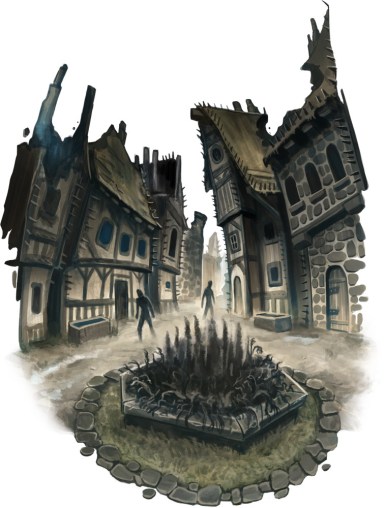
nidal land of shadows - stormhollow
Stormhollow from Nidal, Land of Shadows

Some of my favourite places to read about were the Atteran Ranches (which is a great place to create characters who want to be members of the underground resistance), Auginford (a small settlement which recently unearthed a disturbing monument), Blacksulfur Pond (a pond connected to the Shadow Plane), Brimstone Springs (where a devil is enjoying a ‘delightful’ prank), Grayfrond (home to a creature based off a chilling Inuit folk creature), Stormhollow (a village whose inhabitants were slaughtered by kytons — and still walk the streets today as mutilated husks), and, my personal favourite, The Library Without Light, which is home to ancient texts and relics dating back to before Earthfall. If any of you own this book, I’d be curious to hear what your favourite locations were!

Zon-Kuthon
Unholy symbol of Zon-Kuthon, god of envy, pain, darkness and loss.

The next chapter, ‘Threats in the Gloom,’ begins with a recounting of an adventure in Nidal, by an Aspis Agent. It’s dour and dark, and perfect. And the art that comes with it? Creeeeeeepy! After this is looks at eleven different dangerous locations in Nidal, dedicating about a page to each. It includes the classes of powerful denizens, the kinds of creatures you can encounter there, features common to the area, as well as history, and plot-hooks for these locales.  Once again, there’s a wide variety of locations here, from dungeons, dangerous wilds, haunted places, and urban areas. Those of you looking for more information on hidden bastions of good should check out the ‘Plains of Night’ and ‘Undervale.’ ‘The House of Lies’ is a great location for those of you looking for reasons for  foreigners to visit. ‘Shadowreach’ revisits the legacy of a character from the Council of Thieves Adventure Path (Ilnerik Sivanshin who was mentioned in Council of Thieves: Book 3: What Lies in Dust, and featured in Council of Thieves: Book 5 – Mother of Flies). Looking for something darker? Check out the ‘Tower of Slant Shadows.’ Not only does it have connections to the wonderful Curse of the Crimson Throne Adventure Path, it’s also (in my humble opinion) the creepiest thing in the entire book. Yikes! I wish I had thought of that for my home game of Second Darkness… My personal favourite locations in this chapter are ‘Castle of the Captive Sun’ wherein a vampire keeps a collection of divinely descended beings prisoner, and tortures himself with holy artifacts! Very cool! And Barrowmoor, which is land filled with ancient burial mounds of the Nidalese Horselords. It’s steeped not only in creepy a atmosphere and a bunch of undead, but also in the occult, which I ALWAYS love. Barrowmoor is also the setting of the Tomb of Attai Horse-Speaker, which was published in its entirety in Pathfinder Campaign Setting: Tombs of Golarion. Honestly, it’s one of my favourite tombs I’ve ever had the pleasure to read.
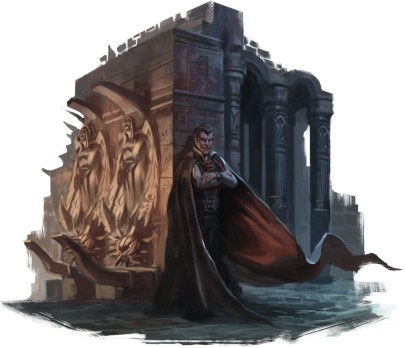
nidal land of shadows - castle of the captive sun
Castle of the Captive Sun from Nidal, Land of Shadows

The last chapter of this book is the Bestiary, which collects six random encounter tables (which contains a few entries which pleasantly surprised me!) and six new monsters. The creatures vary from CR 2 to CR 8. There’s a new kyton, of course, called the suffragan. It’s born from the souls of another new creature, the joyful thing, which definitely is my pick for the most disturbing creature in this book! Yikes! The strongest monster on offer is the hive brute. For more information on hives you can check out Pathfinder Roleplaying Game: Horror Adventures. I’m not a big fan of most plant creatures, but there is a cool shadow plant called the shadow fern which I actually really like. There’s also the smokeshade, which is a tiny extraplanar, incorporeal, aberration that looks like a patch of shadow. In addition to being an enemy, these little guys can be taken as familiars by casters of at least 7th level with the Improved Familiar feat. They’re actually quite fun, flavourful critters, that enjoy forming themselves into different rude shapes in order to mock other people or pantomime insults. I want one! Haha. But, the definite winner for the most useful creature is the shadow animal template. Not only can it be used to make shadow tainted creatures, it’s abilities are chosen from a list, which makes it very adaptable. It’s super useful, and really well done.

And that brings us to the end of Nidal, Land of Shadows. Overall, I really enjoyed this book. It made me think about Nidal in a new way, which made it playable. It also gave me a lot of good ideas for characters and adventures set in this morbid, horrible place. But, keep in mind, this book is NOT for everyone. Only purchase this book if you enjoy adding dark horror to your games.

Those of you looking to more fully immerse yourself in Nidal should pick up the Pathfinder Tales novels: Nightglass and Nightblade, both of which are written by Liane Merciel. Player’s looking to make characters from Nidal, should check out Pathfinder Player Companion: Blood of Shadows, or Pathfinder Roleplaying Game: Horror Adventures.

Thanks for taking a walk through the darkness with me!

Jessica

shadow plane by jay epperson
The Shadow Plane by Jay Epperson

Legacy of the First World

Hello, hello! Welcome! Today we’re going to take a look at one of my favourite soft cover releases of the past year: Pathfinder Player Companion: Legacy of the First World! If you’ve been reading the blog for a while, you’ll know that my daughter is already using some of the awesome character options found inside this little gem, with her Pathfinder Society character, Lady Naysha. Admittedly, I’m super jealous.

Legacy of the First World is a soft cover book that is 32 pages in length. As a book in the Player Companion line, it’s aimed at players, which means that you won’t find any great secrets of the First World hidden inside, or details on the plane itself. For that kind of information you’ll have to pick up Pathfinder Campaign Setting: The First World, Realm of the Fey, or the soon to be released Pathfinder Roleplaying Game: Planar Adventures. Legacy of the First World features amazing cover art by Kiki Moch Rizky, which showcases the iconic druid, Lini, and the iconic hunter Adowyn, engaged in battle against a grodair!
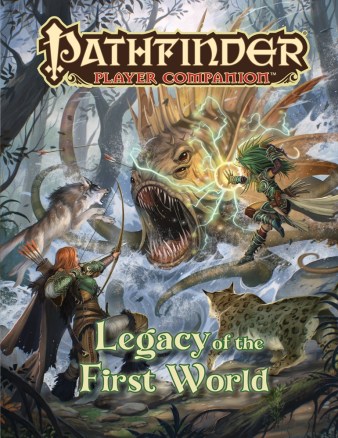
The front inside cover features brief information on all nine of the Eldest: gods of the First World who are often worshipped by fey and fey-blooded or fey-touched humanoids. Each entry includes their name, title, holy symbol, alignment, domains, favoured weapons, and the pages where related information and character options can be found. Curious who the Eldest are? Fear not! We’ll get into that later!

PZO9480After this we’ve got the table of contents, the rules index, and the introduction. Here we find five new regional traits, each themed around places on the material plane where fey  are common. Curious which locations? The Darkmoon Wood, Grungir Forest, Irrisen, Uringen, and a caravan known as the Witchmarket. ‘Fey Mediator (Grungir Forest)’ is a solid trait, but I think that ‘Voices of Solid Things (Witchmarket)’ turned out to be my favourite! This allows you to select either Appraise, Craft, Disable Device, or Spellcraft. In addition to making that a class skill, you can apply your Charisma modifier on those checks instead of Intelligence/Dexterity. Neat!

Moving on from the introduction we come to a pair of pages entitled ‘Fey Origins’ that deal with characters who have a touch of the fey in their bloodlines. Each of the core races has ideas for how fey-touched members of that race might look or act, and an alternate racial trait. After this there are three story feats which can be taken by any race. Although the human, half-orc, and half-elf alternate racial traits are very cool, its the one for elves that turned out to be my favourite. ‘Fey-sighted’ grants your elf detect magic as a constant ability, and replaces ‘elven magic.’ So cool! As for story feats? Check out ‘Fascinated by the Mundane’ for a really fun character concept!

Wait! That can’t be all that gnomes get in this book? Is it? Just a trait? Nope! It’s not. The next few pages focus on two races intrinsically tied to the First World: gnomes and gathlain. Up first? Gnomes! First up, rules for playing a bleaching, followed by two feats that can be taken by bleachlings. Finally! Past that we come to a quirky alchemist archetype called the ‘First World Innovator’ which lets you mix a bit of primal reagents into your alchemical creations (bombs, extracts, potions or mutagens) which will alter them in a random way. I highly recommend giving this one a read, because I loved it. Following the archetype itself are a trio of discoveries that let you create a fey-themed mutagen, which are pretty nifty. After that we come to two new alchemical creations: the chroma grenade, which dazzles enemies and makes them susceptible to illusions, and the vine tube, which spouts fast growing vines. These vinescan either grow along the ground to make difficult terrain, or can be molding by a skilled craftsman into basic tools and furniture which last for ten minutes. An interesting alternative to carrying around a bunch of heavy tools! The final little treat on the section on gnomes? It contains my favourite artwork in the book! A blue and orange haired little alchemist surrounded by very natural-looking components, crafting up some kind of glowing brew. I’m feeling it.

Leaving the gnomes behind we get into a pair of pages about gathlain. This section doesn’t contain any race-specific archetypes (for those you’ll need to check out Pathfinder RPG: Ultimate Wilderness), instead it features five alternate race traits, eight new favoured class options, and four new feats. For race traits be sure to check out ‘bower born’ and ‘sticky tendrils,’ and for feats take a peek at the very quirky ‘strange yield,’ which lets you pull a single fruit off of your wings a day that acts as a random potion.
After the various racial options in this book, we move on to the ways in which the First World has affected the material plane. The first two pages include the fey-touched template, a new oracle curse and mystery, and a bard archetype called the First World Minstrel. Although the First World Minstrel’s ability to pass on the ill luck of a pugwampi to your enemies is absolutely delightful, if I recommend only one thing from this book it would be the new oracle mystery: whimsy. It’s just… awesome. Flavourful, fun, and useful. I’d use it in a heartbeat. Unfortunately for me, (and very fortunate for my daughter), right before I could make a character with it, my daughter did. She beat me to it! And she did it so… perfectly. I just can’t compete. And so, for the forseeable future, I’ll refrain from making one of my own… At least until I can think of a concept completely different than my six-year old daughter’s…. For those of you who don’t have that issue, be sure to check out our favourite revelation: ‘whimsical prank!’ Other gems include ‘assumed form,’ ‘flicker,’ ‘whimsical step,’ and ‘woodland caprice.’

So good.

Seriously. Check it out.

But with a flip of the page we leave the whimsy behind to delve into two pages of character options which revolve around the harm fey can cause. First up are four alternate racial traits which focus around locations tainted by evil fey: Darkblight, Tanglebriar, and the Upper Korir River. I’d recommend giving the human trait, ‘imposter-wary‘ a read. Although it forces you to put your bonus skill point into sense motive at every level, it also grants you a bonus on saves against illusions. A great trade if you want to make a suspicious character. After this we get to a new hunter archetype that focuses on killing fey, the cleverly named ‘Feykiller.’ This archetype swaps out a few of the animal focus options for different ones, allows your animal companions attacks to bypass DR/cold iron, grants you a bonus against illusions and enchantments or, if they were cast by fey, makes you immune to such effects. Very cool! Lastly, this section gives us three new spells, my favourite of which is ‘iron spine.’ And yes, it does exactly what it sounds like it does. Ouch…

Every page after this point in Legacy of the First World is dedicated to one of the Eldest. First, it gives us a paragraph or two on the Eldest themselves, followed by new archetypes, class options, spells and gear which are related to that god or their teachings. Interesting, right?

First up: Count Ranalc, the Traitor. Eldest of betrayal, exile and shadows. This shifty fellow provides us with my husband’s very favourite part of the book: an archetype for slayers called ‘Ankou’s Shadow.‘ This awesome archetype gives you the ability to make shadow duplicates of yourself which function as mirror image and last until destroyed. As you level up you can command your duplicates to perform other actions, and you gain access to more duplicates. Oh, and you can see invisibility as a swift action for a minute per level per day. Sweet! He’d better get around to making one soon, or I will.  Haha! After this is another interesting archetype, the ‘Shadow Scion‘ for rogues.

PZO9298
For more information on the First World, check out Pathfinder Campaign Setting: The First World, Realm of the Fey

The Green Mother, also called the Feasting Flower, is the Eldest of carnivorous plants, intrigue, and seduction. Yikes! The pages focusing on her give us the ‘Grasping Vine‘ archetype for shamans, which shuffles up some spell options, allows you to speak with plants, gives you the ability to use plant shape, and even turns your familiar into a creature made of leaves and thorny vines. I think you could make a really cool shaman with this archetype. It’s very thematic, but also very… accessible. By that I mean: lots of different character concepts ranging throughout Golarion can make use of this archetype. Not just followers of the Green Mother, or characters from the First World. It’s easy to use. The second archetype up for offer here is much more of a niche, and focuses on The Green Mother’s seduction aspect. It’s the ‘Seducer’ archetype for witch! Their last ability, ‘Garden of Delight,’ just… Wow. I’m… a little surprised that saw print. I’m not sure why it surprised me so much. It shouldn’t. But, I’m certainly not letting my kids play this archetype! No way! That complaint aside, the archetype’s still not really my cup tea. Still, if you want to be a charming enchanter/enchantress style character, this is a really good option. Past the archetypes there are two new witch hexes up for offer and one new shaman hex. My favourite is the shaman hex ‘silkstring snare.’ Lastly, there’s three new spells. My favourite is ‘thirsting entanglement,‘ which is like a soul draining entangle spell, but the others are solid debuffs which should see use in play.

Up next is Imbrex, the Twins, Eldest of endings, statues and — you guessed it — twins. His two pages are almost entirely dedicated to summoners. It features an archetype, a new eidolon subtype, and three evolutions. After that there’s four teamwork feats. Usually, this would be a bit of bummer for me. I don’t often play summoners, even though I enjoy them, and dedicating so much space to only one class is a little unfortunate. But… it’s such an awesome archetype! SO COOL! The ‘Twinned Summoner’ has an eidolon that looks just like him (excluding any nifty evolutions). They also learn teamwork feats, which their eidolon can also automatically use. Think of the possibilities! It’s just… awesome! The moment my husband read it he looked at me and said. “Oh, this is interesting. You would be good with this archetype.” “But not you?” I asked. “No. Too much work. I’d get confused.” We laughed. Later I read through it, and you know what? I agreed. I could rock this archetype! Hahaha. The evolutions are brief, but useful — particularly ‘shared evolution‘ and ‘extra feat.‘ For teamwork feat be sure to check out ‘improved precise strike‘ and ‘spell synergy.’

Taking centre stage next is the Lantern King, also known as the Laughing Lie. He’s the Eldest of laughter, mischief, and transformation. Chances are when you think ‘fey’ you think of the attributes this guy has. He’s a prankster, and a shapeshifter. An agent of chaos with infinite forms. The character options include one archetype, the ‘Fey Prankster’ for bards, and two bloodlines that are both entitled ‘shapechanger.’ One is for bloodragers and the other for sorcerers. Both were really cool, but my favourite turned out to the the bloodrager bloodline. I’m not sure why I liked it so much, as the sorcerer bloodline was really solid, but hey! That’s how it goes sometimes.

Up next is an Eldest who is about as far from a jolly prankster as you can get: The Lost Prince. Also known as the Melancholy Lord, he’s the Eldest of forgotten things, sadness and solitude. This dour, brooding fellow has provided us with the ‘hermit‘ archetype for oracles, which is closely tied to the ‘reclusive‘ oracle curse. There’s also a ‘sorrow‘ themed psychic discipline, and a new type of feats which give you an advantage when no allies are nearby. I highly suggest giving the ‘hermit’ a thorough read, because their abilities are very, very cool. Particularly their base revelation, ‘Recluse’s Stride.’ For feats, be sure to check out ‘Centered Spell,’ which is a new metamagic feat which allows you to exclude yourself and your familiar from your instantaneous spells without increasing the spell level. Who doesn’t want to put themselves in the middle of a fireball once in a while? Right?

The next featured Eldest is Magdh, The Three, Eldest of complexity, fate, and triplets. Let me admit, up front, that I am a huge fan of this goddess. She’s my favourite in the book, by far! Unfortunately, none of the character options in her section wowed me. Now, maybe it’s just me. The three spells are interesting and useful. The monk archetype, ‘Nornkith‘, allows your monk to run off of Charisma instead of Wisdom, which is awesome, but… I wasn’t thrilled by anything. There are also three new items up for offer, my favourite of which was ‘charm of the thriceborn.’ I’d be very interested to hear what others thought about the options in Magdh’s section, so if you’ve given the book a read be sure to let me know in the comments below.

Next up is Ng, the Hooded, Eldest of the seasons, secrets, and wanderers. Under his section you’ll find a new cavalier archetype, the ‘Hooded Knight,’ who has a fey-touched mount, gains benefits when traveling on roads, and at higher levels can use dimension door or teleport. There’s also a new cavalier order, the ‘Order of the Blossom,’ which sounds… interesting. Although it’s got some cool abilities, including gaining sneak attack and some minor enchantments, one of the edicts forces you to always accept a fey’s request for aid — which could be very troublesome for obvious reasons. Thankfully, blighted or corrupted fey are excluded from this, and he must instead destroy them. Still… It could be rough! Best ensure you have an understanding GM before selecting it! The final options in Ng’s section are three new items which involve secrecy. Be sure to check out the ‘whispering gloves,’ and the ‘clandestine horseshoes’! The ‘hood of privacy‘ is awesome, but very expensive. Definitely an investment.

Following Ng’s secrecy is an interesting Eldest who cares nothing for subtlety: Ragadahn, The Water Lord, Eldest of linnorms, oceans, and spirals. He’s a brutish creature who counts all the oceans of the First World as his territory. He expects fealty, and respect, but little else. There’s two new archetypes in his section, The ‘Deepwater Rager‘ for barbarians, and the ‘Serpent Herald’ for skalds. Despite the name, the ‘Deepwater Rager’ isn’t actually an underwater combatant. I highly recommend giving it a read, because their abilities ‘Spiraling Charge’ and ‘Disorienting Grapple‘ and both very cool! There’s also three new rage powers in this section of the book (check out ‘Master of the Deep,’ which lets you command aquatic creatures), and two bardic masterpieces, both of which are cool. ‘Ragadahn’s raqs beledi’ is a dance that allows you and your companions to squeeze into tight spaces without trouble, while ‘Ragadahn’s spiral ascent’ allows you to make a whirlwind which can whisk your companions to higher ground. Intriguing!

Finally, we come to the last Eldest in the book — which is also the last page of the book —Shyka, The Many, Eldest of entropy, reincarnation, and time. Now, time related concepts are both very cool, and very difficult to work with in a d20 system. So, although I went into these pages with high hopes — hopes made higher by the awesome wizard artwork in this section — I was wary I might be let down. This section contains a single archetype, and four new spells. The archetype is called the ‘Chronomancer,’ and is for wizards. They gives up the arcane bond class feature, as well as most of their bonus feats, to gain a reservoir of energy they can use to alter time. At low levels they can use it to improve an ally’s initiative, or saving throws, and to immediately re-prepare failed spells (either due to a failed concentration check, a passed save on behalf of your enemies, spell resistance or other immunities, and so on) as if they had not been cast. Cool, right? At higher levels they can use it to cast haste on their allies or trigger contingencies. At level twenty they can even summon a version of himself from an parallel timeline at the moment of his death. The alternate you only lasts for a minute, but it’s one heck of a final gambit! He even comes with your gear! I was SO pleasantly surprised with this archetype! If you’re even remotely interested you should give it a gander. As for the spells? Very cool! Particularly ‘temporal divergence!’ Definitely read it!

And that’s it! We’ve reached the back cover, and Legacy of the First World has come to an end. I hope seeing a bit of what’s inside has helped you decide whether this is a book you want to invest in. And if you’ve read through it already, be sure to let us know what your favourite options were in the comments! Still want more fey-inspired goodness? Be sure to pick up the newest Wayfinder fanzine, Wayfinder 18: Fey and the First World, which is a free download on Paizo’s website.

Enjoy!

Jessica


Mummy’s Mask: Death in the Streets

Today on d20 diaries we’re heading back to Wati for more of the Mummy’s Mask Adventure Path! That’s right! It’s game night! So while all of our kids settled in for a night of movies and popcorn, we adults cracked out our dice, scrambled around for our character sheets and settled in to play!

PZO9079
Mummy’s Mask: Book One: The Half-Dead City. Written by Jim Grovesand intended for level one characters.

Mummy’s Mask is a six part adventure path for the Pathfinder Roleplaying Game, intended to bring your characters from level one to around level seventeen. This campaign takes place in the deserts of Osirion, and involves trap-filled pyramids, haunted tombs, scorching deserts, bustling bazaars and more undead than you can shake an ankh at! The Mummy’s Mask Player’s Guide is a free download on Paizo’s website, and contains a ton of useful information for players looking to make characters that have lasting ties to the campaign. For more information on Osirion, you can pick up Osirion, Legacy of Pharoahs. Players looking for desert-themed character options can also check out People of the Sands.

My home group has recently completed Mummy’s Mask: Book One: The Half-Dead City, and have moved on to Mummy’s Mask: Book Two: Empty Graves, both of which take place in the desert city of Wati. For those of you looking to run the game as a GM I highly recommend picking up the Mummy’s Mask Adventure Path Pawn Collection, which has a over a hundred unique pawns for use in this campaign. You’ll also get a TON of use from the Mummy’s Mask Poster Map Folio. Trust me, by the end of Empty Graves your map of Wati will have had one hell of a workout. Mine’s already covered in a ton of numbers and labels I’ve added in permanent marker, to help my players keep track of the many locations in this quirky city. The campaign is also available in other formats, including The Pathfinder Adventure Card Game: Mummy’s Mask Base Set, and as a series of audio stories beginning with Pathfinder Legends: Mummy’s Mask 1: The Half-Dead City.

If you’re interested in my previous posts about Mummy’s Mask, check out Mummy’s Mask: Game AidsMummy’s Mask: The Shrine of Wadjet,  Mummy’s Mask: The Canny JackalMummy’s Mask: The Dead Come Knocking…, or learn more about our characters  in Character Focus: Mummy’s Mask: Fateway Five.


When we last left our quirky crew of heroes, commonly known as the Fateway Five, they were standing in the Sunburst Market surrounded by the dead. Or, rather, the recently destroyed undead. The team had been present at an auction which had been rudely (and violently) interrupted by a pack of roving zombies and a particularly angry crawling hand. After saving the other attendees and laying the smack down on some undead, they headed out into the city to find Wati under attack by walking corpses. Without hesitation they waded into battle, saving more than a few familiar faces. But on the wind they could hear the screams of the living, and the rasping groans of the dead. The battle was far from over.

Wati was under attack. But from where? And why were the dead rising?

PZO9080
Pathfinder Adventure Path: Mummy’s Mask: Book Two: Empty Graves.
Written by Crystal Frasier and intended for level four characters.

The Fateway Five paid a quick visit to the three local churches in order to coordinate a plan to save Wati and then set their sights on the town. But first? Gear. Having just come from a fancy auction with the nobles of Wati, they were more than a little under-equipped for battle. Or rather, some of them were. Arc had shown up half naked with a bag of dirt on his back, like always. But Nazim and Kasmet had attended in finery and jewels! Jewels would not win a battle. And finery? It would get torn and stained! They needed their gear, which was tucked away safely in their rooms at the Tooth and Hookah.

As they turned to leave the Sunburst Market they heard some loud screams. Women! Lots of them! And infants….

Immediately my players looked at each other and nodded. They all agreed without argument that paying a visit to Insula Mater (the local hospital dedicated to the care of pregnant women and infants) far outweighed their need for gear. And so, dressed in their finery and under equipped, the Fateway Five rushed off in the opposite direction, to Insula Mater.

Insula Mater is a large, multi-level building with easily locked and shuttered windows and lockable doors. The grounds are surrounded by manicured bushes in order to offer the women and infants on the grounds privacy. Insula Mater is run by a learned and weathered cleric of Pharasma known as Auntie Jehuti, staffed by a team of six other Pharasmin midwives known as the Mother’s Handmaidens, and guarded by a small contingent of holy guards. As the group arrived on the scene they found the windows shuttered, and doors locked. Two guards stood in front of the building’s doors, fighting off two zombies, with two other guards flanking the zombies from the other side. The zombies would not live long. But from the upper windows came panicked cries and the wailing of infants. Another voice rang out above the din, shouting: “We’re missing one! We’re missing a mother!”

images
Learn more about Lamashtu, Pharasma, and the other gods of Golarion, in Pathfinder Campaign Setting: Inner Sea Gods.

Knowing that the two residents of Insula Mater with whom the Fateway Five had shared an evening with had signed themselves out for the evening and were currently safe at the Grand Mausoleum, the group all knew that their companions were not the mother in question. With worry, they left the guards to deal with the zombies and scoured the grounds for the missing woman. They found her easily, engaged in an argument with a guard on the corner of the grounds. It was Keera, a confident pregnant woman they had met earlier in the day, with nasty scars across her face from some kind of clawed creature.

The guard was urging Keera inside, proclaiming: “It’s not safe.”

Only for Keera to reply. “You’re right. It’s not.”

Suddenly, from behind the bushes burst a quartet of zombies, all of whom moved to attack the poor guard. He howled in pain and moved to protect Keera, while Nazim let out a loud ululation and charged into battle with his khopesh raised high. Kasmet dashed into the fight right behind him, while Arc moved to help Keera. Much to their surprise, Keera began to cast a spell, proving herself much more capable than they expected.

The zombies began to fall under the player’s attacks, while the guard was heavily wounded. Kasmet tore into the zombies with her claws, Nazim swung his khopesh, and Arc pulled out a dagger and cut up the zombie’s arms. Suddenly there was a flickering of magic, and some grotesque-looking wild dogs appeared on the battlefield. Keera’s spell was complete! Her dogs let out a growl and attacked the guard. Keera stepped back away from the fight, let out a series of manic laughs and began to cast another spell.

Needless to say the Fateway Five was confused! Arc tried to get through to Keera (because clearly she was delusional! Right…?), while the rest of the team put an end to the zombies and slaughtered the magical dogs. The guard fell during the battle, while Keera laughed and danced away from the group with a dagger in her hand. She intoned a prayer in a foul language and sent a pulse of evil energy out at the PCs. The only discernible word the PCs had understood was a name: Lamashtu. Goddess of monsters, madness, pregnancy and  deformity.

In a rage, Nazim charged at the woman and cut her down, ending her life with a slash across the throat. As she gurgled in surprise, Nazim and Arc got to work on attempting to save her baby. With one of them a trained midwife, and the other a gifted healer, the odds of the child surviving were pretty high. Confident in their abilities, and well aware that she was near term, they performed an emergency cesarian, cutting the infant out of her mother’s womb, only to discover the baby was a hideously deformed monster with crooked hoofed feet, horns on its head, and a scaled tail. While Kasmet raised an eyebrow at the proceedings, Arc and Nazim were unphased by the child’s appearance, caring only for it’s health. During the operation a guard came upon them.

PZO1112_500
Many of the enemies mentioned today can be found in Pathfinder’s Bestiary,including skeletons, zombies, and shadows! This book is available in hardcover, and a small, softcover edition.

Covered in blood, with a nearby guard killed by the teeth of a dog (which could be easily confused with those of say… Kasmet), and a dead pregnant woman at their feet, a guard commanded them to stop. Nazim and Arc refused. Instead they finished delivering the baby, and ensured it was hale and healthy. Then they passed it off to the guards, explained what happened and moved to leave. The guard didn’t believe them at all. Perhaps due to the unbelievability of their tale, the evidence that seemed to point to their guilt, or their HORRIBLE social skills. But, in the end, he let them go anyway, clearly deciding that bringing an infant into battle against three warriors was a horrible plan.

After that emotionally draining experience, the Fateway Five hurried off to the Tooth and Hookah to pick up their gear. On the way they ran into a pair of clearly wealthy people, who were battling a group of six zombies in the road. They seemed experienced with their weapons, and unworried about the entire ordeal. Nazim let out another ululation and rushed into battle, with Kasmet and Arc following close behind. The battle was over quickly, and the moment it was, one of the unknown warriors, a dashing middle-aged man with a charming grin, gave Kasmet’s hand a kiss and began to flirt with her. The other unknown warrior, an imperious woman in her late twenties, rolled her eyes.

“You’re an embarrassment,” she told the man.

The man laughed, and introduced himself to the group as Ahben. He continued to flirt, which Kasmet accepted with a swish of her tail and a purr.

“We need to go home,” the woman pressed.

“Nonsense, Hakor! We have business in Bargetown.” He then proceeded to ignore the other woman’s complaints and explained to Kasmet, “I have a friend I need to visit before they leave. Perhaps we can see each other again, in a more intimate setting.”

Kasmet agreed, then was left in a bit of a daze as Ahben and Hakor turned to leave.

Hakor shook her head in disgust. “You’re the worst father.”

“Oh, don’t be silly.” Ahben remarked as they left. “It’s well known I’m a wonderful father. Just ask your siblings.”

The woman didn’t seem amused.

As the Fateway Five watched the wealthy pair walk away, Kasmet’s heartbeat returned to normal and she finally realized where she had heard the names Ahben and Hakor before… Ahben was the Patriarch of House Okhenti, one of the most powerful families in Wati. He was a member of the city council, and well known for taking care of his many children by giving them government jobs, and seeing to their martial training. His many, many, MANY children. For Ahben was notorious for having hordes of lovers. His legitimate children were known as the ‘Scions’ of House Okhenti, while his bastards were simply his children. All of whom he took to live with him on his vast estate. Much to the displeasure of his wife. In fact, the Fateway Five had met two of Ahben’s son at the auction earlier that night: the pompous Scion of House Okhenti, Khammayid Okhenti, and the irreverent  Teos Okhenti. And Hakor? She was Ahben’s eldest child, a Scion of her line, and set to inherit her family’s wealth and estate.

Kasmet shared what she knew of the man with her companions as they made their way to the Tooth and Hookah. There were a few zombies out front which they dealt with quickly, before being ushered into the building by its owner, Farhaan. The Fateway Five had little time to rest. They quickly re-equipped themselves, ensured the Tooth and Hookah was secure, bid their patron farewell, and headed back out into the night. They headed right for the front gate, but as they passed by the many courthouses along the way they came upon a grotesque sight: fresh corpses lined the road. The PCs approached closer, to discover that many of the bodies were Voices of the Spire, and all of them were missing both of their eyes.

“Oh, gods,” Kasmet gasped while Nazim intoned a Pharasmin blessing over the corpses. “Back in the time of Wati’s first occupation, a common punishment for lawbreakers was enucleation: the removal of the eyes. It’s still practised in some places today, but not here. Once though… Hmm… There was a judge who was known for plucking the eyes out of people for even the simplest offences. A task he would carry out with his own bare hands. They called him ‘Old Eye-Taker.’ And he operated out of that courthouse.” Kasmet pointed to the ancient looking court one building over.

“That’s horrible!” Arc exclaimed.

Kal appeared out of nowhere and let out a laugh. “Hey, sometimes losing an eye is a blessing! Like if they had to look at your ugly face every day!”

Nazim clanged his khopesh onto his shield. “Enough bickering! We must find the culprit.”

And with that the group raced down the road to the courthouse.

Inside they found an undead trial in session. Four skeletal bailiffs presided over a criminal kept on trial against her will. It was Ankhet, a young dwarven member of the Voices of the Spire, whom they were acquainted with. She was unarmed and bruised, with a look of terror on her face. Presiding over the courtroom was a bloody skeleton wearing a judge’s robes with a black fez on his head. It was Old Eye-Taker, himself! Back from the grave!

He slammed his gavel on the wooden podium. “And the verdict has been rendered! You have been judged guilty!” the skeleton announced. “Those who sin against the pharaoh should forfeit the souls their eyes house. Therefore, your punishment is enucleation, to be carried out IMMEDIATELY!”

Ankhet let out a scream.

PZO1012_500
Old-Eye Taker, as well as Osiriani styled zombies, and many other pawns can be found in the Mummy’s Mask Adventure Path Pawn Collection

Nazim burst into the room with a shrill ululation and raced down the aisle towards the front. Arc hurried around the sides, hugging the wall in an effort to get to Ankhet before she lost an eye. Kasmet dashed over pews and benches, tumbling up and around to the other side, in the hopes of flanking the skeletons with Nazim.

“ORDER IN THE COURT!” Old-Eye Taker howled. “GET THEM!” After ordering his bailiffs to attack the PCs he moved down from his podium to attack Kasmet. He gave her a shove and tried to pin her down, in an effort to take her eyes.

Kasmet shrieked and squirmed, and managed to evade his grasp.

Meanwhile, Kal let out a series of ‘eye’ jokes. Then came one of the most enjoyable parts of the session: I challenged my players to come up with eye jokes while we played. Every turn Kal would shout out a new joke or pun and whoever called a new one out first would get to choose it. Everyone took to the challenge with glee, shouting out puns that ranged from obvious to witty. In the end, my sister-in-law ended up giving Kal the most lines, a victory worth celebrating!

Back in Wati, Arc readied his quarterstaff and waded into battle with the skeletons who held  Ankhet prisoner. He urged her to help, but she was too scared, leaving Arc one heck of a challenge! The bailiffs all moved to try to capture and pin down Kasmet, which proved very difficult. Nazim smashed them to pieces with his shield, while Kasmet tumbled around, flanking with Nazim in order to get her sneak attack damage on the skeletons, all while evading their efforts.

Soon, Ankhet was free, and only Old-Eye Taker was left standing among the enemies. United, the group made quick work of him, and promptly stole his wonderful fez. Even better? No one lost an eye.

Arc quickly tried to get Ankhet ready to move, a task made extra difficult by the rude cat making eye jokes from Arc’s plant-bag. With the dwarven woman ready to move, Arc healed everyone and they set out for the gates to the Necropolis. There they hoped to discern if the undead were escaping from inside the Necropolis, or were coming from somewhere else. But, as they reached the road they felt a sudden pulse of foul energy roll through them. A moment later, the eyeless dead shuddered and twitched, and climbed up onto their feet. They had become freshly risen zombies! This wasn’t the first time they group had felt such a feeling, or seen freshly killed dead rise…

“Necromancy!” Nazim shouted. “An affront to the Lady of Graves! We must find the source of this evil!”

“Less talking, more killing!” Kasmet shouted back. She dashed into battle as the zombies tried to gain their footing. Meanwhile, Arc drew his dagger and Nazim let out an ear splitting ululation before charging at the undead with his khopesh. Ankhet stood there in stunned terror.

Kal waved his paws in front of her face and laughed. “HA! Look at her! She looks half-dead herself!” he told Arc’s rabbit familiar.

The little rabbit twitched her nose, wiggled her ears and then shook her head once.

“What? It’s FUNNY!” Kal replied. “You’re too kind!”

By the time the silvanshee was done making his jokes at poor Ankhet’s expense, the battle was over. Eight weak undead stood little chance against the Fateway Five.

Arc sheathed his dagger and turned to face Ankhet. “I’m sorry about your friends. But we have no time to mourn. Wati needs us.”

The group hurried the rest of the way to the Necropolis without further trouble. There they found the gates shut and barred, with a great wailing and banging on the other side.  The voices of dozens of undead moaned and screamed on the other side of the gate, their fists pounding against the doors and the walls. Bal Themm stood at the gate, bracing it shut with her body alongside two other guards from the Voices of the Spire. They strained with all their might, but with each bang from the other side the entire gate shuddered.

“Fateway Five!” Bal shouted at the sight of them. “Come here! I need you to deliver a message to the Precinct of Left Eyes! It’s the base for the Voices of the Spire. Tell them we need reinforcements! And we’re out of holy water!”

The group urged Ankhet to join the other Voices before turning away, when they suddenly noticed a strange sort of shifting ripple across the gate. Two undead shadows emerged from the Necropolis and into the road, passing right through Bal Themm and the other guards.

They gasped in pain.

“Hold your… post…” Bal groaned, but the other two guards broke ranks and ran. Weakened and surrounded by undead spirits, Bal held her ground alone. She did not flee.

BANG!

Behind her, the door shuddered.

BANG!

PZO1001-1_500
You can find pawns for skeletons, zombies and shadows, in the Pathfinder Pawns: Bestiary Box

Nazim let out another ululating cry and held his holy dagger, the Fate Blade, to the sky. He prayed to Pharasma, causing a burst of holy energy to surge out of his dagger. The shadows howled in pain. Kasmet quickly pulled out a few vials of holy water and began tossing, while Arc grabbed Ankhet and dragged her to the gate.

The shadows surged forward at Nazim, who combatted them alongside Kasmet with holy water and divine power, giving Arc the opportunity he needed to help Bal hold they gate.

BANG! BANG!

The gate shuddered, and the undead moaned. Finally, Ankhet seemed to realize that if she didn’t help, the gate would fall, and she would die. Together, she and Arc helped Bal Themm. A few moments later, Kasmet joined them. Nazim struggled against the incorporeal horrors, but he never lost his faith, and soon he defeated them with the powers of his goddess. Tired and weak, he let out a victory cry. Then he pulled out his portable ram and helped use it to brace the gate. Kasmet and Nazim moved over a wagon, then some heavy crates and other heavy objects scavenged from the nearby roads and buildings.

The undead continued to wail and bang loudly against the gate, but it held firm. They had secured the Necropolis Gates.

Arc did his best to treat Bal Themm’s wounds and heal some of her strength damage, then did the same for Nazim.

“Go on,” Bal urged them. “Get the reinforcements.”

Ankhet took a deep breath and nodded. “I’ll stay here.”

And so the Fateway Five headed off down the street and over a few blocks to the Precinct of Left Eyes, home to the Voices of the Spire, and the city’s prison. They could tell there was trouble even before they neared. The wails of the dead mingled with the cries of the living. The clash of steel, and the thudding of flesh on shields thumped below the din, like the drum beat of a wild, savage song.

They quickened their pace and emerged to a great battle. A large group of the Voices of the Spire’s holy warriors stood on the building’s front steps, locked in mortal combat against a thong of undead. Their Commander, Nakht Shepses, stood among them, with his second in command, Shenanda by his side, battling like any other soldier. On the other side of the undead, surrounding them, were other Voices of the Spire warriors. Although the undead were many, the Voices fought with skill and determination. Many of them fought undead on a daily basis, and let neither fatigue nor panic interfere with their duties. Clearly, the skeletons and zombies in the throng stood no chance.

With a cry, the Fateway Five charged into battle, fighting alongside the Voices to bring an end to the undead assaulting this part of the city. Upon the defeat of the final undead, Commander Shepses began giving orders to his troops. He was organizing them to reequip and begin patrols of the Necropolis walls. As expected, they were going to use their resources to keep the undead within the Necropolis, instead of helping the living survive.

The Fateway Five tried to push their way through the Voices in order to reach the Commander, but had no luck. Fortunately, they had fought alongside Shenanda on multiple occasions. When she saw them she made her way through the crowds to them.

“What is it?” she asked without preamble. “Have you come to help?”

“Undead are trying to batter down the Necropolis gates. There’s only two guards there. They need reinforcements.” Kasmet explained.

“And holy water!” Arc added.

Nazim locked eyes with Shenanda. “That’s not the worst of it. Shadows slipped right through the gates. If we would not have been there, the gate would have fallen, and Bal Themm would be dead.

Shenanda looked shocked. “Shadows slipped through the door? You’re sure?” As the others nodded, Shenanda shook her head. “That should be impossible…. The gates and walls are warded to prevent undead of any kind–even incorporeal spirits–from passing through. How did… What is…” She shook her head. “I’ll inform the Commander immediately. Thank you.”

Shenanda slipped back through the crowd and the Fateway Five took the opportunity to follow her. The Commander was shocked at her news. “Send word to the Grand Mausoleum. We’ll need their clerics to assist in reconsecration.”

“We can do that!” Nazim suddenly blurt out. “We need to return there shortly, to inform High Priestess Sebti of your plans.”

Commander Shepses eyed the group with a mix of suspicion and disdain. “Very well. Be gone then. Ensure you don’t lapse in your duties.”

Nazim nodded, and the group turned to leave.

Kal chose this moment to begin speaking again. “MAN! This jerk has a huge stick up his butt! You think he’d give us a thank you or something!”

The Commander glared at the cat (and it’s presumed owners) before ignoring them completely.

Arc blushed brightly and stammered out an apology, but the Commander was already in conversation with a priest. They spoke about summoning psychopomps to combat the undead.

Nazim’s furry jaw dropped. Unable to resist, he pointed out that psychopomps were dangerous creatures. Although they did hunt and destroy undead, many had little care for the living. Such creatures could be incredibly dangerous to the populous!

Unfortunately, The Commander ignored his warnings, and returned to his conversation with the priest.

Nazim frowned. Turning to his companions he growled, “We need to tell High Priestess Sebti. NOW.”

“We promised Manaat we would fetch her family before returning to the Grand Mausoleum.” Arc pointed out.

Kasmet nodded. “They live right against the Necropolis walls, Nazim. They could be in trouble.”

Nazim considered this, then nodded. “You’re right.” He pointed off towards the slums of the Asp District. “Let’s go!”


That’s all for our adventures in Wati today! I appreciate you coming along for the ride. Keep your eyes peeled for an upcoming post, wherein the Fateway Five battle their way through the slums of the Asp!

Jessica

A Trip Down Memory Lane…

I recently started watching iZombie (iZombie: The Complete First Season (Blu-ray)) on Netflix. For those of you who don’t know, it’s a show about zombies that is currently starting its fifth season. Now, this isn’t some depressing ‘Walking Dead’ (The Walking Dead: Complete Series) type show (although I also love that…). It’s more like a funny cop/murder mystery show. Except if one of the main characters was a zombie who needed to feast on brains in order to retain her humanity. Oh, and she works in a morgue. It’s loosely based on the comics (iZombie Volume 1: Dead to the World) that were written by Chris Roberson and Michael Allred, and published by Vertigo.

My husband and both thoroughly enjoy it, and are currently nearing the end of the third season. Anyway, we were watching last night and suddenly came upon an episode entitled “Twenty-Sided, Die” wherein our beloved zombie heroine devours the brains of a dungeon master in order to help solve his murder. It was a hilarious episode, and completely absurd, but halfway through she convinces her friends to play a session with her, in order to help stimulate memories of the deceased. So there they are, sitting at the table: four people attempting to humour their friend. One secretly wants to play, one’s there to give it a shot, and the other two would rather be doing anything else. By the end of their session nearly everyone has had a blast, and gotten right into it. At the end the episode one of the serious cop characters tells the zombie girl that she should run a game every week. It was just SO refreshingly entertaining.

Which got me thinking.

It’s rare you get to see d20 games featured in popular media. I adored this episode of iZombie, and of course, there’s plenty of wonderful Dungeons and Dragons cameos and references in Stranger Things (Stranger Things (Season 1: Collector’s Edition))). But where else have I seen good d20 references? I know there’s others out there, but I couldn’t recall any specific instances.

More than that, though, it brought back memories.

The first time you played a d20 game.

Remember that?

Trying to figure out the rules while you make your first character? Being a little nervous at first, as you figure out what you can and can’t do? Finding your voice? The laughter?The nerves?

The first time I made a character for Dungeons and Dragons I was in high school. A friend had insisted a big group of us make characters and get together to play. Most of my friends said no, but I was one of the few who said I would. A few years before that I had stumbled across a copy of the Dungeons and Dragons Player’s Handbook (3.5) in a bookstore and flipped through it. I wanted the book so bad, but had no idea what it was. I must have looked at it over the next twenty trips. Passing by, browsing, but never buying. Flash forward a few years and I suddenly went ‘A-ha! That’s how you use that book!’ I made myself a dual-wielding elven ranger with long red hair named Meloriel. We went to the store and browsed minis until I found the perfect one. And then…. Nothing. We never played.

It wasn’t until many, MANY years later that I finally had the opportunity to play again. This time I made a half-elven bard named Lorelei. My husband (we had just started dating at the time) played her boyfriend, a gnome illusionist named Blount who worked as her stage-hand. My brother played a fierce minotaur warrior, while co-workers of my brother and husband played a lizardfolk and a half-orc monk. It was DMed enthusiastically by another co-worker of my brother’s. The game wasn’t very long-lived, but it sure was fun. We immediately began buying the rulebooks and campaign settings. I got addicted to Dungeon Magazine. We went out and bought pewter miniatures, only to paint them ourselves with whatever we had on hand. I even cracked out my pencil crayons and drew my own character art. Sadly, the campaign came to an abrupt end when my husband and I went on a vacation, but we never lost our love of the game. We were hooked from that first roll of the dice!

In the years since we must have remade our characters at least three times. But, each time, they never get further than a few sessions into their tales. Maybe we’ll make them again one day. Perhaps as Pathfinder Society characters, or in a home game with my kids.

It’s funny, I suppose, that something as simple as playing a game for the first time can change your life so completely. But, here we are.

I wouldn’t have it any other way.

Have any stories to tell me about your first characters or first experiences playing a d20 game? Know any awesome shows or films that reference d20 gaming? Let me know in the comments! I’d love to hear what you have to say.

Jessica


Farewell to OutPost

As we roll into the month of May, we reach the end of the online play-by-post convention for the Pathfinder Roleplaying Game and the Starfinder Roleplaying Game: OutPost!

OutPost marked my first PFS convention. It was also my husband and children’s first foray into play-by-post gaming, and their second adventure in the Pathfinder Society, so it was pretty exciting for us! My husband signed up for one game, while my children each signed up for two. And me? Well, I signed up for a lot. Three for Starfinder and three for Pathfinder. Plus the Solstice Scar Special.

All of the scenarios were a blast, and we had the wonderful luck to play alongside some awesome GMs and players. All told, not counting specials, OutPost hosted fourteen games of Core Pathfinder Society Scenarios, fifty-seven games of Classic/Standard Pathfinder Society scenarios, eleven games of the Pathfinder Adventure Card Game, and twenty-four games of Starfinder. That makes for nearly a hundred games!

So, what did we play?

I’ll tell you!


Black Waters

GrandLodgeSymbol
Glyph of the Open Road, symbol of the Pathfinder Society and the Grand Lodge faction.

My husband, children and I all signed up for an old classic: Scenario #06: Black Waters. From season zero, this adventure is intended for tier 1-2 and 4-5, and was written by Tim and Eileen Connors back before Pathfinder had it’s own rules set. It was being run by one of my favourite GMs I’ve had the pleasure of playing alongside on Paizo’s Messageboards, GM Shieldbug, who gave us a great game. Seriously. It was such a wonderful experience, my kids and husband are now thoroughly spoiled. I warned them after we finished this scenario to lower their expectations for whatever scenario they signed up to next, because not all GMs are as awesome as Shieldbug. They didn’t believe me at the time, but for the record, they do now. If you happen to be lucky enough to join a game he’s running, I highly recommend leaping at the opportunity. You won’t regret it.

Black Waters takes place in the Beldrin’s Bluff district of Absalom. Once a neighbourhood full of the wealthy elite, this area was devastated by an earthquake a decade or so ago, which killed many, and sent an entire chunk of the cliffs the neighbourhood was built upon, tumbling into the sea. Included in this devastation was a school for the city’s elite called the Tri-Towers Yard, which collapsed into an ancient underground necropolis. As the buildings are destroyed, black foul water rose up from below, drowning all those who weren’t crushed. The Tri-Towers yard was sealed up, and no one has been allowed inside–or into the necropolis–since. Lucky for us, the Pathfinders have finally been granted clearance, presuming they treat the site with respect.

My husband played Enzo Jeggare, a well-groomed, Chelaxian nobleman with pale skin, black hair, grey eyes, and a fabulous moustache. He’s a handsome, if lanky, gentleman with a reputation as a philanthropist and a conjurer. He enjoys fine wine, fine company, and ancient magical objects. Enzo is a secretive man, which gives him an air of mystery. Though well-practised in the art of evasion, he’s an awkward liar. He is never without his Devil Deck—a beautifully illustrated harrow deck adorned with images of devils and infernal symbolism—and a worn-out dog figurine that he can occasionally be seen speaking to. Enzo’s an occultist who specializes in conjuring creatures. He used his esteemed family’s political connections to gain membership into the Dark Archive’s faction of the Pathfinders, and is hopeful that handling other objects of power will allow him to access other magical abilities.

My daughter played a two-tailed kitsune druid (saurian shaman) with pink fur and eyes by the name of Bunny Paras. She is always accompanied by her pink and yellow pet parasaurolophus, called Paras, and adores rabbits. She and Paras run a rabbit farm–although they are sold only as pets, and are not for eating! Bunny Paras is a vegetarian, and a good healer. Paras loves to sing and dance, and is very, very loud.

My son is playing Senton, a pale Ulfen ranger better known as Mr. Ice. He is always shivering with cold, and has constantly chattering teeth.  He wears warm winter clothes in every weather, including a big furry hat on his head, and a fur cloak and boots. He has a black patch on his cheek from some old frost bite, a big bushy beard, and a full moustache. Under his hat his hair is grey and his eyes are blue. He likes to fight with his short swords and his fine longbow. Senton works on Bunny Paras’ rabbit farm as a guard. He often lays traps to protect the farm.

Their characters were first introduced in the d20 Diaries blog post: Joining the Pathfinder Society, where I talked about their backgrounds, creation, and mechanics. Their first adventure, playing Scenario #9-10: Signs in Senghor, was chronicled in a two part series on d20 Diaries: Signs in Senghor: Part One and Signs in Senghor: Part Two.

But, this kooky trio wasn’t the only Pathfinders on the case. I played my wood kineticist, Everbloom, a wild and curious kitsune who grew up alone in the wilds and views life and death as just another fascinating part of existence. Her fur is an orangy-brown, with bits of leaves and flower petals constantly tangled in its length. Everbloom’s easily fascinated by people and places, and just as easily bores of them. More than a little aloof and uncaring, Everbloom comes off as way nicer than she actually is.

The final character was Tera Fosham, a veiled ifrit oracle with clouded vision whose healing touch and blessings were invaluable on this adventure.

Together, these five Pathfinders enjoyed some awesome roleplaying with their venture captain (Drandle Dreng), at a fancy dinner party held alongside Absalom’s nobility, and with the caretaker of the Tri-Towers Yard, who is equal parts sad, deluded, and gifted. Possibly insane. I’ll leave that up for debate! From there they investigated the haunted classrooms, and foul black waters of the estate. Battling off monstrous bugs and undead, they descended into the ancient necropolis to discover its secrets. Along the way, they made some amazing discoveries, and even saved a little girl. The frail–but still alive–Junia Dacilane. Junia reappears a decade down the road in the Pathfinder Society Scenario #7-05: School of Spirits (which is a delight), and can even be found in the  Pathfinder Society Pawn Collection, which I only recently discovered and am itching to get my hands on!

Want to follow along with their adventures? Check out the complete gameplay for our group here.

In the time since playing Black Waters, Enzo, Bunny Paras, Paras and Mr. Ice have played through the Many Fortunes of Grandmaster Torch, and are soon to begin Scenario #7-10: The Consortium Compact!


Delirium’s Tangle

My children were so excited to play in OutPost that they created a second character each for the occasion, a pair of twenty-five year olds who couldn’t be more different. Lady Naysha is an oracle of whimsy who stumbled in the First World through a fairy ring, and came back over a decade later looking like not a day had passed. A few years have passed since then, but she still doesn’t look a day over twelve. Lady Naysha has a child-like enthusiasm and innocence about her. She believes her stuffed rabbit, Miss Whiskers, is the source of her powers (which is entirely false, by the way), and can all upon her fairy friend to play tricks on her enemies.  Contrariwise, my son made a paladin of Iomedae who is brave, bold and true! Unfortunately, he died fighting in the Worldwound. Iomedae took pity on him and granted him a second life, but he was reincarnated as an old man, with horrible memory problems. Unable to even remember his name, he calls himself Fuzzzy, and he relies on his pet owl, Bobby, to keep him on track. For full details on my Lady Naysha and Fuzzzy, check out my blog post OutPost Commences.

I joined them, with my dwarven fighter, Juno Berik, a self-centred woman who believes she’s far more important than she’s given credit for. Together with some other quirky characters, they entered a complicated maze underneath Absalom City to search for a lost minotaur prince, Nuar Spiritskin, in another classic PFS Scenario, #45: Delirium’s Tangle. This is a tier 1-5 scenario written by Crystal Frasier. Personally, I find this is a difficult scenario to run by play-by-post, as navigating a maze is always tricky in person, never mind over message boards. When it could take an entire day for a team to roll a single perception or survival check–which could be done in seconds in person–there’s a high probability the game will get bogged down. Fortunately, our GM was wonderful at streamlining the navigation process. In fact, this scenario finished first out of all the games I played! As poor navigators, the sheer number of pit traps we endured (and by endured I mean fell into over and over again) was painful (literally), and has left permanent mental scarring on Juno. Fuzzzy was also traumatized by the event–for about a minute before he promptly forgot about it. The fights and secret chambers were interesting, and left my kids hungry for more information on the maze and its connecting chambers. The final battle was interesting, as was the wrap-up roleplaying. All in all, we had a lot of fun, although this one certainly left a lot of unanswered questions.

You can read our complete gameplay experience here, if you’re interested.

In the time since, Lady Naysha’s begun Scenario #5-08: The Confirmation, alongside my husband’s character, Toban Tangletop (check out the ongoing gameplay here). Fuzzzy’s moved on to combat the Master of the Fallen Fortress (a free download on Paizo’s website, by the way) and rescue a lost Pathfinder (check out the ongoing gameplay here). And, Juno’s decided to tell the Aspis Consortium where to shove it, in Scenario #4-07: Severing Ties. Currently being as boorish and mean as she can be, she’s in Riddleport, happily dragging the Aspis Consortium’s name through the mud. This scenario’s about to begin a two-week break while some of the participants go on vacation, but you can check out it’s progress so far, here.


The Unseen Inclusion

250px-Scarab_Sages_faction_symbol
Symbol of the Scarab Sages, a faction of the Pathfinder Society.

I was positively thrilled to bring my beloved half-orc monk, Kenza Bloodborn, through Scenario #9-04: The Unseen Inclusion. Why? Well, as a member of the Scarab Sages, whose faction stories have come to an end, I wanted to see my stoic warrior tackle a Scarab Sage-centric mission. Taking place in the Thuvian city of Merab, Kenza delved into haunted ruins on the hunt for a mysterious spirit that even now seeks her master’s jewels… Part dungeon delve and part investigation, I had no idea what to expect with this scenario when I signed up for it, but I ended up having a blast. She had plenty of opportunities to hurl herself into danger to protect her allies, and nearly died on more than one occasion. You can check out the complete gamplay here.

In the time since, Kenza’s journeyed to Absalom for the first time, in order to pay her respect to the centre of her order. There, she’s been called on by Venture Captain Drandle Dreng, on a mission of great importance… Fetching him a bottle of wine. Fortunately, this mission is a lot more than it seems at first, leading the group through hidden chambers, abandoned homes, conspiracies and secrets, and even into Absalom’s Temple of the Fallen. That’s right, she’s playing through a super quick run of Scenario #6-10: The Wounded Wisp. Check out her adventure so far, here.


Yesteryear’s Truth

But not everything’s about Pathfinder! I’m also involved in three wonderful Starfinder Society Scenarios. My primary SFS character, a bold, boastful vesk solarion with far more brawn than brains by the name of Julakesh Starfist participated in Scenario #1-03: Yesteryear’s Truth. We’ve already spoken about Julakesh earlier this week, but if you’ve missed it, check out my blog post Competitions and Compliments. If you’re interested in reading Julakesh’s experiences in Yesteryear’s Truth, the complete gameplay if found here. Want a summary? She discovered a new planet, engaged in amazing battles, attempted to befriend the planet’s natives, and made a lot of people laugh! Seriously, a ton of fun. Speaking of fun, Julakesh recently began a new adventure that’s tailor made for her: Scenario #1-07: The Solar Sortie. Or, it’s half made for her, anyway… Sent to retrieve information from a corporation that orbits the Sun, Julakesh gets to begin this infiltration by impersonating a gladiator! This pretty much consists of her being herself, in front of a large adoring crowd. Awesome! And all that other subtle espionage stuff? Well…. we’ll cross that bridge up (and mess it up horribly) when we get to it! Check out the start of out adventures, here! It’s been a ton of fun so far (and it’s only just begun).


Fugitive on the Red Planet

I also used OutPost as an opportunity to try out two Starfinder classes I had yet to have a chance to test. Firstly, I created a proud, smooth-talking ysoki xenoseeker envoy by the name of Aurora Vim (Rora, for short) who was tasked with finding a rogue Starfinder and retrieving an powerful object he stole from the Society in Scenario #1-02: Fugitive on the Red Planet. Her adventures took her to  the grungy planet of Akiton alongside a haan, a human, and a whopping three other ysoki! Apparently those furry little fellows are popular! All in all this scenario was a lot of fun, and Rora really had a chance to shine throughout its length. It was completed quite quickly, and was hosted by a wonderfully humorous GM. You can check out the complete gameplay here.

Following her adventures on Akiton, Rora hopped a shuttle back to Absalom Station, where she’s been invited to attend a gala in honour of the First Seeker, Luwazi Elsebo. Scenario #1-05: First Mandate is right up her alley, and has seen her wheeling and dealing with a bunch of movers and shakers–including Zo!, who I’ve been dying for her to meet! This scenario is reaching its climax, but you can check out its progress so far, here.


Cries from the Drift

I also made a curious but awkward shirrin spacefarer operative, Zez’ka, who is prone to announcing her emotions to the world. She’s friendly, but super awkward, and honestly a blast to play. Unfortunately, Scenario #1-04: Cries from the Drift, is a horror scenario, which tossed my chipper shirren into the most traumatizing, suspenseful, and gory Starfinder Scenario to date. This adventure particularly benefits from having the element of surprise, so I won’t mention much more in the way of spoilers. What I will say is that if you’re uncomfortable with body horror, don’t play it. That being said, when played by play-by-post the suspense is lost, so it turned out to be a fun, romp despite the tone. For those of you who aren’t afraid of spoilers, our complete gameplay can be read here. In the time since, Zez’ka has joined a delightfully fun and carefree mission, which won’t possibly be as traumatizing for her as her previous one was! Right? Right…? Wrong. She’s currently engaged in Starfinder’s second horror scenario, Scenario #1-10: The Half-Alive Streets, which amuses me to no end. She’s currently oblivious to the dark turn this scenario’s going to take, and is currently having great fun making friends and shopping. You can check it out here.


The end to these Starfinder scenarios will mark the sixth games I’ve played in the SFS, which means I’ve reach a milestone on my Alien Archive Boon. No idea what that means?

PZO7105
The alien archive boon features creatures from Starfinder Roleplaying Game: Alien Archive, which you will need to make full use of the boon.

Well, let me enlighten you!

For every Starfinder Society game you participate in as a player (not a GM) you can get your GM to sign your boon sheet, which is available here. When you have six games played you can apply this sheet to a new character to make them either a wrikreechee, or a ryphorian. Or, you can wait until you have twelve games played, and then apply it to a new character to make them a barathu. After applying it you can start a new boon, and begin earning new plays. Note, that there is a time limit on earning credit for this boon. After June 14th of this year they’ll be releasing a new boon in its place, which will let you unlock other races for play.

Now, of the current options, I think I’d get a kick out of a Barathu, but I won’t have a chance to earn that bad boy. I’ll be hitting six, which leaves the wrikreechee and ryphorians. And for me, the choice is clear! Ryphorians! I have honestly no idea what I’m going to make for her class, but its definitely going to be different than the others I’ve got! Soldier, perhaps? That’s a question for another day!


And that’s it!

OutPost and its associated adventures have come to an end–for this year. But, there’s plenty more adventures out there waiting to be played!

Until next time,

Jessica


Competitions and Compliments

I’m not one to brag.

I don’t usually do it.

But, I’ve been getting a lot of compliments lately and, as my husband so eloquently said: “You should write about that.” So here we are.

Compliments. That’s not a weird thing, I know. People get compliments all the time, right?

Fair.

But, when your father’s compliments are sweet, pleasant gems like: “You look good. That’s new.” and “Did you lose weight? You’re not as fat as you usually are.” you understand why some nice, no-strings-attached compliments from someone other than my wonderful husband, and adorable children, is a big deal.

So as I was sifting through my personal messages on the Paizo website the other day, I read one that included the words, “I was taking a look through your Paizo profile…and just noticed who you are!”

Huh? I thought. Do I know this person from real life? Have I horribly offended them in the past in some way?

Nope!

He knew me from something I’d created.

This is new for me.

On occasion, Paizo announces design competitions on their blog. These are short, miniature competitions where fans are asked to create a stat block on a theme, or something similar. I’ve entered nearly all of them, and done quite well. The most recent one involved creating Eleven, from the wonderful television show Stranger Things, as a Pathfinder character. Any level, any class… Your choice. Make her. It was a ton of fun! There were a lot of great entries, with a few class variations. In an effort to duplicate her many abilities, most of the entries placed her between CR 6 and CR 11, with a few brave souls aiming for lower CR ranges. I put in a version of El that made her a young telekineticist 7/psychic 4 (click the Spoiler button beside meloriel!). My brother (Theron Pearroc) put in a version that made her a young psychic bloodline sorcerer 9/loremaster 5 that made great use of the technology guide and the lassitude spellblight.

The first design competition I entered, challenged the entrants to recreate the final villain from Book Five of the Reign of Winter Adventure Path: Rasputin Must Die! using the rules from Occult Adventures. As a huge fan of that adventure path, and all things occult, I had an absolute blast with that challenge, although the stat blocks high CR and the many new rules meant that it was quite challenging! I ended up making him a CR 17 occultist, but if you’ve never played Reign of Winter, be forewarned! Reading my entry (or any entry) will definitely cause you to go “WHAT?!?” and have one of the many great surprises of that Adventure Path spoiled! Beware the spoilers! I earned an honourable mention in that competition, which made me literally jump for joy. Yes, literally, literally. I got at least an inch of air (which is big for me. I don’t jump…)
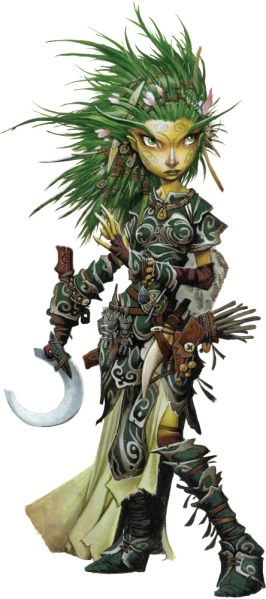
Happily, this is how my friendly GM knew me. He liked my entry, and not only remembered it, but USED IT. As far as compliments from total strangers go, I don’t think there’s a nicer one than that. Something I made for a d20 game, USED. By someone other than me?! Gasp! Haha. (And there was much rejoicing!)

Druid - Lini.jpg
Lini, Pathfinder’s Iconic Druid. Art by Wayne Reynolds. Lini can be found in the Pathfinder Roleplaying Game: Core Rulebook, and many other wonderful Paizo products.

But, it’s the second design competition I entered which made me happiest. In it, we had to recreate one of Pathfinder’s many iconic characters, and make them evil. Delightfully, deliciously, evil. It was really enjoyable to participate, and in the end I made a cruel version of Lini, the gnome druid. And I won. Not only did I win some store credit that I used to purchase some awesome Pathfinder Society Scenarios (the shipping and duty fees are too high to make buying physical books from their website manageable for me), but I also won a custom avatar which I rock on the messageboards all the time. It was a blast.

Now, that’s not the only delightful compliment I’ve received regarding one of my creations lately. I’ve also received a lot in regards to a character I’ve made. Who? My first (and greatest) Starfinder Society character, Julakesh Starfist. Julakesh is a bold vesk solarian who’s strong, proud, and entirely full of herself. She’s prone to accidentally insulted her companions with her generous compliments, getting herself into fights too dangerous to pound with her fists, and generally making people laugh. She’s not the sharpest knife in the drawer. In fact, in that analogy she’s more of a spoon than a knife. But I love her. She’s among my most fun characters to play. Ever. And that’s saying something.

She’s has been called “hilarious,” “great fun,” and “absurd.” More than a few people have mentioned that they love her, with the sweetest being “<3 Julakesh all the time always!” (Here’s looking at you, ElektraDawns! You made my day! Haha.) She’s received personal invitations to join games, and people seem to be pleased to get to play with her a second time. Her recent acceptance of an invitation to a game included excited squealing and the ever-eloquent (and very flattering) exclamation: “Yayy!” But the best compliments I could have possibly gotten?

“On so many levels she is my favorite vesk character I’ve ever seen!”

“…one of the finest vesk characters I’ve seen played since Starfinder was published.”

Seriously. If either of you are reading this, you’re SO NICE.

Now, I’m not saying Julakesh is everyone’s cup of tea. She’s not. I’m sure some poor person she’s played alongside has wanted to tape her mouth shut, and break my fingers to prevent me from typing. But, I am saying, she’s brought some joy to people–myself included–and I hope she continues to do so as her Starfinder career continues.

So who is this, Julakesh anyway?

StarfinderCover
Check out the Starfinder Roleplaying Game: Starfinder Core Rulebook for more information on vesk!

Julakesh Starfist is a fierce looking vesk with horns circling the top of her head like a spiked crown. Her scales are mottled black that never reflects light and bright white that almost seems to glow. She is well muscled and just under seven feet tall. Clearly a warrior! Curiously she bears only one weapon: a small azimuth laser pistol holstered on her hip. A glowing orb of bright white light hovers around her, following her wherever she goes. During battle she grasps the ball of light and it energizes her fists, making them surrounded by a blazing, bright white light.

Julakesh is brave, bold and adventurous. Like most of her kind she revels in the glory of combat and competition. She loves exploring new planets and—most especially—being off planet. She’s most at home in the depths of space and enjoys floating around with her jetpack outside the ship whenever it is stopped.

Before becoming a Starfinder, Julakesh was a vesk soldier. She spent most of her time policing residents and putting down rebellious behaviour among the barbarous feline humanoids on Vesk-6. She treated her charges with respect but revelled in the opportunity for glorious combat, or competition among her fellow soldiers. As she rose through the ranks her chances for combat increased, and eventually she was given the opportunity to join a combat vessel bound for a fierce battlefield on another planet. She accepted the honour with great enthusiam and left Vesk-6 for the first time since she joined the military.

Unfortunately, a solar flare and the subsequent coronal mass ejection struck their ship, causing most of the systems to fail and the nearly all of the crew to die. Of those few crew remaining, all of them were left changed—three suffered slow radiation poisoning, one’s scales turned a sickly brown, one lost more than half his muscle mass and two suffered terrible mutations. The energy from the corona bonded with Julakesh in a moment of intense pain, leaving her capable of using the very elements of the universe as a weapon—the power of gravity and the power of the stars. She was no longer Vesk, she was something other. Something greater.

Through luck and determination, Julakesh and her fellow ailing soldiers managed to steer the ship back to Vesk-6 where they were taken care of by the military doctors. Julakesh was cleared for active duty, but found the next few years of work unfulfilling. Although she enjoyed combat as much as she always had, her gaze was constantly drawn heavenward, she knew in her heart she belonged among the stars.

Eventually she left behind her promising military career and set out into the unknown on a passenger ship travelling to Absalom station. As they took off into the beautiful void of space, Julakesh finally felt at peace. This was where she belonged.

PZOSFS0000E.jpg
Want to join the Starfinder Society? Download the Starfinder Roleplaying Guild Guide for more information. It’s a free download on Paizo’s website. )

Her travels have taken her far and wide since then, but as much as she loves discovering and exploring new planets and stars, she’s always happiest in the void of space, surrounded by silence and stars. She has recently joined the Starfinders, in the Wayfinders, and is excited to push new boundaries and travel the unknown depths of space.

Her love of glory and battle shines through no matter the circumstances, not only from her bright exuberant smiles, but also from her loudly exclaiming her joy for all to hear. She’s easily confused by long words, and has absolutely no understanding of advanced technology. She hacks ‘puters’ with a fist, and never lies. She’s a happy, energetic soul, quick to laugh and often smiling. She doesn’t have much of a verbal filter, and her well-meaning compliments tend to insult her fellow Starfinders.


She offers pleasant and friendly greetings…  

“Greetings, companions! The honour is YOURS!”

“You look at least half-competent! Wonderful! If you’re a quarter as capable as I am we’ll be a formidable team!”

“Hail, friend-bug! We shall soon break bread and bones together!”

She provides compliments and encouragement…

“You are not as feeble as I expected!”

She’s always ready for a good time…

“Ah! Yes! Let us hope there are terrifying beasts and dangerous traps within this ‘mainframe’ they spoke of! THAT WOULD BE GREAT FUN!”

She’s always willing to lend a helping hand…

“Yes! You are very meek and pathetic! Be happy we are here to make you a winner!”

“After my mission and befriending your many soft people, I will pound you into the dirt many times! This will make you stronger! You will know how to use your weapons, then!” She thumps her chest and smiles. “If you are lucky, you will then be as strong as a child among my people! A great accomplishment! You will see! You will be proud! Bring honour to your name!”

She’s understanding…

“Ah, yes! Puters! I know these! When they make noises I don’t like I punch them dead! Many of my fellows do not like this. They caress the puters instead, with fingers and some invisible force called coding. You are one of them, yes? A lover to puters?”

And she’s always ready for a fight…

“BRING YOUR FACE TO MY FISTS!”

“TO BATTLE, FRIENDS! IT IS TIME TO EARN OUR HONOUR! AHAHAHAHAAA!”


All in all, she’s one colourful character, and I hope you’ve enjoyed hearing about her as much as I enjoyed sharing her with you today. If you’re one of the delightful people who have given me kind words about Julkaesh, thank you so much for the feedback! It means a lot. To read more about Julakesh, you can check out some of her previous play-by-post games, including The Commencement, and Yesteryear’s Truth. Or, pop in and check out her current misadventures, in The Dire GM’s Solar Sortie.

Until next time,

I wish you honour and glory (and more than a few laughs)!

Julakesh Starfist
Jessica


Starfinder: Alien Archive

Today on d20diaries we’re going to take a look at an awesome supplement book for the Starfinder Roleplaying Game, the Alien Archive! This book has a hardcover, and clocks in at 159 pages. It’s got an American cover price of $39.99, which means that if you’re Canadian (like myself), you’re looking at a cost of around forty-five to fifty dollars for the book online, or up to sixty in your local game store. There’s a sequel in the works, Starfinder Roleplaying Game: Alien Archive 2, which is due out in October, though I’ve heard little more than that about it.

At it’s core, Starfinder Roleplaying Game: Alien Archive is a book of monsters. Like Pathfinder Roleplaying Game: Bestiary, you’ll find a ton of monsters to fight and ally with inside this book, as well as some new player races. With that being said, there are a lot of differences between the Alien Archive and the many Bestiaries available for the Pathfinder Roleplaying Game. For starters, it’s shorter, with a typical Bestiary being around 325 pages in length, compared to the Alien Archive’s 159 pages. But, that’s only scratching the surface. The Alien Archive is also easier to use, and much more adaptable, than any Bestiary I’ve ever read. So, without further ado, let’s get started!

The Alien Archive features lovely cover art by Remko Troost, which shows off some of my favourite creatures inside the book–the dragonkin and the skittermander–as well as a robot. The inside front and back covers feature an image of the Pact Worlds, although it’s faded looking, instead of shiny and bright. After that we come to the table of contents.

The Alien Archive has sixty distinct monster entries inside it, many of which have more than one stat block or variation of that creature, making the actual number of foes inside larger than it seems (around ninety four). Of these, twenty-two are playable as character races. Each of these player races is differentiated from the other entries by a star beside their name, which is really useful for quickly referencing player options.

Combatant
Combatant icon, which denotes creatures that excel in physical combat.

After the table of contents we reach the introduction. This is where we learn how the races are oriented, and how to read a stat block. While most of this is basic information that only a player new to d20 games with need to read, some of the information is quite important.

For starters, each of the stat blocks inside the Alien Archive is sorted into one of  three categories: combatants (which excels in physical combat), experts (who are most effective with skills), and spellcasters (who rely on spells or spell-like abilities). These categories are represented by an icon in the left margin. These images are easy to distinguish and provide a quick and easy way for GMs to realize the role each monster plays in combat, which makes it super easy to find the type of creatures your looking for, or to quickly discern a creature’s tactics.

Expert
Expert icon, which denotes creatures that rely upon their skills in combat.

There’s also a few interesting things to note about the stat blocks themselves. Very few of the creatures inside have Resolve Points and none have Stamina Points. A creatures ability scores aren’t listed, instead, their stats show their ability modifiers. This is a simple change that will make it easier for GMs–especially new GMs–to handle unexpected situations (like unlisted skill checks) in combat. Not all of a creatures feats are listed in their entry. Instead, only feats that grant new combat options will be shown. Feats that grant static bonuses (like improved initiative, or skill focus) are already factored into the stat block and will not be listed anywhere at all. This really streamlines the stat blocks, and makes it easier to find important information fast. Similarly, not all of a creature or NPCs spells will be listed in a stat block. Instead, it only features their most powerful spellcasting options.

Spellcaster
Spellcaster icon, which denotes creatures who utilize spells and spell-like abilities during combat.

In addition to information provided in this chapter, I’d like to point out a few other things of note. Every one of the bestiary entries in this book is two side-by-side pages long. These entries include information on the creature, where they’re found, their use throughout the Pact Worlds, and their society–if they have one. Many of the entries include more than one stat block on a theme. For example, the Aeon Guard entry gives us stats for a CR 3 rank and file soldier, along with a CR 7 specialist, capable of working without support for weeks and months at a time. Similarly, the apari entry features the both the hive-like apari, and it’s tiny, bug-like constituents. Some entries include many stat-blocks, or simple grafts that can be added to a featured creature to make it into other versions. Examples of this include elementals, which are statted out by size and have grafts which apply the elemental abilities themselves (including air, earth, fire and water), and dragons, which have one age category statted out, rules for making other age categories, and grafts which can be applied to determine the dragon’s colour (including black, blue, green, red and white). In fact, as you’ll soon discover, grafts and templates are a common sight in the Alien Archive, and are used to great effect. Many of the archive entries introduce new gear or consumables. My personal favourites include the shadowstaff found on the draelik’s entry, and the bone cestus of the crest eater.

After this we come to the meat of the book: the Alien Archive itself. There are a ton of cool creatures in this book, and even some that I wasn’t sure I’d like on first perusal, I ended up really enjoying. Some of my favourites you should check out include the asteray, a CR 12 fey which is to space what mysterious water creatures like mermaids and nixies were to the oceans and waterways of golarion. I also adored the caypin, a CR 6 aquatic tentacle beast with eyeball mouth worms which can detach and explore their surroundings, before returning to the caypin’s face. Seriously cool! Electrovores were a fun, low level challenge I also really enjoyed, as were the radioactive fey, hesper.

PZO7105.jpg
Starfinder Roleplaying Game: Alien Archive

Mixed amongst the monster entries are twenty-two playable races. Each entry features two different CR stat blocks representative of their race, a bunch of interesting information on their societies and home worlds, and a side bar which include the rules for playing them as a race. Although many of these were ‘humanoid shaped’, with arms and hands or some sort, there were some which were not, most notably the jellyfish-like barathu. This was just awesome to see, and I really enjoyed it! Some of the races and monsters from old Golarion were up for selection, including contemplatives, drow, and space goblins but many were brand new. I honestly loved a TON of these races, but my favourite new additions are dragonkin, ikeshti, sarcesians, and the cheerful skittermanders.

Curious about the playable races available in this book? Well, look no further! The Alien Archive includes:

  • Barathu: highly adaptable jellyfish-like race who float like blimps through the sky
  • Contemplative: telepathic creatures with massive brains and atrophied little bodies
  • Draelik: green, nihilistic, gaunt humanoids with ties to the negative energy plane
  • Dragonkin: large bipedal dragons who form a close bond with their soul-mate
  • Drow: dark-skinned, demon-worshipping, evil elves–a fantasy classic!
  • Formian: ant-like humanoids who live in hives and are resistant to sonic effects
  • Space Goblin: comical little runts with big heads, and bad attitudes. You know you love them!
  • Gray: small, hairless humanoids with bulbous heads and telepathic powers who abduct and experiment on other beings for unknown reasons
  • Haan: large insectile humanoids who can spew fire and create buoyant balloons of webbing
  • Ikeshti: small lizardfolk who live in desert wastes and can squirt blood from their eyes
  • Kalo: aquatic humanoids with wing-like fins who live in freezing cold waters
  • Maraquoi: primitive simians with prehensile tails who have exceptional hearing
  • Nuar: strong minotaurs with pale skin, a great sense of direction and an affinity for complex patterns
  • Reptoid: cold-blooded reptilians who can assume the appearance of specific individuals
  • Ryphorian: trimorphic elves who have adapted to the generations-long seasons of Triaxus
  • Sarcesian: large humanoids who can survive in a vacuum for a time, and grow glowing wings of energy in the void of space
  • Shobhad: large, four-armed, nomadic giants who are ferocious and quick
  • Skittermander: small, furry, six-armed humanoids with a cheerful disposition who love to lend a helping hand
  • Urog: large, crystalline magical beasts with meticulous minds, a lack of tact, and a resistance to electricity
  • Verthani: tall, long-limbed humanoids with black, orb-like eyes and skin capable of camouflage
  • Witchwyrd: terribly mysterious interstellar merchants with four-arms who are capable of absorbing force from magic missiles and launching them back at their enemies
  • Wrikreechee: amphibious, humanoid, filter-feeders who look like a mix between bugs and mollusks

Past the statistics for all those snazzy new aliens we come to arguably the most important part of the book: Appendix 1: Creating Races and NPCs. In Starfinder, monsters and NPCs–even those with class levels–are created differently than PCs. Within these fifteen pages you’ll find simple, easy to use instructions on how to make any kind of creature you can imagine. To use some options you’ll also need access to the Starfinder Core Rulebook, which shouldn’t be an issue, as if you’ve purchased the Alien Archive you probably own the Core Rulebook it already. And if you haven’t? Well, you really should! Haha.

PZO7109.jpg
Starfinder Roleplaying Game: Alien Archive 2, due out in October.

My kids and I gave making monsters a try and found it very simple and easy to use. It makes use of a few handy charts, some simple templates and your creativity. That’s it, that’s all. For those of you more interested in the nitty gritty, I’ll give you a quick rundown. First: a concept. Figure out what you want to make and what CR. Next? Pick an array. That means deciding if it’s a combatant, expert or spellcaster. Then you look at the chart for that category. Each category has two charts for it, which give you the all the stats you need to make the monster. These numbers are the actual values you’ll be using, so you won’t need to do any calculations. These values include everything from ACs, and hp, to the amount of damage they’ll do with ranged and melee attacks. In addition, it lists how many extra special abilities they’ll be able to select later on.

Once you’ve got your stats you need to select your monster’s creature type from a list. Each of these will grant your monster a slight variation to its statistics, as well as a few other static abilities (typically related to its vision types, and innate immunities). For example, aberrations gain darkvision 60 feet, and a +2 to all Will saves, while fey gain low-light vision, +2 on Fortitude and Reflex saves, and a -1 to all attack rolls. Simple and easy. Once you’ve got your creature’s type applied, you pick out it’s subtype. Not all creatures will have one, but if they do, it will grant them some extra traits. Give your monster the cold subtype and they gain immunity to cold and vulnerability to fire. Give them the demon subtype and they gain immunity to electricity and poison, resistance 10 to acid, cold and fire, the ability to summon allies, and telepathy. Slightly more complicated than applying a creature type, but still easy.

What’s next? A class graft. Now, not all monsters will have a class graft, but many intelligent NPCs you make will. This is essentially a quick and easy way to give your creations access to class abilities. So, how does it work? First, you choose the class you want them to have, then you check out the class graft. This will have a requirement (for example, envoys need to use the expert array), a few adjustments (like which saving throws they get an extra bonus to, and which skills they’re best at), a quick formula for giving them equipment, and a helpful chart. On this chart you look up the CR you’re aiming for and check out which abilities you’ll be applying. Now, this isn’t the full class abilities, but rather a few of the best abilities, which the creature will be able to use. You’re not literally applying a whole class here, but just the selected items on this list. For example, if you’re making a CR 1 mystic, the chart tells you to select one first level connection power and one special ability. Pick those out and you’re done. If he’s instead CR 11, the chart tells you to select the first, third, sixth and ninth connection powers, mind link and telepathic bond. Done and done. Although not overly complicated, this is the most difficult step involved in monster creation.

Once you’re done with your class graft (if you’re adding one) you can choose to add a simple template. These are available later in the Alien Archive (in Appendix Three) and include choices like fiendish, giant and two-headed. These grafts are as easy to use as the creature type ones are, and take barely any time at all to add. There’s also some other templates found in the Alien Archive which can be chosen.

The next step is to select your monster’s special abilities. Depending on their array and CR they’ll have a number between one and four that they can choose from. In addition, some abilities are free. These abilities include things like feats, universal monster abilities, and statistic increases. You can also select abilities that show up in other stat blocks. If you’re like my son, you’ll want to make radioactive broken robots, so you could select an aura of radiation as one ability, the ability to shoot blasts of electricity as a second, construct immunities as a third, a vulnerability to critical hits (to represent their broken chassis), and have them self-destruct upon their destruction. If you’re like my daughter, you’ll want to make colossal sized flying space rabbits who shoot laser beams from their eyes, breathe fire from their noses and can survive in a vacuum. Yes, that’s seriously what she made. So pick up a breath weapon as your first ability, a ranged natural attack as your second, as well as immunity to cold, vacuums, and the no breath universal monster ability. This is also where you’ll decide what kind of attacks your monsters will use. Maybe the aforementioned radioactive robots have a slam attack with the stun critical ability, or perhaps their slams do bludgeoning and electricity damage. (My son’s pretty fond of both at once). And the flying space rabbits? Their bite attacks do piercing damage, and perhaps they can swallow you whole. But their laser beam eyes? Definitely fire damage.

PZO7403
Starfinder Roleplaying Game: Alien Archive Pawn Box, which contains over three hundred pawns.
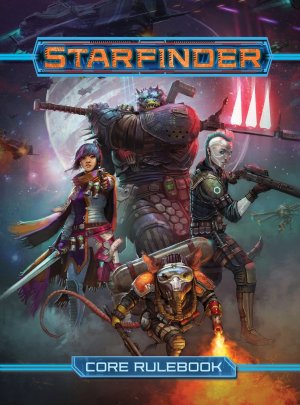
Once you’re done with the special abilities, you can select your monster’s skills. Your array chart already gave you the skill points you’ll have, and how many you’ll be good at, but now’s the time you choose which skills those will be. This is a simple step, and will be done in a flash. Then you’re onto selecting spells and spell-like abilities (if your creature happens to have them from a class graft or a special ability you’ve chosen). If it does you check out a simple chart to see what you’ll be adding by CR, make your spell selections and away you go. If you happen to be making a CR 2 creature with Spell-like abilities, they’ll have two 0 level spells usable at will, and two first level spells each usable once per day. If they instead are CR 16, they’ll have two third level spells usable at will, four fourth level spells usable three time a day each, and two fifth level spells usable once a day each. The chart works the same for spellcasting, but with different numbers. Again, only the most powerful spells will be added into your stat block. Your CR 15 creatures won’t have level one spells available, since they’ll be much more likely to use their third fourth and fifth level spells during battle.

And now it’s time for the last step: checking it over. Take a gander at your creation and make sure it lives up to your concept.

And you’re done! It may sound complicated, but it’s actually very easy to use in practise. Even my kids, who are only six and seven, managed to make something fun, balanced, and unique in a short amount of time.

Once you’re done with the first appendix you move on to the second, which focuses on summoning creatures. Much like the monster creation process, this six page section makes use of charts and grafts, although this is infinitely simpler and easier. Each time you gain access to a summon creature spell you select four specific creatures that you can summon. But what are the options? They’re awesome is what they are! Balanced, thematic and adaptable all at the same time. So what do you do?

First, head on over to the elemental statistics. These will be the base stats for all summoned creatures. The level of summoning spell you’re using determines which size stat block you’ll be using. Then, check out the charts and select what you’re summoning. Is it an aeon, agathion, angel or archon? An elemental? what about a protean, robot or shadow creature? Depending on what you choose it will allow you to select either an elemental or summoning graft which you can then apply to the creature. These grafts are simple and easy to use. And that’s it! You’re done. Get summoning. I, for one, can’t wait.

Which brings us on to our third appendix: simple template grafts. This is two pages of simples grafts, which I already mentioned when I spoke about creating monsters. In addition to their use for monster creation, NPC creation and summoned creature statistics, you can also use these templates to quickly alter existing creatures into new creations.

StarfinderCover
Starfinder Roleplaying Game: Starfinder Core Rulebook

Past this is our fourth and final appendix, which focuses on universal creature rules. Here you’ll find a listing of the common abilities that the different monsters in the Alien Archive have, which also happen to be abilities you can choose to give your monstrous creations.

So what’s left? An index which sorts the creatures by CR for ease of reference, and an advertisement at the back of the book.

That’s it. We’ve come to the end of the Alien Archive.

And what did I think?

I highly recommend this book for players, even if just to have access to the plethora of fun races, but for GMs? This book isn’t recommended, it’s necessity. You need it for the monsters inside, and you need it for the monster creation rules. Lucky for us, this book is just awesome! I’m supremely happy to own it.

And now it’s time to say goodbye!

But before I go, I want to hear from you! What’s your favourite creatures and races from the Alien Archive? What have you made with it? Let me know in the comments!

Until next time,

Jessica