Pathfinder Society Scenarios: Breath of the Dragonskull and Fragments of Antiquity

Today we’re going to take a look at two of the most recent Pathfinder Society Scenarios that are currently available for purchase, and let you know we thought. Although you’ll find references to events in each that I liked or disliked, and comments about specific characters, these scenarios are not explored in detail. It’s not my intention to spoil the events in these scenarios, or give summaries and full reviews, but to share my opinions and provide recommendations. That said, if you want to avoid even minor spoilers I recommend you check out a different article. Whether you intend to use them in home games of the Pathfinder Roleplaying Game, sanctioned scenarios for use with the Pathfinder Society Organized Play, or just want to read a nifty new adventure, we’ve got you covered! So let’s get cracking!

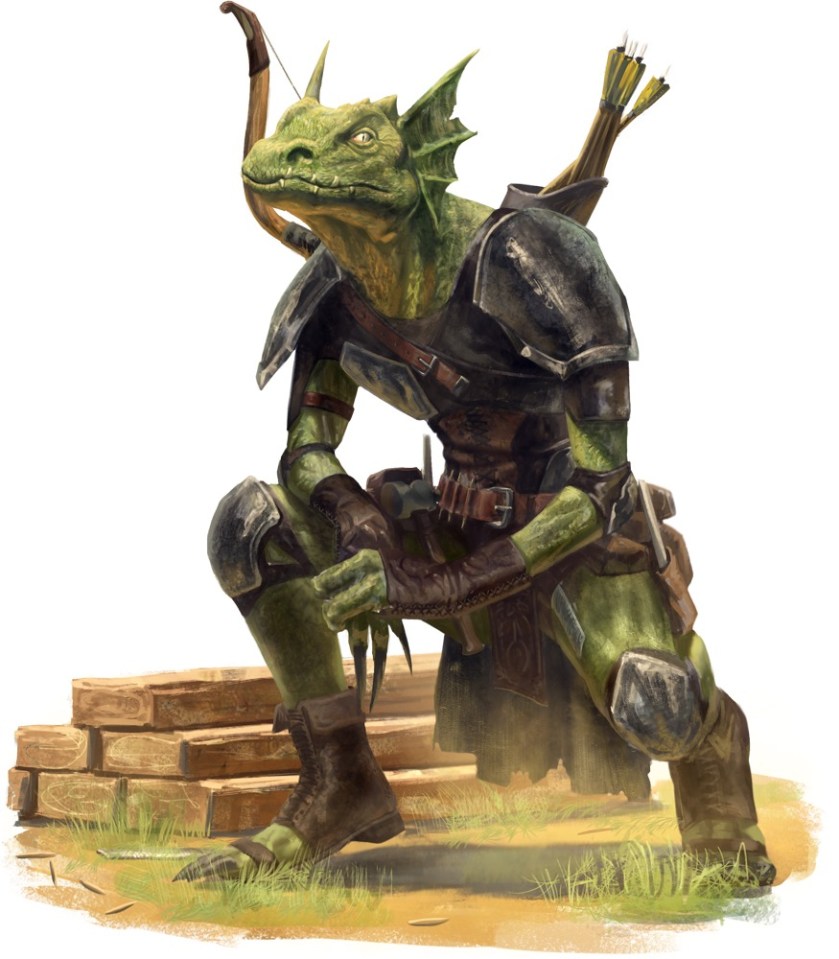
scourge of the farheavens - dolok darkfur - sebastian rodriguez
Dolok Darkfur from #9-18: Scourge of the Farheavens and #10-12: Breath of the Dragonskull. Illustrated by Sebastian Rodriguez. Art courtesy of Paizo Inc.

Pathfinder Society Scenario #10-12:Breath of the Dragonskull is a Tier 1-5 adventure written by Michael Sayre. It takes place in Iobaria, beginning in the Starrise Spire of Nerosyan, before quickly travelling to Mishkar and the Findabar Forest. It features creatures from Pathfinder Roleplaying Game: Bestiary and Inner Sea Monster Codex (although all of the necessary stat blocks are included within the scenario) and includes content from the Core RulebookAdvanced Class Guide, and Ultimate Equipment. It utilizes the Pathfinder Flip-Tiles: Forest Starter SetPathfinder Flip-tiles: Forest Perils ExpansionPathfinder Flip-Mat: Forest Fire, and a custom half-page map.

This adventure tasks the PCs with protecting a caravan of Sarkorian refugees who are scheduled to begin a journey from Mishkar back to their long-lost homeland of Sarkoris (recently the Worldwound). The caravan has run into trouble with goblins, a forest fire, and centaurs, and need assistance so they can get underway. PCs will need to protect the caravan’s members, figure out what the heck is going on, and put a stop to it. Breath of the Dragonskull continues the storyline from #9-18: Scourge of the Farheavens, and features Dolok Darkfur and Nelket, with Jorsal of Lauterbury serving as Venture-Captain. This scenario involves a lot of interacting with the forest fire, so be sure to prepare your characters appropriately after the mission briefing. I loved the new characters introduced in this scenario — particularly Dragbog — and the various social encounters. There’s a lot of them, and they’re great fun. The battles are enjoyable and each is more complicated than it seems, which I was really happy to see. My only complaint is that if PCs manage to avoid some of the encounters (which they could), this scenario could pass by rather quickly. Overall I thought this was a really fun scenario. I can’t wait to run it for my family. I give it five out of five stars.

Kaana Korag by Tawny Fritz
Kaana Korag from #10-12: Breath of the Dragonskull. Illustrated by Tawny Fritz. Art courtesy of Paizo Inc.

Pathfinder Society Scenario #10-13: Fragments of Antiquity is a Tier 5-9 adventure written by Sam Polak that takes place in the Hao Jin Tapestry. It features creatures from Pathfinder Roleplaying Game: BestiaryBestiary 4, and the Monster Codex (although all of the necessary stat blocks are included within the scenario) and contains content from the Core RulebookAdvanced Player’s GuidePlanar AdventuresUltimate Combat, and Ultimate Equipment. This scenario heavily utilizes Pathfinder Flip-Mat: Arcane Library. It also features Pathfinder Flip-Mat: Falls and RapidsPathfinder Flip-Mat Classics: Forest (although it’s unlikely you’ll need to run the encounter that uses the Forest Flip-Mat), and a full-page custom map. This mission continues the ongoing Hao Jin Tapestry storyline. Players who can speak Tien will be a great boon during this scenario.

This adventure tasks the PCs with exploring a library within the Hao Jin Tapestry to collect important documents and clues related to the fate of Hao Jin. But, this isn’t as simple as it sounds. PCs will need to deal with kobolds, traps, and mysterious enemies during their mission, in addition to navigating the library. I thought the library location was interesting and atmospheric, but quite complex, so GMs will want to take some extra time to familiarize themselves with it thoroughly. I really enjoyed the interactions with the Scalebreaker kobolds, although they’re quite brief. Particularly canny PCs may be able to gain some extra insights that will be useful for them later on. This scenario is light on combat, but heavy on hazards, so it balances out quite nicely. The final battle in this scenario was very exciting and could prove to be quite challenging, particularly in the lower subtier. In the hands of a clever GM it would be a blast to play. Overall I enjoyed this scenario, particularly the brief interactions with the Scalebreakers, but it will take a solid GM to really make it shine. It’s not the easiest scenario to run. I give it four out of five stars.

Bridge-and-Logs by Tom Ventre
Bridge-and-Logs, Chieftain of the Scalebreakers from #10-13: Fragments of Antiquity. Illustrated by Tom Ventre. Art courtesy of Paizo Inc.

Thanks for joining me today! I hope you enjoyed taking a look at the new Pathfinder Society scenarios.

Jessica


Starfinder Society Scenarios: Survivor’s Salvation and Treading History’s Folly

Today we’re going to take a look at the two most recent Starfinder Society Scenarios that are currently available for purchase, and let you know we thought. Although you’ll find references to events in each that I liked or disliked, and comments about specific characters, these scenarios are not explored in detail. It’s not my intention to spoil the events in these scenarios, or give summaries and full reviews, but to share my opinions and provide recommendations. That said, if you want to avoid even minor spoilers I recommend you check out a different article. Whether you intend to use them in home games of the Starfinder Roleplaying Game, sanctioned scenarios for use with the Starfinder Society Organized Play, or just want to read a nifty new adventure, we’ve got you covered! So sit back, and get ready to explore the Pact Worlds!

Starfinder Society Scenario #1-30: Survivor’s Salvation is a Tier 1-4 adventure written by Kiel Howell. It takes place on Absalom Station, beginning in the Downlow District, then travelling to the Lorespire Complex (home of the Starfinder Society), and down to the Spike. This scenario does not contain starship combat.  It features the Faction (Exo-Guardians) tag, and continues the ongoing Scoured Stars storyline, particularly the events of Scenario #1‑99: The Scoured Stars Invasion. Although playing #1-99 before this scenario is not necessary, doing so will lend more emotional weight to the events of this scenario. Survivor’s Salvation uses two custom half-page maps, and no flip-mats. In addition to the Starfinder Core Rulebook, this scenario features content from the Alien ArchiveAlien Archive 2Armory, and Pact Worlds. All necessary stat blocks are included in the scenario itself. If you happen to have any characters who are doctors, psychologists, healers, or particularly caring or empathic I highly recommend you bring them. This is a great scenario to role-play such characters. On the other hand, if you’ve got particularly blood-thirsty, insensitive, or mean PCs, I recommend you let them sit this one out, and bring a different character. This scenario touches on serious themes such as mental health, PTSD, and depression, so if you’re uncomfortable with such topics, you might want to give this scenario a pass. Finally, it should be noted that my kids (who are nearly seven and eight years old) would be freaked out by the final villain in this scenario. You have been warned! Haha.

Survivor’s Salvation begins in a warehouse that serves at the Exo-Guardians base of operations, which Starfinders who have played #1-01: The Commencement or #1-04: Cries from the Drift will recognize. There your players will have a brief chat with Zigvigix, leader of the Exo-Guardians. Ziggy informs the party that Hurondo, a high-ranking shobhad Starfinder who retired after being rescued from the Scoured Stars system, recently went missing. Hurondo runs a medical facility within the Lorespire Complex called Respite, which offers support and services to Starfinders who have suffered trauma. His disappearance has Ziggy worried, so they want you to investigate. At Ziggy’s request you can check out Respite, interview Hurondo’s co-workers and patients, and try to track the big fellow down. Because this is a mystery I won’t reveal too much more abut the plot than that. I will say that more than one life hangs in the balance. No pressure! Other than Zigvigix this scenario has no recurring characters. New characters of import introduced include Hurondo, Jiwalla Zarvim (a ysoki who works at Respite), Petine, Bygones-B, Quadrant-2, Orghuun, and Bargai (a deaf vlaka who I really enjoyed).

bargaibynicolasespinoza
Bargai, a deaf vlaka from Starfinder Society Scenario #1-30: Survivor’s Salvation. Illustrated by Nicolas Espinoza. Art courtesy of Paizo Inc.

Mental health is a touchy subject for some, and I thought this scenario did a wonderful job of shining a light on trauma, depression, post-traumatic stress, and other mental health issues, along with the stigma that can be associated with them, without being insensitive or preachy. You have plenty of opportunities as players to offer support to, gain insight from, and empathize with the various side characters throughout this scenario, all while fulfilling your mission objectives. In fact, the opening series of social encounters at and around Respite turned out to be one of my very favourite parts of the scenario. I also really enjoyed the tense social interactions with Bargai. The true villains of this scenario were exceptionally well-utilized, and I can’t wait to see what further events they could later be linked to. The final battle is quite dynamic, but to retain the element of surprise we won’t go into any more detail that that. Overall, I loved this scenario. It had a ton of engaging social interactions, interesting enemies, and a dynamic final encounter. It’s one of those scenarios where your actions clearly matter. I give it five out of five stars.

Starfinder Society Scenario #1-31: Treading History’s Folly is a Tier 3-6 adventure written by Vanessa Hoskins. It takes place on Kukanou-2b, a hot, toxic, shattered moon in the Vast that orbits the gas giant Kukanou. You’ll definitely need to use your armour’s environmental seals for this mission, so if you’re using a character who doesn’t have armour, buy some. This scenario features the Faction (Second Seekers [Jadnura]) tag and does not contain starship combat. It continues the ongoing Scoured Stars storyline — particularly Scenarios #1-11: In Pursuit of the Scoured Past, #1-13: On the Trail of History, #1-17: Reclaiming the Tome-Lost Tear, #1-23: Return to Sender, #1-99: The Scoured Stars Invasion, and #1-29: Honorbound Emissaries — although it does so in a completely different way than Survivor’s Salvation. It features a minor encounter that has ties to Scenario #1-24: Siege of Enlightenment and will have further connections to the upcoming Scenario #1-37: Siege of Civility. If you have any characters who have played Siege of Enlightenment I recommend bringing them along, but not at the expense of characters with ties to the Scoured Stars. Finally, characters who have the ‘Abysshead Download’ boon from Scenario #1-06: Night in Nightarch will need to endure an unfortunate surprise (which I enjoyed!). Treading History’s Folly makes use of Pathfinder Flip-Mat: Cavernous Lair and Pathfinder Flip-Mat Classics: Village Square.  In addition to the Starfinder Core Rulebook it contains content from the Alien Archive and Armory. It’s only recurring characters are First Seeker Jadnura (who was previously featured in Scenario #1-99: The Scoured Stars Invasion and #1-26: Truth of the Seeker) and Iteration-177 (who was previously featuring in Scenario #1-05: The First Mandate, #1-11: In Pursuit of the Scoured Stars, and #1-29: Honorbound Emissaries).

kadricalsymbolbygraeyerb
The symbol of Kadrical. Illustration by Graey Erb. Art courtesy of Paizo Inc.

Treading History’s Folly begins when the PCs accept a secret mission on behalf of First Seeker Jadnura. Wracked with guilt over his past decisions, which lead to many agents losing their lives in the Scoured Stars Incident, Jadnura is searching for meaning. He wants a team of reliable agents to visit the location where he originally found the Tear that lead him to discovering the Scoured Stars trinity system. Your PCs mission it to investigate the site and see if he missed anything that could have fortold the danger the system posed. It’s a fun adventure that features a few interesting social interactions, and plenty of traps, hazards, and enemies. My favourite part was the exploration of Xaharee. It’s a really cool, atmospheric location, that gives clever PCs the chance to learn a LOT about the Scoured Stars trinary system and the Tears. Although some of this information can be gleaned from previous scenarios, a lot of the information is brand new. Very cool! There’s also a surprisingly touching player hand-out, which I always enjoy. This scenario’s chronicle features two easy to acquire boons and some nice thematic gear for both sub-tiers. One of the boons is another segment of the mysterious ‘Journey to the Scoured Stars’ boon which doesn’t do anything right now but promises to do something in the future. The second boon is a really useful limited use ally boon. Overall, I really enjoyed this scenario. It was unique, atmospheric, and enlightening, I give it four out of five stars.

Haunted Earth Elemental by Graey Erb.jpg
An earth elemental haunted by the mentrasi from Starfinder Society Scenario #1-31: Treading History’s Folly. Illustration by Graey Erb. Art courtesy of Paizo Inc.

Thanks for joining me today. I hope you come to love these two solid Starfinder Society Scenarios as much I do. Be sure to come back later this week when we take a peek at the two newest Pathfinder Society Scenarios.

Jessica


Tails of Equestria: The Pet Predicament

A few weeks ago I wrote a review on a delightful kids RPG called Tails of Equestria: The Storytelling Game. We delved into game mechanics, character creation, and general fun factor. I also touched on an adventure — The Pet Predicament — and promised that I would share further details on the adventure in the future.

Well buckle in folks, cause the future is now!

Today, much to my daughter’s delight, we’re talking The Pet Predicament!

Tails of Equestria: Storytelling Game is an easy to understand pen and paper roleplaying game featuring the world and characters of the hit TV show My Little Pony: Friendship is Magic. The game is aimed at children, but is definitely fun for the whole family. For more details on the game and how it works, click here!

my litte pony tails of equestria storytelling game

At the back of Tails of Equestria: The Storytelling Game you’ll find a starter adventure called The Pet Predicament. Intended for level 1 ponies, its the perfect first adventure for this game. Yes, seriously. And, it’s not a short or cheap adventure, either! It’s forty pages in length if you count the stat blocks it comes with. My family played through the adventure in two short sessions, though my kids were so engrossed they wanted to play it in one.

In a practical sense, this adventure is incredibly important. It provides a first adventure for players to use, and teaches them how a game should be run by example. For experienced players it also serves to alter our preconceptions about RPGs, and really shake things up. Tails of Equestria isn’t the same kind of RPG as Pathfinder or D&D. It downplays battle, and really encourages players to use creative thinking, kindness, teamwork, and roleplaying to overcome obstacles. This game requires a different mindset than other RPGs. Happily it’s a mindset that kids and young players will naturally settle into and flourish.

So what is The Pet Predicament? I mentioned it was the perfect starter adventure for this game and I meant it. It’s well written, easy to GM, engaging, and fun. There’s plenty of opportunity for Scuffles, but just as many chances for players to completely avoid Scuffles with Tests and Challenges. It features the Mane Six (main characters) from My Little Pony: Friendship is Magic as initial NPCs, and features plenty of other cameos along the way.

adventure - the pet predicament - d20diaries

Our adventure begins, innocently enough, in Ponyville’s market. There your PCs (short for Pony Characters in Tails of Equestria) are grocery shopping and have a chance to describe all the things they’ve been buying. This is a great opportunity for your players to talk about their characters, and decide how they know each other.

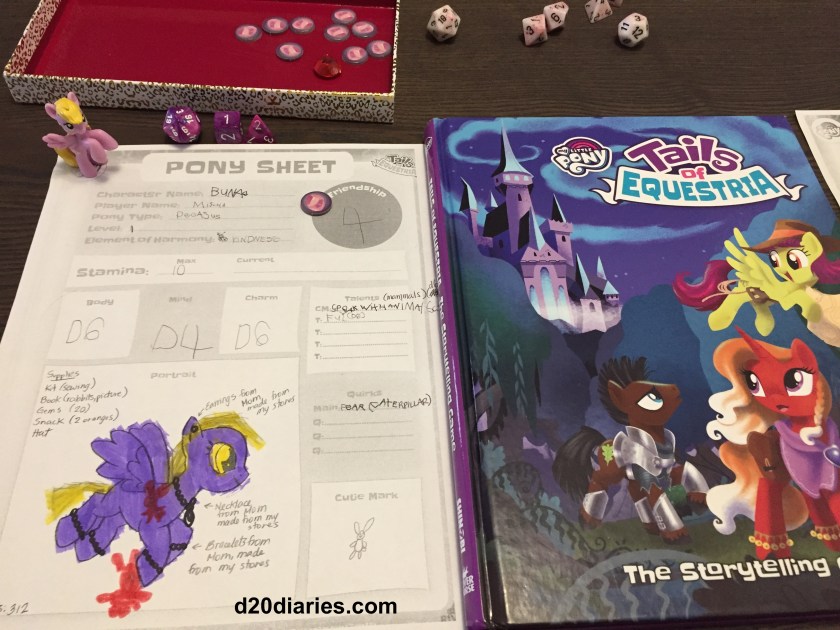
My family decided to play a strange family of ponies. I played Soothing Heart, an over-prepared earth pony mother who carries saddlebags filled with everything her little fillies might need (including snacks, first aid supplies, cleaning supplies, and protective gear for a wide variety of weather). She’s tough, caring, loyal, and determined, with the Healing Touch talent. But, her vision is poor, and she needs glasses to see. Also, since I was also going to be the Storyteller, Soothing Heart is a bit of a follower, allowing her little fillies to explore the world while she minds them from afar. My/her husband is Nugget, a unicorn with a spectacular hairdo and the beginnings of a beard. He’s clever,  charming, and a talented magic-user. More than anything, Nugget is an artist with an obsession for magical creatures. If he sees one he can’t resist stopping to draw it — a dangerous habit! My daughter created a pegasus called Bunna who is kind, happy, and adores animals. She can even speak to mammals! Bunna is a seamstress who specializes in hand sewing stuffed animals. She particularly adores rabbits. Unfortunately, she has a terrible fear of… caterpillars! Eeeek! The horror! Finally, my son created Flying Recall, a mystery loving pegasus with special pony senses who always trusts his gut. He’s a friendly, funny fellow, who is a little bit too silly.
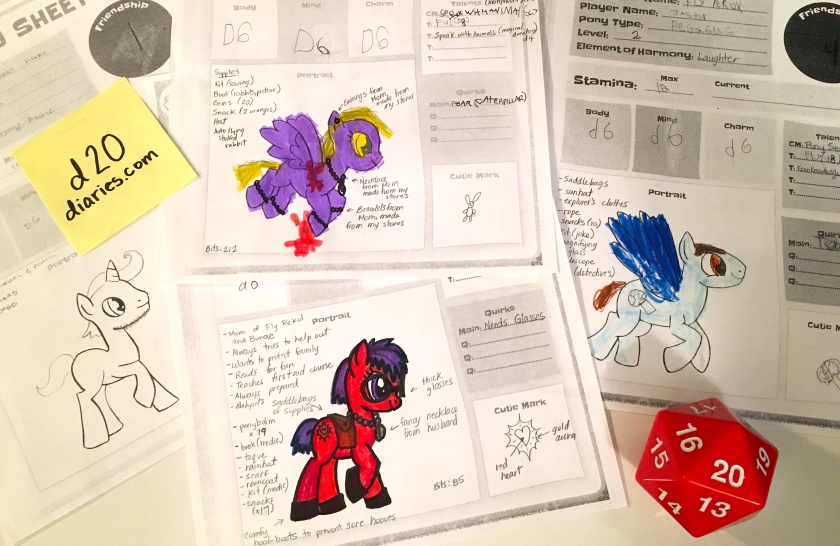
characters - tails of equestria - d20diaires

My kids had great fun describing their many, many purchases in the market, with my son buying healthy snacks and my daughter buying a massive rabbit shaped cake. Soon, my daughter (the PC who bought the tastiest treats or, in my case, loves rabbits the most) felt her grocery bag getting heavier and heavier… Bunna looked down to realize there was an adorable little rabbit in her bag eating all of her cake! My daughter squealed in absolute delight while my son looked at the picture of the rabbit and exclaimed: “Oh, no! Not THAT rabbit! THAT rabbit is trouble!”

And my son couldn’t have been more right! Angel is Fluttershy’s rabbit, and he’s horribly behaved. Kids are sure to have a blast roleplaying with this little guy. My daughter’s attempts to befriend the rabbit led to it growling, glaring at her, and crossing his arms in irritation. Soon she just decided to let him enjoy the cake which is when my kids (and I’m sure many more) let out their second squeal of glee: Fluttershy herself appears looking for her ‘little Angel.’ Impressed with your ability to handle the rabbit — cue my daughter’s proud smile — Fluttershy asks your PCs for a favour. She and her friends (yes, those friends) have to go on an important trip, but they promised they would give their pets a pampering party! They really can’t delay their mission, but they don’t want to let their pets down, either. They need someone really special to come over and pet-sit!

My kids literally threw their arms up into the air and were begging to be the petsitters before Fluttershy could even get the offer out. They were SO in. Haha. Not a surprise! It’s likely that any kids who has seen the show will be absolutely thrilled at this turn of events. Getting to meet such famous characters is enough to make many kids squeal in glee, and finding themselves the caretakers of all six of their pets? I don’t think I’ve ever met a kid who doesn’t love animals!

Fluttershy asks the PCs to show up at her house the next morning and trots away leaving your PCs with the rest of the day to spend as they see fit. It’s assumed that you finish checking out the market and then skip to the scene at Fluttershy’s house, but both of my kids play a lot of complex RPGs, so they had other plans. Especially when you take into account that Flying Recall loves a good mystery! The pair of them spent time investigating the identities of the Mane Six and their pets, figuring out what each animal enjoyed doing, and what each loved to eat. My kids were counting on fingers, trying to remember the pets from the tv show, guessing what those kinds of animals would like in real life, and rolling dice to ask around for gossip, and recall obscure bits of information. They had a blast! I rewarded their efforts with lots of helpful information and they spent time picking up items in the market that they thought would be of use in petsitting. A juicy bone and a ball for Applejack’s dog, the fanciest and most expensive cat treats they could find for Rarity’s spoiled cat, and so on.

ponyville market - tails of equestria - d20diaries

When they were ready to move on our PCs headed over to Fluttershy’s house — with my kids wearing incredibly proud smiles on their faces. They got to meet each member of the Mane Six, each of the pets they would be babysitting, and ask any questions they had. I casually dropped a lot of information on my kids in this scene while roleplaying, most importantly about all the pets and what they like or don’t like. The information is easy to come by for GMs, but players will need to rely on their memories, note-taking, or rolling a Mind Check to get everything down. Surprisingly my kids were obsessively dedicated petsitters, and remembered every little detail all on their own. My husband was more concerned with matters like: ‘Where’s the food?’ ‘Where are you going?’ and ‘When will you be back?’

Nugget learned that the Mane Six were off to solve a mystery. Ponies throughout Equestria were being magically turned into statuettes! They always turned back to normal after a while, but it was very jarring. So the Mane Six were heading out to investigate. Their mission would take them into the dangerous Badlands to the south.

Nugget decided that sounded very dangerous, and he would much rather stay behind and pet-sit. My kids agreed.

The Mane Six bid everyone farewell and left. We were alone in Fluttershy’s house with a whopping six pets to care for. All very different. Some easy to tend to and some not. Both my son and daughter got super into this part of the adventure. They did their best to take care of the animals, find and feed them their favourite things, pamper and play with them, and so on. They carefully decided who would be best suited to caring for each pet, and excitedly tried to recall every bit of information they could. They fed Owlowiscious (Twilight Sparkle’s wise owl) chocolate mice and tickled him just behind his ear feathers. They gave Winona (Applejack’s playful dog) the bone they had bought for her, played ball, and patted her tummy. They were absurdly happy to see Winona enjoy the bone they bought him. They gave Gummy (Pinkie Pie’s toothless baby alligator) fish cakes and played Snaps. They brushed and groomed Opalescence (Rarity’s fat, spoiled cat) while feeding her the most expensive cat treats money could buy (which they had already bought a lot of!). They took Tank (Rainbow Dash’s helicopter flying turtle) out for a fly and fed him lettuce. My kids had such a blast with this part of the adventure! They were exchanging high fives and shouting out ‘great job’ and other congratulations at the table. It was just a giant ball of feel-good fun.

And then my daughter tried to handle Angel, the fluffy little rabbit menace. They knew it would be tough. They got him the perfect carrots, gently fluffed his tail, and offered him cuddles. Shockingly, my daughter managed to control the rabbit for a while, but in time he got out of hand. Carrots were met with growls, tail fluffing with glares, and cuddles with fierce little punches from fluffy paws. He was a terror!

pets - pet predicament - tails of equestria

Which is the point!

Angel causes such a commotion he knocks all the books off the bookshelf, some of which land on Tank. Tank’s helicopter motor starts up and shoots him right through a window and into the sky. Worried for Tank, Winona hops through the broken window after him. Owolwiscious screeches in panic at the commotion — he had previously been napping — and flies up the chimney in a cloud of soot. Gummy starts to sneeze and ends up biting Opalescence, who leaps into the air, clings to the curtains with her claws, and brings the whole curtain rod down at you! Your PCs have a chance to dodge the curtains, but fate is not with them. If they fail a Body Check they get tangled in the curtains, and if they pass they instead get knocked into a cupboard as it falls over.

“AHHH!” My kids shrieked. “The pets!”

“Tank flew right out the window!” my son exclaimed with wide eyes.

“And the cat got bit by a crocodile!” my daughter added. “That bunny is so naughty! Oh… but he is very cute… I forgive him!”

“We need to save them!” my son pointed out.

Only then did they realize they were stuck. Really stuck.

By the time we all extricated ourselves with our skills from curtains and cupboards, the pets were gone. All of them.

We headed outside to investigate. Flying Recall searched around for clues — he loves a good mystery — while Bunna asked around for eye-witness accounts from the nearby mammals. In time they discovered that each pet had wandered off on their own — most into the nearby Everfree Forest. They immediately decided we had to get them back. But who was most in need of rescue? And which clues should they follow first?

From here we get to the bulk of the adventure: finding and rescuing all six pets. This will present your players with all kinds of obstacles, Tests, and Challenges. Following the trails and clues in some cases is difficult, with failure causing new challenges and mishaps that range from falling into a marshy pool or getting tangled in clinging thorns, to stepping on a cragadile, getting surrounded by timberwolves, and even meeting the mysterious zebra mystic known as Zecora. Surprisingly, my kids didn’t fail a single tracking Check, and never faced any of the mishaps. Rescuing each pet will take creative thinking and teamwork but exactly how each task is accomplished is incredibly open ended, which really allows your group of PCs to use their own unique approach to get things done. The order they choose to rescue the pets in is entirely up to them.

Once your players manage to rescue a pet they need to keep it happy. Each animal has a few paragraphs written about how they act after being rescued, and how your players can affect their behaviour. Some pets are helpful, others silly, and some (here’s looking at you Angel) are a giant pain in the butt! Managing these rescued pets becomes a fun part of the rest of the adventure, even as they distract you from (or help to) rescue the others.

My kids decided that finding Gummy was most important. They had tracked his footprints to a fast-moving stream and easily determined that the alligator was so small he wouldn’t be able to fight the current. Knowing that if they didn’t follow him right away they might never find him at all, they raced off downstream. They discovered a boat nearby, which some of us rode in, but my son didn’t trust the boat. Instead he insisted on racing along the riverbank. The stream leads to a large lake where they spotted a big bird flying through the air with a baby alligator clamped onto his tail feathers. Gummy is at risk of falling, and the bird looks in pain. There’s plenty of ways to go about rescuing the alligator, but with two pegasus in the party my kids decided to fly up there and get the job done themselves. Bunna held onto Gummy, and Flying Recall tried to pry his mouth open while telling him silly jokes. From the ground, Nugget steadied Gummy with his telekinesis, and Soothing Heart prepped a snack and some first aid supplies. They freed the bird without harm, and got Gummy down safe. …only to have him chomp onto Flying Recall! (Gummy sure does love to bite!). Soothing Heart fed Gummy food (thus freeing Flying Recall) while Bunna made Gummy a special stuffed animal. When it was ready she gave it to him to chew on, and then Flying Recall carried Gummy back to the cottage.

After a few minutes of checking the trails and clues again, its clear that all the rest of the pets entered the spooky Everfree Forest. Spotting a plume of smoke that they were sure would dissipate if they delayed any longer, they hurried into the forest after it. But, the forest is dense and travel through it is hard. Flying Recall flew up above the canopy to keep an eye on the smoke and lead the team toward their goal.
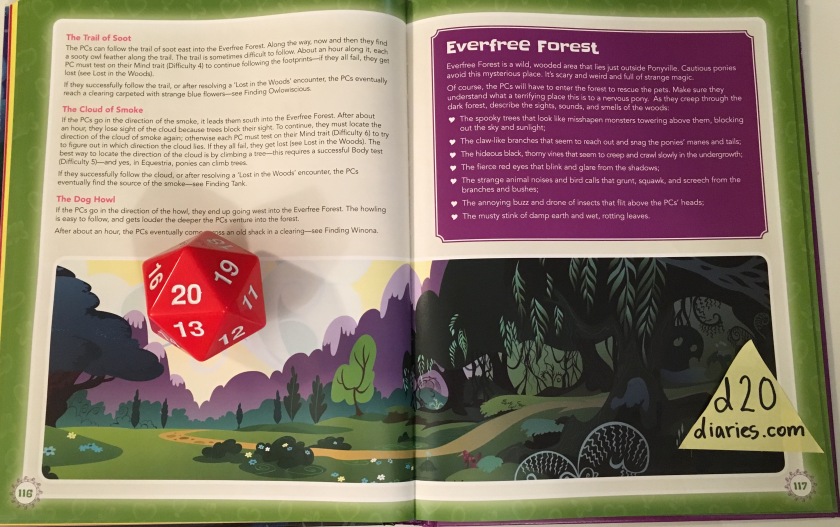
img_4301

Tank had crash landed in a canyon dotted with caves and got his aviation goggles tangled on a tree branch. When my kids saw him dangling from a stick halfway down a canyon with a clearly broken helicopter rotor on his back they panicked! After much shrieks Bunna and Flying Recall flew to the rescue — only to discover that this canyon was home to a massive quarray eel that swallowed Flying Recall whole. My son panicked. Seriously. We reminded him that there’s no such thing as death in Tails of Equestria, and I described the strange soft squishy insides of the eel he finds himself in. That’s when my son exclaimed: “I USE MY TOKENS OF FRIENDSHIP TO REROLL SO I DODGE!!! NOW!!” My daughter decided this was a great plan, so the group gave up some Tokens of Friendship, we rewound the action, and Flying Recall managed to dodge the jaws of the quarray eel.

Now, this wasn’t necessary. PCs who find themselves swallowed whole only need wait on their friends to come up with a plan to rescue them. Jokes, smoke, sneezing, and many other options could work, all depending on what Talents your PCs have and what they come up with. Even if they all get too close to the eel and get swallowed, gameplay doesn’t end. In this case Tank’s rotor puffs up once more, sending him careening relatively safely to the cave ground. There the little loyal turtle waddles up to the eel — he’s much too small for the eel to care about eating — and gives the eel’s tail a solid chomp. The eel reels in pain and spits out any swallowed ponies, leaving Tank to slowly wander back out of the cave to give a proud little nod to the ponies he’s saved. Coolest turtle ever.

In my game, our heroic pegasi both carefully stayed out of the quarray eel’s way after the timely dodge, and delicately untangled Tank with some steadying help from Nugget’s telekinesis.

With Tank safe we headed out after Winona, whose barks and whimpers we could hear from afar. We found her tied up outside the den of some diamond dogs, which my kids knew (from watching the show) like to capture ponies and force them to work in their diamond mines. The goal here is to rescue Winona without getting noticed by the diamond dogs. For most groups its incredibly unlikely to happen, and you’ll then need to parley or otherwise deal with the diamond dogs themselves once they arrive on the scene to investigate the noise. But, super paranoid, Bunna snuck close to Winona and used her ability to speak with mammals and her Charm to good use, telling Winona to stay silent. After a few checks she rescued Winona and we all snuck off without the diamond dogs any wiser.

Next we followed a trail of sooty feathers which lead us to Owlowiscious. Much to my kids surprise they found him flying over and over again into a tree, which was right in the middle of a patch of blue flowers. My kids, who are avid RPG players, were immediately suspicious. They both looked at each other and said: “Trap.”

Both deduced it had something to do with the flowers, with one deciding they were cursed and the other insisting their pollen or smell must make you stupid. Turns out they were both right. The flower’s pollen puts a curse on anyone who sniffs it, which makes something happen that the victim would hate. For Owlowiscious that turned out to be losing his intelligence. Now dumb as a post, the poor owl was smashing himself silly by flying into the same tree over and over.

With no knowledge of the flowers abilities but feeling like they were to blame my kids gave this one a bit of a think. Unbeknownst to them the key here is teamwork. You can solve this any way your group wants, as long as everyone helps. Everyone. In the end Soothing Heart gave Bunna and Flying Recall some protective clothing, Nugget steadied the owl with telekinesis, and both Pegasus flew up there to grab him, being careful not to breathe at all. Mission accomplished!

Unfortunately, even after rescue the bird was still stupid. Luckily, Soothing Heart’s first aid training came in handy. She figured to what was wrong and used her ponlybalm to take away the harmful effects of the curse. But, that wouldn’t be permanent. They’d need to find a way to cure her for good, which would require a visit to the zebra mystic Zecora. Deciding that rescuing the pets was more important, they treated the owl as best as they could and moved on, determined to rescue Opalescence, the pampered cat next.

The cat we found stuck at the bottom of a magic well. Poor Opalescence was yowling in fear, shivering cold, and exhausted. As they approached words appeared on the well, a poem that hinted that if you threw what you loved and would miss into the well, it would return the cat. My kids did not like this. But, they wanted the cat. So my son threw in something he would miss — not his magnifying glass! He would miss that too much, but something else. His notepad. The water in the well rose and the cat floated closer. Following his lead my husband tossed in his art book, which caused the water level to rise a lot. Bunna made a new stuffed animal and threw it into the well, causing the water to rise. But there was a lot of way left to go, and my son soon discovered that no one could give something twice. Soothing Heart would have to throw in something she would really miss. So she took off her necklace — one of a pair which Nugget had given to his wife and daughter — and threw it into the well.

And my daughter freaked out. Holy cow! She suddenly broke down in tears shouting “We don’t match!!”

Did not see that coming. Apparently this necklace meant a lot to her. So, I told her to explain that to the well, and maybe it would make you another deal. Meanwhile, my son grumbled it was just a necklace and saved the cat, which was way more important that jewelry.

Now, it is expected that some folks might not want to give up some of their favourite items forever. The adventure has a few ways in it for your PCs to convince the well to return their items to them. In the end my daughter befriended it, and promised to visit the lonely well once a week. Satisfied, the well returned everything the gang had given it. Bunna let it keep the stuffed animal for company.

Relieved (and no longer sad), my daughter led the group away from the magic well.

We had one pet left to save: Angel.

My kids had decided to save her for last knowing that she would be a handful to manage. They didn’t want her messing up their other rescue missions! But, with all the pets free and safe (in varying degrees of happiness), they set out after the troublesome rabbit.

“I’ve got this!” My daughter told us. “Bunny, prepare to be cuddled!”

The trail led them to a dark cave.

“Trap,” my kids decided.

“Dangerous monster!” my son guessed.

“Spider webs,” my daughter guessed.

“Oh, wait! Please no more cave eels….” my son remarked with a groan.

Nugget made his unicorn horn glow a pleasant green colour and led the way inside. There we found a monstrous magical bear called an Ursa that was cuddling and rocking Angel like a baby. And… cooing at her? My kids were pretty sure the Ursa was singing Angel a lullaby. Angel, for his part, was wearing a diaper and struggling as much as he could for freedom. He glared, he flailed, he punched, and he nibbled. But still, the Ursa would not let it go.

For most groups this will be the most challenging pet to rescue. If they attempt to take Angel by force or trickery the Ursa will cry and wail, drawing its mother home from her hunting trip early. (Yup! This massive bear is actually a baby called an Ursa Minor). The Ursa mother (Ursa Major) will also return if your PCs take too long to rescue Angel or make too much noice. Clever PCs will choose that moment to flee, while adventurous souls might get into a Scuffle which is sure to end with the Ursa Minor (or Major) the victor. Any ponies knocked unconscious from such a Scuffle will likely find themselves the Ursa Minor’s new toy, and will then need to come up with a clever plan to escape.

The best way to free Angel is with kindness. Luckily for us, my daughter found another amazing use for her stuffed-animal-crafting Talent. She headed outside, made up a beautiful new rabbit stuffed animal and offered it to the Ursa in place of angel. She even described how she would give it a little voice box so the new stuffed animal made happy noises. In order to ensure maximum success she used some Tokens of Friendship to automatically pass the Check. The Ursa Minor was delighted.

The real trouble came with Nugget.

Nugget who can’t help but draw magical beasts. Luckily they had charmed the Ursa Minor enough that Nugget got in a quick sketch before Ursa Major came home.

Once your players have rescued all the pets they can head back to Fluttershy’s cottage and clean up. But, my ponies had other plans. They headed deeper into the forest and used all their knowledge to find Zecora. A zebra healer who talks in rhyme. Rhyme! Oh, so hard to role-play! Haha. But, I did a pretty good job. My kids enjoyed it, anyway.

Now, Zecora is written into the adventure as one of the mishaps that can occur if your PCs get lost in the Everfree Forest, so rules for how to utilize her already appear in this adventure. First give your PCs a chance to Charm her — which mine all failed horribly at. Usually, this would mean she sends you away with some cryptic words of farewell, or your players use some Tokens of Friendship to reroll or auto-pass their failed Charm Check. But, my family had already used up all of their Tokens of Friendship. Instead they tried to reason with her. They explained whose pets they were caring for and presented the poor, incredibly dumb, Owlowiscious to Zecora. Being friends of the Mane Six, Zecora recognized the pets and offered to break the owl’s curse. If the PCs repaid her with two future favours. (Hello, future plot hooks!). My family all agreed and Owlowiscious was cured — and grateful! Everyone traded farewells and then headed back to Fluttershy’s cottage.

Which was a mess!

Everyone hurried to get it clean, worried that the Mane Six would come home to find the place trashed. Then they cleaned the pets, fed everyone, and got back to pampering them. Just as the pets settled down for a nap there was a knock at the door. Nugget opened it to find a little purple dragon. It was Spike, the devoted companion to Princess Twilight Sparkle. He looked really hurt.

“You’ve gotta help, guys! Twilight Sparkle and the other ponies are in big trouble! I’m the only one who escaped! They need help right now!” Spike exclaimed, right before falling over unconscious.

Which is where the adventure ends.

Sort of. After this there’s information on how your players can continue the adventure. If you want you can buy the official sequel, Tails of Equestria: The Curse of the Statuettes. But, the book also encourages GMs to make their own adventures, with the cliffhanger ending as the opening plothook. It offers plenty of questions and suggestions, then reminds GMs to tell their players to level up! Everypony is now level 2.

After the ending of The Pet Predicament there’s stat blocks for every creature featured in this adventure. The stat blocks are easy to read, with colourful pictures, descriptions, and tactics. Stat blocks included are the cragadile, diamond dog, mohawk, quarray eel, timberwolf, Ursa Minor, and Zecora. There’s also statistics for each of the Mane Six — cause you know one day kids are going to want those! Its nice of them to include official stat blocks for the show’s main characters right in the rulebook. Finally, there’s my favourite stat blocks: typical ponies. Here you’ll find one stat block for a typical earth pony, pegasus, and unicorn. There’s a description, stats, and a reminder to select one talent and one quirk for each pony you have your players run into. That’s what makes every pony special, after all! These three little stat blocks are super useful, since your players will often find themselves engaging in social interactions with other NPCs.

pony statistics - tails of equestria - d20diaires

And with that, The Pet Predicament comes to an end.

We found that this adventure was a delight to read, GM, and play. Everyone in my family had a blast (including my husband).  My kids adored getting to hang out with the pets, and were really invested in the story. The ending also had my kids hooked, as it leads directly into the Tails of Equestria: The Curse of the Statuettes adventure (which I may admit to having bought my daughter for her upcoming birthday).

If you’ve got kids who enjoy light-hearted RPGs or who love My Little Pony: Friendship is Magic, I highly recommend picking up Tails of Equestria: The Storytelling Game and giving The Pet Predicament a try. Roleplaying Games of all kinds are really educational (teaching math, probability, reading, writing, problem solving, teamwork, kindness, empathy, and how to handle failure). In addition, they’re just really enjoyable for kids to play — either with friends or family. And this one plays so smoothly. It truly is a wonderful game.

Thanks for joining us today!

Enjoy!

Jessica

equestria - d20diaries


Review: Endless Quest

I have always loved ‘Choose Your Own Adventure’ books. Whenever I see one that my kids might like I let them give it a look-see or check it out from the library. Both of my kids enjoy them, particularly the ‘You Choose: Scooby-Doo‘ series. There’s plenty of others they’ve read. Choose your own adventure style books featuring SupermanBatman, the Justice LeagueLEGO® Batman, and even Pokemon (ReaderActive). And, of course, my son’s tried the official ‘Choose Your Own Adventure’ books. My daughter’s too young to read them, and my son could, but he just doesn’t like reading small letters.

So this past holiday season when I realized that Dungeons and Dragons had put out a series of choose your own adventure style kids novels, I immediately looked them up online, put them on hold at my local bookstore, and took a trip out to pick them up. I stood there in the bookstore, opened them up, and was… IMPRESSED! They’re really high quality, with lots of cool artwork and a bigger sized font my son will be happy with. So I brought them home, wrapped them up, and that was that. When my son opened them he was amazed. Absolutely thrilled. He started reading them almost right away.

blog endless quest spreadAfter about ten minutes he stopped and said: “Mom, I just died. Actually DIED! This is… This is… This book is dangerous! Poisoned mushrooms killed me!”

I laughed and he went on reading.

“Okay, now I got squished by a giant!”

Which got me thinking. Death was a pretty common occurrence in the ‘Choose Your Own Adventure’ series of books I read as a kid. So was failure. But in the ‘choose your own’ books my kids have read? Not a thing that happens. Batman doesn’t die. Superman doesn’t die. Scooby-Doo doesn’t die (okay, once Fred dies). Ash obviously doesn’t die, either. Not every ending is a ‘win’ — although most are —  but losing isn’t quite so final.

I watched my son for a while, curious if he would get frustrated and put the books down.

He didn’t.

He read them, read them again, and read them a few more times. Then he moved onto a different one. In the weeks since he’s read them all a lot. Finally, just yesterday, he let me pick them up and give them a read myself. Now, I’m a bit of a completionist when it comes to this style of book. I read through the way I want to, then go back and try out the different options, then go back further and do the same again, and again, until I’ve got to experience most (if not all) of the book within a day or so.

And you know what I’ve come to realize?

My son makes horrible decisions! Hahaha. It’s not that there’s no way to ‘win,’ because there is. There’s plenty of ways to lose but survive, as well. But my son? Nope! He dies every time.

Curious, my daughter gave one a try. It was ‘Into the Jungle,’ one of the books that has a lot of ways to die, a lot of ways to survive, but I hadn’t yet found the ‘perfect ending’ where you live and achieve all your objectives. So, there was my daughter, sitting there and reading the book aloud. It took her a while, since the books are a bit above her reading level. But an hour or so later she smiled, put down the book, and said: “That was good.” I sat down beside her to see how her story had ended. Much to my surprise she had found the ‘perfect ending.’ Hahaha. My son was so jealous! Heck, I was jealous!

We’ve had a ton of fun with these books. So, today we’re shining a light on them and spreading the word!

blig endless quest spread 2Endless Quest is a series of four ‘choose your own adventure’ style novels aimed at middle-grade readers (eight to twelve year olds, although my kids are six and seven years old and both enjoyed them). Written by Matt Forbeck, each official Dungeons and Dragons book casts you in the role of a different class. Endless Quest: To Catch a Thief lets your kids (or you!) be a female halfling rogue, Endless Quest: Into the Jungle casts you in the role of a male dwarf cleric, Endless Quest: Escape the Underdark lets you play as a male human fighter, and Endless Quest: Big Trouble lets you play as an female elf wizard. While reading the book your character’s gender has no bearing on perspective or story. It’s invisible, honestly. Only the image on the front reveals your gender. Which is awesome! Both of my kids immediately assumed the character was just like them, irrelevant of the cover image, slipping into the role without hesitation.

Each softcover book is exactly 122 pages long. Most of the pages are filled completely with text and images (no wasted pages here!), and both of my kids found the font size comfortable. All of the books contain a lot of awesome artwork. Some images are in full colour — typically locations or a main character/villain — while the rest are in sepia tones. You’ll find images of allies, enemies, items, equipment, maps, scenery, and locations. Some of the images are even tactical maps, which everyone in the house enjoyed examining. Two of the images  are on the gory side (a zombie with his insides hanging out from ‘Into the Jungle‘, and a grotesque female hill giant devouring hunks of questionable pink meat from ‘Big Trouble‘). Each of the books follows a different kind of story, features different main characters with unique motivations and personality traits, involves different situations and enemies, and takes place in vastly different locations. You’ll get to visit actual places from the Dungeons & Dragons campaign setting, both on a large and small scale, which fans of D&D will love. Each book also has cameos from known D&D personalities (including Elminster, Volo, and Xanathar, to name a few). The decisions you get to make are important. Common choices include deciding which way to go, how you choose to deal with other characters, and how you react to situations. Each of the books has ways to ‘win,’ to happily survive but fail, to survive but fail horribly, and to die. The number of these outcomes varies between each book, with the most deadly having about half of its endings fatal. None of the deaths are graphic, and many are suggested more than described. Some of the endings are quite abrupt, and if you make poor decisions right from the start your story could be over in only a few pages. But, that’s to be expected in books of this kind. My biggest complaint? Names! A lot of characters and places have difficult to pronounce names which the vast majority of kids will just skip over instead of bothering to sound out. Some of them I even stumbled over on first glance. For my kids? Those words are just Sli-jibberjabber or Nya-somethingsomething. Also? Battle is nearly always fatal. Fair! But, at the same time, battle is a big part of RPGs, and some of these characters — the cleric and the fighter particularly — seem like they should be capable combatants.  That they die so easily and so often in a fight is a little jarring. For me, anyway. My kids didn’t mind too much.

It should also be noted that these books very often intersect with other D&D books and products. Two books directly mention Volo’s Guide to Monsters and one mentions the kids book Dungeonology (also penned in lore by the infamous Volo). Characters and events from some of the other books also connect to major campaigns, as noted below. My kids and I thought this was awesome! But, not all parents will. Particuarly if it makes your kids want those (pricy) books. Haha.

So what exactly are these books?

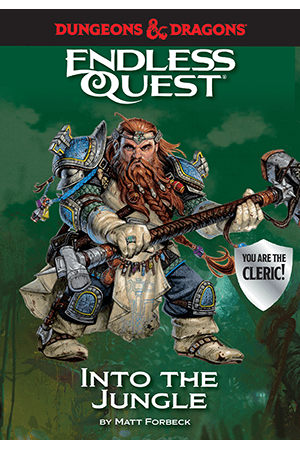
EndlessQuest_ProductImage_Cleric_full
Take on the role of a dwarf cleric in Endless Quest: Into the Jungle by Matt Forbeck.

My son’s favourite book was ‘Into the Jungle,’ which lets you play as a male dwarf cleric of the god Clangeddin Silverbeard, the dwarven god of honourable battle.  Your character was given a mission by the Harpers, to track down an ex-member of their order by the name of Artus Cimber and retrieve a powerful magical ring that is in his possession, the Ring of Winter. In the wrong hands this ring could bring about an eternal winter, and the Harpers want the ring to remain in their possession. Artus has disappeared in the jungles of Chult, and its up to you to track him down, retrieve the ring, and bring it back. This was the most deadly of the books, with only one ‘perfect ending’ (which my daughter discovered on her first try), a heavy amount of ‘survive but fail’ (only two of which have a happy tone), and a whole lot of fatal endings. Despite its lethality, both of my kids adored it. There’s a pair of lovable characters you can befriend (Qawasha the druid and Kupalué the friendly vegepygmy), a wide variety of exciting locations to explore (from dinosaur races to ancient ruins), tons of cool enemies to encounter (including a stone golem, froghemoth, zombie tyrannosaurs rex, green hag, and the witch Nanny Pu’Pu), and a variety of interesting races to interact with (like pterafolk, grungs, aarakocra, and goblins). Famous cameos include Volo, the Harpers, Artus Cimber, and the Red Wizards of Thay. The majority of the book deals with the hazards of the jungle, and the undead which are rampant throughout it — particularly zombies. My son’s favourite part of the book was the variety of cool places you visit, and a timely rescue from stone golems by an aarakocra (eagle-people). My daughter’s favourite part was when she read the book for the second time and was killed by eating a tasty (but poisonous) dinner with a tribe of adorable grungs (humanoid poisonous tree-frogs). My favourite part? Your side-kicks! Qawasha and Kupalué are wonderful guides and great fun. As an added bonus, certain circumstances can make them turn against you, which gives your decisions extra weight. There’s also a series of lovely interactions with the witch Nanny Pu’Pu which will force you to choose between your morals and survival. Your character will then have to deal with the ramifications of that decision. Awesome! The downsides? I found that the main character doubts his faith a lot. He’s he’s in a bad situation he often wonders why his god is displeased with him or has abandoned him. Now, I’m not saying it’s not alright to have a crisis of faith, but he has them a LOT, which is a strange character trait to give a devoted cleric. My other complaint? As previously mentioned, if you get into a fight chances are you lose. Which is unfortunate when you’re playing a cleric who gets to fight against undead and worships a god of honourable battle. That’s not to say he never wins a fight — cause he does. It just doesn’t often happen. I’m totally fine with him dying against a stone golem, or a froghemoth, or a swarm of pterafolk who drop him to his death. But against a few zombies? Or a few goblin and some zombies? It makes him feel a little lame. Overall, we all really enjoyed ‘Into the Jungle.’ My kids loved it most and both give it a rating of “Awesome,” while I really enjoyed it. The characters and events in this book are tightly intertwined with the Tomb of Annihilation campaign and Board Game. Artus Cimber also appears in the books Realms of Valor: The Family Business, and The Ring of Winter (which I can’t seem to find available online, but I could find as an audio book).

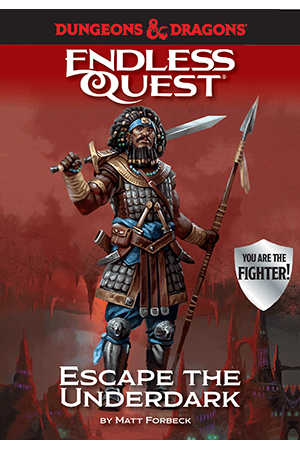
EndlessQuest_ProductImage_Fighter_full
Take on the role of a human fighter in Endless Quest: Escape the Underdark by Matt Forbeck.

The second most-deadly of the Endless Quest books is ‘Escape the Underdark.’ In this book you play as a male human fighter who is captured by drow. You begin the book by waking up in a prison cell (classic!) alongside a motley crew of other prisoners. It’s up to you to escape or die trying! But, as you’ll soon learn, escaping isn’t the hardest part. Getting back to the surface alive is. Depending on your choices you’ll get to face off against a wide variety of underground hazards and enemies. Much to my surprise the fighter can make a lot of allies. In addition to the other prisoners you start the book alongside, you can befriend myconids, and ally with an opportunistic kuo-toa, duergar, a dangerous red dragon, and even an intelligent gelatinous cube named Glabbagool. My favourite of your allies are a pair of quirky goblins named Spiderbait and Yuk Yuk. They were both adorable and hilarious. I love them! The locations you visit are surprisingly varied, including cities, underground lakes, and even a crevasse filled with spider webs that acts as a kind of highway for adventuresome locals. In addition to the prison located in Velkynvelve, which is where you start the book, you can travel to the famous drow city of Menzoberranzan and the duergar city of Gracklstugh.  Although Menzoberranzan has no happy endings, visiting the duergar can lead to a variety of adventure, some of which can lead to back to the surface. There’s plenty of foes for you to face off against, although nearly every single fight you get yourself into will end in death (even more so than the cleric) which is an odd choice since your playing as a FIGHTER. You’ll need to rely on your wits more than your fists. The most terrifying foe you encounter? Demogorgon. Yup! The demon lord himself! Yikes! Despite its lethality, this was my favourite of the Endless Quest books. The large cast of characters is a lot of fun to interact with and, if I’m being honest, I’ve always been a sucker for drow. It also has some of the most satisfying endings out of the Endless Quest books. Even some of the deaths and failures where you never escape the Underdark are surprisingly satisfying. It was great fun. This book, its overarching events, and its characters are intertwined with the D&D campaign Out of the Abyss and the Rage of Demons storyline.

EndlessQuest_ProductImage_Rogue_full
Take on the role of a halfling rogue in Endless Quest: To Catch a Thief by Matt Forbeck.

Next up is ‘To Catch a Thief‘ which places you in the role of a female halfling rogue who picks the wrong pocket! After being caught by Lord Laeral Silverhand, the Open Hand of Waterdeep and a contingent of the City Watch you’ll need to use to wits to escape jail time. This will lead you to either trying to flee or taking on a dangerous task for Lord Silverhand. Recently her pet griffin was stolen by the Thieve’s Guild and she wants you to retrieve it for her. Sound easy? Not so! The Thieve’s Guild is incredibly powerful and far-reaching. It’s leader, The Xanathar, is a powerful beholder. Not someone to trifle with! Stuck in an impossible situation, its your wits, adaptability, and shifting allegiances that will see you out of this whole. That and fleeing! Running away is a common ending in this one, and you often have the chance to abandon your mission — whatever it may be at the moment — and skip town. Which is awesome, actually! Very in character for a rogue. I also really enjoyed that you have plenty of chances to change sides, trick, and betray someone. This book takes place in both the city of Waterdeep, and the underground city of Skullport. You get to visit some famous places, and interact with a few well-known characters. You may also get to disguise yourself as some famous characters including Marune the  Masked, and the infamous Drizzt Do’Urden. Surprisingly, the wily rogue manages to survive most of the fights you can get into, and dies rarely. Most often she survives by fleeing, but sometimes finds herself beholden to one faction or another. Likely for life. It’s probably that however you ‘win’ this book you’ll make enemies, meaning even victory can be dangerous. By far the most satisfying endings involve rescuing the griffon, which lets you take on the role of hero. But that’s not necessary. Not everyone wants to tangle with a beholder, after all. Another wonderful ending involves saving a group of slaves from their bugbear kidnappers and leaving town with them. Other than a beholder, bugbears slavers, and bandits and thieves of all kinds, you can also face off against pirates, assassins, thugs, guards, a demilich, and even start a bar brawl!  Lots of danger in this one! All in all, my kids liked this book least (although they still enjoyed it a lot) due to the lack of scenery changes. You’re in a city and you might move to another city. Not much in the way of far-flung and exotic locations, here. However, it was my second favourite of the Endless Quest books. I thought it was lots of fun. Waterdeep, Undermountain, and Skullport are the main locations in a variety of adventures, including Waterdeep: Dragon HeistWaterdeep: Dungeon of the Mad Mage, and Tales From the Yawning Portal.

EndlessQuest_ProductImage_Wizard_full
Take on the role of an elf wizard in Endless Quest: Big Trouble by Matt Forbeck.

Finally, we have ‘Big Trouble.’ This is both the least lethal, but the saddest of the books. In it you take on the role of a female elf wizard whose home is attacked by an army of hill giants. During the attack you’re told to take your younger brother and flee, though whether you listen to that sound advice is entirely up to you. Although its possible you get out with your brother, it’s most likely you end up alone. Lost and worried about your family you set out on a quest to find them and bring them home. Along the way you (very likely) meet up with a cloud giant wizard named Zephyros who travels around in a flying tower and is a friend of your parents. With his help you can choose to track down either your father, or your mother and brother. Both choices lead you on a variety of adventures to some far flung locations. The quest for your father can take you to the Eye of the All-Father in the frozen north and pit you against bandits, giants, a blue dragon, and a dragon cult. The quest for your mother and brother will lead you to Grudd Haug, a hill giant settlement where they have been taken prisoner by the disgusting Guh, a female hill giant that believes if she is the fattest hill giant her gods will give her their blessings. She’s gross. There’s plenty of ways for things to go awry on your journey, and a surprisingly large number of ways you can rescue some of your family. However, there are no endings where you can rescue everyone. You might save your brother, or your mother, or your father, or your mother and brother — or no one — but you can never save them all. That means that even the happy endings are bittersweet. Surprisingly, this determined wizard gets into a lot of fights throughout the book, and can even take down (or help take down) some very powerful enemies with low-level magic. She proves that even the young and inexperienced can make a difference. This was a really wonderful, welcome change from the previous books, which often end with you dying in such circumstances. It was also really unexpected. Some important locations you can visit in this book include Ardeep Forest, the Eye of the All-Father, and Grudd Haug, and some famous characters include Harshnag, Claugiyliamatar, Zephyros, and the infamous wizard Elminster! Events and characters in this book directly intersect with the Storm King’s Thunder campaign. Some of the characters can also be found in the old Heroes’ Lorebook, and the old City of Splendors: Waterdeep. Elminster, of course, can be found in a LOT. It was a lot of fun!

Both my kids and I really enjoyed the Endless Quests books. I highly recommend them for any kids who have an interest in fantasy novels, adventure novels, choose your own adventures, or tabletop RPGs. They’re engaging, variable, and a ton of fun. Fans of D&D will particularly enjoy all the famous places you can visit and people you can meet. Best of all? Each one is very different.

Well done, Matt Forbeck! My family is sending you a round of applause for writing these delightful kids novels!

As for everyone else? I hope some of you have the chance to share these books with the kids in your life. They’re great fun and well-worth the money.

Jessica.

blog endless quest stack


Tails of Equestria: The Storytelling Game

Quite a few months ago a fellow gamer recommended my family give Tails of Equestria: Storytelling Game a try. I looked into the game, and told my daughter and son all about it. They were extremely excited. The problem?

Finding it.

Although I was able to find a copy of the rulebook on some American and European retailers websites, I could not find this RPG in Canada. None of the local game shops had it, Amazon had only German language copies in stock, and Indigo was sold out completely. We’ve been keeping our eyes open in the months since and, although I did see a copy turn up once or twice, it was never for long (or affordable!).

And then Christmas came. My daughter, in a stroke of brilliance, asked our only relatives that live in the States for My Little Pony: Tails of Equestria: Storytelling Game for Christmas. She typed out the title of the book she needed to play, and then all of the other supplement books she wanted, and assured me that YES, she would definitely be happy with a big pile of books as a Christmas gift, and YES, she was sure that’s what she wanted.

Grandma and Grandpa came to the rescue. This past Christmas my daughter opened up not one, but three RPG books. My Little Pony: Tails of Equestria: Storytelling Game (which is the Core Rulebook and essentially all you need to play), Tails of Equestria: The Festival of Lights (which is a published adventure), and Tails of Equestria: The Storytelling Game Starter Set (which contains an adventure, dice, and all kinds of accessories).

My daughter was thrilled. So was my son. And honestly? So was I. I had heard wonderful things about this game and, although it wouldn’t become my favourite game anytime soon, it looked like a ton of fun. Definitely something my kids would enjoy.

After squealing in glee and obsessing over some of the cool pictures inside she put down the books and moved on with the rest of the holidays. She tried out new toys and video games. We learned how to play our new board games. And at the end of that first weekend after Christmas she held up her books and gave me a big grin.

“Will you read this with me now, Momma?”

I was about to head out for a trip to the laundromat, so it wasn’t exactly the ideal time. But, I’ve never been one to say no to a kid with a book, so I put aside all the work I was going to bring with me and packed up my kids and our hardcover book instead. Clothes in the wash and water bottle in hand — reading an entire RPG core rulebook aloud is thirsty work! — we settled in to learn a new d20 game together.

my litte pony tails of equestria storytelling game

The book is bright, colourful, and engaging. It’s simple to understand but doesn’t talk down to you. It is perfectly written for its audience. Seriously. My daughter is in grade one and not only did she follow along with everything I was reading to her (and pay attention!), she understood the game and its rules immediately. I never had to stop and explain anything further than the book already had. I never had to give her an easy example to illustrate a rule. Nothing. She listened and understood. My son, who is only a year older than her, could have read the entire book by himself and understood it. In fact, my daughter probably could have read it herself too, but that’s not typical for kids her age (both of my kids are very strong readers). We weren’t done the rulebook by the time we were done at the laundromat, but after we got home my daughter sat down beside me on the couch and we finished it. Cover to cover in few hours. She was practically bouncing in excitement.

“Can we make our characters now?”

So we printed off some fancy character sheets, called over my son, and got creating! The entire process took us around an hour, which included drawing and colouring our ponies. Follow-up ponies we made took much less. About fifteen minutes from start to finish.

We were ready to play!

…sort of. We still had to convince my husband to make a character so he could join in on the game. Haha. I’ll share more details about our first gameplay experience in an upcoming blog post later this month, but for now, we’re going to talk about the rulebook itself. Interested? Read on!

Tails of Equestria: Storytelling Game is an easy to understand pen and paper roleplaying game featuring the world and characters of the hit TV show My Little Pony: Friendship is Magic. The game is aimed at children, but is definitely fun for the whole family. A hardcover book 151 pages in length, this tome is packed full of artwork, and is written in an easy to read font (and font size). Licensed by Hasbro, published by River Horse Games (in Europe) and Shinobi 7 (in the USA and Canada), and written by Alessio Cavatore, Dylan Owen, and Jack Caesar, this book’s suggested retail price is 25 pounds, 30 Euros, 35 American dollars, or 40 Canadian dollars. Of course, that cost will vary a lot depending where you pick it up. I found forty five is more typical online in Canada (if you manage to find a copy in stock at all). The book is sturdy and well made — a must have for kids books! The front cover features an image of the three iconic Tails of Equestria ponies navigating the wilds with a castle in the background. Firebrand, the iconic unicorn takes the lead, with Thrilly Filly the pegasus flying above, and Strong Oak the armoured earth pony alert at the back of the group. My kids love the art, which is drawn by Amy Mebberson, but its the back of the book that really shines for me.

I remember when I was in junior high there was a Chapters nearby that I went to constantly. On one visit I passed by the Dungeons & Dragons Player’s Handbook and stopped in my tracks. I picked it up and flipped through it. I knew in my gut I wanted it, but I had no idea what it was. None. Eventually I put it back and moved on. Every visit afterwards I passed by that book and picked it up. But I never bought it. Not until many years later when someone actually explained to me what the heck D&D was. By then the book store wasn’t even open anymore. I would have liked to buy it from there. But this? This book doesn’t have that problem. Right there on the back cover it explains what this book is, how you use it, and what it’s for. It’s written in simple language that any kid or parent (or grandparent!) can understand. It’s simple, clear, and concise. I love it.

Seriously.

I love it so much I’m going to let you read it for yourself.

What is this book?

Hey there! So I imagine you’ve picked up this book knowing a little bit about My Little Pony: Friendship is Magic. You’ve probably had a quick flick through the book and are wondering exactly what it is.

This book is a manual for a storytelling game, which allows you and your friends to create your very own pony characters to explore the amazing and magical world of Equestria — will you be a dynamic adventurer like Daring Do or a bold treasure hunter like Rarity?

Wait, wait, wait! You said this is a game, but this is clearly a book!

You’re right, but it’s actually both a book and a game. This book contains rules and a story. Rules that will tell you how to make a strong, clever, or charming pony. A story that you and your friends will enjoy, where the choices you make will change the story itself until you are telling the story as much as the book or the GM.

GM… what is that?

A GM (gamemaster) is a player at the table, but instead of playing as a pony, he or she will play as a storyteller, impersonating all of the ponies you meet, the beasts you face, and the challenges you have to overcome. Think of the GM as a narrator in a movie — it is his or her role to tell the players exactly what is happening in the story and what the outcomes of their actions are, depending on their choices.

Cool! How do I win?

Winning a storytelling game is very easy; you just need to have fun! Tails of Equestria is not about getting to the end of the board or having the most points, but all about having fantastical adventures and using the magic of friendship to overcome any obstacle that stands in your way, You and your friends, including the GM, are all on the same team — as long as everypony is having fun, everybody wins!

So open up Tails of Equestria and be prepared to enter a world of magic and friendship.”

See what I mean? Simple, approachable, and understandable. This isn’t just a book for RPG gamers. In fact, most of the kids who pick up this book won’t have played a pen and paper RPG at all. This is a book that can guide kids to becoming RPG gamers in a way that’s fun, cool, and tailored to them. It’s really well done.

Tails of Equestria: Storytelling Game is split into fourteen sections: twelve chapters, an adventure module, and the appendix. The chapters are each colour coded, which makes the book super easy to navigate and has the added bonus of making it look like a pleasant rainbow. Even better, the chapters are well ordered. One naturally progresses into the other in a way that just makes sense. It’s perfect.

The book starts off by explaining what a roleplaying game is, how to play them, what you need to play, what kind of dice the game uses, and some other supplemental material that some people like to use but isn’t mandatory. It mentions other Tails of Equestria products (like dice sets, gaming screens, and ‘tokens of friendship’), but also offers free solutions. It suggests using beads, buttons, and other small objects as ‘tokens of friendship’ and recommends free dice rolling apps. It also has dice charts in the back of the book so that all you need to do is flip to the proper chart, close your eyes, and point, to figure out what you’ve rolled. Offering these free alternative options in a way that makes it seem normal and acceptable is really important. Parents don’t want to be shelling out a ton of money after already having paid for a rulebook. Also, kids who do use buttons and the dice chart don’t need to feel like they’re left out or ‘making due.’ It makes it clear that you don’t need fancy supplies. You just need this one book. There’s also a short section intended for parents, which explains some of the benefits of roleplaying games.

Tails of Equestria: The Storytelling Game then moves on to character creation, which takes up the majority of the book. The first thing you need is a character sheet. One is provided in the back of the book, which you can photocopy. You can also go here to download a variety of character sheets for free. They have blank sheets and ones with male and female ponies, pegasus, and unicorns pre-outlined. My whole family loves those ones, so I highly suggest you give them a gander. Once you’ve got your pony sheet ready you need to choose your pony type.

my litte pony tails of equestria the storytelling game character sheet

Players can choose to be an earth pony, pegasus, or unicorn. Earth ponies are hardy and strong. They gain the stout heart trait, which allows them to really push themselves to accomplish a physical task once a day. They also have higher Stamina (which is your hp) than the other pony types. Pegasus and Unicorns are less hardy than earth ponies, but have special abilities of their own. Unicorns can use magic. They begin the game with telekinesis and can make their horns glow. As they level up you can select more magical powers with them (if you want) such as force fields, stun rays, and teleportation. Pegasus can fly and walk on clouds. As they level up you can even learn to control the weather. There is a fourth type of pony in My Little Pony, the alicorn, but it’s off limits to players. Although kids will likely be a bit sad about that, the book explains quite clearly why, which was more than enough reason for my kids. After all, only Princesses of Equestria can be alicorns, and those thrones are all currently taken.

Once you know what kind of pony you want to use you write down your level, which is one. Then you select your Element of Harmony. This doesn’t have a mechanical effect. It acts more like a a guide to help you and your fellow players know what personality trait your character is most tied to. The Elements of Harmony are generosity, honesty, kindness, laughter, loyalty, and magic (which is a balance of all of the others). Once you’ve chosen your Element of Harmony you allocate your statistics.

Before we get into that, though, let me give you a little context about how this game works. Every pony has three main statistics: Body, Mind, and Charm. Each of these statistics will have a dice type associated with it. In this game your lowest statistic and traits will use a d4, but will increase as you level up, moving on to a d6, d8, d10, and so on. Low dice are bad, and high dice are good. Simple.

If you come across an obstacle — things like kicking down a door, untying a knot, or climbing a cliff — this is called a Test. Your GM selects the Test’s difficulty from a simple chart. Then the players roll a dice for the stat most applicable. Kicking down a door or climbing a cliff would be a Body check, discovering a clue or solving a riddle would be a Mind check, and making friends or telling a joke would be a Charm check. If you beat the DC you pass and if you’re under the DC you fail.

If you happen to have a skill that could also apply to whatever you’re trying to do, like bucking to kick down a door, or keen knowledge (geography) to find your way in the wilds, you get to roll that dice also and keep the better result. For example, if a pony with a Body d4 and Bucking d6 wants to kick down a door, they roll both a d4 and a d6, then they choose which die result they want to keep.

If you’re making a check against a different pony or an opponent, this is instead a Challenge. Examples of this include a baking competition, a race, or a debate. In this case the ponies and opponents involved roll the appropriate dice and the highest outcome is the winner.

Battles are a special type of challenge called a Scuffle. This works just like a regular challenge, except that the loser loses an amount of Stamina equal to the score rolled by the winner. So, if a pegasus and a timberwolf get into a scuffle, they each roll a Body check. If either of them has an additional trait that would be useful they roll that as well and keep the better of their rolls. If the pegasus rolled a 4 and the timber wolf rolled a 6, the timberwolf has won the round and the pegasus loses six Stamina. When you start the game your ponies will have either 10 or 12 Stamina, so battles tend to pass quick. Its a fun and simple way to handle combat. However, it should be noted that scuffles aren’t a major part of Tails of Equestria. Its much more likely ponies will avoid combat with clever roleplaying, creative thinking, and teamwork.

There’s a bit more to rolling than that. Rolling a 1 results in an automatic fail and is called Bad Luck. Beating a Test by double its difficulty is called an Amazing Success, and means something wonderful happens. Rolling maximum on your dice is called an Exploding Hoof and allows you to immediately roll on a dice one step higher (from d4, to d6, to d8, and so on). If you roll higher than your previous roll you can use the higher result, otherwise you keep your previous die roll. And if you roll maximum again? You go up another dice step and keep going. These all turned out to be fun additions to the game. My kids particularly enjoyed the Exploding Hooves. Haha.

Now that we’ve got the basics covered we can jump back into character creation.

All ponies begin with a d6 in Charm (which is your social statistic). Then you get to allocate a d4 and a d6 to the other two stats, which are Body (the physical trait) and Mind (your mental stat). Smart and clever ponies will want to put their d6 into Mind and their d4 into Body, while tough or nimble ponies will want to put the d6 into Body and the d4 into Mind. Earth ponies are a special exception and instead count their Body as one dice type higher, meaning an earth pony’s starting statistics will either be Body (d8), Mind (d4), Charm (d6) for strong ponies, or Body (d6), Mind (d6), Charm (d6) for brainy ponies.

Once you’ve chosen your statistics you calculate your Stamina. This acts as your hp, and is the sum of your Body and Mind stats. This means that pegasus and unicorns will have 10 Stamina to start with, while earth ponies will have 12. Failing Tests, Challenges, and Scuffles can lower your Stamina, as can lack of sleep or a poor diet. You can recover Stamina by resting, eating a good meal, or using Ponybalm (which is like a healing potion).

Now its time to select your Talents, which are sort of feats, special abilities, and skills all rolled into one. Each pony type starts with their own Talent. Earth ponies have Stout Heart (d6), pegasus have Fly (d6), and unicorns have Telekinesis (d6). At level one you also get to select one other Talent from a list, which is tied to your Cutie Mark and is your specialty. This Talent should be a huge part of your character and shape their outlook, personality, name, and so on. There’s a decent sized list of Talents to choose from, many of which have an unlimited number of subtypes. Keen Knowledge, for example, is knowing a lot about a specific topic, but what topic is entirely up to you. Similarly, Creative Flair is something creative that you’re particularly good at, such as baking, comedy, or painting, and Special Skill is something physical that you’re talented in, like bucking, gymnastics, or sneaking. Other Talents are more specific. Healing Touch, which was my personal favourite, allows you to heal an ally, while the Stare allows you to fascinate or command someone to do something. Finally, some talents can only be taken by a specific type of pony. Only unicorns can use magic, for example, and only pegasus can fly. Although the list is nice and allows for a lot of variance between characters, I found myself wishing it was a little longer. Fortunately it’s mentioned that players hoping to create something not on the list can do so with approval from their GM. Although my family has made a few ponies already, we haven’t had the need to do this yet. So far the written Talents have been more than enough.

Whichever Talent you select at level one begins at a d6. Throughout the game you’ll have the chance to upgrade the dice types of your various Talents, and learn more. Any Talents learned later begin as d4s though, so choose wisely.

Once you’ve decided on your Talents you get to pick out a Quirk, which is a character flaw. Again, there’s a decent array of options and, again, I found myself wishing there were more. Fortunately, some of them can be incredibly varied. Fear, for example, is a fear of a specific thing (like spiders or heights). Allergies and Oooohhh… Shiny! are equally variable. The others, such as asthma, blunt, messy, and overconfident are much more specific. Again, as with Talents, players have the freedom to create their own Quirks with GM approval. So why would your pony want a flaw, anyway? Quirks will influence your character’s personality and make them unique. It gives kids something fun and often comical to role-play, and teaches us that no one is perfect. But it has an in game effect as well. Every time your ponies face their fears they get rewarded by the GM. My kids loved this and really embraced their ponies Quirks. It turned out to be a lot of fun.

By now your pony is nearly complete. You’ll need to design their Cutie Mark, draw your pony, and give them a name. Some of the ponies my family created included Soothing Heart the over-prepared earth pony mother, Flying Recall the mystery solving pegasus with a sixth sense for trouble, Bunna the stuffed animal seamstress unicorn who can talk to animals, Nugget the unicorn artist who hopes to draw every magical creature in existence, and Thunderhoof the kung-fu fighting earth pony who wants to be an action star. All in all, this game allows you to make unique ponies with only a short amount of work. It’s a fun, streamlined process that everyone enjoyed.

What’s left? Gear. Now, most ponies don’t need to pick up any gear to start. But some, such as adventuresome ponies or those who have a goal or job in mind, will want to spend some of their money — called Bits — on gear before they begin the game. There’s a solid list of equipment you can purchase in the game, with enough variability that nearly all characters should find the things they need (or a similar item whose cost they can use). Whether you decide to spend your bits or not, each pony begins with 400 bits. In between adventures your ponies can earn 200 bits per month plus or minus d20 bits, as determined by the GM. All in all we found that bits and gear were a nice and important addition, but not integral to gameplay.

Finally, players determine how many ‘Tokens of Friendship’ they begin the game with. These are special crystals (or beads, buttons, and so on) which you can use to reroll dice, automatically pass a failed roll, or slightly change the storyline (depending on how many you spend). You begin the game with Tokens of Friendship equal to the number of people you are playing with (including the GM). You also gain more at each level up. If you decide to use your tokens to help out someone else, you reduce the cost of spending Tokens of Friendship. In very rare circumstances, players and characters who are particularly kind can also be gifted a bonus Token of Friendship by the GM. We found that this was a really fun aspect of gameplay that everyone got into the spirit of.

As you adventure your characters will learn and grow. Tails of Equestria does away with experience points, instead allowing ponies to level up after every adventure — or in between sessions if an adventure is particularly long. When a pony gains a level they increase one of their Statistics (Body, Mind, or Charm) by one die type (a d4 becomes a d6, a d6 becomes a d8, and so on). If they choose to increase Body or Mind this also creases their Stamina accordingly. For every Talent that you used in the previous adventure you increase it by one die type as well. Then you either select one Talent you didn’t have a chance to use and increase it by one die type, or you select a new Talent to gain at d4. Finally, your characters gain a number of Tokens of Friendship equal to the number of players (including the GM) who participated in the last adventure. very rarely you can select a new Quirk if you want, but it has to be for something that happened during your adventure, and each pony should do this only once or twice. For example, if your earth pony fell in a pit full of snakes and you role-played them being horrified by the events they might take the Quirk fear (snakes). This approach is simple and easy to understand, but you’ll soon see your PCs all branching off in different directions the more they level up.

With character creation and the basics of the game out of the way, Tails of Equestria: The Storytelling Game goes on to further explain gameplay for players and GMs. Which should bring us to the end.

Only it’s not the end!

This book also comes with an adventure for first level characters called The Pet Predicament. I cannot express how happy I was to discover this. Particularly after I read it! It is honestly the perfect start adventure for this game. And, it’s not a short or cheap adventure, either! It’s forty pages in length if you count the stat blocks it comes with. It took my family two sessions to play through, though my kids were so engrossed they wanted to play it in one. But, alas! It was bedtime. Haha.
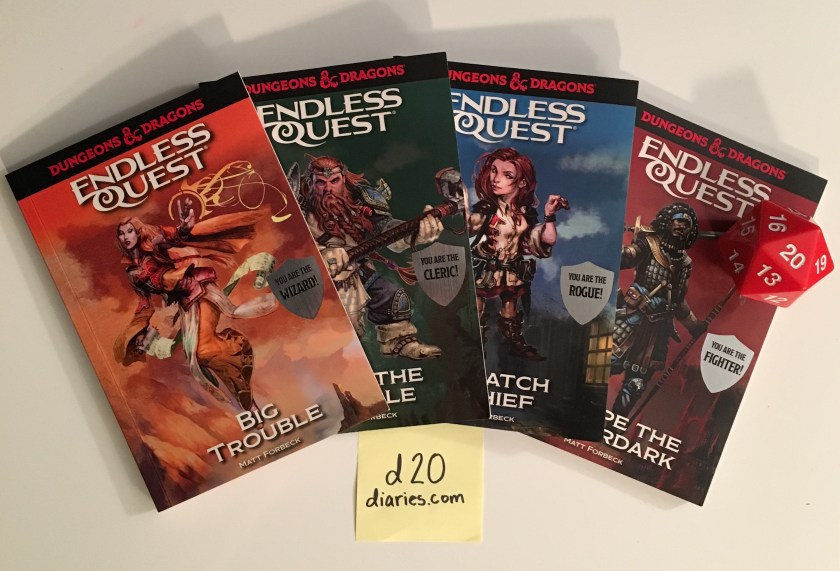
my litte pony tails of equestria the storytelling game in game

In a practical sense, this adventure is incredibly important. It provides a first adventure for players to use, and teaches them how a game should be run by example. For experienced players it also serves to alter our preconceptions about RPGs, and really shake things up. That’s because Tails of Equestria isn’t the same kind of RPG as Pathfinder or D&D. It downplays battle, and really encourages players to use creative thinking, kindness, teamwork, and roleplaying to overcome obstacles. This game requires a different mindset than other RPGs. Happily it’s a mindset that kids and young players will naturally settle into and flourish. I honestly cannot be happier with how this game played.

So what is the Pet Predicament? I mentioned it was the perfect starter adventure for this game and I meant it. It’s well written, engaging, and fun. There’s plenty of opportunity for Scuffles, but just as many chances for players to completely avoid Scuffles with Tests an Challenges. It features the Mane Six (main characters) from My Little Pony: Friendship is Magic as initial NPCs, and leaves the PCs as their pet-sitters. Any kids who has seen the show will be absolutely thrilled at this turn of events. Getting to meet such famous characters is enough to make many kids squeal in glee, and finding themselves the caretakers of all six of their pets? I’ve never met a kid who doesn’t love animals! Both my son and daughter got super into this adventure. They did their best to take care of the animals, feed them their favourite things, pamper and play with them, and so on. Unfortunately for your pet-sitters, not all of the pets are well behaved. Fluttershy’s rabbit, Angel, is a menace (as fans of the show will know!). My daughter, who adores rabbits, had a ton of fun dealing with the fluffy little terror. But, like all good adventures, something goes wrong. And this time? There’s definitely a rabbit to blame! The pets soon get lost in the dangerous and spooky Everfree Forest, and its up to your PCs to rescue all the pets, brings them back to Fluttershy’s cottage, and clean up. Their adventures will present them with all kinds of obstacles, Tests, and Challenges. Rescuing each pet will take creative thinking and teamwork. How each task is accomplished is incredibly open ended, which really allows your group of PCs to use their own unique approach to get things done. I’ll refrain for spoiling any more of the adventure, but I will say that it’s a delight to read, GM, and play. Everyone in my family had a blast (including my husband).  The ending also had my kids hooked, as it leads directly into the Tails of Equestria: The Curse of the Statuettes adventure (although the book also encourages kids to create their own adventure with the cliff hanger ending as an opening plot hook).

In the end, my entire family loved Tails of Equestria: The Storytelling Game. It’s fun, fast-paced, and simple, but offers everyone at the table plenty of opportunities to role-play and work together. I had a blast sharing this game with my kids. And my kids? They couldn’t be happier. In fact, my daughter is sitting in her bed with a little notebook and her rabbit pen creating another character as we speak.

Absolutely a wonderful game.

 Jessica


Adventures in Board Games!

My kids love games. Board games, d20 games, video games. All kinds. So, it should come as no surprise that this Christmas my tree was packed full of games. My kids were lucky enough to get a Nintendo Switch from their uncle this year, so both my son and daughter spent the first few days trying out their new video games. Let’s Go Eevee is a huge hit, as is Super Mario Odyssey. But, when we had some free time together as a family, my kids gravitated right to the new board games. My daughter got quite a few. The Hatchimals Eggventure GameBananagrams, and Bunny Kingdom (plus a new d20 game we’ll talk about another time!). And my son got two: Jumanji  and Dinosaur Island.

We spent a few days this week opening up the new games, learning how to play them — which is technically me learning how to play them and then teaching them to everyone else — and taking each one for a whirl.

Hatchimals Eggventure Game was quick to learn, which should come as no surprise. I assumed it was another one of those generic board games where you just move around the track that happens to be plastered with pictures of the latest popular kids show. Surprisingly, that wasn’t the exactly case. It was a simple kids game plastered with pictures of Hatchimals, the popular kids toy. But it was also a little more complex than just moving around the board. It involved hatching eggs, which you did by matching cards in your hand to eggs on the board. Cards and eggs were colour coded by which ‘nest’ they could hatch at, and when you landed on the proper nest you revealed one of the appropriate eggs to everyone. If it matched yours you hatched it, and if it didn’t you put it back. First to hatch their eggs wins. It was sort of like a mix between go fish, memory, and a generic kids board game. Not exactly a thrilling gameplay experience, but my daughter adored it and it only cost me a few dollars at the local Giant Tiger (which is a Canadian discount store). It’s simple enough that we can teach it to her cousins and they can play it together. Well worth the money. My son had the worst luck, though! Every single time he had a chance to blindly choose an egg, and had a fifty-fifty chance to get the right one, he got the wrong egg, The entire game. Haha. Poor kid.

Bananagrams was much more fun for everyone. For those of you who’ve never played this delightful little word game, it’s essentially a bunch of letter tiles that you put in the middle of the table. You get a bunch of them, and it’s your job to make words out of the tiles. You have to connect the words to one another by shared letters, either horizontally or vertically. It’s like each player at the table plays their own personal game of scrabble. You race to see who uses up their tiles first, then shout ‘Banana’ when you’ve done so. Everyone checks it for spelling errors, and then you start over for another round. You can also swap letters you’ve got with ones on the table if you want to, which is pretty much what my son did the whole time. Haha. Anyway, it’s a fun little game that’s great for kids of all ages. Mine are quite young, so they had no hope of beating me, but they had fun trying to make their own words and came up with some pretty good ones in the end. As an added bonus its one of those small, compact games that’s great for bringing out to family gatherings, a friend’s house, a road trip, or (in our case) the laundromat. It’s pricier than I expected it to be, though, but I was lucky enough to pick it up on sale.

Kids Games.JPG

Jumanji  was hell! Don’t get me wrong, I love the game. I was the perfect age for the original Jumanji when it came out, and owned the board game as well as the movie on VHS. I remember my brother and I got a kick out of using the decoder to read the rhyming cards from the movie. I can still rattle some off of the top of my head, actually. “At night they fly, you’d better run, these winged things are not much fun.” There’s a few more, now that I think about it. In fact, I probably remember more of them than I should…

My son isn’t partial to the original Jumanji  movie, but when he watched the reboot with Dwayne Johnson and Jack Black in it this past year (Jumanji: Welcome To The Jungle ) he LOVED it. Obsessively loved it. He even started writing his own Jumanji stories. Never finished any, of course. He’s both impatient and lazy, which isn’t exactly conducive to finishing the things he starts, but he enjoyed it. So, he was absurdly excited to get a copy of the board game for Christmas. It’s got a nifty little wooden case/board (just like in the original movie), plenty of dice, and is fast paced. Unfortunately, the first time we played it was when my niece and nephew were over. Now, I’m not sure if any of you have had the joy of teaching a new board game to four antsy and overly excited children between the ages of two and seven before, but wow! It was brutal! Haha. As an added complication there were multiple sets of dice — one for each player — and the game pieces were slightly too big for the spaces on the board, so I spent the entire game guiding play, stopping children from consuming game pieces, looking for missing dice, reminding toddlers not to move pieces that aren’t theirs, reading cards, referencing rules, and trying to figure out which of the children happened to have stolen the toy rhino that was supposed to be on the board. It was absolute chaos! Luckily I have the standard Mom superpowers: eyes in the back of my head, extra invisible arms, and limitless patience. In the end we got through it and the kids all had a ton of fun. Definitely not a game to play with all of them again, though. I’ll reach for the generic ‘race around the board’ game plastered with popular cartoon characters next time. But, when it’s just me and my kids, we’re more than happy to enter the jungles of Jumanji. Although, my son insists it would be much more fun as a virtual reality video game. Haha.
Which brings me to the actual point of this blog. Two of the games we picked up weren’t geared at young kids at all. They were aimed at an older audience. And honestly? Both were awesome!

First up? Bunny Kingdom.

Bunny Kingdom is a pricey game that we picked up for my daughter months ago when we found it in the local game store, Game Knight Games and Cool Stuff. Yes, that’s the store’s actual name. It was far out of our budget for an impulse purchase, but my daughter REALLY LOVES RABBITS. Seriously. I’m not sure I can actually emphasize that enough. But, just know: she really loves rabbits. She’s got quite a few rabbit board games already, but none that are games that my husband will sit and play with her. So, when we saw it at the store we figured, why not? I suppose I could have gotten it cheaper off of Amazon, but when we have the chance we always prefer to shop locally. Anyway, we figured that even if my husband hated the game, it was covered in adorable images of rabbitfolk making farms and kingdoms so my daughter would love it.

Luckily, our hunch was right and it turned out to be a lot of fun.

Bunny Kingdom is a board game for 2-4 players. It’s intended for players ages 12 and up, but my kids are only seven and eight and they didn’t have any trouble getting the hang of the game. It’s published by IELLO, features bright and colourful art by Paul Mafayon, and was designed by Richard Garfield (the creator of Magic: The Gathering, King of Tokyo, and Keyforge: Call of The Archons , to name a few). Bunny Kingdom was a nominee for 2018 Origins Awards Best Family Game, and 2017 Cardboard Republic Striker Laurel awards. The box is nice looking and solid, and the board inside looks great. It’s essentially a large map with a 10×10 grid overtop, and a scoreboard on the side. Many of the Bunny Kingdom Boxspaces on the map feature settlements and resources that players can claim. Settlements contain castles, while resources allow you to collect wood, carrots, and fish. Unfortunately, our board had suffered damage in two places despite having a seemingly undamaged box. Not what you want to see when you’ve paid a good chunk of change for a new board game!

Each player has a pile of tiny rabbit tokens they can use to claim their territory on the board, and act as their token on the scoreboard. In addition to the player tokens and board, this game comes with three different sized castles (level 1, 2, and 3), corner markers to denote special upgrades and camps that you can add onto spaces, and a massive deck of cards. Seriously massive! You’ll have to split it into a few piles just to shuffle it. The art throughout the board, cards, and box is consistently wonderful. It’s bright, colourful, and cartoony in all the best ways. My daughter repeatedly shrieked in glee, exclaimed “AUW! CUTIES!”, and hugged cards to her chest, so it’s clearly a winner in her opinion! Haha.

The premise of the game is simple. Your great Bunny King has ordered you to lead your clan of rabbits in gathering resources, claiming some land, and establishing new settlements. The rabbit with the most prosperous fief — determined by having the most golden carrots — wins.

So how do you play? For starters, you select your rabbit colour, place one of them on the 0 on the scoreboard, and deal out ten cards to each player. You draft cards from the hand, selecting two you want to keep for yourself, then pass the rest on to the next player. You play some of the card types and set the others aside for later. Then you proceed with the draft. This continues until there are no more cards in hand. Cards can do a few things, but the most important ones are labelled with a letter and a number — coordinates referring to a space on the board. If you select a card like this you get to place a rabbit token there and claim the space as your own. Other cards include camps (which let you claim any unclaimed space until someone claims it with the proper card), settlements (which let you build castles of various levels on your claimed territory), sky towers (which let you connect two distant parts of your fief), resources (which let you collect resources like wood, mushrooms, and iron from your land), treasures (which give you golden carrots), and missions (which give you bonus golden carrots at the end of the game as long as you meet the requirements stated on the card). After the cards are drafted you enter the ‘Build Phase.’ This is when you play all of the castle cards, camps, sky towers, and resources you’ve drafted. After this you earn points (golden carrots) for how prosperous your fiefs are, which is based on number of ‘towers’ on the castles within your connected territories, and the different types of resources they can create. Once points are tallied you’ve reach an end of a round. Then you deal out another ten cards to each player and begin another draft. The game ends after four rounds of gameplay. Then you reveal the treasures and missions you’ve acquired, gaining extra golden carrots for them as appropriate. The winner is the rabbit with the most golden carrots (the highest score).

Our first game took us about an hour to play, but all the other games took up around 40 minutes, which is about how long the game is expected to run. Because the game always lasts four rounds, you can expect this to be a pretty consistent time. Which is really nice!

Bunny KingdomBunny Kingdom is a relatively fast paced game that involves some strategy, but doesn’t take up an entire afternoon or a whole day just to play it. Selecting the proper territory is important. You want to grow the size of your fiefs and ensure they connect, but you also want to establish cities and ensure there’s a variety of resources within it’s borders. Knowing which to go for at which times is both a matter of chance, and practise. After playing a round you’ll figure out what’s most important to you. Claiming any territory that already has a castle on it is sound, as is claiming any cards that let you establish resources — or luxury resources — in territories of your choosing. In the first two rounds you won’t earn many golden carrots from your fiefs, but if you build it properly you’ll make a lot in the last two rounds. Treasures are nice, but they offer a small one time payout. Not always worth it. Missions offer a bigger payout, but are sometimes difficult to achieve. They require you invest time in accomplishing them. For example, a mission that promises you one golden carrot per territory you own that can produce wood is nice. But, if you focus on that too much you won’t have a variety of resources available in your fiefs. And it’s variety that earns you golden carrots.

My daughter caught onto the game right away, and had great fun building her kingdoms. She, myself, and my husband all did pretty well. Some games she lagged behind the adults, but others she did just as well or better. Luck played a bit of a factor. So did my daughter’s habit of occasionally selecting cards just because they’re cute. Haha. My son, however, decided that building fiefs takes too much work. Instead he spent the entire first game only taking treasures and missions. We all thought he was crazy! Turns out in the end he went from 0 golden carrots all the way to 147 golden carrots. More than enough to score him a win against my husband’s 116. We were shocked, to say the least. Apparently, taking all the treasures and not bothering with that whole kingdom thing is a decent strategy — as long as you’re the only one who tries it. If too many players go this route it won’t lead to victory.

So, when we played our follow up games, we worked on our kingdoms, took some snazzy treasures and missions, and my son — once again — took every treasure and mission he could get his hands on. This time we thought we had him on the ropes! …And he won again.

*face palm*

I guess we should have taken even more of those treasures… Haha.

Aside from this flaw it was a great game. Of course, it was a rather large flaw. Why should the one person who didn’t bother to even try building a kingdom win a kingdom building game?!? But, we had a lot of fun anyway. Overall, we all thought it was a blast! It’s definitely going to see regular play.

But, our favourite game of the holidays had nothing to do with cute fluffy rabbits. Instead, it featured people-eating dinosaurs! Yes!

Dinosaur Island is a game we picked up for my son because he LOVES Jurassic Park and Jurassic World (and Jurassic World: Fallen Kingdom ). And this game? Pretty much that. You research the genetic code of dinosaurs, create them, and put them in your very own dinosaur theme park. If you don’t have enough security they escape and eat some of your patrons. Which is bad for business, obviously! Haha. In the end, the player with the most successful park wins. The game is designed by Jonathan Gilmour and Brian Lewis, and released by Pandasaurus Games.

Dinosaur Island BoxWe found it on the shelf at another local game shop, Fusion Gaming, and nearly gagged at the price tag. And then we read the box. My husband traded in some Magic cards for the game, and we brought it home for my son for Christmas. It’s a heavy square box packed full of stuff. There’s lots of boards, pieces, dice, cards, and pop-outs of all kinds in this game, which is frankly a little bewildering at first. But, once you’ve got everything popped out and sorted into the many little storage baggies the game comes with (thank goodness!) you can open up the rulebook and try to figure out what the heck you’re supposed to do. Which is hard! Haha. I had to flip back and forth between the first few pages of the rulebook to set everything up — some pages were telling me how to set up the game, and others were telling me the names of types of pieces. All very important! Once I had everything properly set up — which took me around twenty minutes — I finally flipped the page on the rulebook and started to actually read how to play. It didn’t take too long to read, and there were some very useful gameplay examples for each step that helped me figure things out. But, it was still quite complicated. I had to read and reread each step and its example a few times while referencing the board and the list of piece names. Once I figured out a step I moved on, and then by the time I hit the end of a phase description I went back and read that whole phase over again. Anyway, by the time I finished making sense of the rulebook I was confident I understood how the game worked and could teach it to my family, but that I would still need to reference the rulebook for details on most of the gameplay choices the first time we played through. And I was right! I referenced that rulebook constantly during the first game and still made quite a few mistakes. I used it a lot during the second game (so that we find and correct our mistakes from the first play through), and then in the third and fourth game I only had to reference it a few times to double check a rule or a cost for something we hadn’t come across much yet.

In summary, it was hard to learn. This is a bit of a problem since the game is listed as ages eight and up. Eight! In my opinion, this game is too complex for eight year olds. They can play if they’re joining in with the grown ups or teenagers — like mine did — but its not the kind of game you could give to some eight year olds and expect them to be able to learn and play properly. Twelve and up would be more accurate.

That said, the game was awesome.

Everyone had a blast and, surprisingly, my daughter and husband loved it most of all. In fact, they were both the driving factor in us playing it so many times over the last few days. Which is huge! My daughter is always ready to play a board game, but my husband? Not so much. This is particularly surprising when you take into account how long this game takes to play. It says it takes an hour and a half to two hours to play through, but it took us over three on our first run through (and we played the ‘short game’). Further run throughs also took around three hours each, although the second time we played a ‘medium game’ and the third we played a ‘long game’ with three people instead of four. Definitely a time investment!

Dinosaur Island Game Set Up

So what is Dinosaur Island, and how do you play?

The point of Dinosaur Island is to create the most successful park. Your park’s success is measured in Victory Points, which are most often earned by having guests survive their trip to your park. You can also earn Victory Points by creating dinosaurs and by building some attractions. A number of guests visit your park each turn based on your parks Excitement level, which is also influenced by the number and grandeur of the dinosaurs you have created, and by some attractions. But, getting people to your park isn’t all that matters. You also have to have attractions for them to visit. They’ll visit your dinosaurs, of course, but only so many visitors can view a paddock at a time, so you’ll also want to create other attractions. Things like restaurants and rides for the guests to visit. Another factor you need to take into account is danger. You can have a lot of dinosaurs and a huge excitement level, but if you haven’t invested enough in security then your guests will get eaten by dinosaurs. And dead guests don’t earn you Victory Points!

It’s a complex game that involves multiple phases, each of which allows you to make decisions regarding how you choose to run your park. We didn’t find a single obvious method for best increasing your Victory Points. Which is great! You have a lot of choices to make, and all of them are helpful in different ways. Usually you’ll need to change your priorities from round to round to do well in this game. There was a lot of fun strategy and planning involved, which even got my daughter taking the time to sit, think, plan, count, and envision a few stages and turns ahead. Fun planning, too. Not boring. We all really enjoyed this games layered complexity.

So what are these phases?

Dinosaur Island 2Phase One is the Research Phase, which will utilize a shared board that will be in the middle of the table. On it you’ll find dice (which usually show DNA in various types, amounts, and a threat level), dinosaur cards, and some other open spaces. During this phase each player will take turns selecting how you want your three scientists to prioritize their research. They can select one of the dinosaur cards in order to learn the DNA recipe for that dinosaur, they can select a DNA dice in order to collect that kind of DNA, they can work to increase your cold storage (which is the maximum levels of each type of DNA you can hold), or they can refrain from doing research and instead become an extra worker for the third phase. All of these options are really important. Dinosaurs raise excitement levels which in turn draw in guests, but they each cost different kinds of DNA. Collecting DNA to create them is important. Of course, your cold storage starts off small, so you’ll want to increase it as you play.

Phase Two is the Market Phase, which will utilize a shared board that will be in the middle of the table. On it you’ll find a variety of DNA, lab upgrades and park attractions you can purchase, and specialist workers you can hire. During this phase each player takes a turn selecting what they want to purchase, until each player has bought two things.

Phase Three is the Worker Phase, which will utilize a personal board which will be in front of you. On it you’ll find your DNA Cold Storage and your current levels of DNA, your current threat level, your current security level, as well as your current lab facilities and upgrades. During this phase you place your workers (typically you have four) on your board to accomplish certain tasks. Tasks can include refining DNA from one type to another advanced type, creating dinosaurs, increasing security measures, increasing paddock capacity, and raising capital. In addition, some lab upgrades will give you more options, or allow you to perform tasks with less workers invested in them, or at a financial discount. Once everyone has placed their personal workers (which happens all at the same time) you tell your fellow players what your workers are doing and apply it.

Dinosaur IslandPhase Four is the Park Phase, which will utilize a personal board which will be in front of you. On it you’ll find you park, your current dinosaurs and paddock capacities, your attractions, and the number of guests which can visit each location. During the Park Phase you count up your Excitement which determines how many guests visit your park, receive income from entry fees (except for those pesky hooligans who sneak inside!), place guests at attractions, calculate threat against your security, see if any dinosaurs escape, have dinosaurs devour guests, and finally count up how many surviving guests you retain, which will grant you Victory Points.
Phase Five is the Cleanup Phase, which is when you tidy up the boards and prepare them for the next round. It’s also when you determine the next round’s turn order. Whoever has the most Victory Points goes last, while the least goes first. And then its onto the next round, with Phase One.

There’s a lot more to this game than we’ve mentioned. Plot Twist Cards help make every game different, and objective cards determine the goals you need to accomplish in order to end the game. These goals are sorted by game length, so if you want a short game you select objectives at random from the short game deck, while a long game will require cards drawn from the long game deck.

We absolutely loved this game. So much, in fact, that my husband is considering buying my son the expansion for his birthday gift. The expansion, called Dinosaur Island: Totally Liquid, allows for a fifth player to join in the fun, features water dinosaurs, more DNA dice, new attractions, and more. Super cool!

All in all, we’re thrilled with our new games.

Think you know of a game we’ll love? Let us know in the comments! I’d love to hear it!

GAME ON!

Jessica


Our Favourite Things of 2018

To celebrate the New Year we’re taking one last look back at our favourite things of 2018! So what made the cut? Read on and see!

Favourite d20 Bestiary: Alien Archive
(for more information check out this blog post)

Favourite Dungeons and Dragons Book: Dungeons and Dragons: Guildmaster’s Guide to Ravnica
(Dungeons and Dragons meets Magic: The Gathering!!)

Favourite Pathfinder Book: Ultimate Wilderness
(for more information check out this blog post)

Favourite Starfinder Book: Pact Worlds
(for more information check out this blog post)

Favourite d20 Book (Other): Realms of Atrothia: Legacy Races Revisited
(for more information check out this blog post)

Favourite d20 Adventure: Skitter Shot
(for more information check out this blog post)

Favourite d20 Campaign: Return of the Runelords Adventure Path
(for more information check out this blog post and be on the look out for another blog post early this year)

Favourite Pathfinder Society Scenario: #9-10: Signs in Senghor
(for more information check out this blog post as well as this one)

Favourite Starfinder Society Scenario: #1-14: Star Sugar Heartlove!!!
(for more information check out this blog post)

Favourite Kid’s Game: Tails of Equestria: The Storytelling Game
(for more information be on the lookout for a new blog post later this month!)

Favourite Board Game: Dinosaur Island
(for more information check out this blog post)

Favourite Family Movie: Spider-Man: Into the Spider-verse
(now playing in a theatre near you!)

Favourite Movie: Ready Player One
(if you haven’t seen this movie or read this book yet, you REALLY SHOULD!)

Favourite Upcoming Kickstarter: Realms of Atrothia: Primary Expansion
(Kickstarter coming in February 2019!)

I can’t wait to see what 2019 brings!

Jessica

Starfinder Society Scenarios: It Rests Beneath and Honorbound Emissaries!

Today we’re going to take a look at the two most recent Starfinder Society Scenarios that are currently available for purchase, and let you know we thought. Although you’ll find references to events in each that I liked or disliked, and comments about specific characters, these scenarios are not explored in detail. It’s not my intention to spoil the events in these scenarios, or give summaries and full reviews, but to share my opinions and provide recommendations. That said, if you want to avoid even minor spoilers I recommend you check out a different article. Whether you intend to use them in home games of the Starfinder Roleplaying Game, sanctioned scenarios for use with the Starfinder Society Organized Play, or just want to read a nifty new adventure, we’ve got you covered! So sit back, and get ready to explore the Pact Worlds!

1-28 It Rests Beneath
Starfinder Society Scenario #1-28: It Rests Beneath by Jason Tondro.

Starfinder Society Scenario #1-28: It Rests Beneath is a Tier 1-4 adventure written by Jason Tondro. It takes place on the planet Vabaimus, a Near Space world home to a variety of ecosystems and rich mineral deposits. It’s dominant native species is a sloth-like race that is approaching sentience. On Vabaimus you will help out a small Starfinder research facility. This scenario features the Faction (Wayfinders), and Vehicle tags. It does not contain starship combat. It utilizes content from the Starfinder Core RulebookStarfinder Armory, and Starfinder Alien Archive . It makes use of Pathfinder Flip-Mat: Hill CountryPathfinder Flip-Mat: Twisted Caverns, and Starfinder Flip-Mat: Asteroid. In addition, you’ll also want a relatively featureless map, like Pathfinder Flip Mat: Basic Terrain Multi-Pack or Pathfinder Flip-Mat: Dragon’s Lair, for any unmapped encounters. If you’ve got any vehicle-related boons now is the time to slot them. Similarly, if your character happens to own their own vehicle, definitely bring it along!

It Rests Beneath features only one recurring character: Fitch, leader of the Wayfinders faction, an her mischievous grandchildren. It introduces a few new characters: Dr. Mora Motressi, leader of a Starfinder research facility on Vabaimus; her daughter, Little Mina; and Bud, a cuddly sloth-like being that’s both the good doctor’s pet and the most advanced native species on the planet. This scenario begins on the Master of Stars, the largest ship in the Starfinder fleet. It’s currently docked in Absalom Station’s Armada and has been undergoing repairs since the start of Starfinder Society Organized Play. From there it swiftly transitions to Vabaimus, where the rest of the scenario takes place. There PCs will need to assist the science team in performing a survey of a strange landmass. Nearly 85,000 square miles in size, with no water or plant-life, this calcified plateau is of great interest to Dr. Motressi and her team. She asks you to travel across the plateau to three specific locations, set up some specialized towers you brought with you, and calibrate surveying equipment atop of each one. Each tower has its own challenges, hazards, and enemies to contend with. There’s multiple vehicles your PCs can choose from, and the towers can be tackled in any order. There’s a simple vehicle handout that will be useful for both players and GMs, which is a nice touch. I love how flavourful the new creatures and environmental hazards are. A lot of thought has gone into ensuring they fit into their ecosystem — which is particularly important when players are surveying an environment. Also, I particularly enjoyed the mystery of the old kasathan ship.

I do have  one nitpick. Page three is missing half of a sentence at the end of the first section, which I assume should read something along the lines of ‘up to help,’ ‘up to lend a hand,’ or something else similar. It’s not a hindrance to the scenario. You can still get the gist of what it’s supposed to be saying, but it was jarring enough that it caused me to look around in confusion for a half a minute, to make sure I hadn’t missed anything. A minor distraction in an otherwise enjoyable read.

Overall, I loved I this scenario! The premise is different from any that have come before. It was engaging all the way through, with a wonderful array of social interactions, skill-based encounters, hazards, and combat. The enemies and hazards were all well-thought out. The NPCs were properly engaging and ‘real.’ And, best of all, your PCs have to make an important decision regarding the future of this planet. Really top notch! Although it didn’t blow my mind, like some other amazing Starfinder adventures, it was an… understated awesome. I give it 5 out of 5 stars.

1-29 Honorbound Emissaries
Starfinder Society #1-29: Honorbound Emissaries by Jenny Jarzabski.

Starfinder Society #1-29: Honorbound Emissaries is a Tier 7-10 adventure written by Jenny Jarzabski. Yup, you heard that right! Tier 7-10! The first of its kind! It takes place primarily on Saaruq-5, a planet in the Vast that’s part of a multiplanetary federation called the Kreiholm Freehold.  This scenario features the Faction (Second Seekers [Luwazi Elsebo]) tag, and does not involve Starship combat. It continues the ongoing Scoured Stars storyline, and is a direct sequel to the events of Starfinder Society #1-99: The Scoured Stars Invasion. Although playing these previous adventures isn’t necessary, I highly suggest you do. Everything will make more sense, have more importance, and be more engaging if you have.  It features NPCs from some previous scenarios (Starfinder Society Scenario #1-04: Cries from the Drift, Starfinder Society Scenario #1-05: The First Mandate, and Starfinder Society Scenario #1-11: In Pursuit of the Scoured Past). In addition, there are multiple instances where PCs who have played previous scenarios involving the jinsul have an advantage (Starfinder Society Scenario #1–13: On the Trail of History, Starfinder Society Scenario #1–99: The Scoured Stars Invasion, or Starfinder Society Scenario #1–23: Return to Sender). Finally, it should also be noted that this scenario helps lay the foundations for further scenarios, as well as the next interactive special. Important stuff! If you’ve got characters who have played any of the above-mentioned scenarios, I highly suggest bringing them. And, if you’ve got the Honorbound Allies boon, now’s the time to slot it!

Honorbound Emissaries utilizes Pathfinder Map Pack: Starship DecksStarfinder Flip-Mat: Hospital , and a custom half-page map. It contains content from the Starfinder Core RulebookStarfinder Alien ArchiveStarfinder Alien Archive 2, and Starfinder Armory. In addition to containing important events, this scenario has a lot of important NPCs. It features First Seeker Luwazi Elsebo, Iteration-177 (who was previously in Starfinder Society Scenario #1-05: The First Mandate and Starfinder Society Scenario #1-11: In Pursuit of the Scoured Past), Captain Yuluzak (who was previously in Starfinder Society Scenario #1-04: Cries from the Drift), and mentioned (but unfortunately doesn’t feature) the gruff vesk pawnbroker Julzakama (who was previously in Starfinder Quest: Into the Unknown and Starfinder Society Scenario #1-10: The Half-Alive Streets). Captain Yuluzak has his own artwork this time around, and it is awesome! All of these NPCs were well-represented, and I’m happy to see them back. Honorbound Emissaries also introduces a ton of new NPCs to interact with, many of which have names, personalities, and quirks. I particularly enjoyed the crew of Honorbound.

The opening premise for this mission is… convoluted. Captain Yuluzak, who runs a salvager, discovered a starship wreck, took what was valuable and returned to Absalom Station. Some objects he kept, and others he sold to a pawnbroker named Julzakama. Juzakama recognized one of the objects as an important piece of art and contacted some people he thought would buy it. One of those people, Iteration-177, recognized the object as belonging to a culture that was once a part of the Scoured Stars Trinary System, so he contacted Luwazi Elsebo. Luwazi had the object brought to her, along with a team of Starfinders, Iteration-177, and Captain Yuluzak himself. Luwazi tasks the PCs with travelling aboard Captain Yuluzak’s ship to investigate the original wreck. There they’ll  determine the ship’s origins, and travel there to investigate and (hopefully) make some new allies.

Jinsul Graey Erb
A jinsul. Illustrated by Graey Erb. Art courtesy of Paizo Inc.

This scenario was big with a capital ‘B.’ It involves the Scoured Stars storyline, the jinsul, a new solar system full of inhabited planets, three new races (nelentu, syngathrix, and thyr), people to save, important decisions to make, a massive starship battle, and combat on… well we’ll leave that part secret for now. Haha. To say this scenario is bold is an understatement! The entire hospital section of this scenario was particularly well handled, as were the NPC interactions found throughout. And the setting for the final battle? Epic! Your PCs are sure to come away from that fight feeling like badass action heroes. It’s going to be a ton of fun to play.  On the downside, everything in this scenario is overly convenient in a rather heavy-handed way. Now, I’ve no problem with a ‘railroad,’ particularly in short adventures like Society Scenarios, but in Honorbound Emissaries you always arrive in the exact right place at the exact right time in order to avoid something troublesome. Heck, you even travel through a massive space battle and don’t get attacked by either side. At all! In fact, you even manage to approach the planet and land without a single threat or altercation. It’s like you’re invisible. Which brings me to me second down-side: starship combat. This scenario should have had one. Getting to witness an epic starship war and not engage in it at all is kind of a let down. And how fun would it have been to help out the crew of the Honorbound? Now, I get why it’s not in here. This scenario has more than enough encounters to engage in, and they’re all cool. But, it would have been nice to at least see the ship you’re on come under attack. Or mention the bumpy ride as the pilot has to take evasive maneuvers. Something.

…But that final battle! Wow! Haha.

sfs 1-13 - on the trail of history - jinsul ship
A jinsul ship. Originally depicted in SFS #1-13: On the Trail of History. Art courtesy of Paizo Inc.

Overall, I really enjoyed this scenario. It’s bold, daring, and casts your players into situations much bigger than themselves. PCs get to do some heroic things, some absurd things, and   some absurdly heroic things, all of which is going to be a blast! It’s rounded out by some really solid social interactions with a large cast of quirky characters. This is truly one of those scenarios that players will talk about for a long time afterwards, simply because they want to brag about their character’s exploits. Five years some now I’m sure some players will still look back on it fondly and say “Wow, remember when my Starfinder character did THAT? THAT was cool.”

Which is cool!

I give this scenario 5 out of 5 stars.

Thanks for joining us today!

I wish you happy holidays, plenty of natural 20s, and all the best in the upcoming year!

Jessica

Pathfinder Society Scenarios: The Shattered Shield and The Hao Jin Hierophant!

Today we’re going to take a look at two of the most recent Pathfinder Society Scenarios that are currently available for purchase, and let you know we thought. Although you’ll find references to events in each that I liked or disliked, and comments about specific characters, these scenarios are not explored in detail. It’s not my intention to spoil the events in these scenarios, or give summaries and full reviews, but to share my opinions and provide recommendations. That said, if you want to avoid even minor spoilers I recommend you check out a different article. Whether you intend to use them in home games of the Pathfinder Roleplaying Game, sanctioned scenarios for use with the Pathfinder Society Organized Play, or just want to read a nifty new adventure, we’ve got you covered! So let’s get cracking!

10-10 Shattered Shield
Pathfinder Society Scenario #10-10: The Shattered Shield by Leo Glass

Pathfinder Society Scenario #10-10: The Shattered Shield is a Tier 1-5 adventure written by Leo Glass. It takes place in Rahadoum, a nation where religion is outlawed. It features creatures from Pathfinder Roleplaying Game: BestiaryBestiary 3, and Bestiary 4 (although all of the necessary stat blocks are included within the scenario). It makes use of the Pathfinder Core RulebookAdvanced Player’s GuideUltimate Equipment, and Ultimate Magic. This scenario utilizes Pathfinder Flip-Mat: Noble EstatePathfinder Flip-Mat: Museum, and a morbid custom map that looks pretty rockin’. This mission is of particularly importance to members of the Dark Archives Faction, and is very likely going to lead to other Pathfinder Society Scenarios (and tie in with the Tyrant’s Grasp Adventure Path, I’d wager).

On the surface, because religion is outlawed in Rahadoum, bringing a cleric, paladin, or other divine caster on this mission is a really bad idea, but actually… that’s only half true. Yes, religion is outlawed in Rahadoum, and playing a divine caster will be a challenge. There will be social repercussions, and you’re likely to run into trouble with the law. However, these interactions are very well-handled in this scenario with the addition of ‘Legion Points,’ which are a measure of how many legal infractions the Pure Legion has caught you committing. The punishments are clear, and you have plenty of opportunities to lower these totals throughout the scenario. You’re not going to be executed, or immediately kicked out of the scenario or something equally drastic. As long as you play your divine character with some subtlety and caution, you should come out alright. As a nice bonus, there are quite a few obvious benefits to bringing that divine caster along. Players who take the time and try their best to navigate this difficult political landscape will find their efforts were worth it. It’s a gamble. Although I don’t recommend you bring a divine-heavy party to this scenario, I don’t condemn their use either. If you’re up for the challenge, go for it!

The Shattered Shield tasks the PCs with heading into Rahadoum and attending an illegal auction that deals in religious relics. There they’ll need to obtain a shard of the Shield of Arnisant, which was once known as the Shield of Aroden, and was used to battle the Whispering Tyrant. This shield is supposed to be safe in Vigil, but all signs seem to show that the shard up for auction is legitimate. Of course, as with any good scenario, acquiring the shard will be harder than it sounds.

Zaashakar Tom Ventre
Zaashakar and Vaultkeeper from Pathfinder Society Scenario #10-10: The Shattered Shield. Illustration by Tom Ventre

There’s a lot to like in this scenario. It has a lot of interesting social and skill-based encounters. There’s one very weird illness going around that’s used to great effect. The mission briefing with Venture Captain Obo was very detailed, with plenty for roleplay-oriented players to riff off of. I particularly enjoyed how the Pure Legion was portrayed. This scenario did a great job of humanizing them, which was nice to see. The adventure allowed for some deviation from the assumed path, with alternate allies and differing methods accounted for. I really, REALLY liked that. It’s rare to see in published products, particularly of this length. I also really enjoyed some behind the scenes bits with Nulalla, which most players will be curious about but aren’t likely to discover completely. I loved the situation that Torvad Shalzadin and Inusi Mendalari find themselves in. In addition to being dynamic and a little suspenseful, clever PCs will be able to glean a bit of information about this scenario’s main villain from the witnesses. The final location PCs visit in this scenario was super morbid and different. I really, really liked it. And the map for it looks great! Finally, I adored the main villain’s… pal. It’s both horrible and adorable. Just awesome.

That said, there are some downsides. The auction itself was a bit of a let-down. Although there’s some interesting people to interact with, and some cool things to bid on it’s unscripted, and the notes are scattered over a few pages. This is inconvenient for GMs, and means that the auction is unlikely to be a showstopper. Which is a shame! I LOVE a good auction in my Pathfinder. Events are also a bit overly convenient. Not a trait unique to this scenario, but it is more obvious and heavy-handed than is typical. Particularly with regards to the connections between the estate and the auction guests.

Finally, villain tactics. This scenario’s villain is an odd one. Don’t get me wrong, I love her. Seriously. She has flaws, hang-ups, quirks, obsessions, and goals which both haunt and drive her. They affect her tactics and reactions. Unfortunately, it’s not depicted in a way that everyone — GMs and players alike — will necessarily notice. And if you don’t notice? She comes off seeming rather stupid. Which is… unfortunate. And as cool as the final location is, the ending has the potential to be incredibly anticlimactic. I like the premise, and it works for the character, but if certain events occur a lot of players will just be left shaking their heads and asking: ‘That’s it?’ Not really the reaction you want at the end of a successful mission.

10-11 Hao Jin Hierophant
Pathfinder Society Scenario #10-11: The Hao Jin Hierophant by Jessica Redekop.

There’s one other quibble I have with this scenario: penalties. As with any Society Scenario, there’s many opportunities where not discovering ‘X’ or accomplishing ‘X’ can cause your PCs to lose out on some of the gold rewards on their chronicles. Usually accomplishing those tasks is easy, and it just sort of happens as you play. In this scenario that is not necessarily the case. Some are harder to get than is typical. Most groups won’t get full gold. In fact, some groups will miss out on gold two or three times. Now, on the one hand, I like that it’s not a given you’ll get all the rewards this scenario has to offer. It’s refreshing. But, this scenario might have gone too far in the other direction. If too many players miss out on too much of the rewards, they might even feel like they’ve been unjustly penalized.

Overall, I ended up torn on this mission. I love how Rahadoum and the Pure Legion was handled. I also enjoyed the large number of social and skill based encounters. The villain was flavourful, different, and had some serious quirks — all things I adore. Heck, I even liked her doorman. On the other hand, players are likely to come away from this scenario feeling confused over enemy tactics and behaviour, and the ending has the potential to be a let down. In the end I decided to give it 3 out of 5 stars.

Hao Jin Tapestry by Robert Lazzaretti
The Hao Jin Tapestry. Art by Robert Lazzaretti.

Pathfinder Society Scenario #10-11: The Hao Jin Hierophant is a Tier 5-9 adventure written by Jessica Redekop. It takes place in the Hao Jin Tapestry, an artifact that acts as a gateway to a demiplane that the sorceress Hao Jin created to store her greatest treasures. Things like magical objects, temples, places, and even people. The Pathfinder Society won the Hao Jin Tapestry seven years ago at the Ruby Pheonix Tournament, and have made heavy use of it since. This scenario features creatures from Pathfinder Roleplaying Game: Bestiary 5, although all of the necessary stat blocks are included within the scenario. In addition to the Pathfinder Core Rulebook it makes use of  content from Occult AdventuresPlanar AdventuresUltimate Equipment, and Ultimate Magic. It utilizes the Pathfinder Flip-Mat: Forbidden JunglePathfinder Flip-Mat Classics: Swamp, and a custom map.

The Hao Jin Tapestry is unstable. Unravelling, one could say. This scenario tasks the PCs with heading into the demiplane, checking out an ancient Tian site, and getting out with whatever lore and treasures they can before it’s too late. It’s a sequel to this year’s interactive special Pathfinder Society Scenario #10-00: The Hao Jin Cataclysm. In the new year this story will continue with Pathfinder Society Scenario #10-13: Fragments of Antiquity, and Pathfinder Society Scenario #10-15: Tapestry’s Trial. If you’ve got characters who have had a hand in acquiring, exploring, or protecting the Hao Jin Tapestry in the past, now is definitely the time to bring them out! Also, if you’ve got characters with knowledge of Tian Xia, who can speak Hwan, or who can magically communicate in other languages, they’ll be used to great effect in this scenario.

Lin Fen Hai by Michele Giorgi
Lin Fen Hai from Pathfinder Society Scenario #10-11: The Hao Jin Hierophant. Illustration by Michele Giorgi.

This scenario begins in Absalom with an announcement from two members of the Decemvirate! This is followed by a more typical mission briefing with the oread Master of Spells Sorrina Westyr. From there it quickly moves into the Hao Jin Tapestry’s demiplane. There the PCs will get to explore the ancient Tian village of Onhae, which would once have been found in the jungles of Chang Liao. The PCs main goals are to collect a sample of a rare flower from the area, and to learn all that they can about the traditional religion and culture of the people of Onhae, the Sunsu Godae. Happily, there’s still people in Onhae. This should be a cinch! …But, it turns out they’re not practising their traditional religion anymore. They have a new leader, Lin Fen Hai the Hao Jin Hierophant, and a new god who we’ll just call the Ruby Pheonix. Interesting! Your players will get to navigate this newly changed political environment in order to accomplish their missions, all while the Hao Jin Tapestry frays around them, causing unnatural events, magical malfunctions, and planar breaches. It’s an interesting mission to say the least. Similar in form and tone to some previous adventures like… #3-21: The Temple of Empyreal Enlightenment and #9-12: Shrine of the Sacred Tempest.

RubyPhoenix Hao Jin Cataclysm
The Ruby Phoenix.

Onhae was an interesting, rich little village with both and ancient past, recent history, and current changes. Sussing out this places many secrets looks like an enjoyable challenge. Their new religion was awesome! Haha. So good! Although a lot of this scenario was social encounters and skill checks, there are some battles to be fought. Each of these encounters is well written and has interesting flavour and tactics. There’s also some neat planar malfunctions going on you get to interact with. Overall, I really liked this scenario! I give it 4 out of 5 stars.

Thanks for taking the time to join us today! I hope you stop by later this week when we take a look at the newest Starfinder Society Scenarios!

All the best,

Jessica


Alien Archive 2

For my birthday yesterday my family gifted me a wonderful book I’ve been itching to get my hands on: Starfinder Alien Archive 2! And what better way to celebrate than to share it with all of you? So today we’re taking a deep dive into the latest Alien Archive! Ready?

Let’s go!

Starfinder Alien Archive 2

Alien Archive 2 is an awesome supplement book for the Starfinder Roleplaying Game. This book has a hardcover, and is 159 pages in length. It’s got an American cover price of $39.99, which means that if you’re Canadian (like myself), you’re looking at a cost of around forty-five to fifty dollars for the book online, or up to sixty in your local game store. It’s currently on sale for around $32 Canadian on that handy link I posted, so I highly recommend picking it up cheap while you can.

At it’s core, Alien Archive 2 is a book of monsters. You’ll find a ton of creatures to fight and ally with inside this book, as well as some new player races. The book is easy to use, adaptable, and well organized. It also has some new character options, like new spells, equipment, and feats, scattered amongst the monster entries.

The Alien Archive features lovely cover art by Remko Troost which depicts a glitch gremlin, a mi-go, and a trox. The inside front and back covers feature an image of the Pact Worlds. After that we come to the table of contents. Alien Archive 2 has sixty-five distinct monster entries inside it, many of which have more than one stat block or variation of that creature, making the actual number of foes inside larger than it seems (around one hundred and twenty-six by my count). Of these, sixteen are playable as character races. There are also three starships, and twenty-six template grafts.

Combatant
Combatant

After the table of contents we reach the introduction. This is where we learn how the races are oriented, and how to read a stat block. While most of this is basic information that only a player new to d20 games will need to read, some of the information is quite important. Of course, all of this will be business as usual for owners of the first Alien Archive.

Expert
Expert

Each of the stat blocks inside the Alien Archive is sorted into one of  three categories: combatants (which excels in physical combat), experts (who are most effective with skills), and spellcasters (who rely on spells or spell-like abilities). These categories are represented by an icon in the left margin. These images are easy to distinguish and provide a quick and easy way for GMs to realize the role each monster plays in combat, which makes it super easy to find the type of creatures your looking for, or to quickly discern a creature’s tactics.

Spellcaster
Spellcaster

There’s also a few interesting things to note about the stat blocks themselves. Very few of the creatures inside have Resolve Points and none have Stamina Points. A creatures ability scores aren’t listed, instead, their stats show their ability modifiers. This is a simple change that will make it easier for GMs — especially new GMs — to handle unexpected situations (like unlisted skill checks) in combat. Not all of a creatures feats are listed in their entry. Instead, only feats that grant new combat options will be shown. Feats that grant static bonuses (like improved initiative, or skill focus) are already factored into the stat block and will not be listed anywhere at all. This really streamlines the stat blocks, and makes it easier to find important information fast. Similarly, not all of a creature or NPCs spells will be listed in a stat block. Instead, it only features their most powerful spellcasting options.

PZO7105
Starfinder Alien Archive

Every one of the bestiary entries in this book is two side-by-side pages long. These entries include information on the creature, where they’re found, their use throughout the Pact Worlds, and their society — if they have one. Many of the entries include more than one stat block on a theme. For example, the Forman entry gives us stats for a CR 7 taskmaster, along with a CR 10 myrmarch. Similarly, the akata entry features the both the akata and the void zombie, which are controlled by its parasitic offspring. Some entries include many stat-blocks (such as the herd animals, predators, and dinosaurs) or include simple grafts that can be added to a featured creature to make it into other versions (such as metallic and outer dragons). Many of the archive entries introduce new gear, rules, or consumables. My personal favourites include the arquand horns found on the arquand gazelle’s entry, the glass skin of the glass serpent, and the apocalypse solarian weapon crystals from the living apocalypse.

Alien Archive 2 - Glass Serpent -Armor
Armour made from a Glass Serpent

After this we come to the meat of the book: the aliens archive itself. There are a ton of cool creatures in this book, and even some that I wasn’t sure I’d like on first perusal, I ended up really enjoying. Some of my favourites you should check out include the squox, a CR 1/3 or 1 creature which is utterly adorable and makes a fabulous pet. I also adored the adaptable entries on dinosaurs, herd animals, and predators, each of which comes with a sample stat block for a creature of each size, followed by simple rules for how to make an innumerable combination of custom creatures of those types. It’s simple, incredibly useful, and has awesome art. LOVE IT. Glitch gremlins were a fun low level challenge I also really enjoyed, as were the akatas, which I’m thrilled to see included. For a great high-level challenge check out the calecor and the living apocalypse.

PZO7403
Starfinder: Alien Archive Pawn Box

Mixed amongst the monster entries are sixteen playable races. Each entry features two different CR stat blocks representative of their race, a bunch of interesting information on their societies and home worlds, and a side bar which include the rules for playing them as a race. Although many of these were ‘humanoid shaped’, with arms and hands or some sort, there were some which were not, most notably the mollusk-like embri, and the  silicon-based quorlu. This was just awesome to see, and I really enjoyed it! Some of the races and monsters from old Golarion were up for selection, including aasimar, tieflings, ghorans, hobgoblins, orcs, and trox,  but many were brand new. I honestly loved a TON of these races, but my favourite new additions are damai, osharu, pahtra, and the wolf-like vlaka.

Curious about the playable races available in this book? Well, look no further! The Alien Archive includes:

  • Aasimar: celestial blooded humanoids you’ll find under ‘planar scion’
  • Bolida: armoured burrowing arthropods with a wide array of senses
  • Damai: pale, scrappy humanoids forced to hide underground from the colossi they share their world with
  • Embri: masked, mollusk like aberrations with a rigid social order secretly controlled by the forces of hell
  • Ghoran: delicious plant beings from Golarion who have terraformed their own planet-paradise and genetically split into two subraces: oaklings and saplings
  • Hobgoblin: tall, war-mongering, militaristic humanoids with faces similar in appearance to goblins
  • Kanabo: a red-skinned oni, which is a type of evil spirit given a physical form
  • Orc: strong humanoids conditioned as slave labour by the drow of Apostae
  • Osharu: slug-like creatures that view religion and science as intertwined
  • Pahtra: asexual cat-like humanoids that adore music and battle
  • Phentomite: agile humanoids acclimated to thin atmospheres and high altitudes that live on a broken planet
  • Quorlu: silicon based quadrupeds with tentacle arms and eyestalks capable of digging through earth and stone
  • Tiefling: fiendish blooded humanoids you’ll find under ‘planar scion’
  • Trox: large, chitinous, gentle humanoids that have been magically transformed since their time on Golarion
  • Uplifted Bear: intelligent, bipedal bears that you’ll find under ‘bear’
  • Vlaka: wolf-life humanoids from a dying world often born deaf or blind

Past the statistics for all those snazzy new aliens we come to the Appendixes, of which there are eleven. Appendix One contains two pages of creature subtype grafts and Appendix Two contains two and a half pages of environmental grafts. Appendix Three contains rules for the polymorphing creatures. This section is around seven pages long and frankly, feels quite complicated to me. Definitely not something my kids could use. Appendix Four contains all of the universal creature special abilities. Appendix Five, Six, and Seven are very short, sorting the creatures in the Alien Archive 2 by CR, type, and  terrain. Appendix Eight lists the template grafts and the pages they can be found on, while Appendix Nine lists the new character options and gear and the pages they can be found on.  Appendix Ten contains a chart of average vital statistics for all playable races from Alien Archive, Alien Archive 2, and for the Legacy Races from the Starfinder Core Rulebook. Finally, Appendix Eleven is a list of the playable races and their page numbers.

StarfinderCover
Starfinder Roleplaying Game: Core Rulebook

That’s it. We’ve come to the end of the Alien Archive 2.

And what did I think?

In short: I loved it. Alien Archive 2 is packed full of a wide array of monsters and cool races. Many of the stat blocks are highly adaptable, there’s plenty of new templates and grafts that help with monster creation, summon spells, and polymorph. There’s content in here for players and GMs. I’m supremely happy to own Alien Archive 2, and highly recommend it to fans of Starfinder!

Want a sneak peek at some of the playable races? Check out the image below! Got a favourite creature from Alien Archive 2? let me know in the comments!

Until next time,

Jessica