Today we’re going to take a look at the most recent Pathfinder Society Scenarios that are available for purchase, and let you know we thought. Although you’ll find references to events in each that I liked or disliked, and comments about specific characters, these scenarios are not explored in detail. It’s not my intention to spoil the events in these scenarios, or give summaries and full reviews, but to share my opinions and provide recommendations. That said, if you want to avoid even minor spoilers then I recommend clicking on a different article. Whether you intend to use them in home games of the Pathfinder Roleplaying Game, sanctioned scenarios for use with the Pathfinder Society Organized Play, or just want to read a nifty new adventure, we’ve got you covered! So let’s get started!
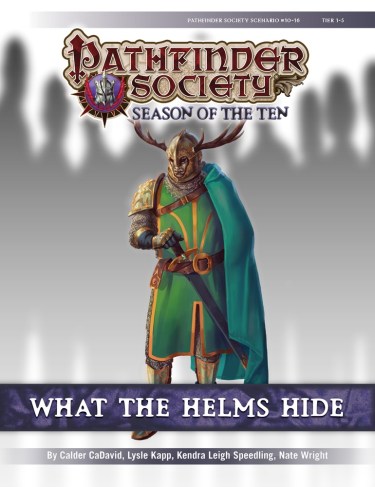
Pathfinder Society Scenario #10-16: What the Helm’s Hide is a Tier 1-5 repayable scenario that consists of four short one-hour long quests. “Collection,” “Autumn,” “Dust,” and “Witness.” “Collection” should always be played first, “Autumn” and “Dust” may be played in any order, and “Witness” is the thrilling finale. Each quest is penned by a different author, including Calder CaDavid, Lysle Kapp, Kendra Leigh Speedling, and Nate Wright. While Speedling and Wright have written for Paizo before, this will be the first Paizo writing credit going to CaDavid and Kapp. Each quest also comes with its own player handout, which is always nice. Also, this scenario has a lot of great artwork in it!
The first quest, “Collection,” is written by Lysle Kapp and takes place in Korvosa’s Jeggare Museum. Here PCs will need to inspect relics discovered by the famous Pathfinder Helven Leroung and uncover clues about her history and character. You also get to delve into Helven’s relationship with the famous Montlarion Jeggare, for whom the museum (and much more!) is named. His descendant, Mercival Jeggare is curator of the museum and willing to lend you a hand. There’s a lot of information you can learn here, although groups are unlikely to get all of it, which I rather enjoyed. For more information on Korvosa you can check out Pathfinder Chronicles: Guide to Korvosa.
“Autumn” is written by Calder Cadavid and takes places in Andoran’s Arthfell Forest. PCs investigate a sliver of the history of the Pathfinder Zaul Blystone. It has amazing art for an NPC, Adelyn Rhinon, which is my favourite art in the scenario. This is a fun quest although I do have one minor complaint. I feel like one of the characters gives up a bit too easily. For more information on Andoran check out Andoran, Birthplace of Freedom.
A member of the Decemvirate. Illustration by Ernanda Souza. Art courtesy of Paizo Inc.
“Dust” by Nate Wright takes place in underground Dwarven ruins on the edge of Highhelm. There players get to dig a little deeper into the history of Veldrid Goldborough. I enjoyed the NPCs in this one and adore the art for Helga Silverbrew. She’s got such a great facial expression. I like enemies in this one a lot, and the… source of information. For further details on the Five Kings Mountains check out the The Inner Sea.
The finale, “Witness,” is written by Kendra Leigh Speedling and was an absolute delight! It takes place in the Grand Lodge of Absalom and involves the PCs enacting a sort of ritual to activate a secret cache hidden by the gnome Pathfinder Eylysia. As Master of Scrolls Kreighton Shaine and two members of the Decemvirate watch on your players get to experience an important event from Eylysia’s past. I won’t say any more to prevent too many spoilers, but I will say it was awesome. I loved the final battle and the revelations it uncovered. And Eylysia’s final line! So good. For more information on the Grand Lodge check out Pathfinder Chronicles: Seekers of Secrets and Pathfinder Society Field Guide.
What the Helms Hide is a really great series of Quests. So great, in fact, that it’s my favourite series of PFS Quests. All of it’s component Quests were enjoyable, but its the finale that really ties it all together and makes it exceptional. Really well done from the whole team of writers. Each Quest has a chance for battle, a social encounter, and to uncover clues regarding their respective mini mysteries. Overall I really enjoyed this scenario. I give it four out of five stars.
Captain Sevenfingers. Illustration by Josef Kucera. Art courtesy of Paizo Inc.
Like the three scenarios before it, On Sevenfingers’s Sails features Venture-Captain Calisro Benarry, a half-orc Pathfinder who has sent plenty of Pathfinders into the depths of the Gloomspires. It also features Benarry’s quartermaster Kakikko, and Hrethnar from Pathfinder Society Scenario #8-15: Hrethnar’s Throne. New NPCs introduced include the very disturbing Thael Shivers, Vashthrexa, Nightdrinker, and Sempet Sevenfingers himself. PCs will need to enter the terrifying tomb, contend with Captain Sevenfingers, and plunder everything they can. Of course, there’s some complications in this mission, and PCs will have to contend with far more than expected. This scenario features an optional Hard Mode for all those players out there who relish a challenge.
The scenario is wonderfully creepy, morbid, and ominous, although that sort of content is not for everyone. Players who have issues with body horror will want to give this scenario a pass. It’s definitely not an scenario for kids. Any characters who played the previous Gloomspires adventures are going to get a bit more satisfaction out of this scenario than their compatriots who haven’t, and will find they get a few extra bonuses along the way. This scenario is packed full of atmospheric environments, memorable characters, and foul villains. The battles are challenging and take place in dynamic locations. I particularly enjoyed the final encounter. Really well done! Overall I think this is a really great scenario that won’t be for everyone. It’s creepy, gory, and a great high level challenge. I give it five out of five stars!
Today we’re going to take a look at the two most recent Starfinder Society Scenarios that are available for purchase, and let you know we thought. Although you’ll find references to events in each that I liked or disliked, and comments about specific characters, these scenarios are not explored in detail. It’s not my intention to spoil the events in these scenarios, or give summaries and full reviews, but to share my opinions and provide recommendations. That said, if you want to avoid even minor spoilers I recommend you check out a different article. Whether you intend to use them in home games of the Starfinder Roleplaying Game, sanctioned scenarios for use with the Starfinder Society Organized Play, or just want to read a nifty new adventure, we’ve got you covered! So sit back, and get ready to explore the Pact Worlds!
Starfinder Society Scenario #1-34: Heart of the Foe is a Tier 3-6 adventure written by Nicholas Wasko. It takes place on Rax, an inhospitable planet the jinsul are known to visit on occasion. There you will explore a ruined city that shows signs of life for any information you can scrounge up on the jinsul and their society. This scenario features the Faction (Second Seekers [Jadnura]) and Faction (Second Seekers [Luwazi Elsebo]) tags making it the first mission to prominently feature both First Seekers. This scenario continues the ongoing Scoured Stars storyline (#1-05: The First Mandate, #1-11: In Pursuit of the Scoured Past, #1-13: On the Trail of History, #1-17: Reclaiming the Time-Lost Tear, #1-99: The Scoured Stars Invasion, #1-23: Return to Sender, #1-29: Honorbound Emissaries, and #1-31: Treading History’s Folly). As such you’ll want to bring along characters who have an interest in the Scoured Stars Trinary System or storyline, who have interacted with the jinsul, or are working on collecting the ‘Journey to Scoured Stars’ boons. I also recommend bringing a character who does not have a Personal Boon permanently slotted. This scenario does NOT involve starship combat, but it MIGHT feature a vehicle chase (more on that shortly). It makes use of Pathfinder: Map Pack: Frozen Sites, Pathfinder: Flip Mat: Tech Dungeon, and an awesome full page custom map that has a very ‘Borderlands‘ feel to it. This scenario features content from Starfinder Core Rulebook, Alien Archive, and Armory. All of the necessary stat blocks are included in the scenario itself. However, GMs will definitely need the Core Rulebook for this one. Although this scenario doesn’t include a vehicle chase (but it could) it does use modified vehicle chase rules, which most players do not have internalized (in my experience). GMs will likely need to brush up on the vehicle chase rules and be prepared to teach it to their players as needed. Be aware that this is a rather dense scenario, so groups that are unfamiliar with chases could cause it to run long.
Heart of the Foe begins when both First Seeker Luwazi Elsebo and First Seeker Jadnura task the PCs with travelling to a planet the jinsul are known to occassionally visit in order to discover actionable intel and information about the jinsul themselves. For those of you who don’t know, the jinsul are a violent race of aliens that conquered the Scoured Stars Trinary system while the Starfinder Society rescued their comrades during the #1-99: The Scoured Stars Invasion. The jinsul have been a thorn in the side of the Starfinder Society ever since and the First Seekers are worried at the threat they pose to the Pact Worlds. Your PCs will need to travel to the mysterious planet — alongside both First Seekers and three other Starfinder teams — investigate a few sites that show signs of life, and uncover what they can about the jinsul and their society. Neither the Starfinder Society nor the players know a whole lot about these insectile fellows, so I was thrilled to dig a little deeper into the history of the jinsul themselves. Exciting stuff! Throughout the course of this scenario PCs will get to learn about jinsul anatomy, culture, history, religious beliefs, and — oh yeah — fight a whole lot of jinsul! It’s an action packed, exciting scenario that’s going to be a lot of fun. The battles all serve a purpose, the chase scene is both exciting and complex, and the world itself is very atmospheric. The finale is exciting and challenging, with a lot of moving parts. It’s chaotic and really well done. Dare I say… epic? Yeah, I do. Haha. There’s only one real social encounter, but the character you get to interact with is really… enjoyable so it strikes a nice balance. I love their demeanour and attitude towards the PCs. So good!
Ekkerah, illustrated by Bryan Syme. Art courtesy of Paizo Inc.
But, it’s not all sunshine and roses radiation and bullets. I do have a few minor complaints with this one. First off, it’s tough to run. Now, this isn’t really a complaint. It’s an observation and potential warning. This is not the kind of scenario an inexperienced GM should attempt. There’s vehicle chase rules, modifications to the vehicle chase rules, environmental conditions, a whole lot of dice rolling during travel scenes, plenty of hopping around between pages for potential clues and intel, and complex battles with lots of enemies and allies to track. Not easy. Second, it has a bit of a slow start. Not the immediate start, but the… well let’s call it the travel scene. There’s a lot of dice rolling done every hour, which runs the risk of becoming a boring sort of routine if not handled right (particularly when you take into account the flipping between pages that might have to occur). That said, I do like the information your group could uncover about the jinsul along the way. Third, environmental protections. Chances are your characters have them. They protect us from a lot, but there’s also things it won’t protect you from. Fair. But in this one it feels like you get penalized for using them. You either use them and suffer X or don’t use them and suffer Y. Which is unfortunate. The scenario refers to snow clinging to your environmental protections’ helmet — when many armour’s environmental protections use a force field instead of helmets — and even if you are wearing armour that has a helmet, couldn’t you just wipe it off? And if you are wearing armour that has an environmental forcefield for it’s environmental protections, can it seriously not handle a bit of clingy snow? Sounds like that armour has a pretty big design flaw to me. I hope my Starfinder kept their receipt. Haha. It felt sort of arbitrary to me. I’m totally cool with some environmental hazards going through your protections, but this snow thing just wasn’t one of them. Contrariwise, if they wanted the snow to hamper visibility, I’m totally fine with that. I am no stranger to snow and yeah, it’s hard to see sometimes. And finally…. I love that baby jinsul on the cover! Except it’s not a baby jinsul at all. It’s a jinsul’s pet. I 100% thought it was a baby jinsul and was thrilled by it’s oddly adorable appearance. Jokes on me, I guess. Haha. Seriously though, I really like the creature, it’s stats, and it’s tactics. Overall, I thought this was a really great, exciting scenario that’s going to be a challenge to run — but well worth it! I give it 5 out of 5 stars.
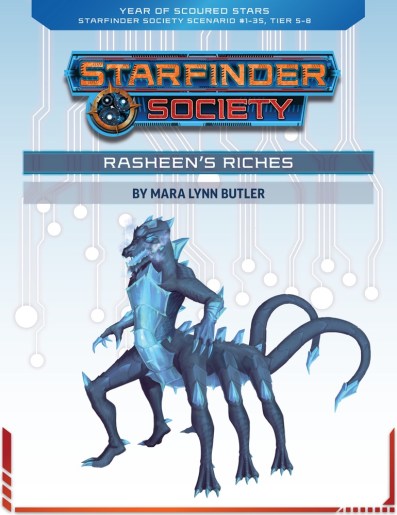
Rasheen’s Riches sounds at first like a classic treasure hunt — in space! Which is only partly true. Radaszam recently discovered a treasure map said to lead to one of the last places the infamous space explorer Jelev Rasheen explored before disappearing. Presumed to house a treasure trove of unimaginable proportions, Radaszam’s taking a more measured approach. Although he doesn’t believe it’s actually the final resting place of Rasheen or her fabulous riches, he does hope that there you’ll find a claim beacon that she placed on planets she discovered but never fully explored. This beacon should be able to lead you to the next place Rasheen went. But, that’s another mission… Rasheen’s Riches is more accurately described as a treasure hunt where you’re aiming to find another piece of the treasure map. As long as this is clear to your players by the end of the mission briefing (which it should be) you won’t have a problem with any players feeling let down. However, if players think they’re off to find unimaginable riches they might be a little disappointed. I know my kids would say “That’s it? But where’s the treasure?!” Be sure to adjust those expectations a little. Haha. I enjoyed this scenario. It’s got some environmental challenges to overcome, an interesting investigation, illuminating player handouts, and a battle against some tragic enemies. It’s got the air of a mystery about it, which I liked. I absolutely adored the descriptions of this moon. The entire atmosphere of it — and the creatures that you encounter there — worked really well together. Definitely a highlight of the scenario for me. The starship combat was straightforward but enjoyable. I like the social encounter it begins with and the artwork of the ship! It looks like some kind of skeletal Batplane! Seriously cool. Overall I thought this was a really solid scenario that will — hopefully — lead to further adventures on the hunt for Rasheen’s riches! I give it four out of five stars.
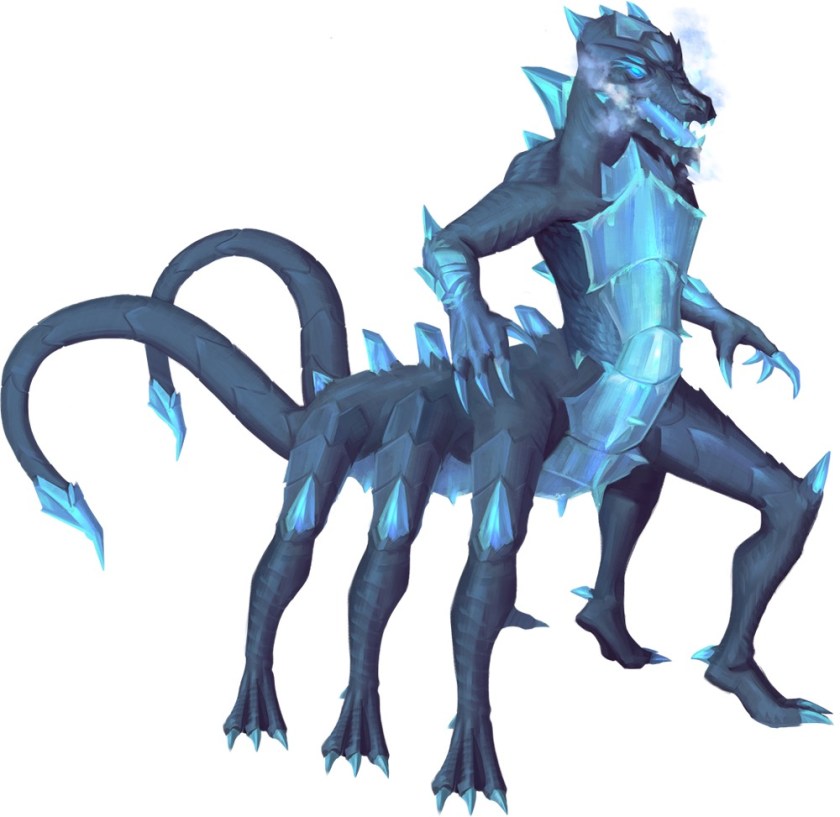
Glaciomonitor, illustrated by William Martin. Art courtesy of Paizo Inc.
Thanks for joining us today! Be sure to tune it again soon to check out our reviews on the newest Pathfinder Society Scenarios!
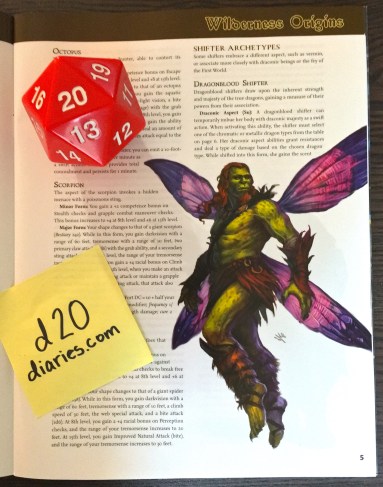
Today we’re taking a peek between the covers of Pathfinder Player Companion: Wilderness Origins! If you’ve been reading d20diaries since its beginning you’ll know that my family and I adore Ultimate Wilderness. My kids love the races introduced — particularly the adorable vine leshys — and my entire family enjoys the shifter class. In fact, each of us have at least two shifters. Needless to say we were excited to get our hands on Wilderness Origins. My husband was hoping for more shifter options, my kids were hoping for more vine leshy options, and I was… Well, I was just hoping someone in my family would find something inside the book that they’d make use of right away.
We were not disappointed.
Pathfinder Player Companion: Wilderness Origins is a soft cover book that is 32 pages in length. As a book in the Player Companion line, it’s aimed at players, which means that you won’t find a ton of world lore or secrets inside. You’ll find archetypes, feats, traits, spells, and more! Wilderness Origins features amazing cover art by David Alvarez, which showcases the iconic shifter, Zova, engaged in battle against an earth elemental.
The inside front over of Wilderness Origins.
The front inside cover features brief information on a few plants described in the book alongside some sketches. The entire page is presented as if they were entries in a scholar’s journal, which is a nice touch. Although no important information is contained here that can’t be found later in the book, it’s nicely showcased. Plants depicted include ambrosial lotus, cleanthistle, ghostblossom, and a ghoran seed. There’s also art of a gathlain’s wing and a leaf leshy.
After this is the table of contents, the rules index, and the introduction which contains eight new regional traits themed around different terrains. Each trait is printed alongside an example background for each terrain, that emphasize how you can embrace nature and your environment. Guerilla tactics and surefooted ascent are sure to be popular, but fruit merchant and strong stomach turned out to be my favourites. Environments covered by these traits include the desert, road, forest, jungle, mountain, swamp, tundra, and coast.
Moving on from the introduction we come to six pages of new shifter options. It features a whopping nine new shifter aspects, all of which are pretty cool. The new shifter aspects are boar, crocodile, dolphin, dragonfly, electric eel, mantis, octopus, scorpion, and spider. Electric eel is my favourite, but my son LOVES the boar aspect. He immediately made a gnomish boar shifter for Pathfinder Society Organized Play and was super excited to give it a shot. Unfortunately, we suffered a TPK that weekend and poor Sid’s career was cut short. Still, my son loved the character and made a ton of use out of the boar’s minor aspect, which gives you diehard as a bonus feat.
A half-orc feyform shifter from Wilderness Origins.
After the shifter aspects are three new archetypes, dragonblood shifter, feyform shifter, and swarm shifter. They’re all pretty self-explanatory, with the dragonblood shifter allowing you to take on the aspects and forms of a variety of dragons, feyform shifter granting you some tricky defences and the ability to transform into fey beings, and swarm shifter allowing you to turn into a swarm of bugs. They’re all really cool, but dragonblood shifter turned out to be my favourite. My husband’s a big fan of the swarm shifter, though, and he’s not going to be the only one. It’s a really useful archetype which is sure to see a lot of play.
Also in the shifter chapter are thirteen new favoured class options, seven new feats (be sure to check out chimeric aspect, greater weapon shift, and raking claws), and my favourite new option for shifters: alternate natural attacks. Each shifter aspect currently released (new and old) has a list of alternate attack forms they can select in place of claw attacks. Bears have a bite attack, for example, while boars have a gore and a hoof. Any time you activate your shifter claws you can choose to take an alternate natural attack from your animal aspect options in place of one of your claw attacks. This changes the damage type and the way your natural attacks look, but otherwise functions as the shifter’s regular claw attacks. It’s a really nice option I’m happy to see available.
Up next are two pages on each of the races introduced in Ultimate Wilderness — gathlain, ghoran, and vine leshy. The new gathlain options include five alternate race traits (arborealvitality, feyresilience, and whimsicaloutlook are my favourites), seven new feats (mighty boughs and strength of wood are my favourites), and one new archetype. Sworn of the Eldest is a Charisma-based inquisitor archetype that I really enjoyed. Particularly the magic of the Eldest ability, which swaps out teamwork feats for some extra spells and spells per day.
Ghoran options include four alternate race traits (check out intoxicating aroma and magicalabsorption), three feats (I love spell mirror), two new spells (pinecone bomb and woodland rune), and the new ninja archetype petal ninja, which lets you transform into a cloud of flower petals.
Vine leshy verdivant. Illustration by Nathanael James. Art courtesy of Paizo Inc.
Vine Leshy options include four alternate race traits (lashvine and writhing eye are awesome!), four new feats (we like bounteous body best), and the cavalier archetype verdivant. This turned out to be both my kids’ favourite archetype — which came as no surprise since they both love vine leshys. The verdivant archetype lets you to have a plant mount, and enables you create effloresces, which are explosive plant growths that can be used a number of times per day and have some cool effects. While one might form a wall of vines to prevent attacks of opportunity, others can make you walk on air, or even give you and your allies fast healing. Effloresce replaces the cavalier’s banner and tactician abilities.
Up next in Wilderness Origins are two pages themed around flowers. It starts by introducing four new magical plants, ambrosial lotus, cleanthistle, ghostblossom, and gravebane petals. All four are surprisingly useful, but I think I like the cleanthistle best. It’s a great plant to add into my family game of Iron Gods. There’s also five awesome new witch hexes. I honestly had a hard time picking my favourite. My daughter loves leshy summoning, my son loves verdant familiar, and heralding bloom is going to be really useful for some characters. In the end its the floating lotus and iceplant hexes I’m most likely to use. Floating lotus conjures a flower that you can stand on to walk over water or gain a bonus on jump checks while Iceplant makes the witch and her familiar’s flesh harden, granting them a natural armour bonus and and the effects of endure elements. Finally, there’s a new alchemist archetype in this section: perfumer. This alchemist creates atomized perfumes in place of potions, an can distill pheromones that augment your Charisma, diplomacy, and bluff checks in place of mutagens. Very cool!
The next two pages are entitled Wardens of the Wild and involve kami. There’s a new kami eidolon subtype for unchained summoners, ward aspects for hunters to make use of, and the new spiritualist archetype ward spiritualist. This archetype allows a spiritualist to purposesly seek out a kami to bond with, and grants them a ward implement which can either be an object or their own body. With their ward implement they can gain occultist focus powers. They can also merge their kami with their implement to empower their implement in battle. I’m a huge fan of both spiritualists and occultists, so I’m totally biased to love this archetype. Haha.
Scorpion familiar. Illustration by Beatrice Pelagatti. Art courtesy of Paizo Inc.
The next four pages are packed full of options for our animalistic pals — animal companions, familiars, and mounts. It starts with two animal companion archetypes: apex species (which gives your companion benefits in certain terrains) and unexpected intellectual (which makes a vermin companion more intelligent). Then there’s three familiar archetypes: occult messenger, the super creepy parasite, and arcane amplifier (my personal favourite) which grants your familiar the ability to use some metamagic feats on touch spells they deliver. Following these are seven feats which can be taken by animal companions, familiars, and their owners. Three are relevant to familiars, three to animal companions, and one is relevant to both. I really like the animal companion feats curious companion and friendly face, but it was two familiar feats that turned out to be my favourite. Changeling familiar gives any familiar capable of changing shape the ability to transform into a child or teenager of their master’s race, while spark of the uncanny gives your familiar the ability to speak. Awesome! (My kids are absurdly excited for this one!) A few levels later you can swap it out for improved familiar. Next up are descriptions of five breeds of mounts along with a trait for each of them (these traits count towards their master’s total number of traits). Finally, there’s an expanded companion list for cavaliers paladins, and rangers.
The following two pages talk about the totem spirits of the Shoanti, with nine new totem rage powers geared at members of the Lyrune-Quah (moon clan), Shundar-Quah (spire clan), and any ancestor-revering character. There’s also a new shaman spirit, tribe.
Wilderness Magic is up next, with five new arcanist exploits, three disaster themed spells, and the psychic archetype Magaambyan telepath, which blends druidic magic and wilderness themed powers with the psychic. Wild stride and wooden flesh are my favourite arcanist exploits, while flash flood — a sixth level spell on the druid, shaman, and sorcerer/wizard spell list — is my favourite spell.
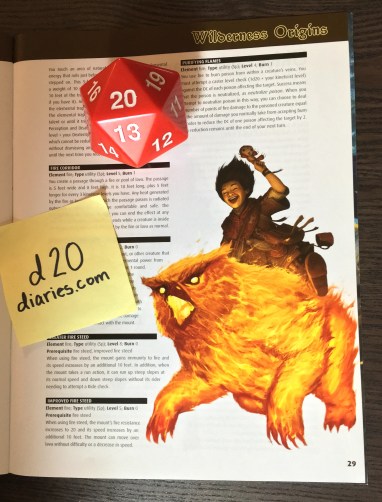
The iconic kineticist Yoon riding a fire steed.
Similar to magic, the following two pages are all about elemental power — specifically fire. First up is the flame steed spell, which conjures a mount made of fire. Continuing this theme is a new archetype, the cinderlands adept, a fire-based kineticist that gains a loyal mount and is based on the Burn Riders of the Sklar-Quah (sun clan). Finally, there are eight new kineticist talents — one form infusion (elemental trap) and seven utility talents. My favourites included fire corridor and the fire steed tree. I’m a huge fan of both the Shoanti and kineticists, so I was pleasantly surprised to discover these new options.
By now there’s only a few pages left. Two pages of character options themed around the sea and sky. It starts with two more archetypes — a very interesting paladin archetype called champion of the cascade and esoteric starseeker, a psychic archetype based around Golarion’s constellations. Following this are two very cool (and disconcerting) oracle curses that have to do with decay: putrid and scourge. Finally, there’s three new ki powers: floating breath, racing current, and zephyr blow.
And that’s it! The end of Pathfinder Player Companion: Wilderness Origins! My whole family loves this player companion. It contains a lot of fun options for all our favourite parts of Ultimate Wilderness — shifters, gathlain, ghoran, and vine leshys — and pays some loving attention to the many different pets you can acquire. It’s rare that we get to make in-game use of a d20 book right after reading it, but this one immediately inspired us to create something new. It was well worth the investment for my family.
Thanks for joining us today! I hope you enjoyed taking a peek behind the covers of Wilderness Origins.
My kids love games of all kinds. Not surprising, I know. Most kids love games of one kind or another. But mine REALLY love games. This year for their birthdays they decided that they have enough toys. What they wanted was some new board games.
“But, awesome board games, Mom. Really good ones.”
So they did some research, made lists, did some more research, discovered a love of Dice Tower, and revised their lists until they each had a (much too long) list of board games they wanted. Although our birthday celebrations aren’t over yet, they’ve both had a few parties with family and were thrilled to find they got some new games. Most of what they asked for are large, complex games. But a few are short, easy to learn card games. You can expect to see a lot of board game reviews in the coming weeks, but today we’re starting short and sweet, with Dungeon Mayhem!
Dungeon Mayhem is a Dungeons & Dragons card game for 2 to 4 players. Games are short and fast-paced, with a round averaging about five minutes. It’s a small, portable game, with the rectangular box about the size of my hand. It’s the perfect size to bring with you on the go or play in compact spaces. We bring it to the laundromat, for example. Intended for ages eight and up Dungeon Mayhem lets players take on the role of an iconic hero and battle it out.
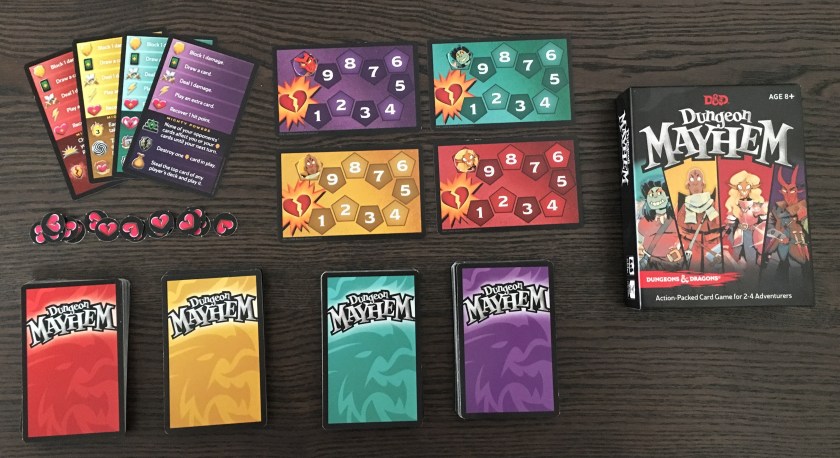
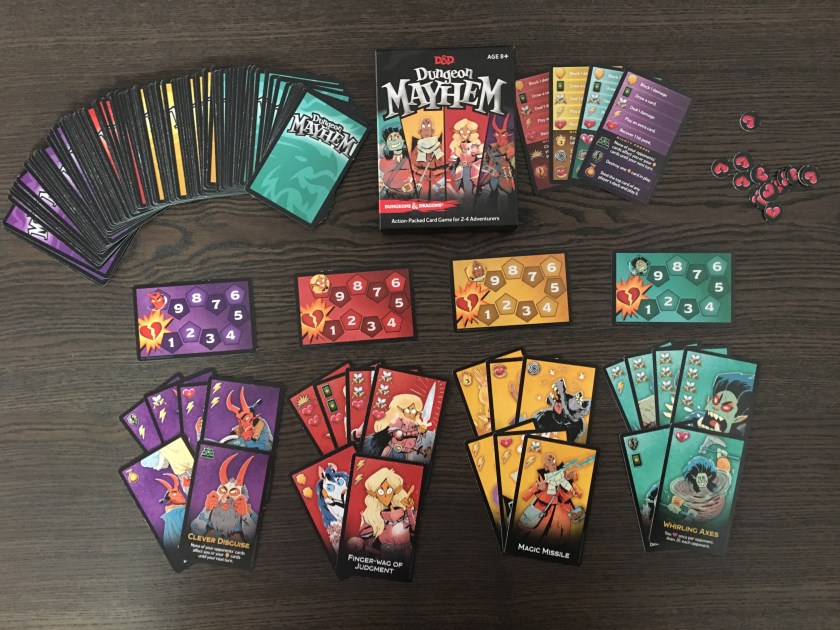
The game is super easy to learn and surprisingly fun to play. First, you choose a character. Each comes with their own unique deck of cards, hit point card and tracker, and a reference card. Youngest player goes first and play continues clockwise. You start with three cards in your hand. On your turn you draw a card and play a card. You start with 10 hp and when you reach 0 hp you’re out of the game. Last adventurer standing wins.
Box contents!
There are four heroes to choose from: Sutha the Skullcrusher (a female half-orc barbarian), Azzan the mystic (a male human wizard), Lia the Radiant (a female elf paladin), and Oriax the Clever (a male tiefling rogue). Each adventurer has their own deck that plays differently, but with the same basic mechanics so it’s easy to pick up any one and just play. Each card features illustrations by Kyle Ferrin showcasing the different characters in a fun-loving, cartoony style. Many cards have clever, entertaining, or familiar names. The cards each have a variety of symbols on them which tell you what each card does. The symbols are all easy to understand and, if you ever forget what they do, each character has their own unique reference card to remind you.
There are five symbols that appear in every character’s deck. A swords deals one damage to an opponent, a shield blocks one damage dealt to you, a heart heals one hp, a card lets you draw one card, and a lightning bolt lets you play one extra card. Although some cards in the decks contain a single symbol on them, most have a combination or two or three symbols. These symbols appear in different combinations and quantities throughout the decks, making each one different. The paladin’s deck has a lot of healing, for example, while the rogue’s lets you play a lot of cards, and the barbarian is the only character who can do four damage at once to a single enemy. In addition, each deck has a few unique symbols and cards. Sutha the Skullcrusher can deal one damage to each enemy and then gain that much hp with her Whirling Frenzy while the wizard Azzan can swap life totals with another player by playing Vampiric Touch.
There’s a few other rules to the game, but not many. Typically when you play a card it gets discarded, but if you play a shield card it instead is placed on the table in front of you. For each damage it prevents it gets a damage counter, and when it’s been completely destroyed the shield card is removed from play and placed in the discard pile. If you happen to use up all the cards in your hand (you’ll need lightning bolt cards to do this, which let you play an extra card on your turn) you can draw two additional cards. And if your deck ever runs out you simply reshuffle it and keep playing.
Pretty simple!
While playing we found that this game was super simple to learn, teach, and understand. You get the hang of it quick, and games are fast and exciting. Since you’re battling each other there’s definitely a ‘take that’ feel to this game. Some rounds you’ll feel picked on if you get defeated quick, but others are more balanced. It just depends on the strategies of your opponents at the time. My kids often decided the best strategy was to kill me and then duke it out themselves, so I was brutally ganged up on a lot. Haha. They quickly realized this was a poor strategy when my husband also joined play, as he often teamed up with me so that he didn’t have to combat a pair of allied kids on his own. (How the tables have turned!) My daughter is an expert at the old ‘kick them when they’re down’ strategy, very often dealing ruthless finishing blows against whoever happens to be doing the worst. …Even if it might be against her brother who she was supposedly allied with. Clever girl. Haha.
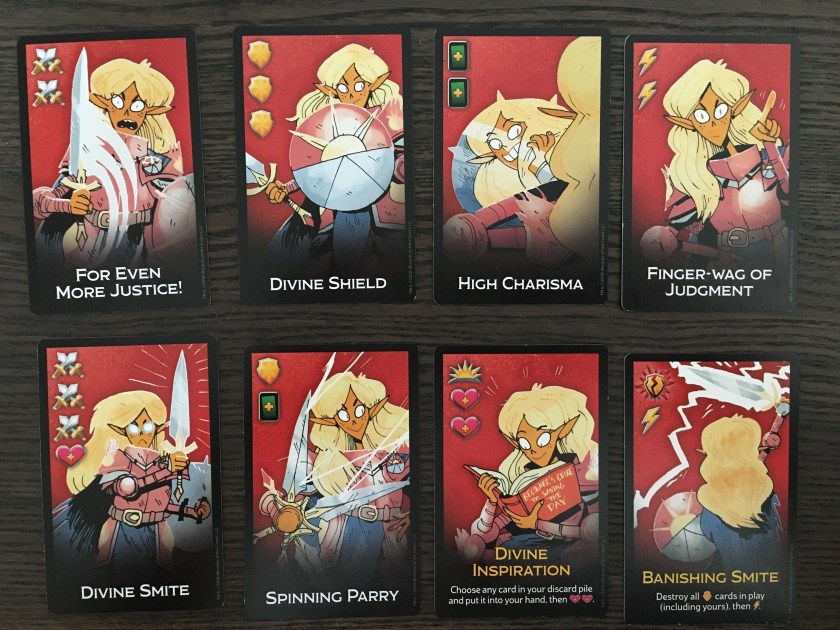
The decks are fun, varied, and balanced. No one deck it better than the other, they’re just different. Although it’s not immediately apparent what the differences are between the decks it becomes clear pretty quick. Lia, the paladin, deals a lot of damage and heals a lot of her own wounds. Her special abilities include Divine Inspiration, which lets her put any card from her discard pile into her hand and then heal two hp and Banishing Smite which destroys all shield cards in play and then lets her play an additional card. This was my daughter’s favourite deck, and my second favourite deck. While my daughter prefers Divine Smite and her beloved steed Fluffy, I’m a big fan of the Finger-wag of Judgement and Divine Inspiration. This deck is tough to take down and enjoyable to play.
Some of the paladin’s cards.
While my daughter and I loved the paladin, my son and I both decided the rogue, Oriax, was out favourite deck. Packed full of cards that let you take extra actions, this deck often lets you play more cards than your opponents. It’s also got some enjoyable tricks, particularly with Clever Disguise, a card that prevents you from being targeted by any cards until the start of your next turn. It’s particularly great for forcing your allies to duke it out at the start of the game, which is likely to result in them retaliating against each other in subsequent rounds. A nice little start! We also really like using Pick Pocket to play a card from someone else’s deck. Need healing? Grab a card from the paladin. Want to wreck your opponent? Snag a card from the barbarian. Want to get a nice full hand or play something tricky? Take a card from the wizard. Sure, it won’t always be what you were hoping for, but I’ve never seen it not be useful. One downside to the rogue is that he only has one way to heal himself: Stolen Potion. Although it lets you heal one hp and play another card (which is great) it does mean that when you’re low on health it’s hard to save yourself. One hp once in a while doesn’t do much. I also love Sneak Attack. It’s art and theme bring a smile to my face every time. Haha.
Some of the rogue’s cards.
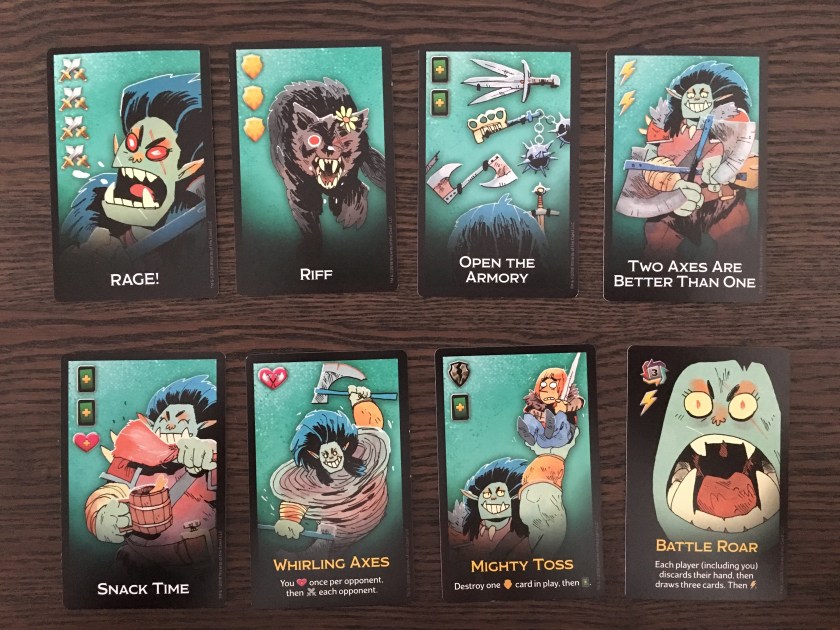
It should come as no surprise that the barbarian’s deck deals a lot of damage. In fact, they have the only card in the game that can do four damage against one enemy (Rage). They also have the awesome Whirling Axes, which we mentioned earlier. What might be surprising is how balanced it is. It’s got some solid shield cards (my daughter loves the dogs Riff and Raff), ways to draw cards (Open the Armory and Snack Time), ways to heal (Snack Time and Whirling Axes) and ways to destroy a shield with one card (Mighty Toss). Although none of us named this deck as our favourites, it also turned out to be the most played deck and both my son and husband’s second favourite decks. Sutha is a fearsome foe!
Some of the barbarian’s cards.
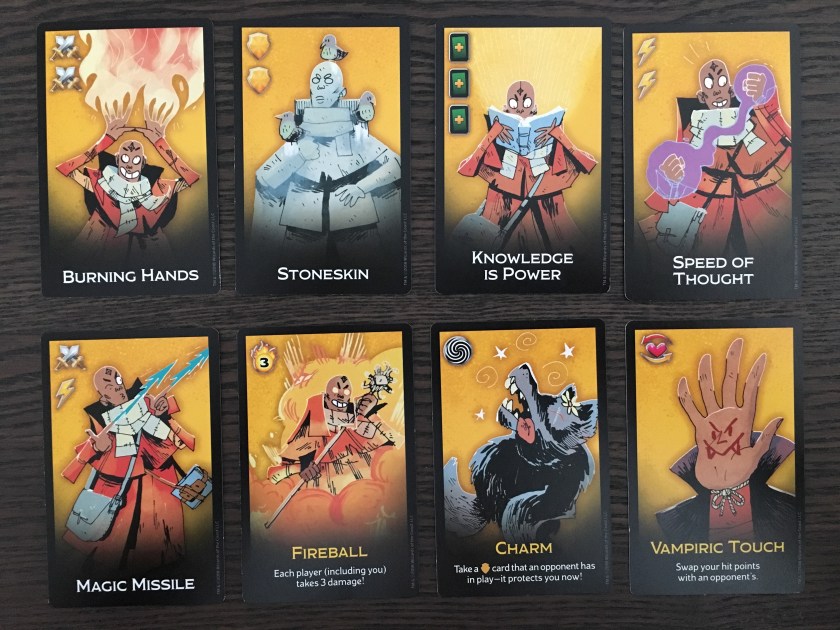
Which leaves us with the wizard. At first glance, Azzan’s deck is the most balanced. He can do everything well, but doesn’t have the most of anything either. Burning Hands and Lightning Bolt are some of his most reliable damage dealing cards. Magic Missile is my favourite, as it lets you deal one damage and play an extra card. Stoneskin and Mirror Image are great shield cards. Knowledge is Power gets him a lot of extra cards while Speed of Thought helps him play those cards fast. His one downside is a lack of healing cards. Eventually we came to realize he does have the most of something very important: TRICKS. His three unique cards include Vampiric Touch, which we already mentioned. This card lets him swap hp totals with another player — which can be game changing. Charm lets him take someone else’s shield card that’s on the table and use as his own — also awesome. And Fireball deals three damage to every player (including himself). My daughter’s prone to hoarding fireballs, using Charm to steal someone else’s defences, and then blasting a bunch of fireballs to kill everyone at once while she hits behind her stolen shields. Cheeky thing. Haha. Although Azzan’s deck is just as easy to use as everyone else’s, it’s also the deck that is most rewarding when played with some forethought.
Some of the wizard’s cards.
We really enjoyed Dungeon Mayhem. It’s not a complex, tactical game like some of our others, but it’s a fun, quick, romp you can bring with you anywhere. We hope they come out with an expansion that contains another two or four decks. It’d be great to have more deck choices and play with more than four players. Happily, this deck was quite affordable. Our copy was only $18 Canadian. Well worth the money.
Today we’re taking a look at two delightful books released by Dungeons & Dragons for kids: The ABCs of D&D and The 123s of D&D. Intended for young children, these books offer kids a first glimpse at the world of Dungeons & Dragons while teaching the alphabet and counting to ten. Both books feature whimsical artwork by Caleb Cleveland, and catchy rhyming couplets written by Ivan Van Norman.
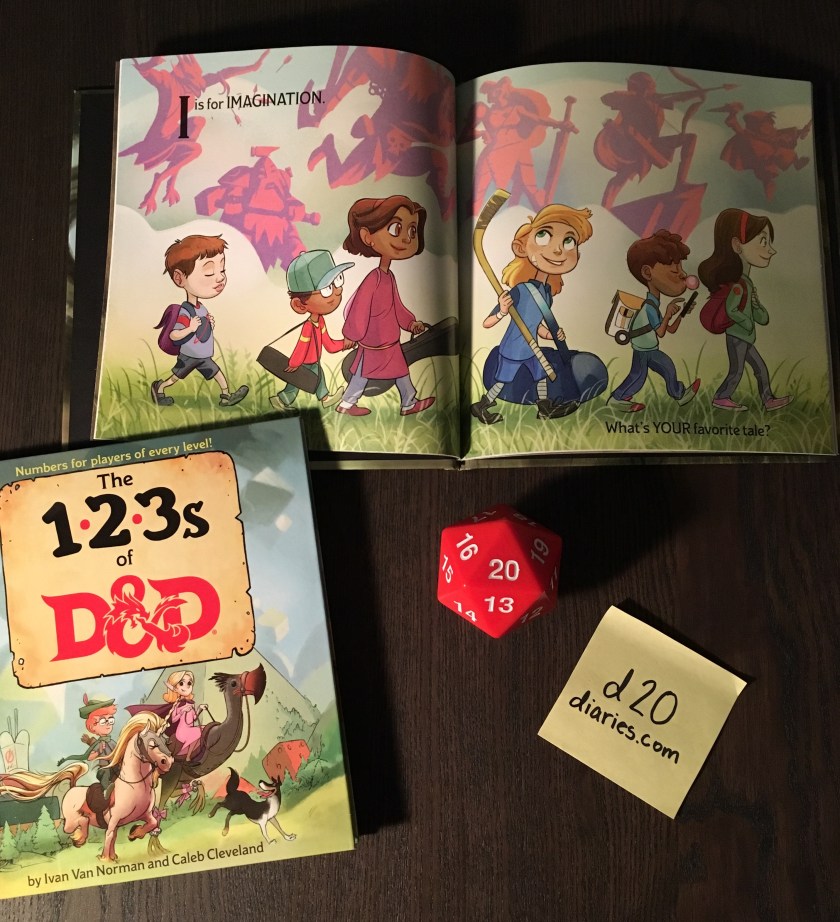
I recently picked up both of these books for my young nephew, who is soon to turn five. Not only does he adore them, but both of my children (a boy aged eight and a girl aged seven) also found them thoroughly entertaining. I was impressed by their quality and content. The art is perfect for kids, with colourful, whimsical illustrations that hide all kinds of secrets — clouds shaped like dice and towers made of books, for example. Delightful little tidbits that kids will discover as they get a bit older.
“I is for IMAGINATION. What’s YOUR favorite tale?”
“A is for ADVENTURE, our journey has begun.
B is for BOOK, the source of all our fun!
C is for CREATURES of every shape and size.”
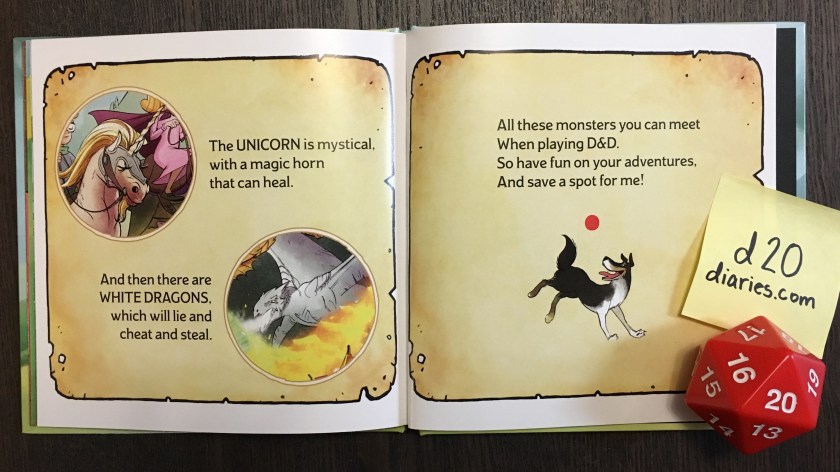
Although I expected The 123s of D&D to be shorter than The ABCs of D&D, that wasn’t the case. Yes, the ABCs of D&D covers the entire alphabet, with typically a letter per page. And yes, the 123s of D&D covers the numbers one through 10, with one number per two pages. Technically that would make it shorter, but after counting to to ten there’s a lovely mini bestiary that features a sentence or two about the creatures depicted throughout the book — all written in rhyming couplets. What a pleasant surprise! I’m really happy they included it and all the kids loved it. It immediately inspired them to start making up stories of their own with the creatures. My daughter’s favourite was the almiraj, of course (she adores rabbits and rabbit-creatures of all kinds).
“We begin with ONE Dungeon Master telling a story of daring deeds, the adventure of TWO heroes and their brave and noble steeds.”
“All these monsters you can meet when playing D&D. So have fun on your adventures, and save a spot for me!”
My kids and I thought that The ABCs of D&D and The 123s of D&D were wonderful, entertaining, inspiring little books. Despite being written for young children, they’re of interest to any kids that still love a picture book. Really wonderful work!
A new series of Dungeons and Dragons books aimed at children is scheduled to launch this summer! The D&D Young Adventurer’s Guide series is written by Jim Zub, Stacy King, and Andrew Wheeler, and published by Ten Speed Press (a part of the Crown Publishing Group). The series begins with two simultaneous releases on July 16th, 2019: ‘Monsters and Creatures‘ and ‘Warriors and Weapons,’ both of which are already available for pre-order. There are two more books in development that are scheduled to be released in Fall 2019 (Dungeons & Tombs and Wizards & Spells) and, if they’re popular enough, there may be more beyond that in the future. The D&D Young Adventurer’s Guide series are intended for middle-grade readers (ages 8-12) and meant to inspire these young readers to read, write, create, imagine, and of course, play D&D.
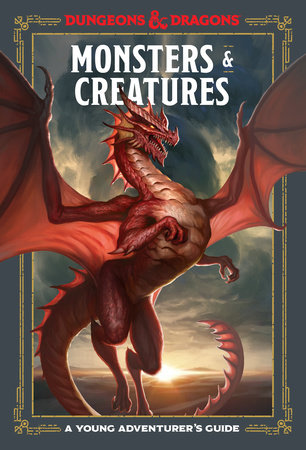
Monsters and Creatures: A Young Adventurer’s Guide is an illustrated guide to the many beasts of Dungeons and Dragons. Featuring one-of-a-kind entries for some of its most memorable monsters, and over 60 brand new illustrations, this book is sure to ignite the imagination of young readers (my kids can’t wait!). Creatures are sorted by the regions they call home, beginning with underground creatures, moving up onto the surface with aquatic, field, graveyard, forest, and mountain dwelling creatures, and finally ending with airborne monsters. Each monster profile contains information on the size of each beast, its danger level, and tips for how to survive an encounter with one. This book also features “introductory ‘Encounter’ stories so readers can practice the problem-solving skills they’ll need to fight these monsters when they play a D&D adventure of their own.” Awesome!
Warriors and Weapons: A Young Adventurer’s Guide is an illustrated introductory guide to the many kinds of warriors you can create in Dungeons and Dragons, along with the weapons, armour, and adventuring gear that they’ll make use of. Featuring one-of-a-kind content and over sixty new illustrations, this book gives young adventurers the information and inspiration they need to create their own characters. It includes “sample profiles, a flowchart to help you decide what type of warrior to be, and brainstorming challenges to start you thinking like an adventurer whether on your own or in the midst of an exciting quest with friends and fellow players.” It’s important to note that this book is NOT a replacement for the D&D Player’s Handbookand does NOT contain game mechanics or rules. It lays out the major concepts in a way that easy to understand, approachable, and engaging. It’s meant to inspire creativity, without overwhelming readers with rules.
“These books have beautiful art, concepts, and stories to engage readers and get them thinking first and foremost about their character and the places they’re going to adventure in without any rules for them to worry about. It’s a creative toolkit focused on character and story,” Jim Zub was quoted as posting on twitter. “Give these books to a new player, get them excited about the possibilities, and then bring them to the gaming table to show them how those concepts and ideas flourish with a roll of the dice. […] We really hope that experienced Dungeon Masters will embrace these books as a way to introduce D&D to their kids or their friends and that schools/libraries will see them as a fun and engaging way to encourage creative writing!”
My kids are thrilled with this news. (Yet another reason for them to look forward to the summer! Haha!). I can’t wait to see what they look like up close.
Hello, and welcome to d20diaries! Today we’re taking a look at a dark and dramatic adventure path filled with political intrigue and horrifying monsters. Trade War for the Mists of Akuma campaign setting.
What is Mists of Akuma?
Mists of Akuma is an Eastern fantasy noir steampunk campaign setting that’s compatible with fifth edition Dungeons and Dragons. Created by Mike Myler and published by Storm Bunny Studios, Mists of Akuma is based in a fictional nation called Soburin which is very closely based on Japanese culture of… oh, the Sengoku period of the 16th century if I had to guess (but I’m no expert). Soburin’s many prefectures are locked in a tenuous peace, torn between tradition and new technology, and beset on all sides by the terrifying Mists of Akuma, which corrupt everything they touch. Capable of transforming the land into a poisoned wasteland, peaceful dead into undead monstrosities, helpful spirits into foul oni, family heirlooms into cunning living objects, and people into terrifying monsters, the Mists of Akuma are a malignant evil. The Mists of Akuma campaign setting also features a wide variety of new character options, rules, technological items, magical objects, and creatures.
It’s a sorrowful, rich setting that pays close attention to eastern traditions and culture, and brings it into an exciting fictional fantasy world. Manners, honour, and lack of, all play a part, as do kami, oni, and a variety of other Japanese myths and traditions. Mists of Akuma is a setting bursting with creativity, intrigue, mythology, and tragedy that fills a niche all it’s own. For more information on the Mists of Akuma campaign setting you can visit Storm Bunny Studios. To pick up a copy of Mists of Akuma you can visit the Open Gaming Store, Paizo, and Drive Thru RPG. There’s also a few FREE primers available. I highly recommend picking up Mists of Akuma: Soburin Primer for a glimpse at the world of Soburin and the Mists of Akuma campaign setting, Mists of Akuma: Primer for a sampling of character options, and Mists of Akuma: Tsukumogami for a collection of new creatures (objects transformed into fell beasts by the corrupting Mists of Akuma).
Mists of Akuma by Mike Myler and Storm Bunny Studios
But, enough about the campaign setting. Let’s talk Trade War.
Trade War
Mists of Akuma: Trade War is a 375-page adventure for the Mists of Akuma campaign setting written by Mike Myler, along with Christopher Rippee, Andrew Engelbrite, and Dirk van de Rijt. Intended for 4-6 players, Trade War should bring characters from levels three all the way to level twelve or so. Although Trade War contains everything you need to play the adventure path, I highly recommend picking up the Mists of Akuma campaign setting or downloading the free primers mentioned above. They really enrich the adventure and your players understanding of their world and the beings in it.
Trade War: A Mists of Akuma Adventure Path
Trade War is a campaign focused on politics, intrigue, and tragedy, with it’s true plot is hidden under layers of other stories and adventures. Players uncover threads of the mystery and its villains right from the beginning of the adventure path, with time weaving these seemingly disparate tales into a wonderful, layered story. The adventures are all open ended, providing information on a variety of paths your players might choose to follow instead of just assuming one ‘ending’ occurs. There’s plenty of important NPCs to interact with — both allies and enemies — and monsters to battle, with the lines between good and evil becoming increasingly blurred. Alliances can be forged, loyalties swayed, promises betrayed, and throughout it all your PCs will need to make difficult choices. For doing the right thing isn’t always easy — if you can even determine what the ‘right thing’ is. These tough decisions, moral dilemmas, and pyrrhic victories are truly a highlight of the adventure path.
Before we get any further into this review it’s important to note that not all of the content of Trade War is new. In fact, Trade War consists of six previously released adventure modules bound together with new adventures, side quests, and connections, all culminating in a brand new, epic conclusion. And when I say ‘epic’ I truly do mean it. The final adventure is exceptionally well done.
The six previously published adventures contained in Trade War are Scourge of Róbai Shita Temple, Feud Primordial, Fangs of Revenge, Curse of the Scorpion Samurai, Yai Sovereign of Storms, and Revenge of the Pale Master. The finale is entitled Hone-Noroi Keep Ascends. There are also two side trek adventures (Golden Carp and Cursed Well of Itami) which have varying difficulty levels and are intended to be inserted by the GM when they need to get the players back on track (or whenever they feel is most dramatic). There’s also a series of five ‘Connections,’ which are basically a collection of short social and combat encounters which occur on the journey between adventures and all tie in with the various ongoing plots and events of the adventure path. In addition to these adventures and connections, Trade War contains a bit of important information on the Mists of Akuma campaign setting, some new rules, a wide array of new character options, a player handout, and a character sheet. Finally, Trade War contains some quick and simple instructions for those GMs who want to run Trade War without the steampunk components.
Because Trade War is a mystery I won’t get into the plot just yet. Instead, information on the adventure’s storyline and various adventures will all be contained at the end of this blog post after a large spoiler warning. So, without spoilers, what do I think about Trade War?
For starters, Mists of Akuma is a really great, atmospheric setting. I love it. Trade War is grand campaign that’s much more layered than it originally appears. Despite it’s rather tightly constructed meta-plot it leaves a lot of room for players to make their own decisions, managing to continue the events of the adventure path no matter how honourable or disreputable your players turn out to be. It’s got a lot of climatic moments, dynamic battles, moral dilemmas, betrayals, and surprises. All of the scripted social encounters matter, playing a role in either the meta-plot, current adventure, or foreshadowing other important events. Many NPCs — both ally and enemy — have chances to make return appearances, and players will often be surprised at the role some of the people they meet will come to have. There’s a variety of factions your players could ally themselves with throughout the course of the adventure, all of which are very different.
However, all that open-ended storytelling does come with a downside. This is a rather loosely scripted campaign, with plenty of decisions for GMs to make, NPCs for GMs to create, and plenty of downtime for GMs to fill. While many GMs will be thrilled with this, I do prefer my adventures have a tighter narrative. Why your characters are travelling from one region to another between adventures is left for GMs to determine in most instances and, although the journey and ‘Connections’ themselves are filled with engaging encounters, the motivations behind the journeys are lacking (until the later adventures). In addition to this, many of the adventures utilize the same opening plot hook: a bengoshi told you to. Bengoshi in Mists of Akuma are essentially government officials who have the power to deputize citizens into performing tasks on their behalf. Refusal is met with execution. Obviously “do this because I said so or you die” is not really an engaging motivator. Although for some of these adventures it makes sense that a bengoshi would hire your PCs, at other times it’s unnecessary. There’s plenty of other PCs who could have acted as quest givers and, in many instances, the plot of the adventure itself or a few social encounters could have done a better job.
As previously mentioned, many of the battles are dynamic and complex. Although thrilling and rewarding, they aren’t easy to run. If you’re a beginner GM this is not the campaign for you to start with. Trade War has a lot of cool new creatures, some of which can transform into more powerful forms. Overall, the battles in this adventure path are challenging, memorable, and very well-crafted.
Mists of Akuma is not for the feint of heart. There are strong themes of tragedy, decay, corruption, and sorrow. There’s also some rather gross, horrific depictions (particularly in the finale), and body horror (as the Mists of Akuma can transform even your PCs into terrifying monsters). Although I thoroughly enjoyed the atmospheric, mature tone, it’s not for everyone. And certainly not a child-friendly or family campaign.
Mists of Akuma utilizes many Japanese terms throughout its length, which I really enjoyed. Particularly for names of people, locations, monsters, weapons, and titles. That said, I found that some terms are used but not explained, so I had to stop and look them up. In a few instances the Japanese version of an English loan word is used, instead of just using the English word, which was both jarring and a strange choice. I’m a fan of using culturally appropriate terms and naming conventions whenever possible, but in my opinion Trade War took it a bit too far. It hindered my comprehension of the material on more than a few occasions, which in turn made it less useful for me as a GM and less enjoyable for me as a reader. This adventure would have greatly benefitted from a glossary.
All in all I thought this was a wonderful, challenging, dramatic campaign that mature players are going to really enjoy. It’s set in an atmospheric fantasy world filled with tragedy, desperation, and corruption, wherein players get to make important, complicated decisions — and live with the consequences. I really enjoyed Mists of Akuma: Trade War.
SPOILERS
Be warned! The following section contains information on the plot and component adventures of Trade War. If you don’t want any spoilers, stop reading!
Trade War‘s metaplot involves an ancient necromancer called the Pale Master, whose minions are working to bring him back into the world of the living. Fortunately for the world of Soburin, a powerful figure (who I won’t mention by name to prevent too many spoilers) has foreseen the return of the Pale Master and set events into motion that they hope will allow the people of Soburin to have a future. It’s the machinations of both the Pale Master and this other figure that drive the events of the Trade War adventure path. Set amongst this turmoil is a variety of other groups and factions which become embroiled in the growing conflict, either as allies, enemies, minions, pawns, or victims. PCs will have the chance to interact with members of all of the above mentioned groups on multiple occasions and forge relationships with them as they see fit (for good or ill).
Throughout this adventure PCs will face off against scheming humanoids, dark magic, ancient evil, corrupting fog, terrifying oni, powerful demons, unquiet spirits, animated dead, ninja, samurai, dragons, and even the undead army of a necromancer.
Trade War begins with Scourge of Robai Shita Temple, an adventure for third level characters. Tasked by a bengoshi to investigate the village of Shibai, PCs will need to determine why the village — which was mystically protected from the Mists of Akuma — has suddenly become overrun by the mists, the monsters that stalk within it, and a powerful wind demon named Fukō. This mystery is fun and pretty free-form, although I think having a bengoshi give your PCs their task is unnecessary. The various NPCs (or even just the events of this adventures) could have motivated the PCs just as easily. I particularly enjoyed the interactions with another group hired to protect the town, the boisterous Mubō Brothers. My only complaint is that there are a lot of battles with tsukumogami in this one (a bit too many, in my opinion).
From there your PCs travel East over the course of the winter, having a variety of adventures on their journey. Some important events in the adventure path are foreshadowed with social encounters, which was nice to see, and important rumours are already flying. I particularly enjoyed the encounters with the elemental oni Kumo-Rui, an ice-themed spider-like monster who has brought about an unnaturally cold winter. In this section the PCs also meet another bengoshi, Akia the Iron Shell, who tasks them with tracking down an oni-touched sorcerer who has formed his own cult and bringing her anything of value in his possession. This task is trickier than it seems, continuing on into the next adventure, Feud Primordial. It should be noted that the inclusion of Akia the Iron Shell is one I support, as she is important to the ongoing plot line and the next adventure, and it makes sense for her to hire the PCs in order to see her goals accomplished.
Feud Primordial is intended for fifth level characters, and begins with the PCs already in the middle of tracking down a cult-leader. Unfortunately, he has way too many possessions for the PCs to easily carry, making them unable to bring everything back to Akia the Iron Shell. They need to determine what’s valuable and sell the rest. Unfortunately, turns out the object Akia most wanted — in fact the whole reason she sent you after the cult-leader — was to fetch a specific object that was valuable to her, but not actually valuable. An object PCs have either sold (most likely) or was stolen from them (less likely). Furious, the bengoshi sends your PCs back out to hunt down the missing object. This adventure leads the PCs to a town where a murderer stalks the streets, and eventually casts them as pawns locked in a power struggle between two incredibly powerful ancient beings.
After finally appeasing Akia the Iron Shell the PCs accept work as a caravan guard and travel north. Along the journey they get involved in some interesting events, my favourite of which involves a corpse-eating oni.
In time the PCs arrive in Samon, home of the Tazuki Rail Company, where they become embroiled in the events of the next adventure, Fangs of Revenge. Once again, they’re hired by a bengoshi, although this time they’re asked to investigate a growing unrest among the labourers of Samon, discover the leader of the workers growing rebellion, and put and end to their uprising before it begins. This leads to a complex web of intrigue and a large cast of interesting characters. PCs will soon discover that there’s more going on in Samon that meets the eye as they clash with shapeshifting snake-folk, and dark rituals.
Leaving Samon behind the group travels south, working as guards for two different groups at different times. By now they’re likely catching wind of a smuggling operation that’s apart of this campaigns meta-plot, although they won’t necessary understand all the movers and shakers behind it. The PCs actions will continue to affect how a few factions see them later in the campaign.
The next adventure, Curse of the Scorpion Samurai, is intended for 7th-level characters and begins when the PCs are hired by a bengoshi from Fuson prefecture to sneak into Fuson, investigate a series of grisly murders, and lay a trap for the killer using his intended victims as bait. But their enemy, the Scorpion Samurai, was once a local folk hero with a tragic past. PCs will need to be exceptionally canny to prevent the people of Shinjitsu from informing the Scorpion Samurai of their presence lest they go from the hunters to the hunted.
From Fuson prefecture the PCs take a mountainous journey at the behest of a poor woman. Although their mission does not reach its conclusion, they do make some important discoveries related to a series of black torii gates that have been popping up throughout Soburin since the start of Trade War.
The next adventure, Yai Sovereign of Storms, is intended for 8th-level characters and takes place in a mountainous region of the GMs choosing, likely the same mountains that PCs were just travelling through. The PCs find themselves ambushed by a fearsome oni bengoshi who wants to hire them (this marks the second instance where I thought using a bengoshi quest giver was particularly important to the story). Xiqzoxix has heard of the PCs recent exploits and needs their aid to oust a powerful storm demon who usurped the throne from the previous warlord that ruled the oni city of Tsukisasu. Unfortunately, the storm demon is a hate-filled beast who gets more powerful by the day. PCs will need to sneak into the city of monsters in disguise, undo the storm demons magic circles, and defeat him before he becomes too powerful. In the end they’ll get to decide who will rule in the storm demons place — the original oni warlord or Xiqzoxix himself.
Leaving the magically hidden city of Tsukisasu behind the PCs suddenly find themselves in a forest near a newly laid rail track. In this series of connections they’ll have to battle an enemy atop a moving train, punish the oni behind the corrupted black torii gates, and discover that the various factions of Soburin are preparing for war.
Revenge of the Pale Master begins in the city of Kizaki immediately before the annual Festival of Falling Hawks. Intended for 8 – 10th level characters, this adventure once again sets the PCs on the trail of an infamous murderer. This time the murderer has come back from the dead to sacrifice six children whose relatives he tried to sacrifice in life exactly ten years ago. Although the local government has already placed three of these children in protective custody, the other three were kidnapped and need to be rescued. Except… that’s not really what’s going on at all. Haha. This adventure is full of twists, surprises, and betrayals. Whether the PCs ever figure out what’s really going on is entirely up to them. Revenge of the Pale Master is my favourite adventure in Trade War.
Which brings us to the all new finale to Trade War: Hone-Noroi Keep Ascends. In this adventure intended for 12th level characters the Pale Master’s bone tower rises from the earth and towers above Soburin, disappearing into the clouds. Undead march from the tower, the land becomes tainted, and dark magic is seen roiling in the skies. Villagers are evacuated by the government and the various factions met in this adventure path put their brewing war on hold to combat this ancient evil. The PCs may be able to ally with one or more of these armies and gain advantages (and disadvantages) based on how they treated the various groups. Some may be trusted allies, while others may be bitter enemies. Together with these armies your PCs will assault the Pale Master’s undead armies, storm the tower, ascend to the top, and defeat the Pale Master. It’s a gross and horrific gauntlet that’s packed full of challenging encounters and foul enemies. Such a great conclusion to this campaign!
Although that’s the end of the adventure path there are two more adventures in this book. Each is a short side quest intended for varying level difficulties. The first, Cursed Well of Itami, is best played at 5th level, and fits well between Feud Primordial and Fangs of Revenge. In it the PCs find themselves in a village whose well has been corrupted and now holds only blood and other vile substances. PCs need to descend into the well — and the hidden chambers connected to it — in order to cleanse the well and save the town. The second adventure, which is my favourite of the side quests, is Golden Carp. Intended for 7th-level characters, this adventure fits well between either Fangs of Revenge and Curse of the Scorpion Samurai or between Curse of the Scorpion Samurai and Yai Sovereign of Storms. In this adventure the PCs find a magical golden carp who begs them to prevent a noblewoman from catching him in her fishing net. If they choose to save the little fish from the woman — who’s actually an oni in disguise — they discover it is a powerful dragon on a pilgrimage back to its home. The dragon must undertake the journey in the humble form of a carp once every century in order to maintain is powers. They’ll need to protect the fish on it’s trip up to it’s mountain shrine without physically interfering in its journey.
Which brings us to the end of Mists of Akuma: Trade War!
Thanks for joining us today. I hope you enjoyed checking out the dark fantasy world of Mists of Akuma as much as I have.
Tails of Equestria, a family friendly RPG based on the incredibly popular My Little Pony: Friendship is Magic, recently announced the release of two new adventures.
The Haunting of Equestria is the fourth adventure in the Tails of Equestria line. This spooky adventure is intended for characters between levels 5 and 10, and is the most difficult adventure they’ve published. Already out in the UK, this book is scheduled for release in North America in August.
Filly Sized Follys is the fifth adventure in the Tails of Equestria line though its release date is currently unannounced. This adventure contains three separate short adventures that focus on helping ponies in need and embracing the magic of friendship. The stories in this volume are intended for characters between levels 2 and 5.
My kids adore Tails of Equestria, and I’ve constantly been impressed with their well written, creative, enjoyable adventures. It’s a really great, high-quality kids RPG and we are thrilled to hear there’s more adventures coming this year.
For more information on Tails of Equestria check out this blog post, or read about our experiences playing through another Tails of Equestria adventure the Pet Predicament.
March is here, and with a bunch of new Pathfinder and Starfinder products. Considering the awesome releases last month — including the launch of two new Adventure Paths with Starfinder’s Firestarters (Dawn of Flame 1 of 6) and Pathfinder’s final first edition Adventure Path: The Dead Roads (Tyrant’s Grasp 1 of 6) — this month has a lot of live up to!
Pathfinder Society Scenarios released at the end of this month include #10-16: What the Helms Hide (a set of four quests for Tier 1-5 written by Calder CaDavid, Lysle Kapp, Kendra Leigh Speedling, and Nate Wright) and #10-17: On Sevefinger’s Sails (a Tier 7-11 scenario that takes place in the Gloomspires and is written by Tom Phillips).
Starfinder Society Scenarios released at the end of this month include #1-34: Heart of the Foe (a Tier 3-6 scenario written by Nicholas Wasko which continues the Scoured Stars storyline and involves the history of the menacing jinsil) and #1-35: Rasheen’s Riches (a Tier 5-8 scenario written by Mara Lynn Butler that has the Faction (Acquisitives) tag).
One final thing to mention, last month marked the release of the massive Mists of Akuma campaign: Trade War. You can expect to see a review of this political-Eastern Fantasy–noir-steampunk adventure for 5th edition Dungeons and Dragons in the coming week.
Paizo Inc. has announced the launch of the second edition of the Pathfinder Roleplaying Game on August 1st, 2019! With over nine releases in August and more to come the following month, Pathfinder Second Edition is scheduled to launch with a BANG!
“The launch slate provides everything you need to set out on a world of limitless fantasy adventure,” said Paizo Publisher Erik Mona. “With more than 20 years of active development and playtest feedback from more than 125,000 gamers, the new Pathfinder rules are easy to learn and exciting to master. We can’t wait to see the diverse and deeply customized characters the RPG community will create!”
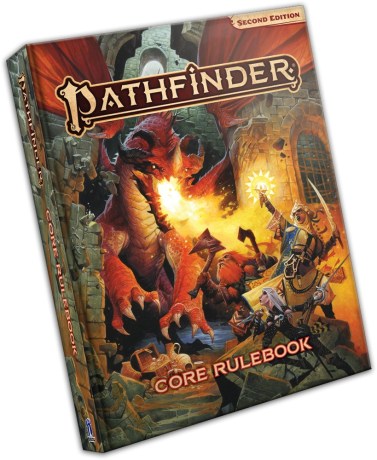
Pathfinder Second Edition is releasing three major hardcover rulebooks right from the start: Core Rulebook, Bestiary, and Lost Omens World Guide. The Core Rulebook is THE BOOK. The one you need no matter who you are and what role you take at a gaming table. Packed full of all the rules players and Game Masters need to play Pathfinder Second Edition, create characters, and run games, the Core Rulebook is a must have. Said to contain streamlined rules and intuitive presentation, Pathfinder Second Edition features the same deep character customizations we all love, allowing for unique characters and boundless creativity. Weighing in at an impressive 640 pages, the Core Rulebook contains game rules, advice, characters options, treasure, and more. There’s six ancestries to choose from (elf, dwarf, gnome, goblin, halfling, and human, as well as the variant human half-elf and half-orc), twelve classes (alchemist, barbarian, bard, champion, cleric, druid, fighter, monk, ranger, rogue, sorcerer, and wizard), thirty backgrounds (such as apprentice, bartender, and soldier), and hundred of spells, feats, and other character options. The hardcover will sell for $59.99 American, while the deluxe hardcover (bound in faux leather with metallic deboss cover elements and a bound-in ribbon bookmark) will sell for $79.99 American.
Bestiary is packed with around 400 monsters spread over 360 pages. This means that not every monster will get its own page and artwork, although there’s said to be full-colour illustrations on nearly every page. While statistics will fill the pages, sidebars are going to contain lore. In Bestiary you’ll also find the always handy Universal Monster Rules, guidelines for awarding treasure, and a variety of monster lists sorted by different qualities (like level, type, and rarity). Many of the creatures in the Bestiary will be familiar, but new creatures are also included (like the “living-nightmare nilith and the three-headed mutoli”). The hardcover Bestiary will sell for $49.99 while the Deluxe Hardcover will sell for $69.99 (bound in faux leather with metallic deboss cover elements and a bound-in ribbon bookmark).
Lost Omens World Guide is basically the new Inner Sea World Guide, with ‘Lost Omens’ being the new name for the Golarion campaign setting. This 136-page hardcover book sorts the Inner Sea into ten regions, and talks about each one. ‘The Saga Lands,’ for example, is a region which encompasses the Lands of the Linnorm Kings, Varisia, New Thassilon, Irrisen, and the Realm of the Mammoth Lords. Each region also contains backgrounds and archetypes thematically tied to the region. Finally, the Lost Omens World Guide contains a giant, two-sided, fully-detailed, poster map of Golarion. Let me repeat that: of Golarion, not the Inner Sea. Awesome! Want to know more about Tian Xia, Casmaron, and other areas outside the Inner Sea? You’ll have to wait — but hopefully not for too long. Lost Omens World Guide is the first book in the Pathfinder World Guide line, which will continue to release region specific books (like those currently in the Pathfinder Campaign Setting line) in a larger, hardcover format, to allow for greater exploration of the world of Golarion. Lost Omens World Guide is $36.99.
In addition to important rulebooks, Paizo is releasing two print adventures: Hellknight Hill, and The Fall of Plaguestone.
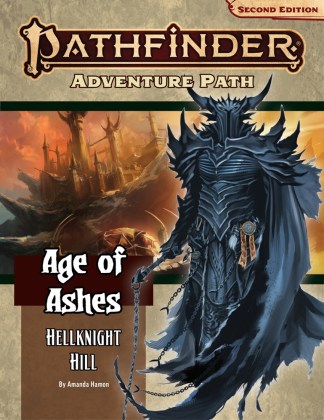
Age of Ashes is a six-part, monthly adventure path that begins with book one: Hellknight Hill. Said to contain “continent-spanning conflict against cultists, slavers, and a fiery draconic devastation that could unleash an Age of Ashes upon the world,” this is sure to be an exciting campaign! Set in Isger, Hellknight Hill begins when your PCs investigate mysterious fires which burn atop “the towers of a nearby citadel long ago abandoned by an order of Hellknights.” Written by Amanda Hamon for first level characters, Hellknight Hill will also contain a gazetteer on the town of Breechill (the starting location for this campaign), a GM guide Age of Ashes, new magic items, and over six new monsters. Hellknight Hill (and presumably all the follow-up adventure path volumes) will sell for $24.99.
The Fall of Plaguestone is a 64-page standalone adventure for first-level characters written by Paizo Director of Game Design Jason Bulmahn. Beginning with the PCs attempting to solve the murder of a friend, this adventure soon spirals out of control with the “discovery of forbidden alchemy, mutant animals, and a nearby forest rotting away due to a mysterious blight.” Ominous! The Fall of Plaguestone features wilderness exploration, dungeon encounters, and urban mystery. In addition to the adventure itself, The Fall of Plaguestone (and every Pathfinder Adventure to follow) includes new monsters, treasures, and player options. The Fall of Plaguestone is $24.99. Launching alongside this adventure is Pathfinder Flip-Mat: The Fall of Plaguestone which depicts the “hillside hideout of an evil alchemist.” The Flip-Mat measures 24″ x 30″ unfolded, 8″ x 10″ folded, and can handle dry erase, wet erase, and permanent marker. It costs $14.99.
Paizo is partnering with the awesome folks over at Dwarven Forge to release a deluxe set of pieces which will allow you to create encounter areas from The Fall of Plaguestone! Which is amazing, by the way. If you haven’t seen any of the Dwarven Forge terrain you should definitely check it out. They make gorgeous 3D terrain and map components, although be warned: it’s expensive!
Finally, Paizo is releasing five other accessories for Second Edition. First up? A GM screen! Featuring beautiful artwork on one side and handy charts, tables, and information on the other side, these high-quality screens are really useful. Available in a landscape style with art by Ekaterina Burmak, or in a portrait style with art of the Iconics by Wayne Reynolds, GM Screens are $19.99.
Up next? Pathfinder Combat Pad, which is basically a double-sided, magnetic, dry and wet erase board that functions as an initiative tracker. It comes with two sheets of magnets, which break down into 13 blue player character magnets, 13 red enemy magnets, 9 green NPC magnets, two round arrows, two turn arrows, and two next round magnets. Pathfinder Combat Pad sells for $24.99.
Pathfinder Character Sheet Pack is a set of class-specific, double sided, black and white character sheets. This set contains one character sheet for each of the twelve classes, as well as extra sheets for equipment and spells. The character sheets come in a folder and costs $14.99.
Pathfinder Combat Pad
Pathfinder Character Sheet Pack
Pathfinder Condition Card Deck
Finally, my favourite of the accessories, Pathfinder Condition Card Deck! I adore condition cards. I use them all the time in both Pathfinder and Starfinder, so I’m thrilled that they’re releasing a set for Pathfinder Second Edition right out of the gate. This 110 card deck of full-colour cards contains details and rules on the many Conditions in Pathfinder Second Edition, with the most common conditions having multiple cards. Pathfinder Condition Card Deck costs $22.99.
In addition to these awesome products, the Pathfinder Society Organized Play program will release two scenarios and a short quest every month!
For more information on Pathfinder Second Edition, it’s products, and to preorder, head over to PathfinderSecondEdition.com
I can’t wait to see how Pathfinder Second Edition turns out! (Now, if only I had the funds to buy some of it…). What are you most excited for about Pathfinder Second Edition? Let me know in the comments.
Jessica
UPDATE: Pathfinder Second Edition is now out! Click here for more information!



 Ready to get wild?
 is a soft cover book that is 32 pages in length. As a book in the Player Companion line, it’s aimed at players, which means that you won’t find a ton of world lore or secrets inside. You’ll find archetypes, feats, traits, spells, and more! Wilderness Origins features amazing cover art by David Alvarez, which showcases the iconic shifter, Zova, engaged in battle against an earth elemental.


 — shifters, gathlain, ghoran, and vine leshys — and pays some loving attention to the many different pets you can acquire. It’s rare that we get to make in-game use of a d20 book right after reading it, but this one immediately inspired us to create something new. It was well worth the investment for my family.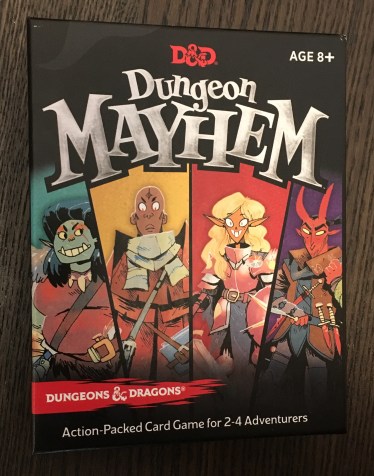
 is a Dungeons & Dragons card game for 2 to 4 players. Games are short and fast-paced, with a round averaging about five minutes. It’s a small, portable game, with the rectangular box about the size of my hand. It’s the perfect size to bring with you on the go or play in compact spaces. We bring it to the laundromat, for example. Intended for ages eight and up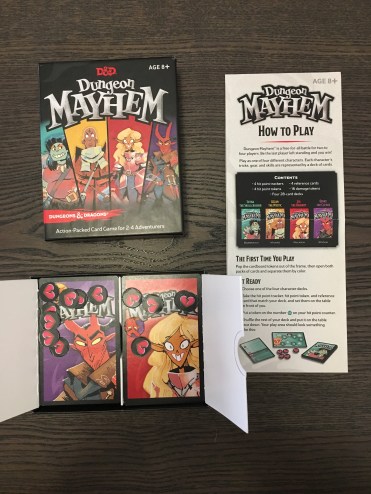



 and
and 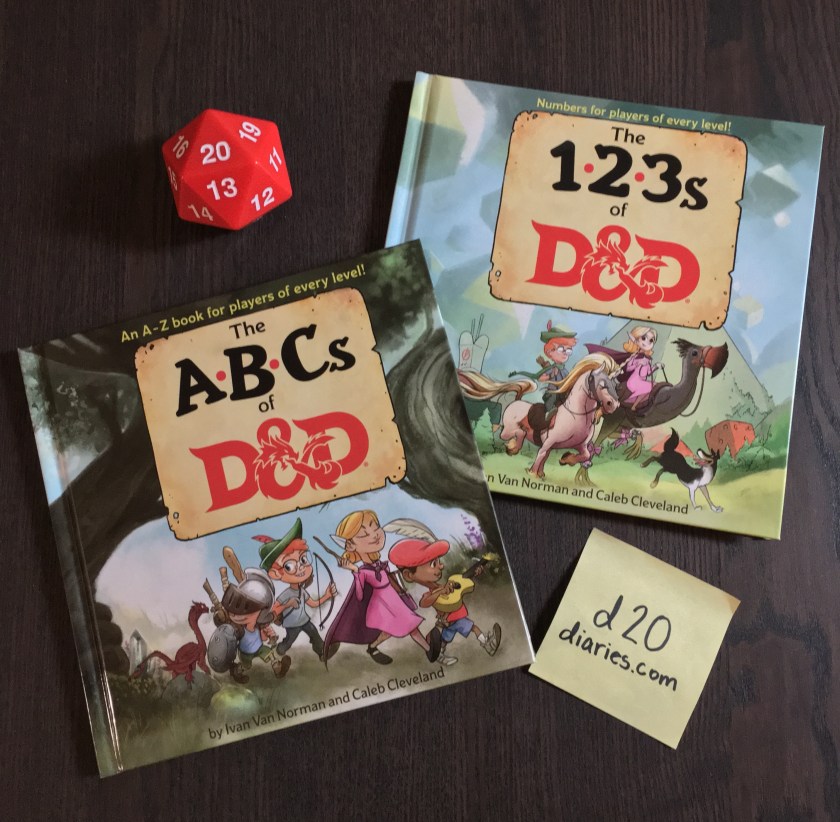

 to be shorter than

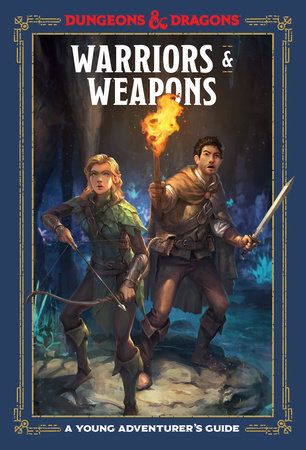

 and does NOT contain game mechanics or rules. It lays out the major concepts in a way that easy to understand, approachable, and engaging. It’s meant to inspire creativity, without overwhelming readers with rules.


 and Pathfinder’s final first edition Adventure Path:
  — this month has a lot of live up to!





 is a 64-page standalone adventure for first-level characters written by Paizo Director of Game Design Jason Bulmahn. Beginning with the PCs attempting to solve the murder of a friend, this adventure soon spirals out of control with the “discovery of forbidden alchemy, mutant animals, and a nearby forest rotting away due to a mysterious blight.” Ominous! The Fall of Plaguestone features wilderness exploration, dungeon encounters, and urban mystery. In addition to the adventure itself, The Fall of Plaguestone (and every Pathfinder Adventure to follow) includes new monsters, treasures, and player options. The Fall of Plaguestone is $24.99. Launching alongside this adventure is Pathfinder Flip-Mat: The Fall of Plaguestone which depicts the “hillside hideout of an evil alchemist.” The Flip-Mat measures 24″ x 30″ unfolded, 8″ x 10″ folded, and can handle dry erase, wet erase, and permanent marker. It costs $14.99.


 d20 Diaries