Adventures in Board Games!

My kids love games. Board games, d20 games, video games. All kinds. So, it should come as no surprise that this Christmas my tree was packed full of games. My kids were lucky enough to get a Nintendo Switch from their uncle this year, so both my son and daughter spent the first few days trying out their new video games. Let’s Go Eevee is a huge hit, as is Super Mario Odyssey. But, when we had some free time together as a family, my kids gravitated right to the new board games. My daughter got quite a few. The Hatchimals Eggventure GameBananagrams, and Bunny Kingdom (plus a new d20 game we’ll talk about another time!). And my son got two: Jumanji  and Dinosaur Island.

We spent a few days this week opening up the new games, learning how to play them — which is technically me learning how to play them and then teaching them to everyone else — and taking each one for a whirl.

Hatchimals Eggventure Game was quick to learn, which should come as no surprise. I assumed it was another one of those generic board games where you just move around the track that happens to be plastered with pictures of the latest popular kids show. Surprisingly, that wasn’t the exactly case. It was a simple kids game plastered with pictures of Hatchimals, the popular kids toy. But it was also a little more complex than just moving around the board. It involved hatching eggs, which you did by matching cards in your hand to eggs on the board. Cards and eggs were colour coded by which ‘nest’ they could hatch at, and when you landed on the proper nest you revealed one of the appropriate eggs to everyone. If it matched yours you hatched it, and if it didn’t you put it back. First to hatch their eggs wins. It was sort of like a mix between go fish, memory, and a generic kids board game. Not exactly a thrilling gameplay experience, but my daughter adored it and it only cost me a few dollars at the local Giant Tiger (which is a Canadian discount store). It’s simple enough that we can teach it to her cousins and they can play it together. Well worth the money. My son had the worst luck, though! Every single time he had a chance to blindly choose an egg, and had a fifty-fifty chance to get the right one, he got the wrong egg, The entire game. Haha. Poor kid.

Bananagrams was much more fun for everyone. For those of you who’ve never played this delightful little word game, it’s essentially a bunch of letter tiles that you put in the middle of the table. You get a bunch of them, and it’s your job to make words out of the tiles. You have to connect the words to one another by shared letters, either horizontally or vertically. It’s like each player at the table plays their own personal game of scrabble. You race to see who uses up their tiles first, then shout ‘Banana’ when you’ve done so. Everyone checks it for spelling errors, and then you start over for another round. You can also swap letters you’ve got with ones on the table if you want to, which is pretty much what my son did the whole time. Haha. Anyway, it’s a fun little game that’s great for kids of all ages. Mine are quite young, so they had no hope of beating me, but they had fun trying to make their own words and came up with some pretty good ones in the end. As an added bonus its one of those small, compact games that’s great for bringing out to family gatherings, a friend’s house, a road trip, or (in our case) the laundromat. It’s pricier than I expected it to be, though, but I was lucky enough to pick it up on sale.

Kids Games.JPG

Jumanji  was hell! Don’t get me wrong, I love the game. I was the perfect age for the original Jumanji when it came out, and owned the board game as well as the movie on VHS. I remember my brother and I got a kick out of using the decoder to read the rhyming cards from the movie. I can still rattle some off of the top of my head, actually. “At night they fly, you’d better run, these winged things are not much fun.” There’s a few more, now that I think about it. In fact, I probably remember more of them than I should…

My son isn’t partial to the original Jumanji  movie, but when he watched the reboot with Dwayne Johnson and Jack Black in it this past year (Jumanji: Welcome To The Jungle ) he LOVED it. Obsessively loved it. He even started writing his own Jumanji stories. Never finished any, of course. He’s both impatient and lazy, which isn’t exactly conducive to finishing the things he starts, but he enjoyed it. So, he was absurdly excited to get a copy of the board game for Christmas. It’s got a nifty little wooden case/board (just like in the original movie), plenty of dice, and is fast paced. Unfortunately, the first time we played it was when my niece and nephew were over. Now, I’m not sure if any of you have had the joy of teaching a new board game to four antsy and overly excited children between the ages of two and seven before, but wow! It was brutal! Haha. As an added complication there were multiple sets of dice — one for each player — and the game pieces were slightly too big for the spaces on the board, so I spent the entire game guiding play, stopping children from consuming game pieces, looking for missing dice, reminding toddlers not to move pieces that aren’t theirs, reading cards, referencing rules, and trying to figure out which of the children happened to have stolen the toy rhino that was supposed to be on the board. It was absolute chaos! Luckily I have the standard Mom superpowers: eyes in the back of my head, extra invisible arms, and limitless patience. In the end we got through it and the kids all had a ton of fun. Definitely not a game to play with all of them again, though. I’ll reach for the generic ‘race around the board’ game plastered with popular cartoon characters next time. But, when it’s just me and my kids, we’re more than happy to enter the jungles of Jumanji. Although, my son insists it would be much more fun as a virtual reality video game. Haha.

Which brings me to the actual point of this blog. Two of the games we picked up weren’t geared at young kids at all. They were aimed at an older audience. And honestly? Both were awesome!

First up? Bunny Kingdom.

Bunny Kingdom is a pricey game that we picked up for my daughter months ago when we found it in the local game store, Game Knight Games and Cool Stuff. Yes, that’s the store’s actual name. It was far out of our budget for an impulse purchase, but my daughter REALLY LOVES RABBITS. Seriously. I’m not sure I can actually emphasize that enough. But, just know: she really loves rabbits. She’s got quite a few rabbit board games already, but none that are games that my husband will sit and play with her. So, when we saw it at the store we figured, why not? I suppose I could have gotten it cheaper off of Amazon, but when we have the chance we always prefer to shop locally. Anyway, we figured that even if my husband hated the game, it was covered in adorable images of rabbitfolk making farms and kingdoms so my daughter would love it.

Luckily, our hunch was right and it turned out to be a lot of fun.

Bunny Kingdom is a board game for 2-4 players. It’s intended for players ages 12 and up, but my kids are only seven and eight and they didn’t have any trouble getting the hang of the game. It’s published by IELLO, features bright and colourful art by Paul Mafayon, and was designed by Richard Garfield (the creator of Magic: The Gathering, King of Tokyo, and Keyforge: Call of The Archons , to name a few). Bunny Kingdom was a nominee for 2018 Origins Awards Best Family Game, and 2017 Cardboard Republic Striker Laurel awards. The box is nice looking and solid, and the board inside looks great. It’s essentially a large map with a 10×10 grid overtop, and a scoreboard on the side. Many of the Bunny Kingdom Boxspaces on the map feature settlements and resources that players can claim. Settlements contain castles, while resources allow you to collect wood, carrots, and fish. Unfortunately, our board had suffered damage in two places despite having a seemingly undamaged box. Not what you want to see when you’ve paid a good chunk of change for a new board game!
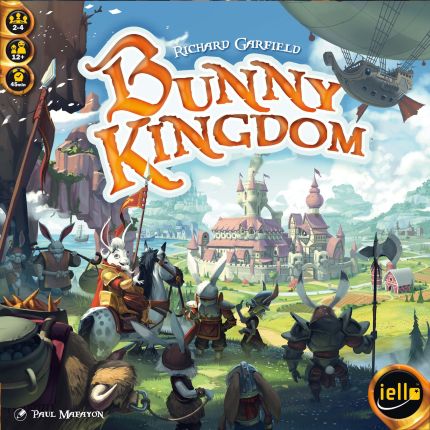
Each player has a pile of tiny rabbit tokens they can use to claim their territory on the board, and act as their token on the scoreboard. In addition to the player tokens and board, this game comes with three different sized castles (level 1, 2, and 3), corner markers to denote special upgrades and camps that you can add onto spaces, and a massive deck of cards. Seriously massive! You’ll have to split it into a few piles just to shuffle it. The art throughout the board, cards, and box is consistently wonderful. It’s bright, colourful, and cartoony in all the best ways. My daughter repeatedly shrieked in glee, exclaimed “AUW! CUTIES!”, and hugged cards to her chest, so it’s clearly a winner in her opinion! Haha.

The premise of the game is simple. Your great Bunny King has ordered you to lead your clan of rabbits in gathering resources, claiming some land, and establishing new settlements. The rabbit with the most prosperous fief — determined by having the most golden carrots — wins.

So how do you play? For starters, you select your rabbit colour, place one of them on the 0 on the scoreboard, and deal out ten cards to each player. You draft cards from the hand, selecting two you want to keep for yourself, then pass the rest on to the next player. You play some of the card types and set the others aside for later. Then you proceed with the draft. This continues until there are no more cards in hand. Cards can do a few things, but the most important ones are labelled with a letter and a number — coordinates referring to a space on the board. If you select a card like this you get to place a rabbit token there and claim the space as your own. Other cards include camps (which let you claim any unclaimed space until someone claims it with the proper card), settlements (which let you build castles of various levels on your claimed territory), sky towers (which let you connect two distant parts of your fief), resources (which let you collect resources like wood, mushrooms, and iron from your land), treasures (which give you golden carrots), and missions (which give you bonus golden carrots at the end of the game as long as you meet the requirements stated on the card). After the cards are drafted you enter the ‘Build Phase.’ This is when you play all of the castle cards, camps, sky towers, and resources you’ve drafted. After this you earn points (golden carrots) for how prosperous your fiefs are, which is based on number of ‘towers’ on the castles within your connected territories, and the different types of resources they can create. Once points are tallied you’ve reach an end of a round. Then you deal out another ten cards to each player and begin another draft. The game ends after four rounds of gameplay. Then you reveal the treasures and missions you’ve acquired, gaining extra golden carrots for them as appropriate. The winner is the rabbit with the most golden carrots (the highest score).

Our first game took us about an hour to play, but all the other games took up around 40 minutes, which is about how long the game is expected to run. Because the game always lasts four rounds, you can expect this to be a pretty consistent time. Which is really nice!

Bunny KingdomBunny Kingdom is a relatively fast paced game that involves some strategy, but doesn’t take up an entire afternoon or a whole day just to play it. Selecting the proper territory is important. You want to grow the size of your fiefs and ensure they connect, but you also want to establish cities and ensure there’s a variety of resources within it’s borders. Knowing which to go for at which times is both a matter of chance, and practise. After playing a round you’ll figure out what’s most important to you. Claiming any territory that already has a castle on it is sound, as is claiming any cards that let you establish resources — or luxury resources — in territories of your choosing. In the first two rounds you won’t earn many golden carrots from your fiefs, but if you build it properly you’ll make a lot in the last two rounds. Treasures are nice, but they offer a small one time payout. Not always worth it. Missions offer a bigger payout, but are sometimes difficult to achieve. They require you invest time in accomplishing them. For example, a mission that promises you one golden carrot per territory you own that can produce wood is nice. But, if you focus on that too much you won’t have a variety of resources available in your fiefs. And it’s variety that earns you golden carrots.

My daughter caught onto the game right away, and had great fun building her kingdoms. She, myself, and my husband all did pretty well. Some games she lagged behind the adults, but others she did just as well or better. Luck played a bit of a factor. So did my daughter’s habit of occasionally selecting cards just because they’re cute. Haha. My son, however, decided that building fiefs takes too much work. Instead he spent the entire first game only taking treasures and missions. We all thought he was crazy! Turns out in the end he went from 0 golden carrots all the way to 147 golden carrots. More than enough to score him a win against my husband’s 116. We were shocked, to say the least. Apparently, taking all the treasures and not bothering with that whole kingdom thing is a decent strategy — as long as you’re the only one who tries it. If too many players go this route it won’t lead to victory.

So, when we played our follow up games, we worked on our kingdoms, took some snazzy treasures and missions, and my son — once again — took every treasure and mission he could get his hands on. This time we thought we had him on the ropes! …And he won again.

*face palm*

I guess we should have taken even more of those treasures… Haha.

Aside from this flaw it was a great game. Of course, it was a rather large flaw. Why should the one person who didn’t bother to even try building a kingdom win a kingdom building game?!? But, we had a lot of fun anyway. Overall, we all thought it was a blast! It’s definitely going to see regular play.

But, our favourite game of the holidays had nothing to do with cute fluffy rabbits. Instead, it featured people-eating dinosaurs! Yes!

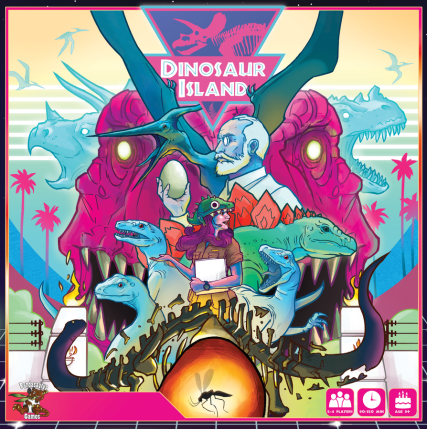
Dinosaur Island is a game we picked up for my son because he LOVES Jurassic Park and Jurassic World (and Jurassic World: Fallen Kingdom ). And this game? Pretty much that. You research the genetic code of dinosaurs, create them, and put them in your very own dinosaur theme park. If you don’t have enough security they escape and eat some of your patrons. Which is bad for business, obviously! Haha. In the end, the player with the most successful park wins. The game is designed by Jonathan Gilmour and Brian Lewis, and released by Pandasaurus Games.

Dinosaur Island BoxWe found it on the shelf at another local game shop, Fusion Gaming, and nearly gagged at the price tag. And then we read the box. My husband traded in some Magic cards for the game, and we brought it home for my son for Christmas. It’s a heavy square box packed full of stuff. There’s lots of boards, pieces, dice, cards, and pop-outs of all kinds in this game, which is frankly a little bewildering at first. But, once you’ve got everything popped out and sorted into the many little storage baggies the game comes with (thank goodness!) you can open up the rulebook and try to figure out what the heck you’re supposed to do. Which is hard! Haha. I had to flip back and forth between the first few pages of the rulebook to set everything up — some pages were telling me how to set up the game, and others were telling me the names of types of pieces. All very important! Once I had everything properly set up — which took me around twenty minutes — I finally flipped the page on the rulebook and started to actually read how to play. It didn’t take too long to read, and there were some very useful gameplay examples for each step that helped me figure things out. But, it was still quite complicated. I had to read and reread each step and its example a few times while referencing the board and the list of piece names. Once I figured out a step I moved on, and then by the time I hit the end of a phase description I went back and read that whole phase over again. Anyway, by the time I finished making sense of the rulebook I was confident I understood how the game worked and could teach it to my family, but that I would still need to reference the rulebook for details on most of the gameplay choices the first time we played through. And I was right! I referenced that rulebook constantly during the first game and still made quite a few mistakes. I used it a lot during the second game (so that we find and correct our mistakes from the first play through), and then in the third and fourth game I only had to reference it a few times to double check a rule or a cost for something we hadn’t come across much yet.

In summary, it was hard to learn. This is a bit of a problem since the game is listed as ages eight and up. Eight! In my opinion, this game is too complex for eight year olds. They can play if they’re joining in with the grown ups or teenagers — like mine did — but its not the kind of game you could give to some eight year olds and expect them to be able to learn and play properly. Twelve and up would be more accurate.

That said, the game was awesome.

Everyone had a blast and, surprisingly, my daughter and husband loved it most of all. In fact, they were both the driving factor in us playing it so many times over the last few days. Which is huge! My daughter is always ready to play a board game, but my husband? Not so much. This is particularly surprising when you take into account how long this game takes to play. It says it takes an hour and a half to two hours to play through, but it took us over three on our first run through (and we played the ‘short game’). Further run throughs also took around three hours each, although the second time we played a ‘medium game’ and the third we played a ‘long game’ with three people instead of four. Definitely a time investment!

Dinosaur Island Game Set Up

So what is Dinosaur Island, and how do you play?

The point of Dinosaur Island is to create the most successful park. Your park’s success is measured in Victory Points, which are most often earned by having guests survive their trip to your park. You can also earn Victory Points by creating dinosaurs and by building some attractions. A number of guests visit your park each turn based on your parks Excitement level, which is also influenced by the number and grandeur of the dinosaurs you have created, and by some attractions. But, getting people to your park isn’t all that matters. You also have to have attractions for them to visit. They’ll visit your dinosaurs, of course, but only so many visitors can view a paddock at a time, so you’ll also want to create other attractions. Things like restaurants and rides for the guests to visit. Another factor you need to take into account is danger. You can have a lot of dinosaurs and a huge excitement level, but if you haven’t invested enough in security then your guests will get eaten by dinosaurs. And dead guests don’t earn you Victory Points!

It’s a complex game that involves multiple phases, each of which allows you to make decisions regarding how you choose to run your park. We didn’t find a single obvious method for best increasing your Victory Points. Which is great! You have a lot of choices to make, and all of them are helpful in different ways. Usually you’ll need to change your priorities from round to round to do well in this game. There was a lot of fun strategy and planning involved, which even got my daughter taking the time to sit, think, plan, count, and envision a few stages and turns ahead. Fun planning, too. Not boring. We all really enjoyed this games layered complexity.

So what are these phases?

Dinosaur Island 2Phase One is the Research Phase, which will utilize a shared board that will be in the middle of the table. On it you’ll find dice (which usually show DNA in various types, amounts, and a threat level), dinosaur cards, and some other open spaces. During this phase each player will take turns selecting how you want your three scientists to prioritize their research. They can select one of the dinosaur cards in order to learn the DNA recipe for that dinosaur, they can select a DNA dice in order to collect that kind of DNA, they can work to increase your cold storage (which is the maximum levels of each type of DNA you can hold), or they can refrain from doing research and instead become an extra worker for the third phase. All of these options are really important. Dinosaurs raise excitement levels which in turn draw in guests, but they each cost different kinds of DNA. Collecting DNA to create them is important. Of course, your cold storage starts off small, so you’ll want to increase it as you play.

Phase Two is the Market Phase, which will utilize a shared board that will be in the middle of the table. On it you’ll find a variety of DNA, lab upgrades and park attractions you can purchase, and specialist workers you can hire. During this phase each player takes a turn selecting what they want to purchase, until each player has bought two things.

Phase Three is the Worker Phase, which will utilize a personal board which will be in front of you. On it you’ll find your DNA Cold Storage and your current levels of DNA, your current threat level, your current security level, as well as your current lab facilities and upgrades. During this phase you place your workers (typically you have four) on your board to accomplish certain tasks. Tasks can include refining DNA from one type to another advanced type, creating dinosaurs, increasing security measures, increasing paddock capacity, and raising capital. In addition, some lab upgrades will give you more options, or allow you to perform tasks with less workers invested in them, or at a financial discount. Once everyone has placed their personal workers (which happens all at the same time) you tell your fellow players what your workers are doing and apply it.

Dinosaur IslandPhase Four is the Park Phase, which will utilize a personal board which will be in front of you. On it you’ll find you park, your current dinosaurs and paddock capacities, your attractions, and the number of guests which can visit each location. During the Park Phase you count up your Excitement which determines how many guests visit your park, receive income from entry fees (except for those pesky hooligans who sneak inside!), place guests at attractions, calculate threat against your security, see if any dinosaurs escape, have dinosaurs devour guests, and finally count up how many surviving guests you retain, which will grant you Victory Points.

Phase Five is the Cleanup Phase, which is when you tidy up the boards and prepare them for the next round. It’s also when you determine the next round’s turn order. Whoever has the most Victory Points goes last, while the least goes first. And then its onto the next round, with Phase One.

There’s a lot more to this game than we’ve mentioned. Plot Twist Cards help make every game different, and objective cards determine the goals you need to accomplish in order to end the game. These goals are sorted by game length, so if you want a short game you select objectives at random from the short game deck, while a long game will require cards drawn from the long game deck.

We absolutely loved this game. So much, in fact, that my husband is considering buying my son the expansion for his birthday gift. The expansion, called Dinosaur Island: Totally Liquid, allows for a fifth player to join in the fun, features water dinosaurs, more DNA dice, new attractions, and more. Super cool!

All in all, we’re thrilled with our new games.

Think you know of a game we’ll love? Let us know in the comments! I’d love to hear it!

GAME ON!

Jessica
 

Our Favourite Things of 2018

To celebrate the New Year we’re taking one last look back at our favourite things of 2018! So what made the cut? Read on and see!

Favourite d20 Bestiary: Alien Archive
(for more information check out this blog post)

Favourite Dungeons and Dragons Book: Dungeons and Dragons: Guildmaster’s Guide to Ravnica
(Dungeons and Dragons meets Magic: The Gathering!!)

Favourite Pathfinder Book: Ultimate Wilderness
(for more information check out this blog post)

Favourite Starfinder Book: Pact Worlds
(for more information check out this blog post)

Favourite d20 Book (Other): Realms of Atrothia: Legacy Races Revisited
(for more information check out this blog post)

Favourite d20 Adventure: Skitter Shot
(for more information check out this blog post)

Favourite d20 Campaign: Return of the Runelords Adventure Path
(for more information check out this blog post and be on the look out for another blog post early this year)

Favourite Pathfinder Society Scenario: #9-10: Signs in Senghor
(for more information check out this blog post as well as this one)

Favourite Starfinder Society Scenario: #1-14: Star Sugar Heartlove!!!
(for more information check out this blog post)

Favourite Kid’s Game: Tails of Equestria: The Storytelling Game
(for more information be on the lookout for a new blog post later this month!)

Favourite Board Game: Dinosaur Island
(for more information check out this blog post)

Favourite Family Movie: Spider-Man: Into the Spider-verse
(now playing in a theatre near you!)

Favourite Movie: Ready Player One
(if you haven’t seen this movie or read this book yet, you REALLY SHOULD!)

Favourite Upcoming Kickstarter: Realms of Atrothia: Primary Expansion
(Kickstarter coming in February 2019!)

I can’t wait to see what 2019 brings!

Jessica

Starfinder Society Scenarios: It Rests Beneath and Honorbound Emissaries!

Today we’re going to take a look at the two most recent Starfinder Society Scenarios that are currently available for purchase, and let you know we thought. Although you’ll find references to events in each that I liked or disliked, and comments about specific characters, these scenarios are not explored in detail. It’s not my intention to spoil the events in these scenarios, or give summaries and full reviews, but to share my opinions and provide recommendations. That said, if you want to avoid even minor spoilers I recommend you check out a different article. Whether you intend to use them in home games of the Starfinder Roleplaying Game, sanctioned scenarios for use with the Starfinder Society Organized Play, or just want to read a nifty new adventure, we’ve got you covered! So sit back, and get ready to explore the Pact Worlds!

1-28 It Rests Beneath
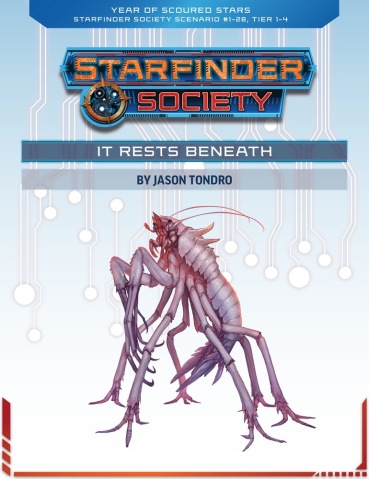
Starfinder Society Scenario #1-28: It Rests Beneath by Jason Tondro.

Starfinder Society Scenario #1-28: It Rests Beneath is a Tier 1-4 adventure written by Jason Tondro. It takes place on the planet Vabaimus, a Near Space world home to a variety of ecosystems and rich mineral deposits. It’s dominant native species is a sloth-like race that is approaching sentience. On Vabaimus you will help out a small Starfinder research facility. This scenario features the Faction (Wayfinders), and Vehicle tags. It does not contain starship combat. It utilizes content from the Starfinder Core RulebookStarfinder Armory, and Starfinder Alien Archive . It makes use of Pathfinder Flip-Mat: Hill CountryPathfinder Flip-Mat: Twisted Caverns, and Starfinder Flip-Mat: Asteroid. In addition, you’ll also want a relatively featureless map, like Pathfinder Flip Mat: Basic Terrain Multi-Pack or Pathfinder Flip-Mat: Dragon’s Lair, for any unmapped encounters. If you’ve got any vehicle-related boons now is the time to slot them. Similarly, if your character happens to own their own vehicle, definitely bring it along!

It Rests Beneath features only one recurring character: Fitch, leader of the Wayfinders faction, an her mischievous grandchildren. It introduces a few new characters: Dr. Mora Motressi, leader of a Starfinder research facility on Vabaimus; her daughter, Little Mina; and Bud, a cuddly sloth-like being that’s both the good doctor’s pet and the most advanced native species on the planet. This scenario begins on the Master of Stars, the largest ship in the Starfinder fleet. It’s currently docked in Absalom Station’s Armada and has been undergoing repairs since the start of Starfinder Society Organized Play. From there it swiftly transitions to Vabaimus, where the rest of the scenario takes place. There PCs will need to assist the science team in performing a survey of a strange landmass. Nearly 85,000 square miles in size, with no water or plant-life, this calcified plateau is of great interest to Dr. Motressi and her team. She asks you to travel across the plateau to three specific locations, set up some specialized towers you brought with you, and calibrate surveying equipment atop of each one. Each tower has its own challenges, hazards, and enemies to contend with. There’s multiple vehicles your PCs can choose from, and the towers can be tackled in any order. There’s a simple vehicle handout that will be useful for both players and GMs, which is a nice touch. I love how flavourful the new creatures and environmental hazards are. A lot of thought has gone into ensuring they fit into their ecosystem — which is particularly important when players are surveying an environment. Also, I particularly enjoyed the mystery of the old kasathan ship.

I do have  one nitpick. Page three is missing half of a sentence at the end of the first section, which I assume should read something along the lines of ‘up to help,’ ‘up to lend a hand,’ or something else similar. It’s not a hindrance to the scenario. You can still get the gist of what it’s supposed to be saying, but it was jarring enough that it caused me to look around in confusion for a half a minute, to make sure I hadn’t missed anything. A minor distraction in an otherwise enjoyable read.

Overall, I loved I this scenario! The premise is different from any that have come before. It was engaging all the way through, with a wonderful array of social interactions, skill-based encounters, hazards, and combat. The enemies and hazards were all well-thought out. The NPCs were properly engaging and ‘real.’ And, best of all, your PCs have to make an important decision regarding the future of this planet. Really top notch! Although it didn’t blow my mind, like some other amazing Starfinder adventures, it was an… understated awesome. I give it 5 out of 5 stars.

1-29 Honorbound Emissaries
Starfinder Society #1-29: Honorbound Emissaries by Jenny Jarzabski.

Starfinder Society #1-29: Honorbound Emissaries is a Tier 7-10 adventure written by Jenny Jarzabski. Yup, you heard that right! Tier 7-10! The first of its kind! It takes place primarily on Saaruq-5, a planet in the Vast that’s part of a multiplanetary federation called the Kreiholm Freehold.  This scenario features the Faction (Second Seekers [Luwazi Elsebo]) tag, and does not involve Starship combat. It continues the ongoing Scoured Stars storyline, and is a direct sequel to the events of Starfinder Society #1-99: The Scoured Stars Invasion. Although playing these previous adventures isn’t necessary, I highly suggest you do. Everything will make more sense, have more importance, and be more engaging if you have.  It features NPCs from some previous scenarios (Starfinder Society Scenario #1-04: Cries from the Drift, Starfinder Society Scenario #1-05: The First Mandate, and Starfinder Society Scenario #1-11: In Pursuit of the Scoured Past). In addition, there are multiple instances where PCs who have played previous scenarios involving the jinsul have an advantage (Starfinder Society Scenario #1–13: On the Trail of History, Starfinder Society Scenario #1–99: The Scoured Stars Invasion, or Starfinder Society Scenario #1–23: Return to Sender). Finally, it should also be noted that this scenario helps lay the foundations for further scenarios, as well as the next interactive special. Important stuff! If you’ve got characters who have played any of the above-mentioned scenarios, I highly suggest bringing them. And, if you’ve got the Honorbound Allies boon, now’s the time to slot it!

Honorbound Emissaries utilizes Pathfinder Map Pack: Starship DecksStarfinder Flip-Mat: Hospital , and a custom half-page map. It contains content from the Starfinder Core RulebookStarfinder Alien ArchiveStarfinder Alien Archive 2, and Starfinder Armory. In addition to containing important events, this scenario has a lot of important NPCs. It features First Seeker Luwazi Elsebo, Iteration-177 (who was previously in Starfinder Society Scenario #1-05: The First Mandate and Starfinder Society Scenario #1-11: In Pursuit of the Scoured Past), Captain Yuluzak (who was previously in Starfinder Society Scenario #1-04: Cries from the Drift), and mentioned (but unfortunately doesn’t feature) the gruff vesk pawnbroker Julzakama (who was previously in Starfinder Quest: Into the Unknown and Starfinder Society Scenario #1-10: The Half-Alive Streets). Captain Yuluzak has his own artwork this time around, and it is awesome! All of these NPCs were well-represented, and I’m happy to see them back. Honorbound Emissaries also introduces a ton of new NPCs to interact with, many of which have names, personalities, and quirks. I particularly enjoyed the crew of Honorbound.

The opening premise for this mission is… convoluted. Captain Yuluzak, who runs a salvager, discovered a starship wreck, took what was valuable and returned to Absalom Station. Some objects he kept, and others he sold to a pawnbroker named Julzakama. Juzakama recognized one of the objects as an important piece of art and contacted some people he thought would buy it. One of those people, Iteration-177, recognized the object as belonging to a culture that was once a part of the Scoured Stars Trinary System, so he contacted Luwazi Elsebo. Luwazi had the object brought to her, along with a team of Starfinders, Iteration-177, and Captain Yuluzak himself. Luwazi tasks the PCs with travelling aboard Captain Yuluzak’s ship to investigate the original wreck. There they’ll  determine the ship’s origins, and travel there to investigate and (hopefully) make some new allies.

Jinsul Graey Erb
A jinsul. Illustrated by Graey Erb. Art courtesy of Paizo Inc.

This scenario was big with a capital ‘B.’ It involves the Scoured Stars storyline, the jinsul, a new solar system full of inhabited planets, three new races (nelentu, syngathrix, and thyr), people to save, important decisions to make, a massive starship battle, and combat on… well we’ll leave that part secret for now. Haha. To say this scenario is bold is an understatement! The entire hospital section of this scenario was particularly well handled, as were the NPC interactions found throughout. And the setting for the final battle? Epic! Your PCs are sure to come away from that fight feeling like badass action heroes. It’s going to be a ton of fun to play.  On the downside, everything in this scenario is overly convenient in a rather heavy-handed way. Now, I’ve no problem with a ‘railroad,’ particularly in short adventures like Society Scenarios, but in Honorbound Emissaries you always arrive in the exact right place at the exact right time in order to avoid something troublesome. Heck, you even travel through a massive space battle and don’t get attacked by either side. At all! In fact, you even manage to approach the planet and land without a single threat or altercation. It’s like you’re invisible. Which brings me to me second down-side: starship combat. This scenario should have had one. Getting to witness an epic starship war and not engage in it at all is kind of a let down. And how fun would it have been to help out the crew of the Honorbound? Now, I get why it’s not in here. This scenario has more than enough encounters to engage in, and they’re all cool. But, it would have been nice to at least see the ship you’re on come under attack. Or mention the bumpy ride as the pilot has to take evasive maneuvers. Something.

…But that final battle! Wow! Haha.

sfs 1-13 - on the trail of history - jinsul ship
A jinsul ship. Originally depicted in SFS #1-13: On the Trail of History. Art courtesy of Paizo Inc.

Overall, I really enjoyed this scenario. It’s bold, daring, and casts your players into situations much bigger than themselves. PCs get to do some heroic things, some absurd things, and   some absurdly heroic things, all of which is going to be a blast! It’s rounded out by some really solid social interactions with a large cast of quirky characters. This is truly one of those scenarios that players will talk about for a long time afterwards, simply because they want to brag about their character’s exploits. Five years some now I’m sure some players will still look back on it fondly and say “Wow, remember when my Starfinder character did THAT? THAT was cool.”

Which is cool!

I give this scenario 5 out of 5 stars.

Thanks for joining us today!

I wish you happy holidays, plenty of natural 20s, and all the best in the upcoming year!

Jessica

Pathfinder Society Scenarios: The Shattered Shield and The Hao Jin Hierophant!

Today we’re going to take a look at two of the most recent Pathfinder Society Scenarios that are currently available for purchase, and let you know we thought. Although you’ll find references to events in each that I liked or disliked, and comments about specific characters, these scenarios are not explored in detail. It’s not my intention to spoil the events in these scenarios, or give summaries and full reviews, but to share my opinions and provide recommendations. That said, if you want to avoid even minor spoilers I recommend you check out a different article. Whether you intend to use them in home games of the Pathfinder Roleplaying Game, sanctioned scenarios for use with the Pathfinder Society Organized Play, or just want to read a nifty new adventure, we’ve got you covered! So let’s get cracking!

10-10 Shattered Shield
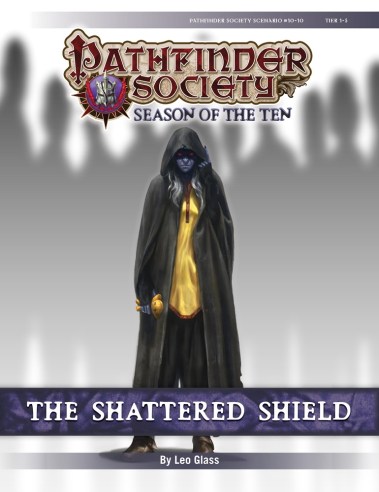
Pathfinder Society Scenario #10-10: The Shattered Shield by Leo Glass

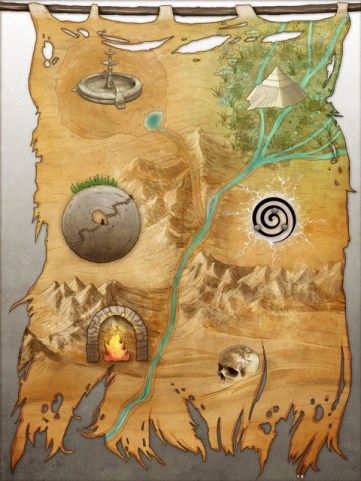
Pathfinder Society Scenario #10-10: The Shattered Shield is a Tier 1-5 adventure written by Leo Glass. It takes place in Rahadoum, a nation where religion is outlawed. It features creatures from Pathfinder Roleplaying Game: BestiaryBestiary 3, and Bestiary 4 (although all of the necessary stat blocks are included within the scenario). It makes use of the Pathfinder Core RulebookAdvanced Player’s GuideUltimate Equipment, and Ultimate Magic. This scenario utilizes Pathfinder Flip-Mat: Noble EstatePathfinder Flip-Mat: Museum, and a morbid custom map that looks pretty rockin’. This mission is of particularly importance to members of the Dark Archives Faction, and is very likely going to lead to other Pathfinder Society Scenarios (and tie in with the Tyrant’s Grasp Adventure Path, I’d wager).

On the surface, because religion is outlawed in Rahadoum, bringing a cleric, paladin, or other divine caster on this mission is a really bad idea, but actually… that’s only half true. Yes, religion is outlawed in Rahadoum, and playing a divine caster will be a challenge. There will be social repercussions, and you’re likely to run into trouble with the law. However, these interactions are very well-handled in this scenario with the addition of ‘Legion Points,’ which are a measure of how many legal infractions the Pure Legion has caught you committing. The punishments are clear, and you have plenty of opportunities to lower these totals throughout the scenario. You’re not going to be executed, or immediately kicked out of the scenario or something equally drastic. As long as you play your divine character with some subtlety and caution, you should come out alright. As a nice bonus, there are quite a few obvious benefits to bringing that divine caster along. Players who take the time and try their best to navigate this difficult political landscape will find their efforts were worth it. It’s a gamble. Although I don’t recommend you bring a divine-heavy party to this scenario, I don’t condemn their use either. If you’re up for the challenge, go for it!

The Shattered Shield tasks the PCs with heading into Rahadoum and attending an illegal auction that deals in religious relics. There they’ll need to obtain a shard of the Shield of Arnisant, which was once known as the Shield of Aroden, and was used to battle the Whispering Tyrant. This shield is supposed to be safe in Vigil, but all signs seem to show that the shard up for auction is legitimate. Of course, as with any good scenario, acquiring the shard will be harder than it sounds.

Zaashakar Tom Ventre
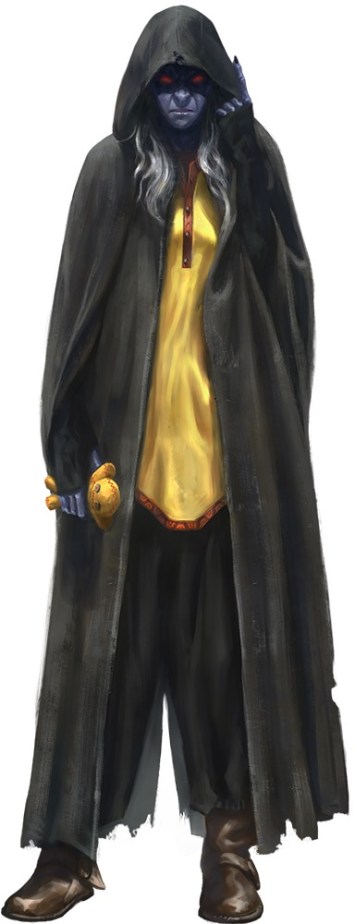
Zaashakar and Vaultkeeper from Pathfinder Society Scenario #10-10: The Shattered Shield. Illustration by Tom Ventre

There’s a lot to like in this scenario. It has a lot of interesting social and skill-based encounters. There’s one very weird illness going around that’s used to great effect. The mission briefing with Venture Captain Obo was very detailed, with plenty for roleplay-oriented players to riff off of. I particularly enjoyed how the Pure Legion was portrayed. This scenario did a great job of humanizing them, which was nice to see. The adventure allowed for some deviation from the assumed path, with alternate allies and differing methods accounted for. I really, REALLY liked that. It’s rare to see in published products, particularly of this length. I also really enjoyed some behind the scenes bits with Nulalla, which most players will be curious about but aren’t likely to discover completely. I loved the situation that Torvad Shalzadin and Inusi Mendalari find themselves in. In addition to being dynamic and a little suspenseful, clever PCs will be able to glean a bit of information about this scenario’s main villain from the witnesses. The final location PCs visit in this scenario was super morbid and different. I really, really liked it. And the map for it looks great! Finally, I adored the main villain’s… pal. It’s both horrible and adorable. Just awesome.

That said, there are some downsides. The auction itself was a bit of a let-down. Although there’s some interesting people to interact with, and some cool things to bid on it’s unscripted, and the notes are scattered over a few pages. This is inconvenient for GMs, and means that the auction is unlikely to be a showstopper. Which is a shame! I LOVE a good auction in my Pathfinder. Events are also a bit overly convenient. Not a trait unique to this scenario, but it is more obvious and heavy-handed than is typical. Particularly with regards to the connections between the estate and the auction guests.

Finally, villain tactics. This scenario’s villain is an odd one. Don’t get me wrong, I love her. Seriously. She has flaws, hang-ups, quirks, obsessions, and goals which both haunt and drive her. They affect her tactics and reactions. Unfortunately, it’s not depicted in a way that everyone — GMs and players alike — will necessarily notice. And if you don’t notice? She comes off seeming rather stupid. Which is… unfortunate. And as cool as the final location is, the ending has the potential to be incredibly anticlimactic. I like the premise, and it works for the character, but if certain events occur a lot of players will just be left shaking their heads and asking: ‘That’s it?’ Not really the reaction you want at the end of a successful mission.

10-11 Hao Jin Hierophant
Pathfinder Society Scenario #10-11: The Hao Jin Hierophant by Jessica Redekop.

There’s one other quibble I have with this scenario: penalties. As with any Society Scenario, there’s many opportunities where not discovering ‘X’ or accomplishing ‘X’ can cause your PCs to lose out on some of the gold rewards on their chronicles. Usually accomplishing those tasks is easy, and it just sort of happens as you play. In this scenario that is not necessarily the case. Some are harder to get than is typical. Most groups won’t get full gold. In fact, some groups will miss out on gold two or three times. Now, on the one hand, I like that it’s not a given you’ll get all the rewards this scenario has to offer. It’s refreshing. But, this scenario might have gone too far in the other direction. If too many players miss out on too much of the rewards, they might even feel like they’ve been unjustly penalized.

Overall, I ended up torn on this mission. I love how Rahadoum and the Pure Legion was handled. I also enjoyed the large number of social and skill based encounters. The villain was flavourful, different, and had some serious quirks — all things I adore. Heck, I even liked her doorman. On the other hand, players are likely to come away from this scenario feeling confused over enemy tactics and behaviour, and the ending has the potential to be a let down. In the end I decided to give it 3 out of 5 stars.

Hao Jin Tapestry by Robert Lazzaretti
The Hao Jin Tapestry. Art by Robert Lazzaretti.

Pathfinder Society Scenario #10-11: The Hao Jin Hierophant is a Tier 5-9 adventure written by Jessica Redekop. It takes place in the Hao Jin Tapestry, an artifact that acts as a gateway to a demiplane that the sorceress Hao Jin created to store her greatest treasures. Things like magical objects, temples, places, and even people. The Pathfinder Society won the Hao Jin Tapestry seven years ago at the Ruby Pheonix Tournament, and have made heavy use of it since. This scenario features creatures from Pathfinder Roleplaying Game: Bestiary 5, although all of the necessary stat blocks are included within the scenario. In addition to the Pathfinder Core Rulebook it makes use of  content from Occult AdventuresPlanar AdventuresUltimate Equipment, and Ultimate Magic. It utilizes the Pathfinder Flip-Mat: Forbidden JunglePathfinder Flip-Mat Classics: Swamp, and a custom map.

The Hao Jin Tapestry is unstable. Unravelling, one could say. This scenario tasks the PCs with heading into the demiplane, checking out an ancient Tian site, and getting out with whatever lore and treasures they can before it’s too late. It’s a sequel to this year’s interactive special Pathfinder Society Scenario #10-00: The Hao Jin Cataclysm. In the new year this story will continue with Pathfinder Society Scenario #10-13: Fragments of Antiquity, and Pathfinder Society Scenario #10-15: Tapestry’s Trial. If you’ve got characters who have had a hand in acquiring, exploring, or protecting the Hao Jin Tapestry in the past, now is definitely the time to bring them out! Also, if you’ve got characters with knowledge of Tian Xia, who can speak Hwan, or who can magically communicate in other languages, they’ll be used to great effect in this scenario.

Lin Fen Hai by Michele Giorgi
Lin Fen Hai from Pathfinder Society Scenario #10-11: The Hao Jin Hierophant. Illustration by Michele Giorgi.

This scenario begins in Absalom with an announcement from two members of the Decemvirate! This is followed by a more typical mission briefing with the oread Master of Spells Sorrina Westyr. From there it quickly moves into the Hao Jin Tapestry’s demiplane. There the PCs will get to explore the ancient Tian village of Onhae, which would once have been found in the jungles of Chang Liao. The PCs main goals are to collect a sample of a rare flower from the area, and to learn all that they can about the traditional religion and culture of the people of Onhae, the Sunsu Godae. Happily, there’s still people in Onhae. This should be a cinch! …But, it turns out they’re not practising their traditional religion anymore. They have a new leader, Lin Fen Hai the Hao Jin Hierophant, and a new god who we’ll just call the Ruby Pheonix. Interesting! Your players will get to navigate this newly changed political environment in order to accomplish their missions, all while the Hao Jin Tapestry frays around them, causing unnatural events, magical malfunctions, and planar breaches. It’s an interesting mission to say the least. Similar in form and tone to some previous adventures like… #3-21: The Temple of Empyreal Enlightenment and #9-12: Shrine of the Sacred Tempest.

RubyPhoenix Hao Jin Cataclysm
The Ruby Phoenix.

Onhae was an interesting, rich little village with both and ancient past, recent history, and current changes. Sussing out this places many secrets looks like an enjoyable challenge. Their new religion was awesome! Haha. So good! Although a lot of this scenario was social encounters and skill checks, there are some battles to be fought. Each of these encounters is well written and has interesting flavour and tactics. There’s also some neat planar malfunctions going on you get to interact with. Overall, I really liked this scenario! I give it 4 out of 5 stars.

Thanks for taking the time to join us today! I hope you stop by later this week when we take a look at the newest Starfinder Society Scenarios!

All the best,

Jessica


Alien Archive 2

For my birthday yesterday my family gifted me a wonderful book I’ve been itching to get my hands on: Starfinder Alien Archive 2! And what better way to celebrate than to share it with all of you? So today we’re taking a deep dive into the latest Alien Archive! Ready?

Let’s go!

Starfinder Alien Archive 2

Alien Archive 2 is an awesome supplement book for the Starfinder Roleplaying Game. This book has a hardcover, and is 159 pages in length. It’s got an American cover price of $39.99, which means that if you’re Canadian (like myself), you’re looking at a cost of around forty-five to fifty dollars for the book online, or up to sixty in your local game store. It’s currently on sale for around $32 Canadian on that handy link I posted, so I highly recommend picking it up cheap while you can.

At it’s core, Alien Archive 2 is a book of monsters. You’ll find a ton of creatures to fight and ally with inside this book, as well as some new player races. The book is easy to use, adaptable, and well organized. It also has some new character options, like new spells, equipment, and feats, scattered amongst the monster entries.

The Alien Archive features lovely cover art by Remko Troost which depicts a glitch gremlin, a mi-go, and a trox. The inside front and back covers feature an image of the Pact Worlds. After that we come to the table of contents. Alien Archive 2 has sixty-five distinct monster entries inside it, many of which have more than one stat block or variation of that creature, making the actual number of foes inside larger than it seems (around one hundred and twenty-six by my count). Of these, sixteen are playable as character races. There are also three starships, and twenty-six template grafts.

Combatant
Combatant

After the table of contents we reach the introduction. This is where we learn how the races are oriented, and how to read a stat block. While most of this is basic information that only a player new to d20 games will need to read, some of the information is quite important. Of course, all of this will be business as usual for owners of the first Alien Archive.

Expert
Expert

Each of the stat blocks inside the Alien Archive is sorted into one of  three categories: combatants (which excels in physical combat), experts (who are most effective with skills), and spellcasters (who rely on spells or spell-like abilities). These categories are represented by an icon in the left margin. These images are easy to distinguish and provide a quick and easy way for GMs to realize the role each monster plays in combat, which makes it super easy to find the type of creatures your looking for, or to quickly discern a creature’s tactics.

Spellcaster
Spellcaster

There’s also a few interesting things to note about the stat blocks themselves. Very few of the creatures inside have Resolve Points and none have Stamina Points. A creatures ability scores aren’t listed, instead, their stats show their ability modifiers. This is a simple change that will make it easier for GMs — especially new GMs — to handle unexpected situations (like unlisted skill checks) in combat. Not all of a creatures feats are listed in their entry. Instead, only feats that grant new combat options will be shown. Feats that grant static bonuses (like improved initiative, or skill focus) are already factored into the stat block and will not be listed anywhere at all. This really streamlines the stat blocks, and makes it easier to find important information fast. Similarly, not all of a creature or NPCs spells will be listed in a stat block. Instead, it only features their most powerful spellcasting options.

PZO7105
Starfinder Alien Archive

Every one of the bestiary entries in this book is two side-by-side pages long. These entries include information on the creature, where they’re found, their use throughout the Pact Worlds, and their society — if they have one. Many of the entries include more than one stat block on a theme. For example, the Forman entry gives us stats for a CR 7 taskmaster, along with a CR 10 myrmarch. Similarly, the akata entry features the both the akata and the void zombie, which are controlled by its parasitic offspring. Some entries include many stat-blocks (such as the herd animals, predators, and dinosaurs) or include simple grafts that can be added to a featured creature to make it into other versions (such as metallic and outer dragons). Many of the archive entries introduce new gear, rules, or consumables. My personal favourites include the arquand horns found on the arquand gazelle’s entry, the glass skin of the glass serpent, and the apocalypse solarian weapon crystals from the living apocalypse.

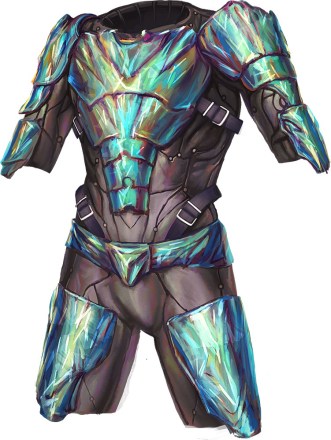
Alien Archive 2 - Glass Serpent -Armor
Armour made from a Glass Serpent

After this we come to the meat of the book: the aliens archive itself. There are a ton of cool creatures in this book, and even some that I wasn’t sure I’d like on first perusal, I ended up really enjoying. Some of my favourites you should check out include the squox, a CR 1/3 or 1 creature which is utterly adorable and makes a fabulous pet. I also adored the adaptable entries on dinosaurs, herd animals, and predators, each of which comes with a sample stat block for a creature of each size, followed by simple rules for how to make an innumerable combination of custom creatures of those types. It’s simple, incredibly useful, and has awesome art. LOVE IT. Glitch gremlins were a fun low level challenge I also really enjoyed, as were the akatas, which I’m thrilled to see included. For a great high-level challenge check out the calecor and the living apocalypse.

PZO7403
Starfinder: Alien Archive Pawn Box

Mixed amongst the monster entries are sixteen playable races. Each entry features two different CR stat blocks representative of their race, a bunch of interesting information on their societies and home worlds, and a side bar which include the rules for playing them as a race. Although many of these were ‘humanoid shaped’, with arms and hands or some sort, there were some which were not, most notably the mollusk-like embri, and the  silicon-based quorlu. This was just awesome to see, and I really enjoyed it! Some of the races and monsters from old Golarion were up for selection, including aasimar, tieflings, ghorans, hobgoblins, orcs, and trox,  but many were brand new. I honestly loved a TON of these races, but my favourite new additions are damai, osharu, pahtra, and the wolf-like vlaka.

Curious about the playable races available in this book? Well, look no further! The Alien Archive includes:

  • Aasimar: celestial blooded humanoids you’ll find under ‘planar scion’
  • Bolida: armoured burrowing arthropods with a wide array of senses
  • Damai: pale, scrappy humanoids forced to hide underground from the colossi they share their world with
  • Embri: masked, mollusk like aberrations with a rigid social order secretly controlled by the forces of hell
  • Ghoran: delicious plant beings from Golarion who have terraformed their own planet-paradise and genetically split into two subraces: oaklings and saplings
  • Hobgoblin: tall, war-mongering, militaristic humanoids with faces similar in appearance to goblins
  • Kanabo: a red-skinned oni, which is a type of evil spirit given a physical form
  • Orc: strong humanoids conditioned as slave labour by the drow of Apostae
  • Osharu: slug-like creatures that view religion and science as intertwined
  • Pahtra: asexual cat-like humanoids that adore music and battle
  • Phentomite: agile humanoids acclimated to thin atmospheres and high altitudes that live on a broken planet
  • Quorlu: silicon based quadrupeds with tentacle arms and eyestalks capable of digging through earth and stone
  • Tiefling: fiendish blooded humanoids you’ll find under ‘planar scion’
  • Trox: large, chitinous, gentle humanoids that have been magically transformed since their time on Golarion
  • Uplifted Bear: intelligent, bipedal bears that you’ll find under ‘bear’
  • Vlaka: wolf-life humanoids from a dying world often born deaf or blind

Past the statistics for all those snazzy new aliens we come to the Appendixes, of which there are eleven. Appendix One contains two pages of creature subtype grafts and Appendix Two contains two and a half pages of environmental grafts. Appendix Three contains rules for the polymorphing creatures. This section is around seven pages long and frankly, feels quite complicated to me. Definitely not something my kids could use. Appendix Four contains all of the universal creature special abilities. Appendix Five, Six, and Seven are very short, sorting the creatures in the Alien Archive 2 by CR, type, and  terrain. Appendix Eight lists the template grafts and the pages they can be found on, while Appendix Nine lists the new character options and gear and the pages they can be found on.  Appendix Ten contains a chart of average vital statistics for all playable races from Alien Archive, Alien Archive 2, and for the Legacy Races from the Starfinder Core Rulebook. Finally, Appendix Eleven is a list of the playable races and their page numbers.

StarfinderCover
Starfinder Roleplaying Game: Core Rulebook

That’s it. We’ve come to the end of the Alien Archive 2.

And what did I think?

In short: I loved it. Alien Archive 2 is packed full of a wide array of monsters and cool races. Many of the stat blocks are highly adaptable, there’s plenty of new templates and grafts that help with monster creation, summon spells, and polymorph. There’s content in here for players and GMs. I’m supremely happy to own Alien Archive 2, and highly recommend it to fans of Starfinder!

Want a sneak peek at some of the playable races? Check out the image below! Got a favourite creature from Alien Archive 2? let me know in the comments!

Until next time,

Jessica


Wayfinder Authors Announced!

This morning brings a bunch of huge smiles to the faces around my house as Wayfinder Fanzine announces the authors whose articles will be published in their upcoming magazine: Wayfinder 19.

Wayfinder is full of fan-created content for the Pathfinder Roleplaying Game, and is a free download on Paizo’s website. Over the years they’ve made an astounding 18 issues of Wayfinder, as well as a Bestiary! Nearly every issue has a theme, with this latest one being Fey and the First World. But, the next one coming up really breaks the mold! In fact, it’s not Pathfinder at all. It’s the Starfinder Roleplaying Game! This coming Wayfinder fanzine focuses on Absalom Station.

As some of you may have heard my kids and I all submitted articles to this coming issue and are proud to say we all had something accepted! My kids are literally screaming in glee and jumping up and down. I’m so proud of them. What a huge achievement for a pair of young kids.

And yes, my daughter’s involves rabbits. She’s desperately hoping hers gets some adorable artwork. Haha.

There’s a long time to wait before Wayfinder 19 releases. Art has to be made and edits have to happen, not to mention the ton of other work that the folks over at Wayfinder have to get done. It’s such a huge undertaking, and I know that my family is always happy to see the results. We adore the Wayfinder fanzine.

So join me in congratulating my kids and all the other authors whose pieces will be showcased in this next issue.

And more importantly, we’d like to offer a huge thank you to the people who work hard every year to make the Wayfinder fanzine a thing of beauty, creativity, and awesome gaming material. They should be beyond proud.

Jessica


For a full listing of which authors works were accepted, check out the announcement here.

A Whirlwind Week!

Whoooo! It’s been a busy week.

My kids had their school holiday concert this week. They were supremely excited for it. My daughter’s been practising her holiday songs and dancing around every day since they first started practising two months ago. She would give me a mischievous smile every time I saw her practising, then shut the door in my face. Haha. Anyway, the concert was a lot of fun. They sang Hanukah, Kwanza, Christmas, and holiday songs, and had a ton of fun. I had my niece and nephew with me for both shows (they do an afternoon and an evening show) which I suppose might make some people nervous. What two and four year old want to sit nice through a concert, never mind the same one twice? But they’re usually pretty good for me, and I bring them with me every year, so they were pretty excited to see their cousins put on a show for them. They had a lot of fun and were actually really, really good. Which was nice. I got to enjoy the show too, haha. I parked my niece in her stroller at the edge of an aisle so she could see, but other parents kept getting up and standing in front of her and blocking her view. I suppose they figured she was ‘just a baby’ and wouldn’t mind. Ha! She’s two and at that age where she’s using new words every day. So, every time someone purposely stood in front of her she’d shake her little fist and exclaim, “HEY! CAN’T SEE! YOU! GO! I CAN’T SEE!”

So many parents jumped and looked around shocked to see it was this tiny, cute little chubby toddler giving them a scolding. Some moved, some ignored her, some scowled at her, some jumped a foot like we were on some gag show, but either way I had a laugh. She’s adorable. Haha.

Later in the show Santa made an appearance and went through the crowd greeting kids so my niece and nephew were just AMAZED. “SANTA! ITS SANTA! LOOK AUNTIE! SANTA!!” My kids up on stage were pretty excited about it to. Apparently Santa had made a few visits to their rehearsal ahead of time to say he was coming and greet all the kids. My daughter explained to me later that night that someone from her class had written him an email to invite him to the concert, so OF COURSE he came. It was cute.


Last night we went to a fancy gala for my husband’s work. Princess Auto is celebrating its 85th year in business. Not only that, it’s a small Winnipeg-based, family owned, Canadian business that stretches from coast to coast. Many of you won’t have ever heard of Princess Auto before, but let me start by saying: no, they don’t sell cars. Haha. They were originally an auto wrecking business based on Princess Street here in Winnipeg, but as the years went on their owners were always adapting to the current and future retail market. They got into army surplus at the end of the war, mail order catalogs, and later stores. They kept changing with the times and now they have 43 stores across Canada and are opening one more that I know of this year, with a few more in 2019. They sell products in all kinds of categories: hand tools, outdoor, farm, trailer, driveline, hydraulics, and surplus (where you can find good deals on just a bunch of.. stuff. Haha). Where I live people either have never heard of Princess Auto, or LOVE IT. Like, OBSESSIVELY love it. Their customers are absurdly loyal. I suppose it’s mostly due to their ethos. Princess Auto has made it their mission, and always has, to treat their customers and employees with kindness and respect. They’re one of those businesses where the regulars come in and hang out all day, chatting and visiting and browsing. Staff probably knows them by name, what they do for a living, and about their family. Like at an independent coffee shop, or your local gaming store. A little community where everyone’s welcome. I’m just some employees wife, and I’ve had the pleasure of meeting the owners, CEO, and all kinds of other wonderful people plenty of times. A lot of customers bring in gifts for the staff and store, just because. I have some smoked fish and pepperoni sticks made by some happy customers sitting in my fridge right now.

Anyway, the folks over at Princess Auto are super nice, and they always throw a great party, so it’s one of those work get-togethers that is always fun to go to. For the 85th Anniversary Gala they hosted a big dinner and dance, with a live brass band, free food and drinks, prizes, gifts for everyone, and (very important) free cab vouchers to get home. There were staff in from all over the country, and guests of honour from the early days of Princess Auto. It was a lot of fun.

My kids went for a sleepover to my Mom’s house for the evening, so I’m sitting in my living room as I type this with a hot cup of tea and… silence. There’s just the tap of the keyboard as I type, a distant drip in my sink — I really should get up and turn that off — and my husband’s snoring from the other side of the apartment. It’s so… still.

I’m not used to that. Being still.

Even when my kids are at school I’m watching other young children and trying to stop them from tearing my modest apartment apart. Life is never quiet for me. And certainly never still.

It’s weird. But nice. Give me another few hours and I’ll miss my kids. Haha. But, for now, it’s the first quiet break I’ve had in a long time.


Later this week it’s my birthday. I’ll be turning… (pardon me while I count) … 33! Yes, I literally had to count. Honestly, once I turned 18 (which is the year you’re an adult where I live in Canada) I just stopped counting. I’m an adult! That’s all I need to know. Haha. I don’t do much for my birthday. I’m not one of those people who has a big party, or even family over really. I usually just take a day off from babysitting and spend the day with my husband. My birthday wishes? Same as always! Hugs from my kids, a day free from chores and cooking, and a slurpee for a treat.

I’m a fan of the simple things. Haha.

Not sure what I’ll be doing this year. Taking my kids to school. Probably cleaning my house and cooking. Haha. But, my husband booked the day off (he’s a sweetheart), so maybe I’ll make him do all my chores for me.

Hey! A girl can dream!

So, from me and mine to you and yours, here’s wishing you all happy birthdays throughout the year. I value every one of you that comes by to visit our little corner of the internet.

A thousand thanks!


In other news, PaizoCon registration has officially begun!

PaizoCon will be held at the DoubleTree by Hilton hotel in SeaTac, Washington over Memorial Day weekend (which is May 24–27). I may admit that I’m a little jealous of all you folks who are going to attend. Haha. At PaizoCon you can meet your favorite Paizo artists, authors, designers, developers, editors, and personalities. You can also play games at the Pathfinder and Starfinder Society organized play tables, attend panels and workshops, get some snazzy sneak-peeks, and (of course) buy stuff! This PaizoCon will also mark the relaunch of the Pathfinder Adventure Card Game (which has been getting an overhaul) and their new Adventure Path: Curse of the Crimson Throne. The Starfinder team  apparently has some secrets to share, and Pathfinder Second Edition is sure to be a hot topic, as well.

The Guests of Honor for PaizoCon 2019 are Liane Merciel (author Pathfinder Tales: Hellknight), Wayne Reynolds (freelance illustrator whose work includes every Pathfinder RPG hardcover release and the Pathfinder Iconics), and The Glass Cannon Podcast (weekly live-play podcasters who play Pathfinder and Starfinder. I’ve previously written about them here.).

Curious about pricing? Look no further!

  • 4-Day Badges are $75.00
  • 4-Day Kid’s Badges are $40.00
  • PaizoCon Preview Banquet Tickets are $45.00 and include an exclusive commemorative item available only to attendees at the Preview Banquet and through auctions or prizes at select charity events.
  • Purchasing a 4-Day Badge (regular) and a Preview Banquet ticket together are $110 ($10 savings)

For more information on PaizoCon 2019 and to register head over to PaizoCon.com. Want to learn more about the special guests? Check out LianeMerciel.com, WayneReynolds.com, and GlassCannonPodcast.com.


In other news, Wayfinder is announcing their accepted authors this week. Wayfinder is a free Paizo magazine written by fans, for fans, which features a ton of new content for the Pathfinder RPG. The issues are always a free download on Paizo’s website, and are always a treat to read. Usually they follow a theme and this year it’s not about Pathfinder at all! It’s about Starfinder! Absalom Station to be exact. They’ve been accepting entries from fans since the summer, and reading through them for another two months, and now this weekend they’re supposed to announce everyone who’s articles and submissions they’re going to use. My kids each created a creature for Wayfinder this year, and I submitted a Weal and Woe article and two themes. We’re all excited to see if any of us made the cut. My kids, particularly, are on the edge of their seats. It’s adorable. We’ve got our fingers crossed.

Wish us luck!


Finally, I want to talk about Pathfinder Friday. This past week’s episode was AWESOME! Erik Mona, Chief Creative Officer and Publisher of Paizo, was on the show and was an amazing guest. Erik has been with the team at Paizo the whole time. From back in the Dungeon and Dragon Magazine days, when Pathfinder wasn’t even born yet. This marked his first time on the show since they got they’re snazzy, comfy set for the twitch stream, and wow! They should really get him on more often!

Erik shared a ton of information with us about the Starstone! From behind the scenes inspirations, to the history and lore of the Starstone, how it arrived on Golarion, it’s effect on the world, its powers, and how you can use it. Just a ton of interesting information. Some of it was even new to me (exciting!).

For those of you who don’t know, the Starstone is part of a giant meteorite that was called down from outer space by some ticked off aboleths in order to put those uppity humans back in their place. The meteorite was slowed and detoxified by two Azlanti gods, Acavna and Amazden, which prevented much of the devastation that could have been caused at the expense of their lives. But, the impact still shook up the world. Civilzations ended, the sun was blocked from the sky, the terrain was literally reshaped, some races fled to different locations, which even created new races. In short, it was a BIG DEAL. A long time later a survivor by the name of Aroden found the stone, raised it up from the oceans, created the isle of Kortos, became a god, and made a city for his worshippers called Absalom. Thanks Aroden! When you interact with the Starstone you undergo a series of phantasmagoric visions and experiences that is different for everyone. This is known as the Test of the Starstone, and it sort of pits yourself against yourself. This inner test determines if you’re worthy to be a god, and if so, what you’ll be god of. If you pass you can become a living god, which is sort of like a demigod and is the most available method for ordinary people to become divine. Some people managed (Norgorber, Iomedae, and Cayden Cailean), while many more died in the attempt. Around the Startsone Aroden built a temple and filled it with dangerous tests, traps, and guardians.

“The first part of the Test of the Starstone, the dungeon part, tests your character sheet, but the second part tests your character,” said Erik Mona.

The Starstone is an artifact which had a huge historical impact on Golarion, it’s people, and the Pathfinder Campaign Setting as a whole. It even has a role to play in the Starfinder universe. Which is why this episode was such a neat one to get to see. Because, despite its importance, the Starstone isn’t really something that Pathfinder has focused on. It set the stage for the game and the world, but then it’s been sort of… idle. Nothing’s really happened with it lately, in and out of game. This is something that they hope to remedy in Pathfinder Second Edition. Erik explained that they’re going to do the Test of the Starstone one day, but the question is when and how. Is it better served as an Adventure Path or a high level deluxe adventure? He also mentioned that the team at Paizo is putting in a lot of thought into some central themes which may have been neglected over the last few years. This includes Absalom (which only PFS has focused on), Aroden, the Starstone, and much more.

If you haven’t seen the most recent Pathfinder Friday episode, I highly suggest you give it a watch. You can watch it and other previous episodes on Paizo’s Twitch stream, as well as on youtube. Although, I highly recommend watching it on Twitch so you can see the Q&A portion of the episode as well.

Enjoy!

Have a great week everyone,

Jessica

Starfinder Wednesday Dissects the Biohacker!

Last week on Starfinder Wednesday Dan and the gang over at Paizo talked about the Character Operations Manual Playtest, where you can take three new Starfinder classes for a test drive. This week was the first of three episodes streaming over the next month that will take an in depth look at these three classes: the biohacker, the witchwarper, and the vanguard. So which is up first?

The biohacker!

Host Dan Tharp welcomed special guests Jason Keeley and Owen K.C. Stephens. Jason wrote the first draft of the biohacker and, although it was a team effort, this class is his baby. In fact, the biohacker is the first class that Jason has ever written. Yes, ever. For anything.

Congrats, Jason! I love it!

Know what else I love? Jason even wore a bloody lab coat  to get into character. Honestly? I think Jason’s always a delight to see on the show. He’s a sort of… understated hilarious.

So what did Jason have to say about the biohacker?

“Biohacker is a science based class that works with a lot of our injections (a weapon special property) and can aid his allies and hinder his foes with science. WITH SCIENCE!”

And yes, everyone should say ‘with science’ with great enthusiasm!

WITH SCIENCE!!!

Yeah!

Have I mentioned I really like the biohacker?

…Well, I do. And I’m not the only one! When asked why he wanted to make the biohacker, Jason had this to say:

“So when we decided the three classes that we were going to do I was very excited to jump in and get to write the first pass on the biohacker because I used to want to be a scientist. In high school I had some really great science teachers. I actually had a teacher whose last name was — I kid you not — ‘panic,’ spelt a little differently […] and he taught us all sorts of fun science experiments and I was like ‘Yeah, science is cool! I’m going to go to college for science.’ And I went to the University of Delaware for two years […] with a biochemistry major.”

Unfortunately for Jason, and very fortunately for Paizo and all of use at home, science didn’t really work out for Mr. Keeley. He shared some hilarious stories about his misadventures working in a science lab, which sound like they could have been showcased in the classic Disney ‘Sorcerer’s Apprentice.’ In short, it ended with Jason accidentally flooding the entire science lab on his way home for the night. Luckily for all of us, Jason later realized he liked theatre a lot more, and got an English degree instead.

“And that eventually led me here. And that’s my backstory, everybody.”

Thanks for sharing, Jason!

But, back to business. When asked how he used his experiences to help him create the biohacker, Jason replied:

“So I was excited to take what I remembered from science, and chemistry, and biochemistry, and biology, and try to […] apply that to a fun class.” […] “Thinking about all the aspects of biochemistry […] going into the generalities of genetics, and neurotransmitters, and enzymology and that sort of thing, were words that I definitely wanted to use. Right? And figure out how it would work in the game.”

Owen K.C. Stephens went further, saying:

“I think an important part of where his experience came into this draft is that Jason discovered the very important difference between the fun ‘imagining what science would be like that is exciting and interesting’ and what real science is like.” […] “The biohacker is not designed to be any kind of real world statement about genetics, or biochemistry, […] we don’t want you to have to pick up a thesaurus or have two years of biological chemistry in order to play this class, so its, its very much a fun idea catchphrase driven class.”

So what is a biohacker? What cool goodies do they get and what roles are they meant to fill? Well, as we mentioned in a previous blog post on the Starfinder Playtest classes, the biohacker can do a lot. They have a custom scanner which they can use to identify creatures and heal their allies. They can fire injection weapons at their allies without causing them harm — an ability that lets them fire a healing serum or other beneficial medicinal without hurting their pals. They have some balancing abilities — buffs and debuffs — that let them influence the battle, and a large list of theorems that they can choose to learn which allow them new abilities. Some of these are toolbox-y, others alter how you might use injections or what your injections can do, and others force mutation. High level theorems can even stop peoples hearts and lower an enemy’s cognitive abilities. Basically, they inject people with things to solve problems.

StarfinderCover
Want to give Starfinder a whirl? Pick up the Starfinder Core Rulebook!

Owen explained that they have three main categories of classes: combatants, spellcasters, and classes that are neither. Instead, these classes have a unique array of abilities that are good in and out of combat. Its these classes — like the biohacker — that are the most difficult to design. Which is also why it needs playtesting!

So if we want to help make the biohacker the best it can be, what kind of information should we be giving in our feedback surveys and on the message boards? For starters, they want to know how the class works mechanically. Did you like it? Was it easy to understand? What works well and what doesn’t? How does it work on its own, in a group, and at high-level play? Did you come across any odd situations or combinations what caused problems. Also, they want to know if the class fits in with the world of Starfinder, and if you liked it. Was it fun? Exciting? Boring? Tell them!

Following the episode was a great Q&A segment where fans can ask questions live on Paizo’s twitch stream through the chat function, or by posting a question online ahead of time here. There were a lot of good topics discussed, including clarifications to mechanics and rules. My favourite question? “Can a biohacker build an injection ship weapon to target living ships?” Answer? No! Not right now. But clearly Owen and Jason loved the idea, so it’s likely we’ll see something like that one day down the road. Owen said he was going to add it to his list of ‘things that are too cool to forget.’

All in all, it was an awesome episode. If you haven’t watched it yet, I highly recommend you do! Starfinder Wednesday airs on Paizo’s Twitch stream on Wednesdays at 4 p.m. PST. You can also watch already aired episodes on their Twitch stream, or watch partial episodes on their youtube channel. Curious what’s on the agenda for upcoming shows? Next Wednesday Amanda Hamon Kunz and Owen K.C. Stephens discuss the Witchwarper. On Boxing Day Paizo will be airing a pre-recorded show about the beginnings of Starfinder.  And on January 2nd Joe Pasini and Owen K.C. Stephens discuss the Vanguard.

Exciting!

For more information on the Character Operations Manual Playest and to download the new classes check out StarfinderPlaytest.com.

Happy gaming!

Jessica


Pathfinder Friday: Runelords, Spoilers, and a Glimpse of the Future!

This past week’s Pathfinder Friday episode was an absolute delight! Marketing Manager and Host Dan Tharp welcomed special guest James Jacobs, Creative Director for Pathfinder, to discuss the history and lore of the Runelords. It was awesome. I highly recommend you give it a watch but, BE WARNED! A common phrase on the episode was essentially: ‘I don’t want to give too many spoilers, but…’ Followed by some spoilers. Haha. It was awesome.

So what did they talk about?

PaizoLogo Hi-Res.jpeg
Check out Paizo’s website to learn more about Pathfinder and their products!

For starters, James Jacobs shared some wonderful stories about creating the Runelords in the first place. He spoke about brainstorming sessions, allocating sins, and the reasons for making the classic ‘evil wizards’ the big bad guys in Pathfinder’s first Adventure Path. This was my favourite part of the episode.

Afterwards he touched on the Thassilonian Empire, Xin, and each of the Runelords in turn, their sins, their story, how they avoided dying in Earthfall, what happened to them in the time since, and even if they died in the intervening years (likely from PCs in either the Rise of the Runelords Adventure Path, or the Year of the Risen Rune Season of Pathfinder Society Scenarios, or in the Pathfinder Tales novel, Lord of Runes). He also mentioned what each of the Runelords is up to at the start of Return of the Runelords. This is mostly where the spoilers came into play, particularly in regards to Alaznist and her plans (which involve TIME TRAVEL)! My favourite Runelord to hear about? Sorshen! I love the changes she’s gone through over the years.

They put up an image of a gorgeous map of Ancient Thassilon which is going to appear as a poster sized map in the Return of the Runelords Map Folio. Another exciting spoiler? Jame Jacobs has confirmed that Alaznist’s meddling will cause New Thassilon to be a nation at the end of Return of the Runelords AND in the world of Golarion going into Second Edition Pathfinder. Which is… EPIC! Haha. I love it.

They dropped a few other PF2 tidbits over the course of this episode and the previous one. For starters, last week they announced that although Golarion and the Inner Sea will be the same world with the same places, it will be assumed going into PF2 that all of the PF1 Adventure Paths have happened. That means Queen Ileosa was overthrown, the Runelords were defeated, The Worldwound has been closed, and so on. But, that doesn’t mean that Golarion will be a safe place. Some regions are still as dangerous as always — the Worldwound is still a wasteland overrun by demons, for example (although the Crusades are pushing back and has victory in sight a few more years down the line). In other places new/old evils have risen to cause havoc. Many such changes are being fleshed out now, but aren’t set in stone. We’ll have a long time to wait to get full details on that. James also mentioned that Paizo will be doing something with Nex at some point, but not immediately.

Two other interesting tidbits I particularly enjoyed? Jame Jacobs mentioned that they are intending for all Pathfinder Second Edition Adventure Paths to go all the way from levels 1 to 20! Although, whether this will work out in execution remains to be seen. Personally, I think that’s awesome! Also, James has mentioned that he’s currently working on the first PF2 Adventure Path and that people will be excited for its topic and content. What a delightful teaser! Exactly what that content is? Still under wraps! We’ll have to wait and see.

Future episodes of Pathfinder Friday will include conversations on the Whispering Tyrant, who happens to be the big bad in the upcoming Tyrant’s Grasp Adventure Path (which is the final PF1 Adventure Path), as well as conversations on the world of PF2, and the product lines we can expect in PF2.

To check out Pathfinder Friday episodes as they air head over to Paizo’s official Twitch stream on Fridays at 4 p.m. PST. You can also watch already aired episodes on their Twitch stream, or watch partial episodes on their youtube channel. I highly recommend you check it out! It’s a favourite in my house.

Jessica

A Continuing Partnership: Paizo Inc. and The Glass Cannon Network

Fans of Pathfinder and the Glass Cannon can rejoice! Paizo Inc. and the Glass Cannon Network recently announced that their licensing partnership will continue for another three years. This includes both The Glass Cannon podcast for the Pathfinder Roleplaying Game and Androids & Aliens for the Starfinder Roleplaying Game.

Huzzah!

“Our whole enterprise began out of a love bordering on obsession for Pathfinder and the adventures that Paizo puts out. We are thrilled to be extending this partnership at an exciting time in the industry as tabletop RPGs continue to explode into the mainstream and technology allows people worldwide to take part in a shared gaming experience with us on an almost daily basis,” said Troy Lavallee, CEO of The Glass Cannon Network.

“We’re excited to continue adventuring through GCP’s imagination as they bring our Pathfinder and Starfinder Adventure Paths to life through their gifted storytelling,” said Jim Butler, Vice President of Marketing & Licensing at Paizo. “We look forward to working with Troy, Joe, Matthew, Skid, and Grant as they continue their foray into the Pathfinder and Starfinder universes.”

For those of you who don’t know, The Glass Cannon Network is a super popular weekly podcast where the GM and players work their way through Pathfinder and Starfinder adventure paths. Their shows began airing back in 2015, and have been going strong over the last few years. GMed by Troy Lavallee with players Skid Maher, Matthew Capodicasa, Joe O’Brien, and Grant Berger, the gang over at Glass Cannon are captivating, funny, and just a joy to listen to. If you haven’t given them a shot you really should. They’re just top notch.

The Glass Cannon Network includes The Glass Cannon Podcast, where they are currently playing through Pathfinder’s Giantslayer Adventure Path; Androids & Aliens, where they are currently playing through Starfinder’s Dead Suns Adventure Path; the behind the scenes Cannon Fodder Podcast, and their Glass Cannon Live! Tour which will be touring the USA this year. For more information on The Glass Cannon Network, to listen to their podcasts, or to see them live, head on over to their website or support them on Patreon!


Want to get in on Gianstlayer or Dead Suns yourself? Good! You should! They’re awesome.

Giantslayer is a six-part Adventure Path for the Pathfinder Roleplaying Game that sees your PCs defend the town of Trunau from orc raiders, only to learn that the orcs were just the start of something much, much worse… The giants are coming! Your PCs will need to work fast to bring down the giant army and foil their plans, before the giants march off to war! Giantslayer and its supplementary products include:


Dead Suns is a six-part Adventure Path for the Starfinder Roleplaying Game that sees your PCs join the Starfinder Society, and race to gain control of an ancient super weapon before the undead Corpse Fleet, and the terrifying Cult of the Devourer get their hands on it and lay waste to the galaxy! Dead Suns and its supplementary products include:


You can also check out the awesome trailer for Dead Suns below!

Enjoy!

Jessica