Quite a few months ago a fellow gamer recommended my family give Tails of Equestria: Storytelling Game a try. I looked into the game, and told my daughter and son all about it. They were extremely excited. The problem?
Finding it.
Although I was able to find a copy of the rulebook on some American and European retailers websites, I could not find this RPG in Canada. None of the local game shops had it, Amazon had only German language copies in stock, and Indigo was sold out completely. We’ve been keeping our eyes open in the months since and, although I did see a copy turn up once or twice, it was never for long (or affordable!).
And then Christmas came. My daughter, in a stroke of brilliance, asked our only relatives that live in the States for My Little Pony: Tails of Equestria: Storytelling Game for Christmas. She typed out the title of the book she needed to play, and then all of the other supplement books she wanted, and assured me that YES, she would definitely be happy with a big pile of books as a Christmas gift, and YES, she was sure that’s what she wanted.
Grandma and Grandpa came to the rescue. This past Christmas my daughter opened up not one, but three RPG books. My Little Pony: Tails of Equestria: Storytelling Game (which is the Core Rulebook and essentially all you need to play), Tails of Equestria: The Festival of Lights (which is a published adventure), and Tails of Equestria: The Storytelling Game Starter Set (which contains an adventure, dice, and all kinds of accessories).
My daughter was thrilled. So was my son. And honestly? So was I. I had heard wonderful things about this game and, although it wouldn’t become my favourite game anytime soon, it looked like a ton of fun. Definitely something my kids would enjoy.
After squealing in glee and obsessing over some of the cool pictures inside she put down the books and moved on with the rest of the holidays. She tried out new toys and video games. We learned how to play our new board games. And at the end of that first weekend after Christmas she held up her books and gave me a big grin.
“Will you read this with me now, Momma?”
I was about to head out for a trip to the laundromat, so it wasn’t exactly the ideal time. But, I’ve never been one to say no to a kid with a book, so I put aside all the work I was going to bring with me and packed up my kids and our hardcover book instead. Clothes in the wash and water bottle in hand — reading an entire RPG core rulebook aloud is thirsty work! — we settled in to learn a new d20 game together.

The book is bright, colourful, and engaging. It’s simple to understand but doesn’t talk down to you. It is perfectly written for its audience. Seriously. My daughter is in grade one and not only did she follow along with everything I was reading to her (and pay attention!), she understood the game and its rules immediately. I never had to stop and explain anything further than the book already had. I never had to give her an easy example to illustrate a rule. Nothing. She listened and understood. My son, who is only a year older than her, could have read the entire book by himself and understood it. In fact, my daughter probably could have read it herself too, but that’s not typical for kids her age (both of my kids are very strong readers). We weren’t done the rulebook by the time we were done at the laundromat, but after we got home my daughter sat down beside me on the couch and we finished it. Cover to cover in few hours. She was practically bouncing in excitement.
“Can we make our characters now?”
So we printed off some fancy character sheets, called over my son, and got creating! The entire process took us around an hour, which included drawing and colouring our ponies. Follow-up ponies we made took much less. About fifteen minutes from start to finish.
We were ready to play!
…sort of. We still had to convince my husband to make a character so he could join in on the game. Haha. I’ll share more details about our first gameplay experience in an upcoming blog post later this month, but for now, we’re going to talk about the rulebook itself. Interested? Read on!
Tails of Equestria: Storytelling Game is an easy to understand pen and paper roleplaying game featuring the world and characters of the hit TV show My Little Pony: Friendship is Magic. The game is aimed at children, but is definitely fun for the whole family. A hardcover book 151 pages in length, this tome is packed full of artwork, and is written in an easy to read font (and font size). Licensed by Hasbro, published by River Horse Games (in Europe) and Shinobi 7 (in the USA and Canada), and written by Alessio Cavatore, Dylan Owen, and Jack Caesar, this book’s suggested retail price is 25 pounds, 30 Euros, 35 American dollars, or 40 Canadian dollars. Of course, that cost will vary a lot depending where you pick it up. I found forty five is more typical online in Canada (if you manage to find a copy in stock at all). The book is sturdy and well made — a must have for kids books! The front cover features an image of the three iconic Tails of Equestria ponies navigating the wilds with a castle in the background. Firebrand, the iconic unicorn takes the lead, with Thrilly Filly the pegasus flying above, and Strong Oak the armoured earth pony alert at the back of the group. My kids love the art, which is drawn by Amy Mebberson, but its the back of the book that really shines for me.
I remember when I was in junior high there was a Chapters nearby that I went to constantly. On one visit I passed by the Dungeons & Dragons Player’s Handbook and stopped in my tracks. I picked it up and flipped through it. I knew in my gut I wanted it, but I had no idea what it was. None. Eventually I put it back and moved on. Every visit afterwards I passed by that book and picked it up. But I never bought it. Not until many years later when someone actually explained to me what the heck D&D was. By then the book store wasn’t even open anymore. I would have liked to buy it from there. But this? This book doesn’t have that problem. Right there on the back cover it explains what this book is, how you use it, and what it’s for. It’s written in simple language that any kid or parent (or grandparent!) can understand. It’s simple, clear, and concise. I love it.
Seriously.
I love it so much I’m going to let you read it for yourself.
“What is this book?
Hey there! So I imagine you’ve picked up this book knowing a little bit about My Little Pony: Friendship is Magic. You’ve probably had a quick flick through the book and are wondering exactly what it is.
This book is a manual for a storytelling game, which allows you and your friends to create your very own pony characters to explore the amazing and magical world of Equestria — will you be a dynamic adventurer like Daring Do or a bold treasure hunter like Rarity?
Wait, wait, wait! You said this is a game, but this is clearly a book!
You’re right, but it’s actually both a book and a game. This book contains rules and a story. Rules that will tell you how to make a strong, clever, or charming pony. A story that you and your friends will enjoy, where the choices you make will change the story itself until you are telling the story as much as the book or the GM.
GM… what is that?
A GM (gamemaster) is a player at the table, but instead of playing as a pony, he or she will play as a storyteller, impersonating all of the ponies you meet, the beasts you face, and the challenges you have to overcome. Think of the GM as a narrator in a movie — it is his or her role to tell the players exactly what is happening in the story and what the outcomes of their actions are, depending on their choices.
Cool! How do I win?
Winning a storytelling game is very easy; you just need to have fun! Tails of Equestria is not about getting to the end of the board or having the most points, but all about having fantastical adventures and using the magic of friendship to overcome any obstacle that stands in your way, You and your friends, including the GM, are all on the same team — as long as everypony is having fun, everybody wins!
So open up Tails of Equestria and be prepared to enter a world of magic and friendship.”
See what I mean? Simple, approachable, and understandable. This isn’t just a book for RPG gamers. In fact, most of the kids who pick up this book won’t have played a pen and paper RPG at all. This is a book that can guide kids to becoming RPG gamers in a way that’s fun, cool, and tailored to them. It’s really well done.
Tails of Equestria: Storytelling Game is split into fourteen sections: twelve chapters, an adventure module, and the appendix. The chapters are each colour coded, which makes the book super easy to navigate and has the added bonus of making it look like a pleasant rainbow. Even better, the chapters are well ordered. One naturally progresses into the other in a way that just makes sense. It’s perfect.
The book starts off by explaining what a roleplaying game is, how to play them, what you need to play, what kind of dice the game uses, and some other supplemental material that some people like to use but isn’t mandatory. It mentions other Tails of Equestria products (like dice sets, gaming screens, and ‘tokens of friendship’), but also offers free solutions. It suggests using beads, buttons, and other small objects as ‘tokens of friendship’ and recommends free dice rolling apps. It also has dice charts in the back of the book so that all you need to do is flip to the proper chart, close your eyes, and point, to figure out what you’ve rolled. Offering these free alternative options in a way that makes it seem normal and acceptable is really important. Parents don’t want to be shelling out a ton of money after already having paid for a rulebook. Also, kids who do use buttons and the dice chart don’t need to feel like they’re left out or ‘making due.’ It makes it clear that you don’t need fancy supplies. You just need this one book. There’s also a short section intended for parents, which explains some of the benefits of roleplaying games.
Tails of Equestria: The Storytelling Game then moves on to character creation, which takes up the majority of the book. The first thing you need is a character sheet. One is provided in the back of the book, which you can photocopy. You can also go here to download a variety of character sheets for free. They have blank sheets and ones with male and female ponies, pegasus, and unicorns pre-outlined. My whole family loves those ones, so I highly suggest you give them a gander. Once you’ve got your pony sheet ready you need to choose your pony type.

Players can choose to be an earth pony, pegasus, or unicorn. Earth ponies are hardy and strong. They gain the stout heart trait, which allows them to really push themselves to accomplish a physical task once a day. They also have higher Stamina (which is your hp) than the other pony types. Pegasus and Unicorns are less hardy than earth ponies, but have special abilities of their own. Unicorns can use magic. They begin the game with telekinesis and can make their horns glow. As they level up you can select more magical powers with them (if you want) such as force fields, stun rays, and teleportation. Pegasus can fly and walk on clouds. As they level up you can even learn to control the weather. There is a fourth type of pony in My Little Pony, the alicorn, but it’s off limits to players. Although kids will likely be a bit sad about that, the book explains quite clearly why, which was more than enough reason for my kids. After all, only Princesses of Equestria can be alicorns, and those thrones are all currently taken.
Once you know what kind of pony you want to use you write down your level, which is one. Then you select your Element of Harmony. This doesn’t have a mechanical effect. It acts more like a a guide to help you and your fellow players know what personality trait your character is most tied to. The Elements of Harmony are generosity, honesty, kindness, laughter, loyalty, and magic (which is a balance of all of the others). Once you’ve chosen your Element of Harmony you allocate your statistics.
Before we get into that, though, let me give you a little context about how this game works. Every pony has three main statistics: Body, Mind, and Charm. Each of these statistics will have a dice type associated with it. In this game your lowest statistic and traits will use a d4, but will increase as you level up, moving on to a d6, d8, d10, and so on. Low dice are bad, and high dice are good. Simple.
If you come across an obstacle — things like kicking down a door, untying a knot, or climbing a cliff — this is called a Test. Your GM selects the Test’s difficulty from a simple chart. Then the players roll a dice for the stat most applicable. Kicking down a door or climbing a cliff would be a Body check, discovering a clue or solving a riddle would be a Mind check, and making friends or telling a joke would be a Charm check. If you beat the DC you pass and if you’re under the DC you fail.
If you happen to have a skill that could also apply to whatever you’re trying to do, like bucking to kick down a door, or keen knowledge (geography) to find your way in the wilds, you get to roll that dice also and keep the better result. For example, if a pony with a Body d4 and Bucking d6 wants to kick down a door, they roll both a d4 and a d6, then they choose which die result they want to keep.
If you’re making a check against a different pony or an opponent, this is instead a Challenge. Examples of this include a baking competition, a race, or a debate. In this case the ponies and opponents involved roll the appropriate dice and the highest outcome is the winner.
Battles are a special type of challenge called a Scuffle. This works just like a regular challenge, except that the loser loses an amount of Stamina equal to the score rolled by the winner. So, if a pegasus and a timberwolf get into a scuffle, they each roll a Body check. If either of them has an additional trait that would be useful they roll that as well and keep the better of their rolls. If the pegasus rolled a 4 and the timber wolf rolled a 6, the timberwolf has won the round and the pegasus loses six Stamina. When you start the game your ponies will have either 10 or 12 Stamina, so battles tend to pass quick. Its a fun and simple way to handle combat. However, it should be noted that scuffles aren’t a major part of Tails of Equestria. Its much more likely ponies will avoid combat with clever roleplaying, creative thinking, and teamwork.
There’s a bit more to rolling than that. Rolling a 1 results in an automatic fail and is called Bad Luck. Beating a Test by double its difficulty is called an Amazing Success, and means something wonderful happens. Rolling maximum on your dice is called an Exploding Hoof and allows you to immediately roll on a dice one step higher (from d4, to d6, to d8, and so on). If you roll higher than your previous roll you can use the higher result, otherwise you keep your previous die roll. And if you roll maximum again? You go up another dice step and keep going. These all turned out to be fun additions to the game. My kids particularly enjoyed the Exploding Hooves. Haha.
Now that we’ve got the basics covered we can jump back into character creation.
All ponies begin with a d6 in Charm (which is your social statistic). Then you get to allocate a d4 and a d6 to the other two stats, which are Body (the physical trait) and Mind (your mental stat). Smart and clever ponies will want to put their d6 into Mind and their d4 into Body, while tough or nimble ponies will want to put the d6 into Body and the d4 into Mind. Earth ponies are a special exception and instead count their Body as one dice type higher, meaning an earth pony’s starting statistics will either be Body (d8), Mind (d4), Charm (d6) for strong ponies, or Body (d6), Mind (d6), Charm (d6) for brainy ponies.
Once you’ve chosen your statistics you calculate your Stamina. This acts as your hp, and is the sum of your Body and Mind stats. This means that pegasus and unicorns will have 10 Stamina to start with, while earth ponies will have 12. Failing Tests, Challenges, and Scuffles can lower your Stamina, as can lack of sleep or a poor diet. You can recover Stamina by resting, eating a good meal, or using Ponybalm (which is like a healing potion).
Now its time to select your Talents, which are sort of feats, special abilities, and skills all rolled into one. Each pony type starts with their own Talent. Earth ponies have Stout Heart (d6), pegasus have Fly (d6), and unicorns have Telekinesis (d6). At level one you also get to select one other Talent from a list, which is tied to your Cutie Mark and is your specialty. This Talent should be a huge part of your character and shape their outlook, personality, name, and so on. There’s a decent sized list of Talents to choose from, many of which have an unlimited number of subtypes. Keen Knowledge, for example, is knowing a lot about a specific topic, but what topic is entirely up to you. Similarly, Creative Flair is something creative that you’re particularly good at, such as baking, comedy, or painting, and Special Skill is something physical that you’re talented in, like bucking, gymnastics, or sneaking. Other Talents are more specific. Healing Touch, which was my personal favourite, allows you to heal an ally, while the Stare allows you to fascinate or command someone to do something. Finally, some talents can only be taken by a specific type of pony. Only unicorns can use magic, for example, and only pegasus can fly. Although the list is nice and allows for a lot of variance between characters, I found myself wishing it was a little longer. Fortunately it’s mentioned that players hoping to create something not on the list can do so with approval from their GM. Although my family has made a few ponies already, we haven’t had the need to do this yet. So far the written Talents have been more than enough.
Whichever Talent you select at level one begins at a d6. Throughout the game you’ll have the chance to upgrade the dice types of your various Talents, and learn more. Any Talents learned later begin as d4s though, so choose wisely.
Once you’ve decided on your Talents you get to pick out a Quirk, which is a character flaw. Again, there’s a decent array of options and, again, I found myself wishing there were more. Fortunately, some of them can be incredibly varied. Fear, for example, is a fear of a specific thing (like spiders or heights). Allergies and Oooohhh… Shiny! are equally variable. The others, such as asthma, blunt, messy, and overconfident are much more specific. Again, as with Talents, players have the freedom to create their own Quirks with GM approval. So why would your pony want a flaw, anyway? Quirks will influence your character’s personality and make them unique. It gives kids something fun and often comical to role-play, and teaches us that no one is perfect. But it has an in game effect as well. Every time your ponies face their fears they get rewarded by the GM. My kids loved this and really embraced their ponies Quirks. It turned out to be a lot of fun.
By now your pony is nearly complete. You’ll need to design their Cutie Mark, draw your pony, and give them a name. Some of the ponies my family created included Soothing Heart the over-prepared earth pony mother, Flying Recall the mystery solving pegasus with a sixth sense for trouble, Bunna the stuffed animal seamstress unicorn who can talk to animals, Nugget the unicorn artist who hopes to draw every magical creature in existence, and Thunderhoof the kung-fu fighting earth pony who wants to be an action star. All in all, this game allows you to make unique ponies with only a short amount of work. It’s a fun, streamlined process that everyone enjoyed.
What’s left? Gear. Now, most ponies don’t need to pick up any gear to start. But some, such as adventuresome ponies or those who have a goal or job in mind, will want to spend some of their money — called Bits — on gear before they begin the game. There’s a solid list of equipment you can purchase in the game, with enough variability that nearly all characters should find the things they need (or a similar item whose cost they can use). Whether you decide to spend your bits or not, each pony begins with 400 bits. In between adventures your ponies can earn 200 bits per month plus or minus d20 bits, as determined by the GM. All in all we found that bits and gear were a nice and important addition, but not integral to gameplay.
Finally, players determine how many ‘Tokens of Friendship’ they begin the game with. These are special crystals (or beads, buttons, and so on) which you can use to reroll dice, automatically pass a failed roll, or slightly change the storyline (depending on how many you spend). You begin the game with Tokens of Friendship equal to the number of people you are playing with (including the GM). You also gain more at each level up. If you decide to use your tokens to help out someone else, you reduce the cost of spending Tokens of Friendship. In very rare circumstances, players and characters who are particularly kind can also be gifted a bonus Token of Friendship by the GM. We found that this was a really fun aspect of gameplay that everyone got into the spirit of.
As you adventure your characters will learn and grow. Tails of Equestria does away with experience points, instead allowing ponies to level up after every adventure — or in between sessions if an adventure is particularly long. When a pony gains a level they increase one of their Statistics (Body, Mind, or Charm) by one die type (a d4 becomes a d6, a d6 becomes a d8, and so on). If they choose to increase Body or Mind this also creases their Stamina accordingly. For every Talent that you used in the previous adventure you increase it by one die type as well. Then you either select one Talent you didn’t have a chance to use and increase it by one die type, or you select a new Talent to gain at d4. Finally, your characters gain a number of Tokens of Friendship equal to the number of players (including the GM) who participated in the last adventure. very rarely you can select a new Quirk if you want, but it has to be for something that happened during your adventure, and each pony should do this only once or twice. For example, if your earth pony fell in a pit full of snakes and you role-played them being horrified by the events they might take the Quirk fear (snakes). This approach is simple and easy to understand, but you’ll soon see your PCs all branching off in different directions the more they level up.
With character creation and the basics of the game out of the way, Tails of Equestria: The Storytelling Game goes on to further explain gameplay for players and GMs. Which should bring us to the end.
Only it’s not the end!
This book also comes with an adventure for first level characters called The Pet Predicament. I cannot express how happy I was to discover this. Particularly after I read it! It is honestly the perfect start adventure for this game. And, it’s not a short or cheap adventure, either! It’s forty pages in length if you count the stat blocks it comes with. It took my family two sessions to play through, though my kids were so engrossed they wanted to play it in one. But, alas! It was bedtime. Haha.
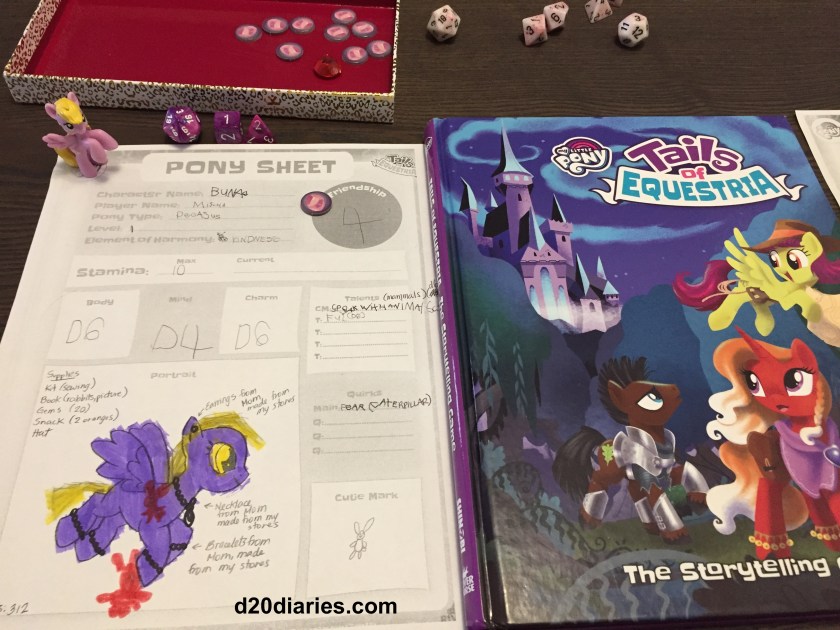
In a practical sense, this adventure is incredibly important. It provides a first adventure for players to use, and teaches them how a game should be run by example. For experienced players it also serves to alter our preconceptions about RPGs, and really shake things up. That’s because Tails of Equestria isn’t the same kind of RPG as Pathfinder or D&D. It downplays battle, and really encourages players to use creative thinking, kindness, teamwork, and roleplaying to overcome obstacles. This game requires a different mindset than other RPGs. Happily it’s a mindset that kids and young players will naturally settle into and flourish. I honestly cannot be happier with how this game played.
So what is the Pet Predicament? I mentioned it was the perfect starter adventure for this game and I meant it. It’s well written, engaging, and fun. There’s plenty of opportunity for Scuffles, but just as many chances for players to completely avoid Scuffles with Tests an Challenges. It features the Mane Six (main characters) from My Little Pony: Friendship is Magic as initial NPCs, and leaves the PCs as their pet-sitters. Any kids who has seen the show will be absolutely thrilled at this turn of events. Getting to meet such famous characters is enough to make many kids squeal in glee, and finding themselves the caretakers of all six of their pets? I’ve never met a kid who doesn’t love animals! Both my son and daughter got super into this adventure. They did their best to take care of the animals, feed them their favourite things, pamper and play with them, and so on. Unfortunately for your pet-sitters, not all of the pets are well behaved. Fluttershy’s rabbit, Angel, is a menace (as fans of the show will know!). My daughter, who adores rabbits, had a ton of fun dealing with the fluffy little terror. But, like all good adventures, something goes wrong. And this time? There’s definitely a rabbit to blame! The pets soon get lost in the dangerous and spooky Everfree Forest, and its up to your PCs to rescue all the pets, brings them back to Fluttershy’s cottage, and clean up. Their adventures will present them with all kinds of obstacles, Tests, and Challenges. Rescuing each pet will take creative thinking and teamwork. How each task is accomplished is incredibly open ended, which really allows your group of PCs to use their own unique approach to get things done. I’ll refrain for spoiling any more of the adventure, but I will say that it’s a delight to read, GM, and play. Everyone in my family had a blast (including my husband). The ending also had my kids hooked, as it leads directly into the Tails of Equestria: The Curse of the Statuettes adventure (although the book also encourages kids to create their own adventure with the cliff hanger ending as an opening plot hook).
In the end, my entire family loved Tails of Equestria: The Storytelling Game. It’s fun, fast-paced, and simple, but offers everyone at the table plenty of opportunities to role-play and work together. I had a blast sharing this game with my kids. And my kids? They couldn’t be happier. In fact, my daughter is sitting in her bed with a little notebook and her rabbit pen creating another character as we speak.
Absolutely a wonderful game.
Jessica


 a try. I looked into the game, and told my daughter and son all about it. They were extremely excited. The problem?
 (which contains an adventure, dice, and all kinds of accessories).
 and stopped in my tracks. I picked it up and flipped through it. I knew in my gut I wanted it, but I had no idea what it was. None. Eventually I put it back and moved on. Every visit afterwards I passed by that book and picked it up. But I never bought it. Not until many years later when someone actually explained to me what the heck D&D was. By then the book store wasn’t even open anymore. I would have liked to buy it from there. But this? This book doesn’t have that problem. Right there on the back cover it explains what this book is, how you use it, and what it’s for. It’s written in simple language that any kid or parent (or grandparent!) can understand. It’s simple, clear, and concise. I love it.
 adventure (although the book also encourages kids to create their own adventure with the cliff hanger ending as an opening plot hook).
 As an added bonus Alien Archive 3 is going to contain some other player options and gear, which is a nice change of pace. Best of all? Rule for pets, mounts, and combatant creature companions! My daughters dreams have just come true. Haha.
 in February, followed by #
 in March,


 by James Jacobs and Greg Vaughan and
  by Thurston Hillman.
  can help players from the surface world survive the Darklands.


 is a huge hit, as is
  (plus a new d20 game we’ll talk about another time!). And my son got two:
  and
and  was quick to learn, which should come as no surprise. I assumed it was another one of those generic board games where you just move around the track that happens to be plastered with pictures of the latest popular kids show. Surprisingly, that wasn’t the exactly case. It was a simple kids game plastered with pictures of Hatchimals, the popular kids toy. But it was also a little more complex than just moving around the board. It involved hatching eggs, which you did by matching cards in your hand to eggs on the board. Cards and eggs were colour coded by which ‘nest’ they could hatch at, and when you landed on the proper nest you revealed one of the appropriate eggs to everyone. If it matched yours you hatched it, and if it didn’t you put it back. First to hatch their eggs wins. It was sort of like a mix between go fish, memory, and a generic kids board game. Not exactly a thrilling gameplay experience, but my daughter adored it and it only cost me a few dollars at the local Giant Tiger (which is a Canadian discount store). It’s simple enough that we can teach it to her cousins and they can play it together. Well worth the money. My son had the worst luck, though! Every single time he had a chance to blindly choose an egg, and had a fifty-fifty chance to get the right one, he got the wrong egg, The entire game. Haha. Poor kid.
 was much more fun for everyone. For those of you who’ve never played this delightful little word game, it’s essentially a bunch of letter tiles that you put in the middle of the table. You get a bunch of them, and it’s your job to make words out of the tiles. You have to connect the words to one another by shared letters, either horizontally or vertically. It’s like each player at the table plays their own personal game of scrabble. You race to see who uses up their tiles first, then shout ‘Banana’ when you’ve done so. Everyone checks it for spelling errors, and then you start over for another round. You can also swap letters you’ve got with ones on the table if you want to, which is pretty much what my son did the whole time. Haha. Anyway, it’s a fun little game that’s great for kids of all ages. Mine are quite young, so they had no hope of beating me, but they had fun trying to make their own words and came up with some pretty good ones in the end. As an added bonus its one of those small, compact games that’s great for bringing out to family gatherings, a friend’s house, a road trip, or (in our case) the laundromat. It’s pricier than I expected it to be, though, but I was lucky enough to pick it up on sale.
 movie, but when he watched the reboot with Dwayne Johnson and Jack Black in it this past year (
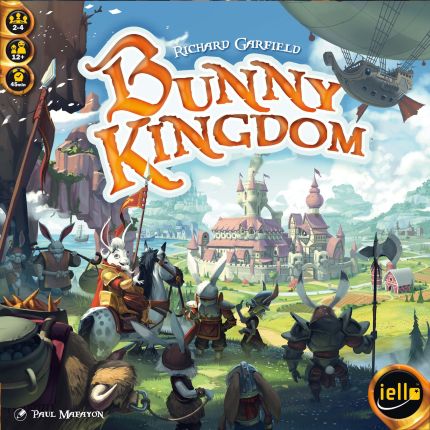 spaces on the map feature settlements and resources that players can claim. Settlements contain castles, while resources allow you to collect wood, carrots, and fish. Unfortunately, our board had suffered damage in two places despite having a seemingly undamaged box. Not what you want to see when you’ve paid a good chunk of change for a new board game!
 Bunny Kingdom is a relatively fast paced game that involves some strategy, but doesn’t take up an entire afternoon or a whole day just to play it. Selecting the proper territory is important. You want to grow the size of your fiefs and ensure they connect, but you also want to establish cities and ensure there’s a variety of resources within it’s borders. Knowing which to go for at which times is both a matter of chance, and practise. After playing a round you’ll figure out what’s most important to you. Claiming any territory that already has a castle on it is sound, as is claiming any cards that let you establish resources — or luxury resources — in territories of your choosing. In the first two rounds you won’t earn many golden carrots from your fiefs, but if you build it properly you’ll make a lot in the last two rounds. Treasures are nice, but they offer a small one time payout. Not always worth it. Missions offer a bigger payout, but are sometimes difficult to achieve. They require you invest time in accomplishing them. For example, a mission that promises you one golden carrot per territory you own that can produce wood is nice. But, if you focus on that too much you won’t have a variety of resources available in your fiefs. And it’s variety that earns you golden carrots.
 is a game we picked up for my son because he LOVES
  and
and  (and
(and 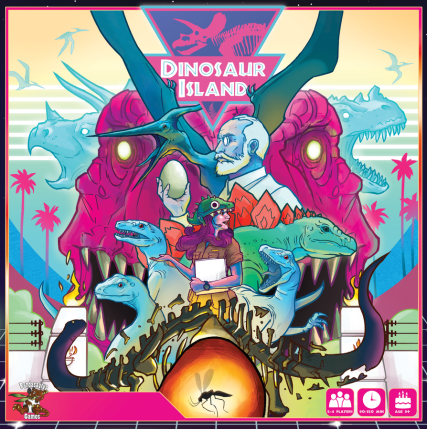 We found it on the shelf at another local game shop,
 Phase One is the Research Phase, which will utilize a shared board that will be in the middle of the table. On it you’ll find dice (which usually show DNA in various types, amounts, and a threat level), dinosaur cards, and some other open spaces. During this phase each player will take turns selecting how you want your three scientists to prioritize their research. They can select one of the dinosaur cards in order to learn the DNA recipe for that dinosaur, they can select a DNA dice in order to collect that kind of DNA, they can work to increase your cold storage (which is the maximum levels of each type of DNA you can hold), or they can refrain from doing research and instead become an extra worker for the third phase. All of these options are really important. Dinosaurs raise excitement levels which in turn draw in guests, but they each cost different kinds of DNA. Collecting DNA to create them is important. Of course, your cold storage starts off small, so you’ll want to increase it as you play.
 Phase Four is the Park Phase, which will utilize a personal board which will be in front of you. On it you’ll find you park, your current dinosaurs and paddock capacities, your attractions, and the number of guests which can visit each location. During the Park Phase you count up your Excitement which determines how many guests visit your park, receive income from entry fees (except for those pesky hooligans who sneak inside!), place guests at attractions, calculate threat against your security, see if any dinosaurs escape, have dinosaurs devour guests, and finally count up how many surviving guests you retain, which will grant you Victory Points.
 or
or 


 d20 Diaries