Happy Halloween!

Happy Halloween, everyone!

We carved pumpkins last week with my sister. My daughter carved a rabbit, and my son a cat.  Or, more accurately, I carved a rabbit, and my sister carved a cat while my children bossed us around. Both of my kids shrieked when they had to put their hands inside and scoop out the pumpkin’s innards. Mostly they poked at it with a spoon. In fact, my kids didn’t do much at all. But, we had fun! We drew on some more pumpkins at home yesterday. Again, my daughter made a rabbit. My son went with a classic jack-o-lantern face.

This morning I packed up my kids costumes, and sent them off to school. They’ll have a party this morning, change into their costumes after lunch, and spend the afternoon at a school dance and haunted house. They’re absolutely over the moon. My son’s going to be a red dragon for Halloween. And my daughter? One guess.

Yup. A rabbit.

She might be obsessed.

My kids can’t wait to head out trick or treating.

And me?

To celebrate I’m taking a look at my five favourite Horror Adventures!

Ooooooh!

*cue the ominous theme music*

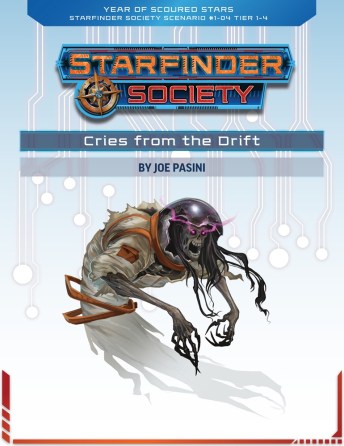
Cries from the Drift, Joe Pasini, Starfinder 1-04,
Starfinder Society Scenario #1-04: Cries from the Drift by Joe Pasini.

We’re starting off small with Starfinder Society Scenario #1-04: Cries from the Drift by Joe Pasini! This delightful little adventure is intended for Tier 1-4, features one starship battle, and tasks the player’s characters with exploring a derelict ship, uncovering what became of it’s crew (Spoiler Alert: NOTHING GOOD), and collecting the valuable intel they were carrying. This scenario does a great job of setting an ominous atmosphere right from the moment you step foot on the ship, and, with a solid GM, can be quite suspenseful. It’s got some surprises, so I won’t go into too much detail, but I will say that this adventures features some body horror, so it’s not for the faint of heart!

Up Next? The Strange Aeons Adventure Path! Strange Aeons is a six part series of adventures that will have your characters questioning their past, their allies, and their sanity! Strongly inspired by the works of H. P. Lovecraft, it’s spooky, macabre, and downright strange. With alien, unknowable entities, crazed cultists, and a whole heck of a lot of weird! I LOVE this adventure path. Seriously. Love it.

Strange Aeons, Part One, In Search fo Sanity, F. Wesley Shneider
Pathfinder Adventure Path 109: In Search of Sanity (Strange Aeons Part 1 of 6) by F. Wesley Schneider.

Strange Aeons begins with your characters waking up in an insane asylum with no idea who they are or how they got there. Oh, also, there’s some strange monster performing invasive surgery on someone else right outside your cell. Not the way you want to wake up! After your daring breakout you’ll have to explore the asylum, battle strange, shape-changing creatures, and find a way to escape — without being devoured by the… things outside. From there? Well, let’s just keep that under wraps for now. This is one of those campaigns where being in the dark is half the fun!

Strange Aeons begins with Pathfinder Adventure Path 109: In Search of Sanity (Strange Aeons Part 1 of 6) by F. Wesley Schneider. Following that is #110: The Thrushmoor Terror (Part 2 of 6) by Tito Leati, #111: Dreams of the Yellow King (Part 3 of 6) by Ron Lundeen, #112: The Whisper Out of Time (Part 4 of 6) by Richard Pett, #113: What Grows Within (Part 5 of 6) by John Compton, and it finishes with #114: Black Stars Beckon (Part 6 of 6) by Jim Groves. I also highly recommend picking up Pathfinder Pawns: Strange Aeons Pawn Collection to go with it if you intend to play this wonderfully creepy campaign. The Player’s Guide is a free download!

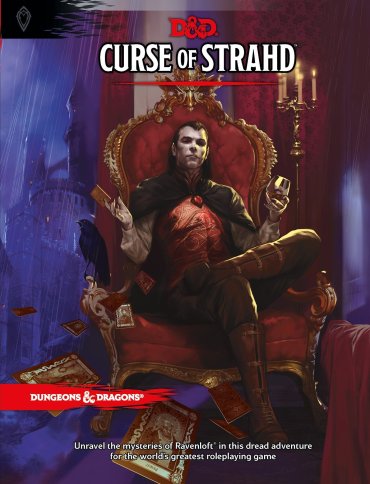
Curse of Strahd, D&D.
Curse of Strahd: A Dungeons & Dragons Sourcebook

Next we leave behind the psychological terror, and head into some classic gothic horror! Curse of Strahd! This hardcover adventure path for Dungeons and Dragons takes place in the Ravenloft campaign setting’s  country of Borovia and will take characters from levels one through ten. It’s a spooky, atmospheric, delightful piece of horror that features the vampire Count Strahd von Zarovich himself! Play it with a good DM and you’re guaranteed to get chills! This campaign has some tough fights, and was the winner of THREE Ennies in 2016: Winner (Gold): Best Adventure, Winner (Gold): Best Art/Cover, and Winner (Silver): Product of the Year. Special player options are available to download here, untagged maps are available here, and some special notes for DMs are available here.

Carrion Crown Haunting of Harrowstone
Pathfinder Adventure Path 43: The Haunting of Harrowstone (Carrion Crown 1 of 6) by Michael Kortes

From Dungeons and Dragons, we skip back over to Pathfinder, with the Carrion Crown Adventure Path! Carrion Crown is a six part gothic horror campaign that is like a tour de force of classic horror beasts! The first volume, Haunting of Harrowstone, tasks the players with investigating a haunted prison, while later volumes feature carrion golems, werewolves, foul cults, strange beings, vampires, undead, liches, and more! The best part? You don’t always have to kill these beasts. Some have the potential to be allies (if you’re brave enough)! The plot? Stop the Whispering Way from freeing the Lich King Tar-Baphon! I ADORE this campaign!

Carrion Crown begins with Pathfinder Adventure Path 43: The Haunting of Harrowstone (Carrion Crown 1 of 6)by Michael Kortes. It continues with volume #44: Trial of the Beast (Carrion Crown 2 of 6) by Richard Pett, #45: Broken Moon (Carrion Crown 3 of 6) by Tim Hitchcock, #46: Wake of the Watcher (Carrion Crown 4 of 6) by Greg A. Vaughan, #47: Ashes at Dawn (Carrion Crown 5 of 6) by F. Wesley Schneider, and concludes with #48: Shadows of Gallowspire (Carrion Crown 6 of 6) by Brandon Hodge. The Player’s Guide is a free download on Paizo’s website.

Carnival of Tears
GameMastery Module E1: Carnival of Tears by Tim Hitchcock and Nicolas Logue.

So what’s my very favourite horror adventure? Carnival of Tears by Tim Hitchcock and Nicolas Logue! First of, let me point out this is a dark, gory, violent, disturbing adventure. Second, I loved it. Carnival of Tears (more properly known as GameMastery Module E1: Carnival of Tears) is a 3.5 adventure from Paizo Publishing intended for fifth level characters that takes place in the desperate little town of Falcon’s Hollow. Man, that place has gone through a lot! So what better way to relax than with a winter carnival? Right? WRONG! When dark fey take over the carnival they twist it into a nightmare, and use powerful illusions to hide the truth from the citizens. The PCs need to stop the fey, save what townsfolk they can, and try their best to survive the night! I find this scenario is particularly effective when played in a town the player’s have grown fond of (even if that means you don’t play in Falcon’s Hollow), and when they’re forced to help deal with the aftermath of the so-called Carnival of Tears. Just awesome. The horror!

And that’s it!

Or is it..?

There’s one last thing I want to talk about: the future! The horror adventure I most want to play (and read), but haven’t.

Signal of Screams, Diaspora Strain
Starfinder Adventure Path 10: The Diaspora Strain (Signal of Screams Part 1 of 3) by Chris S. Sims.

Signal of Screams!

Signal of Screams is a three-part adventure path for the Starfinder Roleplaying Game that starts at level seven. It begins with your PCs on vacation at a luxury resort on an asteroid when suddenly the staff and guests begin to get violent! They’ll need to protect themselves and the uninfected guests. But, what if they’re not immune to the madness? I can’t wait to find out!

Signal of Screams begins with Starfinder Adventure Path 10: The Diaspora Strain (Signal of Screams Part 1 of 3) by Chris S. Sims, which releases in a few more weeks. It continues in December with #11: Penumbra Protocol (Signal of Screams Part 2 of 3)by Jenny Jarzabski, and culminates in January with #12: Heart of Night (Signal of Screams Part 3 of 3) by Saif Ansari.


Got a favourite horror adventure? Let us know in the comments! We’d love to hear about it.

Happy Halloween!

Jessica

SaveSave

SaveSave

SaveSave

SaveSave

SaveSave

Wacky Crew Save Highdelve!

Hear ye! Hear ye! Wacky Crew save Highdelve!

Yup! That’s right. Our weird and kooky crew of eccentric Pathfinders have completed their first mission! We played, we laughed, we triumphed. Oh, yeah, and WE RODE A DRAGON!

Who? What? Why?

Read on and be enlightened!

A while ago my family and I were gifted some boons as part of a delightful contest run by the overly generous Hmm. With them we made a team of goofy eccentrics! (Cause what ELSE should we have done with them?). An exiled aquatic elf magus struggling to adapt to life on the surface, a hyperactive grippli ranger who always looks on the bright side of life, a wise stump-tailed vanara shaman with hair growth issues and a pet pig, and a ratfolk shifter who gnaws on everything he can get his hands on. For more detailed information on our characters and their creation you can check out my previous blog post: Character Focus: Wacky and Weird.

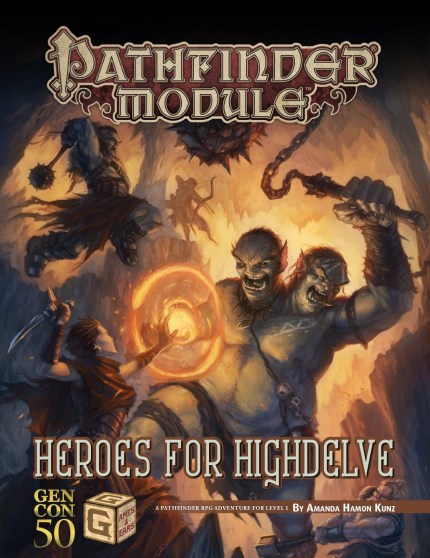
Heroes for HighdelveNot long after creating these delightfully fun characters we were offered the chance to play an adventure all together via play-by-post: the incredibly hard to find Heroes for Highdelve! Our kooky characters took the time to think of a reason they were in Highdelve, and then we got cracking! They arrived just in time for the annual Brightbloom Festival. In addition to exploring the festival, stuffing our faces (and our pigs) with carnival food, riding barrels, competing in sack races, and assisting a puppet show, we each had specific goals we were trying to achieve.

My daughter’s grippli Croak was on the hunt for some stuffed rabbits she had recently purchased and misplaced on a wagon. My son’s vanara Pinesong Rippleroot was looking for some pet pigs he had accidentally sold to a merchant instead of a loving home. My husband’s ratfolk Lomo was in the market for a crafter to repair his father’s magical necklace that Lomo had chewed on. And my aquatic elf Sereia who was trying to track down a coral idol sold by an antiquities smuggler. Their efforts were hampered by the festival, but they had fun and found some promising leads.

Suddenly, the festival was interrupted by screams! The teenaged flower collectors for the festival (known as the Bloomgivers) came back to town wounded! They had been attacked by a pair of young troublemakers. In addition to being beaten up, they were robbed of their protective amulet, and their wagon of Brightbloom flowers was broken. The people gasped. Some called for the village’s legendary draconic protector Aurelliax to bring justice to the wayward youths, but she strode out of the crowd in human form and declined. She had promised the founders of the village long ago that she would protect them, but not interfere in village politics and citizenry. If someone was going to retrieve the protective amulets, gather the brightblooms, capture the teens, and save the festival, it was going to have to be someone else.

Obviously my kids hopped at the chance to volunteer! Their characters announced rather boldly that we would handle it, and once again my aquatic elf was roped into some spontaneous adventure. My daughter’s character Croak assured everyone that this would be the perfect grand adventure! Sereia was unsure.

Still, they were nothing if not true to their word, so the band of outcasts set out from Highdelve, through the hills and wilds until they reached the brightbloom meadow. There they found a field of flowers as far as the eye could see (along with the Bloomgivers’ broken flower wagon). They also found an old cabin, a recently used campsite, and a cave. The group split up, with Lomo and Pinsong checking out the cabin, Croak hopping right into the flower field to pick some brightblooms, and Sereia examining the campsite. But after only a moment the two teenaged hooligans hopped out from behind a rock and started attacking Croak!

What kind of dastardly villains would attack an innocent grippli who was plucking flowers?

Angsty ones!

Ahhh! The horror!

Croak leapt into action, tossing a net at the girl. Much to my daughter’s glee the enemy was stuck in the net the entire fight. (She laughed about this endlessly!). Everyone else rushed over to the meadow while Croak battled the remaining teenager with her blowgun. Pinesong arrived on the scene next, alongside his pig Cutie Pie. While Cutie Pie hid behind a rock, Pinesong clambered up on top of it and formed magical stormclouds  around the enemy, making it difficult for them to see. Lomo arrived next and tore into the guy with his claws — dealing less damage than you might imagine since he’s a Dexterity based combatant. But before Sereia could arrive another enemy showed up on the scene! A tiefling who had hired the teenagers to steal the protective amulet from the Bloomgivers. Why? It was a mystery!

The trident wielding Sereia was the last to arrive, but as the character with the highest damage potential she turned the tide of battle pretty quickly. With the tiefling dead, and the two teenagers prisoner (but conscious) the quartet set about questioning the kids.

They learned that it was the tiefling who had something horrible planned for the town. Apparently he was keeping a monster in the cave, which he was going to unleash upon Highdelve! And the amulet? It would keep the monster protected from Highdelve’s gold dragon defender!

Knowing that they had a monster to defeat but unwilling to risk their prisoners escaping, the group transported the two teens and the tiefling back to Highdelve. After turning them in to the guard’s custody they headed back out to the cave and went right in. It was time to go monster hunting!

The caves were dark, but they could hear strange bellows echoing down the tunnels. In time they found the source — a massive ettin with strange markings carved into its flesh! Tangled in its fingers was the amulet!

When my kids looked at the battle map and the picture of the creature my kids both stopped and said: “Uh oh… That looks strong!”

Despite their fears we waded into battle with enthusiasm.

Now… When you’ve got four players who make characters always intended to play alongside one another, chances are good they’ll make a balanced team. And we did. But… we also aren’t exactly based around damage. We’re more like… a swarm of gnats that flits around the enemy poking it and causing it minor hinderances. Lomo is a melee guy, but his claws do 1d3 damage. No strength bonus. Pinesong is our healer but for damage? Well, he usually uses his storm burst ability to make the enemy treat Pinesong and his pals as if they had concealment. He’s got a crossbow but he’s not a very good shot. My daughter’s little grippli Croak? She fights with nets and poisoned blowgun darts. Considering the ettin beat every single saving throw against her poisons she dealt a whopping 1 damage per shot! Oh, yeah! And Sereia? She’s a magus, so she can deal some solid damage, but she also has to wear a lot of hats in the party. She’s the spellcaster, she’s the second melee character, she’s the academic, and she’s the trap finder. That’s a lot! As a result her attack rolls are good, but not amazing. They’re fair at best if she’s using her spell combat ability. So when she hits she hits hard. But she wasn’t hitting all the time. Meanwhile, Lomo and Croak hit practically every round! (My daughter was very proud of her consistent one damage darts. Haha.

Anyway, the battle was great fun! It lasted quite a few rounds without dragging on too long, we hindered him enough that we rarely got hit, and we bottlenecked him in a tunnel so he couldn’t reach our squishier team members (Pinesong and Croak) with his massive, skull-crushing flail.

We spent a little time gloating when we finally defeated the ettin — okay, mostly it was Croak mocking the dead ettin for looking like a giant plucked chicken with all those darts sticking out of him. Then we looked around, collected the amulet, and left.

Outside we found a dragon.

Not just any dragon.

A freaking HUGE dragon. Thankfully it was gold.

Pinesong and Cutie Pie hid, Croak gave it a chipper hello, and Lomo froze like a character in a Jurassic Park movie who’s squaring off against  T-Rex. Cause a dragon can’t see you if you stay still, right? RIGHT?

….Yeah, not how it works Lomo. But hilarious!

Sereia made the connection between the gold dragon and Aurelliax, guardian of Highdelve, and soon they spoke. The dragon thanked them for their aid and offered them a ride back to town.

My kids were flabbergasted. Literally amazed. My daughter squealed in delight (“UH, YEAH! OF COURSE!”). My son started singing a song from Teen Titans Go! all about riding a dragon (literally).

“We’re gonna ride that dragon! THAT DRAGON! We’re gonna ride that dragon! THAT DRAGON!”

He was so excited he insisted on sending our wonderful GM a link to the exact song and episode. You’re welcome! Haha.

Anyway, we rode that dragon all the way back to Highdelve and learned that the townsfolk had banded together to help us wrap up our tasks! Lomo’s necklace was being repaired, Pinesong’s piglets were being given new homes, Croak’s missing rabbit stuffed animals had been found, and the name of the client that the antiquities smuggler had sold the coral idol to had been found. Soon Sereia could track it down and return it to her people.

My kids were amazed! Big smiles all around. And then they settled in for a feast and dance as the guests of honour. Aurelliax gifted them a magical statuette which turned out to be a super cool boon! Both of my kids transformed the statuette into a magical creature: Pinesong used it to make Cutie Pie covered in golden scales, and my daughter used it to create a pet flying squirrel with giant golden bulging eyes called Roadkill. My husband and I are going to hang onto it to use one of it’s other cool benefits.

We got our chronicles just the other day and the adventure came to an end. And what a good one! Particularly for kids! It had such a nice feel-good ending. Both of my kids said it was among their very favourite adventures they’ve ever played! (My son said he had two favourites: this run of Heroes for Highdelve, and his play through of Signs in Senghor, which was written by my brother and I wrote about in a previous blog post: Signs in Senghor: Part One, and Signs in Senghor: Part Two).

In short, we had a blast!

And if our wonderful GM happens to be reading this: a thousand thanks!

I’m not sure what’s next for our weird and wacky crew. Finding a game all four of us can get into can be tricky, but I do know that whatever we play, we’re going to have fun.

Thanks for sharing this experience with us!

Until next time,

Jessica

Pathfinder Playtest: Resonance Test

Resonance.

If you’re playing the Pathfinder Playtest you’ll know that its one of the of the most controversial additions to the game. It was meant to represented your characters innate ability to activate magic items, and intended to help limit how much magical gear your characters could utilize each day. If you wanted to use a magical cloak you invest some resonance. Fire a magic wand? It costs resonance. Want to drink a potion? Resonance.

Pathfinder Playtest Rulebook

Personally? Disliked it. It felt… arbitrary. Like your GM just suddenly saying: ‘No, you can’t use that,’ when you know you should be able to. Especially with potions! And alchemical objects! Why?

Paizo has already confirmed that when Pathfinder 2.0 comes out there will be a change to the resonance rules. But, just this week they decided to test out a new system. They’ve taken our feedback and shook it up a bit.

Enter the Resonance Test!

The Resonance Test is a PDF rules update that is free to download and focuses on Resonance, new rules for it, and updated items and abilities that reflect this change. Afterwards there are some pregenerated characters. After reading the new rules, you select a character and use them to play through Pathfinder Playtest Society Scenario #2: Raiders of Shrieking Peak. Give the rules a shot and then provide Paizo your feedback in a special survey. It’s important to note that these rules are not for using with the rest of the Pathfinder Playtest, and that you shouldn’t create your own characters to utilize these rules.

So, what are these rules, anyway?

For starters, resonance means something different. It’s no longer the number of magical items you can use every day. Instead, resonance represents how many magical items you can wear each day. Essentially it takes the place of item slots. But, instead of keeping track of each slot on the body, you just get 10 of your choice. This is meant to be a large enough number that you don’t feel constrained, but at the same prevents excessive over-use. Magical items (wearable, consumable, and so on) no longer take resonance to function. In fact, they no longer take any kind of points to function. They just work. Most of them have a limited number of uses (either per day, or total).

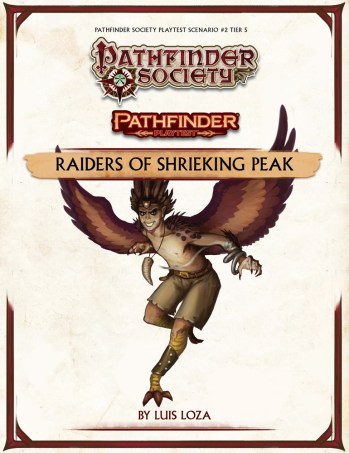
Pathfinder Playtest Society Scenario 2 Raiders of Shrieking Peak
Pathfinder Playtest Society Scenario #2: Raider of Shrieking Peak, by Luis Loza.

But, that’s not all. They’ve also shaken up Spell Points. In this test they no longer exist. Instead you have Focus Points. These points are based off of your charisma and your ancestry. They represent your natural affinity for magic and magical objects. You can use focus points to either activate your spell powers (which you once used spell points for) or to get more out of a magical item. Now, taking a spell power from your class no longer grants you extra focus points and, since you have less focus points to work with that you used to have spell points, all of your spell powers abilities have been amplified. Simply put, spell powers are better than they used to be, and cost Focus Point instead of Spell Points. But you have less spell points.

But what if you don’t have spell powers? No worries! As mentioned, you can also use focus points to get a little something extra out of your magical gear. What that effect is will vary between item. Some potions might have double the duration or potency, a limited use ability could gain an extra use, and so on.

Interesting.

Overall, I vastly prefer the new resonance test rules to those found in the Pathfinder Playtest Rulebook. I like that resonance is going to replace item slots, and I like that you no longer need to spend points to activate magical items. I love the concept of focus points, and using your innate charisma to push magical items beyond their capabilities. It’s very occultist (and I love Pathfinder’s occultists!). I even like that spell powers and these new item focus powers share the same point pool. My only quibble? I’m going to wish I had more points! Haha.

I’m excited to see how these new rules work in play!

Jessica

SaveSave

First snow and giving thanks!

Whoo, it’s been a busy week!

My family spent the better part of last weekend preparing for winter. We dug out and washed all of our winter gear, tried on coats and boots, matched mitts (or shoved lonely mitts into mismatched pairs), donated what was too small to the homeless, and went out to buy new winter boots. Everyone in my house needed a new pair this year and with the amount of walking we do winter boots are a necessity for everyone, not just my kids. Which is unfortunate, I suppose, because they’re really expensive. It’s important they’re warm enough and waterproof to keep everyone nice and toasty throughout our chilly winters, so cheap fashion boots won’t cut it. They’ve got to be cold rated for -30°C at least. -40°C is better. Not easy to find for my daughter. For some reason boys boots are built for the cold, while a lot of girl boots look like they’re warm, but aren’t. Anyway it took us the weekend, but we all managed to find a pair. And just in time! We had our first real snow on Wednesday. I say real snow because we’ve had flurries before this. But this snow stayed. There was enough of it to get the kids all excited, and to make snowballs and tiny snowmen (or in my daughter’s case, tiny snow rabbits). I’m not sure how long the snow will stay. It might not go away until next spring, but there’s only a few centimetres, so if we get a warm day it might still melt away. We’ll see. My kids were thrilled for it, but after only a day of the damp and the (very, very mild) cold they’re already complaining.

Suck it up kids! We’re just getting started! It will get so much worse. Haha.

My toddler-aged niece that I watch on the weekdays hates getting in her winter clothes, so every trip outside and to and from school is a tear-filled struggle. Not to mention the time! It takes twenty minutes to get everyone properly dressed and out the door. (Once they get used to it I hope to cut it down to fifteen. Ten would be a welcome miracle). My niece keeps expecting me to give up on her and let her do whatever she wants, which is not going to happen. Clearly she has forgotten we had this same problem last winter. She did not win. She’ll grow accustomed to it in a few weeks. Hopefully sooner. Thankfully her older brother (he’s four) does remember last year’s winter. He knows he needs to bundle.

Pathfinder Playtest Doomsday Dawn
Pathfinder Playtest Adventure: Doomsday Dawn

In other news, my family and I tried playing some more of Pathfinder Playtest Adventure: Doomsday Dawn. We prepared our characters for ‘In Pale Mountains Shadow’ and got started. Unfortunately, by the end of the session they decided they were bored with it. They’ve officially given up playing through Doomsday Dawn and are ready to go back to their regular games. My son desperately wants to continue with the Carrion Crown Adventure Path (we’re about to start Carrion Crown: Book Two: Trial of the Beast), my husband wants to continue with The Shackled City Adventure Path (we’re nearly done book one), and my daughter wants to play some more of our Starfinder Society characters. Most of the other campaigns we’re playing together I moved online so we can play via play-by-post. Getting in a post a day lets us keep playing, so we can dedicate our one chance to play on the weekends to one of our three main campaigns.

Although it may sound like we’re done with the Pathfinder Playtest that’s not quite accurate. I’m playing through two different play-by-post runs of Doomsday Dawn, and we’re all playing in a play-by-post run of the Pathfinder Playtest Society Scenarios. We’re halfway through Rose Street Revenge right now and enjoying it. My son’s character is particularly hilarious. We’ll share more about that at a later date.

Captain Underpants
My son’s current favourite book: The Adventures of Captain Underpants: The First Epic Novel by Day Pilkey, by Day Pilkey.

My son has been reading like crazy lately! Obviously, I’m very proud of this. I believe that reading is one of those incredibly important skills you really need to instil a love of young. I always encourage my kids to find something they love to read, and indulge in it. Even though both of my kids are good at reading I always push them to try reading something that’s a challenge everyday. Not absurdly hard for them, or anything, but something they do need to work at a bit. Anyway, both of my children are reading well above their grade level so their classrooms don’t have anything that’s a challenge for them. They both bring home books that are far too easy for them for home reading everyday. In fact my daughter can read her older brother’s home reading books without trouble, never mind her own. We have a ton of books at home for my kids to read, but only two books that are a challenge for my son to read that interest him (and he’s read both chapter books repeatedly already). We have plenty of chapter books that my son reads for fun — Geronimo StiltonThe Hardy Boys (Secret Files)Scooby-Doo! mystery novels, Minecraft books, the Jurassic World: Fallen Kingdom junior novelization, and so on — but he can read one of those in under a half hour. They’re a challenge for my daughter (and some are too hard), but not exactly a challenge for my son. Something must be done! Once a week after I pick my kids up from school we go for a walk to the local library and I let them each pick out one book that’s a challenge for them to read, and one book that they just want. I say one, but inevitably they come back with one challenging book and a ton of other books they want to read. This is expected and totally fine. A while ago my son brought home a massive book on ecology clearly intended for pre-teens or teenagers. This thing was huge! Anyway, he loved it, but this time he wanted a chapter book. He contemplated starting the Guardians of Gahoole books, so he picked up one of those. But for his fun book? Captain Underpants. My son LOVES Captain Underpants. So he pulled down not one book, but every single Captain Underpants chapter book the library had. There are twelve of them.

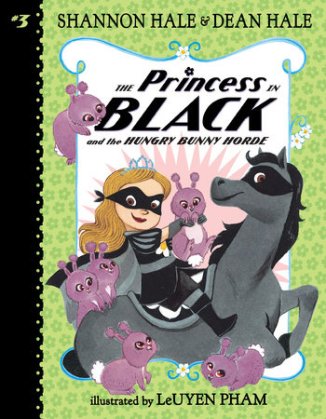
Princess in Black
My daughter’s favourite chapter book: The Princess in Black and the Hungry Bunny Horde, by Shannon Hale and Dean Hale.

“Are you sure you’ll read all of them this week?” I asked my son. “They’re going to be heavy.”

“Uh, yeah, Mom. Of course! But, it might take me two weeks to read them.”

It took him three days. Which is great! But, also… not great. I now have to break it to him that there are only twelve Captain Underpants books. He just read them all.  Meanwhile my daughter picked out three Princess in Black chapter books. She owns one of them: The Princess in Black and the Hungry Bunny Horde, already, but the others are new to her. Although she’s disappointed they are not going to have any rabbits in them, she is enjoying them. So much so that she was inspired to write her own book. It’s called ‘Bunny’s Adventure.’ In it a rabbit named Pim journeys up the rainbow and finds another world. She makes some friends and is back home in time for bed. She worked on it for a few days and in the end gave it to her teacher as a gift. (Her teacher had just returned from surgery that week). It was adorable. She’s so proud of it.

Traveller Core Rulebook
Traveller Core Rulebook by Mongoose Publishing.

I was recently invited to join a play-by-post game of Traveller, and gifted a digital copy of the rulebook by the overly generous Tarondor. (Thank you!) Traveller is a game I’ve never played before, so I’m super excited to give it a shot. I’ve given the book a skim, and have just embarked on a thorough read-through. The character creation rules look particularly interesting. Like a mini-game of its own. Very cool! I can’t wait to try it out. I’ve got plenty left to read though, so I’m not sure how soon that will be. Haha. This time of the year is quite busy around my house. But, I’m happily working on it.

This coming weekend is going to be just as busy as the last one. Busier, in fact. Yesterday was a day off from school, this morning is swimming lessons for my children (which is about a thirty minute walk away), then dentist appointments later today. I’ve got to squish in a trip to the grocery store and the laundromat. And tomorrow? Thanksgiving at my Mom’s! Monday’s another day off from school and more Thanksgiving celebrations, this time at my mother-in-laws. That’s actually pretty quiet for us for Thanksgiving, in all honesty. We usually also try to squish in visits to my grandparents and my Dad’s, but it’s not going to happen this year. We don’t own a vehicle, and frankly I’m too tired. Haha. We’ll be making time for less frantic visits with them soon.

Well, I’ve got to get cracking! Plenty to do and no time to do it in.

Happy Thanksgiving everyone!

Or, for those of you who are not Canadian, have a great weekend! I wish you all the best.

Jessica

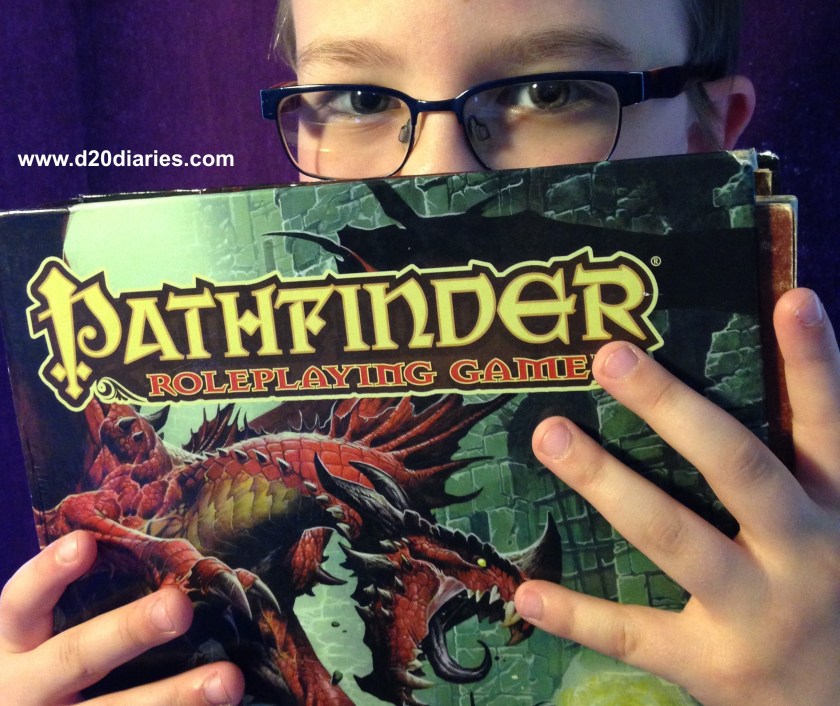
Take a Look d20diaries cropped
My son desperately wanted his picture featured on d20diaries. This was our compromise. Haha.


Return of the Runelords – Player’s Guide!

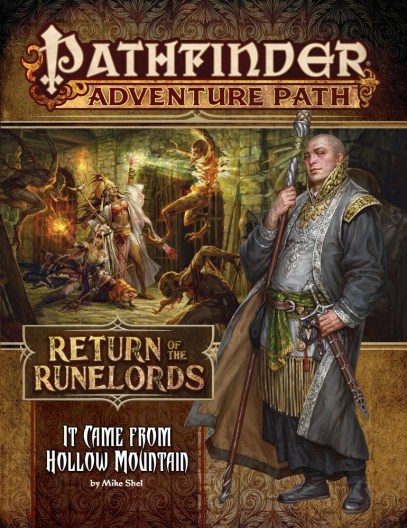
The Return of the Runelord’s Player’s Guide has recently been released by Paizo. Meant to go with the Return of the Runelord’s Adventure Path, which takes place in the nation of Varisia, this player’s guide is a free download on their website. The Return of the Runelords Adventure Path is already underway, with volume one, Secrets of Roderic’s Cove, released at the start of this month, and volume two, It Came from Hollow Mountain, released at the end of this month. The other four volumes have yet to be released (but are available for pre-order).

Return of the Runelords Players Guide
Return of the Runelords: Player’s Guide is a FREE download!

Now, I’m not sure about all of you, but I’ve been supremely excited for the Return of the Runelords Adventure Path. I have loved every adventure path set in Varisia, and played through or GMed quite a few of them. It’s a place of adventure, history, mystery, and — for me — fond memories. It’s right up there with my favourite nations of Golarion.

Like the Adventure Path Player’s Guides before it, this one is filled with all the information you need to create a character well-suited to the (Return of the Runelords) Adventure Path, and invested in its major plots and purpose. It contains advice and short compiled lists of which classes and archetypes are best suited to the campaign.  It briefly describes the region that the Adventure Path will be taking place in (Varisia, in this instance), as well as the races found there. It gives advice on which religions are common — including information on some obscure faiths.  It also contains suggestions for animal companions and familiars that are appropriate to the region. However, these lists (excluding the animals) are very brief. This is because the Return of the Runelords is very broad in scope. There is no one class that is better suited to it than others, and no classes that are unheard of. Characters of any race are more than welcome to play. This is a great time to pull out the wacky, weird, obscure, and eccentric character options you’ve been mulling over and give them a try.

There was plenty of interesting information in this little guide, including six new traits specific to the Adventure Path (called Campaign Traits), of which each character is expected to have one. I particularly enjoy ‘accidental clone,’ and ‘scion of legend.’ The player’s guide left me happily inspired. Although there’s lots of neat tidbits we could discuss here, I’m not going to go into details. It’s free! You might as well download it yourselves. What I will say is that all of your PCs must play people who have been in Roderic’s Cove for at least a month, and that you all are acquainted with one another. Not friends, or anything. That’s not required. But you know of each other and would be willing to work alongside one another for this adventure. Furthermore, your characters should be ambitious, and curious. They need to be willing to seek out answers and adventure for themselves. This adventure path does not rely on NPCs hiring you to complete a task or ordering you around. The drive to continue needs to come from your player’s characters. Finally, your characters need to be willing to protect not just the city of Roderic’s Cove, but the nation of Varisia as a whole. This is not a campaign that stays idle. It travels the width and breadth of the country.

Secrets of Roderics Cove Adam Daigle Return of the Runelords 1
Pathfinder Adventure Path 133: Secrets of Roderic’s Cove (Return of the Runelords 1 of 6)

In addition to your typical Player’s Guide information, this one also had a few extra goodies. For starters, Return of the Runelords is the direct sequel to the Rise of the Runelords Adventure Path and the Shattered Star Adventure Path (which begins with Pathfinder Adventure Path 61: Shards of Sin (Shattered Star 1 of 6)). It assumes that heroes   — probably your PCs from those campaigns — defeated the Runelord of Greed, Karzoug, and reforged an ancient Thassilonian artifact known as the Sihedron. Of the many heroes who accomplished these feats, a few have decided to stay in Varisia and act as the nation’s defenders. Each player gets to select one of their heroes from either Rise of the Runelords or Shattered Star and make them one of these so called ‘Sihedron Heroes.’ These heroes will be in the background of the campaign, doing… stuff! Haha. (I have no idea what they’ll be doing, but you can bet its important!). As for the other PCs from those campaigns? That’s up to you. They will not play a major role in the adventure path. If you’ve never played either previous adventure path, that’s alright! Your fellow players can select their past PCs and you can make a concept (or stats) of your own hero. It’s a nice touch that ensures none of your players will be left out of the fun. Finally, if you’re from a group where none of your players completed Rise of the Runelords or Shattered Star, the GM will make the entire team of Sihedron Heroes themselves. Full details on the Sihedron Heroes role in Return of the Runelords (for GMs) will appear in other issues of the adventure path, beginning in Pathfinder Adventure Path 134: It Came from Hollow Mountain (Return of the Runelords 2 of 6). It should be noted that at the start of Return of the Runelords, the current location of the Sihedron Heroes is unknown.

It Came From Hollow Mountain Mike Shel Return of the Runelords 2
Pathfinder Adventure Path 134: It Came from Hollow Mountain (Return of the Runelords 2 of 6)

And the second? The maps! SO MANY MAPS! Return of the Runelords begins in the town of Roderic’s Cove, but moves on to other settlements and parts of the country. Other cities that play a major role in this campaign are Kaer Maga, Korvosa, Magnimar, and Riddleport. This player’s guide has a map of every one of those locations, plus a map of Varisia! Now, there’s obviously not enough room in the player’s guide to put full information on those cities, but the fact that maps are provided is a really nice touch. For more information on those other places you’ll have to check out a variety of sourcebooks. Roderic’s Cove is detailed in Pathfinder Adventure Path 133: Secrets of Roderic’s Cove (Return of the Runelords 1 of 6). Kaer Maga (which is my favourite city in Golarion) is detailed fully in Pathfinder Chronicles: City of Strangers. Korvosa is the location of the Curse of the Crimson Throne Adventure Path (my personal favourite adventure path) and is detailed fully in Pathfinder Chronicles: Guide to Korvosa (also available as a much more affordable PDF download). Magnimar is the home base of the Shattered Star Adventure Path and is fully detailed in Pathfinder Campaign Setting: Magnimar, City of Monuments. Finally, Riddleport is the starting location of the Second Darkness Adventure Path, and is detailed in Pathfinder Adventure Path 13: Shadow in the Sky (Second Darkness Book 1 of 6). Looking for more books about Varisia and Thassilon? Check out Pathfinder Campaign Setting: Lost Kingdoms, Pathfinder Player Companion: Varisia, Birthplace of Legends, Pathfinder Comics: Hollow Mountain, and Pathfinder Tales: Lord of Runes.

The last little bit of extra fun involves the campaign’s starting event: you’re attending the weekly Circle Market in Roderic’s Cove. During the first session you have a chance to find a great deal in the market. You’ll get 10% off of a single item chosen from either basic gear, alchemical items, weapons, potions, scrolls, or even a magical object. Although you’re free to choose the object itself, what category of item it is is determined by a d20 roll. It’s think its a nice bit of fun. Particularly if its repeated each time you attend the Circle Market. It is a weekly event, after all!

Runeplague Return of the Runelords 3 Richard Pett
Pathfinder Adventure Path 135: Runeplague (Return of the Runelords 3 of 6)

But, this is a Player’s Guide! It’s not about treasure, or cities, or Varisia. Not at its core. At its beating heart the Player’s Guide is a free tool to help players like us make characters who will work well within the Adventure Path they’re going to commit to. It should inspire us to make characters, entice us with ideas, provide us with some cool traits, and let us go crazy. And this one did.

So after reading the guide, what would I make?

A good question!

There’s a huge number of character concepts you could run with for this campaign, and a ton of classes that would work. In fact it’s one of those nice campaign where pretty much anything goes. I wouldn’t suggest using an aquatic mount or animal companion, but other than that it’s pretty open. I gave all the classes a lot of thought and came up with way too many ideas. I would adore playing the children of some of the other PCs from my family’s Varisian campaigns. Children of the heroes of Curse of the Crimson Throne, Second Darkness, and Rise of the Runelords adventure paths would be a ton of fun. Or, perhaps a spiritualist whose spirit companion is an NPC or a PC who died during one of those campaigns! I’ve always wanted to utilize the harrower prestige class, especially coupled with the deadly dealer feat, but have never had the chance. Someone descended from ancient Thassilonians would be a blast. There’s some fun character options from Pathfinder Player Companion: Blood of the Ancients which would make that enjoyable. I have a soft spot for the Shoanti peoples, and playing a member of the Spire Clan would be particularly fun (they practically worship the ancient monuments dotting Varisia). I would have a blast playing a ex-gray maiden whose trying to start fresh and has the masked maiden vigilante archetype. And that’s not even counting all the other things I’d like to do! Chronomancer wizard, twinned summoner, relic raider rogue, and an arcanist are all on my list of things I’d love to play.

How about you? What character concepts and builds would YOU like to play for Return of the Runelords? I’d love to hear them!

Until then,

Get reading! You’ve got a free Player’s Guide to download!

Jessica


All six issues of the Return of the Runelords Adventure Path are listed below.

Pathfinder Adventure Path 133: Secrets of Roderic’s Cove (Return of the Runelords 1 of 6)

Pathfinder Adventure Path 134: It Came from Hollow Mountain (Return of the Runelords 2 of 6)

Pathfinder Adventure Path 135: Runeplague (Return of the Runelords 3 of 6)

Pathfinder Adventure Path 136: Temple of the Peacock Spirit (Return of the Runelords 4 of 6)

Pathfinder Adventure Path 137: The City Outside of Time (Return of the Runelords 5 of 6)

Pathfinder Adventure Path 138: Rise of New Thassilon (Return of the Runelords 6 of 6)


LEGO my Starship!

Well, it took about a week, but Paizo’s website is finally up and running properly. Oh. Actually, it’s down again. Haha. Well, it was up for a day, at least. (You can do it, Paizo!).

Dungeons and Dragons Coloring Book
Dungeons & Dragons Adventures Coloring Book, with art by Todd James.

It was strange, having my play-by-posts out of reach for so long. But, I got plenty of others things done. I got by house in order, helped my Mom move, and got my kids prepared for the new school year (which starts in another week and a half). I saw my youngest brother for his birthday. He asked for books and some socks, so I picked him up Naruto socks, Akasuki socks, and two books I thought he’d like: Ready Player One by Ernest Cline (which is also an awesome movie, by the way), and the first three books in The Legend of Drizzt series (Homeland, Exile, and Sojourn) by R. A. Salvatore. Drizzt’s origins are actually my favourite books he’s in, and my brother’s never read them. (Blasphemy! Haha). I think he’ll really like them. While we were shopping I found an awesome Dungeons & Dragons Adventures Coloring Book which I was super tempted to pick up for my kids (but didn’t). Maybe I’ll buy it for one of them for Christmas in a few months. Haha.

My daughter and I finished creating our newest Pathfinder Society characters, Croak and Sereia, whom we won race boons for, and my husband and son are about halfway done theirs. My daughter completed creating her second character for the Pathfinder Playtest adventure Doomsday Dawn, and I’ve just started mine. I got a lot of reading done, and have a few extra blog posts underway already. Be on the lookout for posts about Starfinder: Pact Worlds (I know, I’m slow, haha) and Pathfinder Player Companion: Blood of the Sea in the coming days.

I never have time for video games anymore, but with my play-by-posts down my kids and I started playing one of my very favourite video games of all time: Chrono Cross for the PlayStation. I was a kid when I played it the first time, and it literally blew my mind. Twist after twist I was just… Stunned. It’s got time travel, alternate dimensions, death, life, fate, a ton of NPCs you can get to join your party (many of which you meet well before you can convince them to join you), and (perhaps the coolest part) halfway through the game, after rallying friends and allies to help you defeat the villain, you have an epic confrontation which culminates with the villain using a magical ritual to swap your minds around. Your mind goes into his body and his goes into yours. All of a sudden those friends and allies are hanging around with the villain, trying to fight you. And you? Well, at least you don’t have to worry about fighting all those minions of the villain anymore. Cause they’re yours now. Sort of. Haha. So, if all your good friends are doing the work of the bad guy now, and they think they’re still doing good, but you and the other villains are working to stop them, are they still good guys? As a kid, I was amazed. Haha. Anyway, I started the game, which made my kids want to try, so we each started our own file. They’ve already reached the first big twist in the game, and were so shocked. They concocted a whole lot of crazy theories in an effort to figure out what’s going on. It’s adorable to watch. It’s been fun. I definitely owe fellow play-by-poster PaleDim a shout out for getting the music from Chrono Cross stuck in my head the other day. (Thanks!)

My husband and kids have been watching Voltron since it launched on Netflix quite a while ago, so they took the opportunity to delve into the newest season. One of the episodes was absolutely hilarious. The characters play a mock version of Dungeons and Dragons called ‘Monsters and Mana’ which is just a blast. I particularly like the GMs in campaign twists, and that one of the characters just kept playing a paladin no matter how many times he died. The other characters kept pointing out that he was a paladin in real life, so maybe he should try something else, but he thought that was absurd. There’s nothing better than a paladin, after all! My kids, my husband and I were laughing so hard. If you ever get a chance to watch Voltron Season 6: Episode 3: Monsters and Mana you should definitely take it! (It’s from the remake on Netflix, in case that needed clarifying, not the original show from when my husband was a kid, haha.)

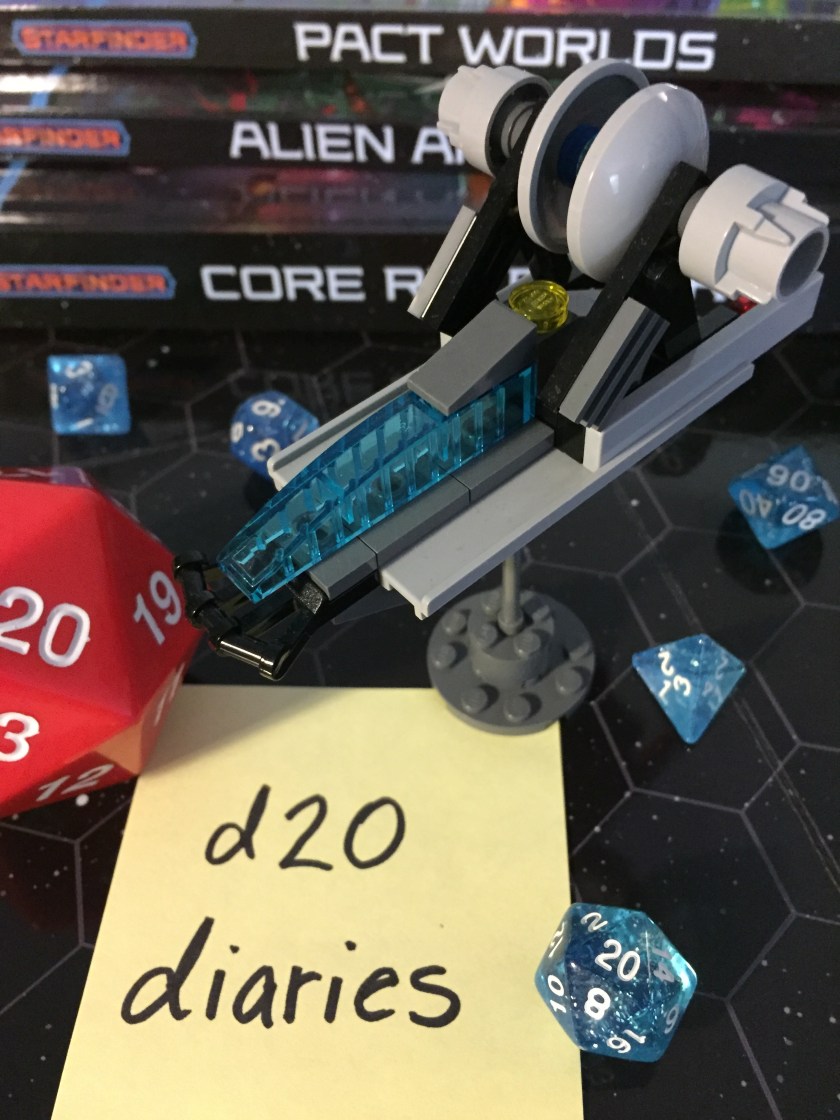
Recently my husband suggested we build our own starships out of LEGO for use in Starfinder starship battles , which we all thought was an awesome idea. I’ve always loved playing with LEGO, but I wouldn’t say I’m great at it. I’m more of a ‘follow the directions’ or ‘build a square house’ kind of girl. But, I took to the challenge with aplomb! Turns out I did a pretty good job! My kids made some really nice ones. But, my husband turned out to be the LEGO Master of the house. Most of our ships came out way too big, but we had a lot of fun.

Well, it’s time for me to sign off now. I’m at the local laundromat and my laundry’s almost done. I’ll leave you with some pictures of our wonderful LEGO starships!

Until next time!

Jessica

d20 diaries starship starfinder 1

d20 diaries starship starfinder 2

d20 diaries starship starfinder 3

d20 diaries starship starfinder 5

d20 diaries starship starfinder 6

d20 diaries starship starfinder 8

d20 diaries starship starfinder 7

d20 diaries starship starfinder 9

d20 diaries starship starfinder 4


Ch-ch-ch-CHANGES! (August News)

Well, it’s official! Season Nine: Year of Factions’ Favour has come to an end, and the Pathfinder Society has launched Season 10: Year of the Ten. Faction Cards have been updated, and the newest edition of the Pathfinder Society Roleplaying Guild Guide has been released. If you don’t have the newly updated versions of these documents then I highly recommend you head on over to Paizo’s website and give them a download. They’re free.

In other news, Gameday VII is underway. This means that my family is enjoying the chance to play in a bunch of new Pathfinder Society Scenarios online via play-by-post. There is a HUGE number of games scheduled to start now. That includes playing in the Pathfinder Society, Pathfinder Society Core, Pathfinder Society Adventure Card Game, Pathfinder Society Playtest and the Starfinder Society! In addition, they’re running the Pathfinder Society Scenario #8-99: Solstice Scar Special and Starfinder Society: #1-99: Scoured Stars Invasion Special as we speak. More games are slated to start in October. That’s also when Pathfinder Society Scenario #9-00: Assault on Absalom Special will run. Although it’s likely too late to join any of August’s games, there’s still plenty of time to sign up for October’s. That said, many games are full already, so I wouldn’t dawdle much longer if you want to get into a game! Haha.

First seeker Jadnura
First Seeker Jadnura. Art by Graey Erb for Starfinder.

For those of you who don’t know, the Scoured Stars Invasion special also brought with it the introduction of a new faction: Second Seekers (Jadnura). Who the heck is Jadnura? Jadnura is the First Seeker who led the Starfinders into the Scoured Stars system. That’s right. He’s the kasatha who got everyone stuck and lost in an event now known as the Scoured Stars Incident. So why would you still follow this guy when Luwazi Elsebo is the current First Seeker? For starters, it lets you make a character who was a loyal Starfinder before the advent of the Scoured Stars Incident. You can be the guy left behind, whose still loyal to a leader no longer present. Second? Well, the special is called the Scoured Stars Invasion, and it’s main purpose is to enter the Scoured Stars System and rescue as many lost agents as you can. I suppose some might call that a spoiler, but honestly, it’s obviously the point of the scenario right from the first few sentences of playing. Why else go there? Want more details? I can’t give them to you! Haha. I’m currently playing this scenario for Gameday VII and don’t know how it ends. If you want more information (and some spoilers) feel free to check out Paizo’s blog post on First Seeker Jadnura here.

GrandLodgeSymbol
The Sigil of the Open Road, logo of the Pathfinder Society.

So what the heck is Season Ten: Year of the Ten all about, anyway? Judging by the title, something to do with the Decemvirate. But what? It’s been hinted that it has something to do with the infamous Grandmaster Torch, and that some of the Decemvirate might find their anonymity threatened and their mysteries unveiled. Interestingly, most of the missions this season will revolve around the Hao Jin Tapestry. For those of you who don’t know, the Hao Jin Tapestry is a literal tapestry that leads to a demiplane which contains mysteries, relics, ruins and other places collected by the wizard Hao Jin. This object was acquired by the Pathfinder Society way back in Season Three and has been a source of tons of adventures. It’s also been harnessed by the Pathfinders in order to allow their agents to travel the world quickly and efficiently. This season the Hao Jin Tapestry is beginning to unravel and, if we can’t fix it, it’ll dump everything inside it into the Astral Plane. An unfortunate event for not only the Pathfinder Society, but also all the people and creatures who still live inside the demiplane itself. Unfortunately, you can bet that fixing it won’t be as easy as just casting mending. I’m sure there’s plenty of adventure involved! There’s a few other things that have been revealed to be a part of this season. There’s plenty of relics related to the lich Tar Baphon that will be surfacing. There’s also a demon who wants to utilize the Worldwound’s collapse to launch his apotheosis into full demon lord. Pretty nifty! I think I’m most excited for the missions involving Grandmaster Torch, but hey, I’m biased! I’m also excited to learn more about Tar Baphon. I love a good (BAD) lich!

Pathfinder Playtest Rulebook

There’s a few more exciting things going on around my house right now. My daughter’s begun work on creating her second Pathfinder Playtest character so that we can continue with our Doomsday Dawn Playtest. She’s decided to make a gnome fighter who wields an absurdly large sword. She’s very excited to be the melee character for a change.

My family and I entered a contest a week or so ago. Hosted by the overly generous Hmm on Paizo’s message boards, she was going to give away all the boons necessary to create a mermaid in PFS play. There were a few ways to enter — for yourself with a mermaid character concept, for a group of friends with a team created from the other boons she was giving away, or by nominating someone else who you thought deserved to win. Now, when we play in the Pathfinder Society, the question my kids ask me most often is:

“Mom, why can’t I be any race I want?”

Unfortunately, at the ages of six and seven, the idea of holding out for race boons is absurd. Haha. The follow up question I most often get after any explanation I can concoct is:

“Yeah. But WHY?”

So, as soon as I read the contest I told my family about it. My kids were jumping up and down in joy. They spend that night brainstorming, and spent the next day planning their characters while I madly tried to keep up with them. And then we got to the end. They were ready! Sort of. For bonus points you could also write a song.

….yup. A song.

Not my forte. My son wanted to add jokes into the song, and my daughter wanted it to have a lot of animal sounds (since we were nearly all animal people of one kind or another).

It was… hard. Haha.

But, in the end we handed in our entry with pride. So what was it?

My family and I wanted to make a quartet of characters who are (and were) universally considered outcasts among their people and Golarion at large. They’re weird, and different. But what’s strange for one culture isn’t strange for others, and it’s those very oddities that the others embraced and connected with. After all, who cares if the vanara has unnaturally large eyes, if he’s hanging out with a grippli? These guys are friends, companions, and (in many ways) family. They don’t have the same interests, and they don’t always get along. But, hey? What family does?

My daughter made an energetic poisonous grippli, my son made an eco-conscious vanara with a stumpy tail who has hair growth issues, my husband made a ratfolk who chews on everything (including magical objects), and I made an overly adventurous aquatic elf whose curiosity got her abandoned on the surface. Together, these quirky characters would do… stuff!

Just the other day the winners were announced. There were a ton of great ones. And some of the songs were awesome! Hmm ended up giving out boons to winners of each category, which is incredibly generous! We won in the ‘buddies’ category, and my kids have been hard at work ever since, plotting out their character mechanics. We were lucky enough that a fellow play-by-poster offered to run us through our group’s first PFS scenario together, so once everyone is ready and formatted for online play we’ll be starting Heroes for Highdelve! My daughter got to work first and is almost done. She’s thrilled!

We’ll post more about these lovable weirdos once they’re ready for a game. One thing’s for certain: they’re going to be the most eccentric group of characters we’ve ever made! (And that’s saying something…)

Now it’s time to say goodbye,

Or, more accurately: ‘Now it’s time to get to work on my next article.’

Season 10, here we come!

Jessica

SaveSave

Pathfinder Playtest – Review

Welcome back to d20diaries!

Wow, finding the time to fully read the new Pathfinder Playtest Rulebook took longer than I expected! Well, not to read it, so much as to digest it. Understand it. Plenty of rules are different, so I had to really focus. Considering that I normally find time to read while overseeing screaming, bickering, playing, laughing, children of various ages (hey, moods change quick!), finding quiet time to get some reading done was more than a little difficult.

That said, I’m a quick reader. I finished it in about two days, then spent some time crafting characters in order to try out the creation process. Before I can take the time to teach my husband and kids how to play, I need to be able to explain it. Properly. Haha. After that I helped my family through the creation process, read through Pathfinder Playtest Adventure: Doomsday Dawn (the first adventure we would be trying out), and we got to work playing.

It’s been a whirlwind! But a fun one.

And then I got sick. Still am.

LAME. Haha.

So whats on the agenda for today?

Today we’re going to take a look at Pathfinder Playtest. Not in depth — this isn’t a replacement for the rulebook. After all, the rulebook’s a free download. It’s my impressions, thoughts, and experiences. Things I’ve discovered, and even some questions I’ve got. Got an opinion of your own? Or an answer to a question I have? Let me know! This game system is brand new and we’re all learning together. Once you’ve had a chance to try out Pathfinder Playtest, be sure to head over to Paizo’s website and give them some feedback. They’re running surveys right now, and have forums up for you to share broader comments.

Ready? Let’s begin!

Pathfinder Playtest RulebookPathfinder Playtest is a new set of rules and gameplay for the Pathfinder Roleplaying Game. It’s intended to streamline the game, while retaining its robust character creation options. Running combat, monsters, and characters should go smoother. Learning the rules from scratch should be easier. Levelling up should be simpler. The book and rules are supposed to be user friendly — even for those who don’t know how to play d20 games.

In theory.

Pathfinder Playtest features gorgeous cover art by Wayne Reynolds which showcases Seoni (the iconic sorceress), Valeros (the iconic fighter), and Fumbus (the iconic alchemist) battling a white dragon! Wait! Fumbus who? Fumbus the goblin alchemist. Thats right! Not only are goblins a core race, but alchemist is a base class. Both are available options to try out in the playtest.

Open the covers (or flip to the next page on the pdf) and you’ll find an introduction by the Paizo staff, followed by the overview. This is where you’ll learn what the heck a d20 game is and how to play. There’s also an overview of the basic terms used in the game, including a few that are new, an explanation of the modes of play, and a list of what you’ll need to play. This section was easy to understand, even for a layman, although not as easy as I expected. It’s a difficult read for my children, for example, and my son (who is more than capable of reading chapter books aimed at pre-teens, published adventures for d20 games, and other Pathfinder products) would definitely get bored and flip past a few pages. Would my teenage/adult siblings read it all the way through? …Tough to say. Probably not. It’s more likely they’d give it a skim and see how it goes. So… sort of an easy read. An easy read for this genre and its audience, I suppose.

Many of the terms in this chapter will be familiar to those of you who have played d20 games before, but even experienced gamers need to give this section a thorough read. Calculations for some of the familiar statistics are different, and there are some very important brand new game mechanics that are explained here. Be sure to pay extra attention to the types of actions, the modes of play, and proficiencies. We won’t get into them in too much detail right now, but for those of you who are curious, these three aspects form a huge part of the game.

There are three modes of play in Pathfinder Playtest. Encounter mode is what you enter when your every moment matters. This is used during a battle, for traps, ambushes, hazards, and anything else similar. You play encounter mode in rounds which are six seconds long, and encounter mode ends when the danger has passed. This is a huge part of the game and the rules. But, it’s not all there is to the Playtest. Exploration mode is used for any situation where you’re not in immediate danger, but you’re not entirely safe, either. This includes exploring a town, ruin, forest, or even a hallway between encounters. It’s what you’re playing in when you’re not fighting something. It’s more than just walking, or a segue between the ‘exciting stuff.’ Exploration mode has its own rules, and has proved quite fun around my house so far. Finally, there’s downtime mode, which is what you use when you’re completely safe.

There are three major kinds of actions in Pathfinder Playtest. Actions, free actions, and reactions. Pretty much all the game is based around this. Nearly every feat, ability, and spell that has a non-passive effect has a symbol beside it right near the top showing what it costs to use. Free actions are free, obviously, Reactions can be taken once per turn, even on your opponents turns, as long as its triggering conditions are met. An example of this is an attack of opportunity (which only fighters can utilize right away!), but there are plenty others for different classes and characters. Lastly, there’s actions. Everything takes actions. Moving, attacking, special attacks, spells and such. Most spells take two actions to cast, although some take one or three. Each turn during encounter mode you’re allowed three actions, and most things you can imagine take one. Walking forward, drawing a sword, and swinging it? Three actions total. Attacking, attacking, and attacking a third time? Three actions. And totally allowed (each successive attack in a round takes a cumulative -5 penalty).  Lastly, there’s proficiencies. Yes, this includes armours and weapons. But in the Playtest proficiencies also replace your base attack bonus, base saving throws, and skill ranks. If you’re trained in something you add your level to the rolls you make with it. If you’re untrained you add your level subtract two. If you’re an expert you add your level plus one, master is your level plus two and if you’re legendary you add your level plus three. For example, if you’re trained in athletics you roll a d20, add your proficiency modifier (your level), your strength modifier, and any other item or extra modifiers you have. Expert in your weapon? Add the expert proficiency (your level plus one), your ability modifier (strength for melee, dexterity for ranged), and any other bonuses from your items. Master at reflex saves? Add your level plus two, plus your Dexterity modifier, anything else special you might have and off you go.

Got it? Good! If not, read the Pathfinder Playtest Rulebook!

After this we get into the fun stuff. Character Creation. The Playtest has a great step-by-step guide to making your characters. In short, you come up with a concept. Then you pick and apply their ancestry (race), background, and class. Each of these will increase some of your ability scores, but you also gain four increases to apply as you see fit. Once you’ve finalized your ability scores, select your trained skills and do some simple math to make it all come together. Spend your coin (150 sp), pick your spells (if you’re a caster) and fill in all your finishing details. Done. Relatively simple. The levelling up process is also simple, as well.

After this there’s an easy to follow example of how you make your ability scores. As I previously mentioned, ancestry, background, class, and your personal preference all play a part. So how does it work?

For starters, you need to know how much to increase an ability score. Increases are referred to as an ‘ability boost’. If the score you’re increasing is under 18 you increase it by 2 points. If it’s over 18 you increase it by 1 point. At character creation, you cannot make a character with over 18 in any one ability score, so all of your boosts will be increasing your ability scores by +2.

When you create a character all of your ability scores start at 10. Now you pick your ancestry. Most will give you two ability boosts that are applied to a specific ability, one ability boost that you can apply as you see fit (called ‘free’), and one flaw (which is a -2 in a specific score). For example, dwarves get ability boosts to Constitution, Wisdom, and Free. They also suffer an ability flaw to Charisma. Humans are different from most races in that they receive no flaw, and no specific ability boosts. Instead they get two free ability boosts, which can be applied at your whim.

Now that you know what to increase you apply it. However, there is a limitation. During each step that you apply your ability boosts, you must apply each to a different ability. In our previous example with dwarves, that means you’re getting +2 Con, +2 Wis, -2 Cha and a +2 to be added to any other ability score (Str, Dex, or Int). The next time you apply your ability scores you can increase any scores you want, but again, only one time each in that phase.

Backgrounds grant an ability boost in a single specific ability score chosen from a selection of two, and then grant a free ability boost. For example, acrobats get an ability boost to either Strength or Dexterity, and then a second ability boost that is free. Meanwhile, a barkeep gets an ability boost to either Constitution or Charisma, and then a second ability boost that is free. (This is not all that a background grants you, just the part that applies to ability scores). As mentioned before, during this step, each ability can only be boosted once. So, our example dwarf could apply the barkeep ability boosts to Constitution, and Strength, but couldn’t apply it to Constitution twice.

Classes offer a single specific ability boost to that classs’ key ability score. Alchemist’s increase Intelligence, bards increase Charisma, and so on. Some classes, like the fighter, can choose one of two ability scores to be their key ability score (in the case of fighters this is a choice between Strength and Dexterity).

Lastly (or second last if you choose to apply these before your class), you get four free ability boosts. You can assign these however you want — although each ability score can only be boosted once in this phase. Essentially this means that four different ability scores will increase by +2.

And that’s the ability score creation process. It’s quite simple when you get the hang of it, and can create a diverse array of balanced characters. There’s also a random generation method offered, for those of you who prefer to roll out your stats, but the characters they create will not come out as powerful as those created with the standard method. Still, it’s nice that its there.

After this we get into the chapter on ancestries and backgrounds. There are six major ancestries you can choose: dwarf, elf, gnome, goblin, halfling, and human. Those of you looking to be half-elves or half-orcs will select ‘human’ as your ancestry, and then choose a heritage feat which allows you to be either of those two ‘half-breed’ races.  This method opens up a unique design space which has potential for an interesting take on some uncommon races when the full game releases next year.

Each ancestry grants you some ability boosts and flaws (as already noted). It also grants you some hit points (which you will only receive at first level), your speed, size, and languages. Some of them also grant you a vision type, or a single special ability. That’s it. You won’t be getting a ton of racial abilities built into your ancestry. I know, I know. This seems like you get so much less. In a way, at low level, you do get less. But, as you level up you also get more out of your race. You see, each ancestry has a list of feats to choose from that only members of that ancestry can select. This is where you’ll find a lot of familiar ‘racial’ abilities like weapon familiarity, ancestral hatred, stonecunning, sure-footed, and other such features that would have once been found under ones race. There’s plenty of new ones, as well. You start the game with one ancestry feat of your choice, and gain more as you level up. This allows you to make your ancestry work for your character as an individual. After all, not all elves are the same.

After I got over the initial shock of seeing ‘how little’ each race gave me, I gave the different ancestry feats a read and, in the end, decided I like this method. It’s adaptable, easy to use, and enjoyable. I found it worked well during character creation. I particularly enjoyed the gnome ancestry feats, so be sure to give them a read!
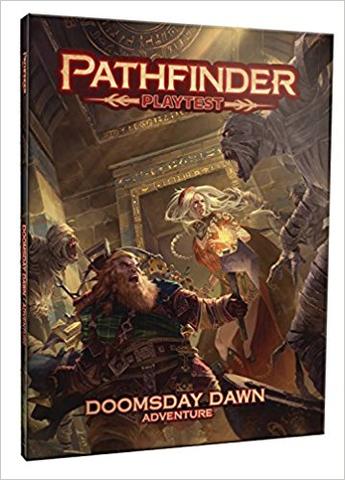
Pathfinder Playtest Doomsday DawnNext up is backgrounds. These represent the things your character did before becoming an adventurer. In addition to the ability boosts mentioned previously, each background grants you one skill feat and training in a single Lore skill tied to that background. What’s a lore? A lore is like a very specific knowledge skill. You can have lore in pretty much anything, as long as it has a very narrow focus. Examples include Vampire Lore, Desna Lore, Circus Lore, and Farming Lore. During downtime, lore skills can also be used to make an income. There are a lot of backgrounds up for offer in the Pathfinder Playtest Rulebook (nineteen!) and you can expect to see a whole lot more in the future. Each adventure path will offer new backgrounds that will tie your characters to the story. The Pathfinder Playtest Adventure: Doomsday Dawn is the first example of this, and provides a further six backgrounds to choose from. The Playtest Rulebook backgrounds include: acolyte, acrobat, animal whisperer, barkeep, blacksmith, criminal, entertainer, farmhand, gladiator, hunter, labourer, merchant, noble, nomad, sailor, scholar, scout, street urchin, and warrior. Although all of the backgrounds are equally ‘good,’ I particularly like the entertainer and the nomad, while my daughter enjoys the animal whisperer, and my son enjoys the warrior.

Past the Background we get to a short section on selecting languages. Players with very high intelligence scores will be surprised to find they don’t get as many languages as in Pathfinder First Edition, with an intelligence over 14 now granting a single bonus language!

Up next is the chapter on Classes. The classes available for the playtest include Alchemist, Barbarian, Bard, Cleric, Druid, Fighter, Monk, Paladin, Ranger, Rogue, Sorcerer, and Wizard. Despite these being familiar to you, each class has plenty of new features, and offers a lot of adaptability. In addition to hp, special abilities and a selection of class feats you can choose from in order to tailor your class to your character, each class also gives you proficiencies in saving throws, perception, and in various weapons, armour and shields. It also gives you a number of skills you can choose to be trained in. Spellcasters get spells, characters get abilities and so on. Now, you really need to read the classes to get a feel for them, so we’re not going to take too close of a look at them. What I will say is that each class we’ve tested in my house has turned out to be a lot of fun. My favourites include Bard (who can use some of their performances an unlimited number of times per day!), Sorcerer (whose spell list and type of magic is determined by their bloodline), and Paladin (who are just plain awesome!). My children particularly enjoyed the druid.

Next up is Skills. This chapter goes over each of the skills, how to calculate their modifiers, and what they can be used for. This is also where you’ll find the rules for crafting, performing and lore. Even experienced players need to give this chapter a read, as there are some changes to the skills. For example, grabbing, grappling and shoving are all tied to your Athletics skill. Yeah. Neat. Skills definitely do more for you now, than they used to. Also, anyone can make attempt any skill check. Obviously, they won’t all be as good at it, but the potential is there, which is nice. That said, some skills have uses that can only be used by characters trained in that skill, which is a nice feature.

After skills we get to the chapter on feats. Now, this section doesn’t have all the feats available in the book. Ancestry feats can be found under ancestries. Instead, it contains all the general, and skill feats available. This chapter is particularly important, because you will gain a LOT of feats.  Beginning characters start with two (at minimum!). One from your ancestry, and one from your background. Most classes grant at least one other feat (sometimes a class feat, sometimes a general or skill feat, and sometimes both). This is a wonderful surprise, which allows customization in a simple way.

After feats you’ll find Equipment. Pathfinder Playtest uses silver as the core coin (instead of gold) which means that the price of gear will be different than what you’re used to. There’s also been some changes to the armour, weapons, and weight systems — all for the better in my opinion! Definitely give the information at the start of this chapter a read before trying to spend your coin! Haha.

Past equipment you get into spells. This begins with a lot of important information about magic, spells, and how they work. Definitely don’t skip this part! Haha. There are four major spell lists: Arcane, Divine, Occult, and Primal. I’m fond of all of them. In addition, you’ll find tenth level spells. After the spell lists are spell descriptions. Amongst these spells you’ll also find a lot of class abilities that are cantrips, or run off of spell points. This includes domain powers, and bardic compositions (among others). Although I understand the purpose of including them here (in alphabetical order alongside the spells), it made it hard to make class choices. For example, if I’m looking for all the bardic compositions (which are a type of cantrip) I have to search through the entire chapter and read the spell traits to find them. There is no compiled list of bardic compositions and, as they are not class spells, they don’t appear on any of the Spell Lists. It’s a giant pain in the butt. Haha. I sincerely hope they find a better way to sort this in the future, cause all that sifting sucks. Not only that, it’s a drain on your time.

I also found (after a lot of jumping between chapters to hunt them down) that a lot of the domain powers weren’t as good as they used to be. Which is unfortunate. I’d gladly trade my cleric of Desna’s domain power from the Playtest with pretty much any other Domain power from First Edition. An unfortunate outcome! Still, it will take more playtesting to determine if it all balances out in the end.

Past this we come to a short chapter on how to level up your characters. In addition, you’ll find the rules for multiclassing and archetypes here. The system for this is very easy to understand, and allows for a lot of cool character concepts. Essentially, you can choose to take archetype or multiclass feats in place of your class feat at any given level — presuming you meet the feat requirements. There’s a bit more to it than that, of course, but not by much. It’s a simple, elegant way to handle multi classing and archetypes without causing characters to fall behind the powers of their peers. I really like it. Definitely give it a read!

Later in the chapter you’ll find the rules for animal companions, familiars, and gods. The rules in all of these categories were fun and easy to use, particularly the rules for familiars. We got ours created in only a few minutes! Wonderful! Of course, I did have questions. It’s specifically pointed out that you can only have one animal companion. But, this is not specified under familiars. Does this mean you can potentially have more than one? My son chose a gnome ancestry feat which granted him a familiar, and then later earned a vine leshy familiar from being a plant druid. Does this mean he gets both? I’ve yet to find a definitive answer, but if you’ve read an official answer somewhere, (or know the page its on that I’ve missed) let me know! I’d love to read the ruling. Another problem with familiars turned out to be damage. Although it mentions the attack rolls they can make, it doesn’t say how much damage one does if it tries to attack. This came up on one of our first combat rounds in our first playtest when my son sent his vine leshy to attack. He hit! And… we had no damage. Haha. I decided that it would do 1 damage unless I found an official ruling that says otherwise. Know of one? Let me know! We’d love to see it!

After this comes a very important chapter entitled ‘Playing the Game.’ Reading it is mandatory. Haha. It’s around 35 pages long and includes all the rules you need to play as a player, as well as the conditions found in the game. Important stuff.

After that is another very important chapter called ‘Game Mastering.’ This chapter includes everything you need to know to run the game as a GM (in addition to the content for players). This chapter is shorter — at only around twenty pages — but its also denser and more complicated. Admittedly, I had to go back and reread parts a few times, particularly regarding exploration mode, downtime mode, hazards, and DCs. I expect I’ll have to reference both this chapter and the ‘Playing the Game’ chapter plenty over the next year, as I get a handle on the rules. In my opinion, the game is easier to learn to play and GM that Pathfinder First Edition was, so I’m pleased, even if reading these chapters caused me a few headaches.

After this we come to (pretty much) the last chapter. Treasure. This is where you’ll find information on wealth, treasure distribution, special nonmagical gear, alchemical items, runes, trinkets, and magic items. There’s a lot of fun stuff in here that you’re going to love reading. I highly recommend discovering these on your own. I will say that I particularly enjoyed the addition of snares, and that I expect to make a character who utilizes them in the near future. I also really like the rune system for making magical weapons and armour. Its very similar to the fusion system in Starfinder.

Past this is the appendices and then the book is over.

That’s it, that’s all! But, that’s not all that I have to say. There are a few things I’d like to mention before wrapping up.

First: Hero Points. I loved them. Each character starts each session with one hero point, and can earn up to one extra each session as a player (for doing something awesome for the group like bringing snacks, tracking gear, or hosting the game) and one extra as a character (for doing something awesome in character like saving someone’s life, being generous, expert teamwork, or accomplishing an important task in game). These points can be used to save yourself from death, reroll a d20, or take an extra action. They’re useful, awesome, and add a great new element to the game. (My daughter’s determined to be the loot-tracker from now on in order to earn that extra point!).

Second: Dying. During our first play session, my husband’s character died. Quickly. All things considered, from the moment he fell unconscious at Dying 1, only a single full round occurred before he died. Two ill-aimed splash damage brought him to Dying 2, and then to Dying 3 with the second instance, and on his turn he failed his first and only fortitude save against death, which brought him to Dying 4: Dead. This was WAY too fast. Sure, he could’ve used Hero Points to save himself. If he had any. He had already fallen unconscious two other times that session, and had used up all his Hero Points. And he wasn’t the only one. My daughter also fell unconscious once during the session, and my son nearly did. Ouch! I found not only did we fall unconscious quite a bit, but we died too QUICK. For a lot of players, a dead character is an end to fun. Especially if your chances for recovery were so brief.

Third: Identifying Magical Items: After you realize something is magical (or alchemical), it takes an HOUR to identify the object. An HOUR. This means, that if you’re the kind of group who doesn’t rest unless its necessary, you can go an entire adventure without knowing what any of your treasure does. In fact, when we played Doomsday Dawn in my house, we went the entire first adventure without knowing what anything did. That means we didn’t get any use out of any treasure. At all. That’s absurd! Now, there are some ways for your characters to shorten this time to ten minutes (or evens shorter at higher levels), which is more manageable. Heck, I even understand the intent. If it takes more time and effort to identify magical objects, that makes them more special. They’ve got an air of mystery about them. That’s cool. But, if it takes so long to identify a healing potion, that without someone specialized in identifying magical or alchemical objects, the group can’t even figure out its a healing potion during their adventure, than what good is it? Now, I know plenty of players like to stop a LOT when they play. Maybe you’re even one of them. The group that gets loot or takes a few wounds and says, ‘We should head back and recover!’ or ‘We should go sell what we’ve found and come back!’ That’s fine. You won’t be hampered by this. But, I’m not that kind of player. Neither are my family or my friends. We very often take on entire missions until we HAVE to rest, due to our wounds. Or we HAVE to recover our spells. Or we’ve spent the whole day and our characters are actually sleepy. This is particularly true in Pathfinder Society missions, which very often occur in a single day on a timeline. This system strikes me as very problematic, unless you specifically ensure your groups always have a way to shorten it. But, why force a group to do so? That’s going to replace another skill or class feat they could have taken. It just… Reading the rules for identifying magical objects didn’t sit right with me. Then we made our characters, brought them to playtest, and it turned out to be both a problem and a handicap. An unfortunate occurrence which we’ve given feedback on.

Fourth: Resonance. This is your character’s natural ability to activate and utilize magical objects. You have a number of resonance equal to your level plus your Charisma modifier. You can invest resonance ahead of time in an object that grants a long-term effect, or spend resonance on the fly to activate a magical object upon use. It’s meant to help replace gear slots (head, hand, and so on). Kind of cool, right? Sure. Until you start counting it out. Want to wear a magical cloak? Cool, 1 point. Want to drink a potion? Cool one point! Wait! One point? What if you only start with one point? What if you’re dying and you have no points? A friend can’t even shove a potion in your mouth to save you?Sort of. When you’re out of points you can attempt to overspend resonance you don’t have in order to activate the magical object anyway. This is a flat check with a DC equal to 10 + the number of points you’ve overspent (including any times you’ve tried and failed). If you pass the magic works, and if you fail it doesn’t (and you can’t attempt to activate that item again until the next day). If you critically fail (roll a 1) you can’t attempt to invest any other magical items at all that day. Ouch! Resonance is of particular interest to alchemists, who need to infuse their alchemical items with resonance in order to craft them. Okay, I can see that, I guess. Particularly for potions and such. Luckily, alchemist’s get to base their resonance off of their Intelligence, instead of their Charisma. But why should the alchemist have to spend resonance to make an acid flask when a wizard can cast cantrip and deal comparable damage at will? Yeah, I get WHY. There’s plenty of justifications. It’s an item, they’re not spell casters, so on and such. But… I don’t know. Both resonance, and the alchemist’s reliance on it is one of those new rules that I read, and just didn’t sit right. So far in playtests around my house it’s been a bit of a problem. Our alchemist was out of resonance within the first fight and had to rely on overspending resonance the entire rest of the adventure. She didn’t critically fail, thank goodness, but if she had, her character would have been completely shut down. She literally would have had to punch people with her gauntlet (a bad idea with her low strength and poor AC) or throw a rock at them (another bad idea). And if a whole character can be shut down so easily (at low levels, at least), that’s probably a problem. Similarly, our dwarf started with no resonance at all. Feeding him a potion in order to save his life was a fifty-fifty chance the first time, with the odds getting worse from there. Considering how quickly he died when he fell unconscious, that’s brutal. Ugh. Now, that said, I haven’t play tested the game enough yet, to make a final decision on resonance. Maybe it’s better with other classes. Maybe it’s less trouble at higher levels. Maybe this is meant to show that magic items are rare and special, tying it into the length of time that it takes to identify them. Maybe we’re not meant to really use something like a healing potion at low level. Maybe other groups didn’t have trouble at all. But so far, it’s been trouble for our groups. I hope that’s not the case in the future. I’d be particularly interested to see how resonance has worked out for you. If you’ve got an experience to share let me know!

Fifth: Initiative. You don’t have one. Instead you initiative is based on your perception modifier. Occasionally, if your character is doing something specific, you can roll a different skill in its place. For example, if you’re swimming your GM might rule you can use Athletics as initiative this time, or stealth if you’re in hiding. And so on. I loved this.

Overall, I really enjoyed the Pathfinder Playtest so far. I like the changes they’ve made to the game system, character creation, and treasure. I like it a lot, actually. That said, I have some questions which need clarifying, and we did run into trouble. We felt it took too long to identify magical items. We felt resonance was too limiting — especially for alchemists. And we felt the that dying turned into dead way too fast. It’s a good game, and we’re going to play it a lot more over the next year so that we can turn our feedback in to Paizo and they can make this next edition the best that it can be.

At the moment, do I think it’s better than Pathfinder First Edition? …I don’t think I can answer that. It’s new, and going to take some getting used to. Meanwhile, I’ve been playing Pathfinder since before it was Pathfinder. It’s nostalgic and homey. You know? I think it would be unfair to compare the two in that manner until I completely get the hang of the new rules. That said, I can answer a similar question. When it comes down to it, I like Pathfinder better than Starfinder. But do I like Pathfinder Playtest better than Starfinder? …No. Not yet. Maybe one day. But, at the moment, the Drift’s got more sway over me.

Well, that’s all for today. I hope you enjoyed this short look at the Pathfinder Playtest, and my opinions on it. I’d really love to hear your opinions and experiences with the Playtest rules, so if you’ve given it a try be sure to leave a comment. If you haven’t downloaded the free PDFs for the Pathfinder Playtest I highly recommend you head on over to Paizo’s website and do so. It’s free! There’s not much you’ve got to lose. Haha. Those of you hoping to get physical copies can find them here: Pathfinder Playtest Rulebook, Pathfinder Playtest Deluxe Rulebook, Pathfinder Playtest Adventure: Doomsday Dawn, Pathfinder Playtest Flip-Mat Multi-Pack.

Until next time,
Jessica

Playtest

Pathfinder Playtest

Pathfinder Playtest RulebookPathfinder Playtest.

It’s here!

Finally, it’s here!

For some of you this might be irrelevant. Others, a little scary.

But me?

I’m excited.

I’m getting up first thing in the morning and heading over to Paizo’s website to download my free copy of everything Pathfinder Playtest. I’ll read it within a day or two, and soon be testing out the character creation process. I’ll be teaching it to my kids by the start of next week, and trying my hand at GMing an adventure for them shortly after. I’ll download the Playtest PFS scenarios as soon as they launch next week, and have reviews up on them within a day or two. When Gameday comes I’ll have a chance to try the game out as a player. Afterwards, I hope to have a chance to play again. Then there’s surveys to fill out and feedback to give, so that Paizo can make this next version of Pathfinder the best that it can be.

So what’s first?

Everything is be available on the Pathfinder Playtest landing page, so head there first and see what there is on offer. Want it all? Click ‘Download All.’ Easy!

But, what exactly is there to download?

The first thing you’ll want to download is the Pathfinder Playtest Rulebook. This is a short version of the rules which give you all the information you need to know in order to play Pathfinder Playtest, GM it, create and level up characters. Now, as the Playtest, this is not a full Rulebook. It’s not what you’ll see when Pathfinder Second Edition launches next year. It’s a streamlined Rulebook with everything you need to know to try out the game. To try running the game. And to make a wide variety of characters. This is the major download. Read it. Enjoy it. Give it a shot. Make characters. Try new things. Share it with your family and friends. Help them make characters.

Pathfinder Playtest Doomsday DawnAfter this you should download Pathfinder Playtest Adventure: Doomsday Dawn. This adventure is actually a series of short, multi-encounter adventures which are linked over a decade of time to tell one epic story. Ancient Osirion features a wide variety of magical clocks which have been counting down through millennia. Previously a mystery, these Countdown Clocks will soon reach 0, at a time when Golarion will line up with the foul planet of Aucturn and allow the horrifying and mysterious Dominion of Black to surge across the world. Your players will travel throughout Golarion over a decade in order to understand the Countdown Clocks, defeat the Dominion of Black, and save Golarion! These mini-adventures are designed to show off and test a wide variety of game mechanics and adventure styles.

I’m thrilled for the Doomsday Dawn, particularly because I first read about the Countdown Clocks back when the The Pact Stone Pyramid was released before Pathfinder had its own rules set. I found the clocks so intriguing I made a whole campaign around it (which was pretty awesome if I do say so myself!). Unfortunately, that was one of the games that fell apart through the years (multiple pregnancies from both a player and myself were the joyous reason that campaign never got played through to its conclusion). I’m thrilled to see what the Paizo team does with it!

Those of you who will be GMing also need to download the Pathfinder Playtest Bestiary (link not available at the time of posting) which contains all the monster rules you’ll need to run the Doomsday Dawn. You’ll likely also want to download the Pathfinder Playtest Flip-Mat Multi-Pack. This contains digital downloads of four major encounter areas in the Doomsday Dawn Adventure. These maps are said to include a burnt-out crypt, a ruined temple, a wizard’s tower, and an astronomer’s underground laboratory. I have high hopes for these maps, so I can’t wait to see them.

Those of you hoping to get your hands on a physical copy of these books can try their hand on Paizo’s website, or order them on Amazon: Pathfinder Playtest RulebookPathfinder Playtest Rulebook Deluxe HardcoverPathfinder Playtest Adventure: Doomsday DawnPathfinder Playtest Flip-Mat Multi-Pack.

And that’s it!

For now.

On August 7th Paizo releases three Pathfinder Society Scenarios for the Pathfinder Playtest (all of which are free). The first, Pathfinder Society Playtest #1: The Rose Street Revenge, is a series of four tier 1 quests that task the PCs with investigating a series of murders perpetrated by the Rose Street Killer, who has been targeting recently freed slaves. They’ll get to ally with kobolds, explore the Puddles, and… do some other exciting stuff that I’m not yet privy to! Haha. This scenario is written by Leo Glass, Thurston Hillman, Joe Pasini, and Linda Zayas-Palmer, so you know it’s going to be awesome!

Pathfinder Playtest Scenario #2: Raiders of Shrieking Peak is a tier 5 scenario written by Luis Loza. Recently, the Pathfinders discovered an Iomedean artifact that was being shipped overland from Diobel to Absalom. Unfortunately the caravan transporting it was attacked and its up to your PCs to find the thieves, and retrieve the relic. It sounds like this scenario is intended to have multiple ways to achieve your goals, which should allow both combat heavy groups, and diplomatic groups to try out different aspects of the game. The only art I’ve seen for this scenario so far features a harpy, so I’m very intrigued! (Fans of my Legacy of Fire novelization will know I’m a huge fan of harpies as potentially dangerous NPCs. Undrella was awesome!)

Sebnet Sanserkoht gnome.jpg
Sebnet Sanserkoht, a gnome Pathfinder from Pathfinder Society Playtest #3: Arclord’s Envy. Art by Javier Charro.

Pathfinder Society Playtest #3: Arclord’s Envy is a tier 5 scenario written by Liz Lydell which I am most excited for. It takes place in NEX, which is a place I’ve never had a chance to play in before, and is a mystery investigation that I know pretty much nothing about! It said to reflect the location wonderfully, and have some flexibility, which ensures that the mystery is different each time you play. This is particularly important since all of the PFS scenarios are replayable.

Well, I’m off now. I’ve got to download the Playtest materials myself, after all. Here’s hoping the website doesn’t crash…

Best of luck!

Jessica

SaveSave

SaveSave

SaveSave

SaveSave

SaveSave

Summer Flies By! (And other news)

Well, it’s been a busy summer so far. We’ve visited family, celebrated birthdays, gone swimming, tended our garden, played at the park and… Well, frankly my allergies are acting up like CRAZY! Whoo, I feel horrible! Haha. Still, my kids are happy, and I’d rather get out and enjoy the summer than I would let it pass me by.

In gaming news we’ve had a chance to play the Mummy’s Mask Adventure Path a few times, Reign of Winteronly once, Shackled City a few times (look for an update soon!) and haven’t had a chance to play Iron Gods at all (sad!). In fact, we haven’t had a chance to play Starfinder at home lately, either. (Double sad!).

A while ago my daughter asked me if I would start moving some of our d20 games online to play-by-post. She felt that she never got to play her many, many, many adventures and characters because when the weekend comes we only have time for one game, and it’s going to be one of the ones everyone agrees on. That means that we could go months without playing some of her characters.

“Pleeeeeeease, Mom?” she asked. “Some of my characters might as well be DEAD! I would rather play them one post a day than take no turns EVER! PLEEEEEEASE!?!?”

She’s a little dramatic, but she got the point across. Haha.

So, at my daughter’s request, we moved one of our ongoing family PFS games online and we moved our family Dead Suns Adventure Path online. My kids and I also have a lot of campaigns that involve only me and them. I told them they could choose one to move online for now. They gave this a great deal of thought and, although they have a ton of characters they enjoy playing, they also have campaign envy.

What?

Campaign envy.

Every time the grown ups play Mummy’s Mask, or Iron Gods, or Reign of Winter they are desperately jealous. A while ago they began their own Mummy’s Mask campaign and they’ve been begging me to let them start Iron Gods and Reign of Winter ever since. In the end, they chose the Mummy’s Mask Adventure Path. I’m actually really excited, since they created a very entertaining group of characters that shook up our typical party dynamics. More details on that will come in an upcoming blog post.

In other news, Gameday VII will start in another few weeks, which is super exciting! I can’t wait! GenCon is coming up (for those of you lucky enough to attend such things), and Paizo recently released their Puzzle Hunt from PaizoCon online for mass consumption. No idea what that is? In short, its a series of Golarion-themed puzzles within puzzles that were given out at PaizoCon back in May. It’s a free download on their website, and you can talk about the puzzles with other gamers on the boards. I gave them a read and am actually super excited to try them out. It looks fun!

Paizo recently announced their upcoming Pathfinder Society Scenarios, which include the finale for Season 9 and the start of Season 10! They’ve also shared details on the next four Starfinder Society Scenarios. Soon we should get information on two new Adventure Card Game adventures, and the first three of their upcoming Pathfinder Playtest Scenarios! I can’t wait to get my hands on these beauties at the end of the month!

Speaking of the Playtest, there have been some awesome spoilers lately. My favourite turned out to be the BARD. Now, I’ve always had a soft spot for bards, so I was pretty sure I was going to love it no matter what they did. After reading their recent blog post on the topic I was elated! It’s got full spellcasting, performances are now a special sort of bard only cantrip called a composition (which means you’re not going to run out of music!), and some of the performances are reactions (counter song, here’s looking at you)! It’s just… awesome! I can’t wait to read the whole class!

Luckily, we don’t have much longer to wait. Pathfinder Playtest releases on August 2nd, along with the Doomsday Dawn Adventure, free maps to go with it, and a trio of Playtest Society Scenarios. I’ve had the good luck to join up with a group of play-by-posters who are going to be playing all three PFS scenarios in a row, which will give me a chance to try the game as a player. Meanwhile, I’ll be GM for Doomsday Dawn (and perhaps even the PFS Scenarios) for my family at home. I expect there will be a lot of characters being made around the house at that time, so who knows what we’ll end up playing with! It’s exciting.

Now I just have to find the time to read all of that…

Today I’m going to leave you with a photo my daughter took especially for d20 diaries. And yes, it has rabbits.

Enjoy

Jessica

d20diaries rabbit

SaveSave

SaveSave