It’s rare that we shine a spotlight on crowdfunding campaigns, but May’s turning out to be one heck of an awesome month for RPGs! Earlier this month we talked about Pathfinder’s Kingmaker Campaign, and today? We’re talking Grimmerspace!
Grimmerspace is a Starfinder Compatible Sci-Fi Horror RPG setting by Iron GM Games. (And by horror, we do mean HORROR. It’s a mature setting and is not intended for children or families). The Grimmerspace team includes Rone Barton, Lou Agresta, and Sean Astin! Launching on May 22nd 2019, the Grimmerspace Kickstarter funded in a few short hours. The main products in the Kickstarter are three books: Grimmerspace: Settings & Adventures, Grimmerspace: Xeno Files, and Grimmerspace: Player’s Guide. These books contain the Grimmerspace campaign setting, horrifying enemies and monsters, five new classes, new character options, and a large number of stand-alone horror adventures. All three books are available in PDF or print form. In addition, backers had the chance to pick up the Starfinder Player’s Guide, Starfinder Beginner’s Box, Immersive Battle Maps by Yarro Studios, Denizen Deck, Xeno Deck, gaming paper, and more through backer tiers and add-ons. Although the stretch goals haven’t been detailed, a digital map pack and a poster are already unlocked at the time of writing.
Grimmerspace takes place in the Gliding Rim Galaxy, an alliance of five technologically advanced polities plagued by terrifying alien abominations. From a purple tear in the sky comes the warmongering Sundermages, magic users from the default Starfinder setting who have travelled for centuries across time and space. The sundermages have become something inhuman, and bring magic and devastation to the magic-less Gliding Rim Galaxy, which they intend to conquer. Teaming up with the monstrous Hodrak’s of the Gyre, the Sundermages are a force to be reckoned with. A battle of magic versus technology has come to Grimmerspace!
Grimmerspace adventures are stand alone modules sorted by horror genre, intensity, and the time they take to play through. They are location specific, so they can easily be dropped into any campaign.
There are five new character classes in Grimmerspace, ARCop, Crypto-Monk, Quantum Seer, Recombinator, Voti Marine. ARCop’s are police officers who bond with a special gun that contains the memories of a dead ARCop. These guns, known and an ARCop PIECE, are intelligent, capable of firing multiple types of ammunition, and grow in power with your PC. Which is super cool! Crypto-Monks are conspiracy theorists that believe an unknown alien presence is controlling all of Grimmerspace. In order to combat this unseen threat they hone their bodies, create weapons out of everyday objects, and learn how to combat and destroy aliens. Quantum Seers can manifest monstrous versions of themselves around their physical bodies. Recombinators are bioengineers capable of creating unique lifeforms that serve them, much like a Starfinder Mechanic creates their own drones. Voti Marine’s are strong warriors that wield shoulder cannons and other powerful arms. In addition to these classes there are new races, archetypes, themes, polities, and factions that players can join and combat.
If you’re even remotely interested in sci-fi horror and RPGs I highly recommend you give Grimmerspace a look-see. It’s going to be amazing!
For more information on Grimmerspace’s Kickstarter Campaign click here. To download a free Grimmerspace adventure, Abattoir 8 by Richard Pett, click here.
They’re obsessively browsing the Dwarven Forge website, and watching their many youtube videos. My son takes every opportunity to bring it up, attempting to convince me I should buy him some for his birthday, or for my birthday, or maybe my husband’s Christmas gift.
So when my son asked if he could download the free Dungeon of Doom Adventure a while back, I let him. And when he asked me over and over if I had read it yet, I pushed it up a little higher on my to-read list.
You see, I like Dwarven Forge, but when it comes to adventures, I tend to prefer a sweeping story over a classic dungeon. And the Dungeon of Doom adventure? Seemed like one big deadly dungeon.
Which it is. But, turns out, it’s also awesome! Haha.
I finally got around to reading the adventure and was pleasantly surprised. Every encounter area is well planned, well executed, and exceptionally creative –– all things I expect from Dwarven Forge. There’s some basic plot hooks to get the adventure moving, but not much else. On the surface, at least. There’s much more going on in this dungeon delve than anticipated, as the PCs will uncover as they adventure.
If they survive.
Dungeon of Doom is packed full of layered, multi-stage traps and puzzles that work to create a deadly challenge for the PCs. It’s smart, clever, and surprisingly funny! There’s a wide array of NPCs you can meet and interact with in the dungeon, from ghostly spirits, to chatty gargoyles and, my personal favourite, a talking door. The PCs have plenty of secrets and history to uncover through their exploration, and a lot of powerful treasure to claim. But, as previously mentioned, this is definitely a deadly dungeon! For starters, the dungeon itself drains your PCs life force, making taking a long rest impossible. PCs will need to complete the entire dungeon with relative speed or they’ll run out of resources. In addition, characters that die have their souls trapped within the dungeon and rise as an undead spirit known as a maerghast. Not a desirable end! Along the way the PCs will need to collect magical artifacts known as glyphstones, which are powerful semi-intelligent artifacts which affect the PCs personality and behaviour, but grants them potent magical powers –– some of which can allow players to heal or gain the effects of taking a long rest. But, the greatest challenge is definitely the dungeon itself. As I previously mentioned the encounter rooms are packed full of well-utilized, challenging puzzles and traps which I absolutely adored. It’s deadly, but a lot of fun.
The Dungeon of Doom Adventure is a free download here, and is intended for characters between the levels of 1 and 10. Each challenge is written for three difficulty levels, based on your party’s APL (average party level). APL 1–4, APL 5–7, and APL 8–10, with the variable numbers (DCs, Damage, and so on) separated by a slash. For example DC 12/14/16 or 1d8/2d8/3d8 damage. It’s easy to understand and efficient. Monsters are instead listed on a chart, with the composition of each encounter being determined by your party’s APL. Level 1 parties might face off against a quasit while a level 10 party might face a nalfeshnee in the same location. The adventure is written for 5e Dungeons and Dragons, but has rules in the back for running it for the Pathfinder RPG (which is awesome!). Those of you interested in investing in Dwarven Forge’s Dungeon of Doom products can buy the pieces needed to make the Dungeon of Doom on a room by room basis on their website, while the adventure contains detailed build guides to show you how to set it all up. You can also watch Dungeon of Doom played or see a run-down of the rooms on youtube.
Dungeon of Doom is a deviously deadly dungeon full of interesting puzzles and traps, perfectly suited to challenge players of a variety of levels. I found it absolutely inspiring! I highly recommend you give it read!
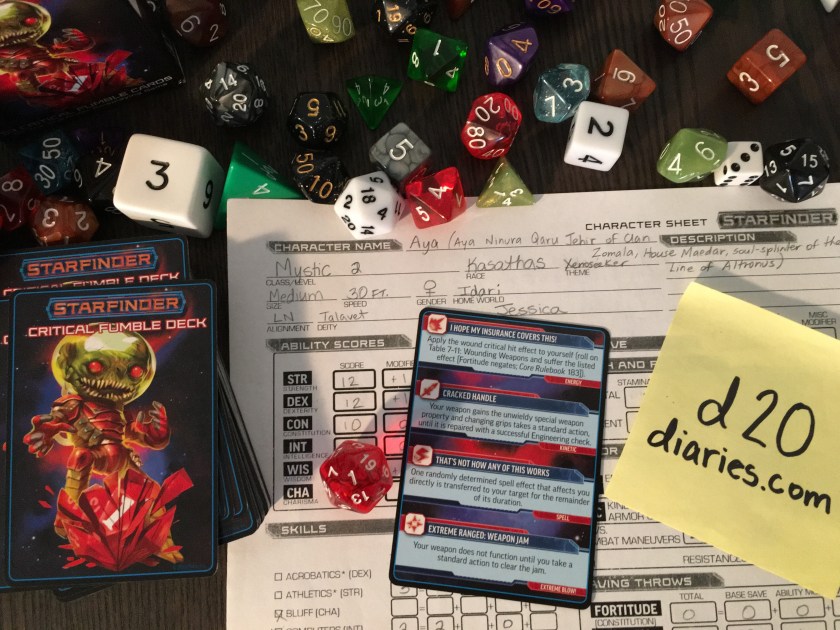
Like its counterpart the Starfinder Critical Fumble Deck is the size and shape of a deck of playing cards. It retails for around $10.99 USD (or around $15 Canadian dollars). There’s a space goblin with a shattered d20 on the box and card backs, with some product information on the back of the box.
The cards inside are high quality and easy to read with a colour scheme matching the Starfinder Core Rulebook and the Critical Hit Deck. There’s fifty-five cards inside. One contains product information, the open game license, and cites Owen K.C. Stephens as the author and Taylor Fischer as the illustrator. The second card lists the rules of using the Critical Fumble Deck. And the other 53 cards are Critical Fumble Cards.
All of the cards follow a specific set of rules laid out on the rules card. You’ll also need to decide ahead of time how to use the Critical Fumble Deck. There’s three methods presented although its suggested you use the first, which sees critical fumbles occur rarely. I prefer to get a lot of use out of my cards, though, so we use the third option in my house: a natural one is a critical fumble if is also misses the targets AC.
The cards themselves work just like the Critical Hit Deck. When you roll a critical fumble you draw a card. Each card has four different critical fumble effects. One for energy attacks, one for kinetic attacks, and one for spell attacks. The fourth critical fumble effect is an ‘extreme blow’ and lists a single specific damage type (such as bludgeoning or fire). You simply read the card, select the critical fumble effect that matches your damage type, and carry out the effect listed. If you happen to deal the exact same type of damage as the extreme blow you use that critical fumble instead.
There’s lots of entertaining critical fumble effects. Some of my favourite effects include burn out (energy), look at the pretty colours (energy), unscheduled dance-off (energy), so much blood (kinetic), spectacularly stubbed toe (kinetic), caster’s block (magic), not what I meant to do (extreme grenade), sword in the stone (extreme melee), and nailed in place (extreme piercing).
Got a favourite critical fumble card? Let us know in the comments!
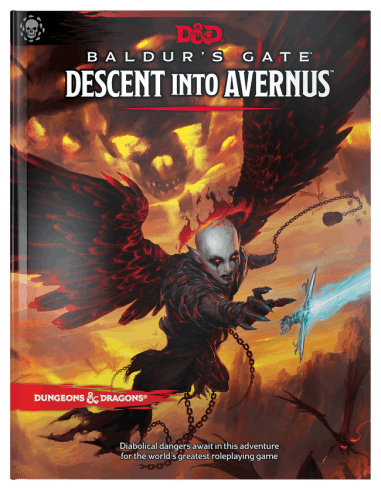
Wizards of the Coast has just announced its newest Dungeons and Dragons campaign, Baldur’s Gate: Descent into Avernus! The announcement was made during its D&D Live: The Descent event in L.A. Beginning in the incredibly popular town of Baldur’s Gate and descending into Avernus (the first level of Hell), this 256-page campaign takes players from level 1 to level 13. Baldur’s Gate: Descent into Avernus is scheduled to make its debut September 17, with the Beadle and Grimm’s Platinum Edition scheduled for release in October.
For more information on this diabolical campaign, check out the video below, or click here for a full list of the D&D Beyond interviews regarding this campaign on youtube.
For more information on Beadle & Grimm’s Platinum Edition of Baldur’s Gate: Descent into Avernus, click here. Only 1000 copies of the Platinum Edition will be made, and yes, it’s expected to sell out. This weekend only (May 18th – May 19th 2019), the Platinum Edition is on sale for $449.00 USD (from it’s full retail price of $499.00 USD).
Baldur’s Gate: Descent into Avernus. Image credit: Wizards of the Coast
Against the Aeon Throne is a shorter campaign than most. Typically six books in length, this Adventure Path is only three. It’s a great change of pace that will allow the folks at Starfinder to tell shorter, more personal stories. In addition, this three part length makes it easier to purchase and play through an entire adventure path. It’s awesome for gift giving and the budget conscious! Six books is a huge investment, but three? Well, that’s a lot more manageable for those of us without much extra cash laying around. On the other hand, with the three book format I feel like I blinked and the whole adventure path was over. I didn’t get my hands on the first book until the third came out and I missed the Signal of Screams Adventure Path completely. In general, it’s both easier to collect and easier to miss. Although I enjoy the three book format, I also enjoy the six book format, so I hope they continue to rotate between the campaign lengths.
So what exactly is Against the Aeon Throne: The Rune Drive Gambit all about? In previous adventures, the PCs defeated an Azlanti military force that had annexed the small colony of Madelon’s Landing on the planet of Nakondis. But saving the fledgeling colony was just the beginning. The PCs discovered that an experimental starship engine and their friend, the android Cedona, were transported off of Nakondis and back to the Azlanti Star Empire. Giving chase the PCs made some allies and rescued Cedona. All that’s left is to find the experimental starship engine, steal it or destroy it, and escape with their lives. Along the way they’ll fight Aeon Guard soldiers, rescue captive scientists, and face off against the man responsible for sending troops to Nakondis in the first place! No problem! …Right?
Now, let me take a moment to be clear. The Azlanti Star Empire is a pack of giant, pompous, jerks. They’re great villains for the PCs to clash with, but an overwhelming opponent. This adventure path does not send your PCs off to take down the entire Azlanti Star Empire. It’s much smaller in scale than that. And frankly? I love it. It lends a sense of suspense to the series and makes it feel like you’re playing real people in a living breathing world universe doing what they can, rather than heroes so powerful they change the whole world universe. It’s a wonderful change of pace and scope. It’s got a very Firefly / Star Wars feel to it.
But, before we get into that too much, let’s take a look at the book itself. Starfinder Adventure Path #9: The Rune Drive Gambit (Against the Aeon Throne 3 of 3) is a softcover adventure written by Larry Wilhelm that is 63 pages in length. It’s intended to take players from level five to level seven. The adventure itself is around 39 pages long, and split into three main parts: With Friends Like These, in which the players upgrade their ship and figure out where the heck they’re going; Within Enemy Territory, in which the players travel to and explore the upper levels of a secret research facility located in an asteroid; and Scientific Theories, in which the players finish exploring the research facility, track down the rune drive, and decide what to do with it. After the adventure there’s six pages of ideas on how to continue the campaign after it’s conclusion, with eight short ideas, and two detailed ideas that include a stat block or two. After that there’s an eight page primer on the Stewards, including two character archetypes. There’s seven new creatures in the Alien Archive, and a short Codex of Worlds article on New Thespera, heart of the Azlanti Star Empire. Lastly, the inside front and back covers feature information and a layout for a tier 5 starship: the Vanguard Regnant.
My favourite parts of this adventure are the layout, enemy tactics, and defences of the research facility, and the NPCs you unexpectedly discover along the way.
Before we continue with a more in depth look at the book, let me point out: there will be SPOILERS.
You have been warned.
For starters, I love the look of this book. I like the colours and the layout. The text inside is easy to read and the colours are easy on the eyes. The cover art is wonderful. It showcases Sardat Zolan Ulivestra, an Azlanti nobleman and enemy of the PCs, as drawn by Anna Christenson. Behind him is an awesome image of Obozaya (the iconic vesk soldier) and Quig (the iconic ysoki mechanic) fighting off Azlanti soldiers.
Azlanti Aeon Guard. Art courtesy of Paizo Inc.
The starship showcased on the inside covers is a Vanguard Regnant. This tier 5 small light freighter is destined to be the final (or second last) enemy the PCs face in this campaign. It’s a well-built luxury ship that’s fast and maneuverable, but still packs a punch. I particularly like the ship layout.
After that we hop right into the adventure itself. This adventure starts in Outpost Zed where the PCs (and Cedona) will need to get their ship upgraded by their friend Hasshachir, who they met in the previous adventure. While they wait they’ll run into trouble, which will ultimately provide the PCs with the clues they need to determine their next destination. We won’t talk about these events any further, as it would ruin the surprise for those of us reading this who ignored my spoiler warning. (You know who you are! Haha). What I will say, is that I enjoyed this section of the adventure.
Which brings us to part two of the adventure: Within Enemy Territory. In this section PCs will need to travel to Aurelos, the secret laboratory the rune drive was taken to, find a way inside, and explore the upper levels. Along the way they’ll have to take on the base’s defences and protectors. As previous mentioned, I was really impressed with the layout of the Aurelos base, both the upper levels featured in this section, and the lower levels featured in the next part of the adventure. It’s functional and easily defensible, and is populated with enemies who know how to use their surroundings. There’s a few complications and other defences to round out these encounters, and an enemy is introduced that I rather enjoyed.
Oliviana. Illustrated by Jakub Bazyluk. Art courtesy of Paizo Inc.
Which brings us to part three: Scientific Theories. In this section the PCs finish their exploration of Aurelos, fighting off further enemies and surmounting further challenges. Along the way they’ll have the chance to meet quite a few NPCs (potential friends and enemies), question scientists, explore science labs, and try to figure out what the heck the rune drive is and why it’s so important. Then they’ll have to figure out what to do with it and attempt to make their escape. They’ll face off against the mastermind of this whole debacle, Sardat Zolan Ulivestra, alongside some of his loyal (or not so loyal, depending upon your PCs actions) minions. Finally, they’ll have to engage in a starship battle to make their escape!
Part Three is fun, dynamic, and exciting, with plenty of people to interact with, challenging encounters, and a dilemma or two. I really enjoyed Evandrian, an Aeon Guard the PCs are destined to combat multiple times, and the Sardat’s statistics and tactics. He’s the perfect mix of pompous and skilled. I think PCs are going to really hate him. Haha. He’s a great villain. Finally, I like that some of the encounters in this section are open ended. There’s more than one potential outcome, and the choice ultimately rests in the hands of the PCs, either knowingly or through their actions. On the other hand, Part Three is also where I have some issues. There’s really only one thing to do with the rune drive. It’s cool, and it makes sense, but there’s clearly no real alternatives to the option presented. Which is unfortunate. Also, that option? Wow, it’s… complex? It’s logical, both in terms of the story and in terms of Pact Worlds implications. But I was also left wondering why it also does… some other stuff that seems tacked on. Cool stuff! But odd. I’m being vague, I know, but you’ll understand when you read it. Haha.
Which brings us to the end of The Rune Drive Gambit and the Against the Aeon Throne Adventure Path. But, that’s not the end of the book. Up next, as previously mentioned, is a lot of ideas for how to continue the campaign. There’s eight minor ideas here, some of which will lead to short adventures, and others which could form the basis of long, epic campaigns. I know my family will want to head back to Nakondis to help out the colony there, so it’s nice to see a few options that deal with the Madelon’s Landing. Other ideas involve the Stewards, the Azlanti Star Empire, and even transitioning into the Signal of Screams Adventure Path (definitely not the option my family will be using, but it’s nice to see it in print). There’s also two longer campaign ideas. One is a direct continuation, which makes a lot of sense, and I’m very likely to make use of. The other is both awesome and out there! I love it! But, it’s way too confusing to run with my kids (which is who I’m currently running through Against the Aeon Throne). If any of you make use of Kellixtrian I’d love to hear about it.
Following this is an eight page primer on the Stewards. Basically the peace-keeping force of the Pact Worlds, the Stewards are warrior diplomats that are organized into four main branches and run by a Director-General. The branches are Constabulary (the police force), Ops (the spies), Overwatch (the starship fleet), and Conclave of Legates (veterans who act as a council and advisory board). This section describes the Stewards origins, history, structure, leadership, purpose, bases, training regimen, and interests. It also presents two new archetypes, the Stewards infiltrator (an ops agent) and Stewards stalwart (self-sufficient agents that often work alone). Both of the archetypes are useful and very cool! I’m really glad the Stewards are getting some attention, as they are a powerful organization that can be utilized and interacted with in a wide variety of campaigns. They’re very usable.
Azlanti Battle Robot. Illustrated by Alexandur Alexandrov. Art courtesy of Paizo Inc.
The Alien Archive is up next, which is always one of my favourite sections of an Adventure Path. It contains seven new creatures, three of which are featured in the adventure itself. The creatures include: power archon, a CR 5 outsider tasked with destroying corrupting technology; carnivorous crystal, a CR 11 ooze that can turn you to crystal; comanide, a very creepy looking CR 7 fey; entropy slug, a CR 4 magical beast the PCs will face in part one of this adventure; hulsa, a CR 10 fey; Azlanti battle robot, a CR 6 robot the PCs will face in part three of this adventure; and twinsoul, a very strange CR 8 creature also featured in this adventure.
Finally, there’s a short, one page Codex of Worlds entry on New Thespera, the heart of the Azlanti Empire and seat of the Aeon Throne. It’s an incredibly useful article, but very brief. New Thespera’s the sort of important place you could write pages of information on.
This Mother’s Day my kids wrote me poems and stories, drew me pictures, cards, and books. My son even made me a coaster to hold my drink. And my husband? He and my children got me character art commissioned for my favourite Pathfinder Society character!
I’ve never had character art for a character of mine before. My kids and I have drawn pictures of some of our characters on occasion. And sure, a picture here or there might inspire us to make a character similar in appearance. But custom professional art? Unheard of! So it was with great shock and surprise I awoke to discover my family had somehow procured gorgeous art of my beloved -1 PFS character.
Clearly I have a wonderful family and am beyond spoiled. Today I’m going to share that art with you!
Introducing Danicka Raburnus and her vicious dog, Prickles!
Danicka Raburnus and Prickles. Original characters of mine for the Pathfinder Society Organized Play program. Art by the amazing Joe Nittoly.
Danicka Raburnus was my very first Pathfinder Society character. My -1. I had played Pathfinder, Dungeons and Dragons, and other RPGs for a long time before making Danicka, but she was the first character meant for organized play. She marked my entry into the Pathfinder Society, and was the first in a series of wonderful characters, delightful roleplaying, and exciting adventures.
Danicka is… far from perfect. When it came time to create Danicka I wanted to do something different. Everyone has characters who are attractive, intelligent, healthy, brave, and so on. People who are special. Heroes. They’re not all perfect, and many have a flaw or two, but they usually have quite a few redeeming qualities. I’ve got plenty, myself. So when it came time to make Danicka I wanted to create a character who was different than those I’d made before. Someone who wasn’t a hero. Who wasn’t special. Someone hopelessly flawed and regrettably forgettable. Someone who wanted to be special, who wanted to be the hero, but just wasn’t.
I have a soft spot for making, strong, independent, female characters. I love playing half-orcs and dwarves. I love bards, rogues, oracles, and sorcerers. Adaptable characters with a flaw or two, and a bit of a scoundrel’s streak.
So I went out of my way to make Danicka different.
I made her a wizard, which I rarely do. And I went out of my way to make her as unremarkable as possible. She has an archetype that prevents her from having a familiar or an arcane bond––qualities that make her feel inferior to her fellow wizards and spellcasters. She learned spells that are visually unremarkable. No fireballs or flashy magic for this girl! She was intelligent and wise, but too shy and nervous to speak her mind.
I never use complimentary words to describe her. I don’t call her pretty, or fit, or athletic, or slender. She’s not even skinny. She’s scrawny. Boney. Her hair is frazzled, limp, plain, or mousey. Her skin is not like porcelain, or alabaster. It’s pale, freckled, and ink-stained. Her clothes are nice but ill-fitting, out of fashion, and in dull colours. She doesn’t show off any skin, covering herself from neck to fingers and toes. She doesn’t even wear nice boots, just flimsy cotton shoes that flop and squelch wildly whenever they get wet. She wears a floppy hat on her head. She has poor vision and wears plain spectacles.
It’s not that these qualities are undesirable or unattractive. They’re not. It’s that I designed her to be average and blend in, and that I describe all of her qualities in as uncomplimentary a fashion as I can.
She shrieks in battle. Gets queasy. Stammers, stutters, whimpers, and whispers. Her efforts to make friends are awkward and almost always end in failure. She’s shy and meek. Easily scared (often terrified!). She faints on occasion (though never in a way or at a time that would hinder her mission or the game). She’s weak, awkward, and extraordinarily clumsy.
But amidst all those awkward and oddly endearing qualities, she’s a hero. Not outwardly. Certainly not obviously. But she’s a good person. She won’t take a life. Ever. And she won’t condone it from her allies. In fact, wanton violence, destruction, theft, and other illegal deeds are among the only things that she’ll speak out against. She’d rather remove an enemy from a fight than cause someone harm. I gave her merciful spell as a feat to ensure her few damage dealing spells aren’t lethal. She’ll stabilize unconscious enemies, hurl herself into danger to protect someone else, and is always the first person to offer healing potions to the wounded. She’s generous and kind. She won’t lie and always gives her enemies a chance to surrender.
So, who was Danicka? Where did she come from? And what make such an ordinary, meek woman want to be a hero?
Danicka was born to a hero. Her mother, Portia Raburnus, was a wizard of great renown who helped saved the city of Magnimar not just once, but on three occasions. Danicka has always wanted to be just like her mother, and grew up studying the arcane arts. Her mother passed away five years ago, right before Danicka began her formal training at the local magical academy, Stone of Seers. Danicka always keeps her mother’s arcane bonded item with her—a highly decorative quarterstaff that looks remarkably like a broom. She had hoped to use the broom as her own arcane bonded item, but could never manage to make it work.
Danicka did well in school, but despite her academic achievements she was constantly overlooked—for Danicka was ordinary looking, and incredibly shy. Regrettably forgettable. Most people don’t even remember Portia Raburnus had a daughter.
Danicka’s recently graduated and set out to finally prove herself brave and bold! A hero, like her mother! She marched right into the local Pathfinder Lodge and demanded a job. Unfortunately, her demand came out a nervous whisper and they hired her as a maid. But, sweeping the floors used by bolder souls with her mother’s broom isn’t enough for Danicka Raburnus! She’s going to prove herself one day! Maybe after she’s done cleaning up the common room…
Danicka is incredibly shy. She speaks rarely, and when she does its in a whisper. She’s constantly trying to work up the courage to be louder, to make friends, and to do something, but her attempts at friendship always come out in awkward stuttering bursts, and her attempts to speak her mind end up with her randomly yelling something (and then losing the courage to finish). She’s easily embarrassed and was bullied on occasion in school (when her classmates could be bothered to remember she was there).
Danicka studies hard and loves to learn new things. She knows she’s a young woman of many flaws and is trying desperately to change. She wants to be brave and bold, but has yet to break out of her shell and really be herself.
Mechanically, she’s a wizard with the exploiter wizard archetype that’s a member of the Silver Crusade faction of the Pathfinder Society. She took the traits tireless logic and volatile conduit. Her beginning feats were eschew materials and merciful spell, although she later added spell focus (enchantment). She’s knowledgable and speaks a wide array of languages. For her first exploiter exploit she chose energy shield, although she never had the opportunity to use it until many adventures had passed. Some of her most commonly prepared low-level spells are daze, detect magic, read magic, comprehend languages, mage armour, shield, sleep, and merciful ray of frost or merciful magic missile. In time she learned that outsiders and undead were a threat her non-lethal methods couldn’t handle, so she started carrying a lethal wand, a few lethal scrolls, and some holy water around to combat such irredeemable threats.
I had intended to keep her a wizard for the entirety of her career, but along the way, things changed. Danicka changed.
After Danicka’s first mission in the world of play-by-post gaming, she was invited to join an ongoing campaign run by the delightful and incredibly talented GM ShieldBug. For a wonderful seven scenarios she had the pleasure of playing in a consistent group of awesome players. Her companions were very different from Danicka. Some were weird, some were liars, some were scoundrels, and most were violent. They pushed her buttons, shoved her out of her comfort zone, tested her morals, and urged her to change. With them she found her backbone. She found courage. She faced peer-pressure and discovered that there were things worth fighting for, even if it meant standing up to your allies. She made friends. She made enemies. She made mistakes. She became a hero. She saved people and towns.
Mostly, she was embarrassed.
But it wasn’t only Danicka that changed. Her friends did, too. She made them better people. And they made her brave.
On one of her adventures she was forced to interact with terrifying, man-eating, Thuvian desert dog. Miraculously she bonded with it, though it terrified her to no end. Later in the scenario she was forced to face the dog in combat, and she managed to convince him to stand down. The mission came to an end and I was faced with a turning point. Move on? Or keep the dog?
Danicka kept the dog. She named him Prickles, for his spiky fur (matted with the blood of his enemies) and terrifying demeanour. Although I could have just bought a dog and remained a wizard, I chose to multiclass Danicka into druid. I selected another understated archetype (the wonderful wild whisperer!) that removed some of the flashier of the druids abilities and replaced it with investigator’s inspiration and talents. She began to take ranks in handle animal, and survival. She used her druid spell slots to prepare healing magic. She took the feat boon companion, and statted up Prickles as a wolf.
Danicka spent the next while attempting to tame her vicious dog. I took great glee in role-played her fear of her own pet, and her worry that it will hurt someone. Prickles is clearly the alpha of the duo, but he usually listens to Danicka’s pleas. That said, out of fear, Danicka never tells Prickles to attack anyone. She’s too afraid she won’t be able to stop him from killing. Instead, she orders him to stay by her side. Mechanically, Prickles has the bodyguard archetype. He’s always on ‘defend’ and won’t enter a fight unless Danicka is hurt. However, if she’s hurt he flies into a rage and attacks whoever wounded her until they’re dead. Usually Danicka hurls herself between the enemy and her dog before they are devoured, but once or twice Prickles killed something––an event which filled Danicka with great regret. For his part, Prickles is used to his ‘pet’s’ panicked shrieks and mewling. But he’s incredibly territorial and won’t stand for anyone touching his ‘pet.’ Not even her allies. He’s a bit cantankerous, and won’t take ‘orders’ from anyone other than Danicka. And he only listens to Danicka if she begs.
All in all, they’re a comical pair, with my shy wizard desperately trying to handle her overwhelming pet.
On her most recent missions, Danicka’s had to bid her old friends farewell. She’s gone on new adventures with new teammates. Only Prickles has remained by her side. But, despite the distance, it’s her old friends that continue to drive her and inspire her. Mhazruk Kruhl and his terrifying familiar Needle, the burly Yaiho Crasher, the tap-dancing escaped-slave Forrest Glavo, the eccentric Arin Qualnoh blessed (or perhaps cursed) by the gods, and Brock Swiftread, a scoundrel if there ever was one. They’re the closest thing to family she’s ever had.
So here’s to Danicka and Prickles, and all the people and characters who have made her who she is. Here’s to the people who have GMed for her and played alongside her. The people who have put up with her panicked shrieks and bleeding heart. Here’s to my family, who brought one of my very favourite characters to life. And here’s to Joe Nittoly, the amazing artist who drew her. Thank you! Thank you! And thank you again! You’re the best!
And here’s to all of you, for taking the time to read about one of my favourite characters. Maybe I’ll see you around a PFS table one day.
It’s rare we take the time to talk about RPGs and other games that are crowdfunding, but today we’re making an exception! Why?
Kingmaker!
Next year marks the tenth anniversary of Kingmaker, a six-part Pathfinder Adventure Path by Paizo Inc. This incredibly popular campaign was recently made into a computer game, by Owlcat Games (for more information check out this blog post). As with many of the popular Pathfinder adventure paths, Kingmaker has been out of print for quite a while. Although you can still find it kicking around on amazon, eBay, and other sites, it is not cheap!
Although Kingmaker’s not my favourite adventure path (sandbox-style campaigns aren’t my preference), I’ve always enjoyed reading and GMing Kingmaker. My copies of the adventures are more than a little dog-eared and worn. They’re riddled with highlighter and post-it notes, and I have multiple notebooks full of hand-written events and expansions for the campaign. Sadly, none of my campaigns ended up making it to the end. I’m cursed! Haha.
To celebrate Kingmaker’s tenth anniversary, Paizo Inc. is releasing an anniversary edition of the Kingmaker Adventure Path for Pathfinder Second Edition! Like previous anniversary editions, the campaign will be updated, enhanced, and expanded upon. Unlike previous anniversary editions, this book is huge. Seriously huge. And you know what? It has the potential to be even bigger.
Today Paizo Inc. began a crowdfunding campaign for Kingmaker 10th Anniversary Edition. There are two primary products you can purchase. The Kingmaker Adventure Path for Pathfinder Second Edition (which will be a minimum of 576 pages long!) and the Kingmaker Companion Guide, which contains information on two of the characters from the Kingmaker computer game (the gnome Jubilost and the halfling Linzi), and brings them to the table with stats, information, kingdom roles, and quests. Backers get both a print and PDF copy of the books, which are due out next year. In addition, there are some cool add-ons for this campaign. Among these are dice, hero tokens, a pin, and the Forest Kingdom PDF by Legendary Games. The most exciting add-on? The Bestiary! Kingmaker Bestiary takes all of the Second Edition creatures and NPC stat blocks and recreates them for Pathfinder First Edition or 5th Edition Dungeons and Dragons! The Bestiary volumes will also contain notes and information on how to run the Kingmaker Adventure Path in First Edition Pathfinder or Dungeons and Dragons 5th Edition. Stretch goals include a Kingmaker Pawn Box (which I would love to get my hands on), flip-mats, and expansions to the Kingmaker Companion Guide. In addition, the Kingmaker Adventure Path will feature more and more content as the various funding goals are met.
Colour me intrigued!
For more information on the Kingmaker 10th Anniversary Adventure Path check out the video below, or head on over to the crowdfunding campaign on Game On Table Top.
Hey everyone! Thanks for stopping by. Today we’re taking a look between the the covers of the latest ‘gods’ book: Pathfinder Campaign Setting: Faiths of Golarion! Although I’ll be mentioning what’s in this book and talking about my favourite parts, this is not meant to replace the book itself. The opposite, in fact! It’s meant to let you know what’s inside so you can decide for yourself whether this is a book that will be of use to you. For me? Definitely! Curious what’s inside? Read on!
Featuring cover art by Igor Grechanyi that showcases the gods Gruhastha, Hei Feng, and Nivi Rhombodazzle, this soft cover book is 64 pages in length. Other contributing artists include Gislaine Avila, Emanuele Desiati, Vlada Hladkova, Sandra Posada, Luca Sotgiu, and Vicky Yarova. Contributing authors include Kate Baker, John Compton, Adam Daigle, Crystal Frasier, Ron Lundeen, Liane Merciel, Michael Sayre, and Owen K.C. Stephens.
Like the many god and faith themed books before it, this book takes an up close look at a variety of faiths, talking about the gods and goddesses, their faith, church, priests, worshippers, holy texts, holidays, aphorisms, planar allies, and so on. It also features information on their alignment, domains, subdomains, favoured weapons, centres of worship, paladin and anitpaladin codes (if there is one), obediences, and boons (usable by those who take the deific obedience feat, or take levels in the exalted, evangelist, or sentinel prestige classes from Inner Sea Gods). There’s plenty of awesome art in this book, with each faith discussed having four images: one of the deity, one of the holy symbol, one of a worshipper, and one action shot of the deity.
There are ten faiths discussed in this book. Each is a lesser detailed but very important faith. This includes a few racial faiths — the halfling goddess Chaldira Zuzaristan, the gnome goddess Nivi Rhombodazzle, the elf god Ketephys, and the dwarf god Magrim. It also includes information on deities from other regions of Golarion such as the Tien gods Hei Feng, Shizuru, and Tsukiyo, as well as the anadi goddess Grandmother Spider who is popular in the Shackles and Sodden Lands, the Vudrani god Gruhastha who is popular in Vudra, and the Razatlani goddess Kazutal who is popular in Arcadia. Each of these faiths is incredibly important to their respective cultures and I’m thrilled to see them get some of the attention they deserve. Information on the racial deities, especially, I feel was long overdue. Before sitting down to read this book I was most excited for further information on Ketephys, Shizuru, and Tsukiyo. All of the entries were great, but after reading I was most inspired to make worshippers of Grandmother Spider, Kazutal, and Tsukiyo.
So who, exactly, are these deities?
So glad you asked!
Chaldira Zuzaristan is a brash and reckless halfling demigoddess of battle, luck, and mischief. She fights against oppressors, tyrants, and injustice, trusting in her luck and companions to see her through. A bit of a thieving troublemaker, but not malicious, Chaldira is good friends with the goddess Desna, who shares her love of travel. One of my favourite parts of the article on Chaldira is her eccentric planar allies, particularly her herald The Button Fellow.
Grandmother Spider is a cunning goddess of twilight, illusions, family, and weaving. Created by the gods as a tool be used alongside her brother, Achaekek, Grandmother Spider was tasked with weaving the world and the destiny of the mortals in it. But she rebelled against the gods and wove a new destiny for herself, granting herself free will and divinity. She’s a trickster, teacher, and folk hero. I particularly enjoyed reading about her relationships with the other gods — she once stole Asmodeus’ keys and enjoys teasing her brother Achaekek. Who doesn’t want to irritate the assassin of the gods?! Haha. I also adore all the art in this section!
Gruhastha is the vudrani god of peace, understanding, and self-improvement. Once Irori’s nephew he sought to record his knowledge for the world. Upon completing his perfect book, the Azvadeva Pujila, he became the divine embodiment of that holy text. Now Gruhasta seeks to enlighten the world so that one day it will be so perfect it becomes one with Nirvana. Interesting!
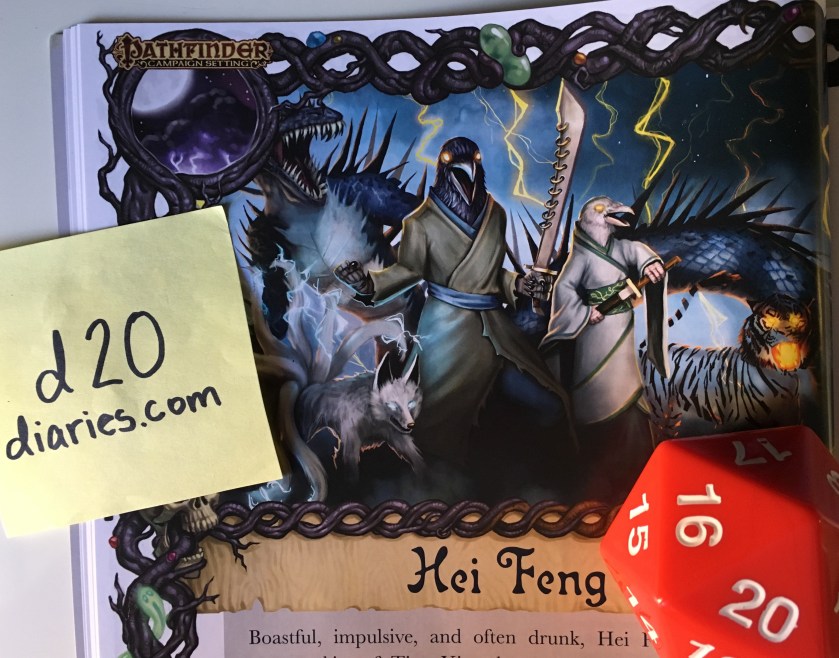
Hei Feng is a wild and unpredictable tengu god who is very popular in Tian Xia. A moody god of the sea, storms, thunder, and wind, he is always accompanied by his four companions, the Counts of Lightning, Rain, Thunder, and Wind. Drunken, boisterous, and easily angered, Hei Feng is a dangerous deity. As one of the most popular Tian gods I’m happy to see he got some attention. Turned out Hei Feng is my son’s favourite god in the book.
Hei Feng and his four Counts.
Kazutal is a deity I didn’t know much about, but wow! She is awesome! Haha. Also known as Mother Jaguar, she’s a war goddess whose focus changed over the Age of Darkness, when community and togetherness became integral for survival. Now a goddess of war, family, togetherness, community, liberty, and safety, she promotes a love of your neighbours, family, and friends. This love should be spoken of plainly and without shame, for its these bonds of love that cause neighbours to have the courage to stand up and protect one another. It’s love that makes communities strong. Those who don’t show love of others are considered cowards. Which is awesome! I really enjoyed reading about her faith’s take on love, and the evolution of her religion. I also adore the art in this section! It’s amazing!
Kazutal, illustrated by Vlada Hladkova. Art courtesy of Paizo inc.
Kazutal Priest, illustrated by Vlada Hladkova. Art courtesy of Paizo Inc.
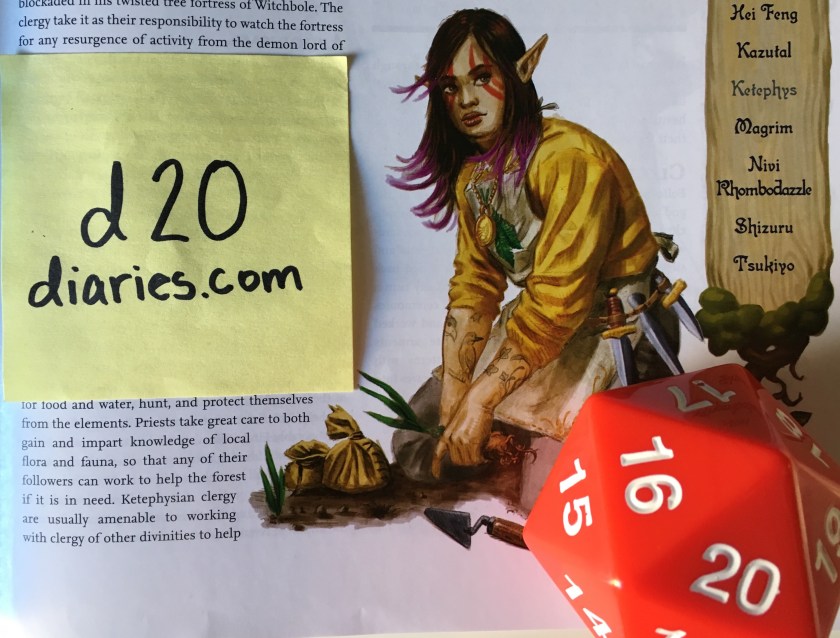
Ketephys is the calm, stoic elven god of hunting, the moon, and the forest. He’s a god of archery, and urges his followers to respect nature, replace what they take, and never waste. This is one of the gods I was most excited to see included in Faiths of Golarion, as the elven deities were among those created back when Pathfinder didn’t have it’s own rules, and I feel like I’ve been waiting forever for further details on them. There are some details, of course. A paragraph or two throughout the various Paizo products, but I wanted more. I would have been happy to see details on any of them, but I’m particularly pleased to see its Ketephys.
A worshipper of Ketephys planting a garden.
Magrim is another deity that’s been around since the beginning of Pathfinder but lacked much information. The dwarven god of death, fate, tradition, and the underworld, he’s fair, unflinching, and unwavering. Magrim considers Pharasma a respected elder, and is often tasked by her to repair damaged spirits that enter the Boneyard. I really enjoyed learning how Magrim fit alongside Pharasma, and his role in the dwarven afterlife.
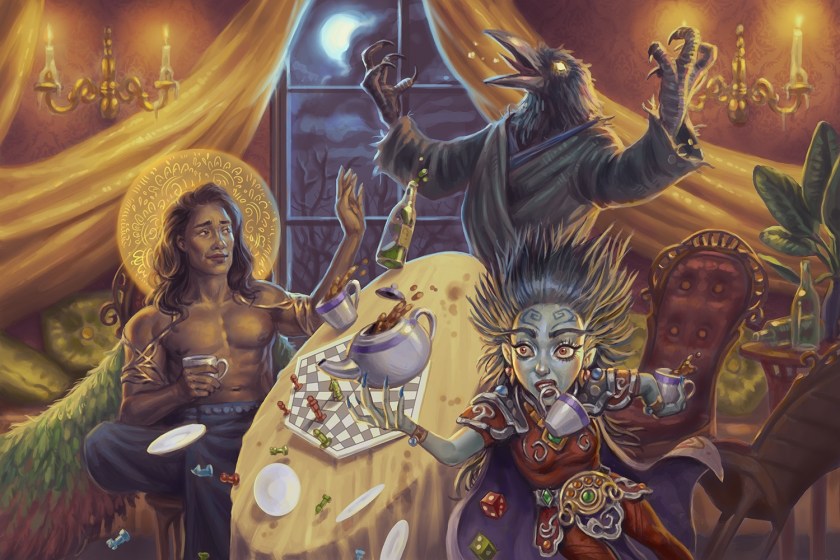
Nivi Rhombodazzle is about as different as Magrim as you can get. This gnome gambler fled underground to escape her many angry creditors and ended up becoming the first of the svirfneblin after she traded a rare gem to Torag in exchange for divinity. Talk about a deal! Nivi’s an impulsive daredevil addicted to the thrill of a wager. She urges others to test their skill, push their luck, and experience the best life has to offer. And when luck turns against you and you’re in a lot of debt? Run, of course! Best of luck! Haha. She’s a tricky, thieving little thing whose faith is said to hold the key to staving off the Bleaching.
Hei Feng proves to be a poor loser in this art featuring Gruhastha, Hei Feng, and Nivi Rhombodazzle. Illustrated by Vicky Yarova. Art courtesy of Paizo Inc.
Shizuru is another of the gods I was most interested in reading about. This draconic Tien goddess is also known as the Empress of Heaven, and is the main deity of the Tien pantheon. A goddess of honour, swordplay, the sun, and ones ancestors, she’s incredibly popular among the people of Tian Xia and players of Pathfinder. I particularly enjoyed reading about her relationship with Tsukiyo, her lover who died and came back to life changed.
Which brings us to Tsukiyo, the final deity in Faiths of Golarion. Killed by his own jealous brother, Tsukiyo was the beloved of Shizuru. But his lover couldn’t accept his death and she ordered Qi Zhong, god of medicine and healing, to bring his back to life. It worked, but Tsukiyo came back changed. Now quiet, contemplative, and possessing an uncommon outlook, he is god of the moon, spirits, and outsiders. He teaches that no matter a person’s perceived flaws and oddities, all are a whole person deserving of respect. This applies to those society shuns, deems insane, are disabled, or those suffering from mental illness. I absolutely love what they did with Tsukiyo. Delightful from start to finish.
Tsukiyo, illustrated by Sandra Posada. Art courtesy of Paizo Inc.
A priestess of Tsukiyo.
Which brings us to the end of Pathfinder Campaign Setting: Faiths of Golarion! If you’re a fan of learning about the many deities of Golarion (like I am) I highly recommend picking up this book!
May is here and plethora of new gaming products are hitting shelves! Check out this month’s new d20 releases!
Dungeons and Dragons
Dungeons and Dragons is releasing two very exciting products this month. Stranger Things D&D Roleplaying Game Starter Set contains everything players need to get started playing D&D – a basic rulebook, an adventure, a set of dice, five character sheets, and an awesome enemy to face off against – all in a retro red box with a Stranger Things twist. The adventure is written in the style of Mike Wheeler, a character and DM from Stranger Things, and pits PCs against a mysterious castle and the Demogorgon! The pre-made character sheets feature the kids D&D characters from Stranger Things, including Dustin the Dwarf, Will the Wise, and so on. Finally, the set comes with two Demogorgon figures (one painted and one unpainted). You can watch Stranger Things on Netflix (I highly recommend it!).
Due out May 21, Ghosts of Saltmarsh is a collection of seven nautical and coastal themed adventures that vary from levels 1-12. These adventures can be run separately, or combined by DMs into one larger campaign. The adventures contained in this volume are all previously published adventures, including some of the most popular first edition D&D adventures and some from Dungeon Magazine. Adventures in Ghosts of Saltmarsh include:
The Sinister Secret of Saltmarsh (originally written by Dave J. Browne and Don Turnbull in 1981)
Danger at Dunwater (originally written by Dave J. Browne and Don Turnbull in 1982)
The Final Enemy (originally written by Dave J. Browne and Don Turnbull in 1983)
Isle of the Abbey (originally written by Randy Maxwell for Dungeon Magazine #34)
Tammeraut’s Fate (originally written by Greg A. Vaughan for Dungeon Magazine #106)
The Styes (originally written by Richard Pett for Dungeon Magazine #121)
Salvage Operation (originally written by Mike Mearls for Dungeon Magazine #123)
In addition to the adventures themselves there’s details on the port of Saltmarsh, mechanics for ship-to-ship combat, new monsters, and new magic items.
Launching next month is Beadle & Grimm’s Sinister Silver Edition for Ghosts of Saltmarsh! Currently available for pre-order on their website, the Sinister Silver Edition contains twelve high quality player handouts, a detailed ship map, a reusable ship map, two large scale battle maps, a map of the Styes, 30 encounter cards (which are designed to be hung over a DM screen so players can see images of the monsters they fight while the DM sees it’s statistics), custom DM screen, two objects, bonus encounters, and characters!
This month’s Pathfinder Society Scenarios have not yet been announced, although canny players can find them on the schedule for PaizoCon (which takes place later this month in Seattle). For more information on PaizoCon and to register for events head over to https://paizo.com/paizocon!
Gardens of Gallowspire (Tyrant’s Grasp Book 4 of 6)
Chronicle of Legends
Pathfinder Adventure Card Game
Very exciting news, as this month the new Pathfinder Adventure Card Game in unveiled! Players can test it out in person at PaizoCon or pick up a copy at the end of the month. Pathfinder Adventure Card Game: Core Set is the base game, which include all the rules, the Dragons Demand adventure series, and a ton of cards. They’re also releasing Pathfinder Adventure Card Game: Curse of the Crimson Throne Adventure Path which is designed to be mixed into the Core Set to create a whole new series of adventures. For more information on some of the changes you can expect to see in the newest version of the Pathfinder Adventure Card Game check out this post, or head straight to the source and check out Paizo’s blog!
WizKids releases some lovely products this month, primarily Pathfinder Battles: Ruins of Lastwall! This brand new set of pre-painted miniatures comes in blind booster boxes that contain four minis each – one large figure and three small or medium figures. In addition to buying a single standard booster box you can order a brick of boosters (which contains eight boosters) or a case of boosters (four bricks for a total of 32 boosters). Anyone who orders an entire case of boosters may also order Pathfinder Battles: Ruins of Lastwall: Cemetery of the Fallen Set which is a collection of graveyard themed set dressing! For images you can check out this blog post from last month, or head straight to the source and view the images on WizKids and Paizo’s blog.
Also out this month is Wave 3 of the Wardlings pre-painted miniatures. My kids and I absolutely adore this line of minis. Each one is interesting, highly detailed, and comes with one youthful adventurer and their pet. A few of the new releases also include male and female versions of eccentric adventurers (such as ghosts, goblins, and zombies), or a single large mini (such as a troll of treefolk).
Wayfinder
Wayfinder Fanzine is a free magazine of fan-created content that releases every year at PaizoCon. Typically filled with Pathfinder content, this years topic is Starfinder – more specifically, Absalom Station! Wayfinder #19 is due out later this month, and will be a free download on Paizo’s website. Although not currently on Paizo’s website, you can find all of the previous Wayfinder issues available, which I highly recommend you download and give a read.
My kids and I are particularly excited for this issue, as each of my kids created an alien that’s going to be featured in the magazine! I wrote a few articles as well (which is awesome!) but not nearly as impressive as my kids doing it. Haha. (Pardon my ‘proud mom’ bragging).
And that’s it for this month! Got a favourite release? I’d love to hear about it!
Today we’re going to take a look at two of the most recent Pathfinder Society Scenarios that are currently available for purchase, and let you know we thought. Although you’ll find references to events in each that I liked or disliked, and comments about specific characters, these scenarios are not explored in detail. It’s not my intention to spoil the events in these scenarios, or give summaries and full reviews, but to share my opinions and provide recommendations. That said, if you want to avoid even minor spoilers then I recommend clicking on a different article. Whether you intend to use these scenarios in home games of the Pathfinder Roleplaying Game, sanctioned scenarios for use with the Pathfinder Society Organized Play, or just want to read a nifty new adventure, we’ve got you covered! So let’s get cracking!
Chalos Visanda from #10-18: The Daughters’ Due. Illustration by Leonardo Santanna. Art courtesy of Paizo Inc.
This adventure tasks the PCs with investigating four missing relics from the Blakros Museum which it’s curator, Nigel Aldain, insists were destroyed or stolen by Pathfinders during their many missions within the Blakros Museum over the years. His boss, Lady Hamaria Blakros, has invited the PCs to her museum to investigate or refute these claims. After this quick mystery the PCs can give their report to Hamaria and even pass judgement on Nigel himself — a turn of events that I’m sure many players will take a perverse joy in. Haha. From there the PCs head into Shadow Absalom, to track down the missing relics and retrieve them from the true thieves. PCs who have played in any of the Blakros-themed Pathfinder Society Scenarios over the years (there’s lots!) will find this mission more relevant and entertaining than those who haven’t. It’s particularly closely tied to the events of Pathfinder Society Scenario #2–11: The Penumbral Accords. PCs who have the “Acquainted with Aslynn” boon from Pathfinder Society #5-09: The Traitor’s Lodge and#7-09: The Blakros Connection have a chance to have a slightly different experience than players who haven’t, although its minor.
Start to finish, this scenario was an absolute joy! The investigations in the beginning of the scenario are interesting. There’s a wide variety of fun social encounters and quirky characters to interact with. The battles were challenging and dynamic, with one of them having the potential to be avoided with clever skill use. Best of all, this scenario includes multiple ways in which the PCs can make important decisions which will come to influence the Pathfinder Society in the future. Overall, I thought this was an excellent scenario that’s going to be a ton of fun to play. It brings the Blakros/Onyx Alliance storyline to a nice ‘conclusion’ for First Edition, which is clearly going to be picked up again in Second Edition. I can’t wait to see where it goes from here!
Ellux Shost, one of the gnomes PCs will have a chance to interact with during their investigation. Illustration by Hannah Boving. Art courtesy of Paizo Inc.
This adventure tasks the PCs with investigating a series of deaths in Kalsgard, all of which occurred in gnomes and were attributed to the Bleaching. Of course, the local priestess of Nivi Rhombodazzle, Quil Tabberdash refutes these claims. Venture-Captain Bjersig Torrsen and his husky Mahki dispatch the PCs to Kalsgard to meet up with Quil and get to the bottom of this mystery! PCs will have a chance to quickly check out a series of crime scenes, dead bodies, and petition neighbours and witnesses for information. As the mystery unravels the PCs will have a chance to follow two different avenues of inquiry with each resulting in a different encounter and event. To make matters even more exciting this is all happening on a backdrop of political turmoil in Kalsgard, and canny PCs can even pick up clues that this mission has a connection to an organization and Adventure Path I’ll leave unnamed. This scenario is a great little mystery that should move at a rapid pace. There’s lots of fun NPCs to interact with. Most are brief witness statements, but Quil is an absolute delight. I’ll leave the other NPCs and villains unmentioned to help prevent too many spoilers, but I will say I enjoyed them all. There’s quite a few fights in this one (although one will be excluded depending on your PCs actions), but it’s the final encounter that will likely prove most challenging. Particularly as the composition of the fight depends upon your PCs actions throughout the scenario. This means that some groups will find it difficult and others… less so. Although this could prove problematic, I think it’s a nice change of pace. I’d be interested to see how this plays out at game tables throughout the Organized Play Community. Overall I thought this was a fun and quirky murder mystery that made an effort to shake things up a bit. I particularly enjoyed that the PCs actions can alter the events and battles in this scenario. I give it four out of five stars.
Thanks for joining us today! We’ll see you again soon!


 is the size and shape of a deck of playing cards. It retails for around $10.99 USD (or around $15 Canadian dollars). There’s a space goblin with a shattered d20 on the box and card backs, with some product information on the back of the box.

 by Ron Lundeen, continues with
  by Eleanor Ferron, and concludes with
  by Larry Wilhelm. All together these three adventures should take your characters from level one through to level seven. You can also pick up the
  .
.
 all about? In previous adventures, the PCs defeated an Azlanti military force that had annexed the small colony of Madelon’s Landing on the planet of Nakondis. But saving the fledgeling colony was just the beginning. The PCs discovered that an experimental starship engine and their friend, the android Cedona, were transported off of Nakondis and back to the Azlanti Star Empire. Giving chase the PCs made some allies and rescued Cedona. All that’s left is to find the experimental starship engine, steal it or destroy it, and escape with their lives. Along the way they’ll fight Aeon Guard soldiers, rescue captive scientists, and face off against the man responsible for sending troops to Nakondis in the first place! No problem! …Right?
 Now, let me take a moment to be clear. The Azlanti Star Empire is a pack of giant, pompous, jerks. They’re great villains for the PCs to clash with, but an overwhelming opponent. This adventure path does not send your PCs off to take down the entire Azlanti Star Empire. It’s much smaller in scale than that. And frankly? I love it. It lends a sense of suspense to the series and makes it feel like you’re playing real people in a living breathing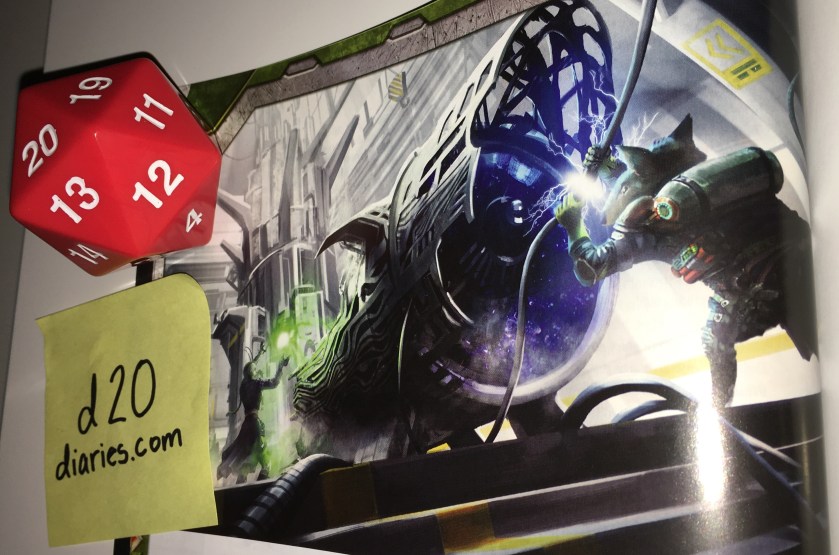


 Hey everyone! Thanks for stopping by. Today we’re taking a look between the the covers of the latest ‘gods’ book:
  There are ten faiths discussed in this book. Each is a lesser detailed but very important faith. This includes a few racial faiths — the halfling goddess Chaldira Zuzaristan, the gnome goddess Nivi Rhombodazzle, the elf god Ketephys, and the dwarf god Magrim. It also includes information on deities from other regions of Golarion such as the Tien gods Hei Feng, Shizuru, and Tsukiyo, as well as the anadi goddess Grandmother Spider who is popular in the Shackles and Sodden Lands, the Vudrani god Gruhastha who is popular in Vudra, and the Razatlani goddess Kazutal who is popular in Arcadia. Each of these faiths is incredibly important to their respective cultures and I’m thrilled to see them get some of the attention they deserve. Information on the racial deities, especially, I feel was long overdue. Before sitting down to read this book I was most excited for further information on Ketephys, Shizuru, and Tsukiyo. All of the entries were great, but after reading I was most inspired to make worshippers of Grandmother Spider, Kazutal, and Tsukiyo.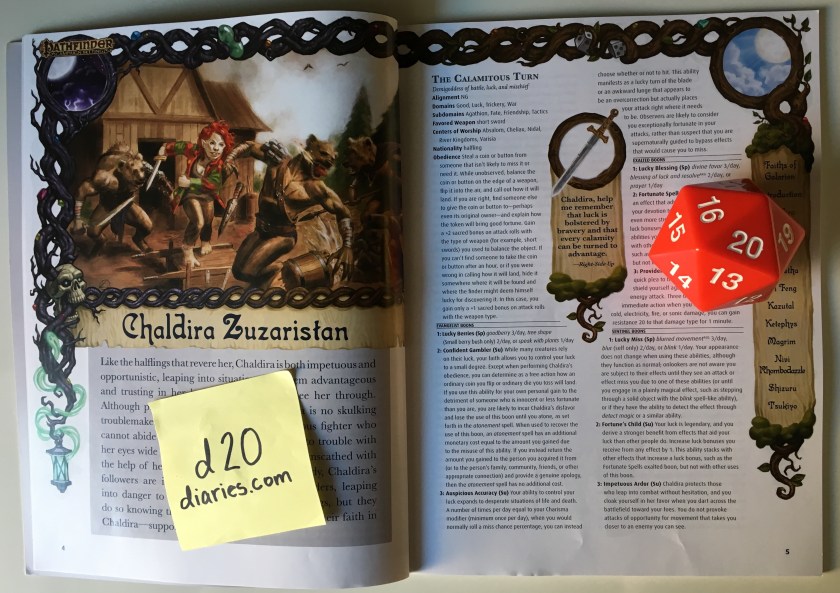






 contains everything players need to get started playing D&D – a basic rulebook, an adventure, a set of dice, five character sheets, and an awesome enemy to face off against – all in a retro red box with a Stranger Things twist. The adventure is written in the style of Mike Wheeler, a character and DM from Stranger Things, and pits PCs against a mysterious castle and the Demogorgon! The pre-made character sheets feature the kids D&D characters from Stranger Things, including Dustin the Dwarf, Will the Wise, and so on. Finally, the set comes with two Demogorgon figures (one painted and one unpainted). You can watch Stranger Things on Netflix (I highly recommend it!).
 include:

 by Larry Wilhelm, and
  by Crystal Frasier and
  and
and  and
and 


 is the base game, which include all the rules, the Dragons Demand adventure series, and a ton of cards. They’re also releasing
  which is designed to be mixed into the Core Set to create a whole new series of adventures. For more information on some of the changes you can expect to see in the newest version of the Pathfinder Adventure Card Game check out

 by Joe Pasini and the
  to look forward to, as well as


 it includes content from the
  (although all of the necessary stat blocks are included within the scenario). It utilizes
  , and a half-page custom map that will look very familiar to some players. For more information on the Shadow Plane check out
  and
and 

 and
and  and
and 

 d20 Diaries