Pathfinder Society Scenarios: Breath of the Dragonskull and Fragments of Antiquity

Today we’re going to take a look at two of the most recent Pathfinder Society Scenarios that are currently available for purchase, and let you know we thought. Although you’ll find references to events in each that I liked or disliked, and comments about specific characters, these scenarios are not explored in detail. It’s not my intention to spoil the events in these scenarios, or give summaries and full reviews, but to share my opinions and provide recommendations. That said, if you want to avoid even minor spoilers I recommend you check out a different article. Whether you intend to use them in home games of the Pathfinder Roleplaying Game, sanctioned scenarios for use with the Pathfinder Society Organized Play, or just want to read a nifty new adventure, we’ve got you covered! So let’s get cracking!

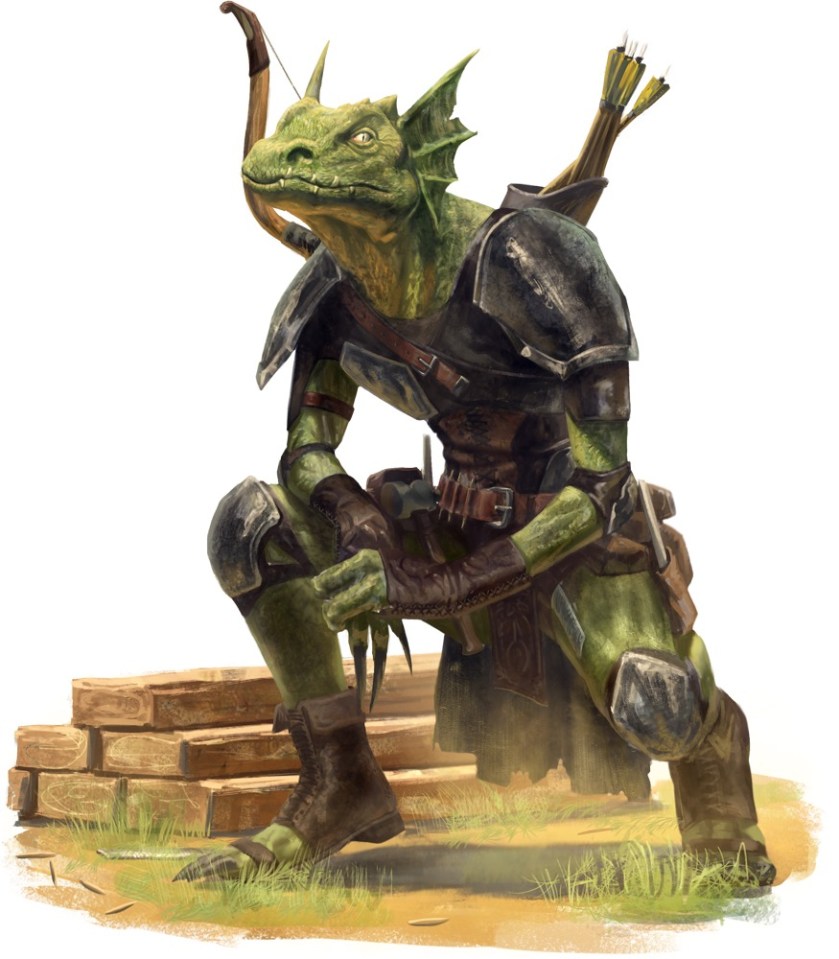
scourge of the farheavens - dolok darkfur - sebastian rodriguez
Dolok Darkfur from #9-18: Scourge of the Farheavens and #10-12: Breath of the Dragonskull. Illustrated by Sebastian Rodriguez. Art courtesy of Paizo Inc.

Pathfinder Society Scenario #10-12:Breath of the Dragonskull is a Tier 1-5 adventure written by Michael Sayre. It takes place in Iobaria, beginning in the Starrise Spire of Nerosyan, before quickly travelling to Mishkar and the Findabar Forest. It features creatures from Pathfinder Roleplaying Game: Bestiary and Inner Sea Monster Codex (although all of the necessary stat blocks are included within the scenario) and includes content from the Core RulebookAdvanced Class Guide, and Ultimate Equipment. It utilizes the Pathfinder Flip-Tiles: Forest Starter SetPathfinder Flip-tiles: Forest Perils ExpansionPathfinder Flip-Mat: Forest Fire, and a custom half-page map.

This adventure tasks the PCs with protecting a caravan of Sarkorian refugees who are scheduled to begin a journey from Mishkar back to their long-lost homeland of Sarkoris (recently the Worldwound). The caravan has run into trouble with goblins, a forest fire, and centaurs, and need assistance so they can get underway. PCs will need to protect the caravan’s members, figure out what the heck is going on, and put a stop to it. Breath of the Dragonskull continues the storyline from #9-18: Scourge of the Farheavens, and features Dolok Darkfur and Nelket, with Jorsal of Lauterbury serving as Venture-Captain. This scenario involves a lot of interacting with the forest fire, so be sure to prepare your characters appropriately after the mission briefing. I loved the new characters introduced in this scenario — particularly Dragbog — and the various social encounters. There’s a lot of them, and they’re great fun. The battles are enjoyable and each is more complicated than it seems, which I was really happy to see. My only complaint is that if PCs manage to avoid some of the encounters (which they could), this scenario could pass by rather quickly. Overall I thought this was a really fun scenario. I can’t wait to run it for my family. I give it five out of five stars.

Kaana Korag by Tawny Fritz
Kaana Korag from #10-12: Breath of the Dragonskull. Illustrated by Tawny Fritz. Art courtesy of Paizo Inc.

Pathfinder Society Scenario #10-13: Fragments of Antiquity is a Tier 5-9 adventure written by Sam Polak that takes place in the Hao Jin Tapestry. It features creatures from Pathfinder Roleplaying Game: BestiaryBestiary 4, and the Monster Codex (although all of the necessary stat blocks are included within the scenario) and contains content from the Core RulebookAdvanced Player’s GuidePlanar AdventuresUltimate Combat, and Ultimate Equipment. This scenario heavily utilizes Pathfinder Flip-Mat: Arcane Library. It also features Pathfinder Flip-Mat: Falls and RapidsPathfinder Flip-Mat Classics: Forest (although it’s unlikely you’ll need to run the encounter that uses the Forest Flip-Mat), and a full-page custom map. This mission continues the ongoing Hao Jin Tapestry storyline. Players who can speak Tien will be a great boon during this scenario.

This adventure tasks the PCs with exploring a library within the Hao Jin Tapestry to collect important documents and clues related to the fate of Hao Jin. But, this isn’t as simple as it sounds. PCs will need to deal with kobolds, traps, and mysterious enemies during their mission, in addition to navigating the library. I thought the library location was interesting and atmospheric, but quite complex, so GMs will want to take some extra time to familiarize themselves with it thoroughly. I really enjoyed the interactions with the Scalebreaker kobolds, although they’re quite brief. Particularly canny PCs may be able to gain some extra insights that will be useful for them later on. This scenario is light on combat, but heavy on hazards, so it balances out quite nicely. The final battle in this scenario was very exciting and could prove to be quite challenging, particularly in the lower subtier. In the hands of a clever GM it would be a blast to play. Overall I enjoyed this scenario, particularly the brief interactions with the Scalebreakers, but it will take a solid GM to really make it shine. It’s not the easiest scenario to run. I give it four out of five stars.

Bridge-and-Logs by Tom Ventre
Bridge-and-Logs, Chieftain of the Scalebreakers from #10-13: Fragments of Antiquity. Illustrated by Tom Ventre. Art courtesy of Paizo Inc.

Thanks for joining me today! I hope you enjoyed taking a look at the new Pathfinder Society scenarios.

Jessica


Crowdfunding Spotlight: Realms of Atrothia

Today we’re talking about a Kickstarter I’m super excited for: Realms of Atrothia: Primary Expansion which just launched this morning! I’ve already made my pledge (although my children are urging me to give more) and  today we’re doing our part to make this book a reality!

So what is Realms of Atrothia?

Realms of Atrothia Primary Expansion

In short, Realms of Atrothia: Primary Expansion is a high quality hardcover d20 book that offers players a rich new campaign setting, imaginative character options, and exciting game mechanics to play around with. It’s Pathfinder First Edition compatible, and scheduled to be released this fall. Realms of Atrothia is the brain child of my brother, Kris Leonard. Kris is the founder of Sunburst Games, an independant Tabletop RPG company focused on Pathfinder Compatible content for the next generation.

I’ve had the opportunity to create plenty of content for this amazing book already, which has been an awesome (and time consuming!) experience. Even more exciting, my daughter’s rabbitfolk race will be featured as a new primary race in Realms of Atrothia! She’s over the moon with this development!

Want more details? Read on for more information straight from the source: Sunburst Games mastermind: Kris Leonard!

“Realms of Atrothia: Primary Expansion is a hardcover book that will surely be the newest addition to any Tabletop Gamer’s library. With an expected release in fall 2019, our Kickstarter just launched this morning. Building upon the legacy of the Pathfinder Roleplaying Game, and the existing d20 game system which is over 35 years in the making, Realms of Atrothia: Primary Expansion includes all new game mechanics, and player options.

Featuring the Realms Campaign Setting, the Ascended system for running a game beyond 20th level, and expanded player content, including new archetypes, base classes, feats, gear, magic items, races, and spells, Realms of Atrothia: Primary Expansion is sure to capture the imaginations of Players, and GMs alike.

You can adventure through a whole new world with lost civilizations, unexplored jungles, and political intrigue abound. Dine with the Hegemony of Kalmarune’s vampire aristocracy. Contend with the Trennian Empire’s claim of national superiority through widespread use of black powder. Push back the ever-expanding armies from the forsaken lands of Xer-Kol whose fanatical peoples serve the whims of the god of corruption bound within their borders. The Realms of Atrothia await.”

Awesome! But, what will we actually be getting?

New Races

Packed with over 25 new playable races, Realms of Atrothia: Primary Expansion features an expansive array of racial options including Alternative Racial Traits, Favored Class Bonuses, Racial Archetypes, and Racial Feats. Including fully re-balanced Legacy Races already seen in the Pathfinder Roleplaying Game, as well as new Primary Races such as the Anithrope, Caitsith, Giantborn, Half-Troll, Hecavus, Immortis, Lupine, Minotaur, Rabbitfolk, Tortoisefolk, and Volaris. If that’s not enough, get ready for dozens of Monstrous Races, such as Cyclops, Dracolyte, Gargoyle, Harpy, Oni, Medusa, Moonbeast, Pixie, Sphinx, Treant, and Yeti! These are powerful races which are modified for play at 1st character level, but cannot reach full strength without pursuing the Exemplar Primary Class for one or more levels.

New Classes

New heroes have arrived with Realms of Atrothia: Primary Expansion. Featuring seven new Primary Classes including Artificer, Erudite, Esoteric, Exemplar, Knight, Priest, and Spellsword, as well as dozens of new Class Archetypes for both the Legacy Classes already seen in the Pathfinder Roleplaying Game and the Primary Classes. In addition they’re introducing a new kind of archetype: Universal Archetypes, which can be taken by any class.

New Worlds

Get ready for a whole new world of adventure! Realms of Atrothia: Primary Expansion includes a new Campaign Setting, the World of Atrothia. Featuring over 25 new deities, including the redeemed knight Davros, and the corrupter Xeronoth, and more than 50 regions to explore, such as the undead aristocracy of the Hegemony of Kalmarune, the pinnacle of prosperity that is Palisade, and the unexplored reaches of the Mogen Wildlands.

New Equipment, Spells, and Game Mechanics

But, that’s not all! There’s new equipment, magic items, spells, and feats for characters of all kinds. There’s also new game mechanics, including the Ascended System, which allows for high level play past 20th level, and ascending to godhood!

To learn more about Sunburst Games, Realms of Atrothia, and their products be sure to check out their website: SunburstGames.com! Want to support the Kickstarter, see some awesome artwork, or find out more? Click here! You’ll be happy you did!

Thanks for joining us today. We hope you enjoy taking a look at Realms of Atrothia!

Dream big,

Jessica

Check out some of the wonderful art that will be featured in Realms of Atrothia: Primary Expansion! Art courtesy of Sunburst Games. Illustrated by Rigrena

Starfinder Society Scenarios: Survivor’s Salvation and Treading History’s Folly

Today we’re going to take a look at the two most recent Starfinder Society Scenarios that are currently available for purchase, and let you know we thought. Although you’ll find references to events in each that I liked or disliked, and comments about specific characters, these scenarios are not explored in detail. It’s not my intention to spoil the events in these scenarios, or give summaries and full reviews, but to share my opinions and provide recommendations. That said, if you want to avoid even minor spoilers I recommend you check out a different article. Whether you intend to use them in home games of the Starfinder Roleplaying Game, sanctioned scenarios for use with the Starfinder Society Organized Play, or just want to read a nifty new adventure, we’ve got you covered! So sit back, and get ready to explore the Pact Worlds!

Starfinder Society Scenario #1-30: Survivor’s Salvation is a Tier 1-4 adventure written by Kiel Howell. It takes place on Absalom Station, beginning in the Downlow District, then travelling to the Lorespire Complex (home of the Starfinder Society), and down to the Spike. This scenario does not contain starship combat.  It features the Faction (Exo-Guardians) tag, and continues the ongoing Scoured Stars storyline, particularly the events of Scenario #1‑99: The Scoured Stars Invasion. Although playing #1-99 before this scenario is not necessary, doing so will lend more emotional weight to the events of this scenario. Survivor’s Salvation uses two custom half-page maps, and no flip-mats. In addition to the Starfinder Core Rulebook, this scenario features content from the Alien ArchiveAlien Archive 2Armory, and Pact Worlds. All necessary stat blocks are included in the scenario itself. If you happen to have any characters who are doctors, psychologists, healers, or particularly caring or empathic I highly recommend you bring them. This is a great scenario to role-play such characters. On the other hand, if you’ve got particularly blood-thirsty, insensitive, or mean PCs, I recommend you let them sit this one out, and bring a different character. This scenario touches on serious themes such as mental health, PTSD, and depression, so if you’re uncomfortable with such topics, you might want to give this scenario a pass. Finally, it should be noted that my kids (who are nearly seven and eight years old) would be freaked out by the final villain in this scenario. You have been warned! Haha.

Survivor’s Salvation begins in a warehouse that serves at the Exo-Guardians base of operations, which Starfinders who have played #1-01: The Commencement or #1-04: Cries from the Drift will recognize. There your players will have a brief chat with Zigvigix, leader of the Exo-Guardians. Ziggy informs the party that Hurondo, a high-ranking shobhad Starfinder who retired after being rescued from the Scoured Stars system, recently went missing. Hurondo runs a medical facility within the Lorespire Complex called Respite, which offers support and services to Starfinders who have suffered trauma. His disappearance has Ziggy worried, so they want you to investigate. At Ziggy’s request you can check out Respite, interview Hurondo’s co-workers and patients, and try to track the big fellow down. Because this is a mystery I won’t reveal too much more abut the plot than that. I will say that more than one life hangs in the balance. No pressure! Other than Zigvigix this scenario has no recurring characters. New characters of import introduced include Hurondo, Jiwalla Zarvim (a ysoki who works at Respite), Petine, Bygones-B, Quadrant-2, Orghuun, and Bargai (a deaf vlaka who I really enjoyed).

bargaibynicolasespinoza
Bargai, a deaf vlaka from Starfinder Society Scenario #1-30: Survivor’s Salvation. Illustrated by Nicolas Espinoza. Art courtesy of Paizo Inc.

Mental health is a touchy subject for some, and I thought this scenario did a wonderful job of shining a light on trauma, depression, post-traumatic stress, and other mental health issues, along with the stigma that can be associated with them, without being insensitive or preachy. You have plenty of opportunities as players to offer support to, gain insight from, and empathize with the various side characters throughout this scenario, all while fulfilling your mission objectives. In fact, the opening series of social encounters at and around Respite turned out to be one of my very favourite parts of the scenario. I also really enjoyed the tense social interactions with Bargai. The true villains of this scenario were exceptionally well-utilized, and I can’t wait to see what further events they could later be linked to. The final battle is quite dynamic, but to retain the element of surprise we won’t go into any more detail that that. Overall, I loved this scenario. It had a ton of engaging social interactions, interesting enemies, and a dynamic final encounter. It’s one of those scenarios where your actions clearly matter. I give it five out of five stars.

Starfinder Society Scenario #1-31: Treading History’s Folly is a Tier 3-6 adventure written by Vanessa Hoskins. It takes place on Kukanou-2b, a hot, toxic, shattered moon in the Vast that orbits the gas giant Kukanou. You’ll definitely need to use your armour’s environmental seals for this mission, so if you’re using a character who doesn’t have armour, buy some. This scenario features the Faction (Second Seekers [Jadnura]) tag and does not contain starship combat. It continues the ongoing Scoured Stars storyline — particularly Scenarios #1-11: In Pursuit of the Scoured Past, #1-13: On the Trail of History, #1-17: Reclaiming the Tome-Lost Tear, #1-23: Return to Sender, #1-99: The Scoured Stars Invasion, and #1-29: Honorbound Emissaries — although it does so in a completely different way than Survivor’s Salvation. It features a minor encounter that has ties to Scenario #1-24: Siege of Enlightenment and will have further connections to the upcoming Scenario #1-37: Siege of Civility. If you have any characters who have played Siege of Enlightenment I recommend bringing them along, but not at the expense of characters with ties to the Scoured Stars. Finally, characters who have the ‘Abysshead Download’ boon from Scenario #1-06: Night in Nightarch will need to endure an unfortunate surprise (which I enjoyed!). Treading History’s Folly makes use of Pathfinder Flip-Mat: Cavernous Lair and Pathfinder Flip-Mat Classics: Village Square.  In addition to the Starfinder Core Rulebook it contains content from the Alien Archive and Armory. It’s only recurring characters are First Seeker Jadnura (who was previously featured in Scenario #1-99: The Scoured Stars Invasion and #1-26: Truth of the Seeker) and Iteration-177 (who was previously featuring in Scenario #1-05: The First Mandate, #1-11: In Pursuit of the Scoured Stars, and #1-29: Honorbound Emissaries).

kadricalsymbolbygraeyerb
The symbol of Kadrical. Illustration by Graey Erb. Art courtesy of Paizo Inc.

Treading History’s Folly begins when the PCs accept a secret mission on behalf of First Seeker Jadnura. Wracked with guilt over his past decisions, which lead to many agents losing their lives in the Scoured Stars Incident, Jadnura is searching for meaning. He wants a team of reliable agents to visit the location where he originally found the Tear that lead him to discovering the Scoured Stars trinity system. Your PCs mission it to investigate the site and see if he missed anything that could have fortold the danger the system posed. It’s a fun adventure that features a few interesting social interactions, and plenty of traps, hazards, and enemies. My favourite part was the exploration of Xaharee. It’s a really cool, atmospheric location, that gives clever PCs the chance to learn a LOT about the Scoured Stars trinary system and the Tears. Although some of this information can be gleaned from previous scenarios, a lot of the information is brand new. Very cool! There’s also a surprisingly touching player hand-out, which I always enjoy. This scenario’s chronicle features two easy to acquire boons and some nice thematic gear for both sub-tiers. One of the boons is another segment of the mysterious ‘Journey to the Scoured Stars’ boon which doesn’t do anything right now but promises to do something in the future. The second boon is a really useful limited use ally boon. Overall, I really enjoyed this scenario. It was unique, atmospheric, and enlightening, I give it four out of five stars.

Haunted Earth Elemental by Graey Erb.jpg
An earth elemental haunted by the mentrasi from Starfinder Society Scenario #1-31: Treading History’s Folly. Illustration by Graey Erb. Art courtesy of Paizo Inc.

Thanks for joining me today. I hope you come to love these two solid Starfinder Society Scenarios as much I do. Be sure to come back later this week when we take a peek at the two newest Pathfinder Society Scenarios.

Jessica


Pathfinder Adventure Card Game: Revamped!

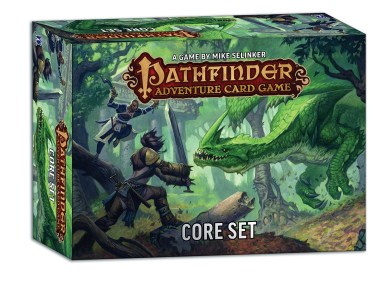
pathfinder adventure card game core set
Sneak peek of the upcoming Pathfinder Adventure Card Game: Core Set! Awesome!

Exciting news from Paizo this week as more spoilers and sneak peeks for the Pathfinder Adventure Card Game were shared with the world.

For those of you who don’t know, the Pathfinder Adventure Card Game is a cooperative strategy card game that allows 1 to 6 players to take on the role of heroes and pits them against monsters, traps, henchmen, and villains. Players will also have the opportunity to discover treasure, magical spells, divine blessings, and allies, as they struggle to complete their goals. “Each player has a unique character composed of a deck of cards and a set of stats. Roleplayers will find the stats very familiar—characters have classes such as fighter, wizard, and rogue, as well as numbers that define strength, dexterity, intelligence, etc.” Over time you’ll customize your deck and character, either by earning new rewards, or by buying Character Add-On Decks (there’s a whopping twenty-seven of these, by my count!). To begin play you need one of the Base Sets, each of which includes the first chapter of an adventure path and all the cards you need to play it. Once you’re done the Base Set you can continue with follow up Adventure Decks, which continue the story for yours characters. Base Sets currently include Rise of the Runelords (along with it’s five Adventure Deck expansions: The Skinsaw MurdersThe Hook Mountain MassacreFortress of the Stone GiantsSins of the Saviors Deck, and Spires of Xin-Shalast), Skull and Shackles (along with it’s five Adventure Deck expansions: Raiders of the Fever Sea, Tempest Rising, Island of Empty EyesThe Price of Infamy, and From Hell’s Heart), Mummy’s Mask (along with it’s five Adventure Deck expansions: Empty GravesShifting SandsSecrets of the SphinxThe Slave Trenches of Hakotep, and Pyramid of The Sky Pharaoh), and Wrath of the Righteous (along with it’s five Adventure Deck expansions: Sword of ValorDemon’s HeresyThe Midnight IslesHerald of the Ivory Labyrinth, and City of Locusts).

But, there’s changes coming to the Pathfinder Adventure Card Game! Lots of changes!

Last year it was announced that the Pathfinder Adventure Card Game was getting revamped. Not rebooted, mind you. All of your old cards will still work with new ones. But, updated.

Why?

In short, they want to make the game better, faster, and smarter. When asked what challenges the game faces, Mike Selinker explained the following issues:

  • “The game is a bit too slow in all phases: how long it took to set up, how long it took to take a turn, how long it took to tear down. We looked for solutions that sped up everything, even if we gained just a few seconds here or there.”
  • “For a game set in one of the most expansive fantasy worlds ever made, we gave you too little story. The opportunity we had to tell stories was mostly limited to tiny boxes on the backs of cards, and conveyed very little of the depth the orignal storytellers had given us.”
  • “Though we tell many different stories, the game often gives off a feeling of sameness.”
  • “Groups of players get varying experiences by group size. A solo character is less likely to run out of time and more likely to die; the reverse is true for large groups. While that’s fine, giving people the ability to toggle those variables seemed smart.”
  • “Many cards have complicated text. We’ve piled template upon template, sometimes requiring three or four powers on a card before we started making it interesting. Certain card types like armors and spells got burdened in ways we never envisioned.”
  • “Some sets were easy and some were hard, but regardless there was no way to control difficulty. If you wanted to make the game harder, you were on your own. We will benefit from giving players controls for this.”
  • “For a cooperative card game, the game is often not interactive enough. When you want to help your friend, the game generally tells you that you can’t unless you have a card that does so. It’s a co-op game, so it should feel more cooperative.”

They’ve come up with a lot of ways to solve these problems and over the last few months they’ve shared some of the results with us. Further changes and details will continue to be released up until the release of the Core Set this summer. So what do we know so far?

The game boxes will be smaller. The Core Set will measure 9″ x 12″ with Adventure Paths measuring 7.5″ × 9″. That’s a huge improvement!

The story your players go through in each game will be focused on more, and made much more clear. Personally, I’m thrilled for this change, as it’s the rich stories and worlds which drew me to Pathfinder in the first place. Inspired by the exciting stories of the Pathfinder Adventure Card Game Guild, they’re getting rid of Adventure Path, Adventure, and Scenario cards, and creating a storybook instead, which will have much more story and content. Each scenario will have a two-page spread in the 5.5″ x 8.5″ storybook. For the Core Set this storybook will be 24 pages long. Curious what this would look like? Check below!

sample story - core set - adventure 1 - welcome to belhaim - scenario 0 - rumble road
An unfinished sample of Scenario 0 from the Core Set Dragon’s Demand Adventure Path. Image courtesy of Paizo Inc.
PZO6040-StorybookSpread
A finished sample of Scenario 1C from the Core Set Dragon’s Demand Adventure Path. Image released during PaizoCon 2019, courtesy of Paizo Inc.

There’s also going to be a variety of ways for you to change the difficulty and length of your games — which is awesome! As a player with young kids, this is a must have for everyone to enjoy the game. Shockingly, my kids don’t like dying all the time. Haha. To aid with this you’ll have the ability to use small, medium, and large locations, and you’ll be allowed to add or remove cards from the Blessings Deck, which is now going to be called the Hourglass. They’ve also added Wild Cards, which can alter scenarios and affect difficulty.

This past week they unveiled some further changes which highlight how they’re streamlining and simplifying the game, it’s text, and its rules. This would make it easier to understand, play, and would fix up any known rules quibbles and difficulties. Simple, right? Not so! That’s a ton of work and much easier than it sounds! Haha. New key words have been added to the game which allowed them to get rid of a lot of repetitive and confusing text that appeared on the cards. Reload, Local, Distant, Hour, Hourglass, and Vault are among some of the new terms. But, you can bet there’s plenty more where that came from. Other terms, like Basic and Elite, were removed from the game. The rulebook will contain a glossary, for ease of reference, and some notes on how to use cards from generation one that feature removed terms.

Want a sneak peek at some of the new cards? Below are some examples of what Paizo has shared with the public so far.

Looking good!

So, how is this going to affect the actual products we’re buying? For starters, all you need to play is the new Core Set.

pathfinder adventure card game core set

The core set contains 440 cards and is based on the mega-module Dragon’s Demand, an adventure that sees your players stranded in a small town called Belhaim. Shortly after arriving an old tower in town collapses, some kobold corpses turn up, and the town wizard goes missing. In time they’ll see there’s more going on here than meets the eye, and face off against a legendary dragon who was supposedly killed long ago. The Core Set allows 1-4 players to play. It contains 12 character pawns of the Iconic Classes (the eleven Core Iconics, plus Fumbus the new Iconic Alchemist), a set of dice, tokens for tracking scourges, a quick start guide, a rulebook, and the storybook for running the Dragon’s Demand Adventure Path. In addition to the cards needed for Dragon’s Demand, the Core Set also contains “a modular core for infinite scenarios that allows you to control the difficulty and speed of play.” Colour me intrigued!

In addition, they’ll continue to release Adventure Paths. To play, you mix the cards from the Adventure Path in with the Core Set, and you’re good to go. Want to play a different Adventure Path? Just mix the Core Set with a different Adventure Path. This will even work with the previous Adventure Path releases, like Rise of the Runelords. As an added bonus, this allows you to play with a fifth and sixth player (if you so choose). And the first Adventure Path they’re releasing? Curse of the Crimson Throne, which is one of my very favourite Adventure Paths. So exciting!

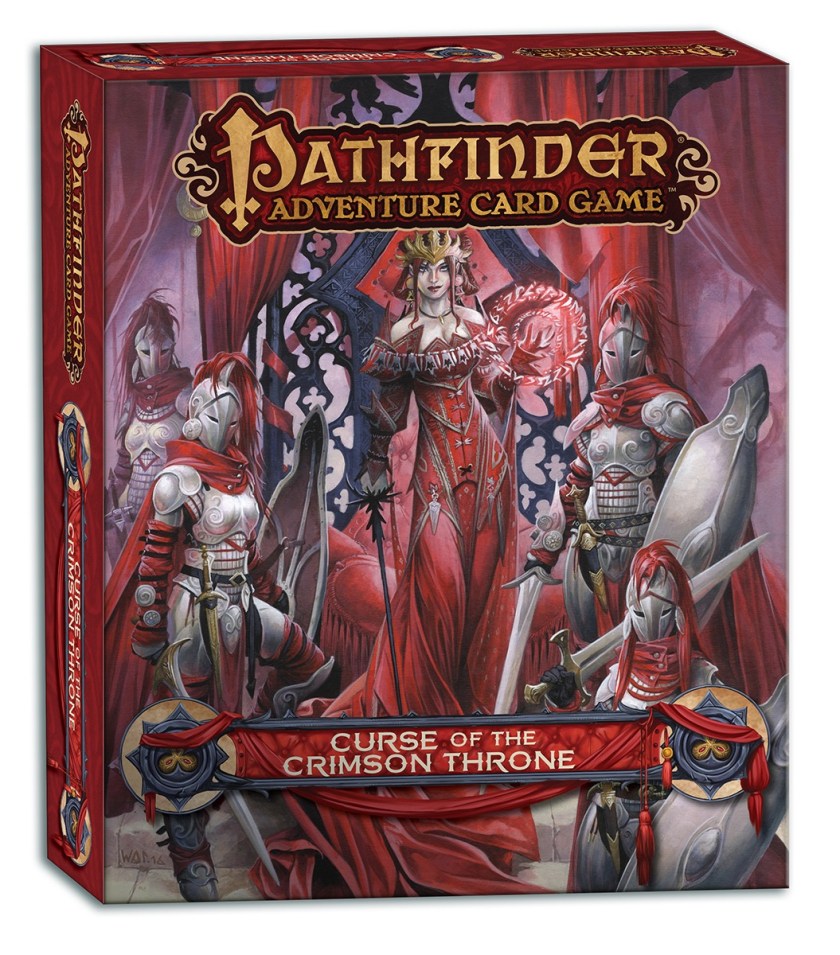
pathfinder adventure card game - curse of the crimson throne

This one Adventure Path release contains the entirety of the Curse of the Crimson Throne Adventure Path. Yup! No more multiple expansions needed. Just this one box and the Core Set. Awesome! It contains 550 cards, a 48-page storybook, and four new character pawns (Hakon the skald, Kess the brawler, Quinn the investigator, and Varian Jeggare the wizard). It’s going to be awesome!

Want to read more about the changes? Click on the following links to read the full spoilers on Paizo’s website: Designing the Next Pathfinder ACG, Injecting Story into the Pathfinder ACG, Varying Challenge in Pathfinder ACG, and Rethinking Complexity in Pathfinder ACG: Part One. More details will be released in the coming months.

Can’t wait to get your hands on the Core Set and Curse of the Crimson Throne? Neither can I! Preorders are expected in May 2019.


UPDATE: The Pathfinder Adventure Card Game is OUT! You can also download a free copy of the rules from Paizo here! Want to buy a copy? Check out the links below!

Pathfinder Adventure Card Game: Core Set

Pathfinder Adventure Card Game: Core Set (direct from Paizo)

Pathfinder Adventure Card Game: Curse of the Crimson Throne Adventure Path

Pathfinder Adventure Card Game: Curse of the Crimson Throne Adventure Path (direct from Paizo)

Free RPG Day 2019 Products Announced!

Exciting news from Paizo as their upcoming releases for Free RPG Day 2019 have just been announced!

Established in 2007, Free RPG Day works with participating hobby game retailers and RPG publishers to bring new and exclusive RPG products and adventures into the hands of gamers worldwide. Fans can grab brand new material for a variety of RPGS for free by stopping by their local participating game and hobby shop.

Last year my family had a ton of fun with Free RPG Day, particularly with Paizo’s two releases: Skitter Shot, a first level Starfinder adventure featuring a crew of excitable skittermanders, and We Be 5uper Goblins, a hilarious sixth level Pathfinder adventure featuring some infamous goblin heroes on their most epic and amazing adventure yet! For those of you who missed FREE RPG Day 2018, both modules are available as a free download on Paizo’s website, or as a physical copy for five dollars.

This year Free RPG Day will be held on June 15, 2019, with Paizo’s free downloads of the PDFs being available on July 1, 2019. So what are they bringing to the table this year?

For starters, our skittermander heroes from Skitter Shot are set to continue their adventures in Skitter Crash! Written by Jason Keeley, this is a third level Starfinder module that sees our skittermander heroes crash their ship on a mysterious swampy planet after a run in with space pirates and an interstellar cyclone! They’ll need to find their ship, deal with the space pirates, and (of course!) make some nu-friends! It sounds like a blast! I’m absurdly excited for this!

skitter crash - free rpg day 2019

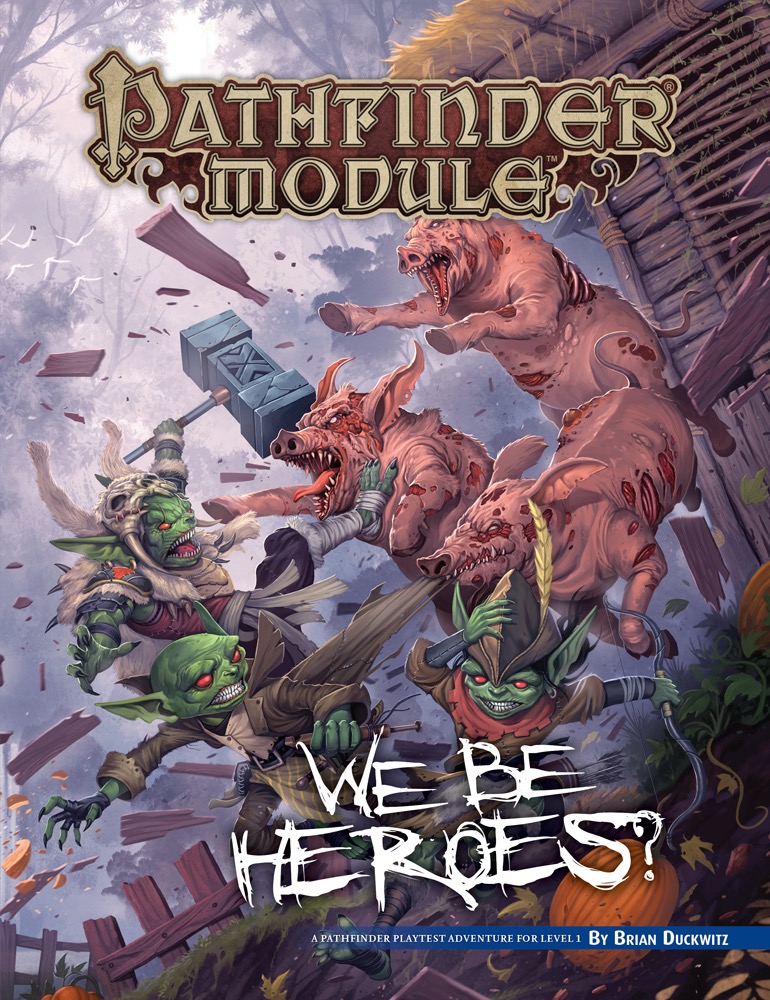
Their second release is called We Be Heroes and will be a Pathfinder Playtest adventure, using the final version of the Playtest rules. This adventure will not grant Playtest Points, but will instead provide players with a chronicle they can apply to a second edition Pathfinder Society character once the new edition is released. We Be Heroes is a first level adventure written by Brian Duckwitz which continues the tradition of the super popular We Be Goblins series (We Be Goblins!, We Be Goblins Too!, We Be Goblins Free!, We B4 Goblins!, and We Be 5uper Goblins!). However, this adventure features a whole new team of goblin adventurers who are set to take on the minions of the Whispering Tyrant! (And zombie pigs?!) Driven by hunger and the orders of their chief, the goblins of the Crookedtoes tribe are tasked with finding out why all the animals in the forest have fled the region, and what happened to the tribe’s best scout. They get to meet up with some heroic knights, explore a wrecked farmhouse, and… be heroes! I’m excited to give this one a read.

we be heroes? free rpg day 2019

For more information on Free RPG Day, check out the official website! They’ll have more information up in the coming months. Got any stories about previous Free RPG Days you want to share? Let us know in the comments!

Jessica

We Be (Good) Goblins
My daughter’s reaction when she realized goblins would be a playable races in Pathfinder Second Edition. Guess her dreams just came true!

Review: Endless Quest

I have always loved ‘Choose Your Own Adventure’ books. Whenever I see one that my kids might like I let them give it a look-see or check it out from the library. Both of my kids enjoy them, particularly the ‘You Choose: Scooby-Doo‘ series. There’s plenty of others they’ve read. Choose your own adventure style books featuring SupermanBatman, the Justice LeagueLEGO® Batman, and even Pokemon (ReaderActive). And, of course, my son’s tried the official ‘Choose Your Own Adventure’ books. My daughter’s too young to read them, and my son could, but he just doesn’t like reading small letters.

So this past holiday season when I realized that Dungeons and Dragons had put out a series of choose your own adventure style kids novels, I immediately looked them up online, put them on hold at my local bookstore, and took a trip out to pick them up. I stood there in the bookstore, opened them up, and was… IMPRESSED! They’re really high quality, with lots of cool artwork and a bigger sized font my son will be happy with. So I brought them home, wrapped them up, and that was that. When my son opened them he was amazed. Absolutely thrilled. He started reading them almost right away.

blog endless quest spreadAfter about ten minutes he stopped and said: “Mom, I just died. Actually DIED! This is… This is… This book is dangerous! Poisoned mushrooms killed me!”

I laughed and he went on reading.

“Okay, now I got squished by a giant!”

Which got me thinking. Death was a pretty common occurrence in the ‘Choose Your Own Adventure’ series of books I read as a kid. So was failure. But in the ‘choose your own’ books my kids have read? Not a thing that happens. Batman doesn’t die. Superman doesn’t die. Scooby-Doo doesn’t die (okay, once Fred dies). Ash obviously doesn’t die, either. Not every ending is a ‘win’ — although most are —  but losing isn’t quite so final.

I watched my son for a while, curious if he would get frustrated and put the books down.

He didn’t.

He read them, read them again, and read them a few more times. Then he moved onto a different one. In the weeks since he’s read them all a lot. Finally, just yesterday, he let me pick them up and give them a read myself. Now, I’m a bit of a completionist when it comes to this style of book. I read through the way I want to, then go back and try out the different options, then go back further and do the same again, and again, until I’ve got to experience most (if not all) of the book within a day or so.

And you know what I’ve come to realize?

My son makes horrible decisions! Hahaha. It’s not that there’s no way to ‘win,’ because there is. There’s plenty of ways to lose but survive, as well. But my son? Nope! He dies every time.

Curious, my daughter gave one a try. It was ‘Into the Jungle,’ one of the books that has a lot of ways to die, a lot of ways to survive, but I hadn’t yet found the ‘perfect ending’ where you live and achieve all your objectives. So, there was my daughter, sitting there and reading the book aloud. It took her a while, since the books are a bit above her reading level. But an hour or so later she smiled, put down the book, and said: “That was good.” I sat down beside her to see how her story had ended. Much to my surprise she had found the ‘perfect ending.’ Hahaha. My son was so jealous! Heck, I was jealous!

We’ve had a ton of fun with these books. So, today we’re shining a light on them and spreading the word!

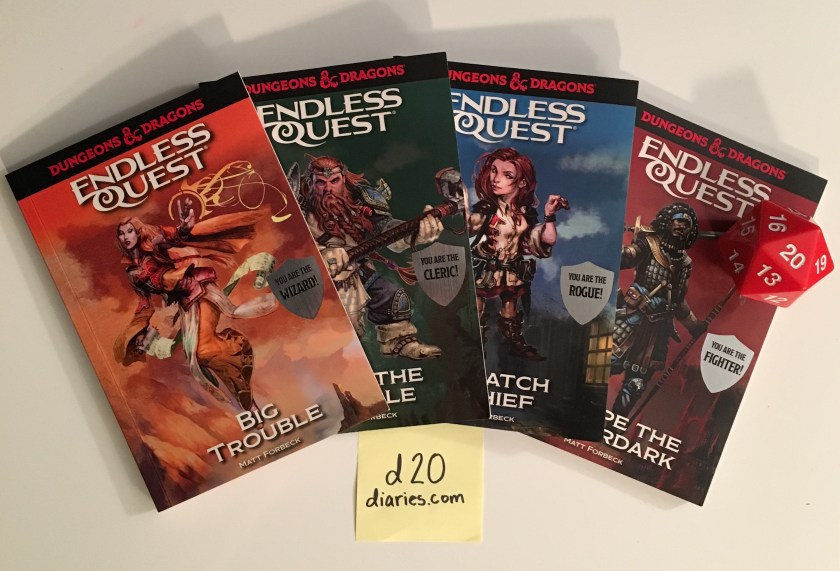
blig endless quest spread 2Endless Quest is a series of four ‘choose your own adventure’ style novels aimed at middle-grade readers (eight to twelve year olds, although my kids are six and seven years old and both enjoyed them). Written by Matt Forbeck, each official Dungeons and Dragons book casts you in the role of a different class. Endless Quest: To Catch a Thief lets your kids (or you!) be a female halfling rogue, Endless Quest: Into the Jungle casts you in the role of a male dwarf cleric, Endless Quest: Escape the Underdark lets you play as a male human fighter, and Endless Quest: Big Trouble lets you play as an female elf wizard. While reading the book your character’s gender has no bearing on perspective or story. It’s invisible, honestly. Only the image on the front reveals your gender. Which is awesome! Both of my kids immediately assumed the character was just like them, irrelevant of the cover image, slipping into the role without hesitation.

Each softcover book is exactly 122 pages long. Most of the pages are filled completely with text and images (no wasted pages here!), and both of my kids found the font size comfortable. All of the books contain a lot of awesome artwork. Some images are in full colour — typically locations or a main character/villain — while the rest are in sepia tones. You’ll find images of allies, enemies, items, equipment, maps, scenery, and locations. Some of the images are even tactical maps, which everyone in the house enjoyed examining. Two of the images  are on the gory side (a zombie with his insides hanging out from ‘Into the Jungle‘, and a grotesque female hill giant devouring hunks of questionable pink meat from ‘Big Trouble‘). Each of the books follows a different kind of story, features different main characters with unique motivations and personality traits, involves different situations and enemies, and takes place in vastly different locations. You’ll get to visit actual places from the Dungeons & Dragons campaign setting, both on a large and small scale, which fans of D&D will love. Each book also has cameos from known D&D personalities (including Elminster, Volo, and Xanathar, to name a few). The decisions you get to make are important. Common choices include deciding which way to go, how you choose to deal with other characters, and how you react to situations. Each of the books has ways to ‘win,’ to happily survive but fail, to survive but fail horribly, and to die. The number of these outcomes varies between each book, with the most deadly having about half of its endings fatal. None of the deaths are graphic, and many are suggested more than described. Some of the endings are quite abrupt, and if you make poor decisions right from the start your story could be over in only a few pages. But, that’s to be expected in books of this kind. My biggest complaint? Names! A lot of characters and places have difficult to pronounce names which the vast majority of kids will just skip over instead of bothering to sound out. Some of them I even stumbled over on first glance. For my kids? Those words are just Sli-jibberjabber or Nya-somethingsomething. Also? Battle is nearly always fatal. Fair! But, at the same time, battle is a big part of RPGs, and some of these characters — the cleric and the fighter particularly — seem like they should be capable combatants.  That they die so easily and so often in a fight is a little jarring. For me, anyway. My kids didn’t mind too much.

It should also be noted that these books very often intersect with other D&D books and products. Two books directly mention Volo’s Guide to Monsters and one mentions the kids book Dungeonology (also penned in lore by the infamous Volo). Characters and events from some of the other books also connect to major campaigns, as noted below. My kids and I thought this was awesome! But, not all parents will. Particuarly if it makes your kids want those (pricy) books. Haha.

So what exactly are these books?

EndlessQuest_ProductImage_Cleric_full
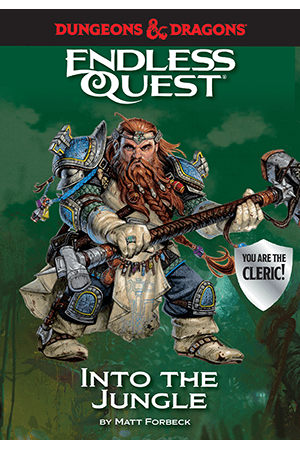
Take on the role of a dwarf cleric in Endless Quest: Into the Jungle by Matt Forbeck.

My son’s favourite book was ‘Into the Jungle,’ which lets you play as a male dwarf cleric of the god Clangeddin Silverbeard, the dwarven god of honourable battle.  Your character was given a mission by the Harpers, to track down an ex-member of their order by the name of Artus Cimber and retrieve a powerful magical ring that is in his possession, the Ring of Winter. In the wrong hands this ring could bring about an eternal winter, and the Harpers want the ring to remain in their possession. Artus has disappeared in the jungles of Chult, and its up to you to track him down, retrieve the ring, and bring it back. This was the most deadly of the books, with only one ‘perfect ending’ (which my daughter discovered on her first try), a heavy amount of ‘survive but fail’ (only two of which have a happy tone), and a whole lot of fatal endings. Despite its lethality, both of my kids adored it. There’s a pair of lovable characters you can befriend (Qawasha the druid and Kupalué the friendly vegepygmy), a wide variety of exciting locations to explore (from dinosaur races to ancient ruins), tons of cool enemies to encounter (including a stone golem, froghemoth, zombie tyrannosaurs rex, green hag, and the witch Nanny Pu’Pu), and a variety of interesting races to interact with (like pterafolk, grungs, aarakocra, and goblins). Famous cameos include Volo, the Harpers, Artus Cimber, and the Red Wizards of Thay. The majority of the book deals with the hazards of the jungle, and the undead which are rampant throughout it — particularly zombies. My son’s favourite part of the book was the variety of cool places you visit, and a timely rescue from stone golems by an aarakocra (eagle-people). My daughter’s favourite part was when she read the book for the second time and was killed by eating a tasty (but poisonous) dinner with a tribe of adorable grungs (humanoid poisonous tree-frogs). My favourite part? Your side-kicks! Qawasha and Kupalué are wonderful guides and great fun. As an added bonus, certain circumstances can make them turn against you, which gives your decisions extra weight. There’s also a series of lovely interactions with the witch Nanny Pu’Pu which will force you to choose between your morals and survival. Your character will then have to deal with the ramifications of that decision. Awesome! The downsides? I found that the main character doubts his faith a lot. He’s he’s in a bad situation he often wonders why his god is displeased with him or has abandoned him. Now, I’m not saying it’s not alright to have a crisis of faith, but he has them a LOT, which is a strange character trait to give a devoted cleric. My other complaint? As previously mentioned, if you get into a fight chances are you lose. Which is unfortunate when you’re playing a cleric who gets to fight against undead and worships a god of honourable battle. That’s not to say he never wins a fight — cause he does. It just doesn’t often happen. I’m totally fine with him dying against a stone golem, or a froghemoth, or a swarm of pterafolk who drop him to his death. But against a few zombies? Or a few goblin and some zombies? It makes him feel a little lame. Overall, we all really enjoyed ‘Into the Jungle.’ My kids loved it most and both give it a rating of “Awesome,” while I really enjoyed it. The characters and events in this book are tightly intertwined with the Tomb of Annihilation campaign and Board Game. Artus Cimber also appears in the books Realms of Valor: The Family Business, and The Ring of Winter (which I can’t seem to find available online, but I could find as an audio book).

EndlessQuest_ProductImage_Fighter_full
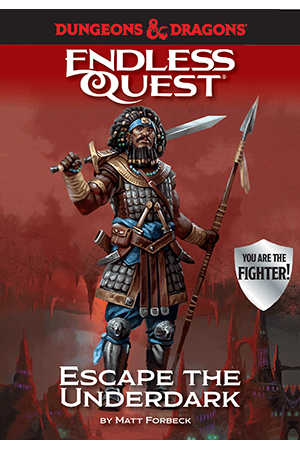
Take on the role of a human fighter in Endless Quest: Escape the Underdark by Matt Forbeck.

The second most-deadly of the Endless Quest books is ‘Escape the Underdark.’ In this book you play as a male human fighter who is captured by drow. You begin the book by waking up in a prison cell (classic!) alongside a motley crew of other prisoners. It’s up to you to escape or die trying! But, as you’ll soon learn, escaping isn’t the hardest part. Getting back to the surface alive is. Depending on your choices you’ll get to face off against a wide variety of underground hazards and enemies. Much to my surprise the fighter can make a lot of allies. In addition to the other prisoners you start the book alongside, you can befriend myconids, and ally with an opportunistic kuo-toa, duergar, a dangerous red dragon, and even an intelligent gelatinous cube named Glabbagool. My favourite of your allies are a pair of quirky goblins named Spiderbait and Yuk Yuk. They were both adorable and hilarious. I love them! The locations you visit are surprisingly varied, including cities, underground lakes, and even a crevasse filled with spider webs that acts as a kind of highway for adventuresome locals. In addition to the prison located in Velkynvelve, which is where you start the book, you can travel to the famous drow city of Menzoberranzan and the duergar city of Gracklstugh.  Although Menzoberranzan has no happy endings, visiting the duergar can lead to a variety of adventure, some of which can lead to back to the surface. There’s plenty of foes for you to face off against, although nearly every single fight you get yourself into will end in death (even more so than the cleric) which is an odd choice since your playing as a FIGHTER. You’ll need to rely on your wits more than your fists. The most terrifying foe you encounter? Demogorgon. Yup! The demon lord himself! Yikes! Despite its lethality, this was my favourite of the Endless Quest books. The large cast of characters is a lot of fun to interact with and, if I’m being honest, I’ve always been a sucker for drow. It also has some of the most satisfying endings out of the Endless Quest books. Even some of the deaths and failures where you never escape the Underdark are surprisingly satisfying. It was great fun. This book, its overarching events, and its characters are intertwined with the D&D campaign Out of the Abyss and the Rage of Demons storyline.

EndlessQuest_ProductImage_Rogue_full
Take on the role of a halfling rogue in Endless Quest: To Catch a Thief by Matt Forbeck.

Next up is ‘To Catch a Thief‘ which places you in the role of a female halfling rogue who picks the wrong pocket! After being caught by Lord Laeral Silverhand, the Open Hand of Waterdeep and a contingent of the City Watch you’ll need to use to wits to escape jail time. This will lead you to either trying to flee or taking on a dangerous task for Lord Silverhand. Recently her pet griffin was stolen by the Thieve’s Guild and she wants you to retrieve it for her. Sound easy? Not so! The Thieve’s Guild is incredibly powerful and far-reaching. It’s leader, The Xanathar, is a powerful beholder. Not someone to trifle with! Stuck in an impossible situation, its your wits, adaptability, and shifting allegiances that will see you out of this whole. That and fleeing! Running away is a common ending in this one, and you often have the chance to abandon your mission — whatever it may be at the moment — and skip town. Which is awesome, actually! Very in character for a rogue. I also really enjoyed that you have plenty of chances to change sides, trick, and betray someone. This book takes place in both the city of Waterdeep, and the underground city of Skullport. You get to visit some famous places, and interact with a few well-known characters. You may also get to disguise yourself as some famous characters including Marune the  Masked, and the infamous Drizzt Do’Urden. Surprisingly, the wily rogue manages to survive most of the fights you can get into, and dies rarely. Most often she survives by fleeing, but sometimes finds herself beholden to one faction or another. Likely for life. It’s probably that however you ‘win’ this book you’ll make enemies, meaning even victory can be dangerous. By far the most satisfying endings involve rescuing the griffon, which lets you take on the role of hero. But that’s not necessary. Not everyone wants to tangle with a beholder, after all. Another wonderful ending involves saving a group of slaves from their bugbear kidnappers and leaving town with them. Other than a beholder, bugbears slavers, and bandits and thieves of all kinds, you can also face off against pirates, assassins, thugs, guards, a demilich, and even start a bar brawl!  Lots of danger in this one! All in all, my kids liked this book least (although they still enjoyed it a lot) due to the lack of scenery changes. You’re in a city and you might move to another city. Not much in the way of far-flung and exotic locations, here. However, it was my second favourite of the Endless Quest books. I thought it was lots of fun. Waterdeep, Undermountain, and Skullport are the main locations in a variety of adventures, including Waterdeep: Dragon HeistWaterdeep: Dungeon of the Mad Mage, and Tales From the Yawning Portal.

EndlessQuest_ProductImage_Wizard_full
Take on the role of an elf wizard in Endless Quest: Big Trouble by Matt Forbeck.

Finally, we have ‘Big Trouble.’ This is both the least lethal, but the saddest of the books. In it you take on the role of a female elf wizard whose home is attacked by an army of hill giants. During the attack you’re told to take your younger brother and flee, though whether you listen to that sound advice is entirely up to you. Although its possible you get out with your brother, it’s most likely you end up alone. Lost and worried about your family you set out on a quest to find them and bring them home. Along the way you (very likely) meet up with a cloud giant wizard named Zephyros who travels around in a flying tower and is a friend of your parents. With his help you can choose to track down either your father, or your mother and brother. Both choices lead you on a variety of adventures to some far flung locations. The quest for your father can take you to the Eye of the All-Father in the frozen north and pit you against bandits, giants, a blue dragon, and a dragon cult. The quest for your mother and brother will lead you to Grudd Haug, a hill giant settlement where they have been taken prisoner by the disgusting Guh, a female hill giant that believes if she is the fattest hill giant her gods will give her their blessings. She’s gross. There’s plenty of ways for things to go awry on your journey, and a surprisingly large number of ways you can rescue some of your family. However, there are no endings where you can rescue everyone. You might save your brother, or your mother, or your father, or your mother and brother — or no one — but you can never save them all. That means that even the happy endings are bittersweet. Surprisingly, this determined wizard gets into a lot of fights throughout the book, and can even take down (or help take down) some very powerful enemies with low-level magic. She proves that even the young and inexperienced can make a difference. This was a really wonderful, welcome change from the previous books, which often end with you dying in such circumstances. It was also really unexpected. Some important locations you can visit in this book include Ardeep Forest, the Eye of the All-Father, and Grudd Haug, and some famous characters include Harshnag, Claugiyliamatar, Zephyros, and the infamous wizard Elminster! Events and characters in this book directly intersect with the Storm King’s Thunder campaign. Some of the characters can also be found in the old Heroes’ Lorebook, and the old City of Splendors: Waterdeep. Elminster, of course, can be found in a LOT. It was a lot of fun!

Both my kids and I really enjoyed the Endless Quests books. I highly recommend them for any kids who have an interest in fantasy novels, adventure novels, choose your own adventures, or tabletop RPGs. They’re engaging, variable, and a ton of fun. Fans of D&D will particularly enjoy all the famous places you can visit and people you can meet. Best of all? Each one is very different.

Well done, Matt Forbeck! My family is sending you a round of applause for writing these delightful kids novels!

As for everyone else? I hope some of you have the chance to share these books with the kids in your life. They’re great fun and well-worth the money.

Jessica.

blog endless quest stack


Starfinder Playtest Comes to a Close

Well, that’s it! Today’s the day! The Starfinder Character Operations Manual Playtest officially comes to a close. It’s time to put down the dice and wave goodbye to the biohacker, the vanguard, and the witchwarper.

I don’t know about you, but my family had a blast testing out these classes. My husband created a brakim vanguard that he really enjoyed, I fell in love with the biohacker class, and both of my kids adored the witchwarper! Sure, the classes had some flaws. Vanguard, for example, had no abilities it could use with its ‘entropy points’ at first level, and I personally found the witchwarper’s ‘infinite worlds’ ability underpowered. But all of those things we discovered, complained about, praised, and gave feedback for will now be used by the folks over at Paizo to shake up these classes, and make some improvements. I can’t wait to see what they become!

The Starfinder Character Operations Manual will release in late 2019 and will contain not only these three new classes, but new character options of all kinds! That’s right! Abilities, feats, spells, and everything in between. It’s going to be awesome!

Got any stories to share about your experience with the Starfinder Playtest? I’d love to hear it!

Jessica

Dawn of Flame Adventure Path

Today we’re leaving our chilly Manitoba winter behind and turning up the heat! Gaze into the future with us as we check out the upcoming Starfinder Adventure Path: Dawn of Flame!

Dawn of Flame is a six part Adventure Path for the Starfinder Roleplaying Game which is currently available for pre-order. The first volume, Starfinder Adventure Path 13: Fire Starters (Dawn of Flame 1 of 6), comes out in February and is written by James L. Sutter. The entire campaign takes place around, on, and IN the Pact World’s sun, with a focus on the Burning Archipelago and the sun’s interior. The campaign should take characters from levels 1 all the way through to levels 12 or 13. In a recent interview on Starfinder Wednesday, Chris Simms explained that this Adventure Path is not as dark as the previous ones — putting it in direct contrast to the previous Starfinder Adventure Path, Signal of Screams (which begins with The Diaspora Strain). Much lighter in tone, Dawn of Flame is intended to get back to the heart of Starfinder — that space opera science fantasy mix of fun. This adventure path is full of mystery, surprises, and interesting discoveries. The further you delve into the mystery, the deeper into the sun you’ll travel, making your physical journey a mirror of your intellectual discoveries.

Which is awesome! As a mother of mystery-loving kids, I’m thrilled that this is a campaign my whole family can get excited about.

The Sun? How can I adventure there?!

A-ha! Good question! In a lot of ways the sun of the Pact Worlds is just like ours. It’s an incandescent ball of burning gas and plasma, with intense pressure and heat. Not very hospitable! But, because Starfinder is a science fantasy game, magic has allowed the folks over at Paizo to do a lot of cool things! The Pact Worlds sun has mystical connections (and magical portals) to both the Plane of Fire and the Positive Energy Plane. Plenty of strange beings live within the depths of the sun, such as the starship-sized flame whales that can be seen swimming and breaching through the sun’s plasma. Outsiders from the Elemental Plane of Fire are also known to live within the sun, including sentient beings such as efreet, and azers.

Upon the surface of the sun floats a settlement called the Burning Archipelago. Multiple districts make up this Pact Worlds Protectorate, each of which is contained within it’s own magical ‘bubble’ of unknown origin. These mysterious bubbles keep the neighbourhoods within protected from the harmful effects of the sun, and provide artificial environments that allow many forms of life to thrive. Although all of these bubbles are connected to one another via magical tunnels, only one bubble allows access from outside the Burning Archipelago. This entrance was originally discovered by devotees of Sarenrae (goddess of the sun) who noticed the mysteriously abandoned bubble settlements and attempted to fly as close to them as they could. Miraculously, they stumbled upon the entrance and claimed the settlement for their own. To this day the Church of Sarenrae has influence over most of the Burning Archipelago, including the only entrance. In the time since its founding, many people have come to the Burning Archipelago, including corporations, scientists, beings from the Plane of Fire, and citizens of the Pact Worlds. Each district has become home to different groups, communities, and industries, and serves different purposes. Each has its own security force, with the Sarenite Dawn Patrol, and the Pact Worlds Stewards acting as other over-arching police forces. Neighbourhoods of the Burning Archipelago include Asanatown, Chroma, Corona, Dawnshore, Fireside, Stellacuna, and Verdeon. The sun has many structures and life forms for its citizens to marvel over and study, and plenty of mysteries to unravel. For more information on the Pact Worlds Sun and its many secrets you can check out Starfinder: Pact Worlds.

the sun - burning archipelago - entrance - dawnshore
Entrance to the Burning Archipelago, as seen in Starfinder: Pact Worlds

Dawn of Flame

At its core, Dawn of Flame is about mystery and discovery. About unravelling secrets, and going places no one has gone before. Your characters will discover new settlements and people, strange creatures, and powerful enemies. After uncovering the machinations of a semi-divine being they’ll need to work fast to protect the sun from extraplanar conquest! The fate of the Pact Worlds Sun in is their hands!

Fire Starters

starfinder dawn of flame adventure path fire starters
Starfinder Adventure Path 13: Fire Starters (Dawn of Flame 1 of 6)

The Dawn of Flame Adventure Path begins in the Burning Archipelago, and involves Far Portal — a structure that, like the Burning Archipelago itself, is far older and more technologically advanced than anything in the Pact Worlds. It’s creator and purpose is a mystery, but it’s function is not. Far Portal is a magical portal to a particularly inhospitable region of the Plane of Fire. It hovers nearby, within sight of the Burning Archipelago, but rarely sees use. Although intrepid and foolhardy explorers sometimes enter it, none have ever returned. What’s more, nothing has come out of it. Ever. Until now! A ship flies out of Far Portal, chased by an astoundingly big flame whale. The portal soon disappears INTO the sun, and a massive psychic disturbance wracks the populace. These life-changing events lead our PCs to accept work for a local scientist, in an effort to help her figure out what’s going on. PCs will need to travel into Asanatown, a lashunta enclave in the Burning Archipelago, to contact another scientist who can help. Unfortunately, the psychic burst has hit the telepathic citizens of Asanatown hard. Tensions boil over, and chaos erupts in the district. Finding that scientist? Yeah, that’s the easy part…

Starfinder Adventure Path 13: Fire Starters (Dawn of Flame 1 of 6) is written by James L. Sutter and is intended for 1st-level characters. In addition to the adventure itself, this volume contains detailed information on the district of Asanatown (written by Jason Tondro) and the Church of Sarenrae and its worshippers (written by Patrick Brennan), including some new equipment common to her worshippers. The Alien Archive entries focus on extraplanar creatures, including ifrits and proteans, and is written by Leo Glass, Owen K.C. Stephens, and James L. Sutter. The Codex of Worlds introduces us to a “beautiful resort planet” with connections to the Plane of Water, and is written by Lacy Pellazar. Finally, the ship that will be showcased is a Sarenite vessel designed by Jason Keeley.

Soldiers of Brass

starfinder sadventure path dawn of flame soldiers of brass
Starfinder Adventure Path 14: Soldiers of Brass (Dawn of Flame 2 of 6)

Starfinder Adventure Path 14: Soldiers of Brass (Dawn of Flame 2 of 6) is written by Crystal Frasier and is intended for characters around level 3. By now your PCs work for the Deep Cultures Institute, which is a scientific corporation of dubious reputation that believes there are not only ancient archeological sites to discover within the sun, but living breathing people and cultures. Intent on unraveling the mysterious psychic burst that came from the Sun’s depths, they’ve turned to outside help to aid them. But, when important data is stolen from DCI your PCs will have to track down the thieves, retrieve the data, and figure out why they wanted it in the first place.

This adventure will take your players through Stellacuna, the district that is home to the Deep Cultures institute and other centres of learning, and Corona, a dangerous district that is home to many denizens of the Plane of Fire, and the infamous market known as the Brass Bazaar. Although no further information is currently available as to the other articles in this book, I imagine we’ll be treated to an in depth article on the district of Corona.

Brass Bazaar
The Brass Bazaar

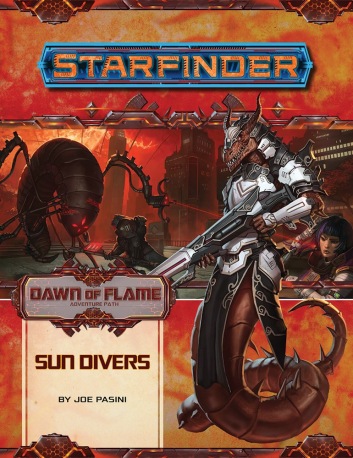
Sun Divers

Sun Divers
Starfinder Adventure Path 15: Sun Divers (Dawn of Flame 3 of 6)

Starfinder Adventure Path #15: Sun Divers (Dawn of Flame 3 of 6) is written by Joe Pasini and is intended for 5th-level characters. During this part of the adventure path your characters will have discovered proof of a settlement within the sun’s depths, and have the coordinates to get there. The problem? A ship! Your PCs will need to track down the creators of an experimental ship known as a Sun Diver, and retrieve it from the shady folks who have it now. In addition to getting to explore the Verdeon district of the Burning Archipelago, they’ll get to take their  awesome new ship (that looks a lot like a pinecone!) beneath the surface of the sun, and explore an undiscovered city!

Further content in this volume includes an article on Noma (the newly discovered bubble-city) and on organized crime. Alien Archive entries are said to include creatures that live within the sun. Although the planet examined in the Codex of Worlds is still a mystery, the ship that will be detailed is going to be the Sun Diver.

The Blind City

Starfinder Adventure Path #16: The Blind City (Dawn of Flame 4 of 6) is written by Ron Lundeen and is intended for 7th-level characters. Your PCs time in the bubble-city of Noma has led to further discoveries, including an ancient magical tablet. Bringing the tablet back to the Burning Archipelago for translation causes a clash with the cult of Azathoth. If they’re lucky, your players will beat back the cultists and discover the coordinates to another mysterious location within the sun, known as Ezorod. The discoveries they make in this lightless (yes, you read that right: LIGHTLESS), foul dungeon will change their lives forever, and finally place the PCs on the trail of Dawn of Flame’s major villain.

Further content in this volume includes an article on various cults found in the Pact Worlds, and a bunch of new and weird techonological and magical equipment. The Alien Archives include new creatures from throughout the multiverse. Information on the Codex of Worlds and ship details have yet to be revealed.

Solar Strike

Starfinder Adventure Path #17: Solar Strike (Dawn of Flame 5 of 6) is written by Mark Moreland and intended for 9th-level characters. It begins with the PCs receiving a distress call from the peaceful citizens of settlement deep within the sun who are under attack by efreet invaders from the Plane of Fire. Your PCs will need to dive back below the surface of the sun to liberate the city of Kahlannal from their conquerers! Unfortunately, this isn’t an isolated incident. It’s the start of an invasion…

Further content in this volume includes an article on the bubble-city of Kahlannal, and an article on the cultures of the Pact Worlds sun and other stars throughout the galaxy. Content of the Alien Archives, Codex of Worlds, and ships has yet to be announced.

Assault on the Crucible 

Starfinder Adventure Path #18: Assault on the Crucible (Dawn of Flame 6 of 6) is written by Jason Tondro and is intended for 11th-level characters. It is the final volume in the Dawn of Flame Adventure Path and should bring your PCs to level 12 or 13. In it, the efreet army, acting at the behest of a semi-divine being from the Plane of Fire known as Malikah, launches an assault on the Burning Archipelago from the depths of the Sun! Aware of this coming attack your PCs will have have to defend the city, bring the fight to the enemy at their hidden base, close the portals to the Plane of Fire, and return Far Portal to its home on the surface of the sun! Epic stuff!

Further content in this volume includes an article on continuing the Dawn of Flame Adventure Path past the story’s conclusion, and an article on Starfinder’s version of the Plane of Fire. The Alien Archive is said to contain creatures from the sun, the Plane of Fire, and elsewhere in the galaxy. Details on the Codex of Worlds and ship details have yet to be revealed.

An Ending

And with that we come to the end of the Dawn of Flame Adventure Path. Or rather, we come to the beginning. Next month the first volume of Dawn of Flame will be in our hands and we’ll get to create characters that can embark on this epic quest of discovery. Turns out the fate of the entire Pact Worlds hangs the in balance. No pressure! When asked if he had any further thoughts and themes that he wants Starfinder fans to come away from Dawn of Flame with, Chris Simms had this to say:

“There’s no place you can’t go.”

And he’s right! Starfinder is a game that allows us to go anywhere, explore anything, and become something greater than ourselves. It’s a world of advanced technology, alien species, and powerful magic. This fusion of big, bold ideas has led to a truly wonderful game. If you haven’t given it a try, I highly suggest you do!

Want more information on the Dawn of Flame Adventure Path, or to see awesome artwork from Fire Starters? Check out this past week’s episode of Starfinder Wednesday, featuring host Dan Tharp and special guest Chris Simms!

Enjoy!

Jessica


UPDATE: Check out the recently released Dawn of Flame Trailer!

January New Releases

January’s here, which means there’s a whole slew of new d20 products coming out.

Dungeons and Dragons doesn’t have any new releases coming out this month (as far as I know), but last month brought us the Waterdeep: Dungeon of the Mad Mage adventure which brings PCs from levels 5-20, as well as the Guildmasters’ Guide to Ravnica which brings the wonder of Magic: The Gathering to D&D.


Pathfinder released plenty of wonderful products last month, including Pathfinder Campaign Setting: Faiths of GolarionPathfinder Module: Cradle of Night, and Pathfinder Adventure Path 137: The City Outside of Time (Return of the Runelords 5 of 6). None of which I own (sadly) so they’re still on my wish list. Haha. This month Pathfinder fans can expect to see the much anticipated finale of the Return of the Runelords Adventure Path with Pathfinder Adventure Path 138: Rise of New Thassilon. Exciting stuff! There’s also Pathfinder Player Companion: Wilderness Origins  coming out, which is sure to be a solid addition to the Player Companion line. Two new pocket editions are coming out: Ultimate Campaign Pocket Edition and Ultimate Intrigue Pocket Edition. Pathfinder Society Scenarios for this month are #10-12: Breath of the Dragonskull (a Tier 1-5 scenario written by Michael Sayre) and #10-13: Fragments of Antiquity (a Tier 5-9 scenario written by Sam Polak). Finally, Pathfinder Flip-Mat: Tavern Multi-Pack comes out later this month.


Starfinder only has a few releases coming out in January. Starfinder Flip-Mat: Jungle World is a really nice looking map. The Against the Aeon Throne Pawn Collection is finally here, which I’ve been itching to get my hands on! And the Signal of Screams Adventure Path comes to a thrilling conclusion this month with Starfinder Adventure Path 12: Heart of Night (Signal of Screams 3 of 3). Starfinder Society Scenarios for this month are #1-30: Survivor’s Salvation (a Tier 1-4 scenario written by Kiel Howell) and #1-31: Treading History’s Folly (a Tier 3-6 scenario written by Vanessa Hoskins). Last month brought us the Starfinder Critical Hit Deck featuring adorable illustrations of skittermanders, which I’ve yet to get my hands on. If you own it, I’d love to hear what you thought in the comments.


It looks to be an exciting month!

Know of another new d20 product you want to recommend we check out? Let me know in the comments!

Jessica

Tails of Equestria: The Storytelling Game

Quite a few months ago a fellow gamer recommended my family give Tails of Equestria: Storytelling Game a try. I looked into the game, and told my daughter and son all about it. They were extremely excited. The problem?

Finding it.

Although I was able to find a copy of the rulebook on some American and European retailers websites, I could not find this RPG in Canada. None of the local game shops had it, Amazon had only German language copies in stock, and Indigo was sold out completely. We’ve been keeping our eyes open in the months since and, although I did see a copy turn up once or twice, it was never for long (or affordable!).

And then Christmas came. My daughter, in a stroke of brilliance, asked our only relatives that live in the States for My Little Pony: Tails of Equestria: Storytelling Game for Christmas. She typed out the title of the book she needed to play, and then all of the other supplement books she wanted, and assured me that YES, she would definitely be happy with a big pile of books as a Christmas gift, and YES, she was sure that’s what she wanted.

Grandma and Grandpa came to the rescue. This past Christmas my daughter opened up not one, but three RPG books. My Little Pony: Tails of Equestria: Storytelling Game (which is the Core Rulebook and essentially all you need to play), Tails of Equestria: The Festival of Lights (which is a published adventure), and Tails of Equestria: The Storytelling Game Starter Set (which contains an adventure, dice, and all kinds of accessories).

My daughter was thrilled. So was my son. And honestly? So was I. I had heard wonderful things about this game and, although it wouldn’t become my favourite game anytime soon, it looked like a ton of fun. Definitely something my kids would enjoy.

After squealing in glee and obsessing over some of the cool pictures inside she put down the books and moved on with the rest of the holidays. She tried out new toys and video games. We learned how to play our new board games. And at the end of that first weekend after Christmas she held up her books and gave me a big grin.

“Will you read this with me now, Momma?”

I was about to head out for a trip to the laundromat, so it wasn’t exactly the ideal time. But, I’ve never been one to say no to a kid with a book, so I put aside all the work I was going to bring with me and packed up my kids and our hardcover book instead. Clothes in the wash and water bottle in hand — reading an entire RPG core rulebook aloud is thirsty work! — we settled in to learn a new d20 game together.

my litte pony tails of equestria storytelling game

The book is bright, colourful, and engaging. It’s simple to understand but doesn’t talk down to you. It is perfectly written for its audience. Seriously. My daughter is in grade one and not only did she follow along with everything I was reading to her (and pay attention!), she understood the game and its rules immediately. I never had to stop and explain anything further than the book already had. I never had to give her an easy example to illustrate a rule. Nothing. She listened and understood. My son, who is only a year older than her, could have read the entire book by himself and understood it. In fact, my daughter probably could have read it herself too, but that’s not typical for kids her age (both of my kids are very strong readers). We weren’t done the rulebook by the time we were done at the laundromat, but after we got home my daughter sat down beside me on the couch and we finished it. Cover to cover in few hours. She was practically bouncing in excitement.

“Can we make our characters now?”

So we printed off some fancy character sheets, called over my son, and got creating! The entire process took us around an hour, which included drawing and colouring our ponies. Follow-up ponies we made took much less. About fifteen minutes from start to finish.

We were ready to play!

…sort of. We still had to convince my husband to make a character so he could join in on the game. Haha. I’ll share more details about our first gameplay experience in an upcoming blog post later this month, but for now, we’re going to talk about the rulebook itself. Interested? Read on!

Tails of Equestria: Storytelling Game is an easy to understand pen and paper roleplaying game featuring the world and characters of the hit TV show My Little Pony: Friendship is Magic. The game is aimed at children, but is definitely fun for the whole family. A hardcover book 151 pages in length, this tome is packed full of artwork, and is written in an easy to read font (and font size). Licensed by Hasbro, published by River Horse Games (in Europe) and Shinobi 7 (in the USA and Canada), and written by Alessio Cavatore, Dylan Owen, and Jack Caesar, this book’s suggested retail price is 25 pounds, 30 Euros, 35 American dollars, or 40 Canadian dollars. Of course, that cost will vary a lot depending where you pick it up. I found forty five is more typical online in Canada (if you manage to find a copy in stock at all). The book is sturdy and well made — a must have for kids books! The front cover features an image of the three iconic Tails of Equestria ponies navigating the wilds with a castle in the background. Firebrand, the iconic unicorn takes the lead, with Thrilly Filly the pegasus flying above, and Strong Oak the armoured earth pony alert at the back of the group. My kids love the art, which is drawn by Amy Mebberson, but its the back of the book that really shines for me.

I remember when I was in junior high there was a Chapters nearby that I went to constantly. On one visit I passed by the Dungeons & Dragons Player’s Handbook and stopped in my tracks. I picked it up and flipped through it. I knew in my gut I wanted it, but I had no idea what it was. None. Eventually I put it back and moved on. Every visit afterwards I passed by that book and picked it up. But I never bought it. Not until many years later when someone actually explained to me what the heck D&D was. By then the book store wasn’t even open anymore. I would have liked to buy it from there. But this? This book doesn’t have that problem. Right there on the back cover it explains what this book is, how you use it, and what it’s for. It’s written in simple language that any kid or parent (or grandparent!) can understand. It’s simple, clear, and concise. I love it.

Seriously.

I love it so much I’m going to let you read it for yourself.

What is this book?

Hey there! So I imagine you’ve picked up this book knowing a little bit about My Little Pony: Friendship is Magic. You’ve probably had a quick flick through the book and are wondering exactly what it is.

This book is a manual for a storytelling game, which allows you and your friends to create your very own pony characters to explore the amazing and magical world of Equestria — will you be a dynamic adventurer like Daring Do or a bold treasure hunter like Rarity?

Wait, wait, wait! You said this is a game, but this is clearly a book!

You’re right, but it’s actually both a book and a game. This book contains rules and a story. Rules that will tell you how to make a strong, clever, or charming pony. A story that you and your friends will enjoy, where the choices you make will change the story itself until you are telling the story as much as the book or the GM.

GM… what is that?

A GM (gamemaster) is a player at the table, but instead of playing as a pony, he or she will play as a storyteller, impersonating all of the ponies you meet, the beasts you face, and the challenges you have to overcome. Think of the GM as a narrator in a movie — it is his or her role to tell the players exactly what is happening in the story and what the outcomes of their actions are, depending on their choices.

Cool! How do I win?

Winning a storytelling game is very easy; you just need to have fun! Tails of Equestria is not about getting to the end of the board or having the most points, but all about having fantastical adventures and using the magic of friendship to overcome any obstacle that stands in your way, You and your friends, including the GM, are all on the same team — as long as everypony is having fun, everybody wins!

So open up Tails of Equestria and be prepared to enter a world of magic and friendship.”

See what I mean? Simple, approachable, and understandable. This isn’t just a book for RPG gamers. In fact, most of the kids who pick up this book won’t have played a pen and paper RPG at all. This is a book that can guide kids to becoming RPG gamers in a way that’s fun, cool, and tailored to them. It’s really well done.

Tails of Equestria: Storytelling Game is split into fourteen sections: twelve chapters, an adventure module, and the appendix. The chapters are each colour coded, which makes the book super easy to navigate and has the added bonus of making it look like a pleasant rainbow. Even better, the chapters are well ordered. One naturally progresses into the other in a way that just makes sense. It’s perfect.

The book starts off by explaining what a roleplaying game is, how to play them, what you need to play, what kind of dice the game uses, and some other supplemental material that some people like to use but isn’t mandatory. It mentions other Tails of Equestria products (like dice sets, gaming screens, and ‘tokens of friendship’), but also offers free solutions. It suggests using beads, buttons, and other small objects as ‘tokens of friendship’ and recommends free dice rolling apps. It also has dice charts in the back of the book so that all you need to do is flip to the proper chart, close your eyes, and point, to figure out what you’ve rolled. Offering these free alternative options in a way that makes it seem normal and acceptable is really important. Parents don’t want to be shelling out a ton of money after already having paid for a rulebook. Also, kids who do use buttons and the dice chart don’t need to feel like they’re left out or ‘making due.’ It makes it clear that you don’t need fancy supplies. You just need this one book. There’s also a short section intended for parents, which explains some of the benefits of roleplaying games.

Tails of Equestria: The Storytelling Game then moves on to character creation, which takes up the majority of the book. The first thing you need is a character sheet. One is provided in the back of the book, which you can photocopy. You can also go here to download a variety of character sheets for free. They have blank sheets and ones with male and female ponies, pegasus, and unicorns pre-outlined. My whole family loves those ones, so I highly suggest you give them a gander. Once you’ve got your pony sheet ready you need to choose your pony type.

my litte pony tails of equestria the storytelling game character sheet

Players can choose to be an earth pony, pegasus, or unicorn. Earth ponies are hardy and strong. They gain the stout heart trait, which allows them to really push themselves to accomplish a physical task once a day. They also have higher Stamina (which is your hp) than the other pony types. Pegasus and Unicorns are less hardy than earth ponies, but have special abilities of their own. Unicorns can use magic. They begin the game with telekinesis and can make their horns glow. As they level up you can select more magical powers with them (if you want) such as force fields, stun rays, and teleportation. Pegasus can fly and walk on clouds. As they level up you can even learn to control the weather. There is a fourth type of pony in My Little Pony, the alicorn, but it’s off limits to players. Although kids will likely be a bit sad about that, the book explains quite clearly why, which was more than enough reason for my kids. After all, only Princesses of Equestria can be alicorns, and those thrones are all currently taken.

Once you know what kind of pony you want to use you write down your level, which is one. Then you select your Element of Harmony. This doesn’t have a mechanical effect. It acts more like a a guide to help you and your fellow players know what personality trait your character is most tied to. The Elements of Harmony are generosity, honesty, kindness, laughter, loyalty, and magic (which is a balance of all of the others). Once you’ve chosen your Element of Harmony you allocate your statistics.

Before we get into that, though, let me give you a little context about how this game works. Every pony has three main statistics: Body, Mind, and Charm. Each of these statistics will have a dice type associated with it. In this game your lowest statistic and traits will use a d4, but will increase as you level up, moving on to a d6, d8, d10, and so on. Low dice are bad, and high dice are good. Simple.

If you come across an obstacle — things like kicking down a door, untying a knot, or climbing a cliff — this is called a Test. Your GM selects the Test’s difficulty from a simple chart. Then the players roll a dice for the stat most applicable. Kicking down a door or climbing a cliff would be a Body check, discovering a clue or solving a riddle would be a Mind check, and making friends or telling a joke would be a Charm check. If you beat the DC you pass and if you’re under the DC you fail.

If you happen to have a skill that could also apply to whatever you’re trying to do, like bucking to kick down a door, or keen knowledge (geography) to find your way in the wilds, you get to roll that dice also and keep the better result. For example, if a pony with a Body d4 and Bucking d6 wants to kick down a door, they roll both a d4 and a d6, then they choose which die result they want to keep.

If you’re making a check against a different pony or an opponent, this is instead a Challenge. Examples of this include a baking competition, a race, or a debate. In this case the ponies and opponents involved roll the appropriate dice and the highest outcome is the winner.

Battles are a special type of challenge called a Scuffle. This works just like a regular challenge, except that the loser loses an amount of Stamina equal to the score rolled by the winner. So, if a pegasus and a timberwolf get into a scuffle, they each roll a Body check. If either of them has an additional trait that would be useful they roll that as well and keep the better of their rolls. If the pegasus rolled a 4 and the timber wolf rolled a 6, the timberwolf has won the round and the pegasus loses six Stamina. When you start the game your ponies will have either 10 or 12 Stamina, so battles tend to pass quick. Its a fun and simple way to handle combat. However, it should be noted that scuffles aren’t a major part of Tails of Equestria. Its much more likely ponies will avoid combat with clever roleplaying, creative thinking, and teamwork.

There’s a bit more to rolling than that. Rolling a 1 results in an automatic fail and is called Bad Luck. Beating a Test by double its difficulty is called an Amazing Success, and means something wonderful happens. Rolling maximum on your dice is called an Exploding Hoof and allows you to immediately roll on a dice one step higher (from d4, to d6, to d8, and so on). If you roll higher than your previous roll you can use the higher result, otherwise you keep your previous die roll. And if you roll maximum again? You go up another dice step and keep going. These all turned out to be fun additions to the game. My kids particularly enjoyed the Exploding Hooves. Haha.

Now that we’ve got the basics covered we can jump back into character creation.

All ponies begin with a d6 in Charm (which is your social statistic). Then you get to allocate a d4 and a d6 to the other two stats, which are Body (the physical trait) and Mind (your mental stat). Smart and clever ponies will want to put their d6 into Mind and their d4 into Body, while tough or nimble ponies will want to put the d6 into Body and the d4 into Mind. Earth ponies are a special exception and instead count their Body as one dice type higher, meaning an earth pony’s starting statistics will either be Body (d8), Mind (d4), Charm (d6) for strong ponies, or Body (d6), Mind (d6), Charm (d6) for brainy ponies.

Once you’ve chosen your statistics you calculate your Stamina. This acts as your hp, and is the sum of your Body and Mind stats. This means that pegasus and unicorns will have 10 Stamina to start with, while earth ponies will have 12. Failing Tests, Challenges, and Scuffles can lower your Stamina, as can lack of sleep or a poor diet. You can recover Stamina by resting, eating a good meal, or using Ponybalm (which is like a healing potion).

Now its time to select your Talents, which are sort of feats, special abilities, and skills all rolled into one. Each pony type starts with their own Talent. Earth ponies have Stout Heart (d6), pegasus have Fly (d6), and unicorns have Telekinesis (d6). At level one you also get to select one other Talent from a list, which is tied to your Cutie Mark and is your specialty. This Talent should be a huge part of your character and shape their outlook, personality, name, and so on. There’s a decent sized list of Talents to choose from, many of which have an unlimited number of subtypes. Keen Knowledge, for example, is knowing a lot about a specific topic, but what topic is entirely up to you. Similarly, Creative Flair is something creative that you’re particularly good at, such as baking, comedy, or painting, and Special Skill is something physical that you’re talented in, like bucking, gymnastics, or sneaking. Other Talents are more specific. Healing Touch, which was my personal favourite, allows you to heal an ally, while the Stare allows you to fascinate or command someone to do something. Finally, some talents can only be taken by a specific type of pony. Only unicorns can use magic, for example, and only pegasus can fly. Although the list is nice and allows for a lot of variance between characters, I found myself wishing it was a little longer. Fortunately it’s mentioned that players hoping to create something not on the list can do so with approval from their GM. Although my family has made a few ponies already, we haven’t had the need to do this yet. So far the written Talents have been more than enough.

Whichever Talent you select at level one begins at a d6. Throughout the game you’ll have the chance to upgrade the dice types of your various Talents, and learn more. Any Talents learned later begin as d4s though, so choose wisely.

Once you’ve decided on your Talents you get to pick out a Quirk, which is a character flaw. Again, there’s a decent array of options and, again, I found myself wishing there were more. Fortunately, some of them can be incredibly varied. Fear, for example, is a fear of a specific thing (like spiders or heights). Allergies and Oooohhh… Shiny! are equally variable. The others, such as asthma, blunt, messy, and overconfident are much more specific. Again, as with Talents, players have the freedom to create their own Quirks with GM approval. So why would your pony want a flaw, anyway? Quirks will influence your character’s personality and make them unique. It gives kids something fun and often comical to role-play, and teaches us that no one is perfect. But it has an in game effect as well. Every time your ponies face their fears they get rewarded by the GM. My kids loved this and really embraced their ponies Quirks. It turned out to be a lot of fun.

By now your pony is nearly complete. You’ll need to design their Cutie Mark, draw your pony, and give them a name. Some of the ponies my family created included Soothing Heart the over-prepared earth pony mother, Flying Recall the mystery solving pegasus with a sixth sense for trouble, Bunna the stuffed animal seamstress unicorn who can talk to animals, Nugget the unicorn artist who hopes to draw every magical creature in existence, and Thunderhoof the kung-fu fighting earth pony who wants to be an action star. All in all, this game allows you to make unique ponies with only a short amount of work. It’s a fun, streamlined process that everyone enjoyed.

What’s left? Gear. Now, most ponies don’t need to pick up any gear to start. But some, such as adventuresome ponies or those who have a goal or job in mind, will want to spend some of their money — called Bits — on gear before they begin the game. There’s a solid list of equipment you can purchase in the game, with enough variability that nearly all characters should find the things they need (or a similar item whose cost they can use). Whether you decide to spend your bits or not, each pony begins with 400 bits. In between adventures your ponies can earn 200 bits per month plus or minus d20 bits, as determined by the GM. All in all we found that bits and gear were a nice and important addition, but not integral to gameplay.

Finally, players determine how many ‘Tokens of Friendship’ they begin the game with. These are special crystals (or beads, buttons, and so on) which you can use to reroll dice, automatically pass a failed roll, or slightly change the storyline (depending on how many you spend). You begin the game with Tokens of Friendship equal to the number of people you are playing with (including the GM). You also gain more at each level up. If you decide to use your tokens to help out someone else, you reduce the cost of spending Tokens of Friendship. In very rare circumstances, players and characters who are particularly kind can also be gifted a bonus Token of Friendship by the GM. We found that this was a really fun aspect of gameplay that everyone got into the spirit of.

As you adventure your characters will learn and grow. Tails of Equestria does away with experience points, instead allowing ponies to level up after every adventure — or in between sessions if an adventure is particularly long. When a pony gains a level they increase one of their Statistics (Body, Mind, or Charm) by one die type (a d4 becomes a d6, a d6 becomes a d8, and so on). If they choose to increase Body or Mind this also creases their Stamina accordingly. For every Talent that you used in the previous adventure you increase it by one die type as well. Then you either select one Talent you didn’t have a chance to use and increase it by one die type, or you select a new Talent to gain at d4. Finally, your characters gain a number of Tokens of Friendship equal to the number of players (including the GM) who participated in the last adventure. very rarely you can select a new Quirk if you want, but it has to be for something that happened during your adventure, and each pony should do this only once or twice. For example, if your earth pony fell in a pit full of snakes and you role-played them being horrified by the events they might take the Quirk fear (snakes). This approach is simple and easy to understand, but you’ll soon see your PCs all branching off in different directions the more they level up.

With character creation and the basics of the game out of the way, Tails of Equestria: The Storytelling Game goes on to further explain gameplay for players and GMs. Which should bring us to the end.

Only it’s not the end!

This book also comes with an adventure for first level characters called The Pet Predicament. I cannot express how happy I was to discover this. Particularly after I read it! It is honestly the perfect start adventure for this game. And, it’s not a short or cheap adventure, either! It’s forty pages in length if you count the stat blocks it comes with. It took my family two sessions to play through, though my kids were so engrossed they wanted to play it in one. But, alas! It was bedtime. Haha.
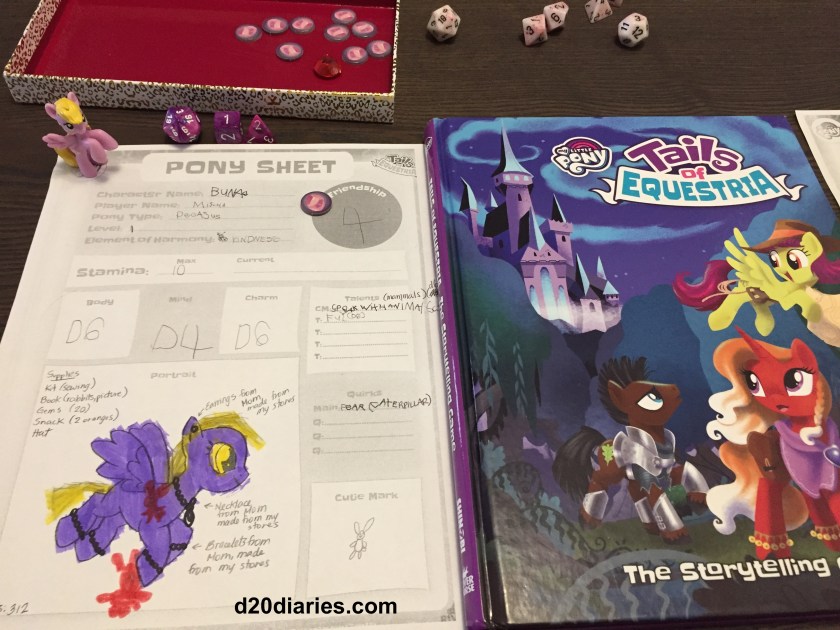
my litte pony tails of equestria the storytelling game in game

In a practical sense, this adventure is incredibly important. It provides a first adventure for players to use, and teaches them how a game should be run by example. For experienced players it also serves to alter our preconceptions about RPGs, and really shake things up. That’s because Tails of Equestria isn’t the same kind of RPG as Pathfinder or D&D. It downplays battle, and really encourages players to use creative thinking, kindness, teamwork, and roleplaying to overcome obstacles. This game requires a different mindset than other RPGs. Happily it’s a mindset that kids and young players will naturally settle into and flourish. I honestly cannot be happier with how this game played.

So what is the Pet Predicament? I mentioned it was the perfect starter adventure for this game and I meant it. It’s well written, engaging, and fun. There’s plenty of opportunity for Scuffles, but just as many chances for players to completely avoid Scuffles with Tests an Challenges. It features the Mane Six (main characters) from My Little Pony: Friendship is Magic as initial NPCs, and leaves the PCs as their pet-sitters. Any kids who has seen the show will be absolutely thrilled at this turn of events. Getting to meet such famous characters is enough to make many kids squeal in glee, and finding themselves the caretakers of all six of their pets? I’ve never met a kid who doesn’t love animals! Both my son and daughter got super into this adventure. They did their best to take care of the animals, feed them their favourite things, pamper and play with them, and so on. Unfortunately for your pet-sitters, not all of the pets are well behaved. Fluttershy’s rabbit, Angel, is a menace (as fans of the show will know!). My daughter, who adores rabbits, had a ton of fun dealing with the fluffy little terror. But, like all good adventures, something goes wrong. And this time? There’s definitely a rabbit to blame! The pets soon get lost in the dangerous and spooky Everfree Forest, and its up to your PCs to rescue all the pets, brings them back to Fluttershy’s cottage, and clean up. Their adventures will present them with all kinds of obstacles, Tests, and Challenges. Rescuing each pet will take creative thinking and teamwork. How each task is accomplished is incredibly open ended, which really allows your group of PCs to use their own unique approach to get things done. I’ll refrain for spoiling any more of the adventure, but I will say that it’s a delight to read, GM, and play. Everyone in my family had a blast (including my husband).  The ending also had my kids hooked, as it leads directly into the Tails of Equestria: The Curse of the Statuettes adventure (although the book also encourages kids to create their own adventure with the cliff hanger ending as an opening plot hook).

In the end, my entire family loved Tails of Equestria: The Storytelling Game. It’s fun, fast-paced, and simple, but offers everyone at the table plenty of opportunities to role-play and work together. I had a blast sharing this game with my kids. And my kids? They couldn’t be happier. In fact, my daughter is sitting in her bed with a little notebook and her rabbit pen creating another character as we speak.

Absolutely a wonderful game.

 Jessica