Starfinder: Armory

Hello and welcome to d20 diaries! Today we’re taking a look at Starfinder: Armory! This is one of the few Starfinder sourcebooks that’s available for purchase. It’s a hardcover book that focuses on new gear and equipment for use in the Starfinder Roleplaying Game.

This article isn’t meant to be a thorough review or critique of Starfinder: Armory. It won’t replace the book (nor would I want it to!). It’s a quick breakdown of what’s found inside, and what I liked best in each chapter. It’s a collection of my favourites parts of the book, and some highlights. It’s here so that fellow gamers and fans can take a look and get a real a feel for what they’ll get out of the book. Hopefully it helps you decide whether this product is right for you.

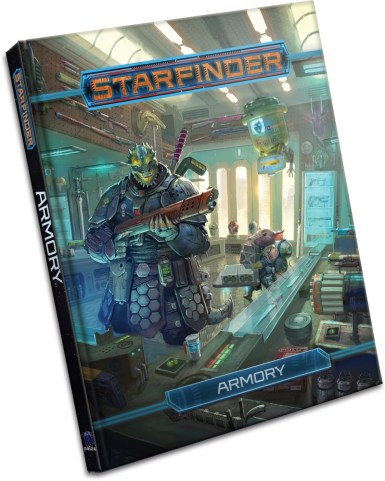
Starfinder: Armory is a hardcover sourcebook 159 pages in length. Nearly all of that is dedicated to gear, with the remaining pages offering new character options for each of the seven Starfinder core classes. It features delightful cover art by Remko Troost which depicts Obozaya (the iconic vesk soldier) and Quig (the iconic ysoki mechanic) shopping. The inside covers feature a nice image of the Pact World System (which is not to scale). Following that is the table of contents and the ‘Overview.’ Basically, the two page introduction just lets you know what kinds of gear you’ll find in this book, and explains the difference between the different types of equipment categories. Perhaps the most useful tidbit? A tiny sidebar about minor equipment. Basically, any random technological item you want to invest in that’s not a weapon — things like cameras, clocks, headphones, so on and so on. Each of those items is available if GM approval for a price of 5 credits. Easy. Done. Love it. My daughter tends to try to purchase a lot of frivolous gear like this, so it’s nice to have a proper baseline for it.
PZO7108
Starfinder: Armory

After this its on to Chapter 1: Equipment. At a whopping 130 pages long, this chapter is by far the bulk of the book. These pages are filled with all new gear (not reprints) sorted by category. Equipment categories include: weapons, weapon accessories, weapon fusions, special materials, armour, powered armour, armour upgrades, augmentations, technological items, magic items, hybrid items, personal items, drugs, medicinals, poisons, other purchases, and vehicles.

Up first? Weapons. In general this book provides a wider array of weapons for each damage type at various levels, and some new abilities. And the number of choices? Huge! Just looking at the weapon charts there are six pages of melee weapons, four pages of small arms, three of long arms, three of heavy weapons, one of sniper weapons, a quarter page of untyped weapons, a quarter page of ammunition, a half page of solarian crystals, and a half page of grenades. That’s hundreds of new weapons up for sale — not even counting the new modifications and weapon fusions. There’s some awesome artwork in this section, with the art for the Bravado Handcannon (a small arm projectile with critical knockdown), the Exhorter Shout Projector (a sonic heavy weapon with critical demoralize), the Grave-Class Void Rifle (a cryo longarm with critical suffocate), the Matrix Resonant Pistol (a sonic small arm with critical deafen), the traditional battle ribbon (an uncategorized advanced melee weapon), and the warfan (and uncategorized advanced melee weapon), all numbering among my favourites. There are 46 new weapon special properties (breach, drain charge, free hands, and gravitation are my favourites), and sixteen new critical hit effects (blind and stifle are my favourites). There’s also an array of weapons manufacturers, each of which can add special abilities to your gun (for an extra fee, of course!). I’d be sure to buy from AbadarCorp and Ringworks Arsenal Group’s lovely weapon selection.

Kent Hamilton-Armory Spread
Some of the many weapons available in Starfinder Armory. Illustrated by Kent Hamilton.

But that’s not all! There’s also new weapon accessories, weapon fusions, and special materials up for offer. For accessories be sure to check out the bayonet bracket and collapsing weapon. I like a lot of the new weapon fusions, but my favourites probably turned out to be accurate, conserving, guarded, obscuring, rebounding, and soulfire. For special materials I was surprised to find I enjoyed horacalcum and inubrix the most.


After leaving behind sixty pages of weapons and weapon-related products we’re heading out into the wide world of armour. There’s six pages dedicated to light and heavy armour (with two of those being full-page art), followed by six pages dedicated to powered armour (with two of those being full-page art), and finally six more pages of armour upgrades. The upgrades are a lot of fun. I particularly enjoyed adaptive energy shield, agility enhancer, auto injector, easy access kit, glamour projector, long strider module, medical interface, stabilizer springs (a nice low-level option), and (my personal favourite) the computer interface, which essentially lets you make a ‘Jarvis’ for your ‘Iron Man’ suit.

Up next? Augmentations. Biotech has two pages dedicated to it (be sure to check out the mighty vocal chords and regenerative blood), Cybernetics has two pages (I like the optical laser), Magitech has four pages of options (check out antimagic skin and arcane lenses), and finally Necrografts fill the last four pages (I like the bore blade and the healing larynx).
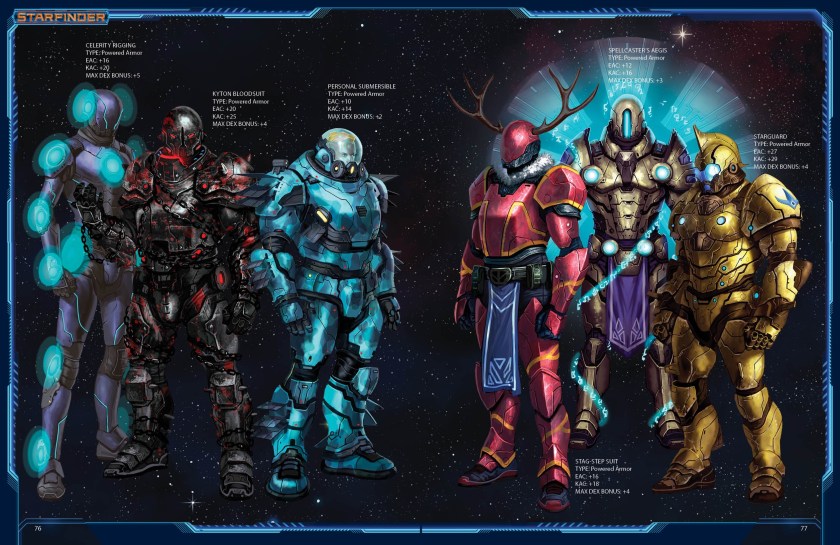
Armory - Power Armor Spread Leonardo Borazio
Some of the Powered Armour found in Starfinder Armory. Illustrated by Leonardo Borazio.

Then we move right on to Technological items. This section fills up a whopping twelve pages! Some of it is new, while others are pleasantly familiar, either because you can find them in our world, or because they were introduced in Pathfinder’s Technology Guide (such as ion tape and zipsticks). I particularly enjoyed the auto cartographer, datapad, domestic drive, emergency raft, evenfire unit, holographic sashimono, hoverskates, ion tape, nanite hypopen, and the many new tool kits. There’s lots of useful stuff!

Magic Items are up next, where you’ll find ten more pages of new equipment to spend your credits on. To start with there’s some cool aeon stones, my favourite of which is the kaleidoscopic icosahedron. The very expensive containment tesseract is also pretty nifty. I also enjoyed the cover seed, darksight goggles, dented kasa, diffraction cloak, figurine of wondrous power (which summon creatures to fight for you), ofuscated journal, plasma beads (pretty much a necklace of fireballs), Starfinder backpack, and the tangle burst seed. This is followed by three new artifacts: Atrocite Sphere, Trafodi Paradox, and, my personal favourite, the Book of Unwritten Truths.

Fusing Technological Items and Magic Items are the delightful Hybrid Items, which take up eight pages. I enjoyed the captive-star amulet and various vital seeds most, although I’m sure there’ll be lots of fans of the new hybrid grenades (of which there are many). I got a great laugh out of computer idols, and the software imp! Be sure to give them a read.

Ysoki Gear - RatAfter this is four pages of Personal Items. Although not the most exciting category of items, it’s certainly useful. My favourites are staples! The gear maintenance kit, mess kit, and books. (I know, I know. I’m really stepping out of my comfort zone there! Haha!).

Drugs, Medicinals, and Poisons all share the next two pages (which aren’t really my cup of tea), followed by two pages of ‘Other Purchases.’ This section is mostly flavour, but I found I really enjoyed reading about the types of cuisine created and favoured by the core races of the Pact Worlds. The ysoki were hilarious! (Don’t eat their food. In fact, I’d stay away from Shirren cuisine, as well!).

Finally, there’s two pages of new vehicles, the cheapest of which is the level two motorcycle for 1,900 credits. And that brings us to the end of the new equipment. 140 pages have flown by just like *snaps* that! But, that’s not the end of the book. That simply brings us to the next chapter.

Armoury Android Envoy Alexander Nanitchkov
Android Envoy by Alexander Nanitchkov.

Chapter 2: Character Options. Here you’ll find one new archetype, plus two pages of new class options for each of the core classes. All of these options are focused on equipment —- typically using your equipment to the best of its ability (or beyond its normal capabilities). The archetype comes first and is called Augmented. These guys are great with — you guessed it — augmentations! They get more, pay less for them, and can make their augmentations do more than they’re built to. The Augmented grants alternate class features at 2nd, 4th, 6th, and 9th levels. I really enjoyed it (and know at least one character created by my family who’ll be using it!).

The Envoy’s class options include four new low level improvisations, two sixth level improvisations, and two eighth level improvisations, followed by seven new expertise talents. Be sure to check out fire support, brace yourselves, improved brace yourselves, terrifying blast, and improved terrifying blast for improvisations, and expert advice for talents.

The Mechanic’s class options include four new level two tricks, three more level eight tricks, two more level fourteen tricks, and four new drone modifications. My favourite tricks were provisional repair and recalibrate engine, both of which are available at level two. My favourite drone mods were barricade, and grease.

The Mystic class options were both the least adaptable, and my favourite! They introduced a new mystic connection, and two new spells granted by that connection. So what is it? The Geneturge! These guys are capable of altering their genetic code (and even those of others). In application their abilities mostly involve biotech, and sudden evolution. I particularly enjoyed their Personal Modification third level ability, their Warping Strain ninth level ability, and their Instant Evolution fifteenth level ability. The two new spells are detect augmentation, and reject augmentation (which sounds awesome! Haha).
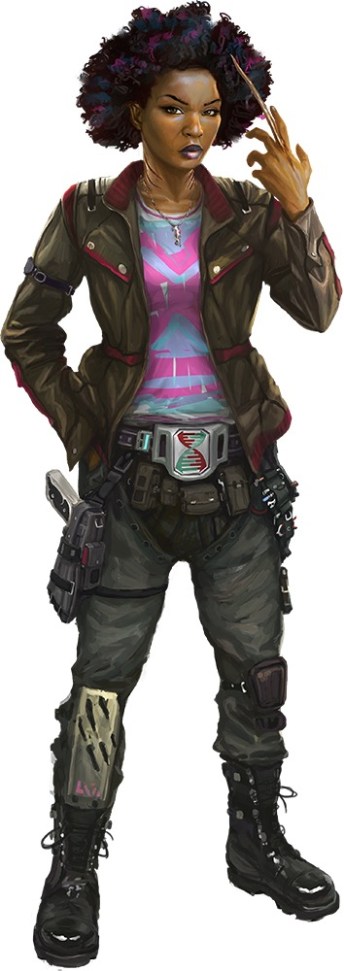
Armoury Human Mystic Alexander Nanitchkov
Human Mystic Genethurge by Alexander Nanitchkov.

The Operative class options include sixteen new exploits (six at level 2, five at level six, four at level ten, and one at level fourteen). and one new operative specialization. Of the exploits, I particularly enjoyed armour optimization, fast aim, pistol whip, trap spotter, and ricochet shot. The new Specialization is the Gadgeteer, a very cool inventor which makes use of two new exploits: utility belt, and quick deployment. His trick attacks involve using a custom device to distract the enemy. Such fun!

The Solarian class options include one new stellar revelation and one new graviton revelation for each level (level two, six, ten, and fourteen), and for zenith revelations. That makes for ten cool new options total. I had a hard time picking my favourites, but in the end I decided I liked constructive interference, stellar equilibrium, attractive force, debris field, particle field, and particle wave, which turned out to be an even split between stellar and graviton powers. Awesome!

The Soldier class options include ten new gear boosts and a new fighting style called ‘Shock and Awe.’ The fighting style is supposed to focus on making a real spectacle of yourself. I like it in theory, but in execution I wasn’t that impressed. Still, it’s different. Fighters who take this style will want to make use of sonic weapons and weapons with the bright special quality. As for gear boosts, there’s a ton of useful options. My favourites were steady sniper, twinned threat, and unstoppable strike.

StarfinderCover
Starfinder Core Rulebook

Finally we come to the Technomancer’s class options which include five new magic hacks of varying levels, and three new spells. My favourite magic hacks were recode gem (which is available at level two), and enchanted fusion (which is available at fifth level). As for spells, I rather enjoyed animate armour, and incompetence. The third spell, electroplating, is also quite useful.

And that’s it! All that’s left is the index and the end. 160 pages of awesome.

Honestly, I think that Starfinder: Armory is one of those books you’ve got to invest in. It’s not a frivolous extra purchase. You’ll reference it ALL the time. Every time you need to spend your credits you’ll crack out the Starfinder Core Rulebook and the Armory. For players, I’d say its more important than the Alien Archive (and Alien Archive 2) and Pact Worlds. For GMs? Well, hard to say. If you only GM it’s going to be less useful for you than the Alien Archives and Pact Worlds. But you’ll still get your use out of it. I adore this book and think it’s well worth the money.

I hope you enjoyed taking a peek inside Starfinder: Armory with us!

See you in the Drift!

Jessica


Pathfinder Playtest 1.5!

This week’s Pathfinder Playtest Update is Version 1.5 and it’s a small one!

Sort of.

There are really only two changes this week, but both changes have quite a bit of a ripple effect. For starters they’ve tweaked the death and dying rules again, which also affects the DC to administer first aid, and the wording used on some other minor abilities (the dwarven ancestry feat mountain’s stoutness, the feat toughness, and the spells breath of life and stabilize are all good examples of this). On a related note, the DC for treating wounds with the medicine skill has changed, and is based on the patient’s level now, instead of the player’s.

And the only other change?

Spells! They’re making them stronger. Unfortunately, the only kind of spells that are easy to edit in this type of playtest are the damage dealing ones. So, although you can expect see many (if not all) spells get beefed up a bit for the release of Pathfinder 2 next year, the 1.5 update only changed the damage dealt by around forty-five spells. Typically it was the initial damage that was changed, with the heightened increases remaining at the same interval. Exciting!

This is definitely one of those aspects of gameplay you want to give feedback on. Did your spells slaughter the enemies without difficulty? Did the enemy’s spells slaughter you? Important to know (and easy to playtest)! So after you’ve given the spells a test run be sure to give your feedback. I know I’m curious to see how this plays out.

Jessica

Media Frenzy!

Whew! Another busy week has come and gone and I feel like I’ve barely come up for air! This month is flying by! But, enough about chores, work, and responsibility! Let’s talk about something fun.

d20 games in the media.

(Around my house).

Teen Titans Go!
Teen Titans Go! (The Complete First Season)

Every once in a while I mention we’ve seen an episode of a show or movie that references D&D in some way. Stranger Things is and obvious (and amazing) example. iZombie has a wonderful set of episodes that feature Dungeons and Dragons, and my kids had a blast watching Voltron’s ode to the game. Just the other day we saw another on one of our family’s favourite kids cartoons: Teen Titans GO! In case you’re unaware, the Teen Titans are a teenage super hero team created by DC comics. Back in 2003 they had an awesome cartoon that played on the Cartoon Network, and a few years ago they re-released a spin-off of the show as… well an inane comedy. They’re the same characters and the same voice actors, but the show is goofy, irreverent, and rarely features any actual crime fighting. It’s a comedy above all else, and my whole family loves it. Seriously! My favourite episode, ‘And the Award for Sound Design Goes to Rob’ (Season Two, Episode 48) involves silence taking over the world, and the Teen Titans making their own sound effects for everything. When dolphins say ‘Booya!’ and Beast Boy makes punches sound like a fart, you know you’re about to have some laughs. My kids were rolling on the ground in laughter. (Seriously). Anyway, there we were, enjoying some Teen Titans Go! when the episode ‘Riding the Dragon’ (Season 3 Episode 51) started. (Most of) The Teen Titans are enjoying a fantasy game where they attempt to ride a dragon, only to have Robin appear and tell them they’re not playing by the rules. He proceeds to force them to, and spends the entire episode sucking all the fun out of their D&D style game. It’s hilarious.

And then today? My kids had the chance to have their weird and wacky characters ride a dragon in game. They were so excited! They even started singing a song from the Teen Titans episode. The look of absolute joy on their faces was truly a delight. Special thanks to GM Dennis for giving them the opportunity! (Thanks!)

On a similar note, my kids finally discovered the glory of Critical Role! How? Why? …Beastmaster!

Seriously.

My kids saw a picture online of Terry Crews holding up a fake warhammer and roaring. Immediately they exclaimed: “Hey! I know that guy! He was a judge on Beastmaster! Let’s watch that!” (My daughter LOVES Ultimate Beastmaster). So we clicked play.

Warcraft Film
Warcraft

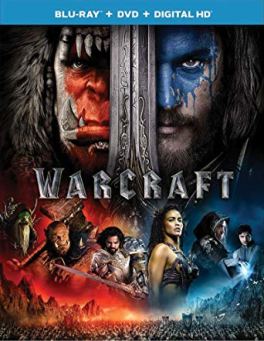
It was an episode of World of Warcraft themed CelebriD&D starring Terry Crews. (I imagine more than a few of you have watched it!). Long story short we gave it a try and my kids were enthralled! They thought it was hilarious. My son thought that Terry Crews’ character ‘Thodak the Blacksmith’ was the coolest, but my daughter loved Marisha Ray’s goblin ‘The Ritz.’ If you haven’t watched it (or any of the other CelebriD&D episodes) and you like that sort of thing I suggest you give it a shot. It was great fun. Of course, my kids have never played World of Warcraft, so when we finally finished watching all the CelebriD&D episodes we watched the World of Warcraft movie, which is currently on Netflix. My husband fell asleep (he’s recently given up coffee, so I wouldn’t hold that against the film), but the rest of us liked it.

While we’re on the topic of random online videos that we’ve enjoyed, I also got a lot of laughs from Joe Manganiello’s and Stephen Colbert’s Dungeons and Dragons interview. Oh! And (not nerd related at all) Robert Irwin’s appearance on Jimmy Fallon with Kevin Hart. Obviously, Kevin and Jimmy are hilarious, but man! Robert is so enthusiastic and adorable! I love it!

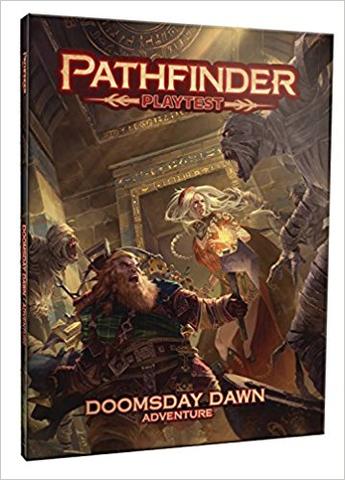
We’ve been watching Paizo’s Twitch Channel recently. The Doomsday Dawn live play episodes look interesting, but I’ve yet to give them a try. Admittedly, I don’t have the time to watch them. Haha. I don’t watch anything live, but when I can find the time (usually while preparing vegetables for dinner or something) I put on a shorter video. I regularly watch the Pathfinder Friday episodes (which are a whole lot of Deconstructing Doomsday Dawn recently!). But my favourite? I ADORE Starfinder Wednesdays! May of the recent episodes preview the Against the Aeon Throne adventure path (and information related to it). Recently they started making episodes about different planets in the Pact Worlds. Eox was first. Then Aucturn. And tonight they’re going further afield to the planet Daimalko. Awesome! My kids even love sitting down to watch these ones. It’s such a great way to get the feel for the many planets across in an engaging way. I hope they keep it up!

Speaking of making gaming engaging, I recently stumbled upon the work of Craig Bailey, a GM who makes props to go along with his games. Most of them are from Starfinder’s Dead Suns adventure path and WOW! Are they ever amazing!  Field notes, passports, news clips, and even mock websites where the players can attempt to sift through an NPCs emails! AWESOME! If you haven’t heard of him (and especially if you’re GMing Dead Suns) be sure to look him up on twitter or youtube!

Seriously.

I can’t even imagine the effort put into these ‘handouts.’

*standing ovation*

 In other news (sort of) I read the Dragon+ Magazine whenever I have the time (which is rarely. Did I mention I’ve been busy lately? Haha). For those of you who don’t know it’s a free Dungeons and Dragons web-magazine you can view online or through the Dragon+ app. But, this last issue I made sure to make the time to give it a read. Why? RAVNICA!

D&D Ravnica
D&D: Guildmasters’ Guide to Ravnica

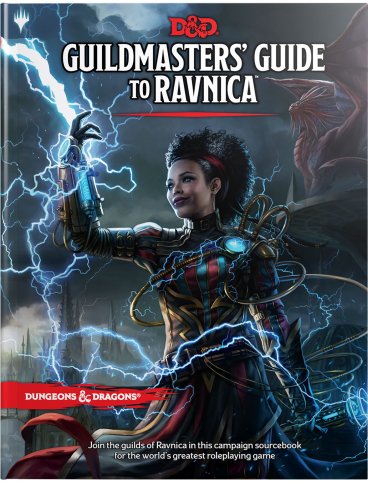
As some of you may be aware, I don’t just plat d20 games. I love all kinds of games. Including collectible card games. And, although my kids love Pokemon, my game of choice is Magic: The Gathering. By far. Love it. I love the game, the art, the lore, the worlds… Everything except the COST! Haha. So when I heard that Dungeons and Dragons was joining forces with Magic: the Gathering and releasing a Ravnica campaign sourcebook I squealed in glee. Then I thought: “It’s about time!” Cause, really! They’re both Wizards of the Coast! Why did this take so long?!? D&D: Guildmasters’ Guide to Ravnica is due out near the end of November, but is already available for preorder on amazon. Even better? At the time of posting it’s twenty dollars off the regular price. If only I had someone to buy it for! (Other than myself…).

A girl can dream.

 Jessica

Pathfinder Playtest: 1.4!

Well, it’s another week and another Pathfinder Playtest Update! There’s new surveys to fill out about Pathfinder Playtest Adventure: Doomsday Dawn: Part Five: Heroes of Undarin, new videos to watch on Paizo’s twitch stream, and a new Pathfinder PlaytestUpdate Document. Be sure to head on over to Paizo’s website and download the free update. This version? 1.4!

So, what’s new this time around?

Heritages.

In previous versions of the Pathfinder Playtest you select an ancestry: dwarf, elf, goblin, gnome, halfling, or human. This choice grants you ability boosts and flaws, hit points, size, speed, languages, and some special abilities. Then you select a single ancestry feat. This feat grants you an additional ability or quality based on your ancestry that you get to select yourself. At higher levels you can select more ancestry feats. Unless of course, you’re a half-elf or a half-orc. To access those races you have to select human, and then use your ancestry feat to become a half-elf or half-orc.

That’s no longer the case.

Pathfinder Playtest Rulebook

Instead, they’ve introduced an additional kind of feat: heritage feats. Now you select an ancestry, apply it, then select a heritage feat and an ancestry feat. Like ancestry feats, heritage feats are tied to your ancestry. Only gnomes can select a gnome heritage feat, and so on. The half-elf and half-orc ancestry feats are now a part of this heritage feat system. You become a human, select a either half-orc or half-elf as a heritage feat, and select an ancestry feat like every other ancestry gets to. In addition to shuffling these feats around they created unique heritage feats for each ancestry. With the selection of a heritage feat you can now play a desert dwarf, jungle elf, svirfneblin, razor tooth goblin, nomadic halfling, and so on. Each ancestry has around four new heritage feat options. Some of these options will be familiar. For example, the dwarven hardy ability has been moved from an ancestry feat to a heritage feat called Strong-Hearted Dwarf. Others options are brand new.

But, that’s not the only changes. With the addition of heritage feats some of the ancestry abilities have been shuffled around. Other ancestries lost abilities, and some (like halflings) gained some (finally!). They’ve also created three new, higher level ancestry feats for each ancestry.

The rest of the changes are quite minor. They’ve altered the phrasing on a few abilities, improved fighter’s bravery, ranger’s full-grown companion, and the feats battle medic and natural medicine. Crafting can now be used to Recall Knowledge about alchemy instead of arcana. Medicine can now be used to find forensic information on a body or a crime scene. A few spells were slightly adjusted.

And that’s it! It’s a small update, but the heritage system is going to effect every character created to date, so it’s quite important. I’m curious to see how this alters the feel of Pathfinder Playtest characters.

Only time will tell!

Jessica


Pathfinder Playtest Scenario #4: Frozen Oath

Pathfinder Playtest RulebookToday we’re going to look at the brand new Pathfinder PLAYTEST Society Scenario and tell you what we thought. Currently, there are four of them available as a free download on Paizo’s website: three that were released back in August, and one that was released a short time ago. (For more information on the first three scenarios check out this previous blog post. Each scenario is replayable. You may create your own characters for the intended tier (either created as level one for a tier one scenario, created as level five for a tier five scenario, or created as level ten for a tier ten scenario). Unlike regular Pathfinder Society Scenarios, you do not need to earn enough XP to reach higher levels for the Playtest. If you don’t want to make your own characters, you can also head over to Paizo’s website and download the Pregenerated Pathfinder Playtest characters for the three low level scenarios. For this new scenario, which is tier ten, there are no pregenerated characters. You’ll need to make your own. All you’ll need to run these four scenarios (other than your characters) is the Pathfinder Playtest Rulebook, the most recent update document which, at the time of posting this, is version 1.3, and the scenarios themselves. Each scenario is intended for groups of FOUR players (unlike regular PFS Scenarios which are intended for six) although each contains easy ways to scale up encounters for larger groups. Although you’ll find references to events in each that I liked or disliked, and comments about specific characters, these scenarios are not explored in detail. It’s not my intention to spoil the events in these scenarios, or give summaries and full reviews, but to share my opinions and provide recommendations. Once you’re done playing or GMing any one of these scenarios, be sure to head over to Paizo’s website and fill out a survey about your experiences. This will be used by the Paizo team to make the Pathfinder Playtest the best that it can be.

So, without further ado, let’s get started!

Pathfinder Playtest 4 Frozen OathPathfinder Playtest Society Scenario #4: Frozen Oath is a Tier 10 adventure written by Ron Lundeen. As previously mentioned, you do not need to earn enough XP to reach level ten. Instead, you need only create your characters at level ten. The majority of this scenario takes place in Urjuk near the Crown of the World. It’s a harsh land of ice and snow, claimed by frost and taiga giants. The adventure begins in Turvik, a settlement in the Lands of the Linnorm Kings, then moves quickly to the Path of Aganhei, and finally to Dvalinheim, a giant temple. For more information on the Crown of the World check out Pathfinder Adventure Path 51: The Hungry Storm (Jade Regent Book 3 of 6). For more information on the Lands of the Linnorm Kings check out Pathfinder Campaign Setting: Lands of the Linnorm Kings. This scenario utilizes Pathfinder Flip Mat: Basic Terrain Multi-PackPathfinder: Flip Mat: Tech Dungeon, and a custom map of Dvalinheim.

ogthup tom ventre
Ogthup by Tom Ventre.

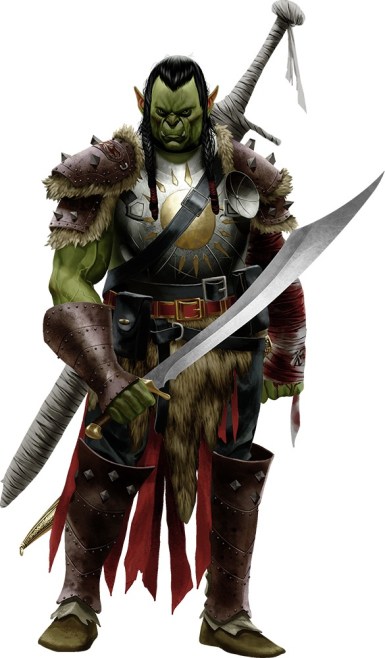
This scenario begins in a meeting in Turvik with the delightful Venture-Captain Bjersig Torrsen and his husky Mahki. Bjersig is a deaf half-orc well trained in reading lips who made another recent appearance in Pathfinder Society Scenario #10-03: Death on the Ice. He’s an awesome VC and I was thrilled to find that he had his own art this time around. Bjersig informs the party that he recently deployed a team of goblin trial-pathfinders on a scouting mission to a giant temple called Dvalinheim. They returned with an object of interest — a few tiles taken from the site which show the giant temple has a connection to the Tian representation of Desna. Believing that this temple could be a site built by the founder of the Path of Aganhei he’s dispatching the PCs to investigate further. He even gives the group a map drawn by one of the goblins. So… yeah. It’s totally accurate (not). Chances are the first thing the group will do is visit the goblin artist to ask her what the heck the map means. Which leads us to our second awesome NPC: Ogthup the goblin. Honestly, chatting with this quirky (and wonderfully drawn) goblin was my favourite part of the scenario. From there the PCs set out to follow Ogthup’s directions to the temple. There’s a few battles along the way, but the bulk of this scenario takes place in Dvalinheim itself. There the group will have to explore the temple, deal with more than a few angry frost giants, and… well let’s leave that part a secret for now. Haha. I particularly enjoyed the monster statistics in this scenario. Many of the creatures have special reactions, and interesting attack forms that make them feel really unique. My personal favourite was the disperse ability of the air elemental. Overall, I thought this was a fun scenario with engaging (but minor) NPCs and interesting opponents. I give it four out of five stars.

Definitely worth a free download!

I hope you enjoyed taking a look at this playtest scenario. If you have a chance to play it, I’d love to hear what you thought!

All the best,

Jessica


New Pathfinder Society Scenarios: ‘Reaver’s Roar’ & ‘Mysteries Under Moonlight: Testament of Souls’

Today we’re going to take a look at two of the most recent Pathfinder Society Scenarios that are currently available for purchase, and let you know we thought. Although you’ll find references to events in each that I liked or disliked, and comments about specific characters, these scenarios are not explored in detail. It’s not my intention to spoil the events in these scenarios, or give summaries and full reviews, but to share my opinions and provide recommendations. That said, if you want to avoid even minor spoilers then I recommend clicking on a different article. Whether you intend to use them in home games of the Pathfinder Roleplaying Game, sanctioned scenarios for use with the Pathfinder Society Organized Play, or just want to read a nifty new adventure, we’ve got you covered! So let’s get cracking!

10-04 Reaver's RoarScenario #10-04: Reaver’s Roar is a Tier 7-11 Adventure written by Steven Hammond. It begins in Three Pines Ford in Lastwall, with a mission briefing hosted by Venture-Captain Shevar Besnik and Ollysta Zadrian, leader of the Silver Crusade. The scenario quickly moves on to the semi-abandoned outpost of Roslar’s Coffer, and the Sarenite temple known as the Bastion of Light found within. For more information on Lastwall you can check out the Inner Sea World Guide. For more information on Sarenrae you can check out Inner Sea Gods. This scenario features creatures from Pathfinder Roleplaying Game: Bestiary, and Pathfinder Adventure Path: Curse of the Crimson Throne Anniversary Edition (although all of the necessary stat blocks are included within the scenario). It makes use of a vast number of sourcebooks, including the Core RulebookAdvanced Class GuideAdvanced Player’s GuideUltimate CombatUltimate Equipment, and even Mythic Adventures. All of the necessary rules from the Advanced Class Guide and the Mythic Adventures are included in this scenario. It features one custom map, and one custom chase. This mission is of particular importance to members of the Silver Crusade faction as well as any worshippers of Sarenrae.

pfs 10-04 - reaver's roar - uirch of the burning sun - dion harris
Uirch of the Burning Sun from PFS #10-04: Reaver’s Roar. Illustrated by Dion Harris. Art courtesy of Paizo Inc.

This adventure tasks the PCs with travelling to Roslar’s Coffer and retrieving a helmet of religious significance from the Bastion of Light, an important temple to Sarenrae. The temple once contained many relics and rituals vital during the Shining Crusade. Unfortunately, the temple has since become the lair of an incredibly powerful red reaver. The PCs will have to enter the temple, defeat the red reaver, and obtain the helmet. But, this mission won’t be as simple as it seems! For starters, the red reaver has formed powerful bonds with the relics housed in the temple, which have greatly empowered it. PCs will need to find ways to weaken the red reaver, sever its connection to these relics, and outsmart the territorial creature. In addition, orcs from the Twisted Nail tribe are also after the red reaver for (no doubt) nefarious purposes. The cast of characters is rounded out by Gorm Greathammer, a famous Pathfinder and the third prince of the dwarven sky citadel Kraggodan, who acts as a contact and source of information for the PCs. The town of Roslar’s Coffer is appropriately serious and ominous. When the villagers learn of your purpose in town they offer to send a letter to your loved ones when you die a horrible death. How sweet! Haha. It’s a simple but effective way to showcase the ‘friendly’ villagers and let the players know that they might not survive the challenges ahead. I love the atmospheric buffer zone between the town and the territory of the red reaver. There’s a great chase scene in this scenario, and the red reaver is wonderfully challenging. The exploration of the Bastion of Light is a lot of fun, providing characters with danger, a few scares, chances to weaken the red reaver, chances to gain holy blessings, and even chances to make an ally or two. It offers GMs some nice flexibility in the placement of a few encounters, and does a really great job of setting an ominous, suspenseful mood. Perhaps one of the most impressive things? It will make your PCs scared for their lives. A rare thing at high levels of play! The red reaver is a fierce opponent that needs to be weakened in order for your characters to have a chance of defeating it. And even then? It should still be a tough fight! This, of course, makes it a difficult scenario to use with players who prefer to decimate everything, straight-forward encounters, and for most younger players. But the ending? SO worth it! Overall I really liked this scenario, although it’s atmosphere and difficulty are not for everyone. I give it four out of five stars.

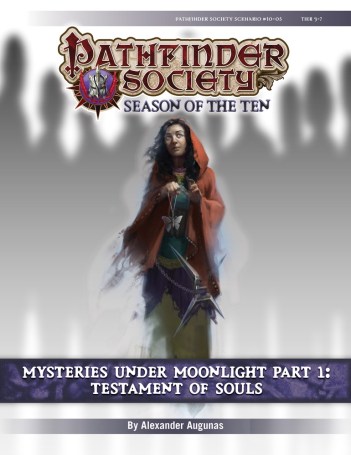
10-05 Mysteries Under Moonlight Part 1 Testament of SoulsScenario #10-05: Mysteries Under Moonlight: Part 1: Testament of Souls is a Tier 3-7 adventure written by Alexander Augunas. It is the first of a two part series that takes place in Magnimar entitled Mysteries Under Moonlight. Both of these adventures are intended to be played in order. This adventure’s sequel Scenario #10-07: Mysteries Under Moonlight: Part 2: The Howling Dance is a Tier 3-7 adventure written by Crystal Malarsky and is scheduled to be released at the end of October. For more information on the city of Magnimar you can check out the Inner Sea World Guide, and Pathfinder Campaign Setting: Magnimar, City of Monuments.

Testament of Souls features creatures from Pathfinder Roleplaying Game: BestiaryBestiary 2, and the Monster Codex (although all of the necessary stat blocks are included within the scenario) and makes use of a variety of sourcebooks including the Core RulebookGameMastery Guide, and Occult Adventures. It utilizes the new Pathfinder Flip-Tiles: Dungeon Starter Set, as well as Pathfinder Map Pack: Village Sites, and a custom map reprinted from Pathfinder Campaign Setting: Undead Unleashed. Although this mission is not tied to any particular factions, if you have any characters who are from Magnimar, have a love of monuments, or an interest in laying spirits to rest, now is a great chance to bring them out to play.
pfs 10-05 10-07 - mysteries under moonlight - inspector theodorus ichonvarde - tadas sidluahskas
Inspector Theodorus Ichonvarde from PFS #10-05: Mysteries Under Moonlight. Illustrated by Tadas Sidluahskas. Art courtesy of Paizo Inc.

Something strange is happening to Magnimar’s beloved monuments, and its up to your PCs to find out what’s going on, and put a stop to it! But, this mystery isn’t as simple as it seems. The honourable Lord-Mayor Grobaras has hired his own investigator to look into the crimes, one who seems to be more than a little biased towards blaming the city’s Varisian population. Your players will have to investigate monuments, question witnesses, confront dangerous enemies, speak with the dead, and dabble in the occult to succeed! The three monuments featured in this scenario are the Cenotaph, Founder’s Flame, and Mistress of Angels. There’s a wide array of NPCs in this delightful adventure including Venture-Captain Shiela Heidmarch and her husband Venture-Captain Canayven Heidmarch, Mystery Cultist Davorge, Inspector Theodorus Ichonvorde, plenty of witnesses (living and dead!), an outsider, and even the ghost of one of Magnimar’s Founders: Ordellia Whilwren! Perceptive PCs can uncover a lovely little tribute to any of your players characters who permanently died during any Season 4 Scenario, or during #7-03: The Bronze House Reprisal, #7-25: Orders from the Gate, #8-01: Portent’s Peril, #8-22: Wrath of the Fleshwarped Queen, or #9-09: Beyond the Halflight Path. It’s a nice little shout-out that’s lovely to see. There’s a lot of unique and interesting social encounters in this scenario, which are really the highlight of this adventure. That said, there’s still a large number of battles in this one, so it’s going to be tricky to fit it all in. I found the final battle properly climatic and exciting, with obvious consequences for failure. The other battles aren’t particularly exciting, though. The occult rituals and objects included in this adventure are fun, and don’t bog down the game with complicated rules. I really enjoyed it (although I admit to being a sucker for the occult! Haha). I really enjoyed this scenario. It’s a fun change of pace that has a lot to offer. My only complaint? If you don’t have a good GM for this one, some sections could become repetitive. Overall, I really enjoyed it! It’s a fun, refreshing adventure that’s right up my alley! I give it four out of five stars.

Thanks for joining us today! Tune in later this week when we take a look at the final Pathfinder Playtest Society Scenario that’s been released: #4: The Frozen Oath!

See ya’!

Jessica


Starfinder Society Scenarios: ‘The Protectorate Petition’ and ‘Return to Sender’

Today we’re going to take a look at the two most recent Starfinder Society Scenarios that are currently available for purchase, and let you know we thought. Although you’ll find references to events in each that I liked or disliked, and comments about specific characters, these scenarios are not explored in detail. It’s not my intention to spoil the events in these scenarios, or give summaries and full reviews, but to share my opinions and provide recommendations. That said, if you want to avoid even minor spoilers I recommend you check out a different article. Whether you intend to use them in home games of the Starfinder Roleplaying Game, sanctioned scenarios for use with the Starfinder Society Organized Play, or just want to read a nifty new adventure, we’ve got you covered! So sit back, and get ready to explore the Pact Worlds!

1-22 Protectorate PetitionScenario #1-22: The Protectorate Petition is a Tier 1-4 adventure written by Mike Kimmel. It takes place on Tabrid Minor, a planet in Near Space that has a population of around two billion. The dominant race on the planet, the copaxis, have applied to the Pact Worlds for Protectorate status. The Stewards have hired the Starfinder Society to conduct an independent review of the ruins of an ancient flying city located on Tabris Minor, with the help of some locals. You’ll need to learn all you can about the cobaxis, their culture, and their history. Once you’ve got a feel for them and their past it will be your job to write a report which will either approve or deny Tabris Minor’s request for Protectorate status. This scenario features no special scenario tags, does not include starship combat, and does not continue any ongoing storylines. It makes use of Pathfinder Map Pack: Ruined Village, and Pathfinder Map Pack: Secret Rooms . In addition to the Starfinder Core Rulebook, it features content from Starfinder: Alien Archive, and Starfinder: Armory. There is a single familiar face in this scenario: the always delightful Venture-Captain Arvin, as well as a host of new NPCs. It introduces a member of the Stewards: Major Tower-9, who will hopefully be featured in another future scenario. The copaxis are a really interesting race. Each individual is actually a colony of microorganisms which live within a single humanoid-shaped exoskeleton and act as a single unit. They’re basically coral-people. There are also a lot of interesting NPCs in this scenario from among the copaxis themselves, including Bryanisis, Gnaucara, Panacula, and Therseis. My personal favourite? Less Than Three (of whom I will divulge no further details).

sfs 1-22 - protectorate petition - therseis - michele giorgi
Therseis, a copaxis from Tabris Minor featured in SFS #1-22: The Protectorate Petition. Illustrated by Michele Giorgi. Art courtesy of Paizo Inc.

Exploring the ruined flying city of Tabantria is a lot of fun, with some locations already excavated and safe, and others still dangerous. There’s opportunities to glean interesting information at both types of locations, as well as copaxis researchers you can turn to for context and advice if desired. Although I don’t want to give away anything about your discoveries, I will say that things are more… complex that they seem. It’s wonderfully handled. There’s some fun battles in this scenario, all of which can provide the PCs with some information. I particularly enjoyed the new crab-like creature known as the corchaaz which can alter gravity and even use some solarian powers! Very cool. There’s no particular boons you’ll want to slot for this one, although members of the Dataphiles, Exo-Guardians, and Wayfinders all should naturally have the most interest in this scenarios goals. If you’ve got a solarian, now is a great time to play them. Solarians have a few unique benefits throughout this scenario. Overall I really enjoyed this scenario. I give it four out of five stars.

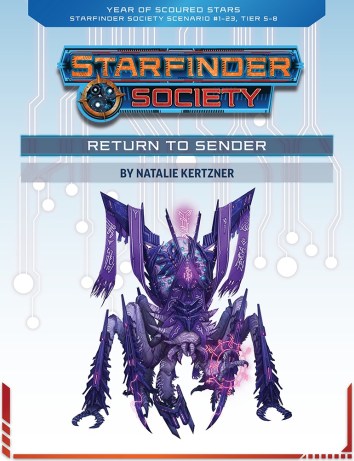
1-23 Return to SenderScenario #1-23: Return to Sender is a Tier 5-8 adventure written by Natalie Kertzner. It takes place on the edge of the Scoured Stars trinary system, which contains three suns, and a plethora of planets. The systems within the Scoured Stars are Callion, Agillae, and Bastiar. This scenario takes place after a number of other Scoured Stars related scenarios including: #1-05: The First Mandate, #1-11: In Pursuit of the Scoured Past, #1-13: On the Trail of History, #1-17: Reclaiming the Time-Lost Tear, and the Starfinder Special: #1-99: The Scoured Stars Invasion. Obviously, this scenario contains some spoilers, particularly in regards to the Special. I recommend playing as many of the previous scenarios as possible, before playing this one. One very important piece of information? Jinsul are an alien species that attacked the Starfinders when they attempted to rescue their comrades from the Scoured Stars system. Although most of the Starfinders escaped, the jinsul conquered the Scoured Stars system. As to what they want next? Unknown.

sfs 1-13 - on the trail of history - jinsul ship
A jinsul ship. Originally depicted in SFS #1-13: On the Trail of History. Art courtesy of Paizo Inc.

This mission begins when Historia-7 (leader of the Dataphiles) flies the PCs to a secret facility run by Radaszam (leader of the Acquisitives) and maintained for his Obsidian Spiders mercenary company. Together the duo gives the PCs an off-the-books mission. Their job? Take a recovered jinsul ship and fly to a space station on the edge of the system. Infiltrate the jinsul base, learn all you can, and destroy it (with the help of Historia-7 and Radaszam!). This scenario features the Faction (Acquisitives) and Faction (Dataphiles) tags and uses two custom maps. It features content from Starfinder: Alien Archive, but all relevant information is included in this scenario. There’s no specific boons I’d recommend slotting (other than the faction boons, of course) or classes to take. It is worth mentioning that one enemy in this scenario has an ability that could allow them to foil the operative’s trick attack ability.  Return to Sender is intended to be a dangerous infiltration mission with a nerve-wracking atmosphere. You’re supposed to worry over alerting the base to your presence, while learning all you can. That said, the path laid before you is noticeably linear, with no real repercussions for being discovered. It runs the risk of feeling like a long, drawn out slug-fest. Room, fight, hack a computer. Room, fight, hack a computer. And so on. This is one of those missions that really requires a talented GM to make it shine. That said, I particularly liked the final battle, and the scenario’s cinematic ending. In my opinion the best part of this scenario was actually nothing to do with the mission at all. Throughout it the PCs get to hear Radaszam and Historia-7 banter over the comms and learn more about the duo. PCs also have the opportunity to release and befriend and adorable little alien that behaves like a goofy puppy dog and looks like a mix between a shark and an octopus, with big, cutesy eyes and a lolling tongue. This little fellow’s antics can either be played up (for groups who would enjoy some comic relief) or fall to the wayside (for groups who are enjoying a more serious, suspenseful playthrough). I think the fact that the option was given for this creature to serve different roles for different kinds of groups was a really nice addition. Although this mission will be a great fit for some players, it just wasn’t my cup of tea. I give it three out of five stars.

Thanks for joining us today! I hope you enjoyed this look at the newest Starfinder Society Scenarios. We’ll be back in a few days with a look at the newest Pathfinder Society Scenarios. See you then!

Jessica

Scoured Stars Trinary System

Pathfinder Playtest 1.3!

As the Pathfinder Playtest keeps chugging along, this week brings us new surveys and new rules updates! The new surveys are open for the next chapter of Doomsday Dawn: The Mirrored Moon which reunites your players with their primary PCs for this mini adventure path. And the rules updates? There’s a lot of them! Thirteen new pages of rules, plus a separate pdf with a bunch of new content on… wait for it… archetypes! (Pardon me while I squeal with glee!)

So, what exactly is new this update?

To start with the penalty for being untrained in a skill is greater. While it used to be equal to your level minus two it is not equal to your level minus four. Although it might seem lame, I like this change. Now those people who have taken the time to become trained in a skill actually feel better at it than those who didn’t. Before it was kind of a toss up.

The next major change is the DC chart. They’ve shuffled around the DCs a bit, and fine-tuned it. This also effects the DCs across all skills and throughout Doomsday Dawn and the Pathfinder Playtest Scenarios. Yeah. This change is sweeping! I’m curious to see how it plays out.

Pathfinder Playtest Rulebook
Pathfinder Playtest Rulebook.Also available as a free download on Paizo’s website, along with the rules updates.

There’s also… the ten minute rest! What? Yup! First of all, identifying magical objects no longer takes an hour, it only takes ten minutes. FINALLY. This was one of my major pet peeves from the Playtest so I’m thrilled they changed it. Ten is more manageable. Repairing items? Also ten minutes. And finally, they’ve added a new way to use the medicine skill. You can now use it to treat wounds. This takes — you guessed it — ten minutes and can heal up to six people (yourself included) of some of their wounds. This means that there are now ways to heal yourself and your party without relying on magic. In addition, it makes taking a ten minute break after a fight a standard, organic thing to do. You fight, you win. Yay! You bandage your wounds. While the healer does that the mage identifies a magical item and the fighter repairs his shield. It fits. You know? This I can get behind.

There have been some nice changes to classes. Alchemist’s are no longer double-dinged on resonance when using infused items that they give to their companions. Monks finally have simple weapon proficiency so they can actually use a ranged weapon. Thank goodness! Rangers have some new 1st level feat options, and Rogues no longer need to be Dexterity based. Instead they have a trio of techniques they can choose from at level one.  Sorcerers no longer have to take their later bloodline feats, which makes them feel less restrictive.

Death and Dying rules have been adjusted again, with the inclusion of a new condition ‘wounded.’ For the full details you’ll have to give the pdf a read, but I think this method is meant to make it a bit harder to survive than the last updates made it, but still easier than the original Playtest rules. I’m curious to see how it plays out.

There’s other smaller changes and clarifications. Its been confirmed that shields can never take two dents at once. Its also been pointed out that your spell roll is not used for your spell attack rolls. Instead you use your proficiency modifier and Dexterity or Strength as normal. I was really happy that the spell roll was used for your spell attack rolls, but I can see why that’s not the case. Still, I think it’s and unfortunate clarification. I rather liked being a mage who could naturally aim their spells. (Sad! Haha).

That’s all of the big changes, but there’s also a second document. This contains updated rules for all of the multiclassing archetypes, changes some of them (fighter: here’s looking at you!), and adds a bunch of new ones. Oh, yeah! There are now multi class options for every base class. Very exciting!

In other news, Pathfinder Kingmaker the video game has now officially launched. For those of you who don’t know, Pathfinder Kingmaker is a computer RPG with a wide variety of NPC allies for your character to befriend (and the ability to create your own allies!). The game looks AMAZING. It’s currently available to purchase on GOG and Steam.  For more information on the game check out our recent blog post: here. Already playing? Let me know what you think! I’d love to hear all about it!

Until next time,

Jessica

SaveSave

Pathfinder Kingmaker

This week brings us a few exciting announcements. For starters, Pathfinder Playtest has just released two new surveys. These are both general feedback surveys which are not connected to Doomsday Dawn. The first is about your experiences and opinions on ancestry and the second is on classes. Both surveys can only be filled out once and feature opportunities for your to offer feedback on each of the ancestry an class options. If there’s any that you don’t want to give feedback on you’re welcome to skip them. It really important to remember that these surveys are very in depth. Make sure you’re prepared to answer detailed questions including which aspects and feats were your favourite, overpowered and so on. It’s handy to have your Pathfinder Playtest Rulebook on hand to reference feat and ability names. Overall I really enjoyed the ancestry survey, but I did have trouble with the class survey. It had an error which kept redirecting me back to the beginning of the survey after I completed the feedback on the first class. I’m going to head back and try again later, but for now I’ve had to leave it be. When you’re ready, be sure to head over to Paizo’s website and fill out the surveys. Or click the links provided: Ancestry Survey and Class Survey.

UPDATE: The survey is now working fine for me!

Octavia, Pathfinder Kingmaker, Half-elf arcane trickster
Octavia the half-elf arcane trickster from the Pathfinder Kingmaker computer roleplaying game.

The other big announcement? PATHFINDER KINGMAKER! I know, I know, Kingmaker’s an old campaign. But we’re not talking about that. We’re talking about Pathfinder Kingmaker the computer game! This RPG is currently available for pre-order on both GOG and Steam and is going to be released next week. It looks AMAZING (if only my computer was good enough to play it… Haha). This game follows the story of the Kingmaker Adventure Path, and expands upon it greatly, including an entire new ending, a plethora of new characters, and a ton of quests. You’ll have to conquer, rule, and protect your own nation in the Stolen Lands! There’s supposed to be a ton of character options for your characters, including multi-classing and archetypes. After completing the tutorial and prologue you can also create your own team of characters. In addition, there’s eleven pre-made party members who have their own stories, personalities, quirks, and abilities. Each has tied to unique events from the game’s storyline, and some of them can even be ‘romanced’ by your characters. I’m definitely looking forward to the banter. Haha.

So who are these characters? So glad you asked!

One of them will be familiar to most of us: Amiri the Kellid barbarian. There’s also Nok-Nok the goblin rogue (who some of us might recognize from his Pathfinder Adventure Card Game promo card). The rest (as far as I know) are all new. Ekundayo the Garundi ranger, Harrim the dwarf cleric of Groetus (god of the end-times), Jaethal the elven undead inquisitor of Urgathoa (goddess of undead), Jubilost the gnome alchemist, Linzi the halfling bard who’s going to chronicle your adventures, Octavia the half-elf arcane trickster and her good friend Regongar the half-orc magus, Tristian the human cleric of Sarenrae (goddess of the sun and redemption), and finally Valerie the human fighter who gave up a life in service to Shelyn (goddess of beauty and love) to learn to fight. They look like a fun group of unique characters. And their art? AWESOME. All of them look great.

For more information on Pathfinder Kingmaker you can check out Paizo’s blog post, or watch some of the previews from GOG and Steam. Want to get the whole scoop? Pick up the game yourself! And be sure to swing by and let us know what you thought of the game.

What are you waiting for? Get gaming!

Jessica

Pathfinder Playtest 1.2!

The Pathfinder Playtest is changing again. That’s right, it’s time for some more rules updates!

This week marks the second set of changes to the Pathfinder Playtest rules. Be sure to head over to Paizo’s website and download version 1.2. But that’s not all! You’ll also need to download the new character sheet! It’s been edited to conform with the new rules, and been shuffled around a bit. I rather like the new layout.

Pathfinder Playtest Rulebook
Pathfinder Playtest Rulebook. Also available as a free download on Paizo’s website.

This update document is eight pages long, with the last page dedicated to the open game license and other fine print. It includes all of the updates to Pathfinder Playtest (from the first and second updates). This means that you only need to have the most recent version of the update document, not all of them. Any new additions to the update document are in bold. Although it sounds simple, it’s actually quite hard to differentiate between regular text and bold text in the document, so look closely!  Rules updates are split into four types of rule changes: New Rules Updates, Critical Updates, Other Updates, and Doomsday Dawn Updates. Despite being ranked by importance, it’s imperative you begin to use all of the new rules immediately.

As for the rules themselves, we won’t get into specifics. The document is free and does a better job of explaining things than I ever could. The biggest changes you will notice this time around are with signature skills. They’re gone. Poof. Vanished. No longer does your class restrict which skills you can become Master or Legendary with. Instead, anyone can become Master or Legendary in whatever they want — if you’re willing to invest in that skill of course. I’m a big fan of this change, so I’m happy they went this route. This change affects a lot of other aspects of the game. Some feats are now irrelevant, and others were modified. The text throughout the book has to change a lot. There’s other skill changes you’ll notice as well. Each class is automatically trained in a certain skill, and many classes have more skills they’re trained in to start with.  More nice updates, if you ask me!

There’s some other fun changes. Bards now have a feat that lets them gain 10th level spells. The range on their soothe spell has also been changed to 30 feet. Some of the spells granted by domains are different now. And the barbarian animal totem can now use weapons — as long as they’re NOT raging. There’s some other barbarian updates as well, so be sure to read closely!

This is just a taste of the changes. There’s a lot more updates. Changes will continue to occur over time so your feedback is incredibly important.

Feedback? What feedback?!

Pathfinder Playtest Doomsday Dawn
Pathfinder Playtest Adventure: Doomsday Dawn. Also available as a free download on Paizo’s website.

Surveys. When you’re done playing any part of Doomsday Dawn, the Pathfinder Playtest Society Scenarios, or just playing in general, head on over to Paizo’s website and fill out one of Paizo’s many surveys. Paizo goes through that feedback and makes changes. That’s right! Constantly over this next year they’ll be combing through your survey responses and adapting their rules for the playtest. It sounds like these changes will occur approximately bi-weekly, but don’t quote me on that. Not only do your responses provide Paizo with a large pool of data that they can use to decide the future of the game, it also lets them find out all kinds of nifty little bits of information.

At the moment, you can fill out surveys on a variety of adventures. Each of the Pathfinder Society Scenarios has it’s own trio of surveys: player survey, GM survey, and general feedback survey. Doomsday Dawn originally launched with access to three surveys, all for the first part of the adventure: The Lost Star. (Again, a player survey, GM survey, and general feedback survey). Surveys are now also available for the second adventure in Doomsday Dawn: In Pale Mountain’s Shadow, and the third adventure in Doomsday Dawn: Affair at Sombefell Hall. Further surveys for the later adventures in Doomsday Dawn will be released in the future. There’s also some general feedback surveys available. Soon you can expect to see new surveys on more general topics.

Now, if you haven’t filled out your previous survey on the Lost Star, or In Pale Mountains Shadow, don’t worry! It’s not too late. All of the surveys will be available until the end of the year, and will be revisited by the Paizo team regularly. You haven’t missed your chance to contribute.

Let us know what you think of the new changes in the comments!

Until next time,

Jessica

Playtest
Farewell old character sheet! It’s time to make some changes!