Review: Against the Aeon Throne: Escape from the Prison Moon

Today we’re going to take an in depth look at Starfinder Adventure Path #8: Escape from the Prison Moon! So hop aboard and get ready to rebel!

Against the Aeon Throne is a three part Starfinder Adventure Path that begins with Part One: The Reach of Empire by Ron Lundeen, continues with Part Two: Escape from the Prison Moon by Eleanor Ferron, and concludes with Part Three: The Rune Drive Gambit by Larry Wilhelm. All together these three adventures should take your characters from level one through to level seven. You can also pick up the Against The Aeon Throne Pawn Collection.

To read our previous articles on Against the Aeon Throne click the links below:

Against the Aeon Throne is a shorter campaign than most. Typically six books in length, this Adventure Path is only three. It’s a great change of pace that will allow the folks at Starfinder to tell shorter, more personal stories. In addition, this three part length makes it easier to purchase and play through an entire adventure path. It’s awesome for gift giving and the budget conscious! Six books is a huge investment, but three? Well, that’s a lot more manageable for those of us without much extra cash laying around. On the other hand, with the three book format I feel like I blinked and the whole adventure path was over. I didn’t get my hands on the first book until the third came out and I missed the Signal of Screams Adventure Path completely. In general, it’s both easier to collect and easier to miss. Although I enjoy the three book format, I also enjoy the six book format, so I hope they continue to rotate between the campaign lengths.

Against the Aeon Throne

So what exactly is Against the Aeon Throne: Escape from the Prison Moon all about? In short, the PCs defeated an Azlanti military force that had annexed the small colony of Madelon’s Landing on the planet of Nakondis. But saving the fledgeling colony is just the beginning. The PCs have discovered that an experimental starship engine and their friend, the android Cedona, were already transported off of Nakondis and back to the Azlanti Star Empire. Determined to rescue Cedona and retrieve the starship drive the PCs travel to the Azlanti Star Empire and attempt to rescue Cedona from the prison moon she’s being held on. Exciting stuff!

Now, let me take a moment to be clear. The Azlanti Star Empire is a pack of giant, pompous, jerks. They’re great villains for the PCs to clash with, but an overwhelming opponent. This adventure path does not send your PCs off to take down the entire Azlanti Star Empire. It’s much smaller in scale than that. And frankly? I love it. It lends a sense of suspense to the series and makes it feel like you’re playing real people in a living breathing world universe doing what they can, rather than heroes so powerful they change the whole world universe. It’s a wonderful change of pace and scope. It’s got a very Firefly / Star Wars feel to it.

But, before we get into that too much, let’s take a look at the book itself. Starfinder Adventure Path 8: Escape from Prison Moon (Against the Aeon Throne 2 of 3)  is a softcover adventure written by Eleanor Ferron that is 63 pages in length. It’s intended to take players from level three to level five. The adventure itself is around 35 pages long, and split into three main parts: A Distant Call, in which the players travel to the Azlanti Star Empire; Outpost Zed, in which the players explore a space station and plan their caper; and Jailbreak, in which the players infiltrate the Prison Moon to free Cedona. After the adventure there’s an eight page primer on the Azlanti Star Empire and an eight page primer on the non-human races of the Azlanti Star Empire. There’s also seven new creatures in the Alien Archive, and a short Codex of Worlds article on Outpost Zed. Lastly, the inside front and back covers feature information and a layout for a tier 3 starship: the Vanguard Parapet.

My favourite parts of this book are the large number of new player races (there’s six of them), the incredibly varied and quirky NPCs (Glest, Half-Red, Xaarb, and Talmrin are all great fun), and how free-form the locations are. Yes, you have to go to ‘A’ place, and accomplish ‘B’ goal, then go to ‘C’ place, and accomplish ‘D’ goal, but how you go about achieving your goals in ‘A’ and ‘C’ — the order and methods — are up to you. I really like that. Another minor thing I really enjoyed is that every enemy has a name. It sounds like a silly thing to enjoy in an adventure, but giving every villain a name allows for PCs to take approaches to dealing with them that amount to more than ‘attack’ and ‘loot.’ That’s incredibly important in this adventure, particularly in Part Three: Jailbreak.

Before we continue with a more in depth look at the book, let me point out: there will be SPOILERS.

You have been warned.

Escape from the Prison Moon

For starters, I love the look of this book. I like the colours and the layout. The text inside is easy to read and the colours are easy on the eyes. The cover art is wonderful. It showcases Cedona, an android, retired Steward, and ally of the PCs, as drawn by Anna Christenson. Behind her is an awesome image of Raia (the iconic lashunta technomancer) and Quig (the iconic ysoki mechanic) fighting off Azlanti prison guards.

The starship showcased on the inside covers is a Vanguard Parapet. This tier 3 medium transport is destined to be the final enemy the PCs face in this adventure. All in all it’s a well-built ship, that packs some serious firepower. I particularly like how it’s shield points are balanced, with barely any shields in the quadrants where they have the most guns, and the excess shields where they have the least guns. The art is nice and the ship layout is useful.

After that we hop right into the adventure itself. This adventure starts a bit slower than its predecessor. It begins with some necessary bookkeeping. The PCs likely have some loose ends and social encounters to wrap up in Madelon’s Landing after the conclusion of Reach of the Empire (Against the Aeon Throne 1 of 3) and they’ll need to upgrade their starship to tier 3. Afterwards they receive a recorded transmission from The Stewards which should help nudge them on their way and get the adventure going. For many groups this transmission is unnecessary. PCs should already know their goals for this one: retrieve the drive and rescue their friend. But, for those groups that need a little more guidance, this recording gets the job done quick and efficiently. The PCs will need to fly to the Azlanti Star Empire, get their bearings, and find their way to the Prison Moon Cedona is being held at. On the way they run into a witchwyrd merchant ship where they’ll have a chance to make friends, barter, and pick up some valuable intel. This social encounter also gives them a destination where they can learn some more about the Azlanti: Outpost Zed.
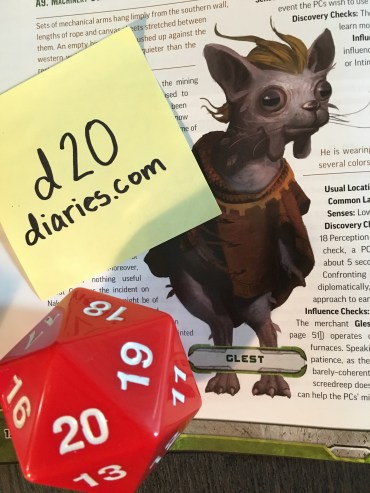
Glest
Glest, a nervous screedreep from Outpost Zed.

Which brings us to part two of the adventure: Outpost Zed. In this section PCs will need to travel to Outpost Zed, a rebellious little space station on the fringes of Azlanti space, figure out where Cedona was taken, and determine a way to properly disguise their ship. This is done primarily through interacting with the locals. Of course, not all the locals are friendly or willing to talk to obvious foreigners. Other hurdles the PCs will come up against are learning how to communicate with the locals, and figuring out Outpost Zed’s societal structure. As previously mentioned, this section of the adventure is a little free-form. There’s plenty of people to talk to, a section of the spaceport to explore, some quick battles (some of which can be avoided), and the PCs can go about their socializing in any order. However, they can’t really stray outside this area or get too off track. Still, it’s fun and enjoyable. Many of the NPCs they’re destined to meet are from races the PCs know nothing about.  I particularly enjoyed Glest (a nervous, shifty screedreep), Half-Red (a tiny squid-like stellifera that floats in an orb of water), Xaarb (an agressive creature who’s mostly mouth), and Talmrin (a very useful NPC who looks like a weasel-person). This section does a great job of showcasing that your PCs are obvious outsiders, which is something they’ll need to address if they want to break their friends out of prison without fighting their way through the whole place. Overall, it’s a fun, flavourful place to explore, filled with plenty of memorable social encounters. Before you move on, the PCs will need to take what they’ve learned and concoct a plan to travelling to and infiltrating the Prison Moon Gulta, for rescuing Cedona, and for escaping alive. Good luck! Haha. In all seriousness, the pieces of the puzzle the PCs need should come relatively easily, and there’s an NPC around who can help with the planning in a major way if the PCs are in need of inspiration or assistance. The actual planning shouldn’t be too hard once they’ve got their ducks in a row.

Glimmshar pirate
One of the many denizens of Outpost Zed!

Which brings us to part three: Jailbreak. This is by far the longest and most challenging section of the adventure. As the PCs approach Gulta, the prison moon, they should already know that non-Azlanti are typically held in Cell Block J. With their destination narrowed down considerably, they’ll need to disguise their ship, approach Gulta, and dock in Cell Block J. From there it’s more free-form. Depending upon what races the PCs are they’ll need disguises to manage any kind of infiltration mission. They’ll also need a way to speak Azlanti, someone who’s decent at lying, and someone who’s handy with a computer or at engineering. Then they’ll need to explore Cell Block J without tipping off the guards or raising an alarm. Plus there’s the security cameras and patrols to worry about. PCs who choose to go in guns blazing will instead need to be quick and get the security feeds shut down as soon as possible. Either way, once the PCs manage to get Cedona free (and hopefully some other prisoners as well), they’ll need to find a way to escape with her — a job much harder than getting in. Finally, before they escape they’ll need to contend with this volume’s big bad — an Azlanti woman named Iolastrila — and the Zandamant, a prison ship that pursues the PCs as they make their escape.

This section of the adventure is incredibly well presented, but not easy for GMs to run. It lays out the entirety of Cell Block J, what security measures are in place, labels every security camera, and shows where guards are located. Every guard has a name and some information about them — all useful information for PCs attempting an infiltration. There’s also notes on what things the PCs can do to raise or lower the alertness of guards, and cause alarms to sound. It describes what changes throughout the Cell Block in such circumstances, and what the various guards do. It’s really detailed, and really well thought out. Which is incredibly important! Your PCs are going to go in there and going to make a scene. GMs will need to keep track of what cameras are in operation, who’s suspicious of them, what the various guards are doing, and so on. It’s complex, and a lot to track. But pulling off this caper — both for the PCs and the GM — is a rewarding, exciting, experience. This place is dynamic, detailed, and reacts to the PCs. It will be different for every group and I really, really enjoyed it.

EronesseBy the end of this chapter the PCs will have freed Cedona, made their escape from the Prison Moon, and retreated to Outpost Zed. But their mission’s not yet complete. The PCs and Cedona know they need to get back the experimental drive from the Azlanti before its too late.

Which brings us to the end of Escape the Prison Moon! But, that’s not the end of Against the Aeon Throne, or the book. Up next, as previously mentioned, is an incredibly useful primer on the Azlanti Star Empire entitled Empire of the Aeon Throne. This eight page article provides a short history of the Azlanti Star Empire, information on the solar systems under it’s control (there’s twelve of them!), and information on their culture, and society. Finally, it’s got some new gear, including five new aeon stones, four new magitech augmentations, and two new weapons.
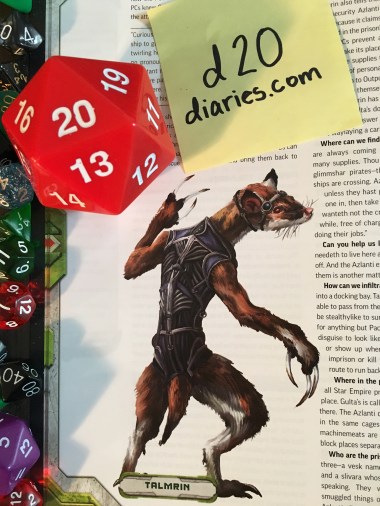
Talmrin
Talmrin, a gosclaw from Outpost Zed.

The second primer is entitled Citizens of the Star Empire. Also eight pages in length, this section describes a whopping nineteen races common to the Azlanti Star Empire, most of which are new. Six of these races is also given much more information and full racial traits to allow you to play these races. Playable races include the brakim, gosclaw, neskinti, screedreep, stellifera, and vilderaros. I really enjoyed all of these races, but the brakim and screedreep turned out to be my favourites. The brakim are also featured in Starfinder Society Scenario #1-27: King Xeros of Star Azlant.

The Alien Archive is up next, which is always one of my favourite sections of an Adventure Path. It contains seven new creatures, four of which are featured in the adventure itself. The creatures include: Aeon Stone Network, a CR 7 construct made from a swarm of aeon stones; Radiation Drake, a CR 9 drake; Iztheptar, a CR 6 shellfish-like humanoid that’s featured in both Escape from the Prison Moon and Starfinder Society Scenario #1-27: King Xeros of Star Azlant; Ooheo, a tiny CR 1 vermin with a long harpoon-like tongue; Paralith, a CR 4 aberration they’ll meet on Outpost Zed; Void Palm, a CR 7 gravity controlling plant; and Xaarb, an aggressive CR 5 magical beast they’ll meet on Outpost Zed.

Against the Aeon Throne - Escape the Prison Moon - Paralith David Franco
Paralith by David Franco. Art courtesy of Paizo Inc.

Finally, there’s a short, one page Codex of Worlds entry on the Outpost Zed. Despite its short length, the information contained therein is useful for this adventure, and a must read for any GMs who expect their PCs to do a bit more exploring of the space port than is scripted in this adventure.
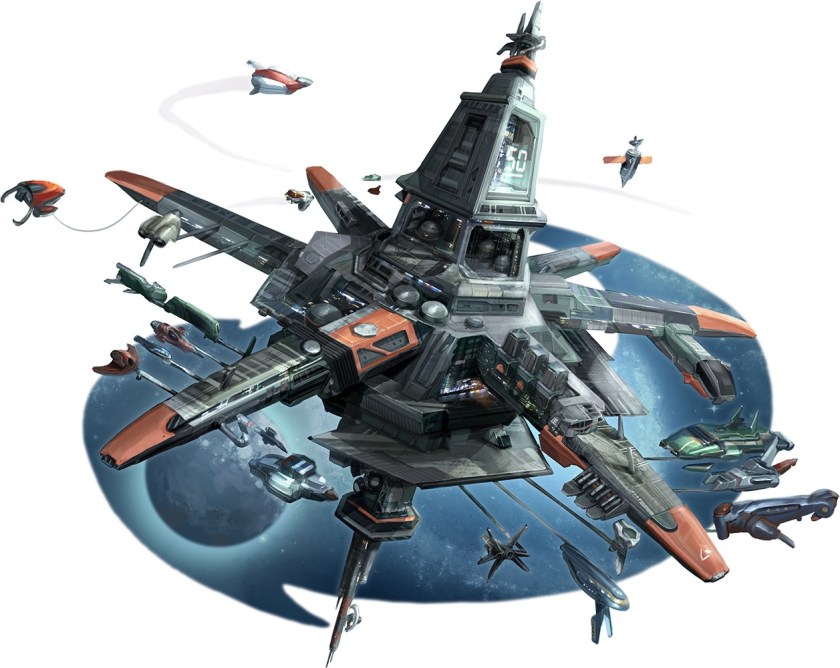
OutpostZed Mirco Paganessi
Outpost Zed by Mirco Paganessi. Art courtesy of Paizo Inc.

And with that, Starfinder Adventure Path 8: Escape from Prison Moon (Against the Aeon Throne 2 of 3) has come to an end. So where does it go from here?

Against the Aeon Throne: Part Three: The Rune Drive Gambit is written by Larry Wilhelm and intended for level five characters. In it, the PCs head to a secret Azlanti science station in an asteroid where the experimental starship drive is being held. They’ll need to get inside, infiltrate or fight their way to the Rune Drive, and learn what the heck it is. Then they’ll need to find a way to steal it. Along the way they’ll fight Aeon Guard soldiers, rescue captive scientists, and face off against the man responsible for sending troops to Nakondis in the first place! Awesome!
EDIT: You can read our review on it here: Review: Against the Aeon Throne: The Rune Drive Gambit.

I hope you enjoyed taking an in depth look at the second volume of Against the Aeon Throne much as I did!

Until next time,

Jessica


Archives of Nethys to host Pathfinder 2e

Archives of Nethys, an online database for official Pathfinder and Starfinder content and rules, recently announced the launch of their new website: 2e.aonprd.com! This new site will be dedicated to Pathfinder Second Edition and will launch on August 1st, 2019, at 7:00 am (Pacific Time). That’s right! It’s coming out the same day that Pathfinder Second Edition launches in print!

Exciting news!

Through the Archives of Nethys players around the world will have all the rules and characters options for Pathfinder Second Edition at their fingertips, online and free. I am absolutely ecstatic! I know cost is a huge factor to consider when deciding whether I’ll be able to give Pathfinder Second Edition a try. Seeing that barrier removed is amazing.

Add your bookmarks now, folks! Archives of Nethys: Pathfinder Second Edition Database. I can’t wait to check it out!

Until then, be sure to head on over to Archives of Nethys: Pathfinder Database and Archives of Nethys: Starfinder Database. It’s my favourite website to look up Pathfinder and Starfinder rules questions and player options. You can also follow Archives of Nethys on Twitter @NethysArchives.

For more information on Pathfinder Second Edition, check out this blog post.

Enjoy!

Jessica


UPDATE: Pathfinder Second Edition is now out! For more information click here!

5-Minute Dungeon

Welcome to d20diaries!

5 Minute Dungeon

Today we’re taking a look at a board game my kids recently got for their birthday: 5-Minute Dungeon! This real-time card game tasks up to five players with working together to escape a dungeon in under five minutes. Each dungeon consists of a randomized deck of cards that features obstacles, monsters, people, and events to overcome. At the end of each dungeon is a powerful boss to defeat. To beat the game you’ll need to triumph over five separate dungeons.

This game is frantic, fast-paced, and more than a little chaotic! Communication and teamwork are essential to your success. Player’s win or lose as a team. 5-Minute Dungeon is intended for players ages eight and up. Although a single dungeon takes five minutes, playing through a whole game takes about thirty to forty-five minutes, depending how many times you fail to escape a dungeon.
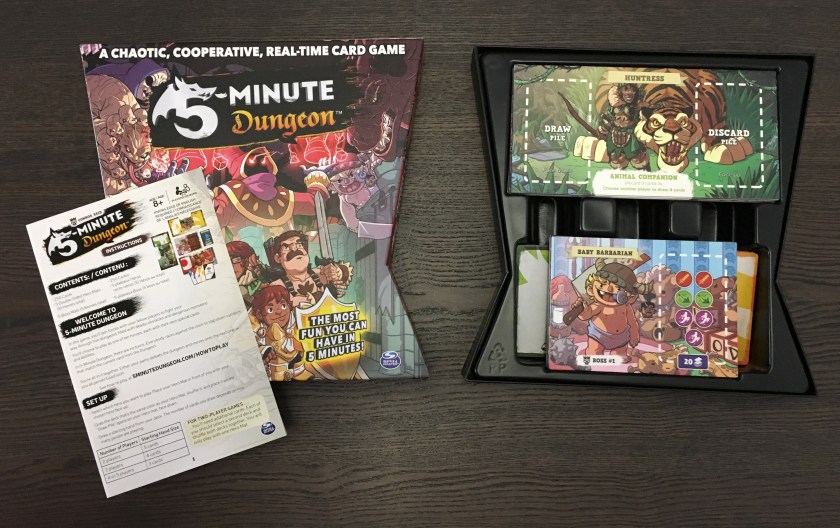
Box Contents

Players take on the role of one of ten characters by selecting a character board. Each board is colour-coded and double-sided, with one male and one female character per board. Every character board makes use of one of five matching decks, and every character has their own unique ability which can be triggered by discarding three cards from your hand. That means that up to five people can play at a time.

Characters include the blue sorceress and wizard, green huntress and ranger, purple ninja and thief, red barbarian and gladiator, and yellow paladin and valkyrie. Most of the special abilities of these characters fall into two types: those that help get someone in your group extra cards and those that automatically defeat a certain category of card. There’s also the wizard’s unique ability to stop time. We found that it was very helpful to play with the wizard and a character who can help the group draw cards, with the rest of the players taking on abilities that can auto-defeat either monsters, obstacles, or people. Once you’ve got your character picked out you place the matching deck on their board.

Next you set up the dungeon. Start by selecting a boss. There are five to choose from and each is numbered 1 though 5. You simply start at Boss #1: Baby Barbarian and work your way up to Boss #5: Dungeon Master. Each boss also has a number of cards written on it. Baby Barbarian has 20, The Grime Reaper has 25, Zola the Gorgon has 30, and so on. This is the number of dungeon cards you’ll randomly select and place on the boss board. Then you’ll pick out two challenge cards per player and shuffle them into the deck of dungeon cards. This is the boss’s dungeon. You simply place the deck of cards into the space marked with the dotted line and you’re ready to begin.

Boss

Player’s begin by drawing a number of cards. This number is variable and determined by how many people are playing the game. Chances are you’ll start with three or four cards. Then you start the five minute timer, flip over the first card in the dungeon deck, and get adventuring!

Cactus wants a hug!
To reach ‘The Grime Reaper’ you’ll need to defeat the ‘A Cactus that wants a hug.’ Oh, no! I hope you’ve got some shields….

This game doesn’t come with a physical timer. Instead there’s a timer app you can download on your phone, tablet, and other handheld device. It’s a quick download and easy to use. You simply select a voice for the announcer (I love the ‘fearful’ voice, but my daughter’s a fan of ‘spiteful’) and click start. Sometimes you’ll need to pause the game (such as with the wizard’s ‘time stop’ ability) in which case you simply push pause. If you defeat the dungeon you click ‘We Won,’ if you lose you click ‘We Lost’ and if you run out of time you don’t need to click a thing. It’s an enjoyable, humorous little timer app and my kids really like it.

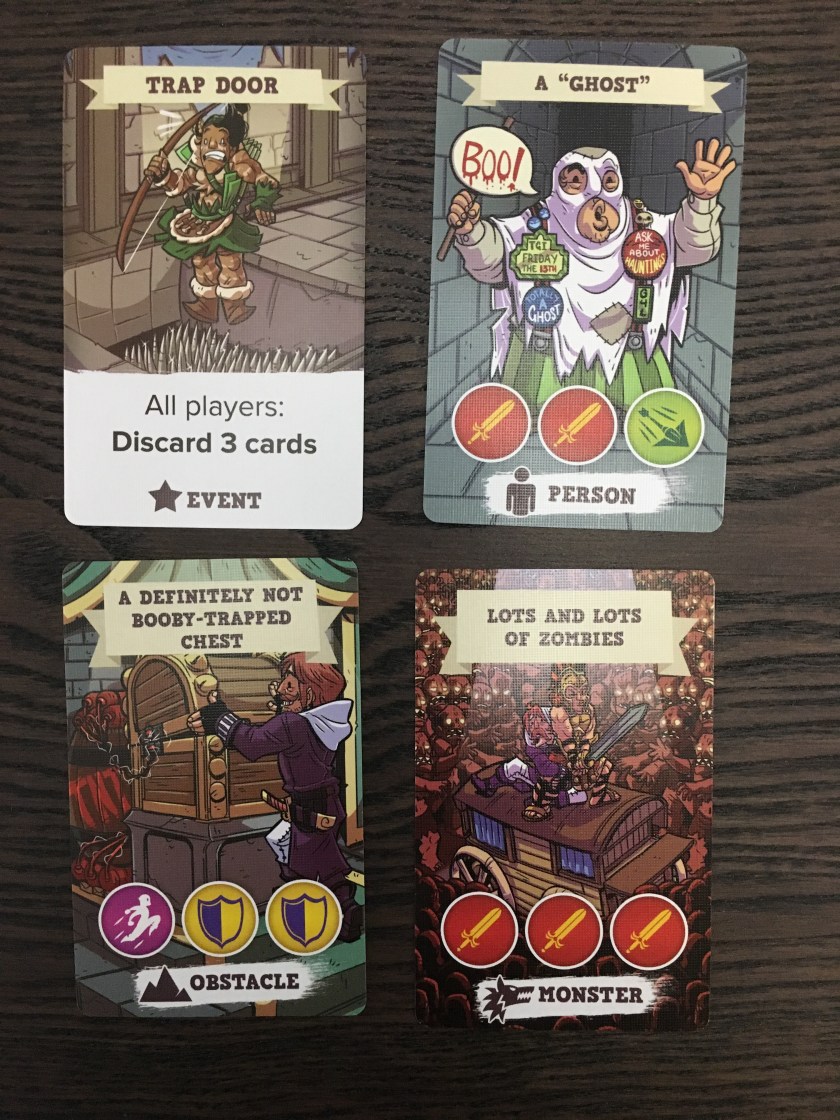
There are four major categories of dungeon cards: event, person, monster, and obstacle. Events are the simplest to resolve. They each have a sentence explaining what you need to do, you do it, then you move on to the next card. Examples of events are ‘Sudden Illness’ which forces every player to discard their hand, or ‘Trap Door’ which forces all players to discard three cards. The rest of the cards — monster, obstacle, and person — have circular symbols on them. These symbols match the cards that you must play to defeat them. These cards can be played in any order and by any player. There are no turns. As soon as all the needed cards are played you have defeated the card, it gets moved to the discard pile, and you flip over the next dungeon card. Once all of the dungeon cards are defeated you will see the symbols needed to defeat the Boss.

This makes gameplay fast and chaotic, with players slapping down cards, shouting out what they’re playing, and calling out what’s still needed to defeat the card. It’s the sort of game where everyone feels a sense of urgency and excitement, and get’s a thrill of triumph when a card is defeated.

Enemy Types
The four types of cards you’ll find in a dungeon.

So what the heck are all these symbols?

There are five major symbols in the game, which are colour coded. These same symbols are seen across all the boss cards and all character decks. Called ‘Resources’ they include the red sword, yellow shield, green arrow, blue scroll, and purple jumping person (which my family always calls ‘sprint’ or ‘dash’ but is probably called ‘leap’). Every deck will have cards of these five types, although they will have them in different combinations. The red barbarian/gladiator deck will have a lot of red swords, for example, while the blue sorceress/wizard deck will have a lot of blue scrolls. In addition to these single symbol cards there’s double symbol cards — cards that have two red swords, two blue scrolls, and so on. These are seen in much lower quantities than the single symbol cards, and not every deck will have them in every kind. While the sorceress/wizard deck may have a few double scroll cards, the huntress/ranger deck won’t. One of the decks — the red barbarian/gladiator has special double symbol cards which consist of a red sword and a second other symbol.

The rest of the cards found in the character decks are black bordered and have a special ability written on them. The most common are abilities that let you auto-defeat a certain category of dungeon card. ‘Fireball’ defeats a monster, ‘Backstab’ defeats a person, and ‘Mighty Leap’ defeats an obstacle. These are super useful cards which can be found throughout all of the different coloured decks in differing quantities. While the sorceress/wizard has a lot of ‘Fireballs’ the ninja/thief has more ‘Mighty Leap’ and ‘Backstab’ cards. Finally, every colour deck has some unique black bordered ability cards. ‘Enrage’ from the red barbarian/gladiator deck lets you choose two players who may draw three cards each. ‘Divine Shield’ from the yellow paladin/valkyrie deck pauses time until someone plays a card and lets every player draw one card. ‘Magic Bomb’ from the blue sorceress/wizard deck counts as one of each type of resource. My personal favourite card? ‘Heal’ which lets you select a player who can put their entire discard pile back on top of their draw pile. Awesome!

Card Types 2
The many card types found in 5-Minute Dungeon

As mentioned, every deck is different but equally useful. You’ll soon discover which play style you prefer and find a favourite, so I highly recommend trying each deck out. I love the yellow paladin/valkyrie deck best — particularly when played with the valkyrie character who can help her fellow players draw cards. The yellow deck has a lot of different healing cards, which I find can be incredibly helpful. My son, on the other hand, prefers the to play as the blue wizard. He’s a huge fan of the wizard’s ‘Time Stop’ ability — which is so helpful I’d go as far as to call it a necessity. He also loves the ‘Magic Bomb’ card which can only be found in the blue deck. Finally, my daughter prefers to play as the green huntress — solely because she loves the art. To each their own, I guess. Haha.

With all the decks in their places, cards in hand, and the timer started, play can begin. There’s a few other rules you need to know, but not many. Whenever you have less cards than your opening hand consisted of you can immediately draw cards to fill your hand back up to maximum. Discard piles do not get shuffled back into the draw pile once the draw pile is empty. This means that if your deck ever runs out you can no longer draw cards — unless someone plays a card that gives you cards from your discard pile or something similar.

Winning will take teamwork, speed, and luck. If you win you reshuffle your decks, select your character (you do not need to keep the same character throughout all the dungeons), set your boards back up, and build the dungeon for the next Boss. When everything’s ready you begin play again. If you defeat all five dungeons you win the game.

If you ever fail to defeat a dungeon you’re supposed to reset, going all the way back to the Baby Barbarian and his dungeon again, but my family didn’t like this rule. Instead we just replayed the dungeon we were on.

We’ve played this game quite a few times. Sometimes we finish it all the way through, and sometimes we only play a round or two. My kids and I really like it. They enjoy the teamwork aspect, and that they can always be playing. There’s no waiting for your turn or getting beat on by your friends. It’s fun and fast. It’s not a game for everyone, though. My husband doesn’t really like it. He’s a fan of strategic, complex games. Chances are whatever game we’re playing he’s going to be that player taking the longest turns. Unsurprisingly, the chaotic, real-time gameplay of 5-Minute Dungeon is not to his tastes. It’s also not the kind of game you can play anywhere. Players are going to get loud. Although you could bring to a party, family gathering, or friend’s house, it’s not the sort of thing you’re going to bring to play at the library, local coffee shop, laundromat, or airport. Finally, it’s not the sort of game you want to let the kids play late at night. Mine get antsy, excited, and leap and jump around. Not really a relaxing, winding-down sort of game.

All in all, we really liked 5-Minute Dungeon — especially my son. It’s fast paced, easy to learn, and enjoyable. My only complaints? I wish the boss cards were double sided so you could choose which of the two to face off against and I wish there were more dungeon and challenge cards included in the game so the dungeons felt more varied. But, I suppose wanting more of a game isn’t much of a complaint. More like a wish list. Haha. 5-Minute Dungeon is a pretty easy game to find that currently retails for around $30 Canadian. Our copy belongs to my eight-year old son, and made an excellent gift. He loves it.

Happy gaming!

Jessica

April New Releases

Spring is in the air, April is here, and plethora of new gaming products are hitting shelves! Check out this month’s new d20 releases!


Dungeons and Dragons

Last month was full of exciting product announcements for Dungeons and Dragons, but only one major product was released, D&D Icons of The Realms: Waterdeep: Dungeon of The Mad Mage miniatures! Produced by WizKids these pre-painted minis come in blind boosters, each of which contains four figures — one large or huge figure and three medium or small figures. In addition to a single booster box you can pick up a standard booster brick, which consists of eight booster boxes. Also released was a special collection of minis and set dressing, D&D Icons of The Realms: Waterdeep: Dungeon of The Mad Mage: Halasters Lab .

There are no major product releases for Dungeons and Dragons this month (as far as I know).


Pathfinder

Highlights from last months Pathfinder releases include the Return of the Runelords Pawn CollectionPathfinder Player Companion: Heroes of Golarion, and Pathfinder Adventure Path 140: Eulogy for Roslar’s Coffer (Tyrant’s Grasp 2 of 6).

.

April will see the release of two Pathfinder books. Pathfinder Adventure Path 141: Last Watch by Larry Wilhelm continues the ongoing Tyrant’s Grasp Adventure Path. Pathfinder Campaign Setting: Concordance of Rivals takes an in depth look at monitors — neutral outsiders — including aeons, proteons, and psychopomps. In addition to details on a variety of monitor demigods, this book also contains occult rituals, details on monitor sects, a prestige class, and a bestiary.

Map releases for April include Pathfinder Flip-mat Classics: Deep Forest and Pathfinder Flip-Tiles: Dungeon Vaults Expansion, which is compatible with Pathfinder Flip-Tiles: Dungeon Starter Set.

Organized Play releases include Pathfinder Society Scenario #10-18: The Daughters’ Due and Pathfinder Society Scenario #10-19: Corpses in Kalsgard. The Daughters’ Due is a Tier 5-9 scenario written by Thurston Hillman that involves the infamous Blakros family, their enemies in the Onyx Alliance, and Shadow Absalom! Corpses of Kalsgard is a Tier 5-9 scenario written by Alex Riggs that takes place in the Land of the Linnorm Kings and involves a sudden outbreak of gnomes dying from the Bleaching.

The most exciting Pathfinder release of April is Pathfinder Battles: Ruins of Lastwall! This brand new set of pre-painted miniatures comes in blind booster boxes that contain four minis each — one large figure and three small or medium figures. In addition to buying a single standard booster box you can order a brick of boosters (which contains eight boosters) or a case of boosters (four bricks for a total of 32 boosters). Anyone who orders an entire case of boosters may also order Pathfinder Battles: Ruins of Lastwall: Cemetery of the Fallen Set which is a collection of graveyard themed set dressing.

There have been a lot of wonderful renderings of this product’s miniatures released over the past month or so. Far too many to share here. Be on the lookout for further details on Pathfinder Battles: Ruins of Lastwall in a future blog post!

NOTE: According to WizKids, Pathfinder Battles: Ruins of Lastwall will be available in MAY, not April. The release date seems to have been pushed back a month.


Starfinder

Highlights from last months Starfinder releases include Starfinder Adventure Path 14: Soldiers of Brass (Dawn of Flame 2 of 6) and the Starfinder Critical Fumble Deck!

This months releases include Starfinder Adventure Path 15: Sun Divers (Dawn of Flame 3 of 6), the Signal of Screams Pawn Collection, and the highly anticipated Starfinder Beginner Box!!! (Yes, it deserves all those exclamation points). Organized Play releases are Starfinder Society Scenario #1-36: Enter the Ashen Asteroid (a Tier 1-4 scenario written by Larry Wilhelm that tasks the PCs with investigating a Duergar complex discovered on an asteroid by dwarven space-miners), and Starfinder Society Scenario #1-37: Siege of Civility (a Tier 5-8 scenario written by Kalervo Oikarinen that sends the PCs on a trip to visit the Gideron Authority Republic previously featured in Starfinder Society Scenario #1-24: Siege of Enlightenment).


Enjoy!

Jessica

Pathfinder Society Scenarios: What the Helms Hide and On Sevenfingers Sails

Today we’re going to take a look at the most recent Pathfinder Society Scenarios that are available for purchase, and let you know we thought. Although you’ll find references to events in each that I liked or disliked, and comments about specific characters, these scenarios are not explored in detail. It’s not my intention to spoil the events in these scenarios, or give summaries and full reviews, but to share my opinions and provide recommendations. That said, if you want to avoid even minor spoilers then I recommend clicking on a different article. Whether you intend to use them in home games of the Pathfinder Roleplaying Game, sanctioned scenarios for use with the Pathfinder Society Organized Play, or just want to read a nifty new adventure, we’ve got you covered! So let’s get started!

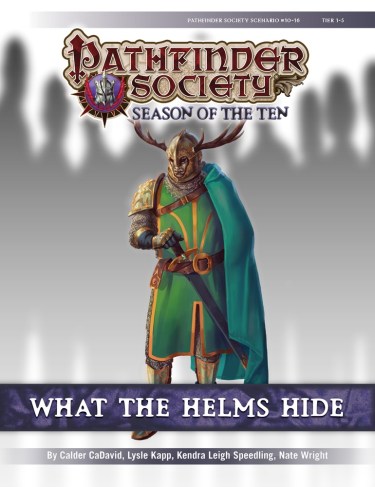
PFS #10-16 - What the Helms Hide
Pathfinder Society Scenario #10-16: What the Helm’s Hide.

Pathfinder Society Scenario #10-16: What the Helm’s Hide is a Tier 1-5 repayable scenario that consists of four short one-hour long quests. “Collection,” “Autumn,” “Dust,” and “Witness.” “Collection” should always be played first, “Autumn” and “Dust” may be played in any order, and “Witness” is the thrilling finale. Each quest is penned by a different author, including Calder CaDavid, Lysle Kapp, Kendra Leigh Speedling, and Nate Wright. While Speedling and Wright have written for Paizo before, this will be the first Paizo writing credit going to CaDavid and Kapp. Each quest also comes with its own player handout, which is always nice. Also, this scenario has a lot of great artwork in it!

What the Helms Hide delves into the history of the mysterious masked leaders of the Pathfinder Society, The Decemvirate! Three hundred years ago violence and assassinations directed at Pathfinder Society leaders caused them to don masks to hide their identities. When Master of Scrolls Kreighton Shaine discovers clues that one such assassination attempt may not have happened the way the history books have recorded he seeks the Decemvirate’s blessing and tasks a group of Pathfinders with investigating the clues, digging up the past,  and discovering the truth. This series of quests will take PCs to a variety of locations throughout Golarion’s Inner Sea Region, including Absalom, Andoran, the Five Kings Mountains, and Varisia. It features creatures from BestiaryBestiary 4, and Monster Codex (although all of the necessary stat blocks are included within the scenario). It contains content from Pathfinder Core RulebookAdvanced Player’s GuideAdvanced Race GuideOccult AdventuresUltimate Equipment, and Pathfinder Player Companion: Champions of Corruption (although all the content needed from Champions of Corruption is included in the scenario itself). It utilizes the Pathfinder Flip-Mat: MuseumPathfinder Flip-Mat: Cavernous LairPathfinder Flip-Mat: Arcane Library, and Pathfinder Flip-Tiles: Forest Starter Set. This mission contributes to this years Season of the Ten metaplot and builds on events from the always popular evergreen scenario #6-10: The Wounded Wisp (and, to a lesser extent, #8-04: Wardens of Sulfur Gulch and #9-11: The Jarlsblood Witch Saga).

The first quest, “Collection,” is written by Lysle Kapp and takes place in Korvosa’s Jeggare Museum. Here PCs will need to inspect relics discovered by the famous Pathfinder Helven Leroung and uncover clues about her history and character. You also get to delve into Helven’s relationship with the famous Montlarion Jeggare, for whom the museum (and much more!) is named. His descendant, Mercival Jeggare is curator of the museum and willing to lend you a hand. There’s a lot of information you can learn here, although groups are unlikely to get all of it, which I rather enjoyed. For more information on Korvosa you can check out Pathfinder Chronicles: Guide to Korvosa.

“Autumn” is written by Calder Cadavid and takes places in Andoran’s Arthfell Forest. PCs investigate a sliver of the history of the Pathfinder Zaul Blystone. It has amazing art for an NPC, Adelyn Rhinon, which is my favourite art in the scenario. This is a fun quest although I do have one minor complaint. I feel like one of the characters gives up a bit too easily. For more information on Andoran check out Andoran, Birthplace of Freedom.

Decemvirate - Illustration by Ernanda Souza
A member of the Decemvirate.  Illustration by Ernanda Souza. Art courtesy of Paizo Inc.

“Dust” by Nate Wright takes place in underground Dwarven ruins on the edge of Highhelm. There players get to dig a little deeper into the history of Veldrid Goldborough.  I enjoyed the NPCs in this one and adore the art for Helga Silverbrew. She’s got such a great facial expression. I like enemies in this one a lot, and the… source of information. For further details on the Five Kings Mountains check out the The Inner Sea.

The finale, “Witness,” is written by Kendra Leigh Speedling and was an absolute delight! It takes place in the Grand Lodge of Absalom and involves the PCs enacting a sort of ritual to activate a secret cache hidden by the gnome Pathfinder Eylysia. As Master of Scrolls Kreighton Shaine and two members of the Decemvirate watch on your players get to experience an important event from Eylysia’s past. I won’t say any more to prevent too many spoilers, but I will say it was awesome. I loved the final battle and the revelations it uncovered. And Eylysia’s final line! So good. For more information on the Grand Lodge check out Pathfinder Chronicles: Seekers of Secrets and Pathfinder Society Field Guide.

What the Helms Hide is a really great series of Quests. So great, in fact, that it’s my favourite series of PFS Quests. All of it’s component Quests were enjoyable, but its the finale that really ties it all together and makes it exceptional. Really well done from the whole team of writers. Each Quest has a chance for battle, a social encounter, and to uncover clues regarding their respective mini mysteries. Overall I really enjoyed this scenario. I give it four out of five stars.

PFS #10-17 - On Sevenfingers's Sails by Tom Phillips
Pathfinder Society Scenario #10-17: On Sevenfingers’s Sails

Pathfinder Society Scenario #10-17: On Sevenfingers’s Sails is a Tier 7-11 adventure written by Tom Phillips. During his time on RPG Superstar 2012 Phillips created the Gloomspires, the haunted, mist-shrouded resting place of the infamous Pirate Captain Sempet Sevenfingers. Rising out of the stormy seas of the Shackles, the Gloomspires are a place of unstable dimensional magic, dark horror, and menacing undead, with connections to the nightmare realm of Leng. The Gloomspires were further explored in Pathfinder Society Scenario #6-06: Hall of the Flesh Eaters, Pathfinder Society Scenario #7-19: Labyrinth of Hungry Ghosts, and Pathfinder Society Scenario #8-15: Hrethnar’s Throne. On Sevenfingers’s Sails marks the finale of this series of linked scenarios and finally features Captain Sevenfingers himself. For more information on the Shackles check out Pathfinder Campaign Setting: Isle of the Shackles and for more information on Leng check out Planar Adventures or Pathfinder Adventure Path 65: Into the Nightmare Rift (Shattered Star 5 of 6).

On Sevenfingers’s Sails features creatures from Pathfinder Roleplaying Game: Bestiary, and Bestiary 2Bestiary 3Bestiary 4Bestiary 5Bestiary 6, and the Monster Codex (although all of the necessary stat blocks are included within the scenario). It contains content from the Pathfinder Core RulebookAdvanced Player’s GuideOccult Adventures, and Ultimate Equipment. This scenario utilizes the Pathfinder Flip-Mat Classics: ShipPathfinder Map Pack: Perilous Paths, two custom half-page maps, and (perhaps) Pathfinder Map Pack: Armada.

Sevenfingers - Illustration by Josef Kucera
Captain Sevenfingers. Illustration by Josef Kucera. Art courtesy of Paizo Inc.

Like the three scenarios before it, On Sevenfingers’s Sails features Venture-Captain Calisro Benarry, a half-orc Pathfinder who has sent plenty of Pathfinders into the depths of the Gloomspires. It also features Benarry’s quartermaster Kakikko, and Hrethnar from Pathfinder Society Scenario #8-15: Hrethnar’s Throne. New NPCs introduced include the very disturbing Thael Shivers, Vashthrexa, Nightdrinker, and Sempet Sevenfingers himself.  PCs will need to enter the terrifying tomb, contend with Captain Sevenfingers, and plunder everything they can. Of course, there’s some complications in this mission, and PCs will have to contend with far more than expected. This scenario features an optional Hard Mode for all those players out there who relish a challenge.

The scenario is wonderfully creepy, morbid, and ominous, although  that sort of content is not for everyone. Players who have issues with body horror will want to give this scenario a pass. It’s definitely not an scenario for kids. Any characters who played the previous Gloomspires adventures are going to get a bit more satisfaction out of this scenario than their compatriots who haven’t, and will find they get a few extra bonuses along the way.  This scenario is packed full of atmospheric environments, memorable characters, and foul villains. The battles are challenging and take place in dynamic locations. I particularly enjoyed the final encounter. Really well done! Overall I think this is a really great scenario that won’t be for everyone. It’s creepy, gory, and a great high level challenge. I give it five out of five stars!

Thanks for joining us today!

Jessica

Starfinder Society Scenarios: Heart of the Foe and Rasheen’s Riches

Today we’re going to take a look at the two most recent Starfinder Society Scenarios that are available for purchase, and let you know we thought. Although you’ll find references to events in each that I liked or disliked, and comments about specific characters, these scenarios are not explored in detail. It’s not my intention to spoil the events in these scenarios, or give summaries and full reviews, but to share my opinions and provide recommendations. That said, if you want to avoid even minor spoilers I recommend you check out a different article. Whether you intend to use them in home games of the Starfinder Roleplaying Game, sanctioned scenarios for use with the Starfinder Society Organized Play, or just want to read a nifty new adventure, we’ve got you covered! So sit back, and get ready to explore the Pact Worlds!

SFS #1-34 - Heart of the Foe by Nicholas Wasko
Starfinder Society Scenario #1-34: Heart of the Foe by Nicholas Wasko

Starfinder Society Scenario #1-34: Heart of the Foe is a Tier 3-6 adventure written by Nicholas Wasko. It takes place on Rax, an inhospitable planet the jinsul are known to visit on occasion. There you will explore a ruined city that shows signs of life for any information you can scrounge up on the jinsul and their society. This scenario features the Faction (Second Seekers [Jadnura]) and Faction (Second Seekers [Luwazi Elsebo]) tags making it the first mission to prominently feature both First Seekers. This scenario continues the ongoing Scoured Stars storyline (#1-05: The First Mandate, #1-11: In Pursuit of the Scoured Past, #1-13: On the Trail of History, #1-17: Reclaiming the Time-Lost Tear, #1-99: The Scoured Stars Invasion, #1-23: Return to Sender, #1-29: Honorbound Emissaries, and #1-31: Treading History’s Folly). As such you’ll want to bring along characters who have an interest in the Scoured Stars Trinary System or storyline, who have interacted with the jinsul, or are working on collecting the ‘Journey to Scoured Stars’ boons. I also recommend bringing a character who does not have a Personal Boon permanently slotted. This scenario does NOT involve starship combat, but it MIGHT feature a vehicle chase (more on that shortly). It makes use of Pathfinder: Map Pack: Frozen SitesPathfinder: Flip Mat: Tech Dungeon, and an awesome full page custom map that has a very ‘Borderlands‘ feel to it. This scenario features content from Starfinder Core RulebookAlien Archive, and Armory. All of the necessary stat blocks are included in the scenario itself. However, GMs will definitely need the Core Rulebook for this one. Although this scenario doesn’t include a vehicle chase (but it could) it does use modified vehicle chase rules, which most players do not have internalized (in my experience). GMs will likely need to brush up on the vehicle chase rules and be prepared to teach it to their players as needed. Be aware that this is a rather dense scenario, so groups that are unfamiliar with chases could cause it to run long.

Heart of the Foe begins when both First Seeker Luwazi Elsebo and First Seeker Jadnura task the PCs with travelling to a planet the jinsul are known to occassionally visit in order to discover actionable intel and information about the jinsul themselves. For those of you who don’t know, the jinsul are a violent race of aliens that conquered the Scoured Stars Trinary system while the Starfinder Society rescued their comrades during the #1-99: The Scoured Stars Invasion. The jinsul have been a thorn in the side of the Starfinder Society ever since and the First Seekers are worried at the threat they pose to the Pact Worlds. Your PCs will need to travel to the mysterious planet — alongside both First Seekers and three other Starfinder teams — investigate a few sites that show signs of life, and uncover what they can about the jinsul and their society. Neither the Starfinder Society nor the players know a whole lot about these insectile fellows, so I was thrilled to dig a little deeper into the history of the jinsul themselves. Exciting stuff! Throughout the course of this scenario PCs will get to learn about jinsul anatomy, culture, history, religious beliefs, and — oh yeah — fight a whole lot of jinsul! It’s an action packed, exciting scenario that’s going to be a lot of fun. The battles all serve a purpose, the chase scene is both exciting and complex, and the world itself is very atmospheric. The finale is exciting and challenging, with a lot of moving parts. It’s chaotic and really well done. Dare I say… epic? Yeah, I do. Haha. There’s only one real social encounter, but the character you get to interact with is really… enjoyable so it strikes a nice balance. I love their demeanour and attitude towards the PCs. So good!

Ekkerah - Illustrated by Bryan Syme
Ekkerah, illustrated by Bryan Syme. Art courtesy of Paizo Inc.

But, it’s not all sunshine and roses radiation and bullets. I do have a few minor complaints with this one. First off, it’s tough to run. Now, this isn’t really a complaint. It’s an observation and potential warning. This is not the kind of scenario an inexperienced GM should attempt. There’s vehicle chase rules, modifications to the vehicle chase rules, environmental conditions, a whole lot of dice rolling during travel scenes, plenty of hopping around between pages for potential clues and intel, and complex battles with lots of enemies and allies to track. Not easy. Second, it has a bit of a slow start. Not the immediate start, but the… well let’s call it the travel scene. There’s a lot of dice rolling done every hour, which runs the risk of becoming a boring sort of routine if not handled right (particularly when you take into account the flipping between pages that might have to occur). That said, I do like the information your group could uncover about the jinsul along the way. Third, environmental protections. Chances are your characters have them. They protect us from a lot, but there’s also things it won’t protect you from. Fair. But in this one it feels like you get penalized for using them. You either use them and suffer X or don’t use them and suffer Y. Which is unfortunate. The scenario refers to snow clinging to your environmental protections’ helmet — when many armour’s environmental protections use a force field instead of helmets — and even if you are wearing armour that has a helmet, couldn’t you just wipe it off? And if you are wearing armour that has an environmental forcefield for it’s environmental protections, can it seriously not handle a bit of clingy snow? Sounds like that armour has a pretty big design flaw to me. I hope my Starfinder kept their receipt. Haha. It felt sort of arbitrary to me. I’m totally cool with some environmental hazards going through your protections, but this snow thing just wasn’t one of them. Contrariwise, if they wanted the snow to hamper visibility, I’m totally fine with that. I am no stranger to snow and yeah, it’s hard to see sometimes. And finally…. I love that baby jinsul on the cover! Except it’s not a baby jinsul at all. It’s a jinsul’s pet. I 100% thought it was a baby jinsul and was thrilled by it’s oddly adorable appearance. Jokes on me, I guess. Haha. Seriously though, I really like the creature, it’s stats, and it’s tactics. Overall, I thought this was a really great, exciting scenario that’s going to be a challenge to run — but well worth it! I give it 5 out of 5 stars.

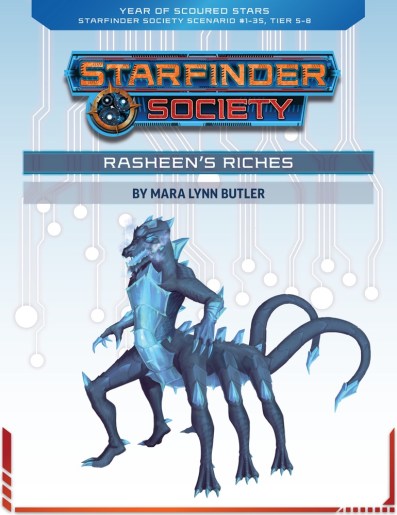
SFS 1-35 - Rasheen's Riches by Mara Lynn Butler
Starfinder Society Scenario #1-35: Rasheen’s Riches by Mara Lynn Butler.

Starfinder Society Scenario #1-35: Rasheen’s Riches is a Tier 5-8 adventure written by Mara Lynn Butler. It takes place on Aratrosim, a unexplored moon in the Vast where you investigate claims of great wealth! Sort of… This scenario features the Faction (Acquisitives) tag and DOES feature starship combat. It makes use of Starfinder Flip-Mat: Basic StarfieldStarfinder Flip-Mat: Starship, and Pathfinder Flip-Mat: Hill Country. It includes content from Starfinder Core RulebookAlien ArchiveAlien Archive 2ArmoryStarfinder Adventure Path 3: Splintered Worlds (Dead Suns 3 of 6), and even Pathfinder Campaign Setting: The First World, Realm of the Fey. All of the necessary stat blocks are included in this scenario. Although this scenario doesn’t really continue an ongoing storyline, it does feature a social encounter that has ties to the Scoured Stars storyline — particularly Starfinder Society Scenario #1–13: On the Trail of History, #1–99: The Scoured Stars Invasion. It’s brief, but it’s something of interest to characters who have played a lot of the Scoured Stars. This scenario only features one recurring character, Radaszam (leader of the Acquisitives), although it also name-drops Historia-7 (leader of the Dataphiles). It introduces one new character that I rather liked, Captain Xizzvee of Tinker’s Path, a bulabar that runs a ship of fey salvagers.

Rasheen’s Riches sounds at first like a classic treasure hunt — in space! Which is only partly true. Radaszam recently discovered a treasure map said to lead to one of the last places the infamous space explorer Jelev Rasheen explored before disappearing. Presumed to house a treasure trove of unimaginable proportions, Radaszam’s taking a more measured approach. Although he doesn’t believe it’s actually the final resting place of Rasheen or her fabulous riches, he does hope that there you’ll find a claim beacon that she placed on planets she discovered but never fully explored. This beacon should be able to lead you to the next place Rasheen went. But, that’s another mission… Rasheen’s Riches is more accurately described as a treasure hunt where you’re aiming to find another piece of the treasure map. As long as this is clear to your players by the end of the mission briefing (which it should be) you won’t have a problem with any players feeling let down. However, if players think they’re off to find unimaginable riches they might be a little disappointed. I know my kids would say “That’s it? But where’s the treasure?!” Be sure to adjust those expectations a little. Haha. I enjoyed this scenario. It’s got some environmental challenges to overcome, an interesting investigation, illuminating player handouts, and a battle against some tragic enemies. It’s got the air of a mystery about it, which I liked. I absolutely adored the descriptions of this moon. The entire atmosphere of it — and the creatures that you encounter there — worked really well together. Definitely a highlight of the scenario for me. The starship combat was straightforward but enjoyable. I like the social encounter it begins with and the artwork of the ship! It looks like some kind of skeletal Batplane! Seriously cool. Overall I thought this was a really solid scenario that will — hopefully — lead to further adventures on the hunt for Rasheen’s riches! I give it four out of five stars.

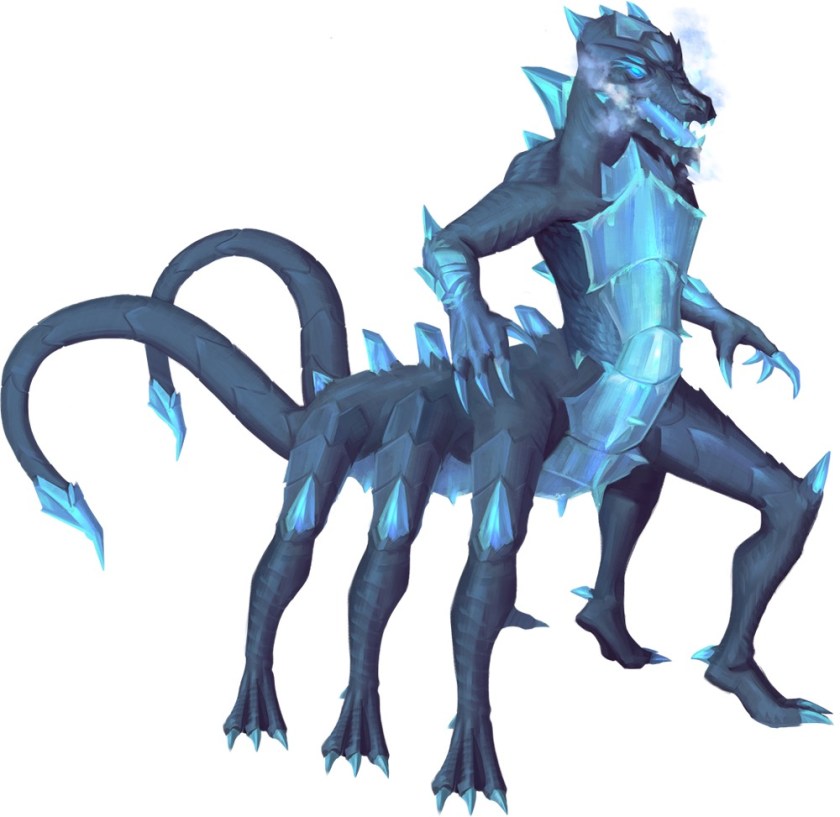
Glaciomonitor - Illustration by William Marton
Glaciomonitor, illustrated by William Martin. Art courtesy of Paizo Inc.

Thanks for joining us today! Be sure to tune it again soon to check out our reviews on the newest Pathfinder Society Scenarios!

See you in the Drift!

Jessica

Wilderness Origins

Wilderness OriginsReady to get wild?

Today we’re taking a peek between the covers of Pathfinder Player Companion: Wilderness Origins! If you’ve been reading d20diaries since its beginning you’ll know that my family and I adore Ultimate Wilderness. My kids love the races introduced — particularly the adorable vine leshys — and my entire family enjoys the shifter class. In fact, each of us have at least two shifters. Needless to say we were excited to get our hands on Wilderness Origins. My husband was hoping for more shifter options, my kids were hoping for more vine leshy options, and I was… Well, I was just hoping someone in my family would find something inside the book that they’d make use of right away.

We were not disappointed.

Pathfinder Player Companion: Wilderness Origins is a soft cover book that is 32 pages in length. As a book in the Player Companion line, it’s aimed at players, which means that you won’t find a ton of world lore or secrets inside. You’ll find archetypes, feats, traits, spells, and more! Wilderness Origins features amazing cover art by David Alvarez, which showcases the iconic shifter, Zova,  engaged in battle against an earth elemental.
Wilderness Origins - Plant Journal
The inside front over of Wilderness Origins.

The front inside cover features brief information on a few plants described in the book alongside some sketches. The entire page is presented as if they were entries in a scholar’s journal, which is a nice touch. Although no important information is contained here that can’t be found later in the book, it’s nicely showcased. Plants depicted include ambrosial lotus, cleanthistle, ghostblossom, and a ghoran seed. There’s also art of a gathlain’s wing and a leaf leshy.

After this is the table of contents, the rules index, and the introduction which contains eight new regional traits themed around different terrains. Each trait is printed alongside an example background for each terrain, that emphasize how you can embrace nature and your environment. Guerilla tactics and surefooted ascent are sure to be popular, but fruit merchant and strong stomach turned out to be my favourites. Environments covered by these traits include the desert, road, forest, jungle, mountain, swamp, tundra, and coast.

Moving on from the introduction we come to six pages of new shifter options. It features a whopping nine new shifter aspects, all of which are pretty cool. The new shifter aspects are boar, crocodile, dolphin, dragonfly, electric eel, mantis, octopus, scorpion, and spider. Electric eel is my favourite, but my son LOVES the boar aspect. He immediately made a gnomish boar shifter for Pathfinder Society Organized Play and was super excited to give it a shot. Unfortunately, we suffered a TPK that weekend and poor Sid’s career was cut short. Still, my son loved the character and made a ton of use out of the boar’s minor aspect, which gives you diehard as a bonus feat.

Wilderness Origins - Feyform Shifter
A half-orc feyform shifter from Wilderness Origins.

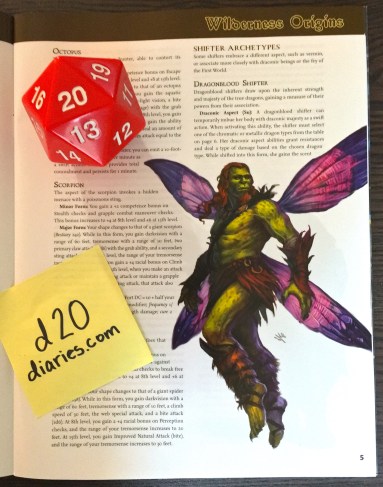
After the shifter aspects are three new archetypes, dragonblood shifter, feyform shifter, and swarm shifter. They’re all pretty self-explanatory, with the dragonblood shifter allowing  you to take on the aspects and forms of a variety of dragons, feyform shifter granting you some tricky defences and the ability to transform into fey beings, and swarm shifter allowing you to turn into a swarm of bugs. They’re all really cool, but dragonblood shifter turned out to be my favourite. My husband’s a big fan of the swarm shifter, though, and he’s not going to be the only one. It’s a really useful archetype which is sure to see a lot of play.

Also in the shifter chapter are thirteen new favoured class options, seven new feats (be sure to check out chimeric aspect, greater weapon shift, and raking claws), and my favourite new option for shifters: alternate natural attacks. Each shifter aspect currently released (new and old) has a list of alternate attack forms they can select in place of claw attacks. Bears have a bite attack, for example, while boars have a gore and a hoof. Any time you activate your shifter claws you can choose to take an alternate natural attack from your animal aspect options in place of one of your claw attacks. This changes the damage type and the way your natural attacks look, but otherwise functions as the shifter’s regular claw attacks. It’s a really nice option I’m happy to see available.

Up next are two pages on each of the races introduced in Ultimate Wilderness — gathlain, ghoran, and vine leshy. The new gathlain options include five alternate race traits (arboreal vitality, fey resilience, and whimsical outlook are my favourites), seven new feats (mighty boughs and strength of wood are my favourites), and one new archetype. Sworn of the Eldest is a Charisma-based inquisitor archetype that I really enjoyed. Particularly the magic of the Eldest ability, which swaps out teamwork feats for some extra spells and spells per day.

Ghoran options include four alternate race traits (check out intoxicating aroma and magical absorption), three feats (I love spell mirror), two new spells (pinecone bomb and woodland rune), and the new ninja archetype petal ninja, which lets you transform into a cloud of flower petals.

Wilderness Origins - Leshy - Nathanael James
Vine leshy verdivant. Illustration by Nathanael James. Art courtesy of Paizo Inc.

Vine Leshy options include four alternate race traits (lashvine and writhing eye are awesome!), four new feats (we like bounteous body best), and the cavalier archetype verdivant. This turned out to be both my kids’ favourite archetype — which came as no surprise since they both love vine leshys. The verdivant archetype lets you to have a plant mount, and enables you create effloresces, which are explosive plant growths that can be used a number of times per day and have some cool effects. While one might form a wall of vines to prevent attacks of opportunity, others can make you walk on air, or even give you and your allies fast healing. Effloresce replaces the cavalier’s banner and tactician abilities.

Up next in Wilderness Origins are two pages themed around flowers. It starts by introducing four new magical plants, ambrosial lotus, cleanthistle, ghostblossom, and gravebane petals. All four are surprisingly useful, but I think I like the cleanthistle best. It’s a great plant to add into my family game of Iron Gods. There’s also five awesome new witch hexes. I honestly had a hard time picking my favourite. My daughter loves leshy summoning, my son loves verdant familiar, and heralding bloom is going to be really useful for some characters. In the end its the floating lotus and iceplant hexes I’m most likely to use. Floating lotus conjures a flower that you can stand on to walk over water or gain a bonus on jump checks while Iceplant makes the witch and her familiar’s flesh harden, granting them a natural armour bonus and and the effects of endure elements. Finally, there’s a new alchemist archetype in this section: perfumer. This alchemist creates atomized perfumes in place of potions, an can distill pheromones that augment your Charisma, diplomacy, and bluff checks in place of mutagens. Very cool!

The next two pages are entitled Wardens of the Wild and involve kami. There’s a new kami eidolon subtype for unchained summoners, ward aspects for hunters to make use of, and the new spiritualist archetype ward spiritualist. This archetype allows a spiritualist to purposesly seek out a kami to bond with, and grants them a ward implement which can either be an object or their own body. With their ward implement they can gain occultist focus powers. They can also merge their kami with their implement to empower their implement in battle. I’m a huge fan of both spiritualists and occultists, so I’m totally biased to love this archetype. Haha.

Wilderness Origins - Scorpion - Beatrice Pelagatti
Scorpion familiar. Illustration by Beatrice Pelagatti. Art courtesy of Paizo Inc.

The next four pages are packed full of options for our animalistic pals — animal companions, familiars, and mounts. It starts with two animal companion archetypes: apex species (which gives your companion benefits in certain terrains) and unexpected intellectual (which makes a vermin companion more intelligent). Then there’s three familiar archetypes: occult messenger, the super creepy parasite, and arcane amplifier (my personal favourite) which grants your familiar the ability to use some metamagic feats on touch spells they deliver. Following these are seven feats which can be taken by animal companions, familiars, and their owners. Three are relevant to familiars, three to animal companions, and one is relevant to both. I really like the animal companion feats curious companion and friendly face, but it was two familiar feats that turned out to be my favourite. Changeling familiar gives any familiar capable of changing shape the ability to transform into a child or teenager of their master’s race, while spark of the uncanny gives your familiar the ability to speak. Awesome! (My kids are absurdly excited for this one!) A few levels later you can swap it out for improved familiar. Next up are descriptions of five breeds of mounts along with a trait for each of them (these traits count towards their master’s total number of traits). Finally, there’s an expanded companion list for cavaliers paladins, and rangers.

The following two pages talk about the totem spirits of the Shoanti, with nine new totem rage powers geared at members of the Lyrune-Quah (moon clan), Shundar-Quah (spire clan), and any ancestor-revering character. There’s also a new shaman spirit, tribe.

Wilderness Magic is up next, with five new arcanist exploits, three disaster themed spells, and the psychic archetype Magaambyan telepath, which blends druidic magic and wilderness themed powers with the psychic. Wild stride and wooden flesh are my favourite arcanist exploits, while flash flood — a sixth level spell on the druid, shaman, and sorcerer/wizard spell list — is my favourite spell.

Wilderness Origins - Fire Steed
The iconic kineticist Yoon riding a fire steed.

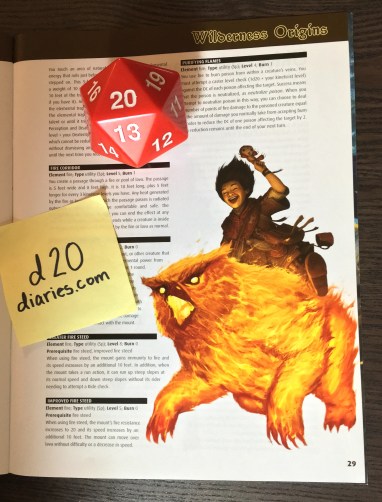
Similar to magic, the following two pages are all about elemental power — specifically fire. First up is the flame steed spell, which conjures a mount made of fire. Continuing this theme is a new archetype, the cinderlands adept, a fire-based kineticist that gains a loyal mount and is based on the Burn Riders of the Sklar-Quah (sun clan). Finally, there are eight new kineticist talents — one form infusion (elemental trap) and seven utility talents. My favourites included fire corridor and the fire steed tree. I’m a huge fan of both the Shoanti and kineticists, so I was pleasantly surprised to discover these new options.

By now there’s only a few pages left. Two pages of character options themed around the sea and sky. It starts with two more archetypes — a very interesting paladin archetype called champion of the cascade and esoteric starseeker, a psychic archetype based around Golarion’s constellations. Following this are two very cool (and disconcerting) oracle curses that have to do with decay: putrid and scourge. Finally, there’s three new ki powers: floating breath, racing current, and zephyr blow.

And that’s it! The end of Pathfinder Player Companion: Wilderness Origins! My whole family loves this player companion. It contains a lot of fun options for all our favourite parts of Ultimate Wilderness — shifters, gathlain, ghoran, and vine leshys — and pays some loving attention to the many different pets you can acquire. It’s rare that we get to make in-game use of a d20 book right after reading it, but this one immediately inspired us to create something new. It was well worth the investment for my family.

Thanks for joining us today! I hope you enjoyed taking a peek behind the covers of Wilderness Origins.

Until next time,

Jessica


Mantisbane Pact: Release

One of the play-by-post campaigns I am lucky enough to take part in is run by the wonderful GM Zek on Paizo’s messageboards. The campaign is called the Mantisbane Pact, and it takes place in Golarion, the world of Pathfinder. Mantisbane Pact involves an alliance of powerful monarchs and rightful rulers who come together to destroy the Red Mantis Assassins and their god, Achaekek. Our players would act as their agents, travel to Ilizmagorti (a city firmly in the grasp of the Red Mantis Assassins), and work to bring the entire organization crumbling down.

A few weeks ago I shared a short story I wrote as part of the application process to get to play in the Mantisbane Pact. In it we met my character, a smart-ass, jaded slayer named Kilarra Calvennis. Throughout the course of this campaign the GM and players have had the opportunity to write a variety other vignettes and flashbacks, often from the perspective of our shaman, who can view moments from the past by using the Akashic Record.

Today I’m sharing with you a flashback from Kilarra’s life I wrote when our shaman (Talia) attempted to discover why Kilarra was out of prison, despite being sentenced to life in jail for patricide. After today it will be available on the d20 Stories section on our website. Enjoy!

Jessica


Release

Its dark.

Cold.

Talia feels like she’s laying on something hard and rough. A stone floor?

There’s sounds. Women crying, wailing voices, a distant scream of pain. Breathing close by — Kilarra perhaps — it’s hard to tell in the dark.

Time passes. There’s the sound of something falling to the ground and tumbling around. It sounds like a dice, but it’s likely a stone. There’s a bit of a slapping sound, then a scraping, as if whoever dropped it was picking it back up.

It falls again. Slap. Scrape. Silence.

It falls again. Slap. Scrape. Silence.

In the distance the crying continues. Different voices, the same sounds. A sigh, a scream, denials, and tears.

“Please! I’m innocent!” someone can be heard to call above the din. A young woman by the sounds of it. “I didn’t kill him!”

Nearby someone scoffs. Talia recognizes it as Kilarra. “No one cares,” she mutters under her breath.

“Yeah, I’m innocent, too!” a different voice calls out. It’s deeper, and clearly mocking the crying woman. “I didn’t kill nobody!” The voice breaks out into a cackling laugh.

The young woman devolves into sobs.

The stone falls. Slap. Scrape. Silence.

Eventually something changes. There’s a lightening of the room. It’s subtle at first, but soon becomes light enough to see vague shapes.

Kilarra’s pale and thin. Her lip is cut and swollen, and a poorly healing wound on her face is clearly going to become the familiar scar she bears to this day. Kilarra lays on her back in a bare, stone cell, staring up at the ceiling. She fiddles with a tiny dice in her fingers, dropping it on the floor, covering it, and picking it back up again. Her other fingers tug on the hem of her ‘dress.’ She wears a filthy sack with a few holes cut in it for her arms and head that looks like it once held potatoes. The fabric’s rough and little bugs scurry around amongst it’s loose fibres.

Behind her is a wall of bars. Outside there are other cells, filled with women of varying ages. Some cry, some speak to themselves, but most sit in resigned silence. The other woman across the hall wears pants and a shirt, has a pallet of hay, a blanket, and a chamber pot — luxuries Kilarra’s cell does not possess.

The world continues to brighten. The walls turn red and the flickering of an open flame can be heard. The light suddenly spills into Kilarra’s cell, and stops.

From her place on the floor Kilarra raises an eyebrow. She rolls onto her stomach, pushes herself up to standing and stalks over to the bars. She grabs hold of them, her knuckles bloody and bruised, and leans her face up against the bars.

Outside her cell is a man in shining armour. He holds a torch in one hand, and a bag in the other. Kilarra’s eyes drift to his belt where she sees a keyring and an empty scabbard — the sword is nowhere to be seen. She smirks, apparently finding that funny.

As Kilarra grabs hold of the bars the guard — a young man, really — steps back quickly. He’s jumpy and nervous.

“You forgot your sword, kid,” Kilarra remarks with a curled lip. “Better go get it before the warden finds out. Don’t worry, I’ll wait. I’ve got nowhere else to be.”

The man shifts uncomfortably, then straightens himself. “It’s not lost. I — “

Kilarra chuckles then nods at the package. “You bring me a gift?”

The young guard clears his throat. “Step back,” he orders.

Kilarra smirks and takes a few steps back. She leans against a nearby wall and crosses her arms. The man steps closer, pauses, and looks at her, then quickly shoves the bag between the bars and steps back.

“You finally returning my chamber pot?” she asks.

“What? No, its…”

As the guard stutters Kilarra opens the bag and pulls out a blouse. She scoffs in disgust and shoves it back in the bag. “What’s the matter? Warden tire of his other whores?” She tosses the bag on the floor. “Tell him I bite. Hard.”

The fresh-faced guard looks confused for a moment, either unsure what Kilarra’s talking about or unsure why she’s angry. “No, it’s… You’re free.”

Kilarra scoffs aloud. “Free. Seriously?” She scoffs again and shakes her head.

The man nods. “By order of the Warden, you’re to be set free.”

“Why?” she asks skeptically.

“Good behaviour.”

Kilarra bursts out laughing.

The guard shifts uncomfortably. “Could you… put on your clothes? You can’t go outside like that. It’s unseemly.”

Kilarra’s laughter fades to silence. She watches the guard for a moment, wary and on edge. Eventually she takes off the rough sack and tosses it to the ground, then empties the bag out and starts getting dressed. There’s a blouse, pants, boots — familiar looking clothes Talia’s seen Kilarra wear every day.

The guard blushes and turns around, giving her privacy — an act which causes her to let out another cackling laugh.

“This place is going to eat you alive, kid.” She laughs some more, then approaches the bars. “Ready.”

The guard unlocks the cell. “Follow me.”

Taldor
The flag of Taldor. Image courtesy of Paizo Inc.

Kilarra slips out behind him, following the guard down the hall. His torch illuminates the cells they pass — some of which are as spartan as Kilarra’s, but most of which have hay, pallets, chairs, simple beds, blankets, one even has a flickering candle and a pile of books. The prisoners are all female of varying ages, some cry, some beg, but most simply watch with tired, hopeless eyes. A few of the prisoners give Kilarra a nod as she goes. A few others step back in fear.

At the end of the hall is a pair of barred doors flanked by armoured guards. Above them is a massive painting of Grand Prince Stavian the third. Words underneath it read: A crime against the empire is a crime against yourself. Repent, Obey, Serve.

Unlike the guard walking with Kilarra, these men are hardened and unafraid. They each draw their swords at her approach. One sports a broken nose and a missing front tooth. He snarls at the sight of her.

She smirks. “Love the new look.”

“Listen up, you bit—“

Kilarra’s laughter drowns out the man’s words as the young guard quickly unlocks the door and ushers Kilarra through it.

They travel through more corridors and gates, up stairs and through a few checkpoints. Wherever Kilarra was being held, it was a long ways underground. The sort of place where the prisoners are never expected to leave alive.

As they travel the halls get lighter, and the torch is left behind. Kilarra squints into the dim light as if she were looking into the sun. In time they reach a large room. One final gate blocks the way to the prison’s main hall. One final gate to freedom.

A rotund man wearing nobleman’s finery and a deep sneer scowls at her. “I don’t know what strings you’ve pulled, but it won’t last.”

Kilarra smirks. “Hello, Warden. Fancy seeing you here.”

“You’re a degenerate!” the man spits. “You may be free now, but you’ll be back. Scum like you always comes back.”

“Aww,” she replies with a sarcastic pout. “I’ll miss you too.”

The warden stands seething in front of the gate. He takes a deep breath, nods at the guards, and clenches his fists. As the guards unlock the doors he speaks in a grand voice. “Kilarra Calvennis. In the name of Grand Prince Stavian the third, long may he rule, you are hereby released for… good behaviour…” he spits at Kilarra’s feet then straightens himself. He waves his arms through the air, clearly deciding she’s not worth reciting the rest of the words. “I hereby release you. Now go, before I arrest you for loitering.”

Kilarra strides out of the gate, hurries through the waiting room and bursts out of the doors onto the busy streets of Oparra. She squints into the sun and takes a deep breath. Slowly, a smile spread across her scarred face.

“Kilarra Calvennis?” a voice calls out.

Blinded by the sun, Kilarra’s smile slips. A fleeting look of panic crosses her face. A moment later it’s replaced by a look of determination.

“Who wants to know?” she calls back.

But before the voice can reply the vision blurs and fades, leaving Talia back in her own body.


Want to read more about Kilarra? Be on the look out for more vignettes and flashbacks in the coming weeks!

Want to learn more about Golarion, Taldor, Grand Prince Stavian III, Kyonin, Ilizmagorti, Mediogalti, and the Red Mantis Assassins? Check out Pathfinder Campaign Setting: The Inner Sea and explore Golarion for yourself! For more information on Taldor you can also check out Pathfinder Companion: Taldor, Echoes Of GloryPathfinder Campaign Setting: Taldor, The First Empire, or play the War for the Crown Adventure Path which begins with Pathfinder Adventure Path 127: Crownfall (War for the Crown 1 of 6).

Dungeon Mayhem

My kids love games of all kinds. Not surprising, I know. Most kids love games of one kind or another. But mine REALLY love games. This year for their birthdays they decided that they have enough toys. What they wanted was some new board games.

“But, awesome board games, Mom. Really good ones.”

So they did some research, made lists, did some more research, discovered a love of Dice Tower, and revised their lists until they each had a (much too long) list of board games they wanted. Although our birthday celebrations aren’t over yet, they’ve both had a few parties with family and were thrilled to find they got some new games. Most of what they asked for are large, complex games. But a few are short, easy to learn card games. You can expect to see a lot of board game reviews in the coming weeks, but today we’re starting short and sweet, with Dungeon Mayhem!

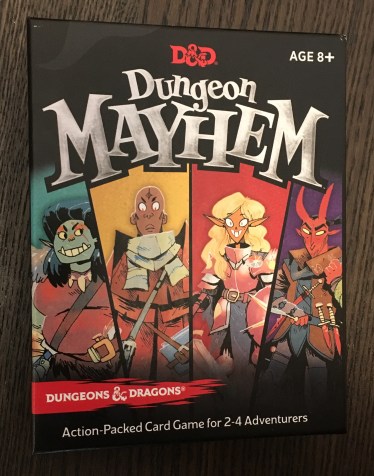
Dungeon Mayhem

Dungeon Mayhem is a Dungeons & Dragons card game for 2 to 4 players. Games are short and fast-paced, with a round averaging about five minutes. It’s a small, portable game, with the rectangular box about the size of my hand. It’s the perfect size to bring with you on the go or play in compact spaces. We bring it to the laundromat, for example. Intended for ages eight and up Dungeon Mayhem lets players take on the role of an iconic hero and battle it out.
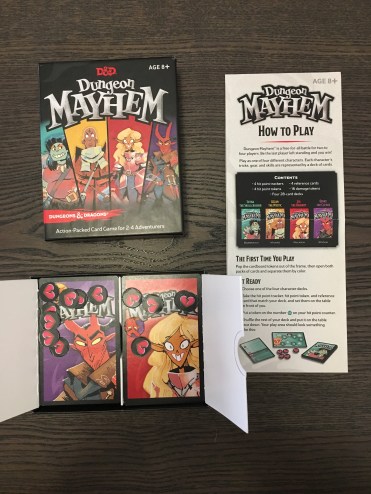
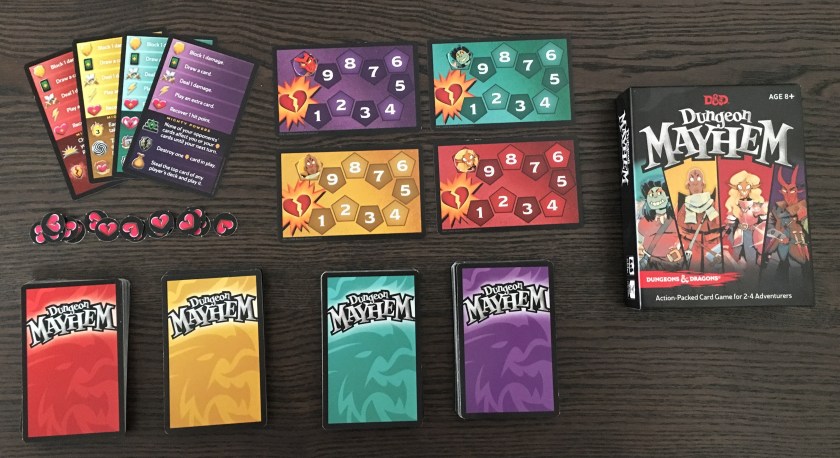
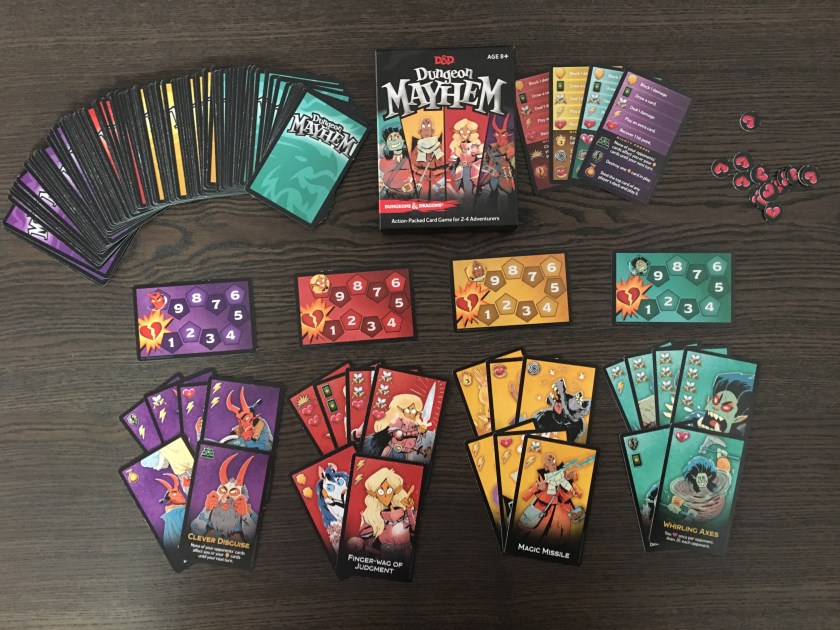
The game is super easy to learn and surprisingly fun to play. First, you choose a character. Each comes with their own unique deck of cards, hit point card and tracker, and a reference card. Youngest player goes first and play continues clockwise. You start with three cards in your hand. On your turn you draw a card and play a card. You start with 10 hp and when you reach 0 hp you’re out of the game. Last adventurer standing wins.

Contents 2
Box contents!

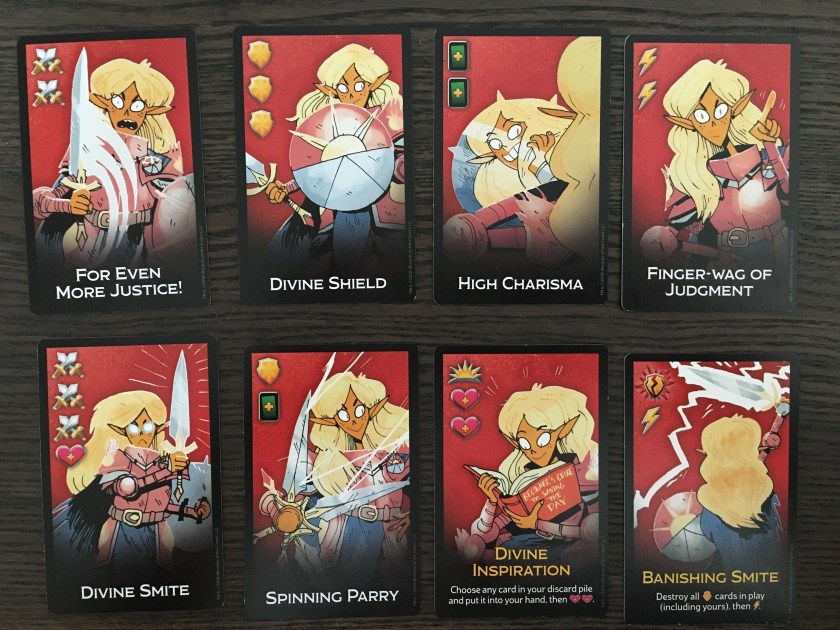
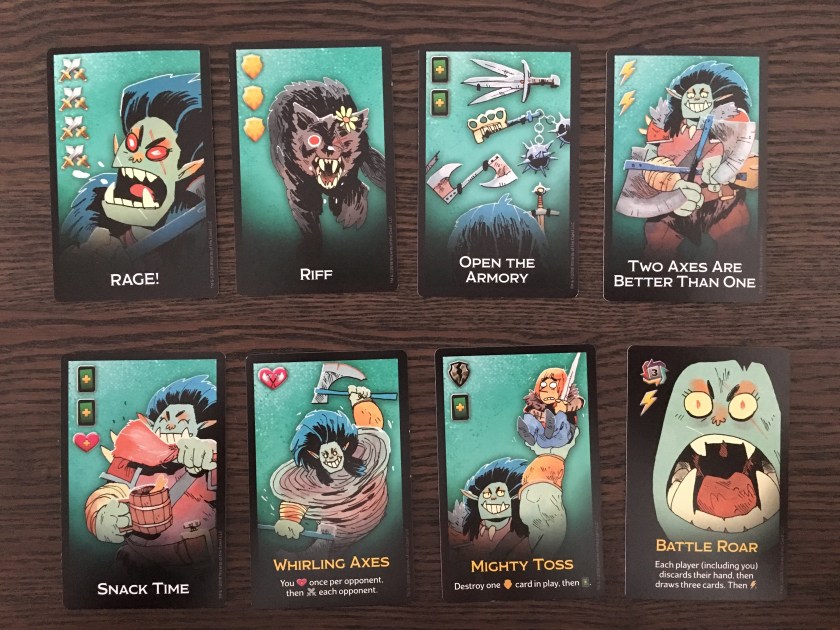
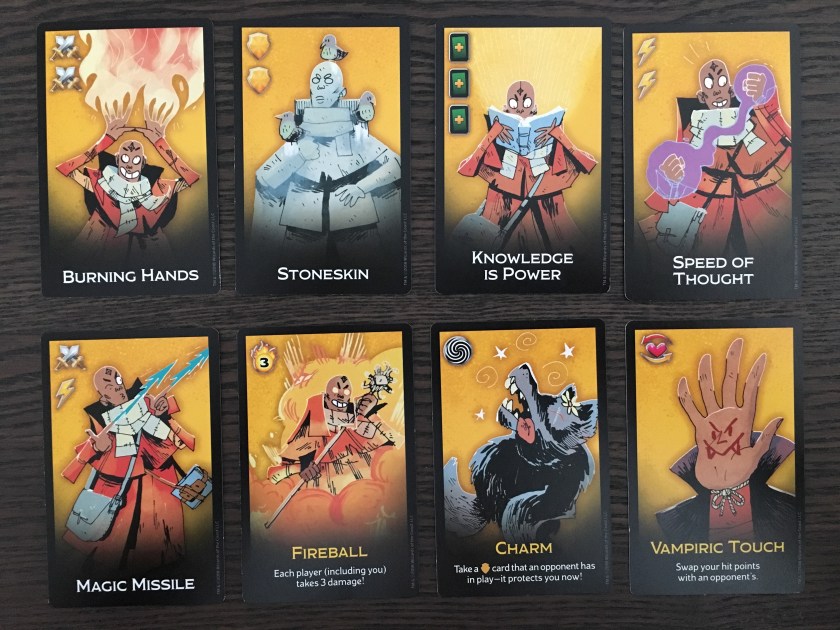
There are four heroes to choose from: Sutha the Skullcrusher (a female half-orc barbarian), Azzan the mystic (a male human wizard), Lia the Radiant (a female elf paladin), and Oriax the Clever (a male tiefling rogue). Each adventurer has their own deck that plays differently, but with the same basic mechanics so it’s easy to pick up any one and just play. Each card features illustrations by Kyle Ferrin showcasing the different characters in a fun-loving, cartoony style. Many cards have clever, entertaining, or familiar names. The cards each have a variety of symbols on them which tell you what each card does. The symbols are all easy to understand and, if you ever forget what they do, each character has their own unique reference card to remind you.

There are five symbols that appear in every character’s deck. A swords deals one damage to an opponent, a shield blocks one damage dealt to you, a heart heals one hp, a card lets you draw one card, and a lightning bolt lets you play one extra card. Although some cards in the decks contain a single symbol on them, most have a combination or two or three symbols. These symbols appear in different combinations and quantities throughout the decks, making each one different. The paladin’s deck has a lot of healing, for example, while the rogue’s lets you play a lot of cards, and the barbarian is the only character who can do four damage at once to a single enemy. In addition, each deck has a few unique symbols and cards. Sutha the Skullcrusher can deal one damage to each enemy and then gain that much hp with her Whirling Frenzy while the wizard Azzan can swap life totals with another player by playing Vampiric Touch.

Contents

There’s a few other rules to the game, but not many. Typically when you play a card it gets discarded, but if you play a shield card it instead is placed on the table in front of you. For each damage it prevents it gets a damage counter, and when it’s been completely destroyed the shield card is removed from play and placed in the discard pile. If you happen to use up all the cards in your hand (you’ll need lightning bolt cards to do this, which let you play an extra card on your turn) you can draw two additional cards. And if your deck ever runs out you simply reshuffle it and keep playing.

Pretty simple!

While playing we found that this game was super simple to learn, teach, and understand. You get the hang of it quick, and games are fast and exciting. Since you’re battling each other there’s definitely a ‘take that’ feel to this game. Some rounds you’ll feel picked on if you get defeated quick, but others are more balanced. It just depends on the strategies of your opponents at the time. My kids often decided the best strategy was to kill me and then duke it out themselves, so I was brutally ganged up on a lot. Haha. They quickly realized this was a poor strategy when my husband also joined play, as he often teamed up with me so that he didn’t have to combat a pair of allied kids on his own. (How the tables have turned!) My daughter is an expert at the old ‘kick them when they’re down’ strategy, very often dealing ruthless finishing blows against whoever happens to be doing the worst. …Even if it might be against her brother who she was supposedly allied with. Clever girl. Haha.

The decks are fun, varied, and balanced. No one deck it better than the other, they’re just different. Although it’s not immediately apparent what the differences are between the decks it becomes clear pretty quick. Lia, the paladin, deals a lot of damage and heals a lot of her own wounds. Her special abilities include Divine Inspiration, which lets her put any card from her discard pile into her hand and then heal two hp and Banishing Smite which destroys all shield cards in play and then lets her play an additional card. This was my daughter’s favourite deck, and my second favourite deck. While my daughter prefers Divine Smite and her beloved steed Fluffy, I’m a big fan of the Finger-wag of Judgement and Divine Inspiration. This deck is tough to take down and enjoyable to play.

Paladin
Some of the paladin’s cards.

While my daughter and I loved the paladin, my son and I both decided the rogue, Oriax, was out favourite deck. Packed full of cards that let you take extra actions, this deck often lets you play more cards than your opponents. It’s also got some enjoyable tricks, particularly with Clever Disguise, a card that prevents you from being targeted by any cards until the start of your next turn. It’s particularly great for forcing your allies to duke it out at the start of the game, which is likely to result in them retaliating against each other in subsequent rounds. A nice little start! We also really like using Pick Pocket to play a card from someone else’s deck. Need healing? Grab a card from the paladin. Want to wreck your opponent? Snag a card from the barbarian. Want to get a nice full hand or play something tricky? Take a card from the wizard. Sure, it won’t always be what you were hoping for, but I’ve never seen it not be useful. One downside to the rogue is that he only has one way to heal himself: Stolen Potion. Although it lets you heal one hp and play another card (which is great) it does mean that when you’re low on health it’s hard to save yourself. One hp once in a while doesn’t do much. I also love Sneak Attack. It’s art and theme bring a smile to my face every time. Haha.

Thief
Some of the rogue’s cards.

It should come as no surprise that the barbarian’s deck deals a lot of damage. In fact, they have the only card in the game that can do four damage against one enemy (Rage). They also have the awesome Whirling Axes, which we mentioned earlier. What might be surprising is how balanced it is. It’s got some solid shield cards (my daughter loves the dogs Riff and Raff), ways to draw cards (Open the Armory and Snack Time), ways to heal (Snack Time and Whirling Axes) and ways to destroy a shield with one card (Mighty Toss). Although none of us named this deck as our favourites, it also turned out to be the most played deck and both my son and husband’s second favourite decks. Sutha is a fearsome foe!

Barbarian
Some of the barbarian’s cards.

Which leaves us with the wizard. At first glance, Azzan’s deck is the most balanced. He can do everything well, but doesn’t have the most of anything either. Burning Hands and Lightning Bolt are some of his most reliable damage dealing cards. Magic Missile is my favourite, as it lets you deal one damage and play an extra card. Stoneskin and Mirror Image are great shield cards. Knowledge is Power gets him a lot of extra cards while Speed of Thought helps him play those cards fast. His one downside is a lack of healing cards. Eventually we came to realize he does have the most of something very important: TRICKS. His three unique cards include Vampiric Touch, which we already mentioned. This card lets him swap hp totals with another player — which can be game changing. Charm lets him take someone else’s shield card that’s on the table and use as his own — also awesome. And Fireball deals three damage to every player (including himself). My daughter’s prone to hoarding fireballs, using Charm to steal someone else’s defences, and then blasting a bunch of fireballs to kill everyone at once while she hits behind her stolen shields. Cheeky thing. Haha. Although Azzan’s deck is just as easy to use as everyone else’s, it’s also the deck that is most rewarding when played with some forethought.

Wizard
Some of the wizard’s cards.

We really enjoyed Dungeon Mayhem. It’s not a complex, tactical game like some of our others, but it’s a fun, quick, romp you can bring with you anywhere. We hope they come out with an expansion that contains another two or four decks. It’d be great to have more deck choices and play with more than four players. Happily, this deck was quite affordable. Our copy was only $18 Canadian. Well worth the money.

Jessica

Dungeon Mayhem Contents
Some of our favourite cards for each deck.


Adventures at RetroCon!

My family and I don’t often have the chance to attend conventions. We don’t usually get to play Pathfinder Society or Starfinder Society games in person. We play a lot via play-by-post (which is a ton of fun) and we play a lot in small family groups. But to actually play in a public venue? That’s a new experience for us.

So, when we discovered that there would be a convention just down the road from our home how could we say no?

I wasn’t sure my kids would behave. Would they remain focused in a noisy room? Would they sit still long enough to get a whole game in? My son’s a fidgeter, and he fiddles with everything, so I was more than a little skeptical. Would we drive our poor GM bonkers?

Most likely.

But, my kids wanted to go, and my husband wanted to go, and of course I wanted to go. So we went.

In the week leading up to RetroCon we decided to make new characters. We have plenty of PFS characters to choose from but my kids wanted to make some that actually matched the minis we own. My son picked out a snazzy little halfling mini and rolled up a gnome shifter to match it — with the new boar options from Wilderness Origins (more on Wilderness Origins in an upcoming blog post!). My daughter chose one of the only minis she personally owns and created a hunter (her first one!). Determined to make use of an adorable little badger mini she owns she selected one as her animal companion. Yes, you read that right. She finally made something that does not involve a rabbit! GASP! My husband made a dwarven warpriest of Cayden Cailean with a mini we picked up from the flea market this past summer. And I was determined to use of one of my painted minis — which means there aren’t many options! Haha. I’ve only painted minis once and, although I had intended to use the four minis I painted right away, none of them ever saw use. I hummed and hawed a bit until I picked up my wealthy looking noblewoman mini and I created an over-enthusiastic librarian who has spent her life reading about the world and was thrilled to finally go out and experience it.

RetroCon Team

We spent the morning packing and double checking our game time. My kids were practically bouncing off the walls in excitement (which is both a good and bad sign! Haha!). It’s a quick walk down the road, but the sidewalks are an icy, rough mess, so that slowed things down a bit. Luckily no one took a spill or got soaked. We had more than enough time to get settled and say some hellos before our GM arrived and the game got started.

Our GM was really great. He had my kids laughing a lot and was super patient. My kids weren’t the most attentive players, my son kept fixating on off-mission activities, and my son made some of the worst tactical decisions of his short PFS career. We probably drove the GM crazy. Haha. Anyway, my kids had a ton of fun. People were saved, villains were defeated, fish were thrown around, my daughter uttered the battle cry ‘nibble nibble,’ and my arcanist finally left the library.

And then we died.

Yup! Total party kill in the final fight. My kids were both in tears.

My son cheered up a bit when he won a special boon — he’s pretty sure he’s going to apply it to Fuzzzy (his forgetful wizard). My daughter didn’t win anything, but someone was walking around handing out bee folders which she assumed was a prize and happily  claimed. She seriously loves this folder. She’s been cooing over it all evening.

By the time we were packed up and on our way home both of my kids decided that — despite having to suffer through their first character death, first PFS character death, and first TPK all in the same afternoon — they had fun. By the time they got home they were already discussing their next characters and when we would get to play next. (I guess we’ll be attending another Game Day in the future). It turned out to be a good first convention for them — tears and all.

Jessica

Near death
We had a good start. The final boss went down quick! Unfortunately, his undead minion did not. A few rounds later and it was the only one still standing.